
ABC Studio Grounds a Socio-Educational Center in Metz's Borny District with Meadow and Mesh
A 2,000 m² community center rises from wild grasses to stitch together a 1960s housing estate remaking itself in Metz, France.


Borny is not the part of Metz that appears on postcards. Built in the 1960s under architect Jean Dubuisson as part of France's postwar suburban expansion program, it is a landscape of tall housing towers and linear slab blocks, many of which have since been demolished, leaving awkward voids in a grid that was never especially generous to begin with. Into one of those voids, ABC Studio has inserted a new socio-educational center that tries something difficult: to be both civic infrastructure and landscape repair at the same time.
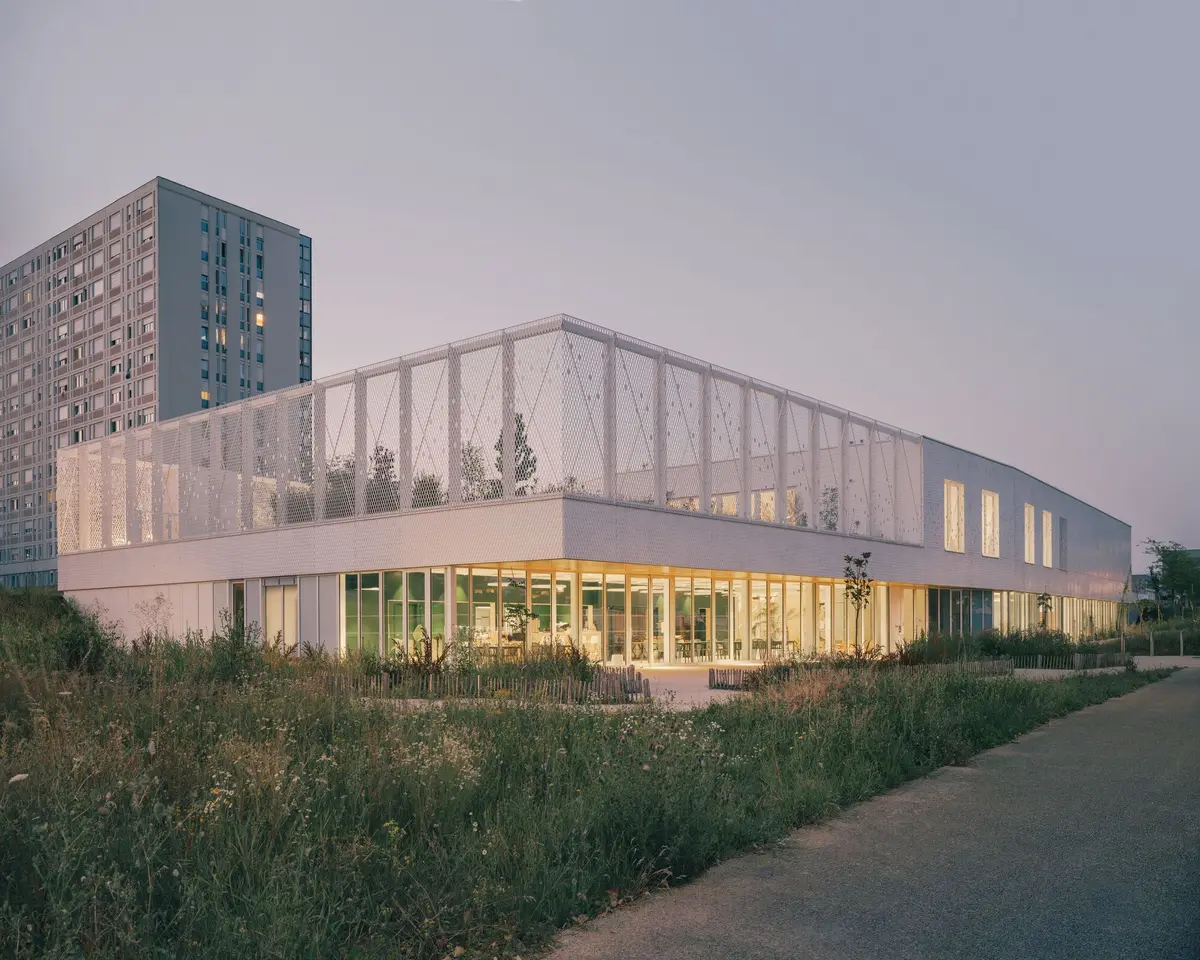
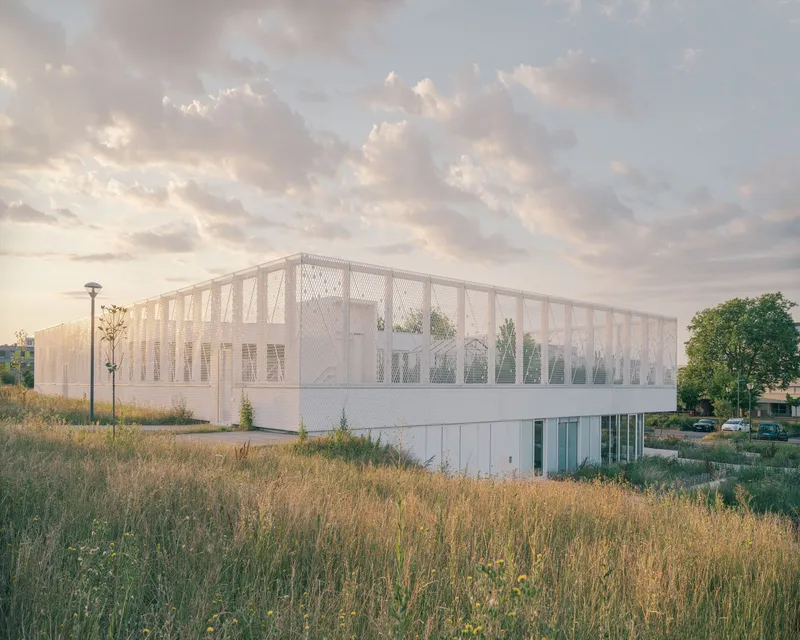
What makes the project compelling is its refusal to announce itself as a monument. The building sits low, partially embedded in the sloped terrain, wrapped in expanded metal mesh and crowned by a planted green roof that merges with beds of tall grasses at grade. From certain angles it nearly disappears behind its own wildflower meadow, which is a deliberate provocation in a neighborhood defined by hard concrete verticals. The 2,000 m² center, delivered in July 2025 at a cost of nearly €10 million, packs a dense community program (restaurant, association meeting rooms, early childhood spaces, therapy rooms, a parent-child welcome center) into a form that reads more as topography than architecture.
A Building That Acts Like Ground
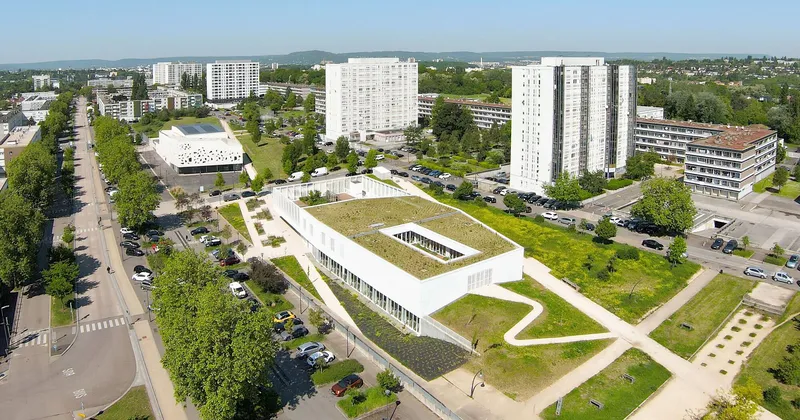
The site sits at the intersection of Boulevard d'Alsace and rue du Vermandois, and ABC Studio's first move was to pull the volume back from that corner to open a large public plaza that connects to the adjacent BAM cultural facility. The building's simple rectangular footprint, visible clearly from the air, is angled to define two pedestrian axes around its perimeter, preserving existing foot traffic patterns rather than cutting them off. This is urban design as common sense, though common sense is remarkably uncommon in social housing districts.
The green roof, visible in the aerial view as a generous planted courtyard, does double duty. It provides environmental performance (the project holds HQE certification and meets RT-2012 thermal standards), and it gives the surrounding residential towers something other than another hard surface to look down upon. For residents in those upper floors, the center registers as a garden, not a building.
Mesh as Mediator
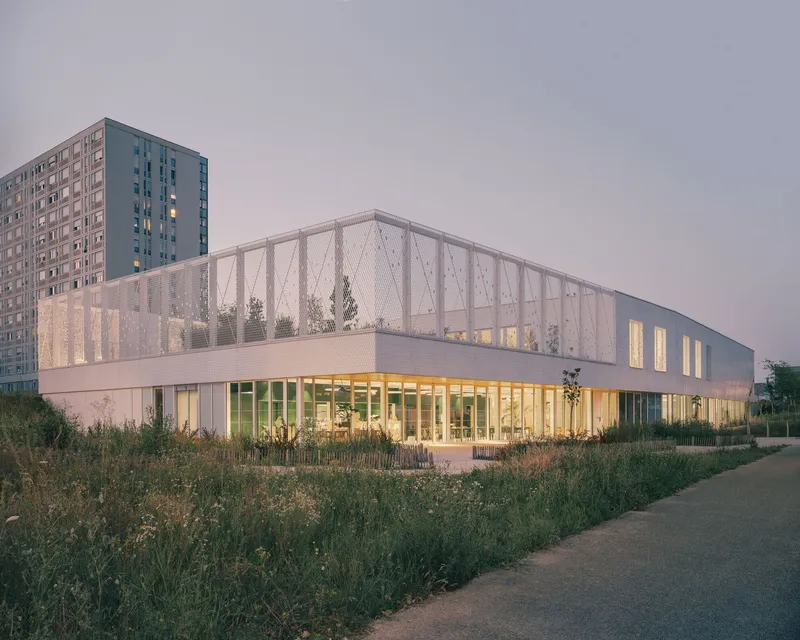
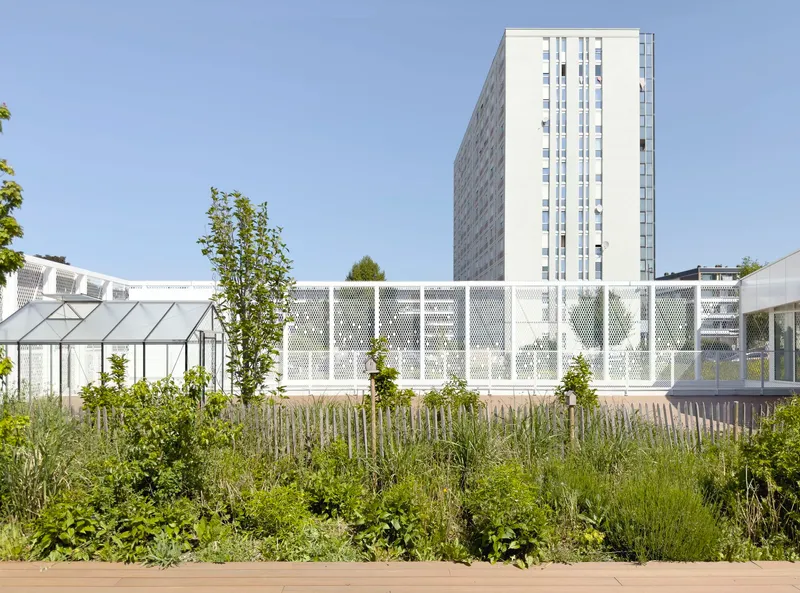
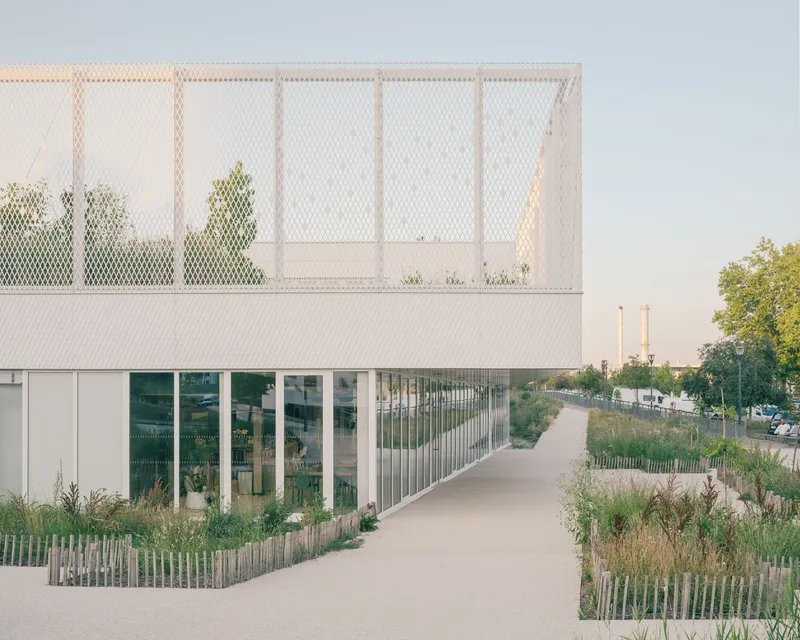
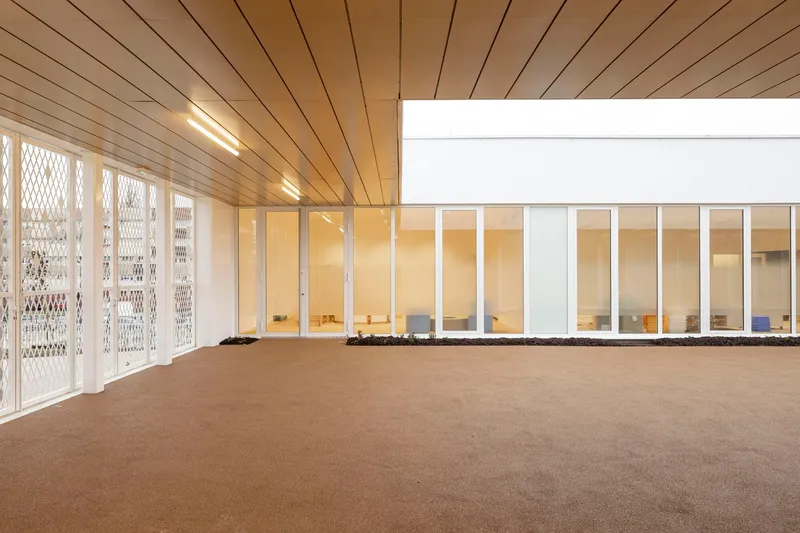
The expanded metal mesh that wraps the upper floor is the project's most visible architectural gesture, and it works harder than it looks. At dusk, the perforated screen catches ambient light and gives the building a warm, lantern-like glow against the surrounding towers. During the day, it acts as a solar screen for the more intimate upper-floor programs (early childhood rooms, quiet spaces, care facilities) while allowing views out to the neighborhood. The diamond pattern is consistent with the utilitarian language of the district without mimicking it.
At ground level, the facade shifts to full glazing, making the public functions visible and accessible from the surrounding paths. Planted beds behind timber fencing soften the transition between pedestrian path and interior, reinforcing the building-as-landscape concept. The contrast between the transparent base and the screened upper volume is legible and logical: public below, protected above.
Timber Interior, Concrete Shell
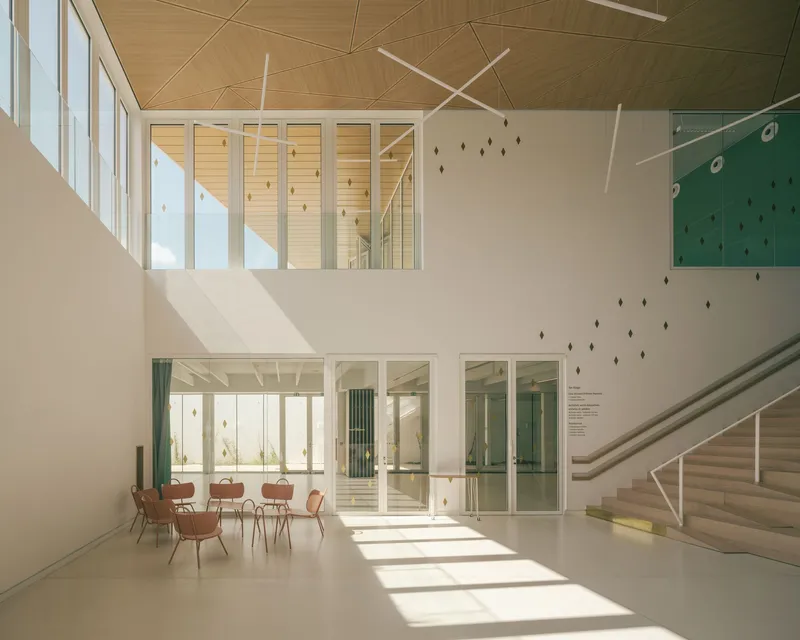
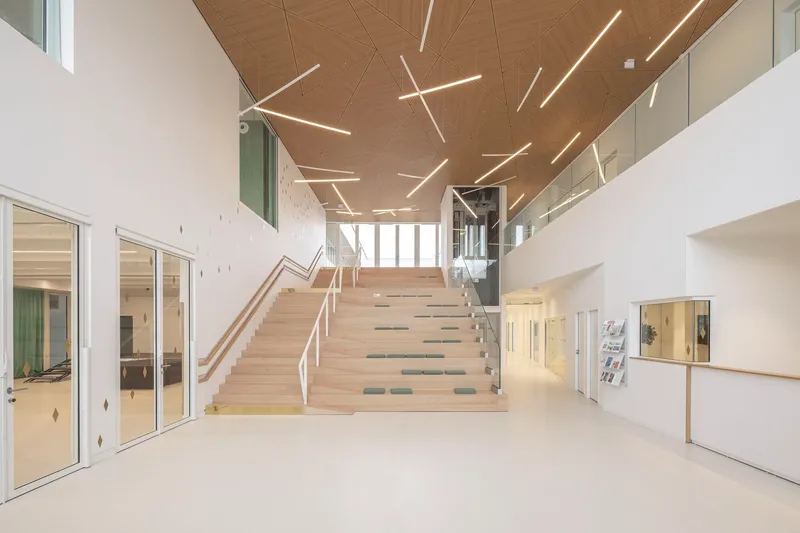
Step inside and the material palette pivots sharply. The structure is prefabricated concrete (prémur panels), but the interiors are dominated by timber: plank ceilings, plywood surfaces, and a generous central staircase in wood that rises through a double-height foyer. Linear light fixtures run in geometric patterns across the wooden ceiling, casting shadow lines on white walls that give the entrance hall a quiet graphic energy.
The staircase is more than circulation; it is the social spine of the building. Wide enough for gathering, visible from the entry, it encourages movement between the public ground floor (restaurant, association spaces, event hall) and the more sheltered upper level. ABC Studio clearly understood that in a community center, the stair is where people run into each other, and they gave it the proportions and warmth to reward that.
Color, Texture, and the Details That Signal Welcome
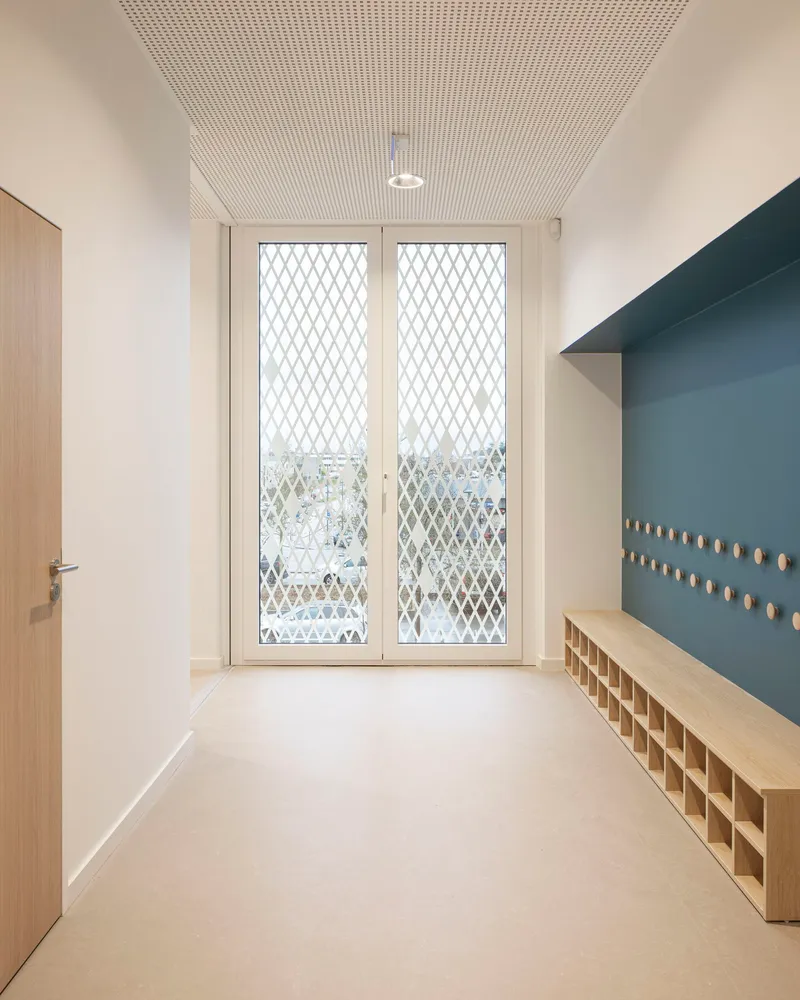
The interior detailing reveals a design team thinking carefully about who will use this building. A blue pegboard wall in one corridor doubles as display surface and acoustic treatment. Diamond mesh glazed doors maintain visual transparency between rooms while keeping noise contained. Plywood benches line corridors, providing seating that feels domestic rather than institutional. These are not expensive moves, but they are specific ones, calibrated to the reality of a facility that will serve families, children, and neighborhood associations daily.
The perforated metal doors opening onto glazed corridors on the upper floor allow daylight to penetrate deep into the plan while the timber plank ceilings maintain acoustic comfort. For a building with such a varied program (a café-restaurant, a parent-child welcome center, shared workspaces, therapy rooms), the palette is remarkably cohesive: wood, white, blue, mesh. The restraint holds everything together.
Plans and Drawings
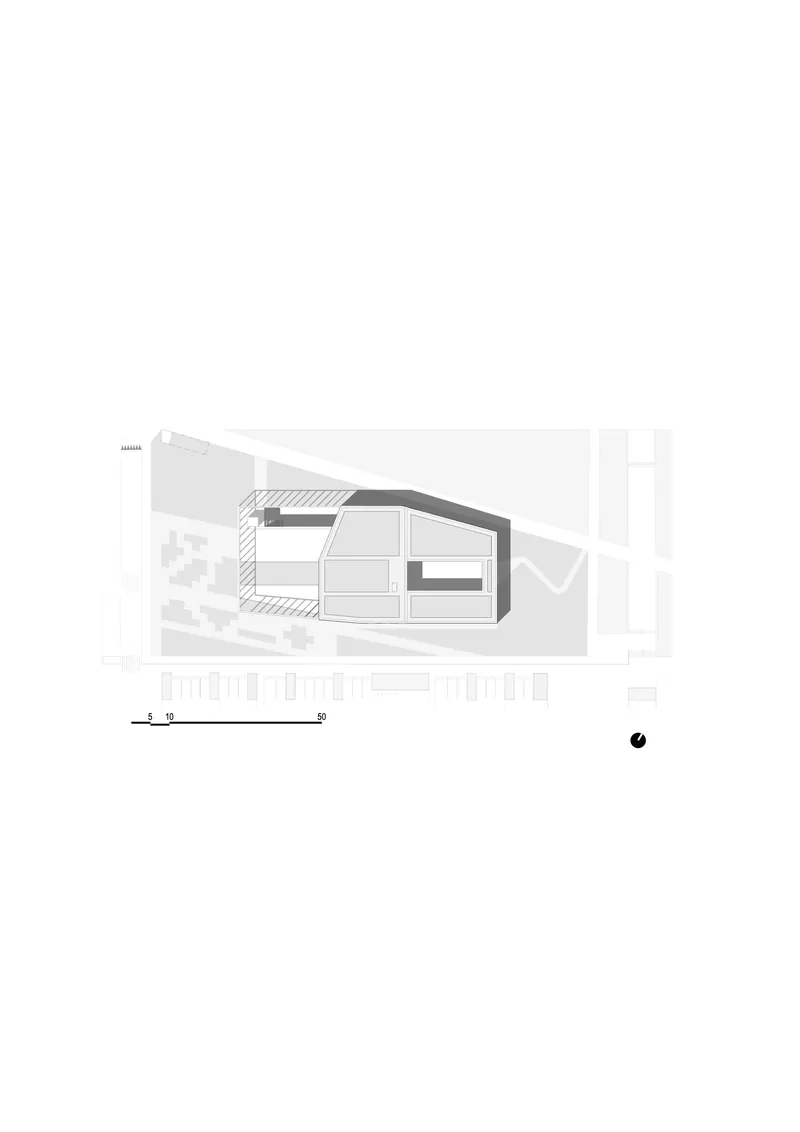
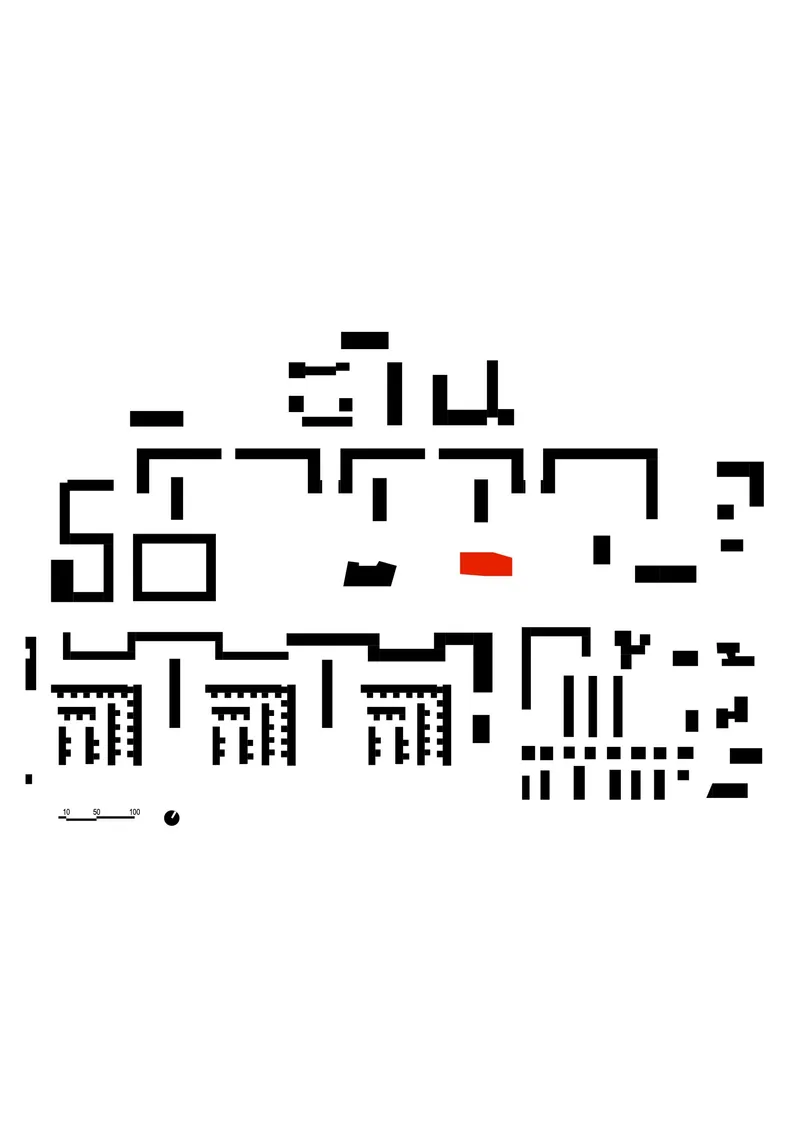
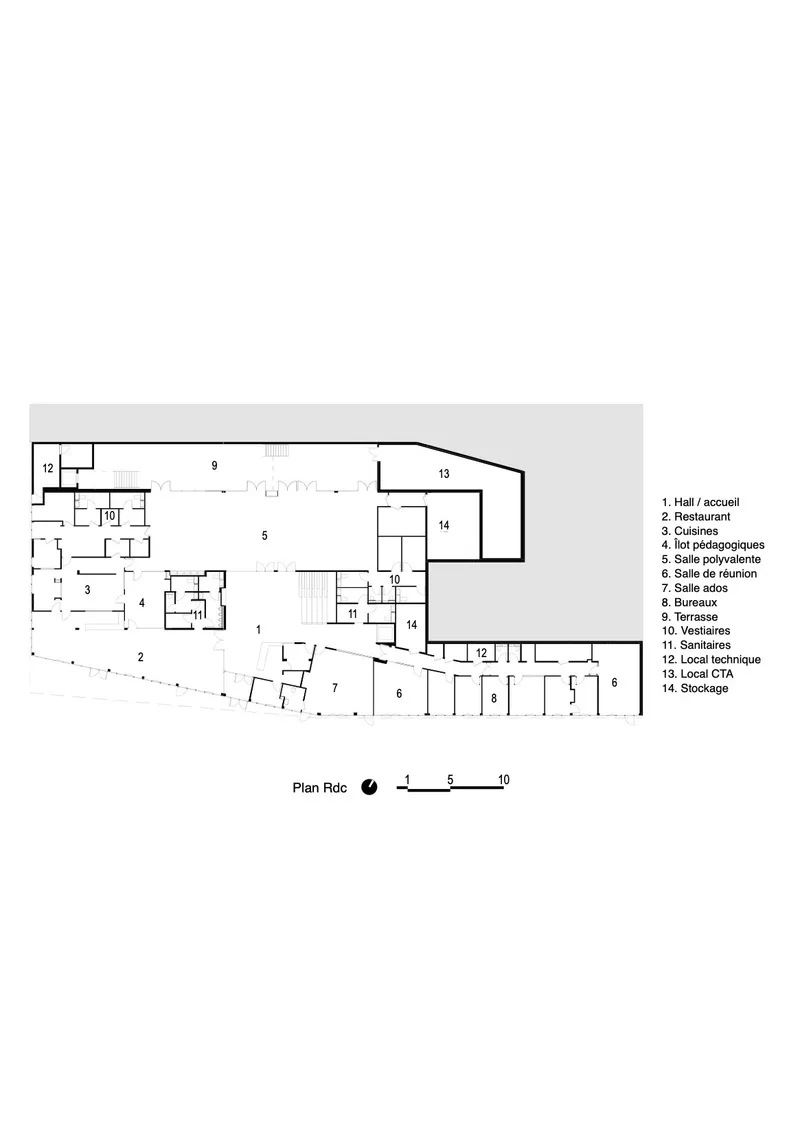
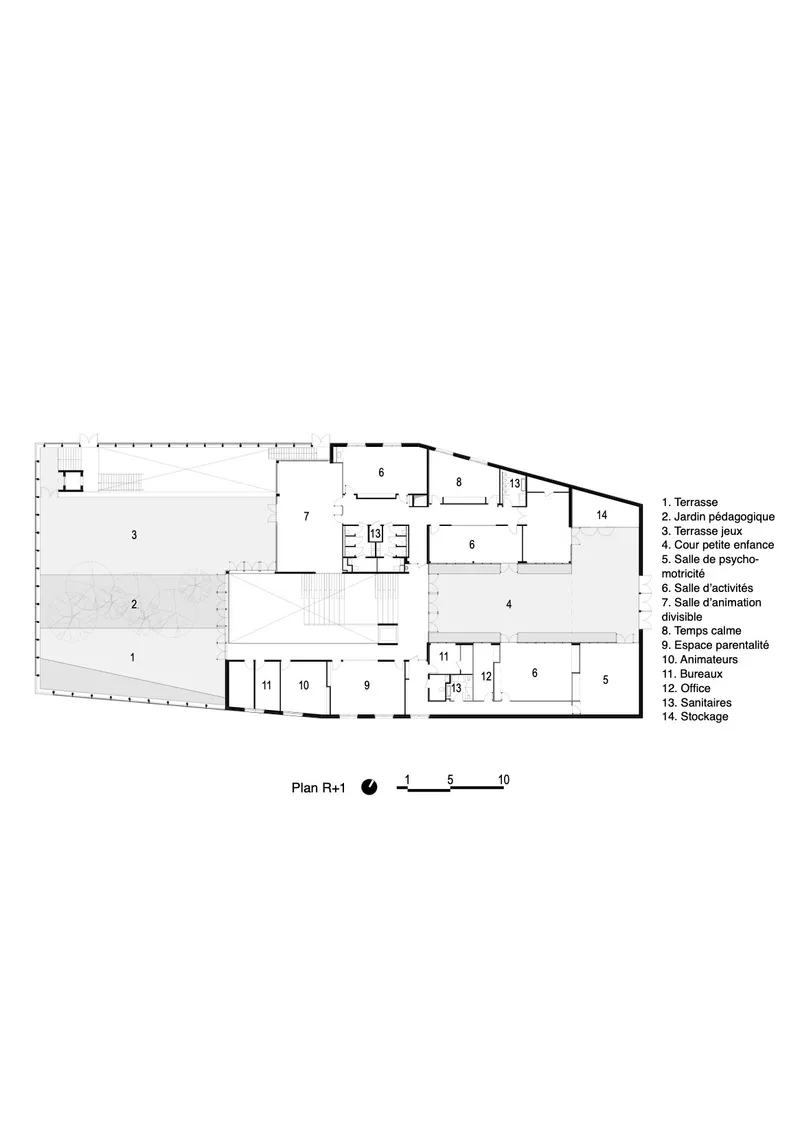
The plans reveal how much program ABC Studio has packed into the footprint. The ground floor organizes public spaces around a central courtyard, with the restaurant and educational rooms clearly legible as distinct zones connected by wide corridors. The upper floor arranges its rooms around a large central space, likely the double-height foyer visible from below, with the early childhood and care functions positioned along the perimeter to benefit from the mesh-filtered daylight.
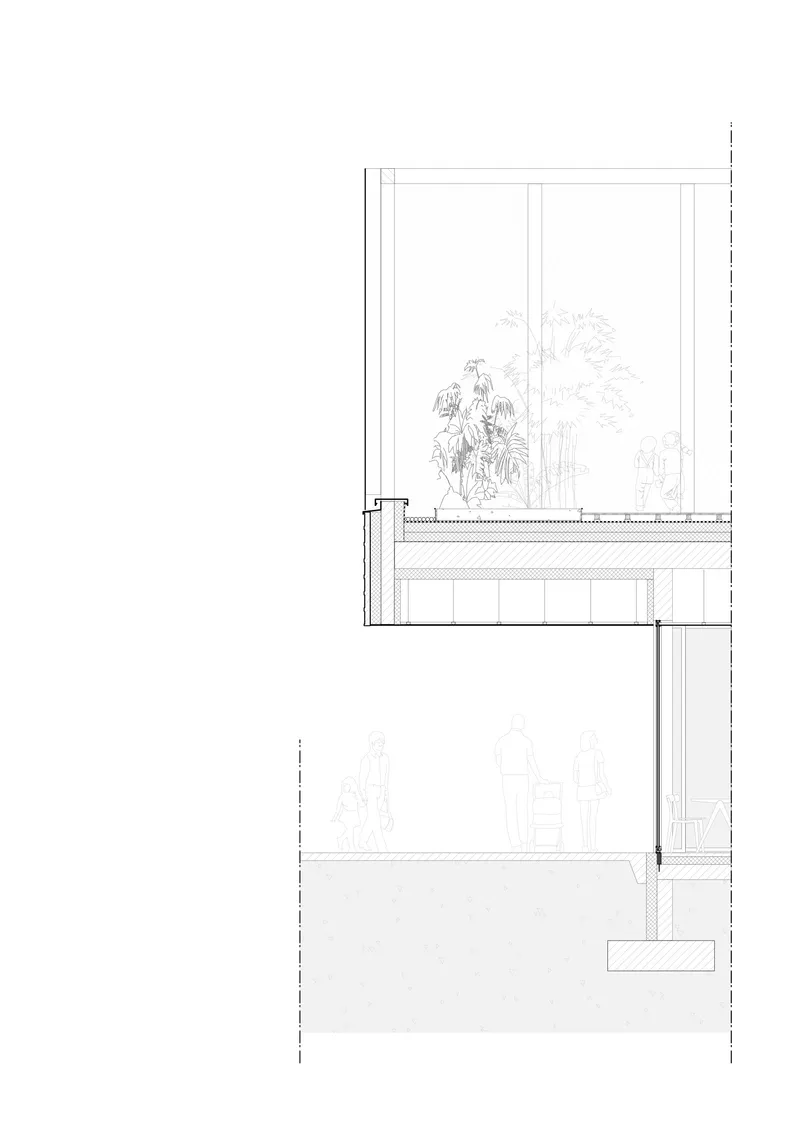
The section drawing is perhaps the most revealing. It shows the planted terrace sitting directly above the double-height entrance hall, with figures for scale that make clear just how embedded the building is in its terrain. The ground floor partially sinks into the site's natural slope, which explains why the building reads as low and horizontal from the street despite containing two full levels. The angled roof form visible in the site plan follows the geometry of the adjacent street network, tilting the building's mass to create the public plaza at the critical corner.
Why This Project Matters
The Borny Socio-Educational Center matters because it demonstrates that architecture can be a form of reparation without being condescending about it. ABC Studio did not design a flashy object to "save" a struggling neighborhood. They designed a quiet, well-organized building that gives Borny's residents something they lacked: a warm, functional gathering space that also heals a physical gap in the urban fabric left by decades of demolition. The meadow is not decoration; it is a statement that this part of Metz deserves softness.
For architects working in postwar housing districts across Europe, this project offers a useful model. Keep the volume low and the materials honest. Use the site's topography instead of fighting it. Wrap the building in a skin that protects without fortifying. And invest in the interior details that tell everyday users they are valued. At €10 million for 2,000 m² of community infrastructure, this is not cheap architecture, but it is architecture that earns its cost through precision rather than spectacle.
Borny Socio-Educational Center by ABC Studio, Metz, France. 2,000 m², completed 2025. Photography by Charly Broyez, Cyrille Lallement, and ABC Studio.
About the Studio
Share Your Own Work on uni.xyz
If projects like this are the kind of work you want to make, uni.xyz is a place to publish your own, find collaborators, and enter design competitions.


Popular Articles
Popular articles from the community


GROUP A Strips a 1969 Rotterdam Harbor Headquarters to Its Frame and Wraps It in Timber Louvers
In Rotterdam's M4H harbor district, Ferro Offices reuses a 1969 frame, adds one timber storey and reaches BREEAM-NL Outstanding.

Jaramillo Van Sluys Arquitectura and Urbanismo Turn a Demolished Registry Lot in Quito into an Orchard Plaza
In Quito's Centro Histórico, a 2,800 m² plaza exposes the San Agustín convent wall and redraws its lost Augustinian orchard in volcanic stone.

Cube Design Draws an Ecological Corridor Between Two Shenzhen Hills with the Nankai Building
Beside Shenzhen's container docks, the Nankai Building pairs stacked balconies with a climbing green screen to connect two hillsides across its height.

U.GA Architects Wraps an Oval Rooftop Pool in Curved Board-Formed Concrete on Busan's Jeollidan-gil
In Busan's Jeonpo-dong, a 454 m² mixed-use block stacks a neighborhood facility, guest rooms and an oval rooftop pool inside spiraling concrete walls.

Similar Reads
You might also enjoy these articles


LAVA Architecten Gives Vocational Education a Sawtooth-Roofed Face on a Mechelen School Campus
In Mechelen, Belgium, a 2,053 m² STEM school on a 6×6 m grid turns workshops and classrooms into rooms that can be rearranged as teaching changes.

KEMA Studio Turns a Derelict Marvila Attic into a 60 m² Lighthouse Apartment Above Lisbon
In Lisbon's Marvila district, a rebuilt roof, four skylights and two plywood volumes turn an unlivable attic into a bright home facing the Tagus.

Pixel Gardens: One Repeated Module Stacked Into a Terraced Social Housing Tower for Famagusta
Salem Bader's shortlisted housing tower builds a vertical neighbourhood from one repeated module, offsetting units to carve terraces, light and air.

Bao Huynh Watercolor Atelier: A Serene Art Retreat in Hội An
Bao Huynh Watercolor Atelier in Hội An blends multifunctional art spaces, sustainable design, local materials, and family-friendly living in a serene environment.


Comments (0)
Please login or sign up to add comments
No comments yet. Be the first to comment!