
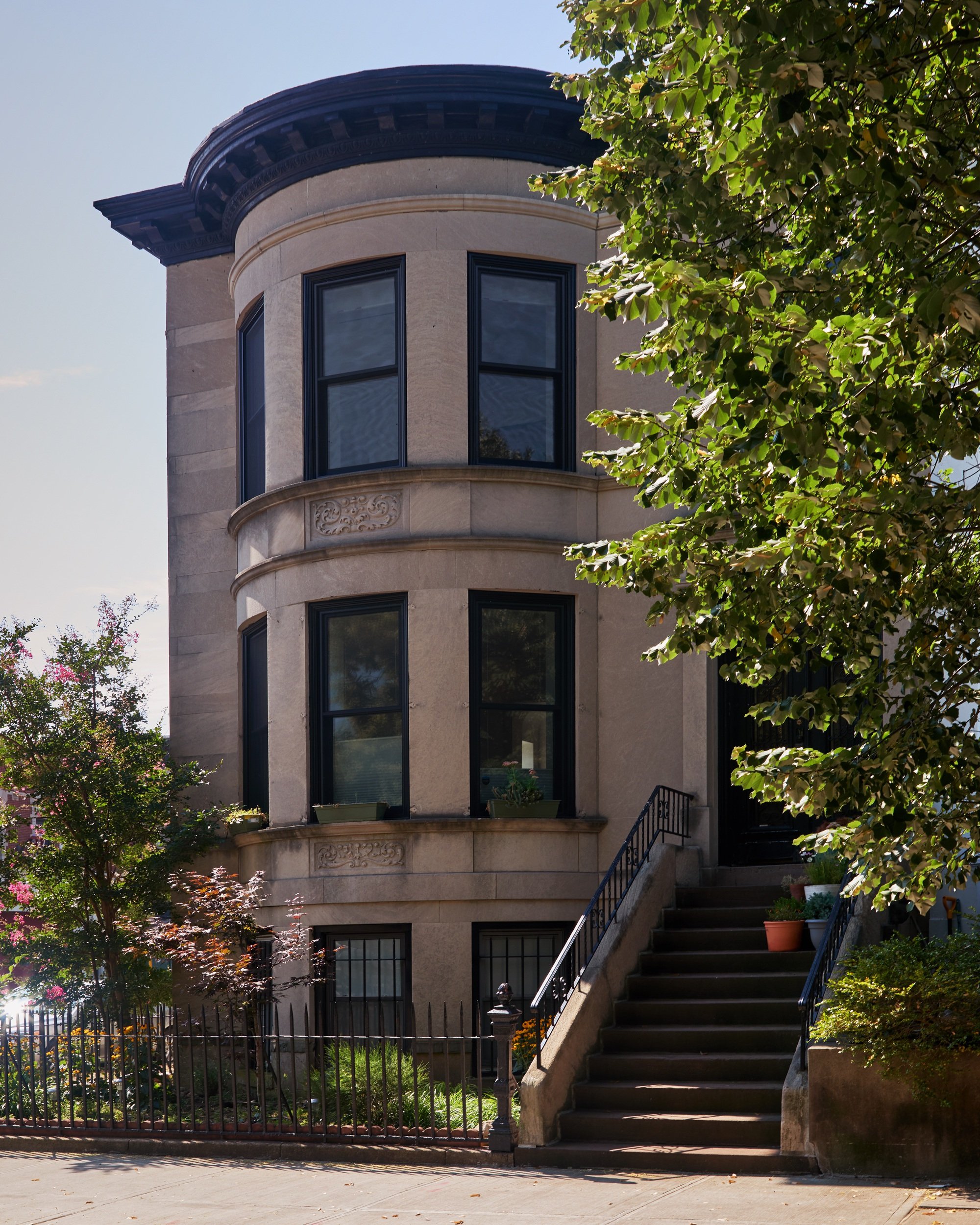
Abruzzo Bodziak Architects Reshape a Brooklyn Rowhouse with Curves That Honor Its Historic Block
In Prospect Lefferts Gardens, a landmarked sandstone rowhouse gets a meticulous interior rethink organized around sweeping oak surfaces.

Lefferts Manor is one of those New York micro-neighborhoods that rewards close looking. The blocks of Prospect Lefferts Gardens are lined with remarkably intact late-nineteenth-century rowhouses, their sandstone facades and bay windows forming a continuous rhythm that the city's Historic District designation has worked to protect. Intervening inside one of these houses without compromising that rhythm is a design problem that demands restraint, but restraint alone rarely produces architecture worth discussing.
Abruzzo Bodziak Architects found a more productive strategy: introduce a single formal move, the curve, and let it ripple through every floor of the house. The result is a home whose street-facing elevation reads as a respectful neighbor while its interior unfolds as a sequence of warm, sculpted volumes defined by custom oak paneling, terrazzo floors, and arched openings. The curves never feel decorative. They organize circulation, soften transitions between rooms, and give the house a spatial continuity that typical rowhouse renovations, with their stack of rectangular boxes, rarely achieve.
Street Presence
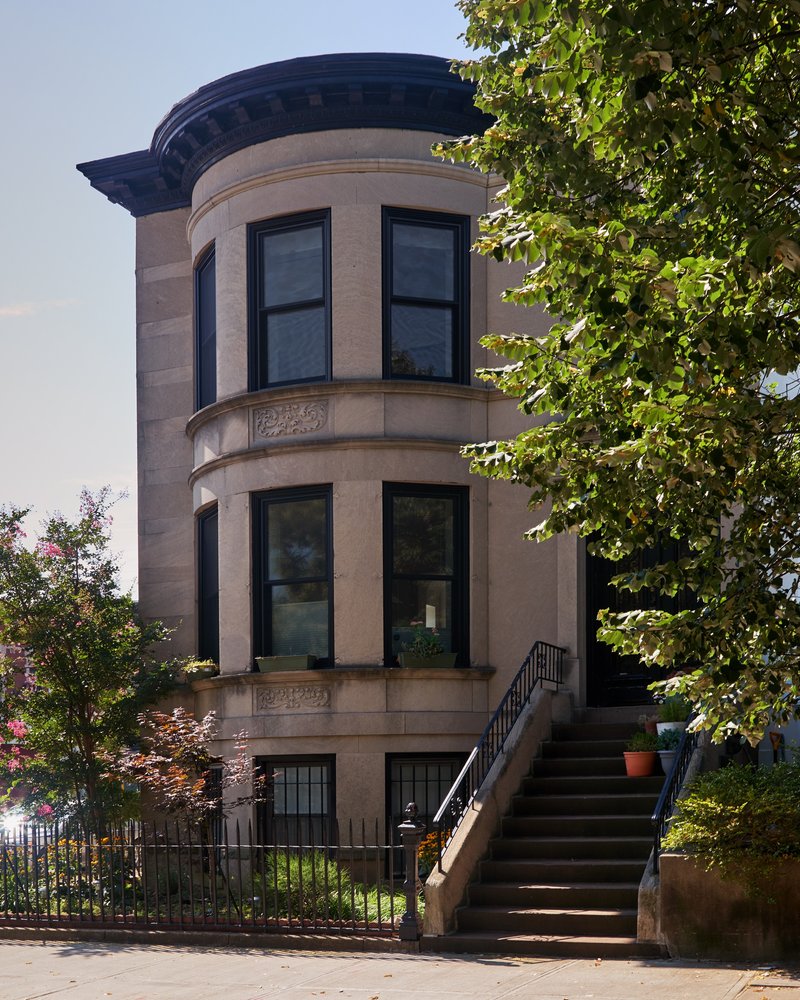
From the sidewalk, the house could pass for a well-maintained original. The curved sandstone bay, the entry stoop, and the cornice detail all belong to the block's established language. This is the right call. In a historic district, the front facade is essentially a shared asset, and architects who treat it as a canvas for personal expression tend to damage the very quality that made the neighborhood worth preserving. Abruzzo Bodziak save their energy for the interior, where it counts.
The Curving Spine
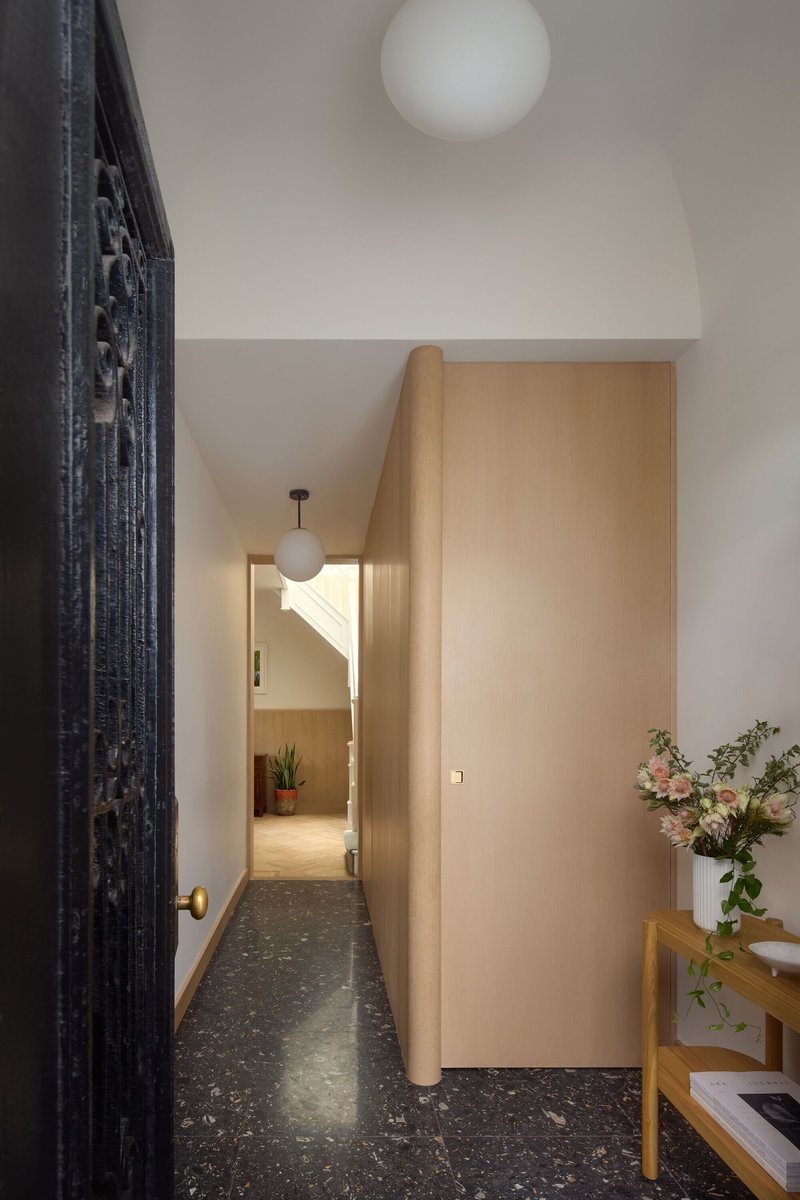
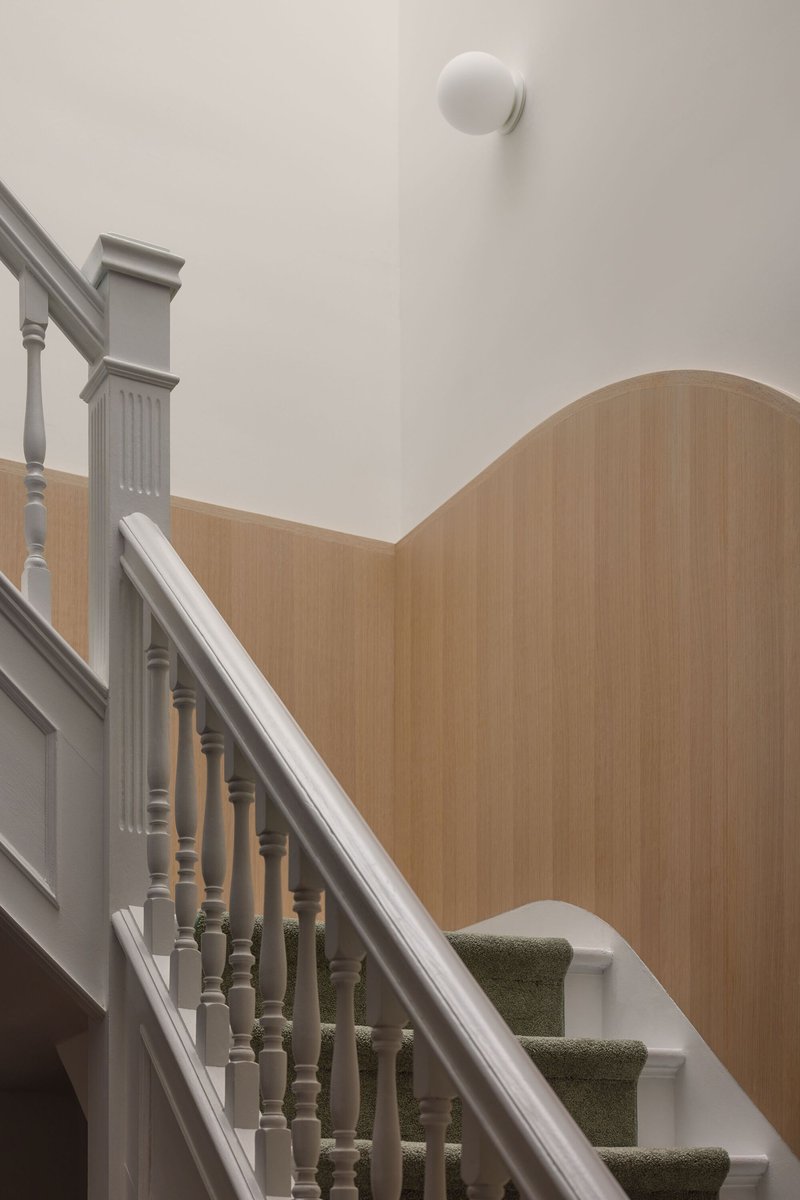
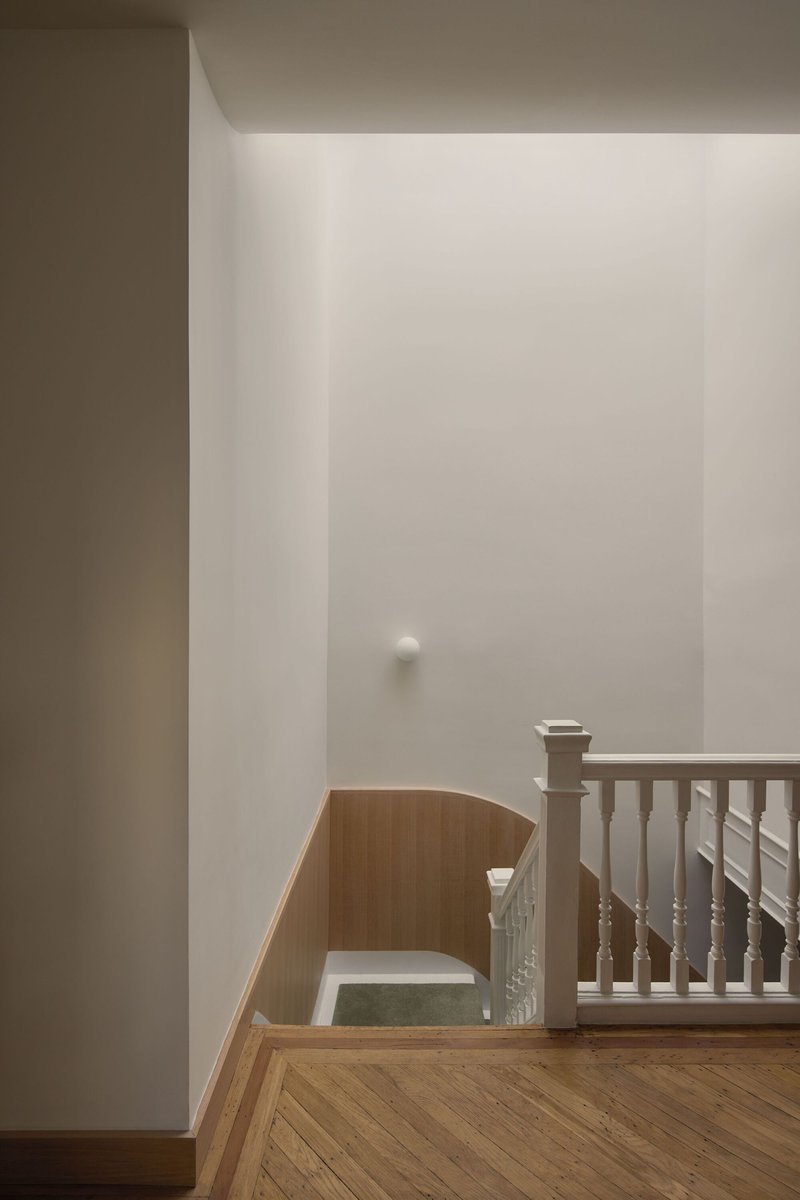
The project's signature gesture is the curved oak wall that runs along the stair hall, visible the moment you step inside. On the ground floor, it appears as a smooth, timber-clad surface guiding you from the entry toward the rear of the house. As you climb, it continues as paneling that wraps the staircase landings, shifting from vertical boards to herringbone timber flooring underfoot. The material stays consistent; the geometry keeps moving.
What makes this work is that the curve is not ornamental. It resolves a practical problem: how to connect a deep, narrow rowhouse plan without resorting to a dark corridor. By bowing the wall outward, the architects create generous landings and sightlines that pull natural light from the skylight above all the way down to the lower floors.
Living Spaces and Light
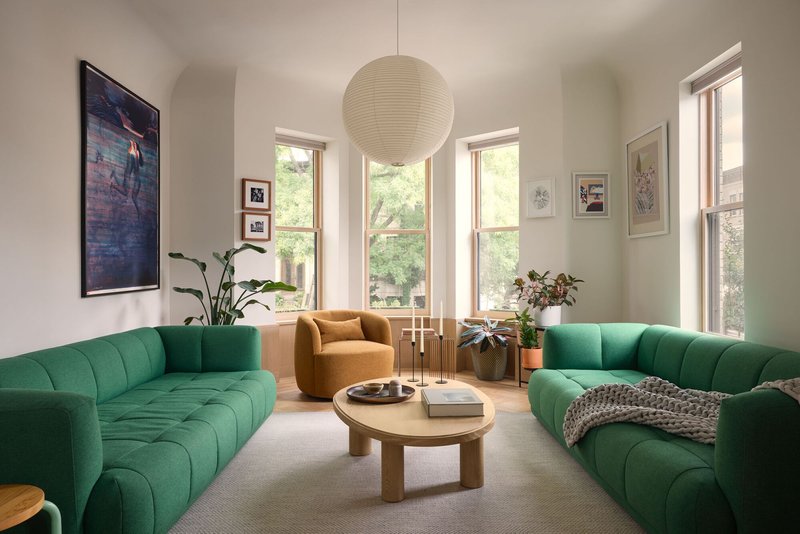
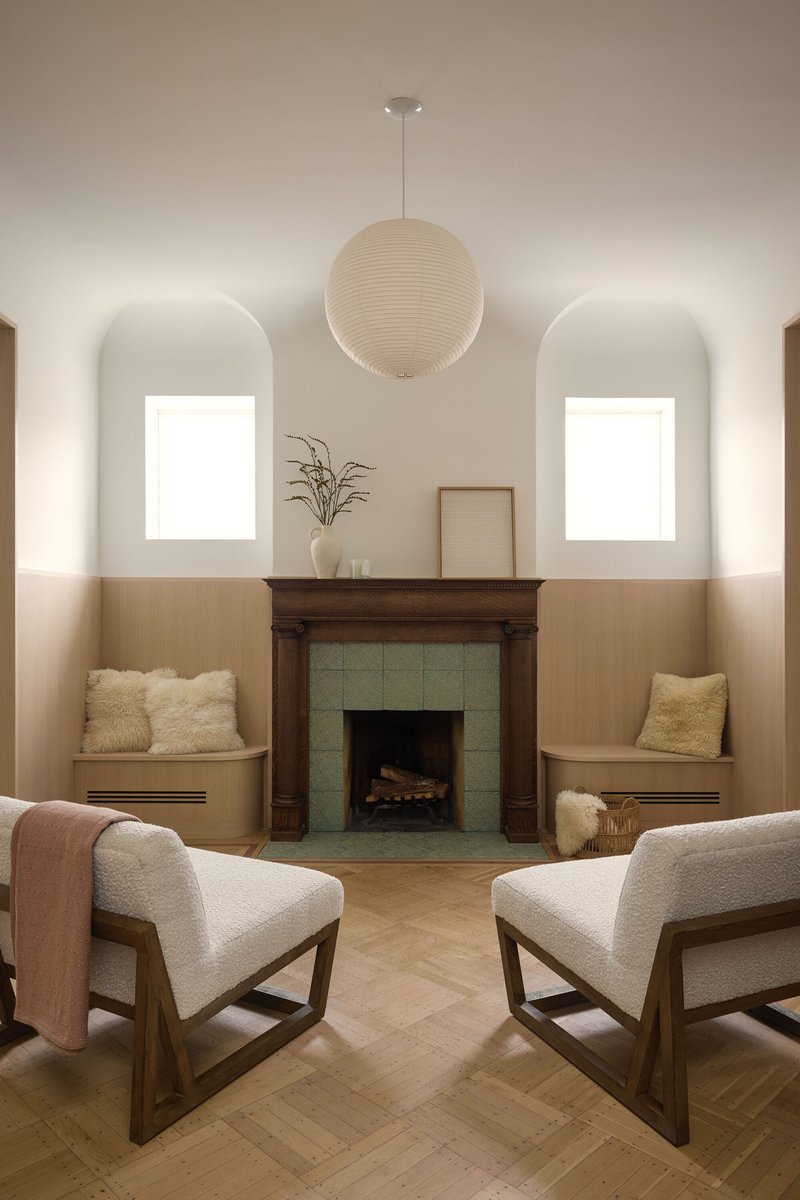
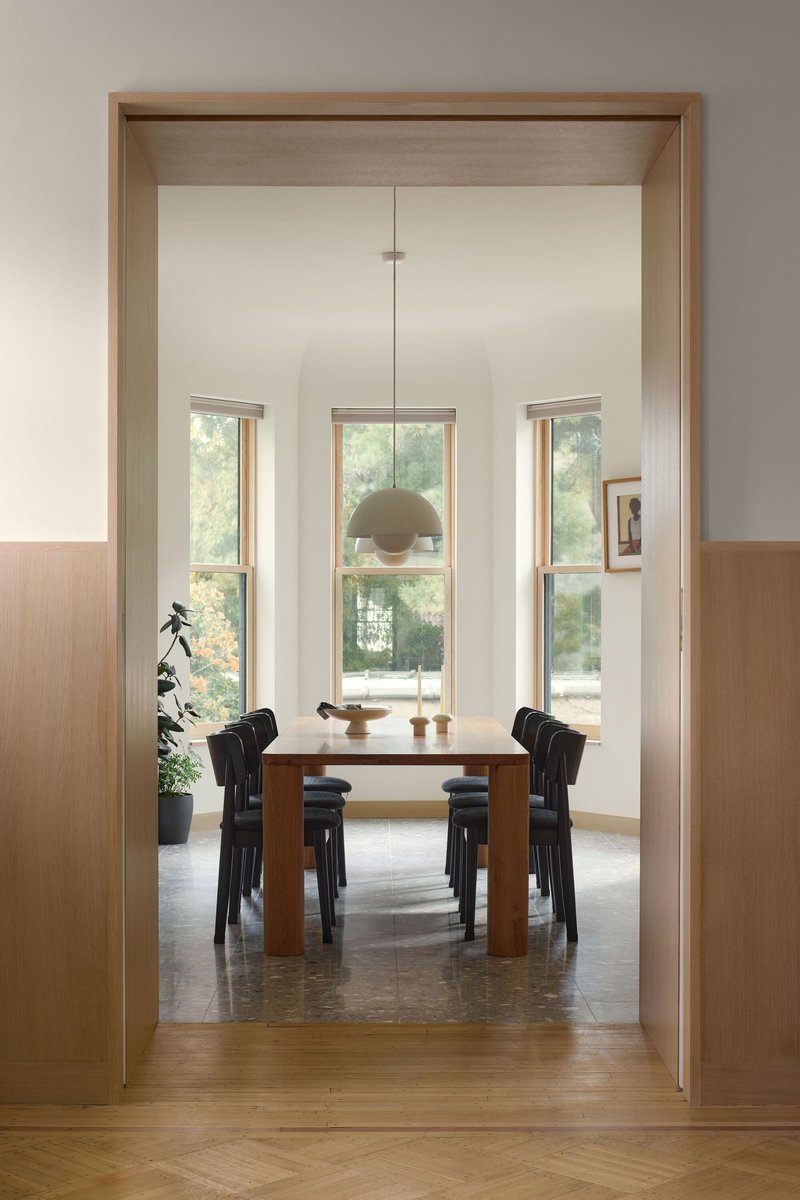
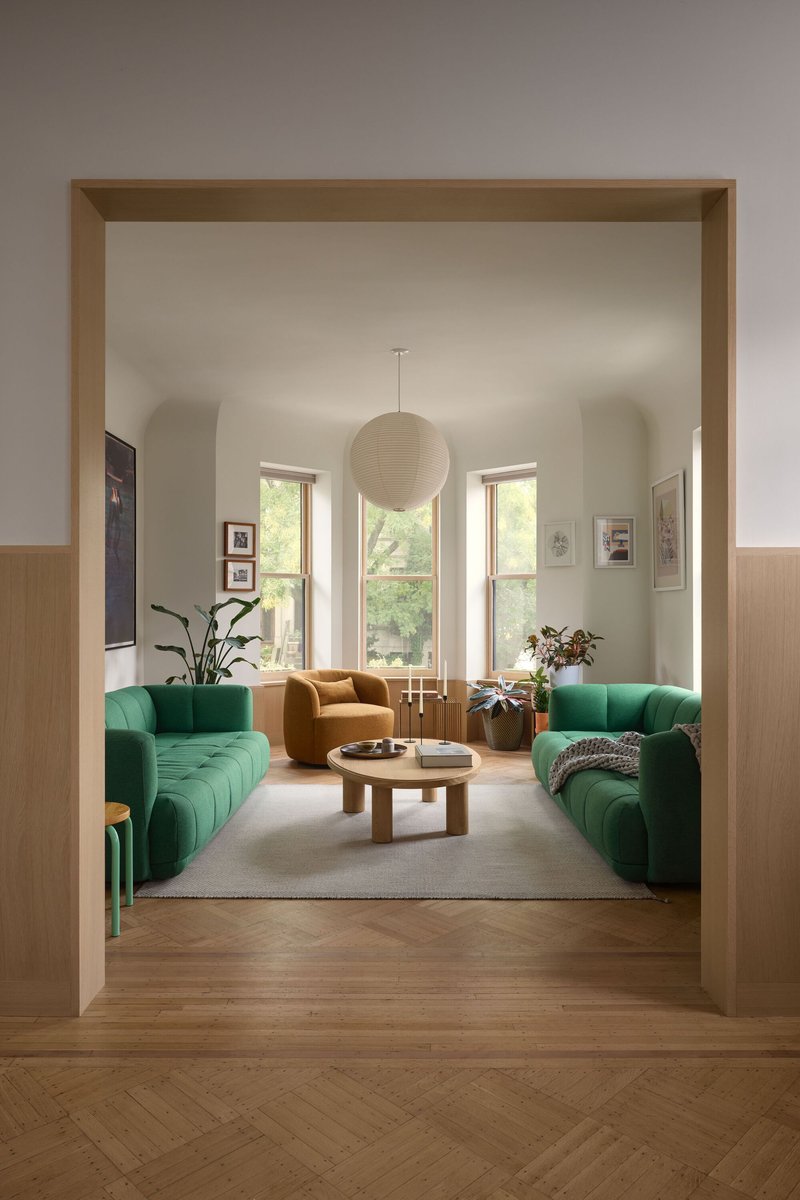
The parlor-level living room is the heart of the house. Tall windows flood the space with daylight filtered through the canopy of street trees, and the furnishings, channeled green sofas, a circular timber coffee table, a spherical pendant lamp, pick up the project's curvilinear logic without mimicking it. Across the hall, a sitting area organized around the fireplace uses arched windows above timber wainscoting to bring the exterior bay geometry inside. The proportions feel generous without the rooms being large.
Framed doorways connect these rooms in sequence, so you always perceive depth beyond the space you are standing in. It is a classic enfilade strategy, but the mix of oak frames and carefully positioned openings keeps it from reading as a period-room exercise.
Kitchen and Material Palette
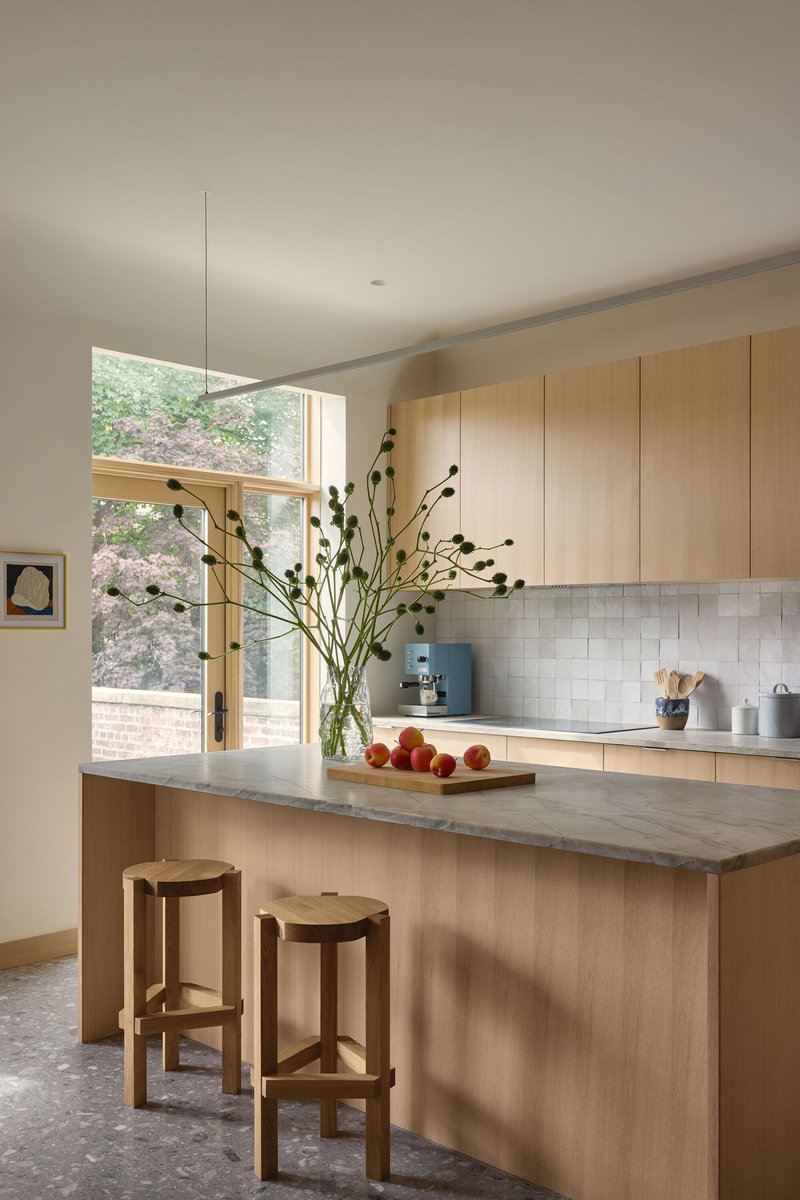
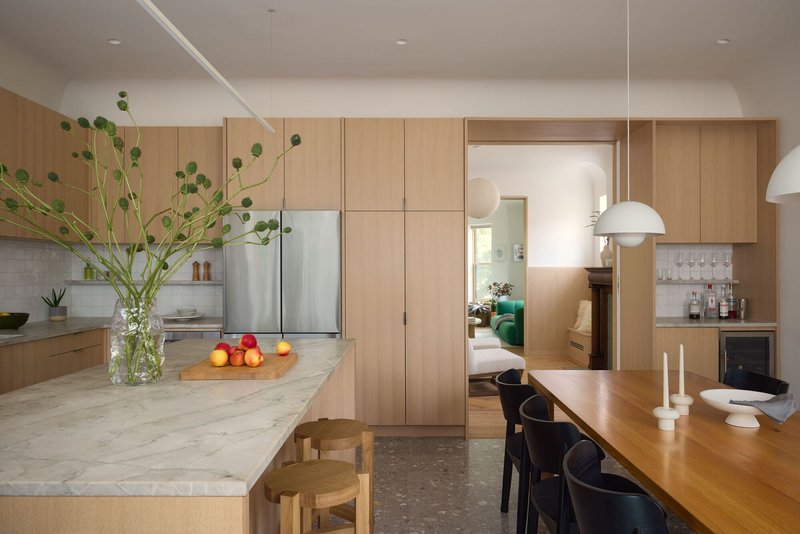
The kitchen sits at the rear of the first floor, where a clerestory window frames the garden and pulls in southern light. The island is topped with a pale stone slab, and the cabinetry continues the warm oak tone that defines the rest of the house. There is no sudden shift in material language when you cross from living room to kitchen; the transition is handled through proportion and joinery rather than a change in palette.
That discipline is worth noting. In many renovations, the kitchen becomes a showcase for a different set of finishes, breaking the spatial continuity the rest of the plan works hard to establish. Here, marble, oak, and white plaster carry through, letting the architecture hold the room together rather than relying on contrast.
Upper Floors and Private Rooms
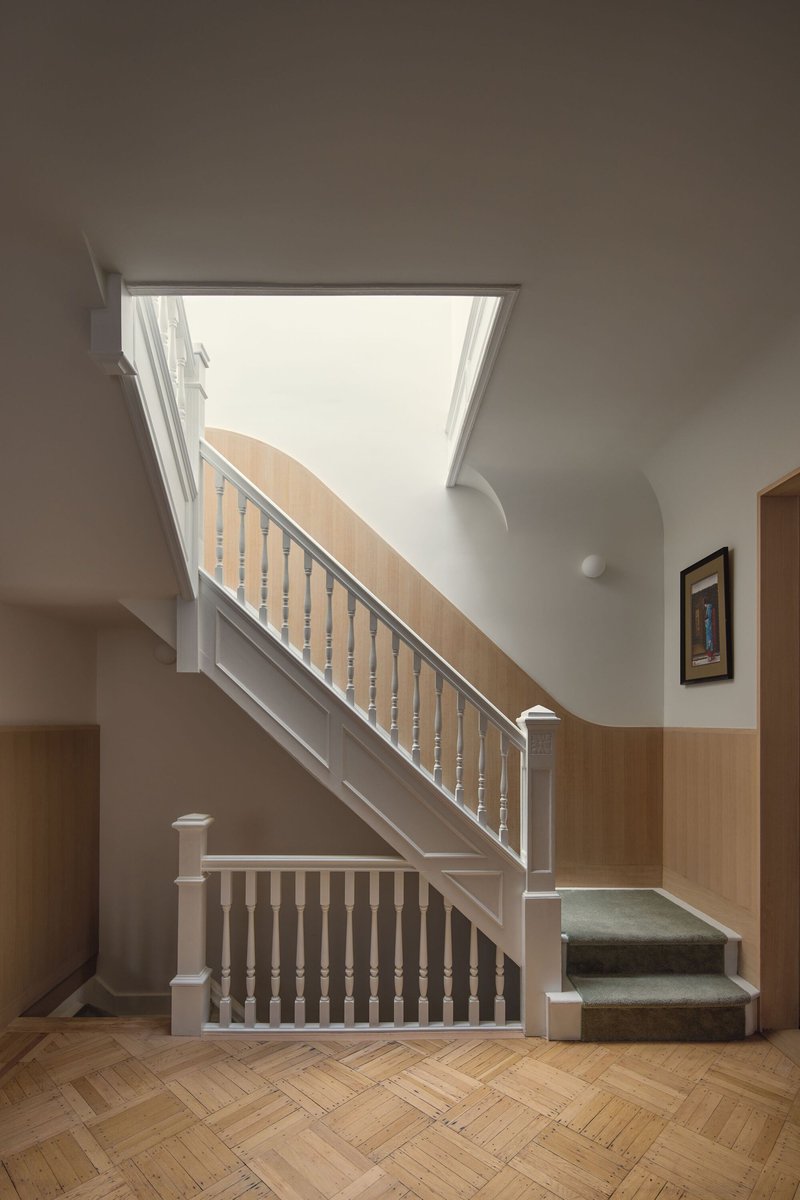
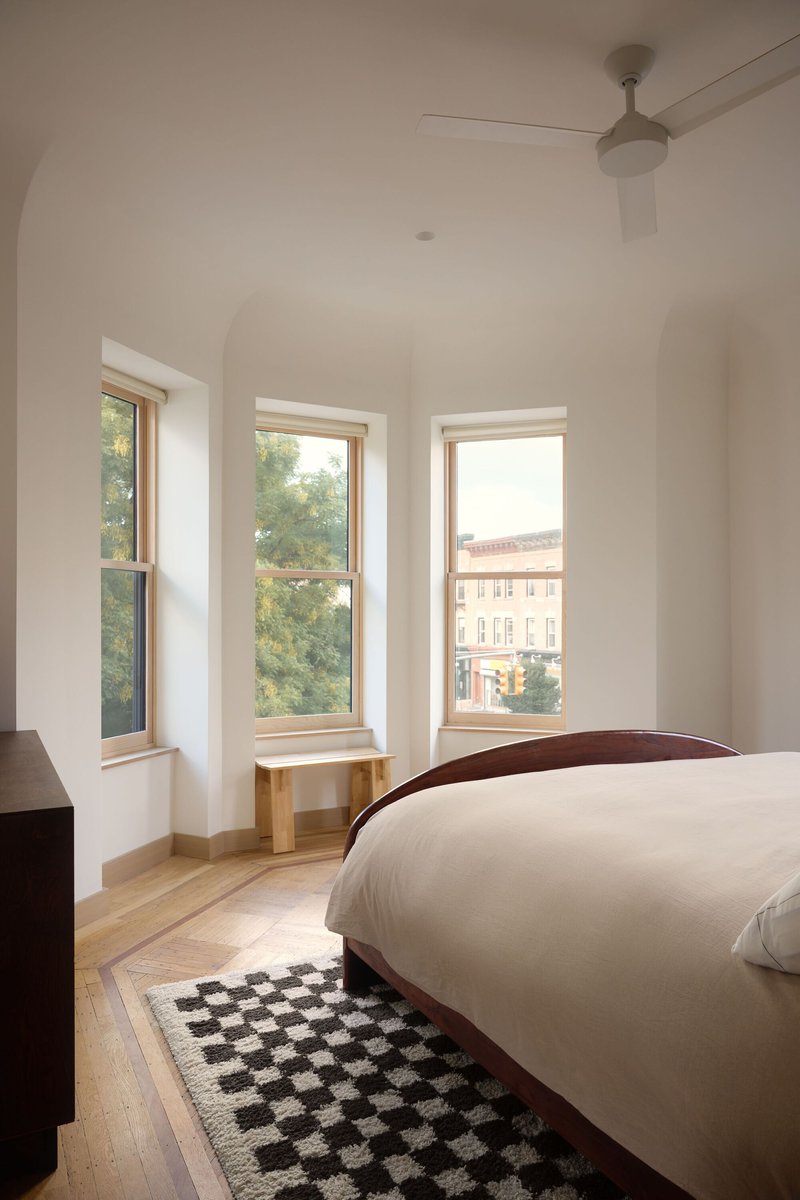
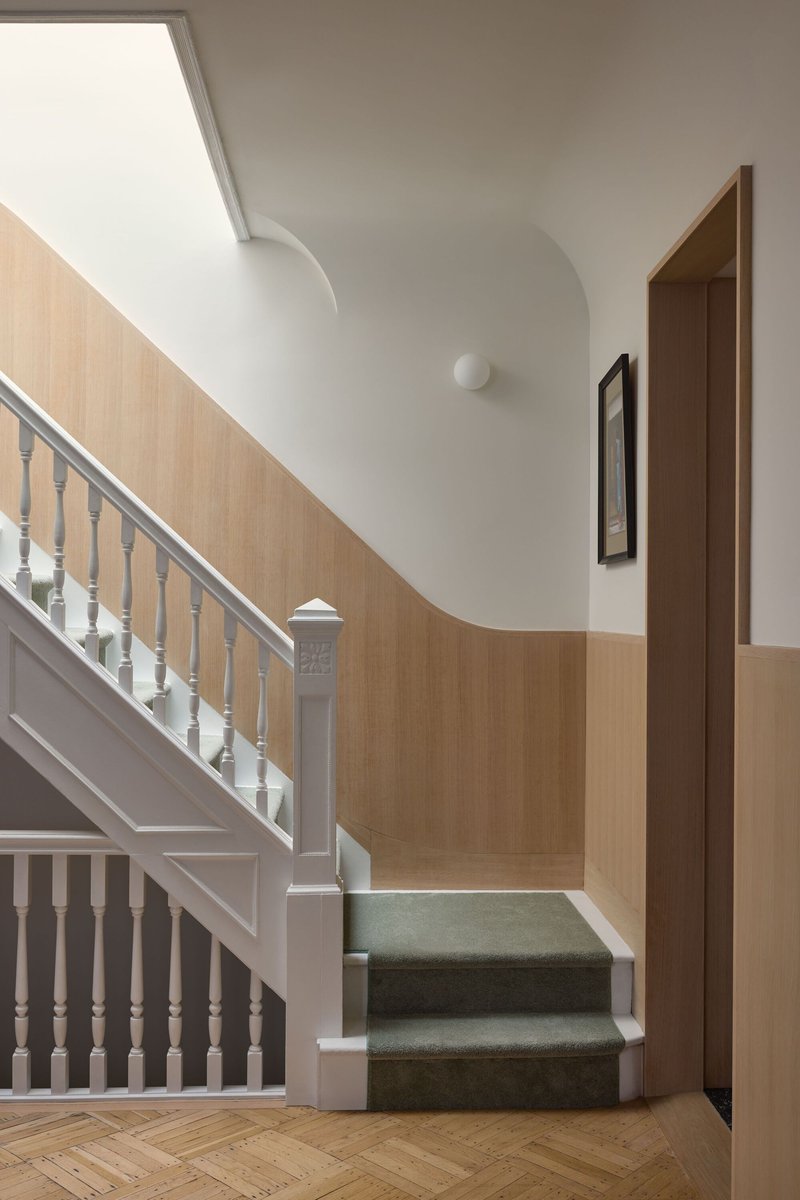
The staircase, with its painted balustrade and turned timber balusters, threads daylight from a generous skylight down through the core of the house. The upper floors hold bedrooms that face the street through tall windows, framing the leafy Prospect Lefferts streetscape in a way that makes the neighborhood part of the room. The curved oak paneling continues on the landings, giving the circulation spaces a warmth that most townhouses reserve for their primary rooms.
Bathrooms and Detailing
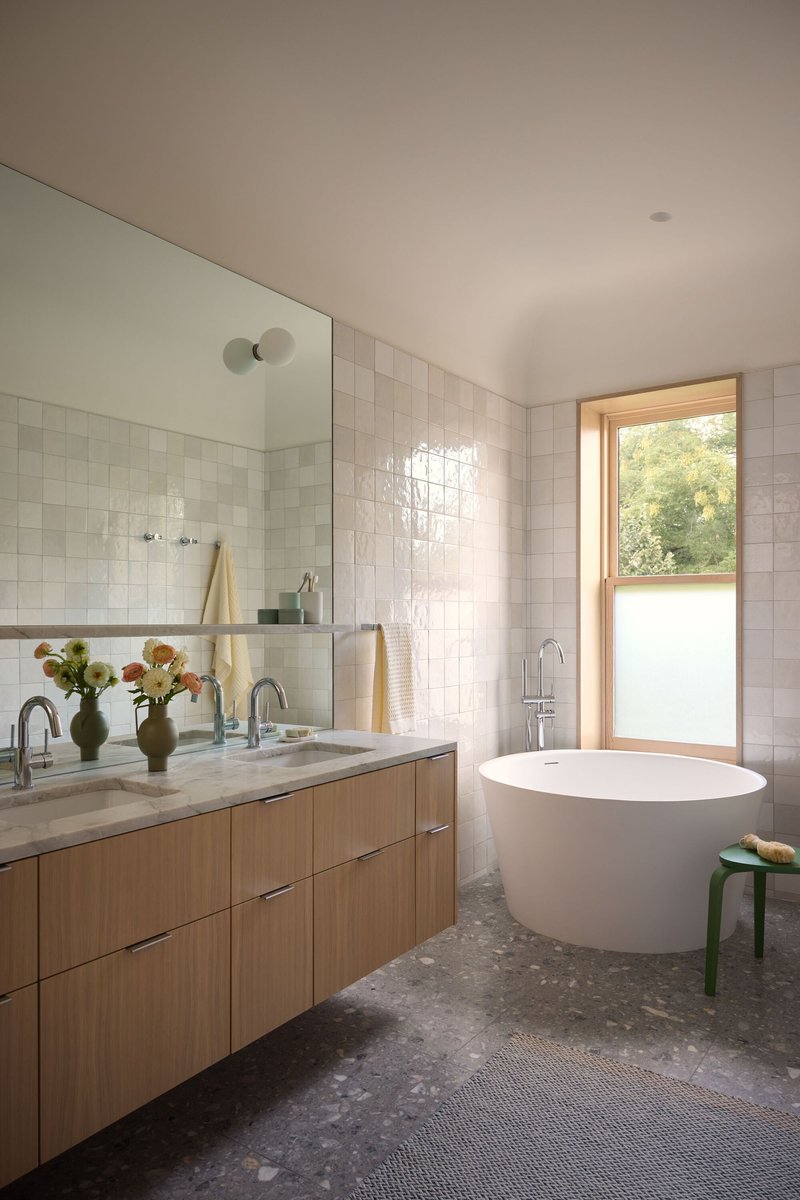
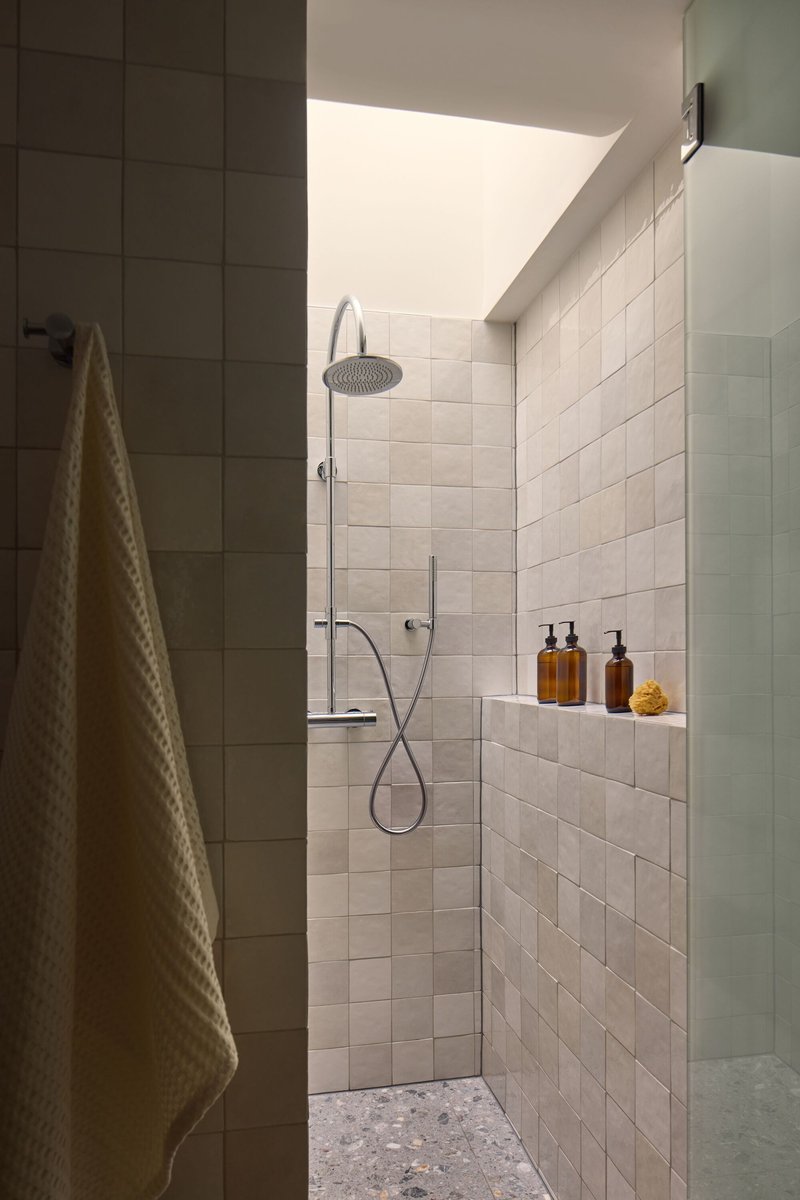
Even the bathrooms follow the project's logic of consistency. White tile walls, oak vanities, and frosted windows overlooking greenery maintain the restrained palette. A skylight in the shower enclosure casts angular sunlight across the fixtures, turning a utilitarian space into one of the house's quieter pleasures. The detailing is precise without being fussy: flush joints, simple hardware, and a deliberate absence of decorative tile patterns.
Plans and Drawings
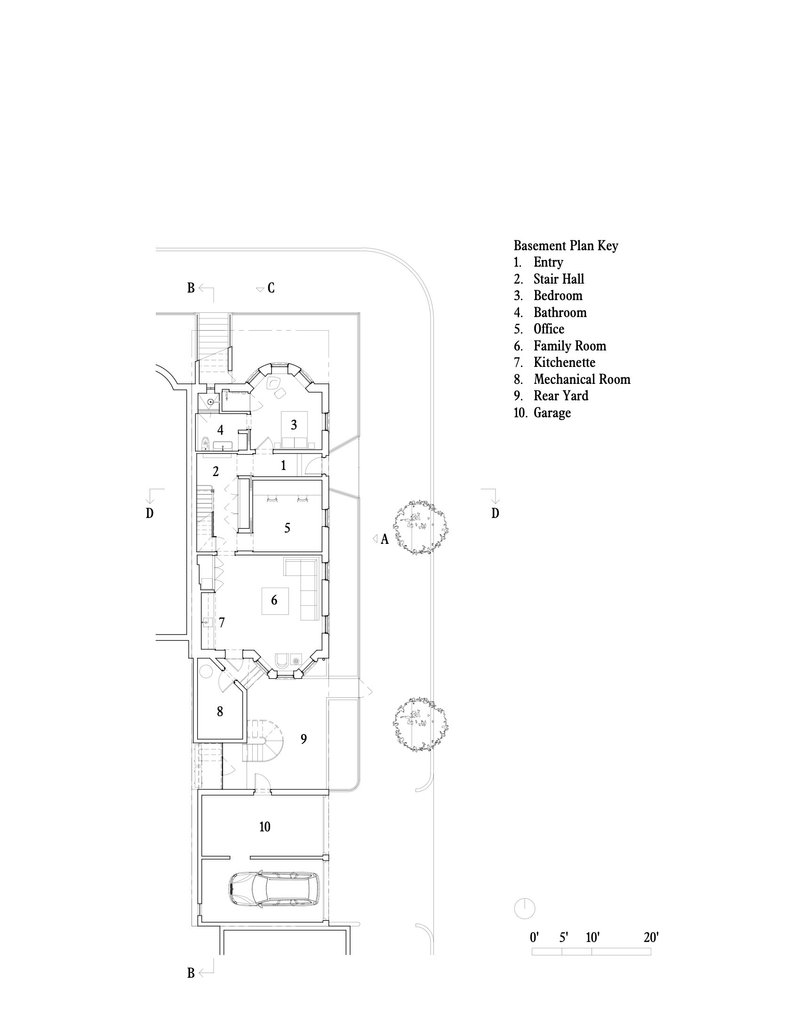
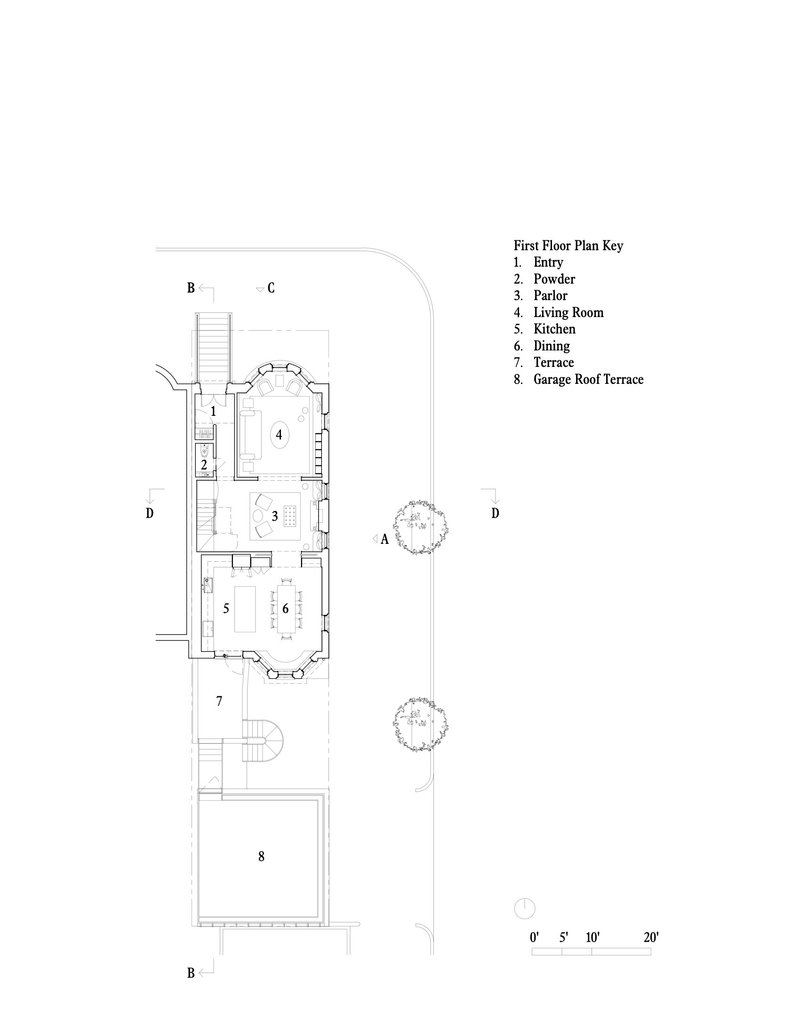
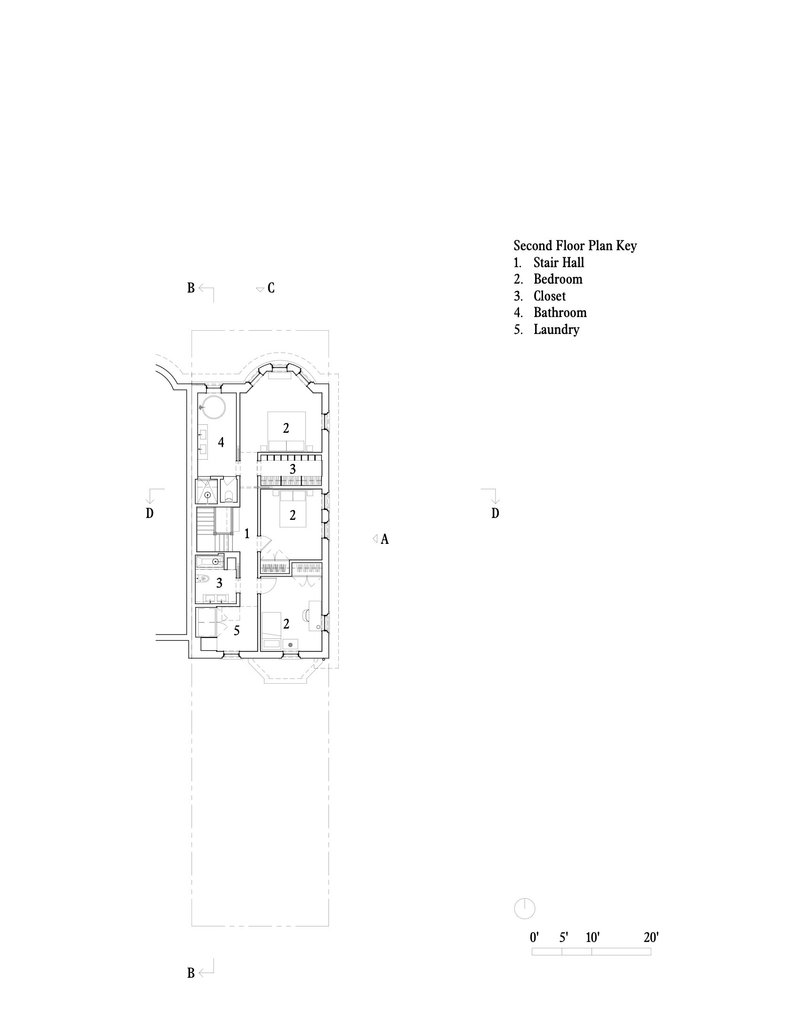
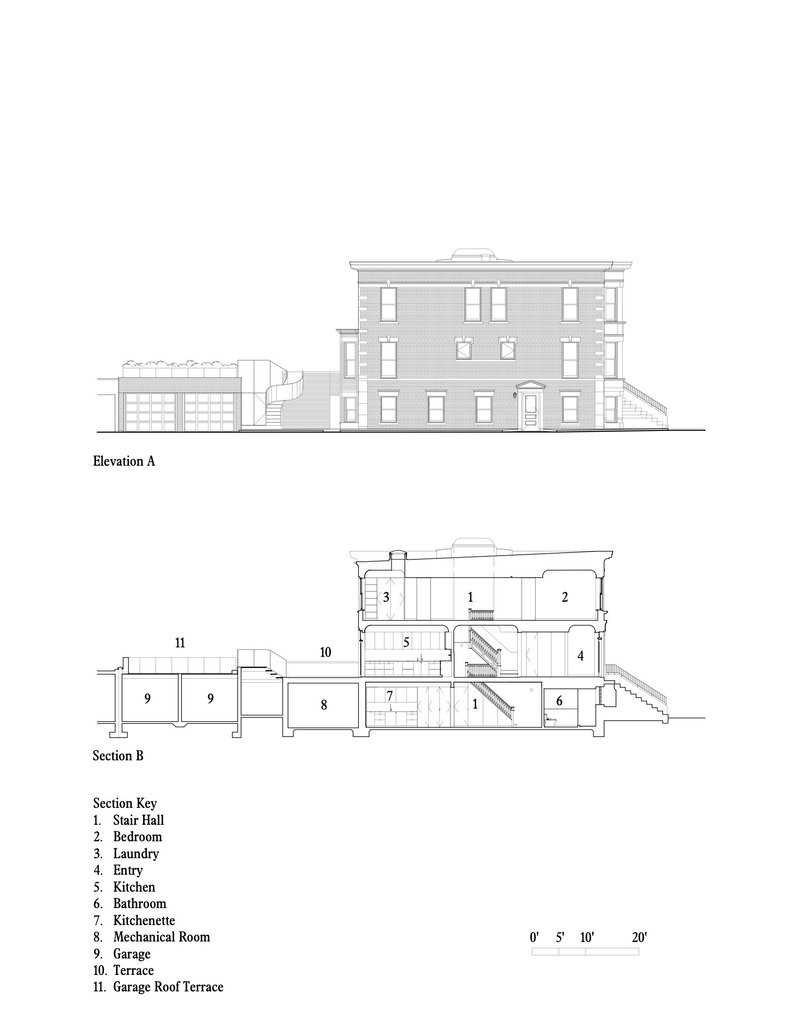
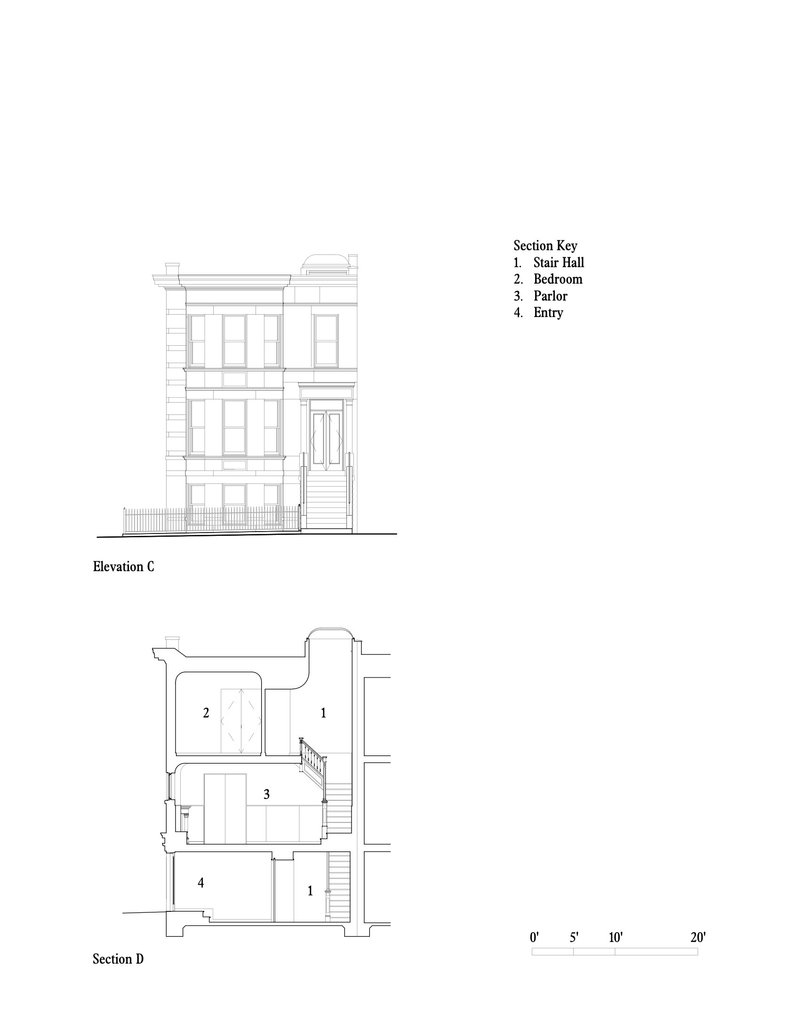
The plans reveal the organizational clarity behind the experiential richness. The basement accommodates a bedroom, office, and garage, keeping service functions below grade. The first floor reads as a continuous loop of parlor, living room, and kitchen terminating at a rear terrace. Upstairs, bedrooms flank the central stair hall, which acts as a vertical commons rather than mere corridor. The section drawings confirm what the photographs suggest: the skylight and curved wall together turn the stair into a light shaft that activates all three stories.
Why This Project Matters
The Lefferts Manor House demonstrates that working within the constraints of a historic district does not have to mean designing a timid interior. Abruzzo Bodziak Architects found a way to assert a contemporary spatial idea, the continuous curve, without disturbing the block's collective character. The move is legible, consistent, and structurally motivated, which keeps it from drifting into formalism for its own sake.
More broadly, the project is a useful model for how to treat the rowhouse typology as something other than a series of stacked rooms connected by a dark stair. By reimagining the circulation spine as the primary architectural event, the architects gave the house a coherence that most renovations of this type never find. That is the real lesson here: in a deep, narrow plan, the hallway is the architecture.
Lefferts Manor House by Abruzzo Bodziak Architects, Brooklyn, United States, 2025. Photography by Eric Petschek and Pete Deevakul.
About the Studio
Share Your Own Work on uni.xyz
If projects like this are the kind of work you want to make, uni.xyz is a place to publish your own, find collaborators, and enter design competitions.




Popular Articles
Popular articles from the community

Milan Crossover: Sustainable Architecture for a New Fashion Culture in Milan
Milan Crossover transforms fashion culture through sustainable architecture, linking material libraries, remake studios, and public runways.

Kaffeebühnen: Coffee Shop Architecture Designed as a Civic Stage Between Vienna’s City and Park
Kaffeebühnen turns coffee shop architecture into a civic stage, linking Vienna’s park edge, urban life, warm timber yards, and coffee craft.
Eco Chapel: A Green Architecture Pavilion Designed in Symbiosis with the Forest
Eco Chapel uses green architecture to weave prayer, learning and reuse into a forest pavilion shaped by modular hexagonal canopies for life.
Inside a Timeless Mumbai Residence by Aether Studio
Aether Studio's 2,250 sq ft apartment in Malad, Mumbai uses marble, brass, boucle, and disciplined restraint to build a quiet retreat from the city.


Similar Reads
You might also enjoy these articles
Freebird Residence by Alexis Dornier: A Tropical Modernist Sanctuary in Bali
Floating living pavilion above pool anchors H-shaped tropical villa, blending Japanese minimalism, sustainable strategies, lush landscape, and sculptural interiors.
127af Flips a Tiny Bagnolet Rowhouse Upside Down with a Handcrafted Roof Extension
A 55-square-meter terraced house on the edge of Paris gains a luminous upper living floor through lightweight timber and steel.
1.61 Design Workshop Wraps a 600-Square-Meter Café in Vietnam in Sculptural Burgundy Drama
Reden Café & Bistro pairs a helical staircase, mosaic floors, and deep red interiors to rethink Vietnamese hospitality space.

The Unbound Brain: A School Shaped by Cognitive Architecture
Cylindrical learning pods radiate like neurons from a central cortex, turning the floor plan into a spatial model of human thought.


Explore Urban Design Competitions
Discover active competitions in this discipline




The Global Benchmark for Architecture Dissertation Awards


Challenge to design mud housing for contemporary communities
Comments (0)
Please login or sign up to add comments
No comments yet. Be the first to comment!