

ACDF Architecture Builds a Forest Pavilion Around an Apple Tree in Quebec's Boreal Wilderness
A single-story glass and timber residence in Saint-Donat-de-Montcalm places a living apple tree at its center to anchor family life to nature.


Most architects who design their own homes end up revealing something about themselves that client work never quite discloses. For Maxime-Alexis Frappier, founding partner of ACDF Architecture, that revelation is a radical commitment to transparency. The Apple Tree House, set on a 250,000-square-foot forested lot in Quebec's Lanaudière region, is a single-story glass pavilion that asks a deceptively simple question: what happens when you build a house that barely separates you from the forest?
The answer, it turns out, is a plan organized around an actual tree. An apple tree grows in a glass-enclosed courtyard at the geometric center of the house, turning what could have been a conventional modernist box into something more specific and more strange. Three charred-timber volumes slot between two horizontal concrete slabs, each one pushed and pulled to accommodate a distinct domestic function, while the spaces between them dissolve into floor-to-ceiling glazing. The result reads less like a house and more like a clearing in the woods that somebody roofed over.
A Pavilion Dissolved into the Forest
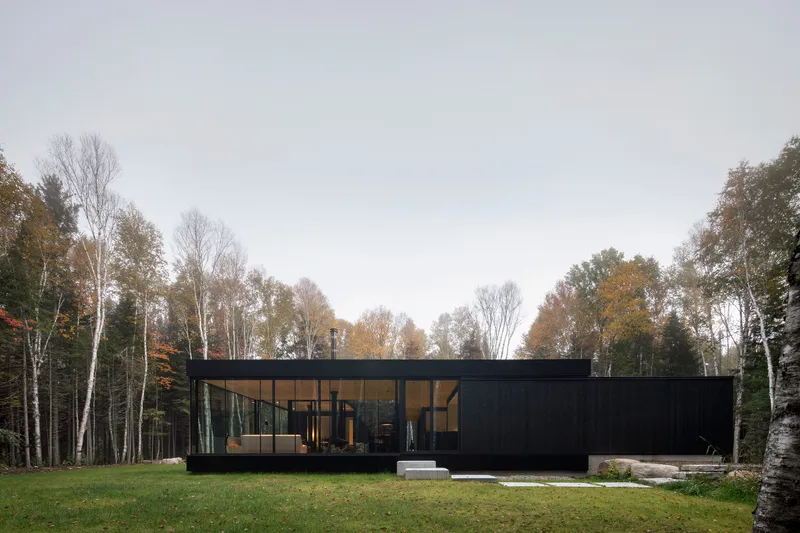
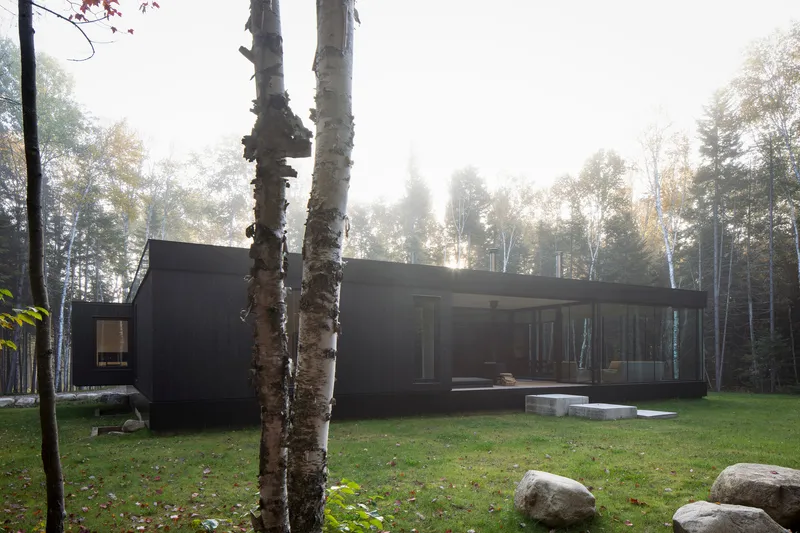
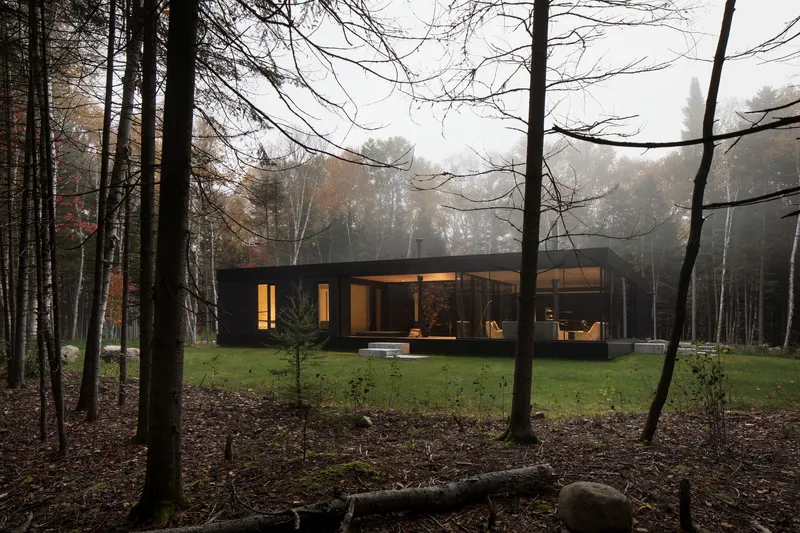
From a distance the house registers as a dark horizontal band among the birch trunks. The flat roof, the low profile, the black timber cladding: everything conspires to keep the architecture subordinate to its site. In fog or autumn mist the building nearly vanishes, its edges softened by the vertical rhythms of surrounding trees. ACDF calibrated the massing so that the structure never rises above the forest canopy. It occupies the understory, quietly.
The seasonal range here is extreme. Snow buries the terrace steps in winter. Leaves crowd the glass in summer. The house was designed to absorb those shifts rather than resist them, and the photographs by Adrien Williams capture this legibility well. The same facade that glows warmly at dusk disappears entirely under a grey November sky.
Two Slabs and Three Boxes
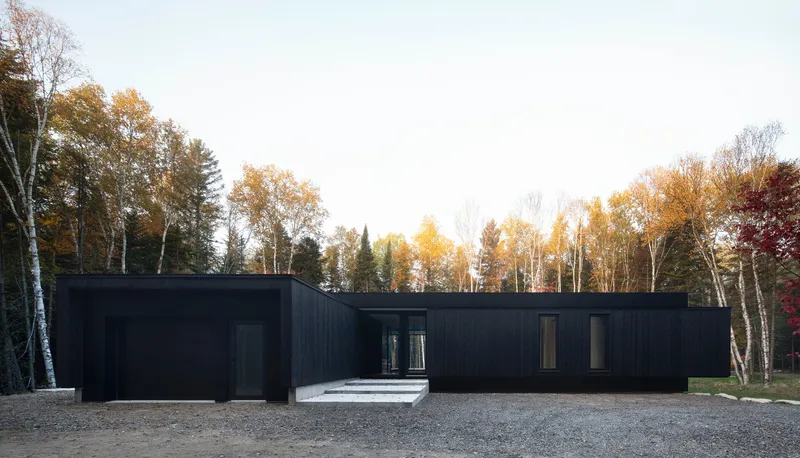
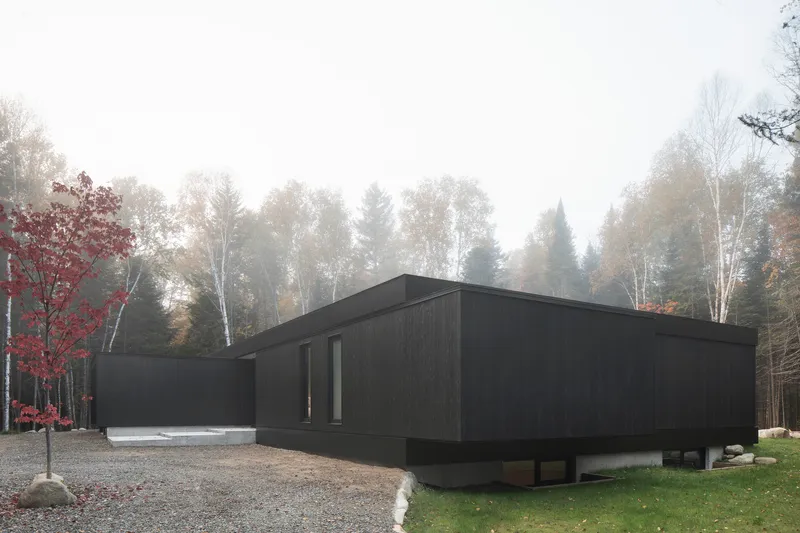
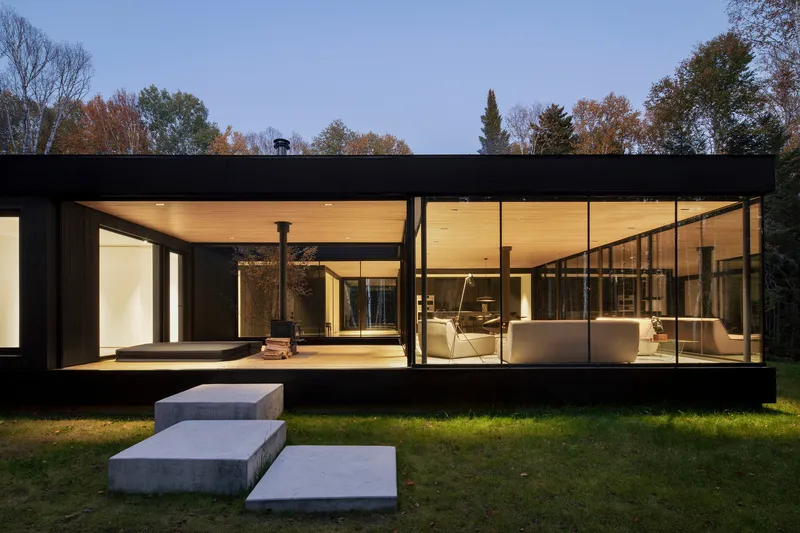
The structural logic is clean enough to diagram on a napkin. Two concrete slabs, clad in solid aluminum frames, define the floor and roof planes. Between them, three independent timber volumes are inserted like drawers in a chest. One holds the garage and service spaces, another contains the children's bedrooms and bathrooms, and the third houses the primary suite. Each box protrudes slightly beyond the concrete planes, giving the elevations a subtle push-pull articulation that prevents the facade from reading as a flat wall.
Steel columns carry the loads where glass replaces solid wall. The contrast between the opaque timber boxes and the fully glazed intervals creates a rhythm of compression and release as you move through the plan. You are either enclosed by wood or exposed to forest. There is no ambiguous middle ground.
The Tree at the Center
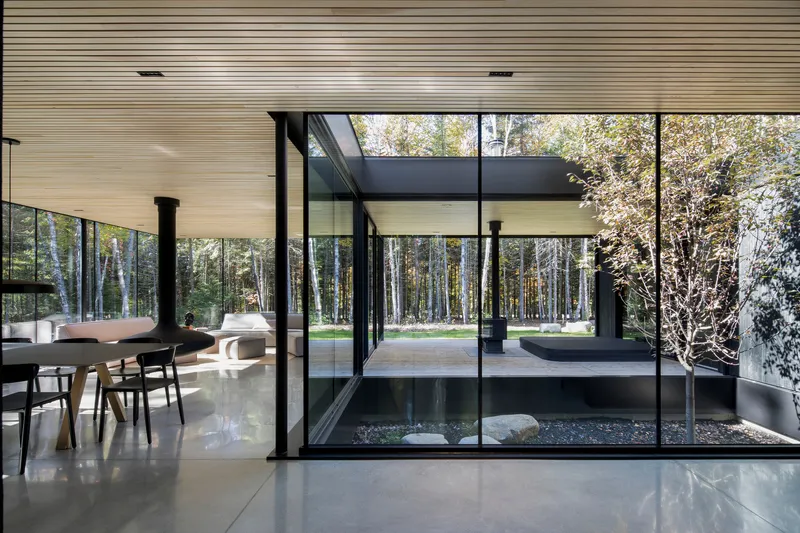
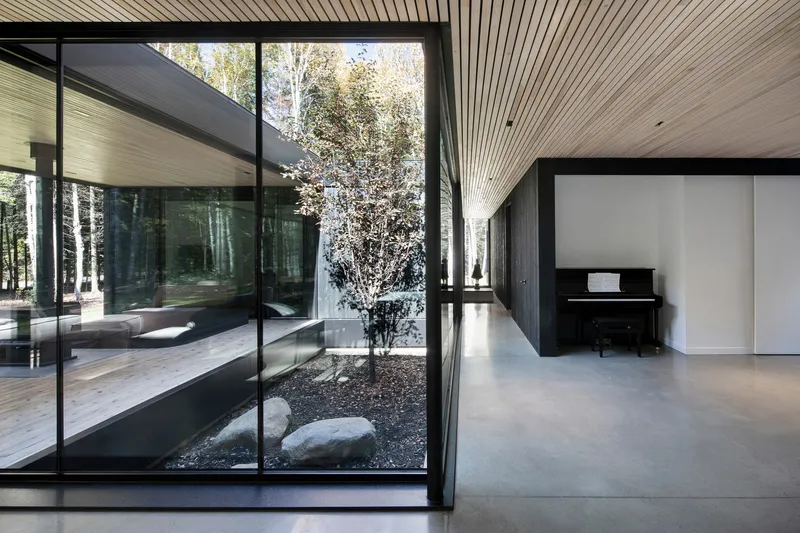

The apple tree courtyard is the move that elevates this project from polished pavilion to something with genuine conceptual weight. ACDF cut an opening through the center of the plan and replanted a tree inside it, enclosed by glass on all sides and open to the sky above. Black gravel fills the bed. In winter, bare branches scratch against the aluminum framing. In summer, the canopy filters light down into the corridors that flank it.
Functionally, the courtyard serves as a light well, pulling daylight deep into the plan and framing upward views of sky and treetops. But its real purpose is symbolic. The tree becomes the central pillar of the house, a living element that the architecture literally wraps around. It ages. It drops fruit. It loses leaves. In a house defined by precision and control, the tree introduces the one variable the architects cannot manage.
Interior: Concrete, Wood, and Silence
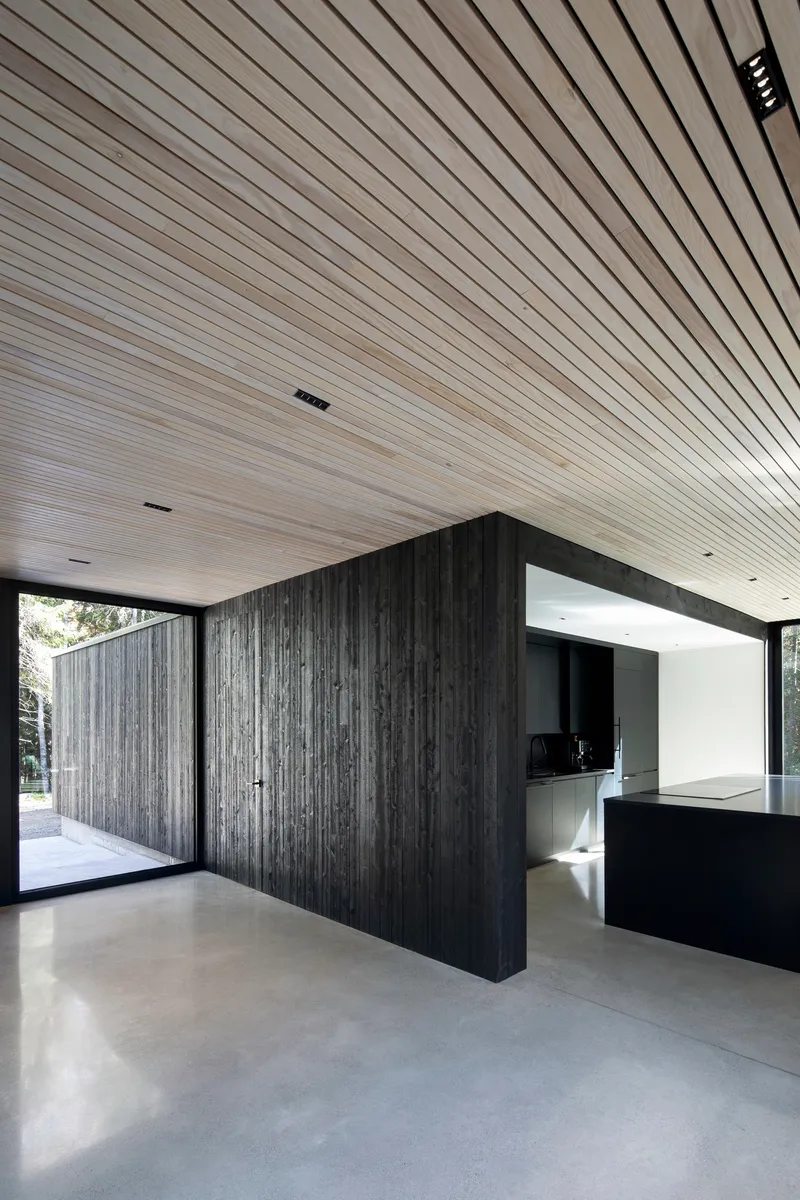
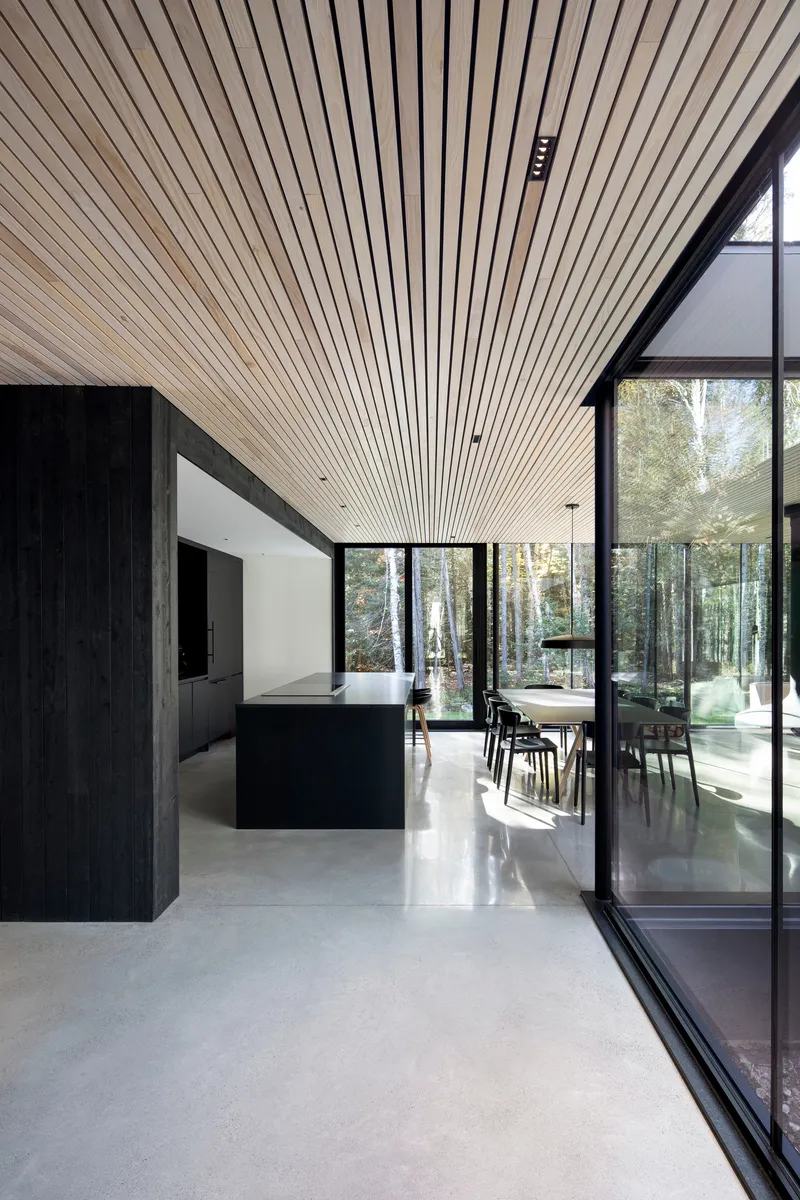
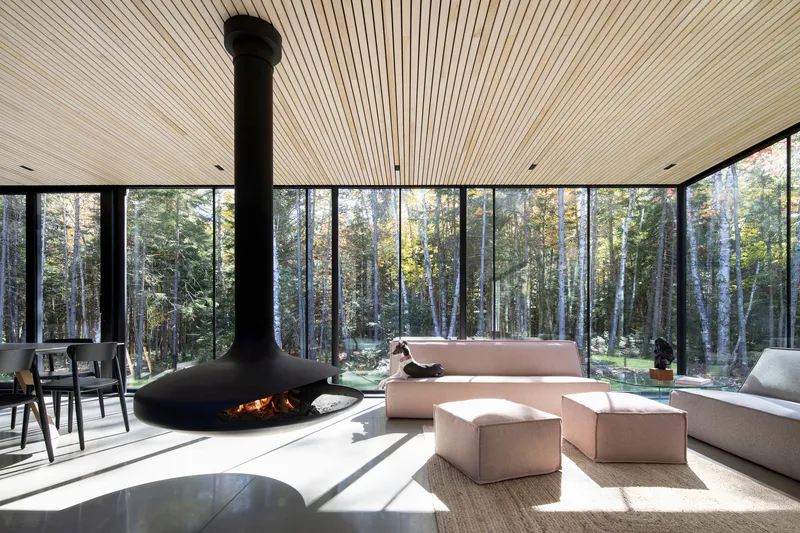
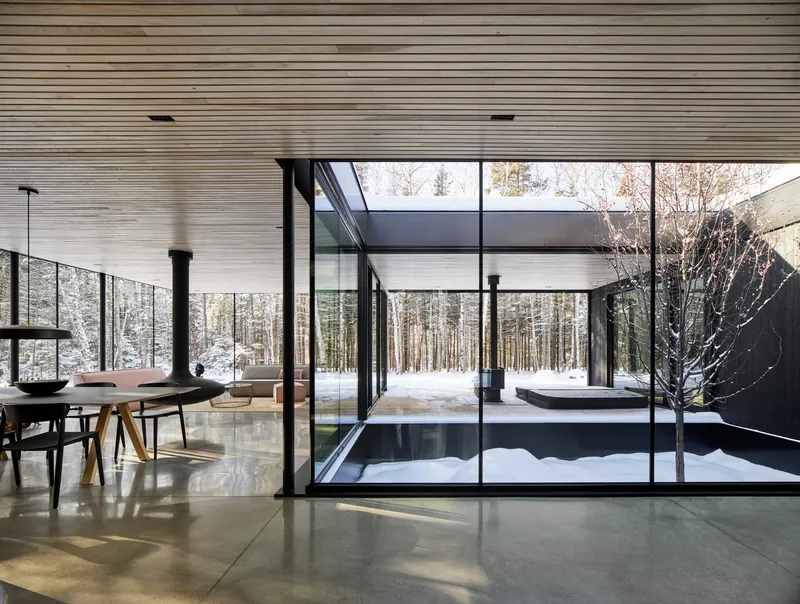
The open floorplate is generous without being ostentatious. Kitchen, dining area, and living room flow into one another across a polished concrete floor, organized by the timber volumes rather than by partition walls. A suspended conical fireplace anchors the living area, providing a focal point that is not a screen. Near the main entrance, an upright piano sits in a custom-built alcove, positioned so that playing does not impose on the broader dynamics of the room. These are domestic details that suggest a family actually lives here.
The slatted wood ceiling deserves attention. Wooden planks run in parallel lines with half-inch gaps between them, and a layer of black fabric sits on the underside to capture sound. The acoustic strategy is a direct response to the enormous amount of glazing: without intervention, the space would reverberate harshly. Instead, the ceiling absorbs sound while its warm tone counters the coolness of concrete and steel below. It is one of those details that you might not notice until you clap your hands and hear how quickly the room quiets down.
Living with the Seasons
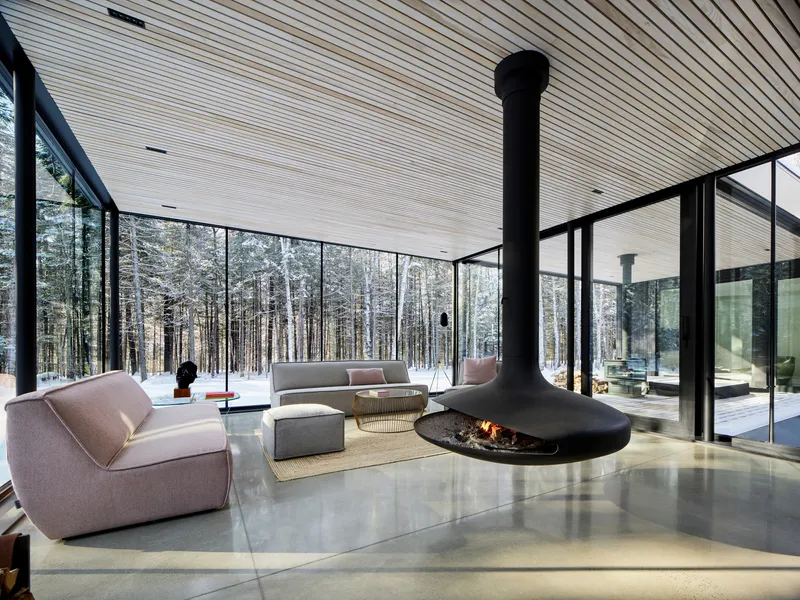
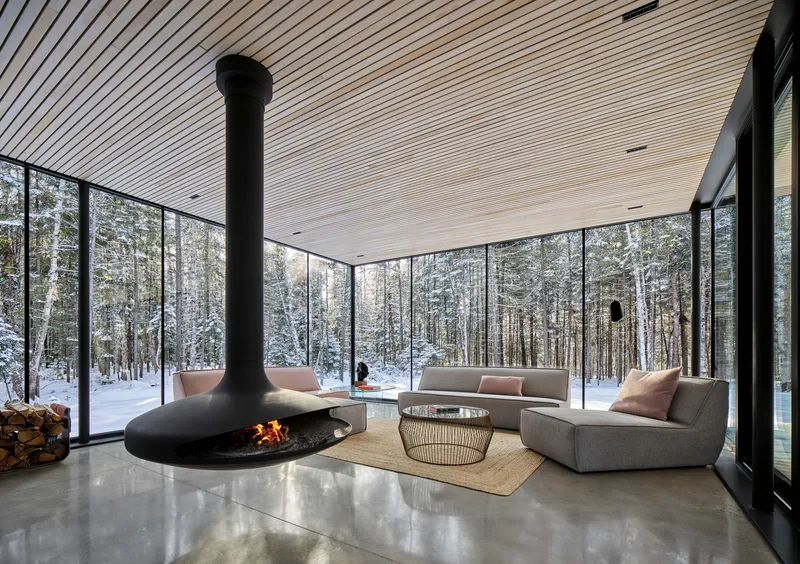
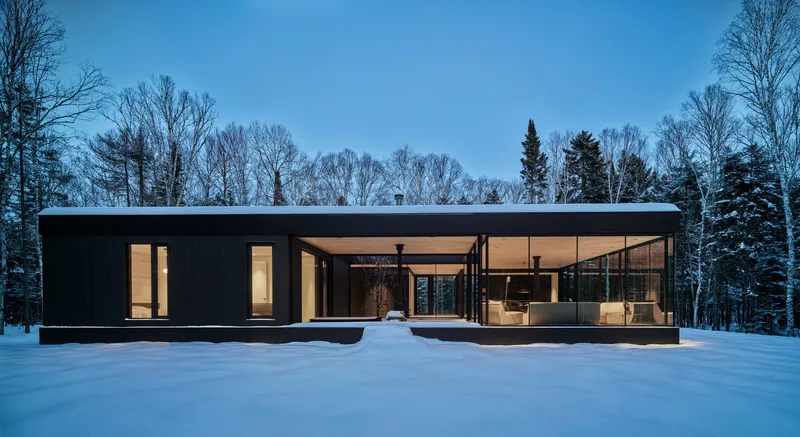
The winter images are extraordinary. Snow piles against the glass walls, birch trunks stand white against a blue twilight, and the interior glows like a lantern. The house was oriented to correspond with the movement of the sun, maximizing the light admitted through its floor-to-ceiling windows at every hour. In a climate where winter daylight is scarce and precious, this alignment is not decoration. It is survival.
The covered timber deck, with its freestanding black steel fireplace column, extends the living space outdoors in warmer months. Sliding glass doors open fully to dissolve the boundary between deck and interior. In deep snow, the same terrace becomes a visual buffer between the warm concrete floor and the frozen landscape beyond, a threshold that the eye crosses even when the body cannot.
Private Spaces and Forest Views
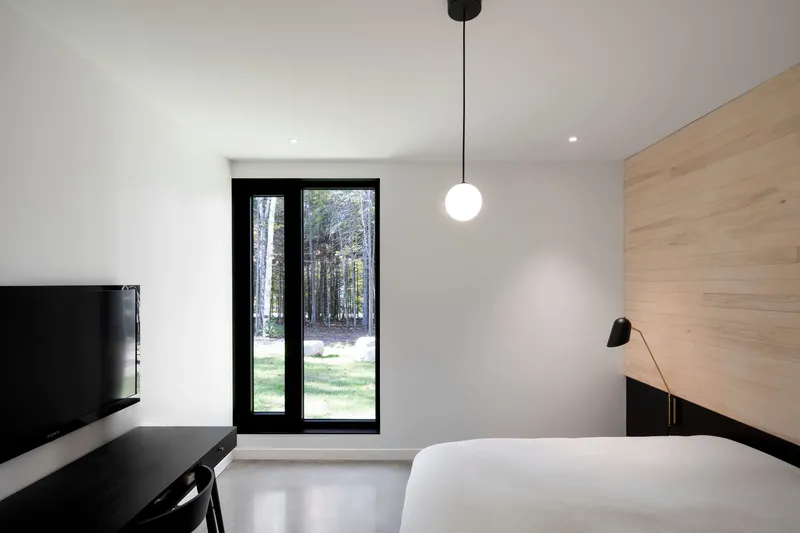
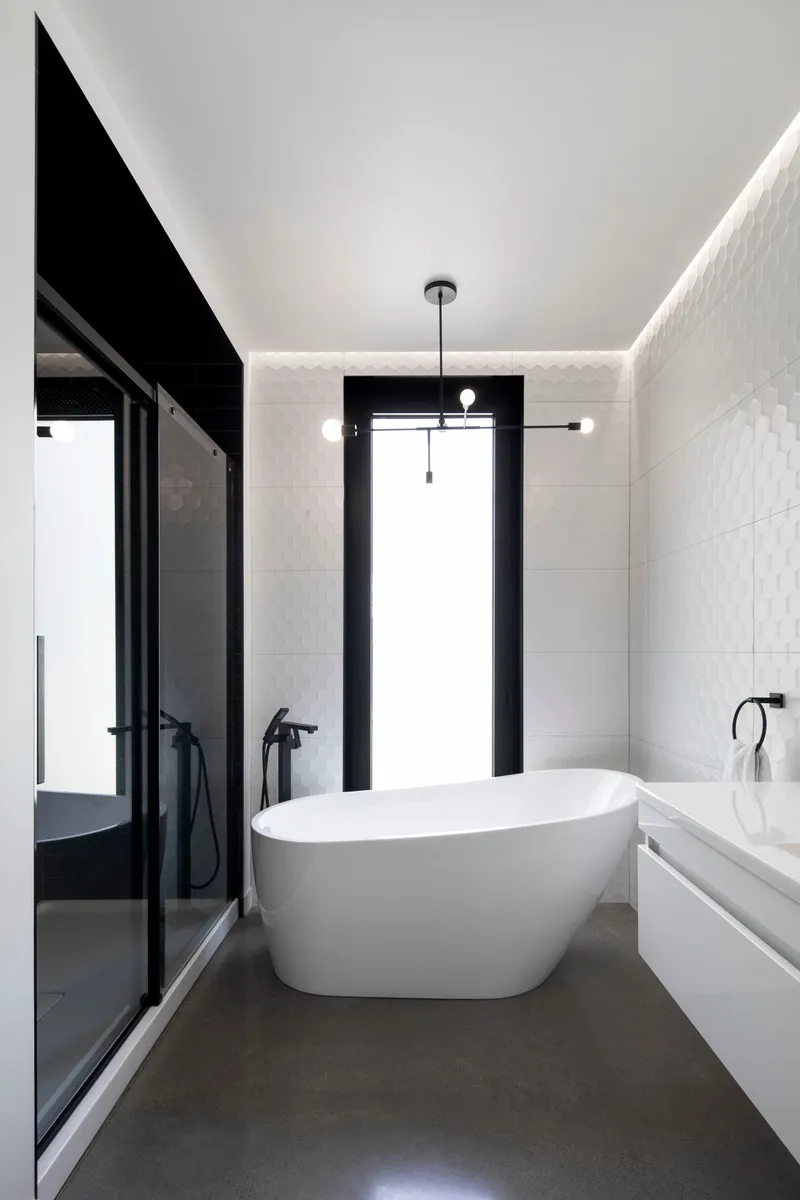
The private rooms retreat behind the timber volumes. The bedroom features a wood accent wall and a carefully scaled window that frames the forest without turning the room into a fishbowl. The bathroom, by contrast, is fully enclosed: white tile, a freestanding tub, concealed perimeter lighting. It is the one room in the house where you cannot see a tree, and the relief feels intentional.
From the interior corridors, views through black-framed glazing reach into the central courtyard and out to the forest beyond, layering depth through multiple glass planes. The effect is cinematic. You see the apple tree, then the birch forest behind it, then the sky. The architecture becomes a series of frames within frames.
Threshold and Approach
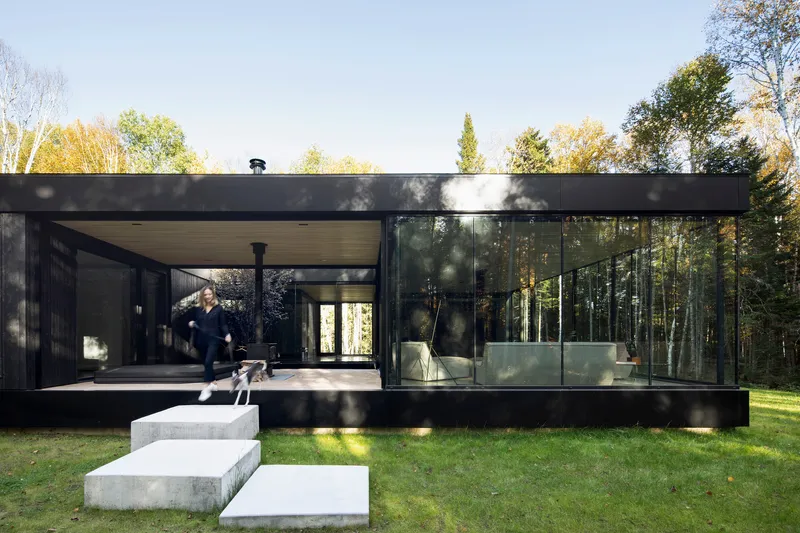
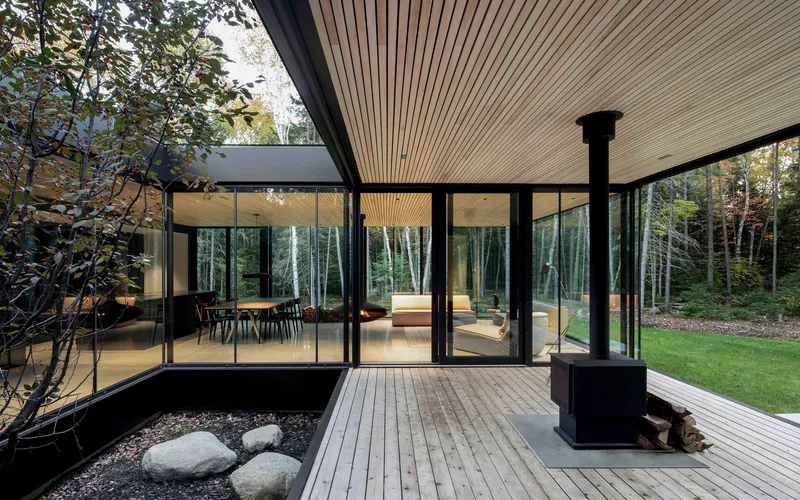
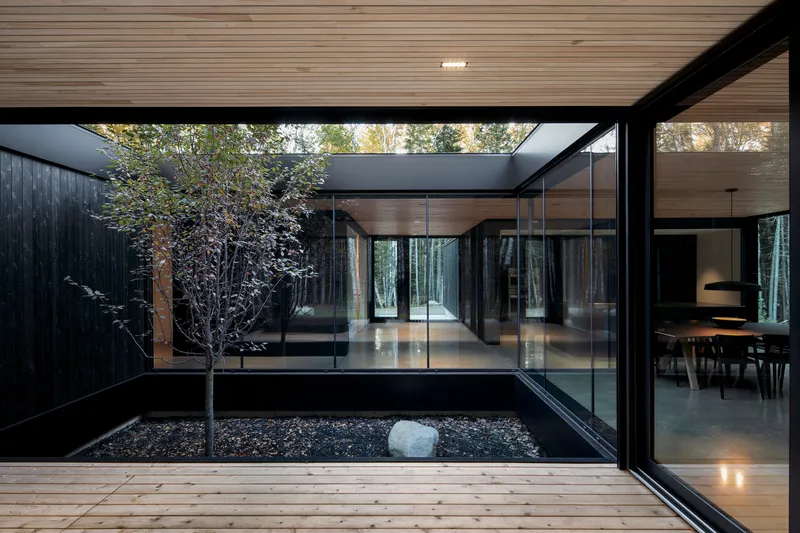
Arrival is handled with restraint. A gravel drive leads to stone entry steps and the vertical black cladding of the front facade. The house does not announce itself. You approach through the trees and the building reveals itself incrementally, its dark surfaces blending with the bark of surrounding trunks. The concrete terrace steps mediate between the grade of the site and the elevated floor plane, and a figure walking beneath dappled sunlight reads as part of the landscape rather than an intruder upon it.
At dusk, the courtyard becomes the most compelling view from the deck. The gridded timber platform, dusted with snow, frames the young tree against charred wood walls. Interior lighting turns the glass enclosure into a vitrine. The tree is simultaneously inside and outside, sheltered and exposed, domestic and wild.
Plans and Drawings
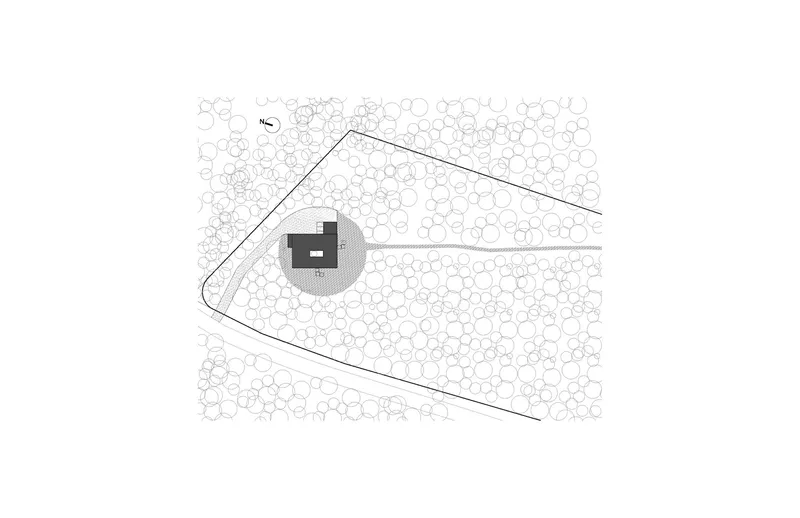
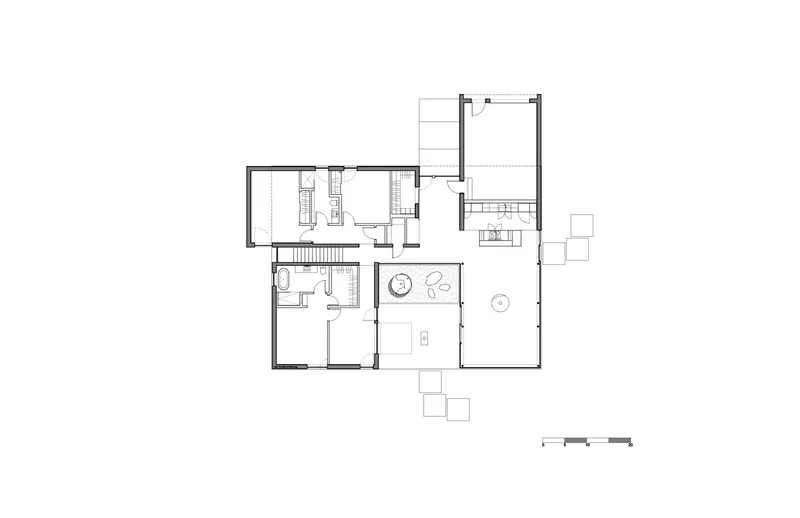
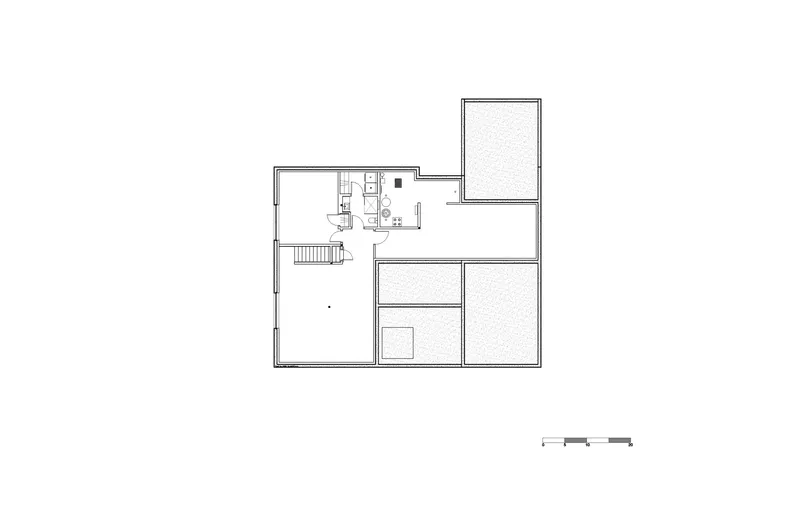
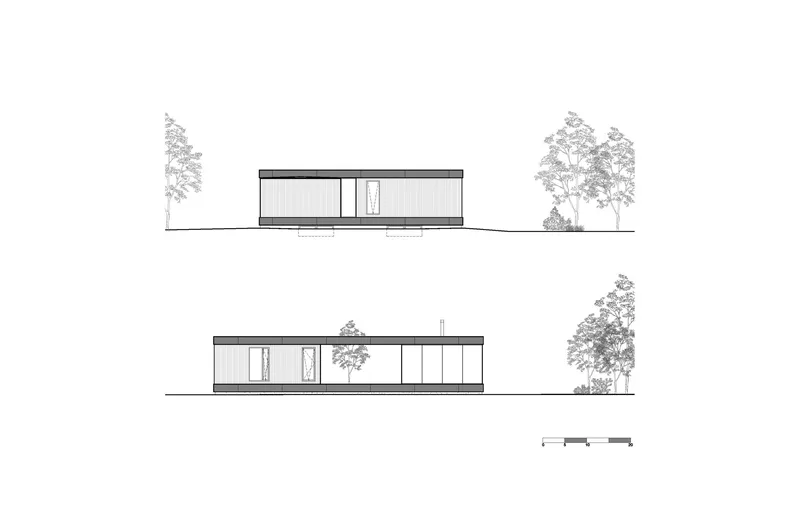
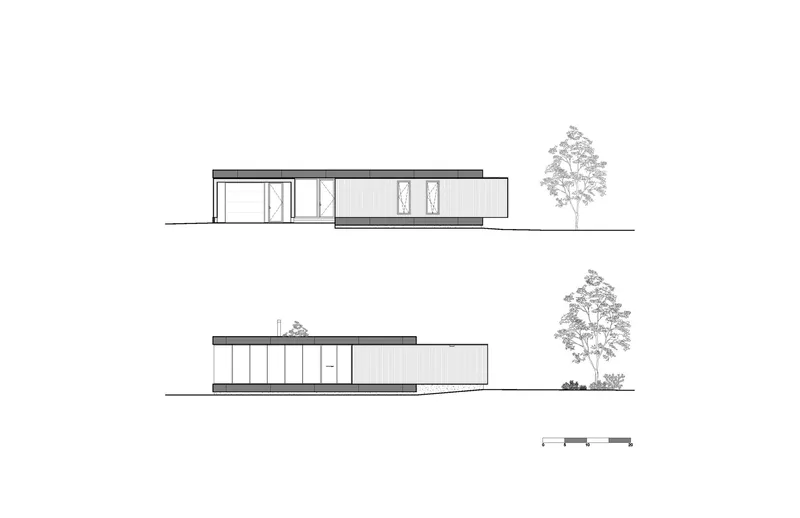
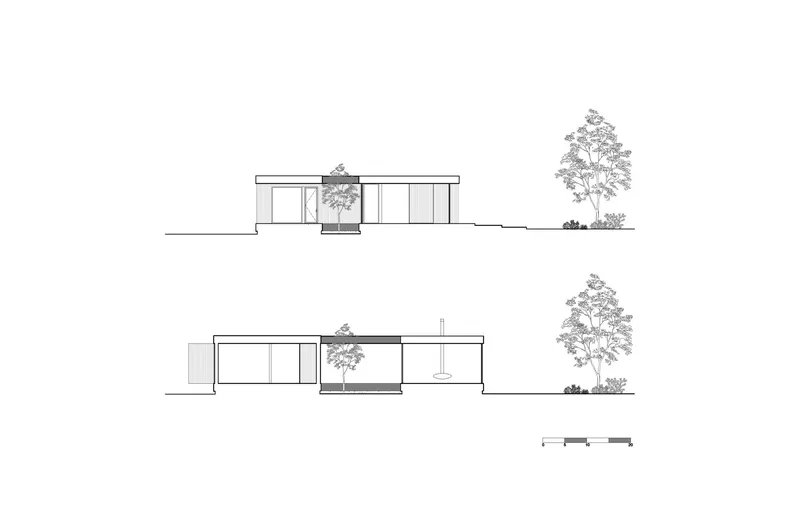
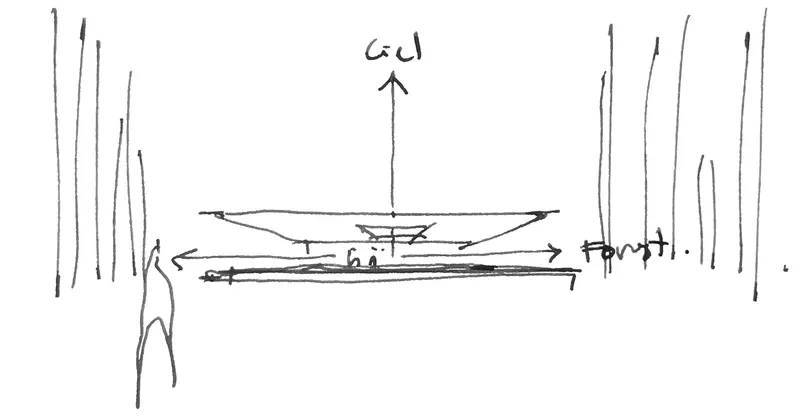
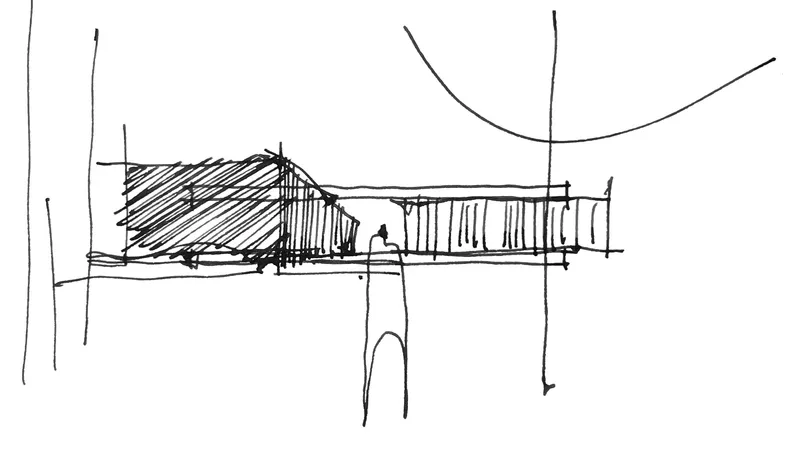
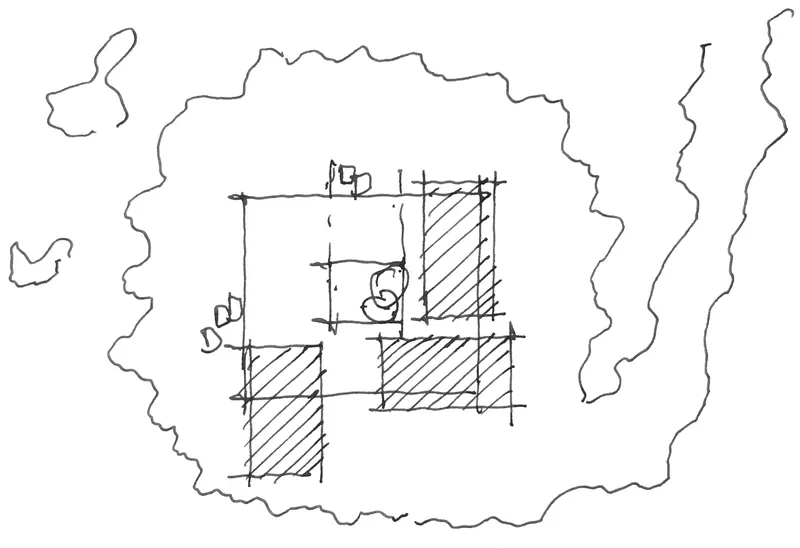
The site plan reveals the house as a compact rectangular composition within a vast irregular lot, its long axis aligned to capture solar movement. The floor plans confirm the L-shaped organization, with the three timber volumes creating clear zoning between public and private programs. Early sketches show the design concept at its most elemental: a cantilevered roof plane floating above a landscape of trees, with arrows indicating cross-ventilation strategies. The hatched roof and vertical screening elements in the sketch elevations point to the acoustic and thermal thinking that shaped the final detailing.
Why This Project Matters
The glass pavilion in the woods is one of modernism's most enduring archetypes, and it is also one of its most exhausted. From Farnsworth to the countless Instagram cabins that followed, the formula can feel like a cliché. What distinguishes the Apple Tree House is the decision to bring the landscape inside, not as a view but as a physical presence. The apple tree growing through the center of the plan is not a gimmick. It is a structural and spatial commitment that reorganizes circulation, light, and meaning around a living element that the architects cannot control.
There is also something worth noting about an architect designing for his own family. The choices here, from the piano alcove to the acoustic ceiling to the single room without a view, suggest a level of domestic intelligence that client-driven work rarely achieves. ACDF has built a house that is rigorous in its systems and specific in its comforts, a rare combination in residential architecture. The forest will keep growing. The tree will keep fruiting. The house, if it is good enough, will keep up.
Apple Tree House by ACDF Architecture, located in Saint-Donat-de-Montcalm, Quebec, Canada. Completed in 2021. Photography by Adrien Williams.
About the Studio
Share Your Own Work on uni.xyz
If projects like this are the kind of work you want to make, uni.xyz is a place to publish your own, find collaborators, and enter design competitions.


Popular Articles
Popular articles from the community


Manzana Morphosis: Stretching Barcelona's Grid into a Living Landscape for 2050
A radical reworking of the Eixample manzana turns density into a tool for generous public space, vertical ecology, and environmental performance.
Opera by the Sea Estonia: Three Shells Dissolving Architecture into Tallinn's Coastline
A winning opera house proposal replaces monumental form with interconnected shells that blur the boundary between building, park and Baltic Sea.
Extended Shell: Retrofitting Kolkata's Balconies as Living Urban Thresholds
A modular retrofit system recovers the social and environmental intelligence of Kolkata's historic verandas for contemporary Park Street residents.
Temporary Home for Dogs: A Reversed Zoo Rethinks Animal Shelter Architecture
In Bucharest, a sinuous corridor and freed landscape flip the logic of containment, designing a shelter that works to make itself unnecessary.

Similar Reads
You might also enjoy these articles

Bao Huynh Watercolor Atelier: A Serene Art Retreat in Hội An
Bao Huynh Watercolor Atelier in Hội An blends multifunctional art spaces, sustainable design, local materials, and family-friendly living in a serene environment.

Atelier Macri Concept Store Interior Design by CASE-REAL
Atelier Macri store features a "ko" counter, walnut wood details, cork displays, blending retail, gallery, and seamless customer experiences.

Manuel Vargas Izquierdo Stadium and High-Performance Sports Center: Architectural Excellence in Jalpa de Méndez
The Manuel Vargas Izquierdo Stadium blends sustainable design, inclusive sports facilities, and cultural-inspired architecture, revitalizing Jalpa de Méndez’s public spaces.

KAKR Buluh Awar Hall: Revitalizing Community and Ecology Through Bamboo Architecture
Community built bamboo hall revitalizes Buluh Awar village, empowering youth, restoring ecology, celebrating vernacular craftsmanship through sustainable architecture and culture.

Explore Tree House Competitions
Discover active competitions in this discipline

Challenge to design mud housing for contemporary communities

Challenge to reimagine the Iron Throne

Photograph architecture without architects

Illustrate the lost glory of Angkor Wat - Render Challenge
Comments (0)
Please login or sign up to add comments
No comments yet. Be the first to comment!