
Adaptive Reuse Architecture for Social Integration: Exodus Palace by Tolga Hazan
Adaptive reuse architecture transforms Parisian urban voids into a refugee-led cultural hub fostering social integration and economic resilience.


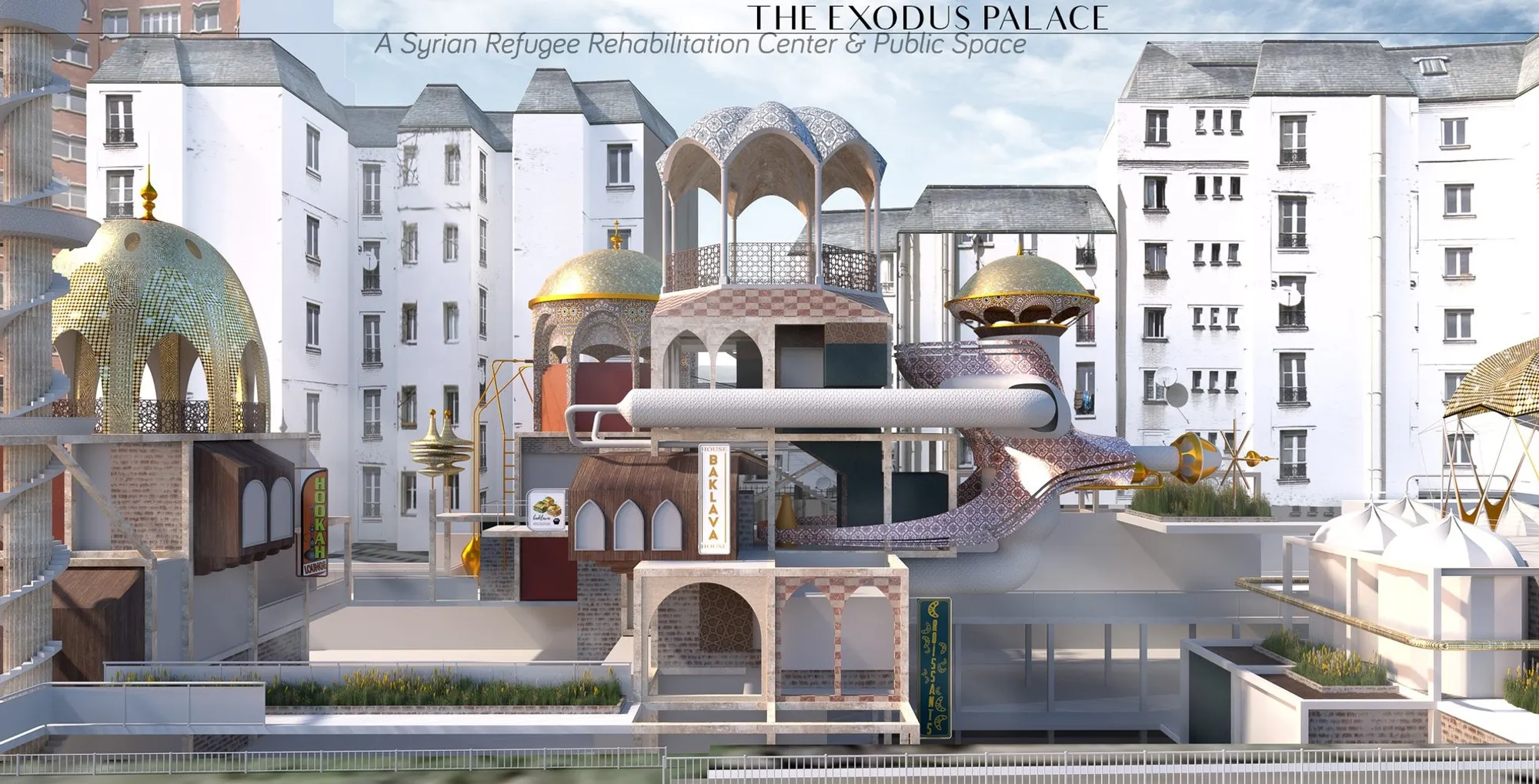
In the evolving discourse of adaptive reuse architecture, projects that merge social infrastructure with public space are redefining how cities respond to displacement and cultural integration. Exodus Palace, a shortlisted entry in the Salut Paris competition by Tolga Hazan, proposes a Syrian Refugee Rehabilitation Center embedded within a public urban framework. The project operates not only as a spatial intervention but as a socio-economic system that activates underutilized urban fabric.
Positioned within the context of Paris’ fragmented urban voids, the proposal reimagines architecture as an interface between displaced communities and the host city. By integrating cultural production, economic participation, and public engagement, the project aligns with contemporary strategies in adaptive reuse architecture that prioritize inclusivity and resilience.
Concept: Architecture as a Catalyst for Integration
At its core, Exodus Palace is conceived as a hybrid typology combining rehabilitation infrastructure with a vibrant public realm. Refugee families are not passive occupants but active contributors to the spatial and economic ecosystem. The project enables them to engage in culturally rooted activities such as culinary production, music, crafts, and spiritual practices, transforming these into public-facing programs.
This approach mirrors the socio-spatial dynamics of cultural enclaves such as Chinatown, where identity-driven economies become urban attractors. However, Exodus Palace extends this model by embedding it within an architectural framework that actively encourages cross-cultural interaction rather than segregation.
The result is a public space that is both performative and participatory, where cultural exchange becomes the primary driver of urban activation.
Spatial Strategy: Linear Connectivity and Layered Platforms
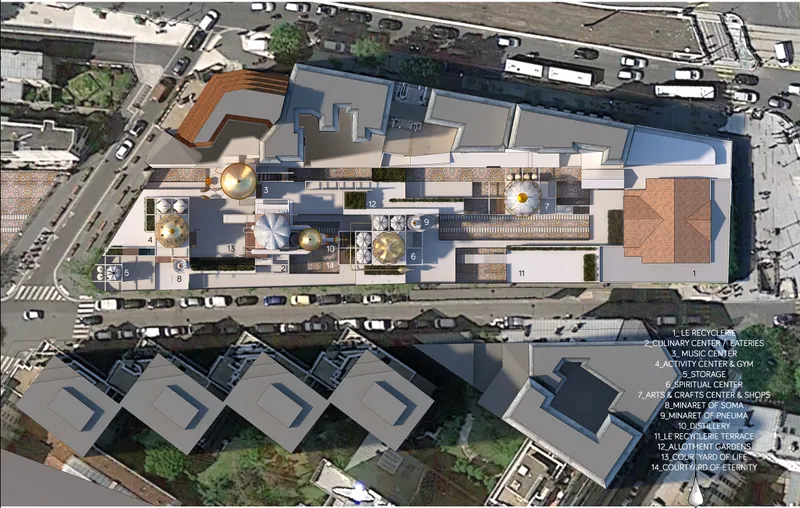
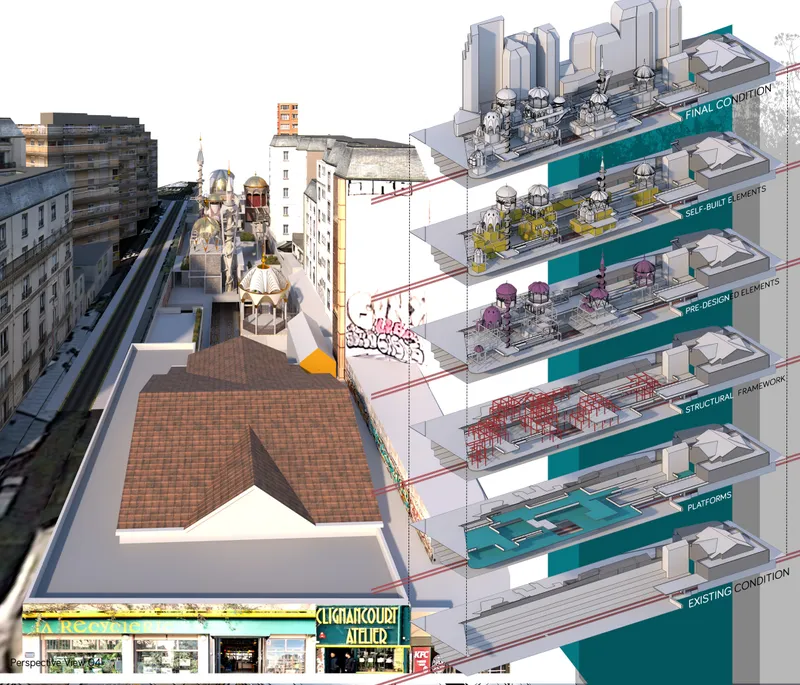
Responding to the inherent linearity of the site, the project introduces a multi-level platform system that stitches together previously disconnected edges. This platform acts as the primary circulation spine, expanding usable surface area while facilitating movement across the site.
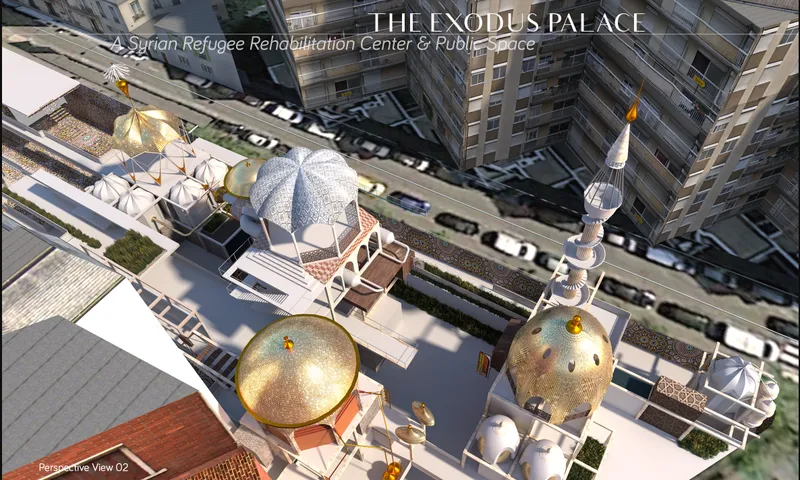
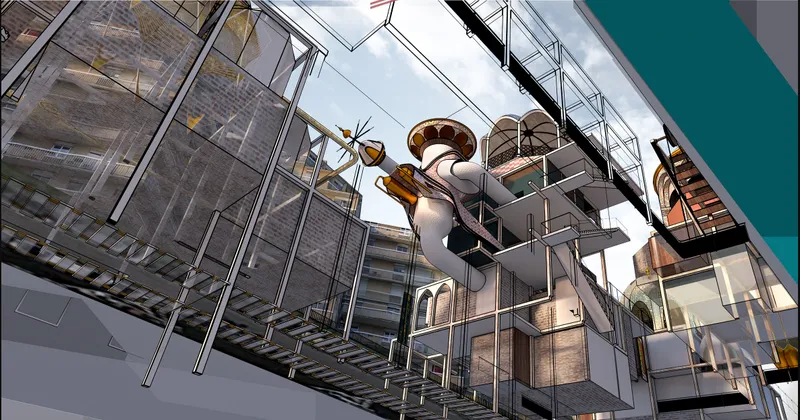
Vertical elements, including expressive towers and domed structures, punctuate the horizontal continuity, creating spatial anchors and visual identity. These towers are strategically placed to break monotony, introduce courtyards, and generate moments of pause within the linear sequence.
The layered organization enables a gradient of public to semi-private spaces, allowing for both collective engagement and individual occupation. This spatial logic aligns with advanced adaptive reuse strategies where layering becomes a tool for densification without compromising accessibility.
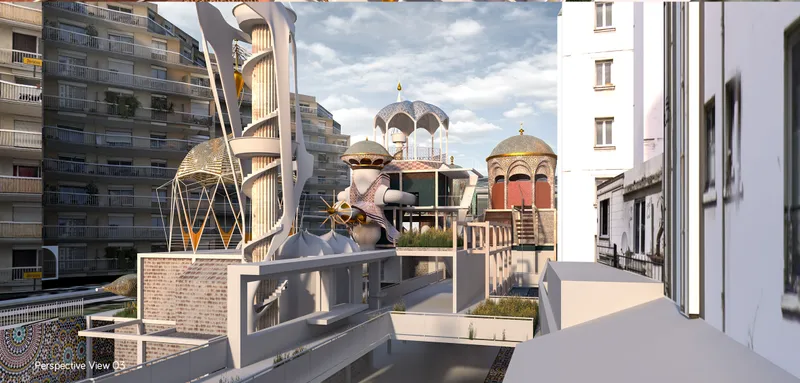
Programmatic Framework: Cultural Production as Infrastructure
Exodus Palace integrates a diverse range of programs that collectively function as an economic and cultural engine:
- Culinary Center & Eateries: Spaces where refugees prepare and sell traditional Syrian cuisine while engaging with local culinary practices.
- Music Center: Platforms for live performances and cross-cultural musical exchange.
- Activity Center & Gym: Recreational spaces that support physical well-being and community interaction.
- Spiritual Center: Multi-religious environments for meditation, yoga, and spiritual practices.
- Arts & Crafts Center: Workshops that enable skill development and artistic expression across Eastern and Western traditions.
- Distillery: Production of traditional Syrian beverages, introducing niche cultural products into the urban economy.
Additionally, symbolic architectural elements such as dual minarets represent both physical and spiritual dimensions, reinforcing the narrative of identity and belonging.
This programmatic diversity transforms the project into a micro-urban system where production, consumption, and interaction coexist within a unified architectural language.
Material and Construction Strategy: Flexibility Through Reuse
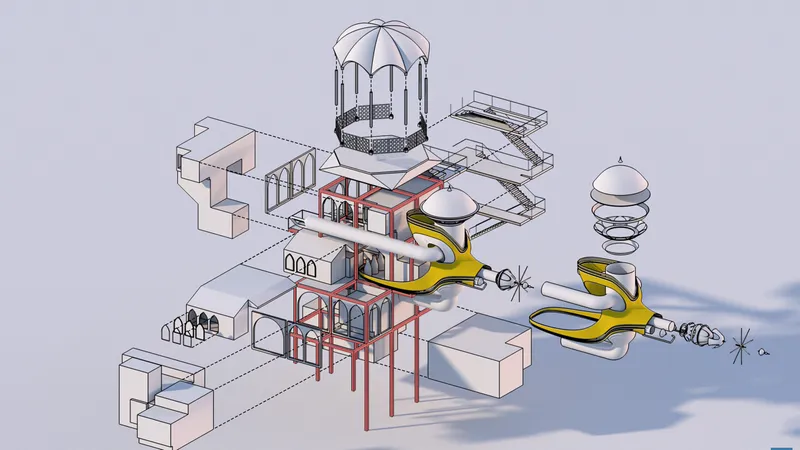
A key aspect of the project lies in its emphasis on cost efficiency and adaptability. The design incorporates pre-designed modular elements alongside a flexible framework that allows for incremental, self-built interventions using reclaimed materials.
This strategy reflects a critical understanding of adaptive reuse architecture, where sustainability is not limited to material recycling but extends to enabling user participation in construction and evolution of space.
The phased layering of structural frameworks, platforms, and infill elements allows the project to evolve over time, responding to changing needs without requiring large-scale redevelopment.
Urban Impact: Bridging Social and Spatial Fragmentation
Exodus Palace operates as a connective urban device that addresses both physical and cultural disjunctions. By bridging fragmented site conditions, the project establishes continuity within the urban fabric while simultaneously fostering social cohesion.
The integration of public programs ensures constant activity, transforming the site into a destination rather than a residual space. Cultural programming becomes the mechanism through which the public engages with refugee communities, shifting perceptions from marginalization to participation.
This dual role as both infrastructure and social platform positions the project within a broader architectural agenda that seeks to redefine public space as an inclusive and dynamic system.
Critical Reception
The project generated mixed responses from the jury, reflecting both its ambition and its unresolved challenges.
Rachel Luchetti (Juror): "Not convinced that this solution responds to the brief"
Fuensanta Nieto (Juror): "The presentations and drawings are very appealing but we do not believe that it complies with the requirements of mobility and flexibility that the brief looks for."
These critiques highlight a key tension within the proposal. While the conceptual framework and visual articulation are compelling, questions remain regarding its operational adaptability and responsiveness to the competition’s requirements.
Exodus Palace stands as a provocative exploration of adaptive reuse architecture in the context of migration and urban integration. By positioning cultural production as a central architectural strategy, the project challenges conventional notions of rehabilitation infrastructure.
Its strength lies in its ability to merge social systems with spatial design, creating a platform where identity, economy, and public life intersect. At the same time, the project opens up critical discussions on flexibility, mobility, and the practical implementation of such complex hybrid systems.
Within the broader discourse of architecture, Exodus Palace contributes to an ongoing shift toward projects that are not only spatially innovative but socially transformative.




Popular Articles
Popular articles from the community


Riyadh For All: Intergenerational Urban Design for Active Aging in Rabat
Riyadh For All reimagines urban design in Rabat with intergenerational co-living, adaptive courtyards, and Moroccan cultural exchange today.

The Ocean Hive: Sustainable Architecture for a Self-Sufficient Civilization at Sea
The Ocean Hive imagines sustainable architecture at sea, where modular habitats, algae, wave power and ocean waste sustain a growing colony.

Co-life: Sustainable Architecture for Age-Friendly Community Living
Co-life reimagines sustainable architecture for seniors through courtyards, rammed earth, shared gardens, and spaces designed for belonging.

Lunar Spiral: Space Architecture Shaped by the Mathematics of the Universe
Lunar Spiral reimagines space architecture through Fibonacci geometry, lunar regolith, levitating habitats, and self-sustaining Moon living.
Similar Reads
You might also enjoy these articles

Eco Chapel: A Green Architecture Pavilion Designed in Symbiosis with the Forest
Eco Chapel uses green architecture to weave prayer, learning and reuse into a forest pavilion shaped by modular hexagonal canopies for life.
Kaffeebühnen: Coffee Shop Architecture Designed as a Civic Stage Between Vienna’s City and Park
Kaffeebühnen turns coffee shop architecture into a civic stage, linking Vienna’s park edge, urban life, warm timber yards, and coffee craft.
Healing Façade: Sustainable Architecture for Reforestation, Community, and Sacred Ecology in Ethiopia
Healing Façade reimagines sustainable architecture as a living wall that restores soil, catches water and renews Ethiopia's forest churches.


Urban Forest: A Vertical Ecosystem for 5,000 Workers in Singapore's Changi Business Park
Radially stacked pods and layered green decks turn a 7-acre plot into 47 acres of ecological workspace projected for 2040.


Explore Architecture Competitions
Discover active competitions in this discipline



Challenge to reimagine the Iron Throne


Photograph architecture without architects


Illustrate the lost glory of Angkor Wat - Render Challenge


Design challenge to reuse E-waste
Comments (0)
Please login or sign up to add comments
No comments yet. Be the first to comment!