
Aeroscraper: A Vertical Airport for Midtown Manhattan
A supertall tower above Grand Central Terminal with cantilevered aircraft docking bays, sky lobby atria, and a cruciform plan built for flight.


A skyscraper is, by definition, a building that scrapes the sky. The Aeroscraper is a building that uses the sky. Designed by Xiaohan Wu, Jin Qiu, and Xiyao Wang, this supertall tower for Midtown Manhattan integrates vertical airspace into its architecture. Every few floors, a cantilevered platform extends from the facade for aircraft to dock. The building is not just tall. It is a port.
The project received an Honorable Mention in the Hybrid Futures '19: Work x Fly competition on uni.xyz. It is one of the most site-specific entries in the competition: designed for a real plot between 42nd and 43rd Streets, directly above Grand Central Terminal.
Midtown Manhattan: The Only Site That Makes Sense

The Aeroscraper is not a generic supertall. It is designed for the densest, most connected transportation hub in the Western hemisphere. Grand Central Terminal sits at its base. The subway, commuter rail, and bus networks are directly below. The argument is simple: if personal air mobility arrives, the first place it will land is the place that already has the most connections. You do not build a vertical airport in the suburbs. You build it where people already are.
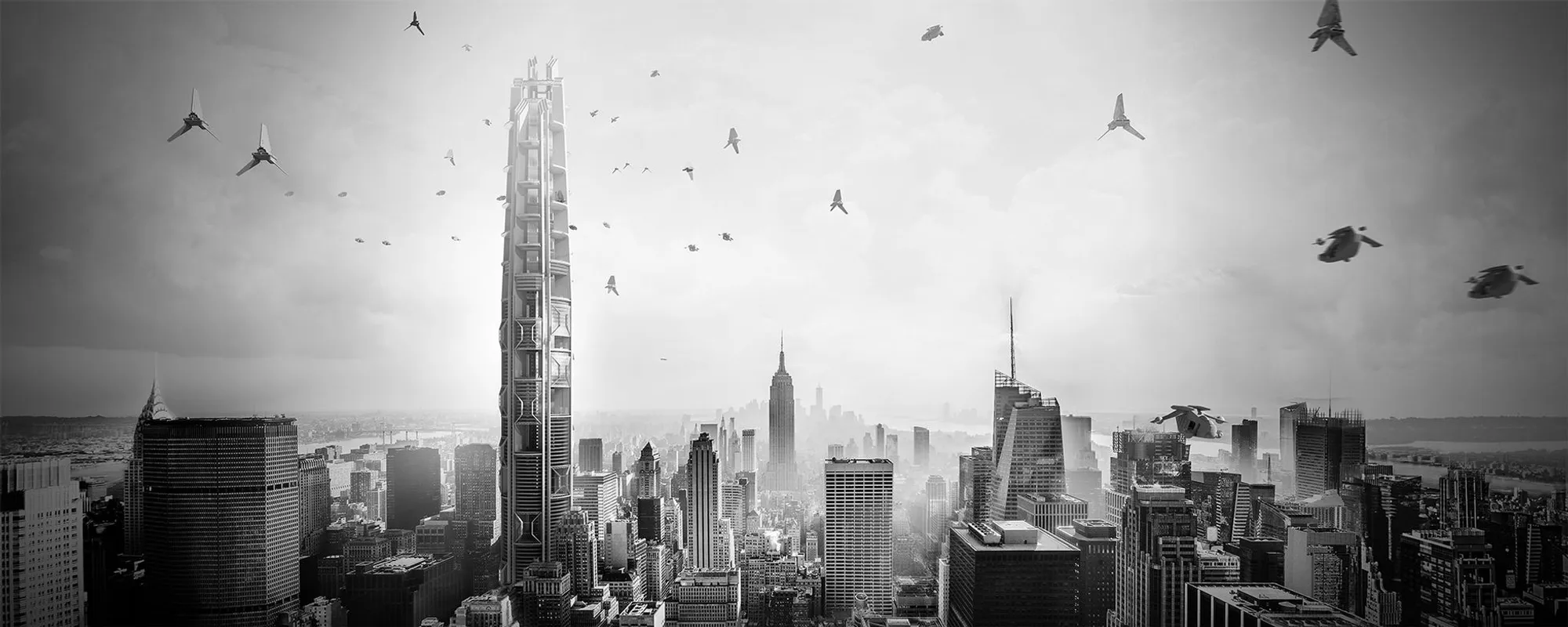
The monochrome skyline render makes the scale legible. The tower rises above the existing Midtown skyline, with personal flying vehicles circling at various heights. The Empire State Building is visible in the background, providing the scale reference that makes the Aeroscraper's ambition clear.
The Docking Bay: Where Building Meets Aircraft
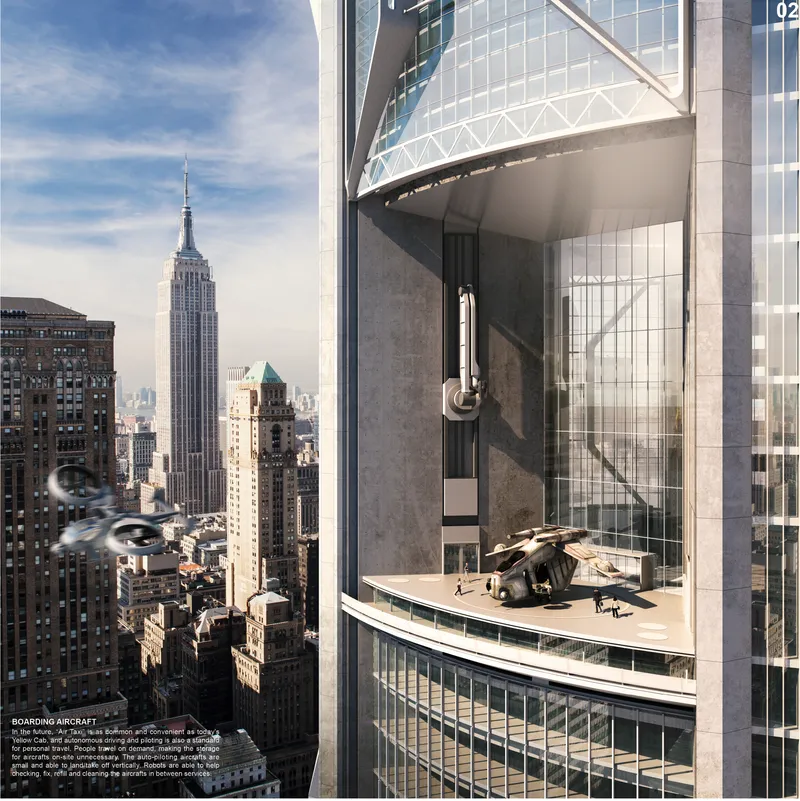
The close-up render is the project's signature image. A VTOL vehicle sits on a cantilevered platform that extends from the building's glass facade. The bay is open to the air on three sides. The Empire State Building is visible across the skyline. The annotation describes these as functioning like vertical taxi ranks: autonomous vehicles dock, passengers board, and the platform clears for the next arrival.
The engineering challenge here is real. Cantilevering a landing platform from a supertall at height means managing wind loads, vibration, and dynamic forces from aircraft takeoff and landing. The project does not solve these problems in detail, but it identifies them clearly, which is the appropriate scope for a competition entry.
Sky Lobbies: Not Lobbies, but Neighbourhoods
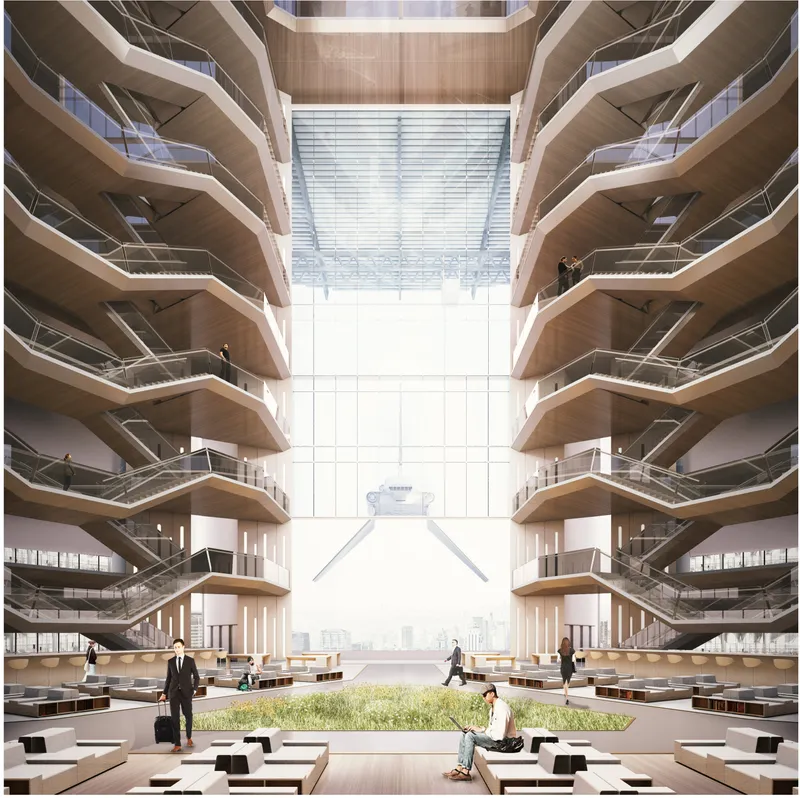

The sky lobbies are the project's best interior spaces. They are full-height atria surrounded by stacked timber-clad balconies, flooded with natural light from above, with grass-covered floors and seating scattered informally. An aircraft is visible through the glass wall, reminding you that this is not a conventional office building. It is a building where you arrive by air and work in a garden.
The second sky lobby render shows the same space at sunset, transformed into a concert venue. A crowd gathers beneath the stacked balconies as golden light pours through the curtain wall. This image proves the lobbies are not mono-functional. They are public spaces that shift between co-working, events, lounging, and transit throughout the day. The programme is flexible because the volume is generous.
The Drawings: Section and Plans
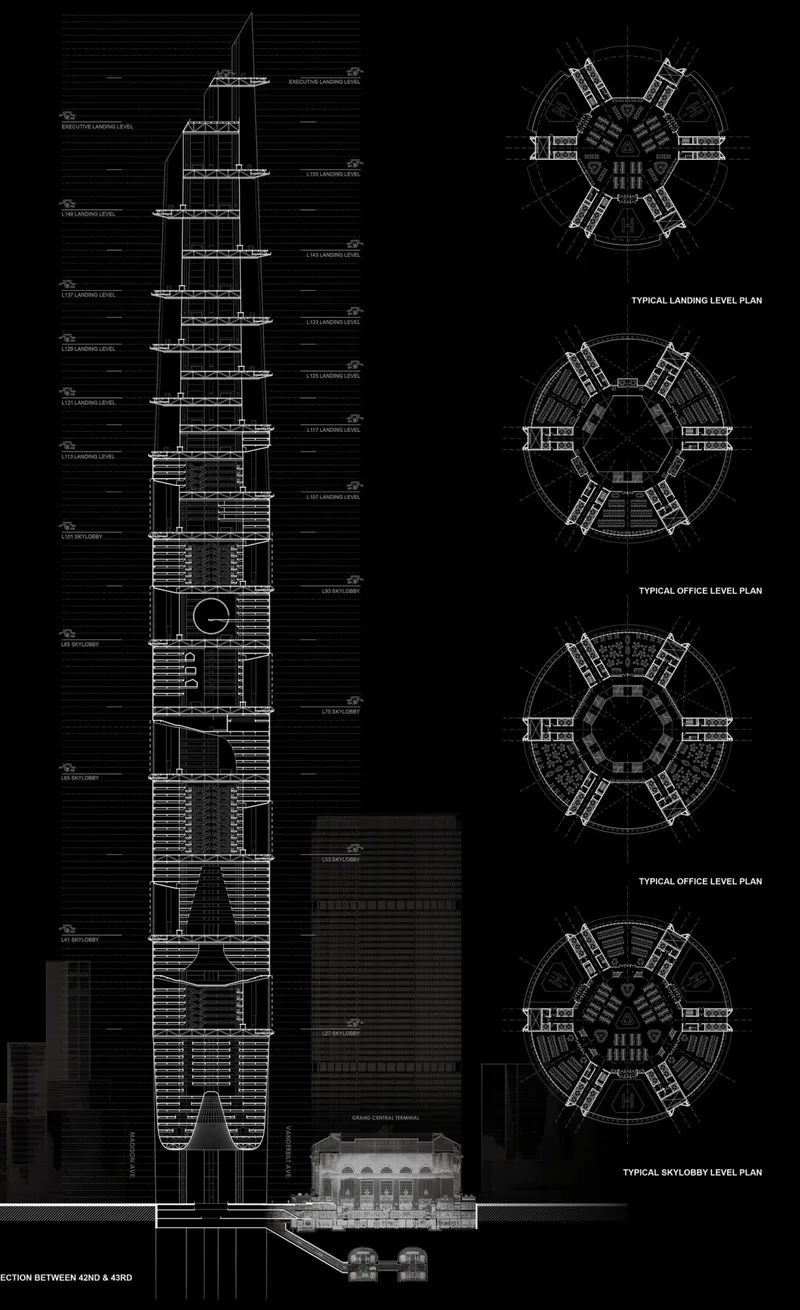
The technical board is the most informative image. A full building section shows the tower sitting above Grand Central Terminal at street level. The section reveals the rhythm of the docking platforms: they occur every several floors, alternating sides of the building to distribute structural loads. Four floor plans show the typical landing level, two office level variants, and the sky lobby level. The plans are cruciform, which maximises perimeter for daylight and creates the setbacks needed for the docking bays.
The cruciform plan is a smart choice. It gives the building four arms, each of which can support a cantilevered platform without interfering with the others. The central core handles vertical circulation. The arms handle programme and landing. Structure and function align.
Why This Project Matters
The Aeroscraper is the most architecturally detailed response to the Hybrid Futures brief. Where other entries proposed general concepts, this one produced a section, four floor plans, a specific site, and interior renders that show how the spaces actually feel. The sky lobby renders alone are worth studying for anyone designing large atria or hybrid public spaces.
The project also raises a genuine urban question: when personal air mobility arrives, will it need new building types or just new additions to existing ones? The Aeroscraper argues for a new type: a building designed from the ground up for flight, placed at the centre of the existing transport network. Whether that is the right answer is debatable. That it is a serious question is not.
View the Full Project
About the Designers
Designers: Xiaohan Wu, Jin Qiu, Xiyao Wang
Enter a Design Competition on uni.xyz
If supertall design, urban air mobility, or hybrid building typologies are the kind of work you want to pursue, uni.xyz runs competitions year-round that reward detailed, site-specific architectural thinking.
Project credits: Aeroscraper by Xiaohan Wu, Jin Qiu, Xiyao Wang. Honorable Mention, Hybrid Futures '19: Work x Fly (uni.xyz).



Popular Articles
Popular articles from the community


Conexión: Biophilic Design Reimagines High-Rise Living in Hong Kong
Conexión reimagines high-rise living in Hong Kong through biophilic design, green facades, shared spaces, daylight, water and nature within.

AL-JANNAH: Sustainable Architecture and Permaculture for Afghan Widows
AL-JANNAH uses sustainable architecture and permaculture to create resilient oasis of housing, learning, work and renewal for Afghan widows.

Co-Life: Senior Housing Design That Reconnects Older Adults With the City
Co-Life reimagines senior housing design through healing gardens, shared streets, workshops, and a sustainable community across generations.

Co-life: Sustainable Architecture for Age-Friendly Community Living
Co-life reimagines sustainable architecture for seniors through courtyards, rammed earth, shared gardens, and spaces designed for belonging.

Similar Reads
You might also enjoy these articles

Day and Night Park: A Time-Based Urban Newsstand in Beijing
A temporary urban newsstand in Beijing blending travel, light, and reading through poetic colors, compact form, and community-focused design.

Modernist Patio Renovation in El Masnou, Barcelona by Oliver Segura Arquitectura + Cebrià Arquitectura
Modernist patio renovation blending tradition and innovation with a movable pool, leveled floors, and Catalan materials in El Masnou.

Alto Residencial Coop: Cooperative Housing Development in Santiago de Compostela by Carbajo Barrios Arquitectos
A linear cooperative housing complex blending white volumes and perforated metal façades, enhancing community living, natural light, privacy, and urban integration.
Vil Genis School by BPA ARCHITECTURE – Massy, France
Vil Genis School in Massy, France, features sustainable design, south-facing classrooms, community integration, accessible spaces, and modern educational architecture.


Comments (0)
Please login or sign up to add comments
No comments yet. Be the first to comment!