
Arquipélago Arquitetos Tucks a Brick-and-Timber Retreat Behind a Perforated Wall on Paraty's Coast
On a compact beachfront lot in Jabaquara, double brick walls become structure, climate system, and screen for a 230 m² family house.


Paraty sits where the Serra do Mar jungle crashes into the Atlantic, a colonial town known for its whitewashed streetscapes and loose boundary between architecture and landscape. On a 360 m² lot at Jabaquara Beach, Arquipélago Arquitetos, led by architect Marinho Velloso, stacked a full residential program into just 230 m² while giving most of the plot back to a garden that bleeds into the communal life of the beach: a soccer field, food kiosks, mangrove, and open water.
What makes AF House worth studying is not its size but its strategy. By pushing the building mass to the rear of the site, every inhabited room faces the bay. By deploying two large double brick walls as both structure and climate device, the architects avoid a conventional frame and gain thermal mass that moderates Paraty's humid heat. And by building the street-facing access wall from horizontally laid perforated bricks, they screen the interior without blocking the sea breeze or the view of the horizon. It is a house that performs quietly, built almost entirely from materials sourced within a short drive.
The Perforated Threshold
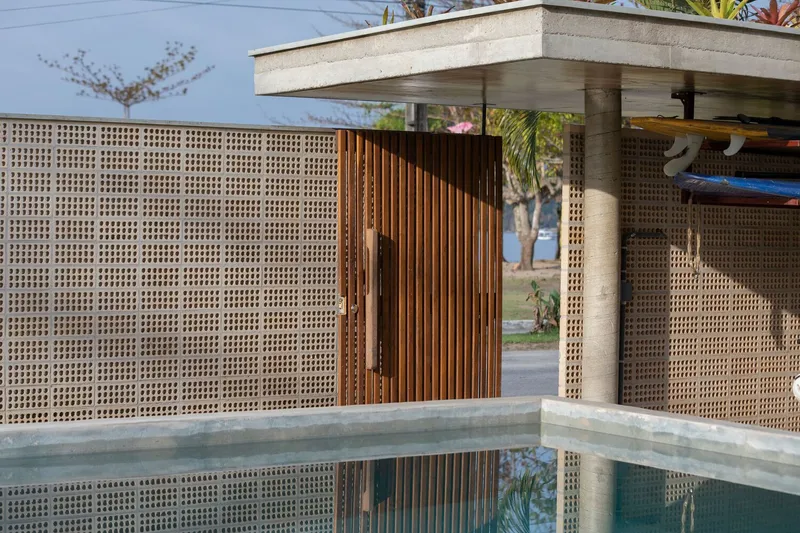
The first thing you encounter is not the house but a wall. Perforated concrete blocks and timber slat screens wrap the pool level, creating a semi-transparent boundary that establishes privacy from the street without sealing the house off from the coastal air. It is a straightforward move, but the proportions are carefully tuned: the ground floor is slightly elevated above the original land profile so that someone standing inside can see over the access wall to the horizon. Filtered light throws shifting patterns across the concrete terrace throughout the day, making the threshold itself a kind of inhabitable space.
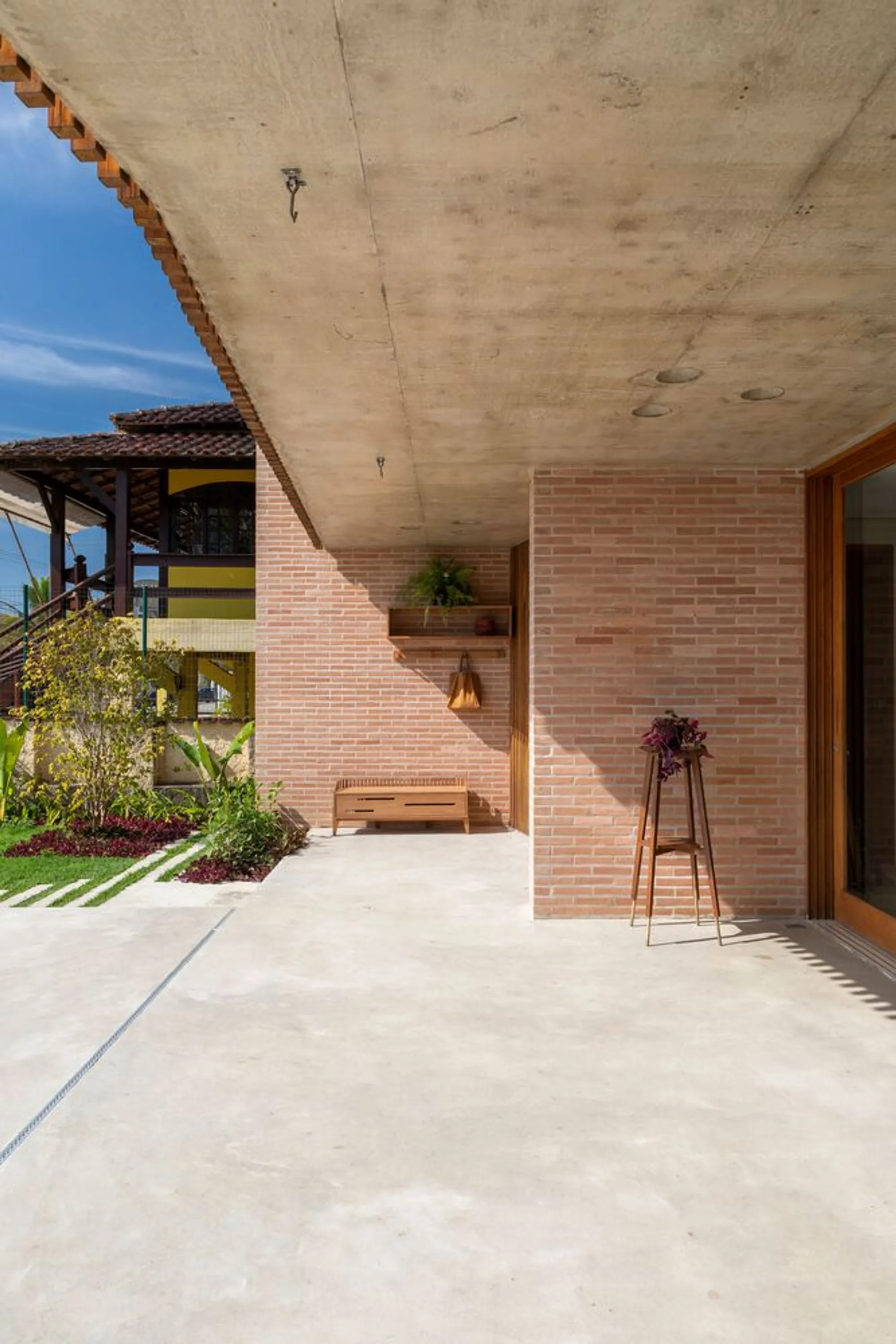
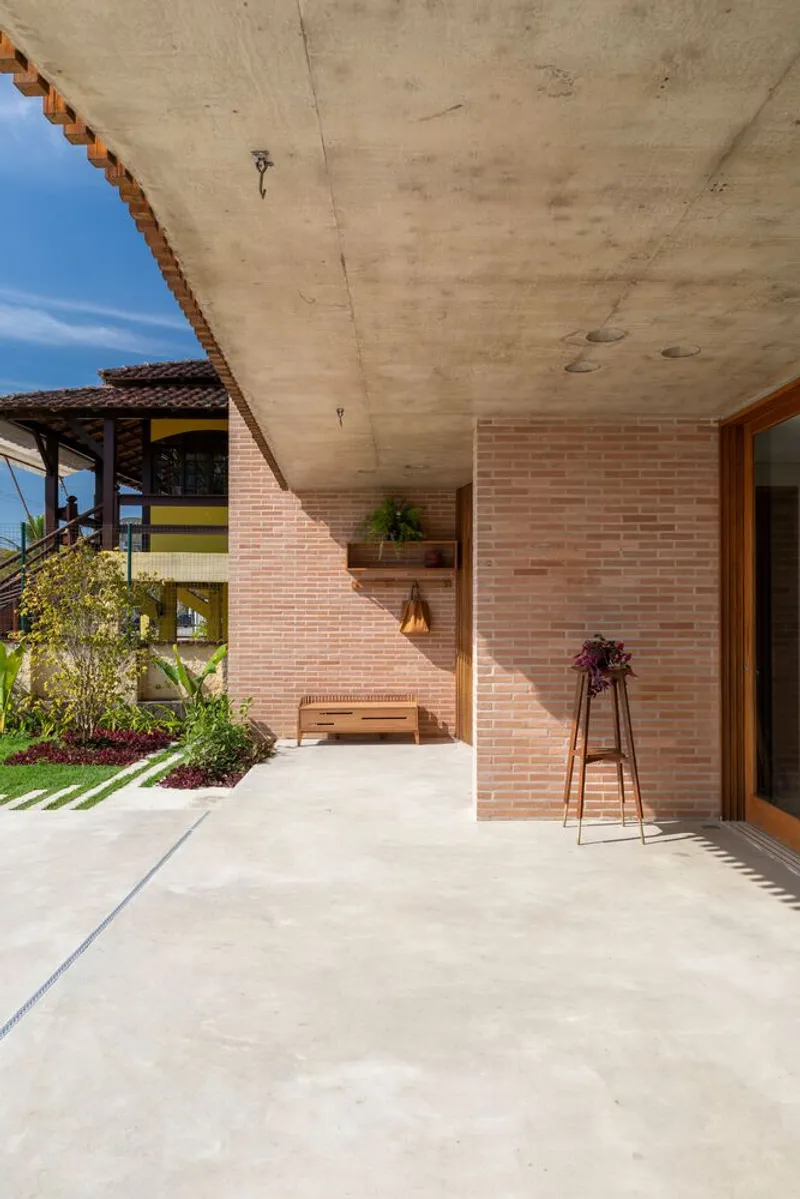
A covered entry terrace introduces the angled brick wall alongside board-formed concrete soffits and planted beds. The combination of rough textures, warm brickwork from the Olaria Tabuinha Cunha kiln in nearby Cunha, and local timber from Madeireira Mato Dentro signals the material palette before you step inside.
Pool, Terrace, and the Extended Ground Floor
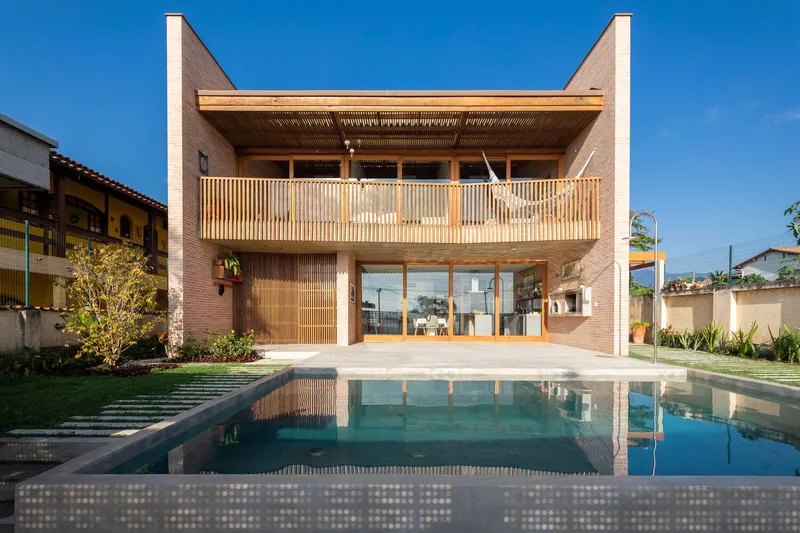
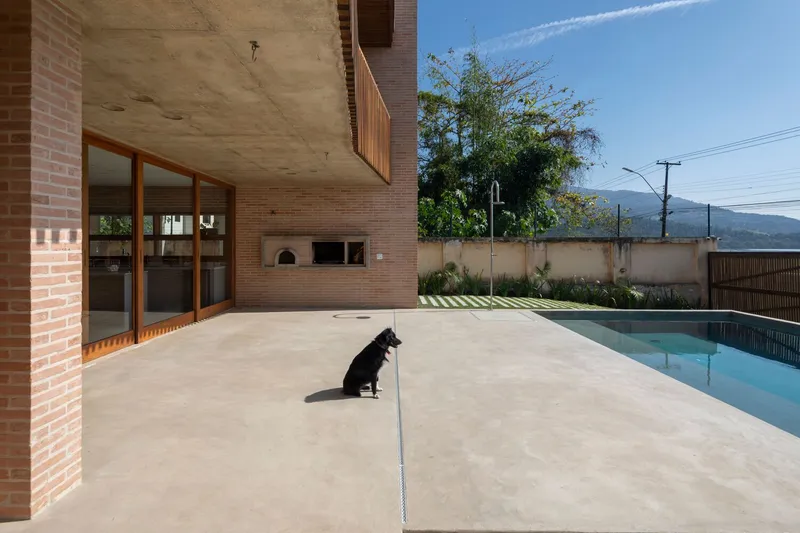
The ground floor stretches past the covered veranda to absorb the swimming pool as a continuation of domestic space rather than an add-on. Vertical timber slat screens at the rear facade give the upper balcony a rhythm of solid and void that reads cleanly against the sky, while the pool below reflects the composition, doubling the apparent height of the house. A concrete canopy provides shade at the pool edge, and the terrace paving is kept plain and broad, sized for outdoor dining or simply doing nothing in the afternoon light.
The pool deck doubles as a social threshold between the private rooms behind and the garden in front, a zone where the house relaxes its grip and starts to become landscape.
Brick as Structure and Thermal Mass
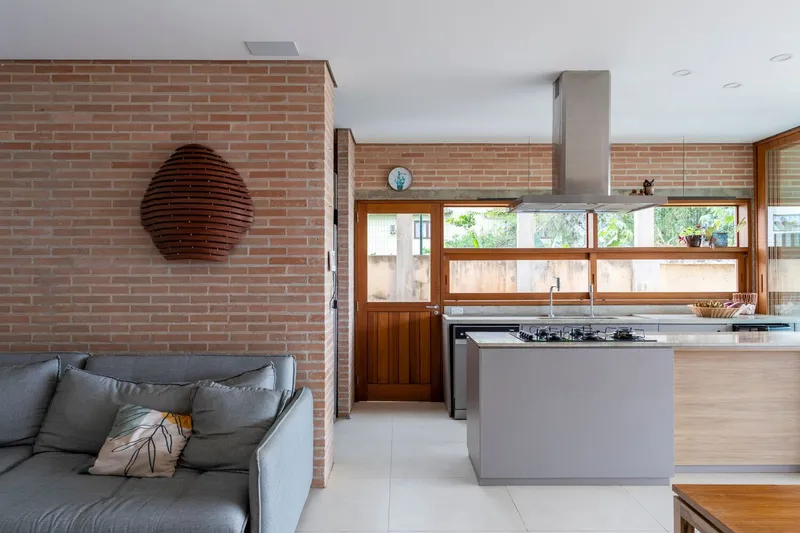
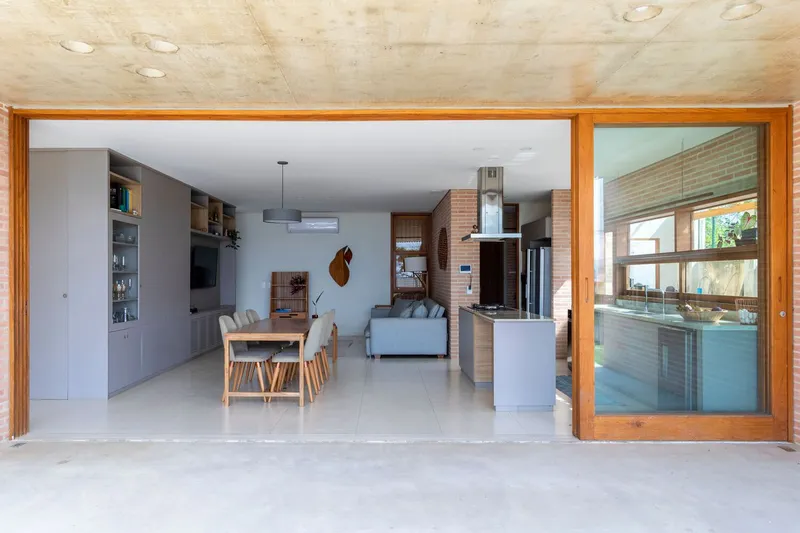
Inside, the two large double brick walls are impossible to miss. They carry the loads, house the vertical infrastructure piping, and act as thermal radiators that absorb heat during the day and release it slowly at night. In a coastal climate where humidity can make air conditioning feel necessary, this passive strategy reduces energy demand substantially. The walls are left exposed rather than plastered, giving every room a warm, textured surface that ages well and never needs repainting.
Between these walls, large timber-framed openings slide open to connect the living and kitchen area directly to the exterior terrace and the distant hills beyond. The open-plan ground floor gains depth from the layering of thresholds: brick wall, glazing, veranda, pool, perforated screen, garden, beach. Each layer peels back a degree of enclosure.
Kitchen and Communal Living
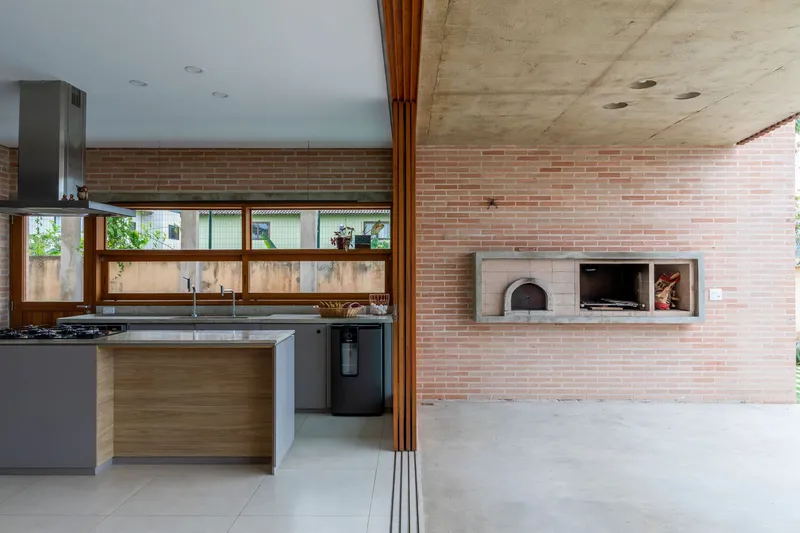
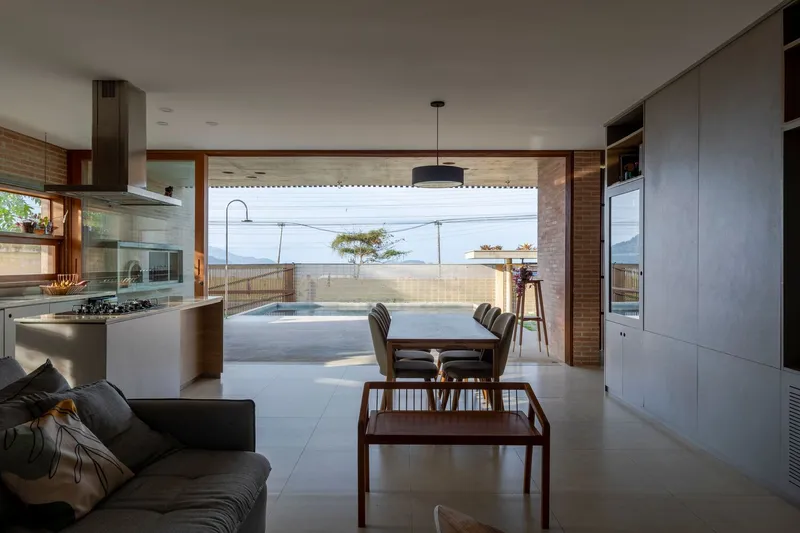
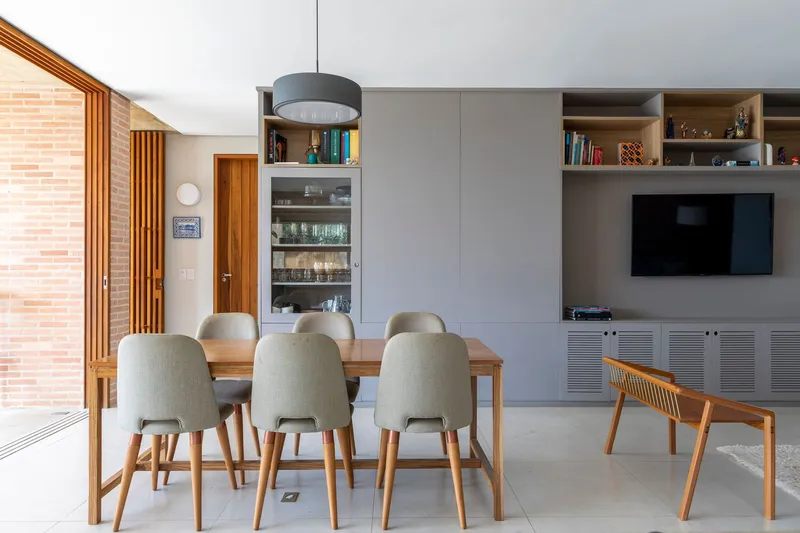
The kitchen leans into its brick wall with confidence: a built-in pizza oven sits flush with the masonry, a horizontal window above the timber cabinetry delivers controlled light, and the concrete countertop runs long enough to serve as a prep surface and a bar in one. It is an honest room that treats cooking as a central event rather than a service function.
The dining area, set under a pendant light against another stretch of exposed brick, connects seamlessly to the living zone and the view corridor that terminates at the hills of the Serra do Mar. Built-in timber shelving keeps the room clean of freestanding furniture, reinforcing the sense that every element was considered together. The material consistency, brick, timber, concrete, repeats without becoming monotonous because each surface meets the next at a different scale.
Private Rooms That Breathe
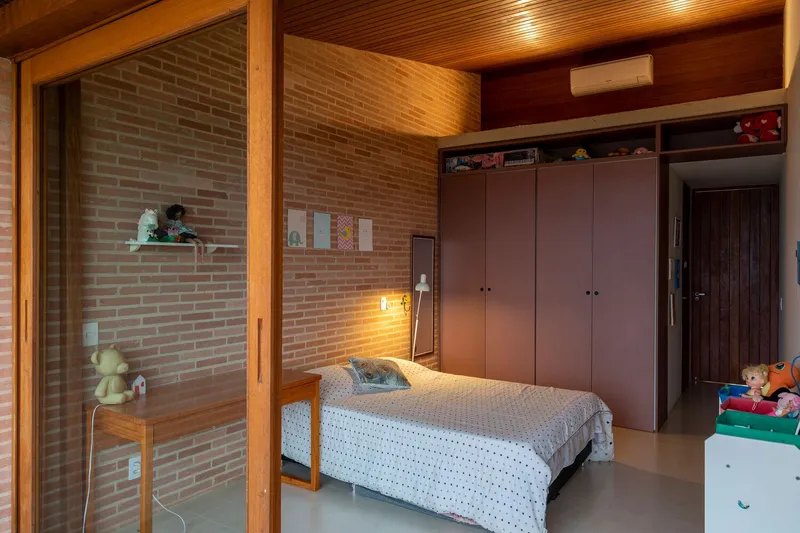
The bedrooms continue the exposed brick and timber ceiling language of the common spaces, but the mood shifts. A sliding glass door opens to an interior courtyard, introducing cross-ventilation and a pocket of greenery that belongs only to the room. The timber ceiling boards run in the same direction as the bed, pulling the eye outward toward the light. There is no applied decoration; the architecture does all the atmospheric work.
The decision to orient every bedroom toward the bay rather than the street is what makes the compact footprint livable. No room faces a blank neighbor. Every room wakes up to water.
Why This Project Matters
AF House demonstrates that a small lot and a full brief do not require compromise if the section is smart and the materials are allowed to do double duty. The double brick walls carry loads, manage heat, and conceal plumbing. The perforated screen provides privacy, ventilation, and filtered light simultaneously. The slightly elevated ground floor solves a view problem and a drainage problem in one gesture. None of these moves are flashy, but stacked together they produce a house that feels generous despite its modest footprint.
There is also a quiet argument here about sourcing. The bricks come from a kiln in Cunha, the timber from a sawmill in Paraty itself. The structural engineering by WXYZ Projetos Estruturais keeps the system simple enough for a local contractor, Jhoston Tec, to execute without specialized equipment. In a region where construction logistics can be difficult, this matters. Arquipélago Arquitetos has built a house that belongs to its coast not just aesthetically but materially and economically. That kind of rootedness is harder to achieve than it looks.
AF House by Arquipélago Arquitetos, Jabaquara Beach, Paraty, Brazil. 230 m², completed 2022. Photography by Pedro Napolitano Prata.
About the Studio
Share Your Own Work on uni.xyz
If projects like this are the kind of work you want to make, uni.xyz is a place to publish your own, find collaborators, and enter design competitions.



Popular Articles
Popular articles from the community

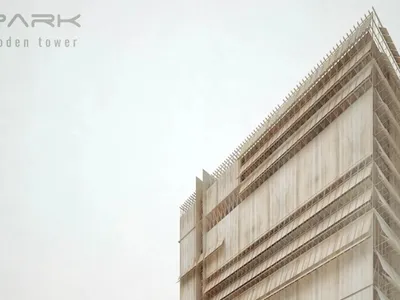
EW PARK: Sustainable Architecture Reimagines the Future of Urban Parking
EW PARK reimagines city parking as a modular wooden tower combining automation, solar energy, electric mobility, and adaptable urban design.

Co-Life: Senior Housing Design That Reconnects Older Adults With the City
Co-Life reimagines senior housing design through healing gardens, shared streets, workshops, and a sustainable community across generations.

The Earth Pod: 3D Printed Homes for Resilient Refugee Communities
The Earth Pod reimagines refugee housing through 3D printed homes made from clay, combining resilience, self-sufficiency, and rapid shelter.

Riyadh For All: Intergenerational Urban Design for Active Aging in Rabat
Riyadh For All reimagines urban design in Rabat with intergenerational co-living, adaptive courtyards, and Moroccan cultural exchange today.


Similar Reads
You might also enjoy these articles


Hodi-Mandai Geram
Project Function: Preservation and revitalization of the Intangible heritage and socio-spatial identity of the Hodi by Housing, Cultural Memory Center, Sacred Grove, landscape, local tourism economy


Olio Towers: A Mid-Rise for Performers That Fuses Housing, Rehearsal, and Stage
Located blocks from Houston's Theater District, this modular tower stacks living units around a central performance atrium.

Oasis: Modular Green Housing Carved into Dhaka's Urban Fabric
A shortlisted Plugin Housing entry reclaims unauthorized settlements in Dhaka with stepped concrete volumes, green roofs, and ventilation-driven design.

Black Hole: A Floating Megastructure for the Post-Physical Era
Emiliano Mazzarotto envisions a spherical, self-scaling arena where e-sports, digital hotels, and holographic stadiums replace traditional public space.


Explore Housing Competitions
Discover active competitions in this discipline



Challenge to reimagine the Iron Throne


Photograph architecture without architects


Illustrate the lost glory of Angkor Wat - Render Challenge


Design challenge to reuse E-waste
Comments (0)
Please login or sign up to add comments
No comments yet. Be the first to comment!