
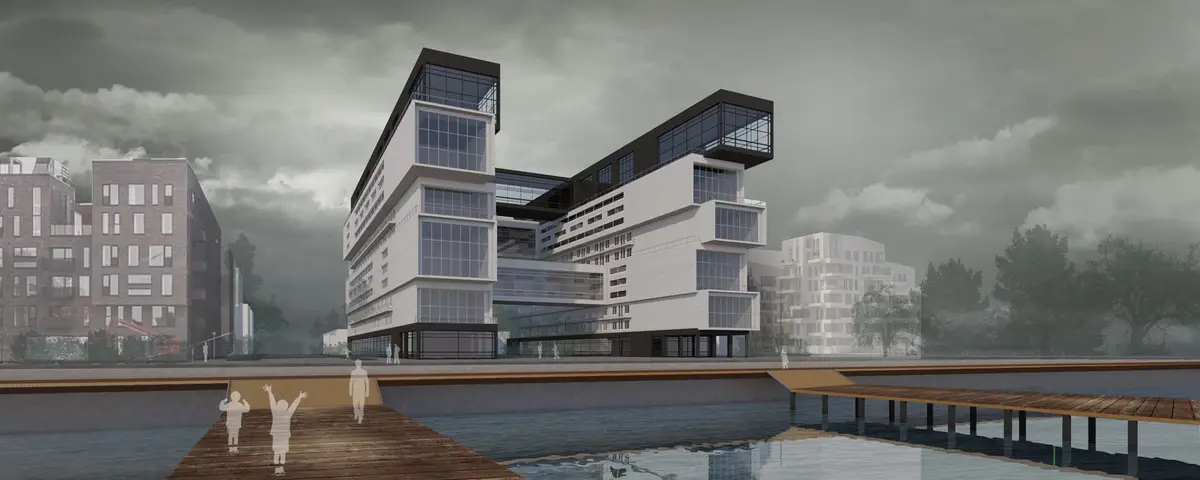
Hustle Hub Moscow: Stacked Blocks and Shared Living as Affordable Housing
A cohousing prototype displaces modular volumes to weave communal kitchens, coworking zones, and green terraces into compact Moscow housing.


What if the most radical cost-saving move in housing isn't shrinking private rooms but expanding what residents share? Hustle Hub Moscow takes that question seriously, compressing individual apartments to between 48 and 63 square meters while distributing generous communal kitchens, lounges, coworking areas, and rooftop gardens across every level. The result is a building that treats shared space not as leftover corridor but as the primary architectural experience, a strategy that cuts per-unit costs while producing richer daily life than a conventional apartment block.
Designed by Ekaterina Popova and shortlisted in the Hustle Hub 2019 competition, the project sits within Moscow's urban fabric with direct access to public infrastructure and river views. It proposes a cohousing prototype that challenges the conventional residential model: compress the private, amplify the collective, and let the architecture itself generate the social life that makes compact living desirable rather than merely tolerable.
Displaced Volumes, Inhabited Voids
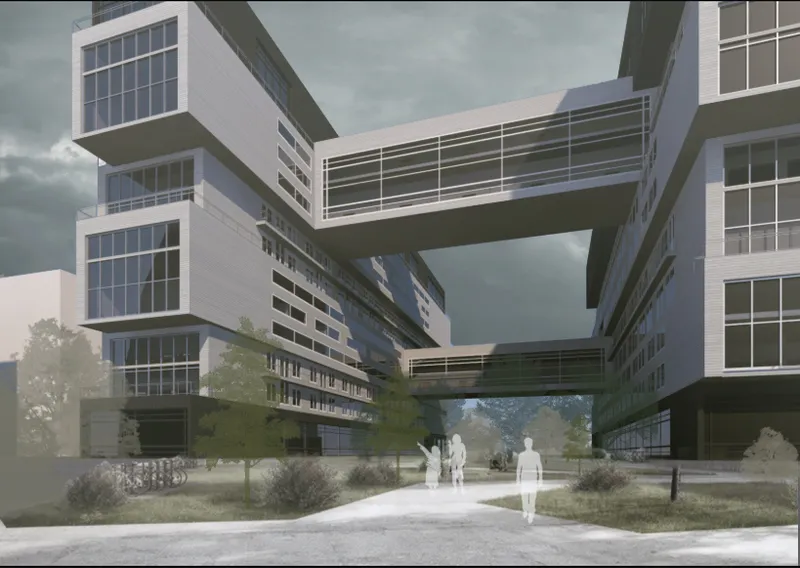
The building's form reads as a stack of rectangular blocks shifted longitudinally and transversally from one another. Where conventional towers consolidate mass, this scheme deliberately fractures it, producing voids between volumes that become elevated bridges, open-air terraces, and light-filled courtyards. The exterior rendering captures the drama of these interstitial spaces: figures walk through a landscaped courtyard at grade while bridges connect upper volumes overhead, framing the sky. The effect is an architecture that is simultaneously solid and porous, giving residents varied spatial experiences as they move between private units and shared zones.
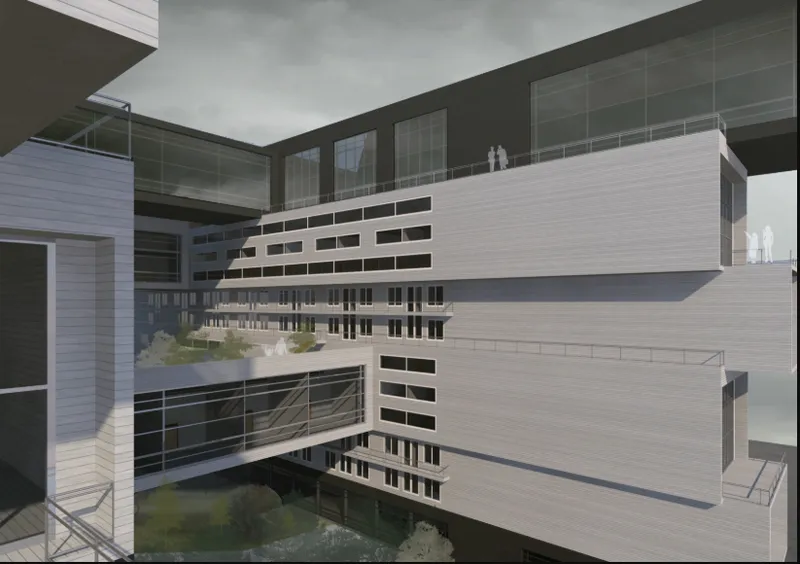
The interior courtyard view reinforces this reading. Glazed facades and horizontal banded cladding line the courtyard walls, pulling daylight deep into the plan while the connecting bridges above create a layered sense of enclosure without sealing the space off. It is a semi-public zone designed to encourage pedestrian activity and outdoor community use, blurring the line between the building's interior and the surrounding Moscow streetscape.
Section Logic: Public Ground, Shared Core, Private Periphery
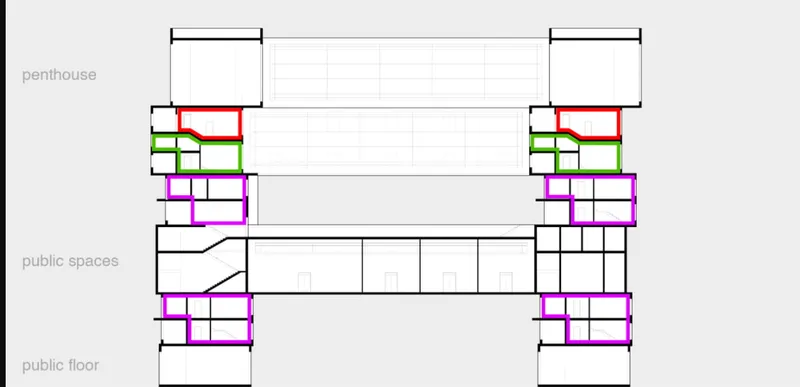
The section drawing reveals how the programme layers vertically. Ground-floor circulation zones anchor the building to the city, giving way to communal living rooms, dining areas, and facilities like libraries, gyms, and children's play areas on intermediate levels. Some of these shared amenities can be rented to external users, generating revenue that offsets building maintenance costs. Private corridor-type housing blocks occupy the remaining floors, oriented for optimal solar access. At the top, rooftop gardens cap the composition, offering residents recreational green space and ecological benefits. The highlighted zones in the section make the hierarchy legible: public at the base, collective in the middle, private and green at the edges.
Interlocking Geometry and the Green Courtyard Core
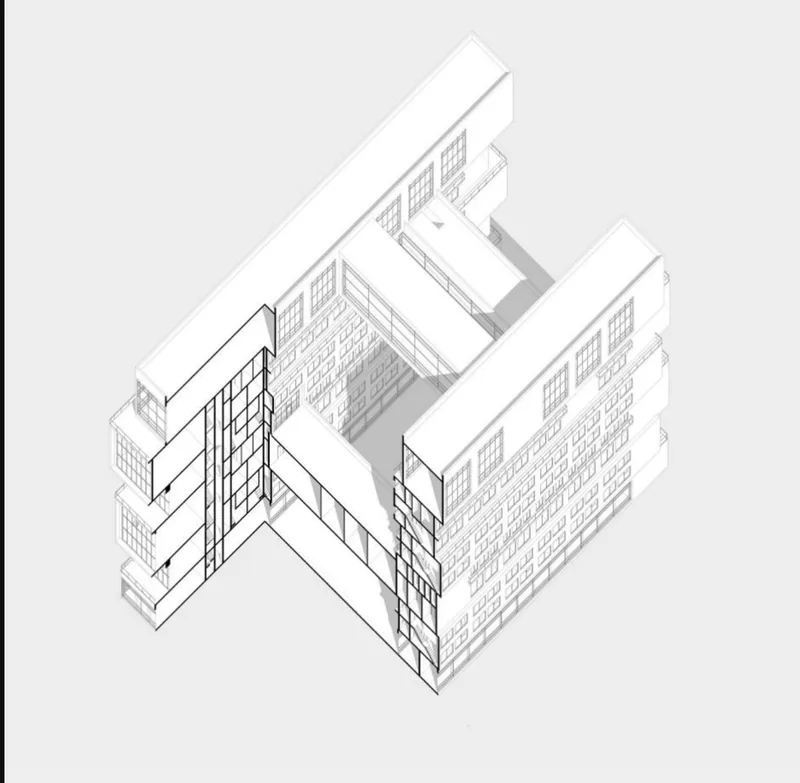
The axonometric drawing pulls apart the building's formal logic. Rectangular volumes interlock around an open courtyard at the center, with glazed corner towers marking the transitions between blocks. The courtyard functions as both a green zone and a social condenser, connecting the communal spaces that face it on every floor. By organizing the plan around this void rather than a solid core, Popova ensures that the shared facilities orient toward scenic river views and natural light rather than being buried in a building's interior.
The modular, interlocking geometry also suggests replicability. Each block operates as a structurally legible unit that could be adapted in dimension or programme for different sites, making the scheme function as a genuine prototype rather than a one-off formal exercise. That scalability is central to the project's ambition: affordable housing architecture that works as a system, not just as a single building.
Why This Project Matters
Hustle Hub Moscow reframes the affordability question. Instead of asking how small an apartment can get before it becomes unlivable, it asks how much shared space a building can absorb before individual units stop needing to do everything on their own. The answer, in Popova's scheme, is quite a lot: coworking rooms replace home offices, communal kitchens supplement compact private ones, and rooftop gardens substitute for balconies. The financial logic follows the spatial one: smaller units cost less to build and heat, while shared amenities generate rental income.
More importantly, the project demonstrates that this economic model doesn't require architectural austerity. The displaced volumes, bridging walkways, and courtyard voids create a spatially generous building that feels nothing like a budget housing block. For a dense city like Moscow, where housing pressure will only increase, that combination of cost efficiency and spatial richness points toward a cohousing model worth taking seriously at scale.
View the Full Project
About the Designers
Designer: Ekaterina Popova
Enter a Design Competition on uni.xyz
uni.xyz runs architecture and design competitions year-round that reward proposals with spatial conviction and real site intelligence.
Project credits: HUSTLE HUB Moscow by Ekaterina Popova Hustle Hub 2019 (uni.xyz).


Popular Articles
Popular articles from the community


The Amber Palace Opera: A Geological Fiction Surfaces on Tallinn's Baltic Waterfront
Pierre Brillard reimagines a Baltic legend as a public landscape, opera house, and waterfront promenade rooted in Tallinn's coastal identity.
Temporary Home for Dogs: A Reversed Zoo Rethinks Animal Shelter Architecture
In Bucharest, a sinuous corridor and freed landscape flip the logic of containment, designing a shelter that works to make itself unnecessary.
Tsunami Convergenics: Turning Catastrophic Ocean Forces into Underwater Housing Infrastructure
A speculative underwater settlement off the coast of Onagawa, Japan, treats tsunamis and typhoons as energy sources rather than threats.

Cloaked Colonization: A Mobile Underwater Habitat That Moves Like a Fish
Micah Abaya's shortlisted EHC Pacific entry reimagines ocean settlement as a dispersed network of self-sustaining architectural organisms.

Similar Reads
You might also enjoy these articles

Shakur's House: Exposed Brick as an Interior Organiser in a 168 m² Mashhad Residence
Brick moves indoors in this Mashhad residence, where masonry walls, glass partitions and teal planes sequence a compact home without closing it off.

Day and Night Park: A Time-Based Urban Newsstand in Beijing
A temporary urban newsstand in Beijing blending travel, light, and reading through poetic colors, compact form, and community-focused design.

Modernist Patio Renovation in El Masnou, Barcelona by Oliver Segura Arquitectura + Cebrià Arquitectura
Modernist patio renovation blending tradition and innovation with a movable pool, leveled floors, and Catalan materials in El Masnou.

Alto Residencial Coop: Cooperative Housing Development in Santiago de Compostela by Carbajo Barrios Arquitectos
A linear cooperative housing complex blending white volumes and perforated metal façades, enhancing community living, natural light, privacy, and urban integration.

Comments (0)
Please login or sign up to add comments
No comments yet. Be the first to comment!