

Feste Landscape & Architecture Airlifts 25 Identical Cabins Across Norway's Agder County
A diamond-shaped timber refuge, prefabricated and helicoptered into 25 different municipalities along Norway's southern coast.


Building one cabin well is hard enough. Building 25 identical ones across 25 different municipalities, each on a different piece of terrain, and doing it without driving a single truck to the site: that is a logistics problem masquerading as an architecture project. Feste Landscape & Architecture pulled it off with the Agder Day-Trip Cabins, a regional initiative that scatters compact, 28-square-meter timber shelters across Norway's southern Agder County, from cliff edges above fjords to hilltops above winding lake inlets. Every cabin is prefabricated off-site and airlifted in by helicopter, a decision that sounds extravagant until you consider the alternative: heavy vehicles carving permanent scars through fragile mountain landscapes.
What makes the project genuinely interesting is how it resolves a contradiction. The brief demanded a standardized, repeatable unit, yet each site is radically different in elevation, geology, exposure, and ecology. Feste's answer is a sharp, diamond-shaped plan that reads as site-specific even though it is anything but. The form takes its cue from the Norse root of the name Agder: ǫgd, meaning sharp, or land extending into the sea. From above, the county itself looks like a spearhead, and the cabin's geometry echoes that. A closed back shelters the entrance and firewood store; an open front, anchored by a floor-to-ceiling corner window, cracks wide toward whatever view the site offers. The architecture does not change. The landscape does the rest.
Siting Without Settling
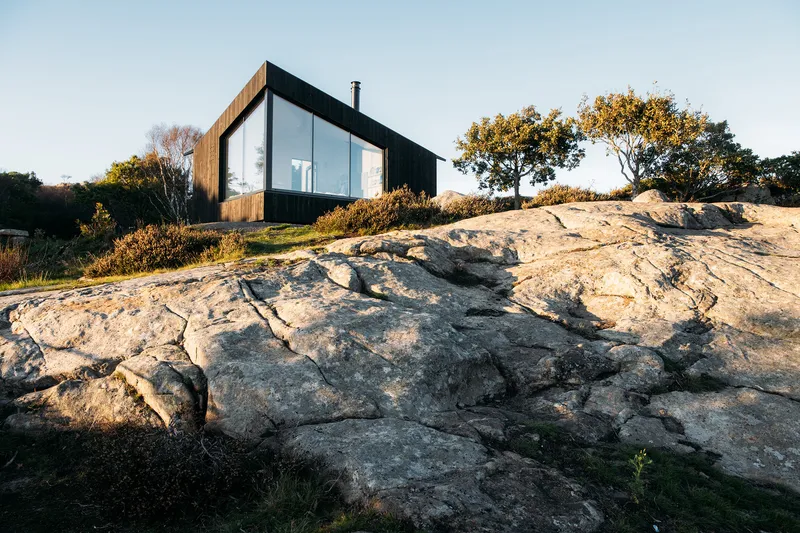
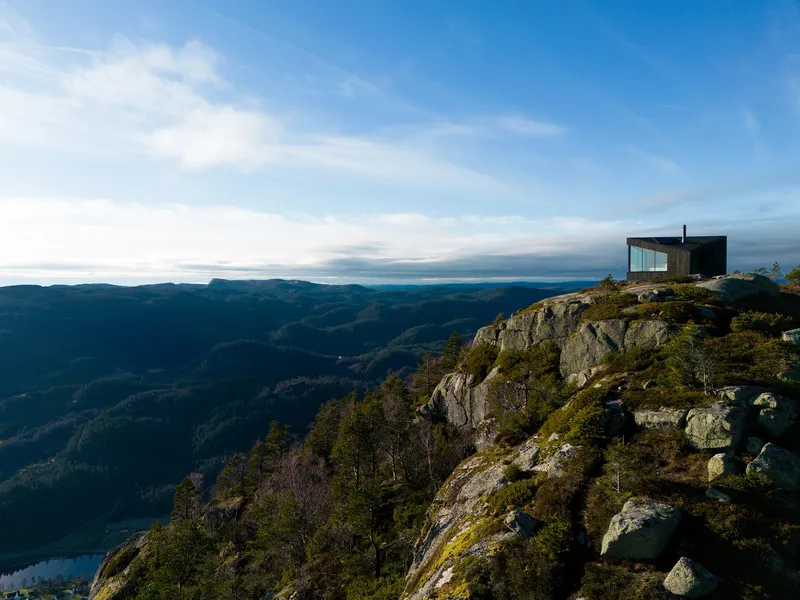
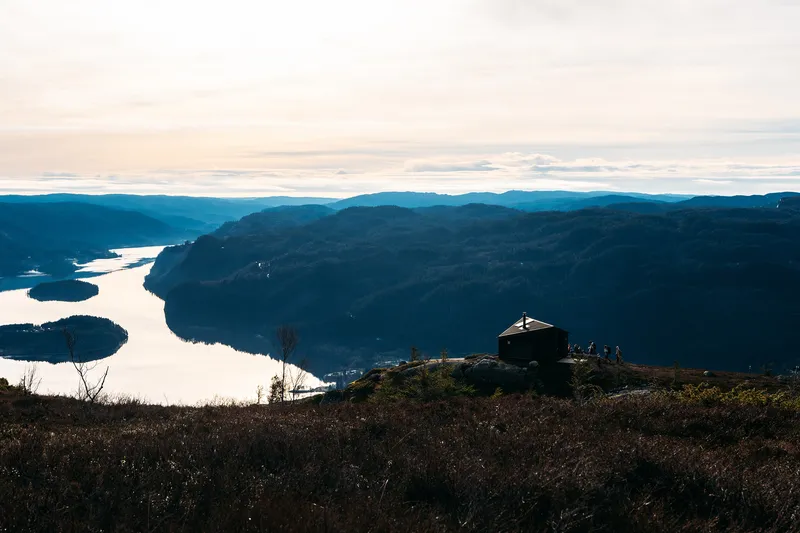
Each of the 25 cabins sits 20 to 45 minutes on foot from a municipal center, close enough to encourage casual day-trip hiking, far enough to feel genuinely remote. Feste developed detailed guidelines for how the foundation meets the terrain, customizing the interface for each site while keeping the superstructure identical. On exposed granite bedrock, the cabin appears to perch directly on the rock. On a cliff edge above a fjord, it leans into the drop. On a grassy hilltop at dusk, it becomes a silhouette against the sky. The variety in these three images is not the result of different designs but of different ground.
Helicopter transport is the enabling move. Without it, access roads would need to be cut through protected landscapes, heavy machinery would compact fragile soils, and the ecological cost of 25 separate construction sites would dwarf the carbon embedded in the buildings themselves. The prefab modules are sized to the helicopter's payload capacity, which in turn constrains the architecture. Every dimension in the cabin traces back to what can be lifted and dropped.
One Room, Fifteen People, a Fireplace
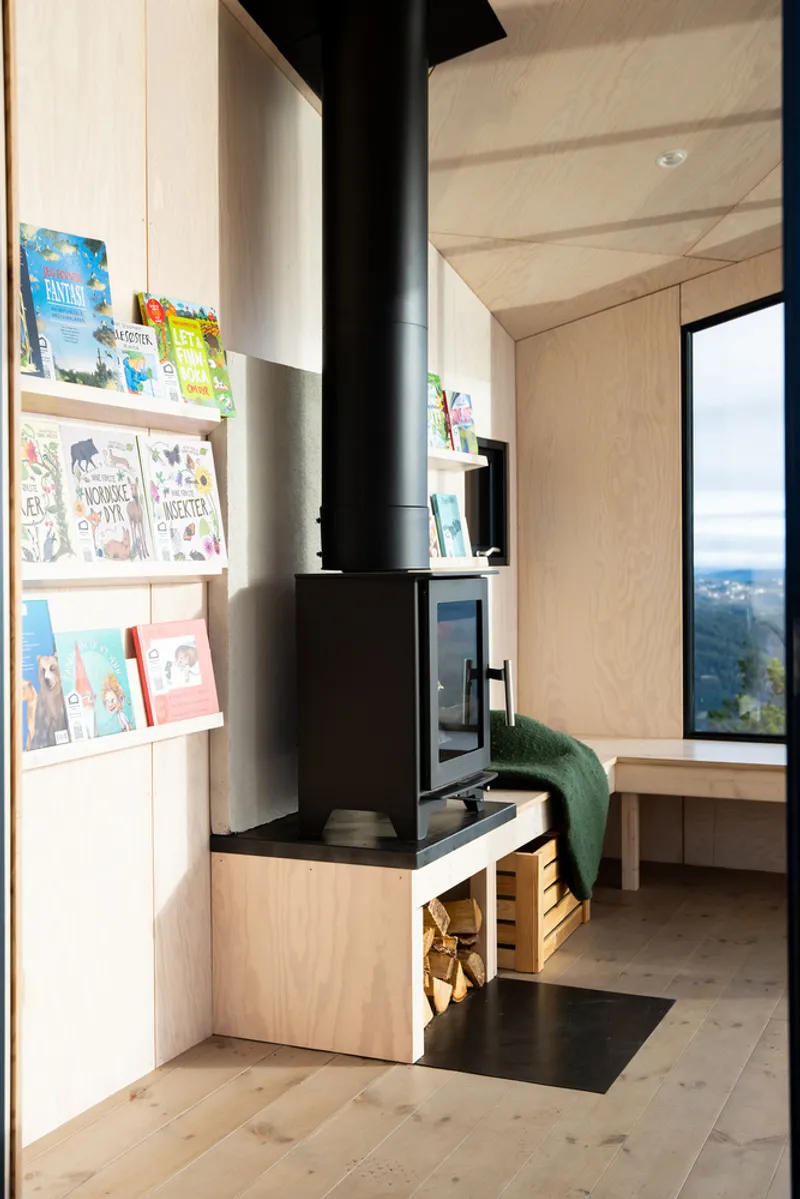
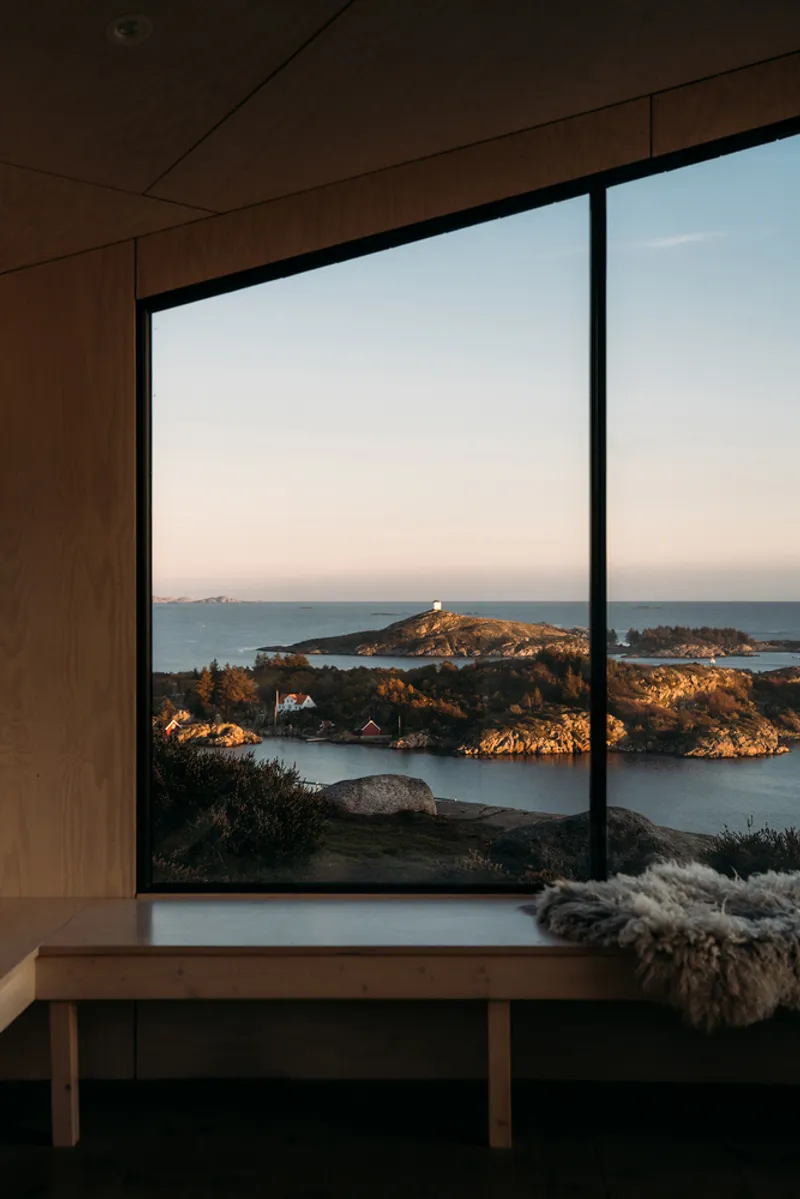
The interior is a single main room organized around two focal points: a black steel woodstove on a plywood hearth and a large corner window that stretches to the ceiling. Benches at varying heights ring the perimeter, seating up to 15 people in a configuration that feels more campfire circle than waiting room. A small library is integrated into the wall surrounding the fireplace, a quiet gesture that suggests lingering rather than passing through. The plywood ceiling and walls are left exposed, warm in tone and honest in construction.
The corner window is the room's real protagonist. By pulling the glazing to the junction of two walls and running it to the ceiling, Feste dissolves the cabin's sharpest corner and replaces it with a panoramic frame. In image four, the view opens onto coastal islands and rocky shoreline in fading evening light. The cabin becomes a piece of optical equipment, pointed at a landscape. A solar panel on the roof provides enough power for interior lighting and phone charging, keeping the building off-grid without pretending electricity doesn't exist.
Material Logic
The exterior cladding is royal-impregnated standing seam timber in two colorways, Nordic Black and Clay Grey, supplied by local manufacturer Marnar Bruk. The choice of a local supplier is pragmatic rather than performative: sourcing cladding from the region the cabins inhabit reduces transport distances and supports the industrial ecology the project claims to serve. Inside, the timber lining is lighter, warmer, and untreated, drawing a clear distinction between the cabin's weathered shell and its sheltered core.
The diagonal gable roof is the most historically loaded element. Gable roofs are embedded in Norwegian building tradition, and Feste deploys one here deliberately, pairing it with the asymmetrical plan to create a form that feels both familiar and slightly disorienting. The roof is traditional; the plan is not. That tension gives the cabin its identity and prevents it from reading as a miniature house or a generic hiking shelter.
Accessibility as a Design Constraint
Where terrain permits, the cabins are wheelchair accessible, with ample free floor space in the communal room and a covered entrance threshold designed to accommodate mobility aids. The qualification "where terrain permits" is important: Feste does not flatten sites to achieve universal access, nor does it pretend that a cabin perched on a cliff is reachable by everyone. Instead, it embeds accessibility into the standard module so that when a site allows it, the architecture is ready. That is a more honest approach than many public projects manage.
Plans and Drawings
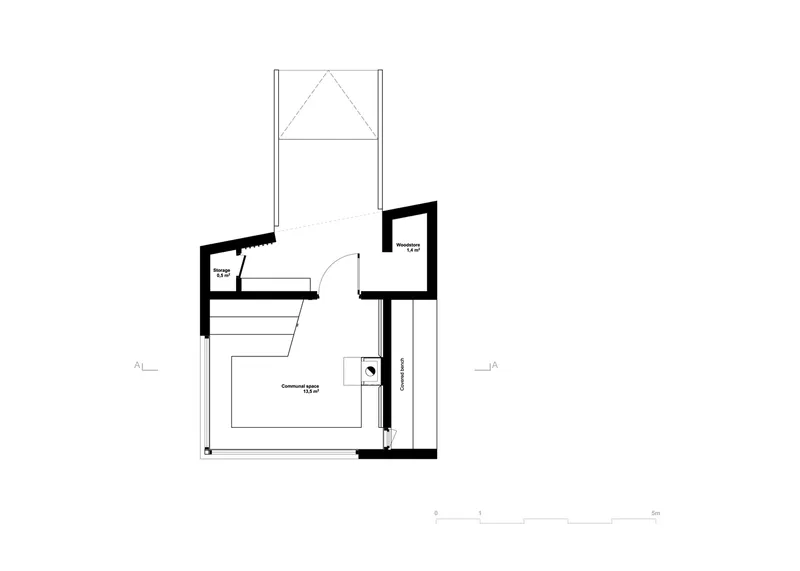
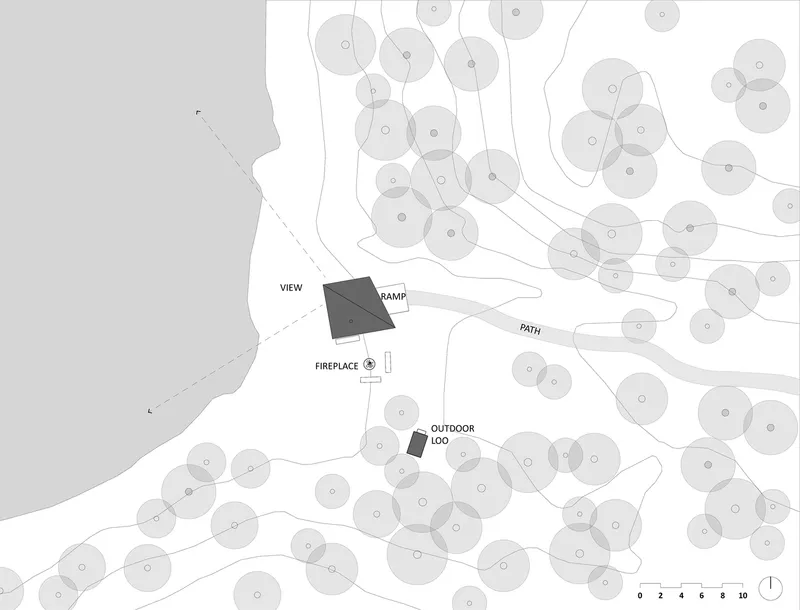
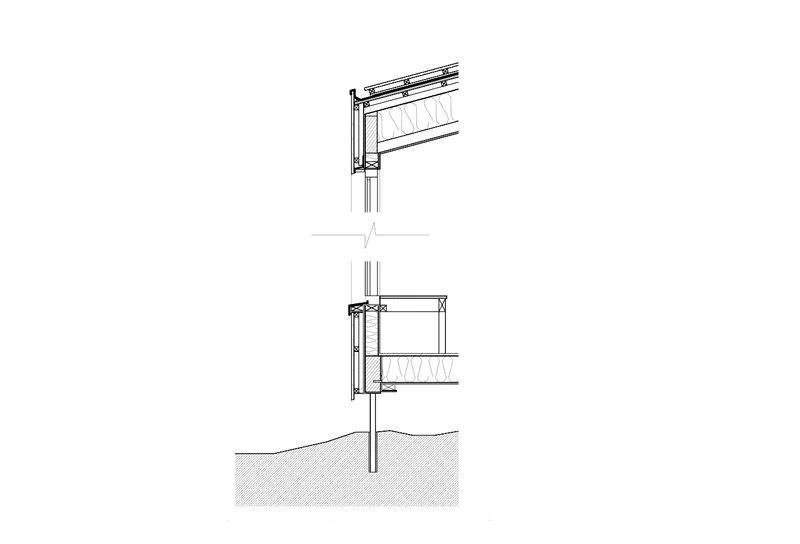
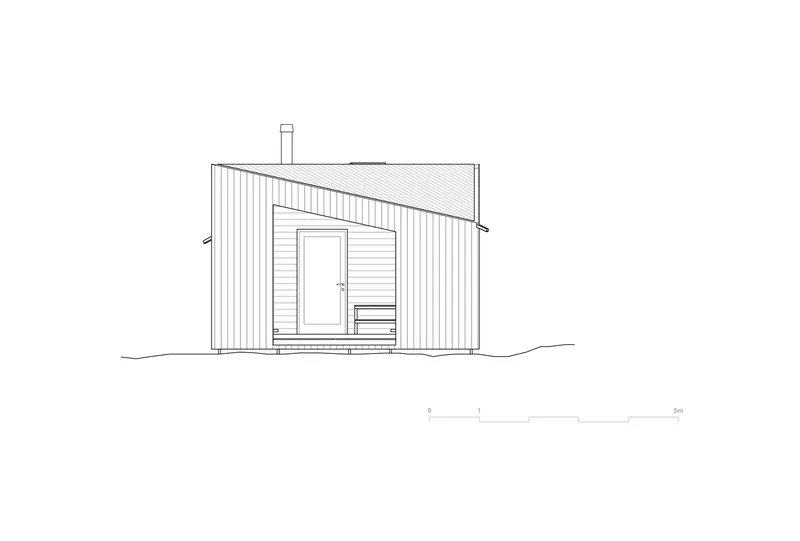
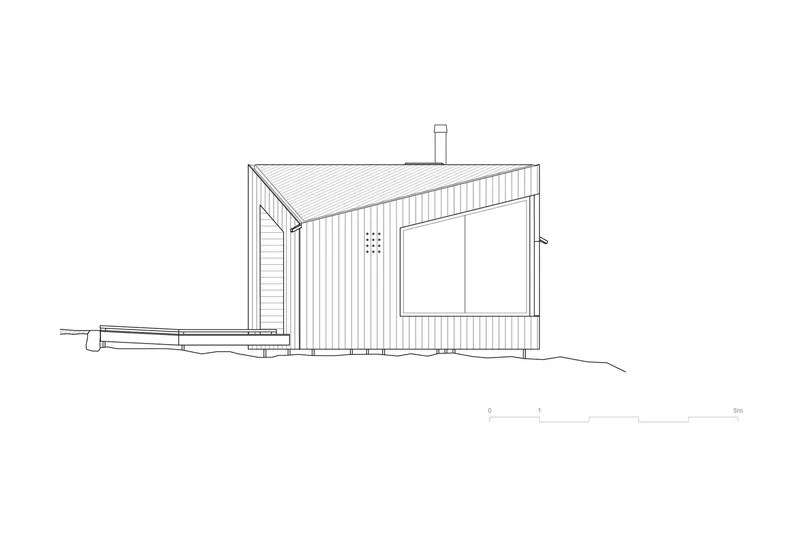
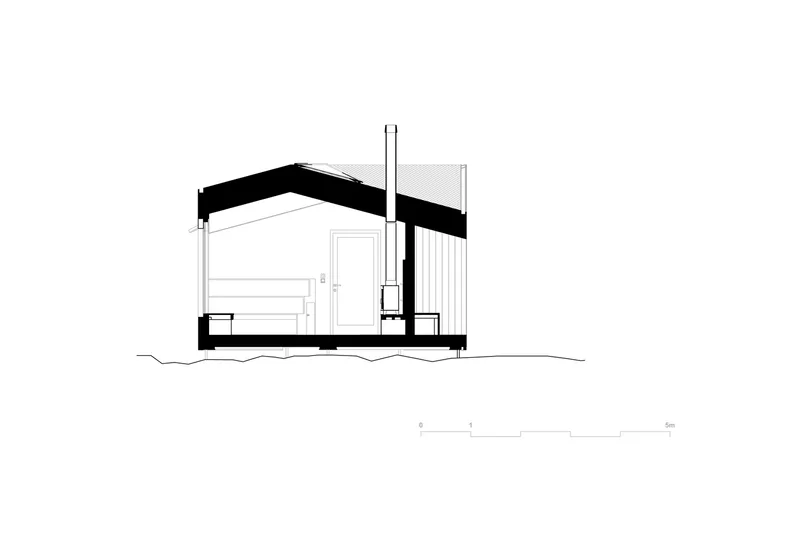
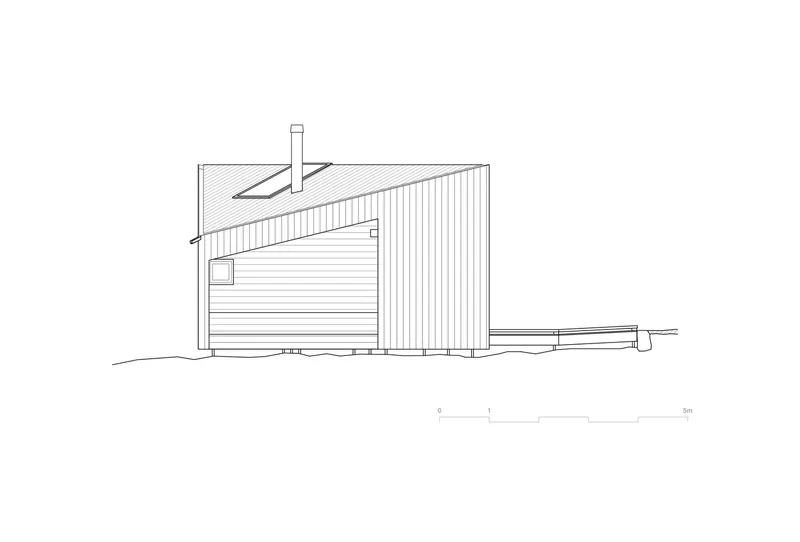
The floor plan reveals the asymmetry that photographs only hint at. The main living space is not centered under the ridge but shifted, creating a taller wall on one side and a lower, more intimate slope on the other. The section drawing confirms this: the sloped ceiling rises from bench height at the back to full standing height at the window wall, pulling occupants' attention toward the view. The site plan shows how the cabin's diamond footprint sits among existing trees with minimal clearing, and how the entry deck, firewood store, and outdoor bench are composed around the perimeter.
The elevation drawings are worth studying for their restraint. The rear facade is almost entirely opaque, a dark wall with a chimney and an extended platform. The front facade is dominated by the large window and the entry deck. The vertical cladding and central chimney give each elevation a different character without introducing any material that isn't already in the plan. These are drawings of a cabin that knows exactly what it is.
Why This Project Matters
The Agder Day-Trip Cabins matter because they demonstrate that standardization and site sensitivity are not mutually exclusive. Feste designed a single module flexible enough to land on granite, grass, or gravel, and rigorous enough to be repeated 25 times without losing its coherence. The helicopter delivery method, the prefabricated construction, and the foundation-to-terrain guidelines together form a replicable protocol for building in sensitive landscapes. Other regions with similar ambitions, and similar terrain, should study this closely.
More broadly, the project reframes what public infrastructure can look like in rural Norway. These are not trailhead toilets or picnic shelters. They are social rooms with fireplaces and libraries, designed to seat 15 people and encourage strangers to share a view. The architecture insists that public health, landscape stewardship, and architectural quality are not competing priorities. They are the same priority, expressed in 28 square meters of timber and glass.
Agder Day-Trip Cabins by Feste Landscape & Architecture. Agder County, Norway. 28 m². Completed 2024. Photography by Even Lundefaret.
About the Studio
Share Your Own Work on uni.xyz
If projects like this are the kind of work you want to make, uni.xyz is a place to publish your own, find collaborators, and enter design competitions.


Popular Articles
Popular articles from the community


LT2A and OPEN Architectes Thread a Brick and Glass High School Through a Wooded Belgian Campus
In Braine-l'Alleud, a 3,000 m² wing for Collège Cardinal Mercier pairs pale brick with a glazed colonnade, deferring to a small chapel and a dense wood.

longwave studio Reorganizes a 112 m² Tainan Apartment Around the Daily Routines of a Family and Two Cats
In Tainan, Taiwan, birch plywood, rust-red furniture and a freestanding plaster wall link arrival, storage, work and family life in one apartment.

Cube Design Draws an Ecological Corridor Between Two Shenzhen Hills with the Nankai Building
Beside Shenzhen's container docks, the Nankai Building pairs stacked balconies with a climbing green screen to connect two hillsides across its height.

U.GA Architects Wraps an Oval Rooftop Pool in Curved Board-Formed Concrete on Busan's Jeollidan-gil
In Busan's Jeonpo-dong, a 454 m² mixed-use block stacks a neighborhood facility, guest rooms and an oval rooftop pool inside spiraling concrete walls.

Similar Reads
You might also enjoy these articles


Hodi-Mandai Geram
Project Function: Preservation and revitalization of the Intangible heritage and socio-spatial identity of the Hodi by Housing, Cultural Memory Center, Sacred Grove, landscape, local tourism economy


Olio Towers: A Mid-Rise for Performers That Fuses Housing, Rehearsal, and Stage
Located blocks from Houston's Theater District, this modular tower stacks living units around a central performance atrium.

Oasis: Modular Green Housing Carved into Dhaka's Urban Fabric
A shortlisted Plugin Housing entry reclaims unauthorized settlements in Dhaka with stepped concrete volumes, green roofs, and ventilation-driven design.

Black Hole: A Floating Megastructure for the Post-Physical Era
Emiliano Mazzarotto envisions a spherical, self-scaling arena where e-sports, digital hotels, and holographic stadiums replace traditional public space.

Explore Architecture Competitions
Discover active competitions in this discipline

Challenge to reimagine the Iron Throne

Photograph architecture without architects

Illustrate the lost glory of Angkor Wat - Render Challenge

Design challenge to reuse E-waste
Comments (0)
Please login or sign up to add comments
No comments yet. Be the first to comment!