

AgroSphere: An Eco-Village Where Architecture and Agriculture Grow Together
A crescent-shaped community in Boa Vista fuses modular housing, smart farming labs, and AI-driven agriculture into one living system.


What if a building could grow food, generate energy, and teach its residents how to farm, all at the same time? AgroSphere answers that question with a crescent-shaped eco-village in Boa Vista, a region caught between urban sprawl and agricultural decline. The project replaces the conventional separation of housing and farmland with a continuous organic ring where modular dwellings, smart farming labs, and landscaped courtyards operate as a single living system. Architecture here is not a container for life but a productive participant in it.
Designed by Azra Can Çarıkcı and İdil Su Türkyılmaz, AgroSphere was shortlisted in the Live Green competition on uni.xyz. The project responds directly to Boa Vista's intersecting crises of climate change, migration, and food insecurity, proposing an architecture that adapts and evolves alongside its community rather than standing still as a finished monument.
A Continuous Ring Shaped by Sun, Wind, and Soil
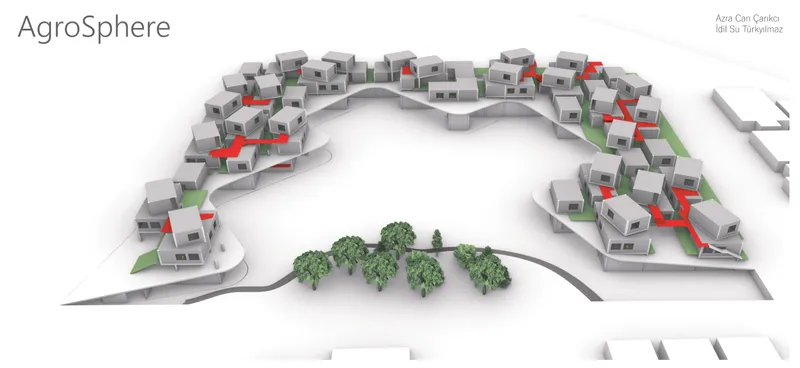
From above, AgroSphere reads as a sweeping crescent: white volumes punctuated by red canopies curve around a central landscaped spine thick with trees. The form is not arbitrary. The designers mapped sun paths, wind flow, and soil fertility across the site, letting those analytical layers dictate where residential modules sit, where farming terraces step down, and where open labs bridge the gap between human and natural systems. The resulting plan creates a sheltered microclimate along the central courtyard, optimizing conditions for crop growth and outdoor social life simultaneously.
Embedded within the architectural fabric are rainwater collection networks, composting systems, and solar harvesting surfaces, so every dwelling contributes to the energy and resource cycles of the whole community. Sustainability here is structural, not decorative; it is built into the section, the orientation, and the material logic of the project from the ground up.
Stacked Modules, Red Terraces, and Shared Green Courtyards
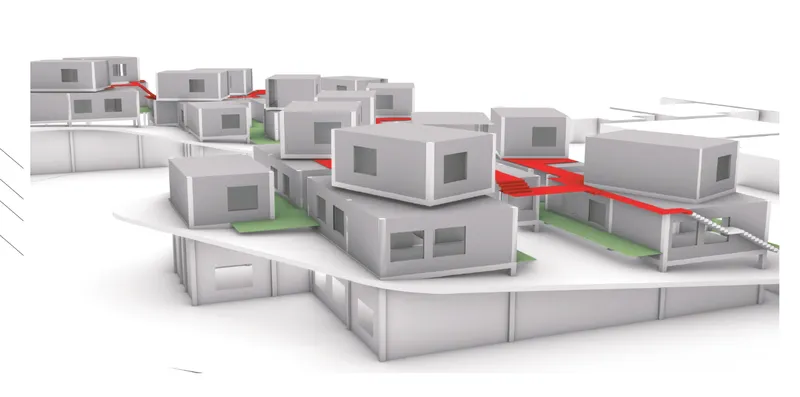
At closer range, the residential units reveal their modular DNA. White volumes stack and offset to create sheltered pockets of outdoor space, while red roof terraces cap each cluster, providing elevated gathering areas with views across the farming landscape. Green courtyards thread between the modules at ground level, serving as both social thresholds and productive growing zones. The interplay between private dwelling and communal agriculture is legible in every section: step out of your front door and you are already in a field, a workshop, or a conversation.
Elevated walkways, marked in red across the design diagrams, connect residential clusters and symbolize the flow of knowledge and resources through the village. These paths turn AgroSphere into a network of relationships rather than an arrangement of buildings, linking residents, researchers, and visitors in a shared circuit of sustainable practice.
A Living Classroom for AI-Powered Agriculture
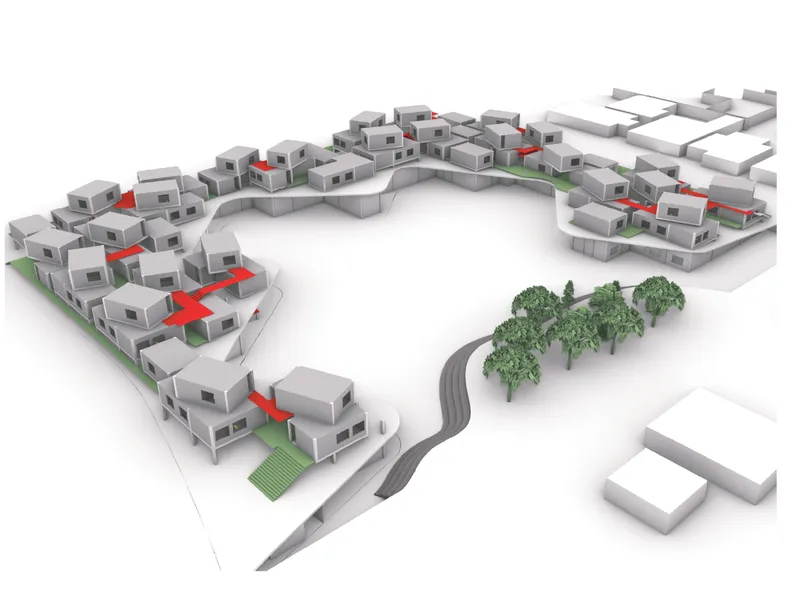
AgroSphere is as much a research facility as it is a neighborhood. Smart farming labs are woven into the village fabric, spaces where residents and researchers collaborate on soil sensors, irrigation models, and autonomous crop systems. Open fields serve rotational farming and educational workshops, positioning the entire community as a living classroom. Vertical crop façades and adaptive energy grids push data-driven technology into the everyday experience of the village, making innovation tangible rather than abstract.
The elevated perspective of the crescent form reinforces how deliberately the landscaped central pathway organizes the program. Trees line the spine, farming terraces step outward, and housing volumes frame the edges, creating a gradient from collective productivity at the core to private retreat at the perimeter. Every spatial decision reinforces the idea that food production, community building, and ecological restoration are not separate agendas but one integrated architectural proposition.
Why This Project Matters
AgroSphere rejects the premise that cities must choose between density and agriculture, between technological ambition and ecological responsibility. By merging AI-driven farming, modular housing, and community research spaces into a single crescent-shaped plan, Çarıkcı and Türkyılmaz demonstrate that these goals are not competing priorities but complementary layers of the same design problem. The project offers a credible spatial model for regions like Boa Vista where climate migration, food insecurity, and rapid urbanization collide.
What makes AgroSphere compelling is its refusal to treat sustainability as a surface treatment. Rainwater systems, composting loops, solar harvesting, and smart sensors are not accessories bolted onto a conventional housing scheme; they are the scheme. The architecture only makes sense because these systems exist. For students and young designers grappling with the question of how buildings can do more than shelter, this project provides a clear, spatially rigorous answer: let the building grow.
View the Full Project
About the Designers
Designers: Azra Can Çarıkcı, İdil Su Türkyılmaz
Enter a Design Competition on uni.xyz
uni.xyz runs architecture and design competitions year-round that reward proposals with spatial conviction and real site intelligence.
Project credits: AgroSphere by Azra Can Çarıkcı, İdil Su Türkyılmaz Live Green (uni.xyz).



Popular Articles
Popular articles from the community


Co-Life: Senior Housing Design That Reconnects Older Adults With the City
Co-Life reimagines senior housing design through healing gardens, shared streets, workshops, and a sustainable community across generations.

Riyadh For All: Intergenerational Urban Design for Active Aging in Rabat
Riyadh For All reimagines urban design in Rabat with intergenerational co-living, adaptive courtyards, and Moroccan cultural exchange today.

The Earth Pod: 3D Printed Homes for Resilient Refugee Communities
The Earth Pod reimagines refugee housing through 3D printed homes made from clay, combining resilience, self-sufficiency, and rapid shelter.

Lunar Spiral: Space Architecture Shaped by the Mathematics of the Universe
Lunar Spiral reimagines space architecture through Fibonacci geometry, lunar regolith, levitating habitats, and self-sustaining Moon living.


Similar Reads
You might also enjoy these articles
Lunar Spiral: Space Architecture Shaped by the Mathematics of the Universe
Lunar Spiral reimagines space architecture through Fibonacci geometry, lunar regolith, levitating habitats, and self-sustaining Moon living.
The Main Dream: Modular Architecture for Play, Learning, and Community
A modular playground turns recycled plastic into adaptable spaces where refugee children can play, build, learn, and reconnect.

Play: Fragments of Their World
Familiar architecture becomes modular playground design, creating safe spaces where displaced children can learn, connect, imagine and play.

Wadi Rum Observatory: Desert Architecture Designed for the Night Sky
Wadi Rum Observatory turns desert architecture into a quiet instrument for astronomy, hiding research spaces under Jordan's starlit terrain.


Explore Agri-urbanism Competitions
Discover active competitions in this discipline



Challenge to reimagine the Iron Throne


Photograph architecture without architects


Illustrate the lost glory of Angkor Wat - Render Challenge


Design challenge to reuse E-waste
Comments (0)
Please login or sign up to add comments
No comments yet. Be the first to comment!