
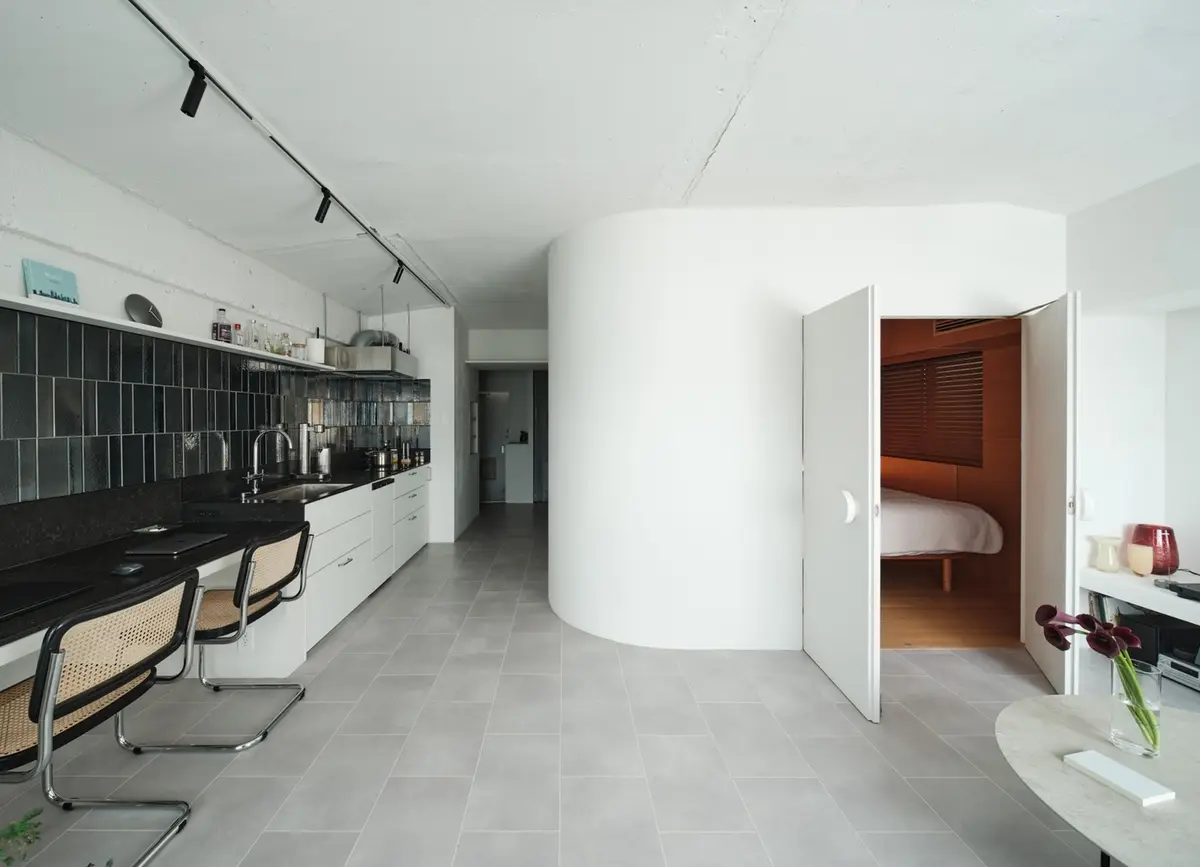
AKASAKA BOUNDS Apartment: A Honeymoon-Inspired Sanctuary in the Heart of Tokyo
A honeymoon-inspired Tokyo apartment blending light, textures, and thoughtful boundaries to create a serene, luxurious living retreat for a newlywed couple.


The AKASAKA BOUNDS Apartment by Studio KOM reimagines compact Tokyo living through an intimate blend of emotional storytelling, refined materiality, and spatial innovation. Located in Minato City and spanning 54 m², the 2024 renovation transforms a typical urban unit into a home inspired by the newlywed couple's shared journeys, personal histories, and the delicate balance between two merging lifestyles.
Photographed by Akira Nakamura, the project showcases a warm, atmospheric environment where architecture becomes a means of capturing ephemeral beauty: those fleeting moments of connection, discovery, and quiet solitude that define early married life.
A Home Shaped by Two Life Paths
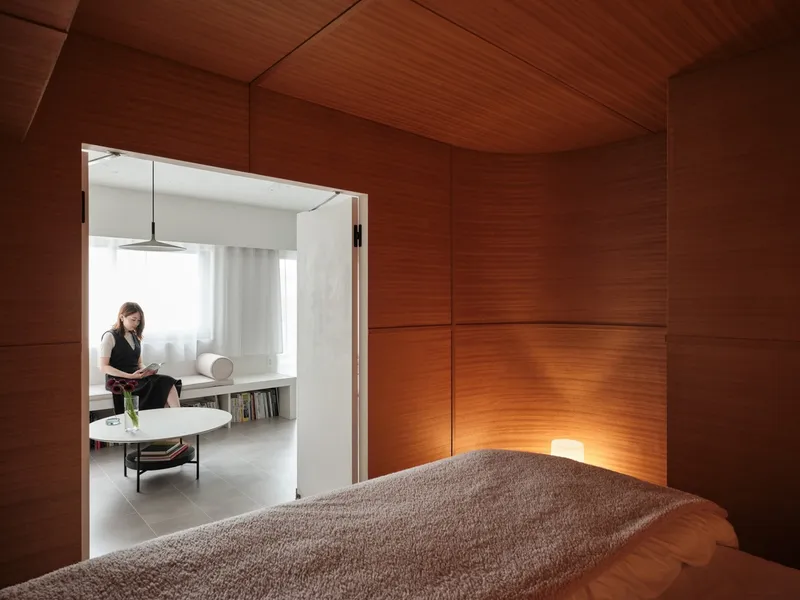
The design narrative begins with the idea of newlyweds learning to embrace each other’s distinct pasts. Studio KOM describes this as a “once-in-a-lifetime encounter,” filled with refreshing contrasts and subtle nostalgia. This emotional foundation becomes the conceptual framework for the space, shaping everything from the circulation to the material palette.
To reflect the couple’s honeymoon memories in New Zealand and Australia, the theme for the home became “an endless stay at the most prestigious hotel.” The apartment was envisioned as a serene retreat where the natural landscapes, colors, and tactile sensations from their travels translate into a calm yet richly layered interior experience.
Celebrating the Existing Structure Through Spatial Editing
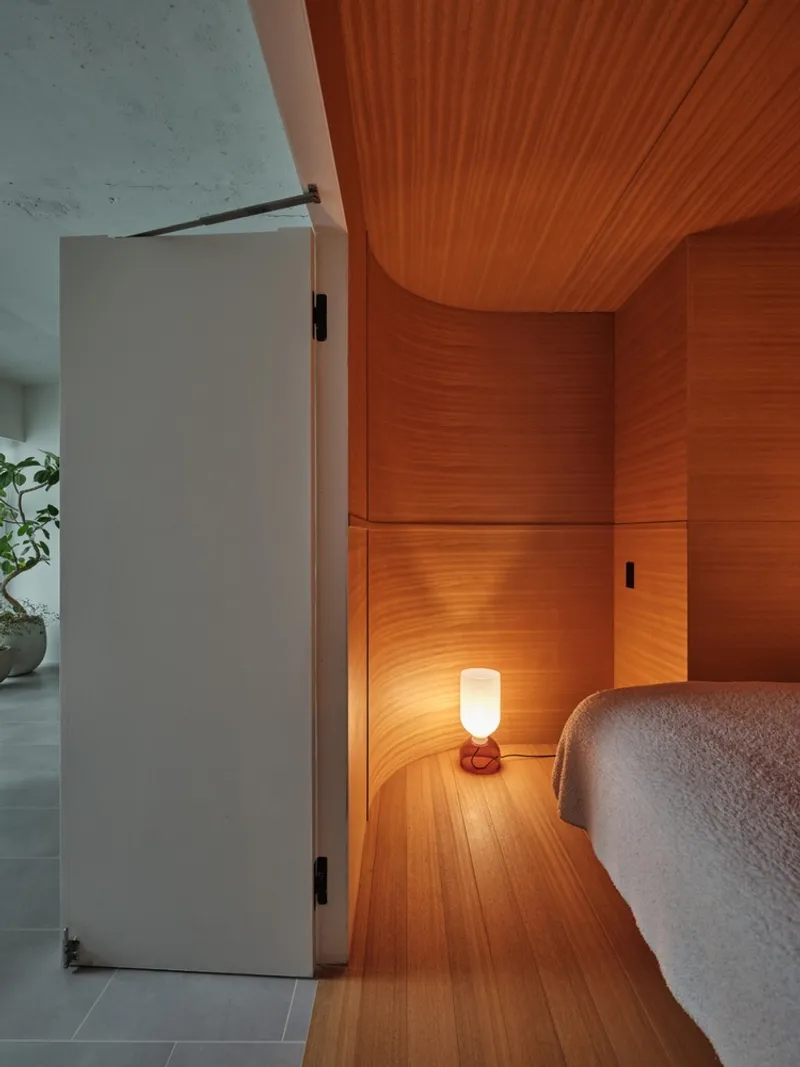
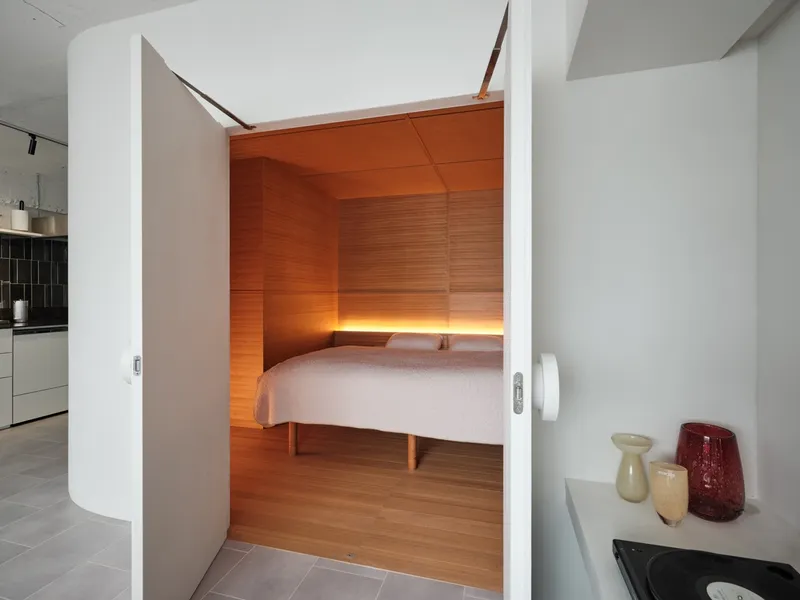
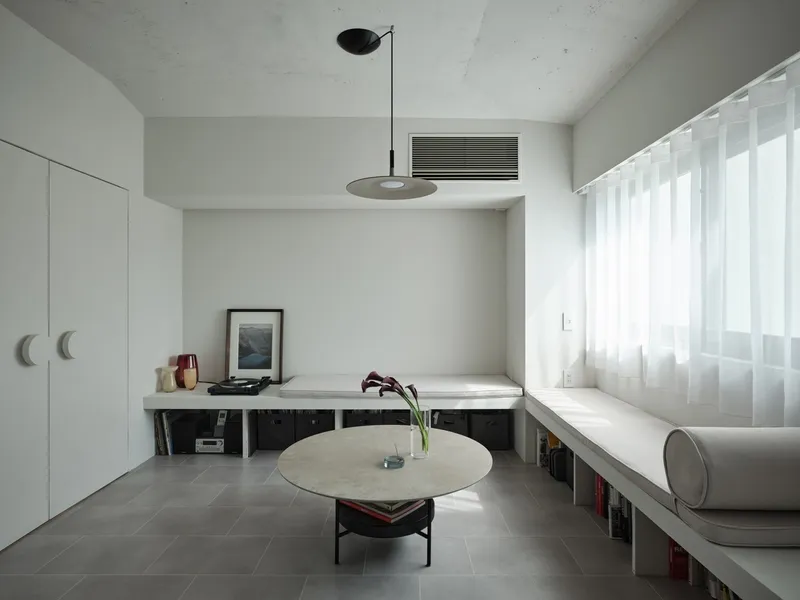
The apartment sits within a rigid RC frame of 5.4m × 6.3m units. Studio KOM strategically removed the floor across half a span from the entrance, creating a floating, corridor-like approach that immediately sets a luxurious tone rarely found in compact Tokyo apartments. On the opposite side, a semi-indoor balcony extending 2.7m × 3.1m becomes a private oasis, offering soft daylight and a visual extension of the interior.
These opposing elements, the entry approach and the balcony, function as architectural devices that buffer the home from Tokyo’s intensity. They create an experiential threshold where the city’s bustle dissolves into a refined, intimate environment.
The Entrance as an ON-OFF Boundary
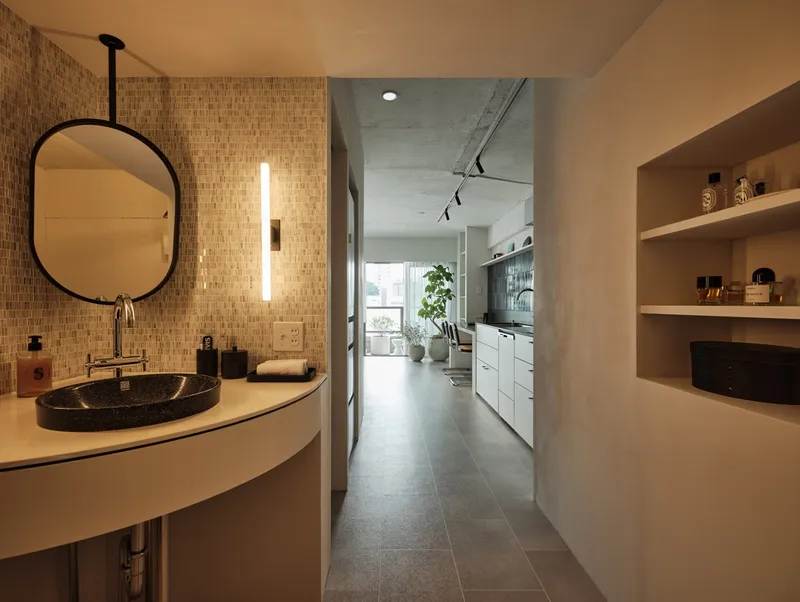
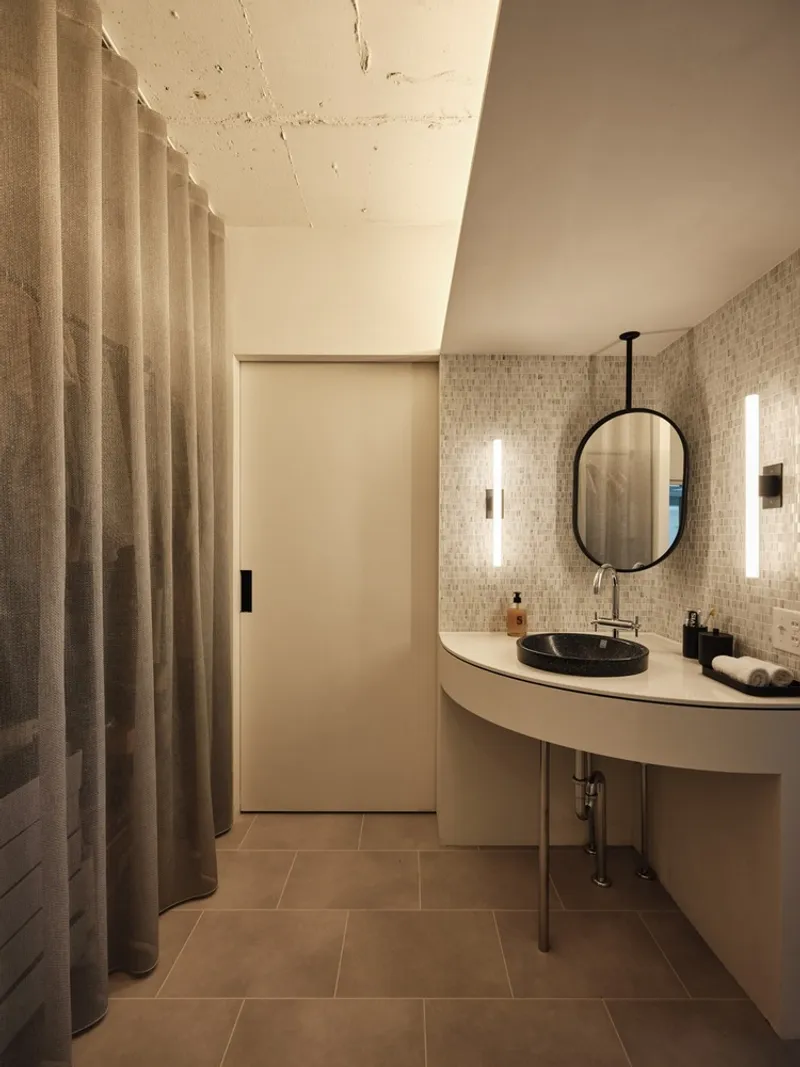
One of the project’s standout ideas is the redefinition of the entrance hall as an “ON-OFF border.” With existing ductwork hugging the wall and a constrained ceiling height of 1900 mm under a large beam, Studio KOM inserted a washbasin beneath the beam like a symbolic gateway.
This gesture serves several purposes:
- A ritual cleansing point when returning home from the city
- A transition zone between public and private realms
- A visual cue hinting toward the bright southern balcony
By turning an architectural constraint into a feature, the designers crafted an entry experience that is both symbolic and functional.
A Continuous Axis: Kitchen, Workspace, and Light
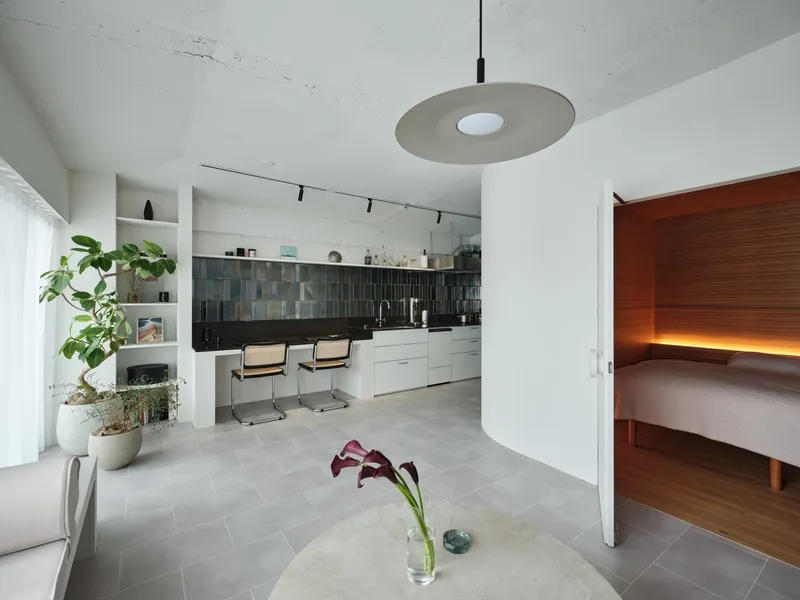
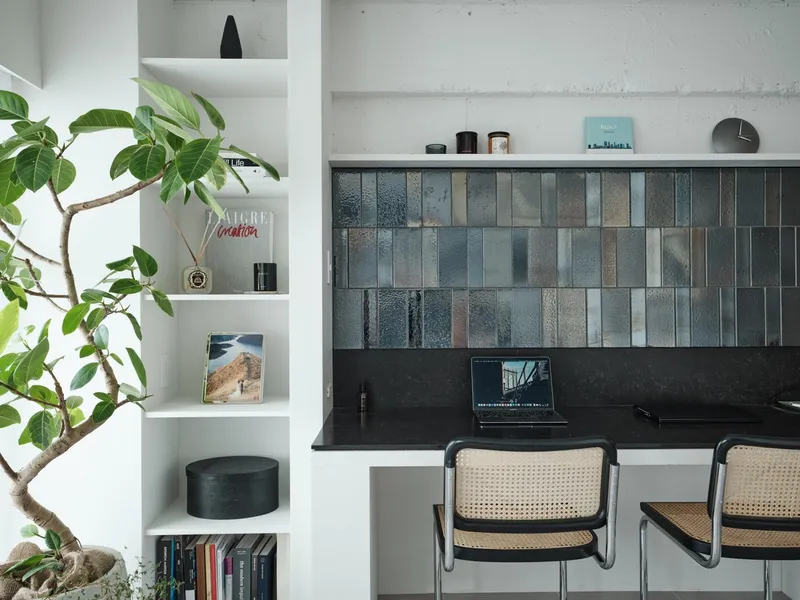
The kitchen and workspace are arranged along a single wall that visually and spatially connects the entrance to the balcony, forming a dynamic daily-use axis. Their adjacency encourages fluid movement and interaction, ideal for a young couple navigating life together.
A key design inspiration came from Lake Erskine in New Zealand, whose shimmering surface is reinterpreted through wet extruded tiles. Composed of rough chamotte soil mixed with metallic powders, these tiles produce shifting reflections, allowing natural light to dance across surfaces throughout the day.
This creates a poetic sequence of illumination: morning light glides from the balcony, travels along the tile-clad wall, and reaches the entrance gate like a gentle visual guide.
Materiality, Craft, and Meaning
Manufacturers such as Cocentino, KSAG, Pacific Textile, Tajima, and Timber Crew contributed materials that enhance the apartment’s tactile richness. Rough textures meet smooth finishes, soft textiles balance structural elements, and handcrafted details evoke the couple’s shared memories of nature and travel.
This thoughtful palette mirrors the deeper narrative of the project: two distinct lives merging, negotiating boundaries, and forming a harmonious whole.
A Home Named for Its Concept: “Bounds”
For Studio KOM’s Keisuke Okamoto and Maria, architecture and interior design operate with different values yet overlap meaningfully in this project. As the couple’s first shared home and their first collaborative life project, the apartment becomes a living framework for future growth.
All photographs are works of Akira Nakamura


Popular Articles
Popular articles from the community


Aquadapt: An Underwater Habitat That Rewrites Its Rooms by the Hour
Curved modules ring the seabed while one shell shifts from breakfast room to cinema, farm and football pitch as residents' needs change.

The Amber Palace Opera: A Geological Fiction Surfaces on Tallinn's Baltic Waterfront
Pierre Brillard reimagines a Baltic legend as a public landscape, opera house, and waterfront promenade rooted in Tallinn's coastal identity.

Singing Woman: An Opera House That Performs Before the Curtain Rises
Ovidiu Cristian Pavel's conceptual opera house translates Estonia's choral identity into a sculpted waterfront landmark facing the Baltic Sea.


Cube Design Draws an Ecological Corridor Between Two Shenzhen Hills with the Nankai Building
Beside Shenzhen's container docks, the Nankai Building pairs stacked balconies with a climbing green screen to connect two hillsides across its height.

Similar Reads
You might also enjoy these articles


Hodi-Mandai Geram
Project Function: Preservation and revitalization of the Intangible heritage and socio-spatial identity of the Hodi by Housing, Cultural Memory Center, Sacred Grove, landscape, local tourism economy


Olio Towers: A Mid-Rise for Performers That Fuses Housing, Rehearsal, and Stage
Located blocks from Houston's Theater District, this modular tower stacks living units around a central performance atrium.

Oasis: Modular Green Housing Carved into Dhaka's Urban Fabric
A shortlisted Plugin Housing entry reclaims unauthorized settlements in Dhaka with stepped concrete volumes, green roofs, and ventilation-driven design.

Black Hole: A Floating Megastructure for the Post-Physical Era
Emiliano Mazzarotto envisions a spherical, self-scaling arena where e-sports, digital hotels, and holographic stadiums replace traditional public space.

Explore Tokyo Competitions
Discover active competitions in this discipline

Challenge to reimagine the Iron Throne

Photograph architecture without architects

Illustrate the lost glory of Angkor Wat - Render Challenge

Design challenge to reuse E-waste
Comments (0)
Please login or sign up to add comments
No comments yet. Be the first to comment!