

ALAWABBAD: Modular Maglev and Shipping Containers Reimagine Mumbai's Rail Network
A layered transit proposal weaves magnetic levitation tracks, repurposed containers, and vertical towers into Mumbai's overstressed suburban rail corridors


What if Mumbai's next transit revolution borrowed its logic from the city's legendary Dabbawala system? ALAWABBAD takes that provocation seriously, proposing a Modular Maglev Transit System that threads elevated magnetic levitation tracks through the dense urban fabric and repurposes shipping containers as passenger pods. The result is a speculative but meticulously detailed vision: a radial network of compact transit towers, or "sub-loci," feeding into major suburban rail stations while housing public amenities and rehabilitation units for displaced communities. It is infrastructure that does more than move people; it attempts to give them somewhere to belong.
The project is a People's Choice Award entry in the Hyperlocal competition on uni.xyz, designed by Sibin Sabu, Radhika Suresh, Aravind S, Aswin S. Kumar, and Aparna Lakshmy Krishnan. Set within the Mumbai Metropolitan Region, a territory of seven municipal corporations and fifteen smaller councils serving 13.92 million residents, ALAWABBAD confronts a transit system that carries over 7.5 million daily commuters under conditions of extreme overcrowding, unsafe crossings, and persistent encroachment. The designers benchmark Mumbai against alpha cities like Amsterdam, Chicago, and Singapore to expose the paradox: staggering population density paired with weak intermodal connectivity and low GDP per capita.
Containers on Maglev Tracks: A Transit System Drawn from Logistics
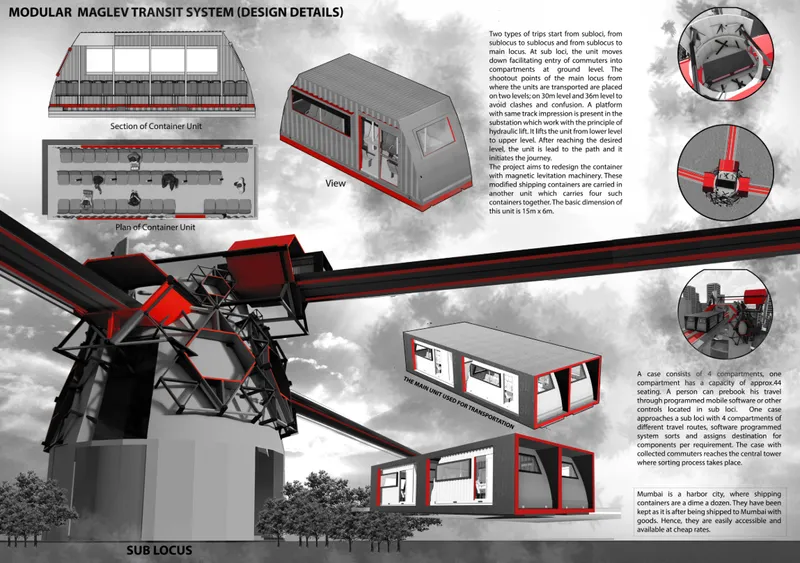
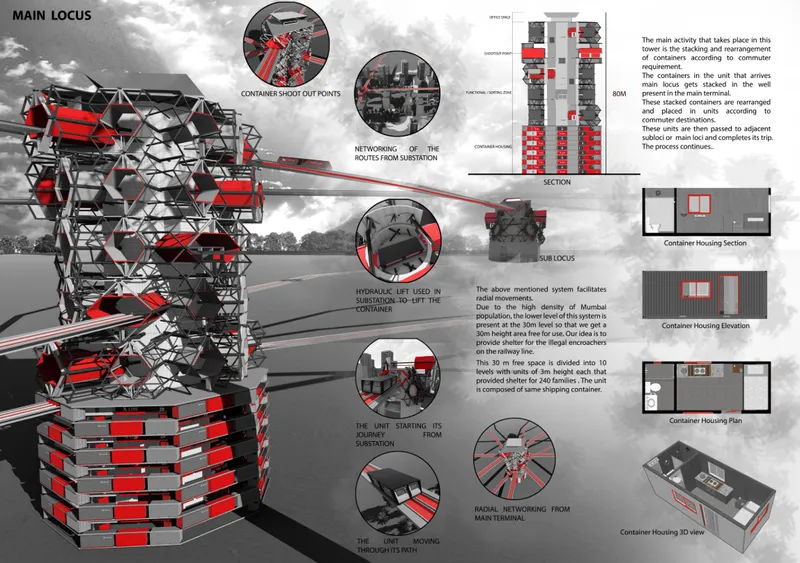
The technical drawings reveal the anatomy of the Modular Maglev Transit System in precise detail. Shipping containers, redrawn as passenger transit units highlighted in red, slot into elevated magnetic levitation tracks that bypass surface congestion entirely. The exploded axonometric of the modular tower structure shows how each vertical node, termed a "sub-locus," stacks transit tubes, public amenities, and community rehabilitation spaces within a single compact footprint. Connection diagrams map the physical joints between container modules and the tower frame, treating logistics hardware as architectural vocabulary. The reuse of containers is not merely symbolic; it directly reduces construction cost and carbon footprint while allowing rapid, modular deployment across multiple station sites.
The inspiration from Mumbai's Dabbawala network is more than a conceptual nod. Just as the Dabbawala system routes 200,000 lunchboxes through the city with near-zero error, ALAWABBAD applies architectural intelligence to commuter flow, channeling passengers through container pods along predictable radial paths. Maglev technology minimizes waiting periods and travel delays, while the modular construction logic means the system can scale incrementally rather than requiring a single massive capital outlay.
Radial Connectivity Across Mumbai's Dense Urban Mosaic
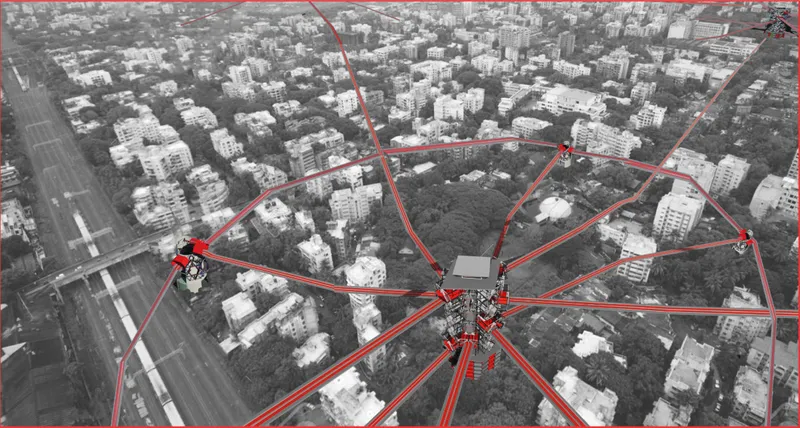
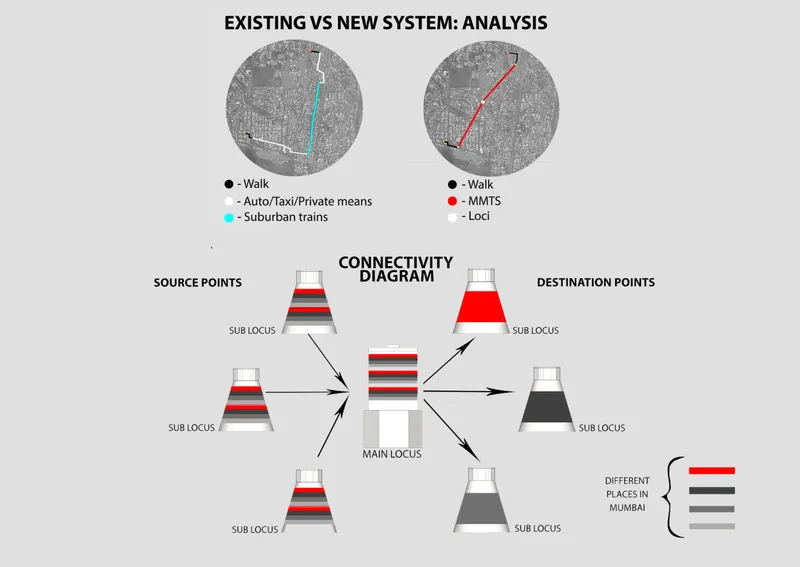
The aerial overlay shows the proposed radial transit network in red, stretching across Mumbai's tightly packed residential blocks. Rather than reinforcing the existing north-south congestion corridor, the MMTS radiates outward from main loci at key suburban stations like Andheri and Vile Parle, connecting to distributed sub-locus points. The comparative analysis diagram beneath it maps these transit routes explicitly, illustrating how a single main locus links to multiple sub-loci through branching elevated tracks. The network logic is clear: redistribute pressure away from overburdened surface-level rail by introducing a secondary, elevated layer of movement.
The designers frame their approach through a dual strategy they call "Incrementation + Integration." Incrementation means layering modular upgrades onto existing stations, including underground metro connections, crowd-control zones, and safe interchange pathways. Integration means stitching those upgraded stations into the new MMTS network alongside metros, buses, and pedestrian links. Together, the two strategies aim to expand capacity while humanizing the transit experience, turning stations from bottlenecks into multi-layered architectural ecosystems.
Station Sections: Where Rail Infrastructure Meets Walkable Urbanism
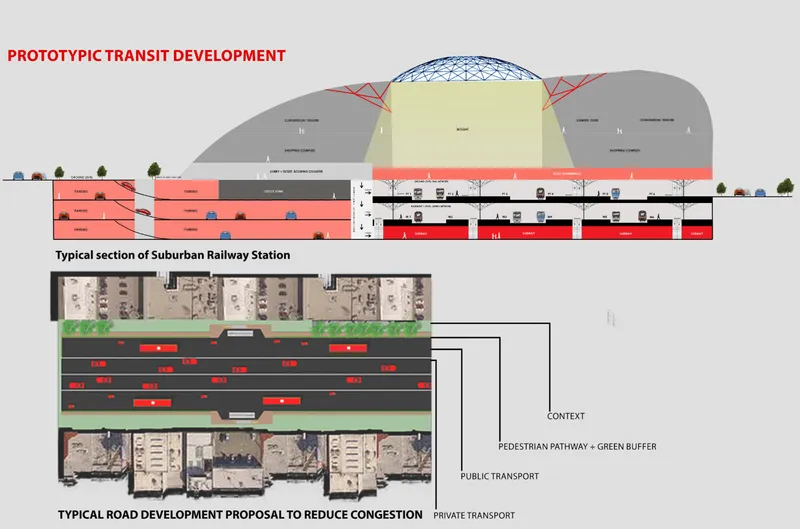
The section drawing cuts through a suburban railway station topped by a domed structure, revealing how ALAWABBAD reorganizes vertical circulation across multiple levels. Below, the typical road development integrates dedicated transit lanes, showing the project's ambition to extend its influence beyond the station boundary into the surrounding streetscape. Pedestrian access threads through each level, reinforcing what the designers describe as "walkable urbanism," a commitment to making transit nodes approachable on foot rather than accessible only by car or auto-rickshaw.
This is where the project's social dimension becomes most legible. The compact transit towers do not just process commuters; they incorporate rehabilitation units for communities displaced by rail corridor encroachment. By embedding housing and public amenities within the transit infrastructure itself, ALAWABBAD attempts to address one of Mumbai's most politically charged realities: the millions who live alongside and on top of the railway system because they have nowhere else to go.
Why This Project Matters
ALAWABBAD is speculative, and it knows it. Magnetic levitation tracks threading through Mumbai's most congested neighborhoods would face enormous political, financial, and engineering obstacles. But the value of a proposal like this lies not in its immediate buildability. It lies in the clarity with which it diagnoses the problem: Mumbai's transit infrastructure was designed for a city that no longer exists, and incremental surface-level fixes cannot keep pace with a population that adds density faster than it adds capacity.
What sets the project apart is its refusal to treat transit as a single-purpose system. By folding housing, community rehabilitation, and pedestrian networks into the same modular towers that carry maglev pods, the team demonstrates that infrastructure can be socially productive, not just logistically efficient. For a city where 7.5 million people ride the rails each day and millions more live in their shadow, that integration of mobility with habitation is not a luxury. It is the design problem of the century.
View the Full Project
About the Designers
Designers: Sibin Sabu, Radhika Suresh, Aravind S, Aswin S. Kumar, Aparna Lakshmy Krishnan
Enter a Design Competition on uni.xyz
uni.xyz runs architecture and design competitions year-round that reward proposals with spatial conviction and real site intelligence.
Project credits: ALAWABBAD by Sibin Sabu, Radhika Suresh, Aravind S, Aswin S. Kumar, Aparna Lakshmy Krishnan Hyperlocal (uni.xyz).


Popular Articles
Popular articles from the community

Tsunami Convergenics: Turning Catastrophic Ocean Forces into Underwater Housing Infrastructure
A speculative underwater settlement off the coast of Onagawa, Japan, treats tsunamis and typhoons as energy sources rather than threats.

Singing Woman: Contemporary Architecture Inspired by Estonia’s Voice and the Sea
Singing Woman turns Estonia’s song culture into flowing opera house architecture, blending public life, landscape, sea, and national memory.

Cloaked Colonization: A Mobile Underwater Habitat That Moves Like a Fish
Micah Abaya's shortlisted EHC Pacific entry reimagines ocean settlement as a dispersed network of self-sustaining architectural organisms.
Faces of the Soviet Avant-Garde: Turning Moscow's Street Names into an Open-Air Museum
A network of sculptural installations across a Moscow residential district transforms forgotten architect names into spatial encounters with cultural memor

Similar Reads
You might also enjoy these articles

The Amber Palace Opera: A Geological Fiction Surfaces on Tallinn's Baltic Waterfront
Pierre Brillard reimagines a Baltic legend as a public landscape, opera house, and waterfront promenade rooted in Tallinn's coastal identity.
Dynamic Modules Shelter: A Telescopic Ring for Mountain Pilgrimage
A circular modular framework of steel, bamboo, and fabric grows vertically with demand, wrapping communal ground in adaptable shelter.
Singing Woman: Contemporary Architecture Inspired by Estonia’s Voice and the Sea
Singing Woman turns Estonia’s song culture into flowing opera house architecture, blending public life, landscape, sea, and national memory.
HYPERBLOCK: Flexible Urban Design for Barcelona’s Future City
HYPERBLOCK reimagines Barcelona as flexible urban design, layering density, daylight, public space and adaptable housing above Cerdà’s grid.

Comments (0)
Please login or sign up to add comments
No comments yet. Be the first to comment!