

Al.Irene Escudé y Aleix Gz Call Replace a Dark Corridor with a Sculptural Core in Barcelona
A 100 m² flat in Les Corts trades its cramped hallway for a sinuous, fluted volume that floods every room with light and color.


Most apartment renovations in Barcelona start with the same problem: a long, lightless corridor that funnels residents past rooms they can barely see into. In Les Corts, a neighborhood whose streets ignore the Eixample grid and carry their own informal logic, the 100 m² LC354 flat suffered from exactly this condition. Two facades, one to the street and one to an interior patio, should have guaranteed generous daylight. Instead, a spine of partition walls turned the plan into a sequence of dark, disconnected cells.
Architects Irene Escudé and Aleix Gonzalez of Al.Irene Escudé y Aleix Gz Call gutted the corridor entirely and replaced it with something far more ambitious: a freestanding, curved volume clad in fluted panels that shifts from red to orange depending on the light. The move is simple in concept and rich in consequence. The core absorbs a toilet and kitchen storage, anchors circulation, frames views between rooms, and gives the apartment an unmistakable identity. Rather than hiding services behind plasterboard, the architects turned infrastructure into the protagonist.
The Curved Core as Protagonist

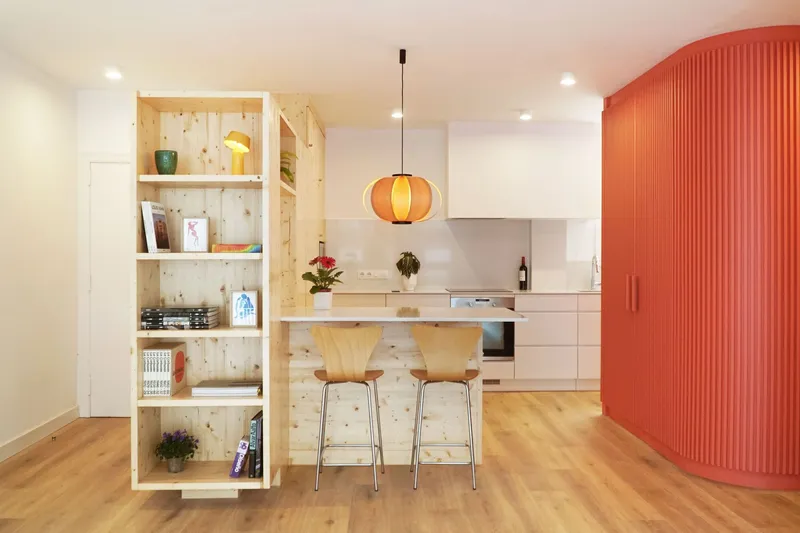

The central volume reads as a piece of furniture scaled up to architecture. Its sinuous plan eliminates sharp corners, guiding movement around it in a continuous loop rather than the dead-end shuffle of the old layout. The fluted cladding catches raking light from both facades, turning the surface into a gradient of warm tones that shift throughout the day. Doors are integrated flush with the fluting, so you have to look twice to find them. It is a deliberate act of camouflage: the volume wants to be read as a single, continuous object.
Functionally, it does heavy lifting. One side houses bathroom plumbing; the other accommodates deep kitchen storage. A linear closet extends from the core to frame the entrance to the two main rooms, consolidating all general storage in a single gesture. The result is that every perimeter wall is freed for windows, furniture, or open shelving. Nothing competes with the core for attention, and nothing needs to.
Pine, Color, and Honest Materials


Solid pine and knotted plywood do most of the material work here. The kitchen island, shelving units, and breakfast bar are all built from the same blonde timber, giving the apartment a consistent warmth without resorting to the antiseptic white-on-white palette that dominates so many Mediterranean renovations. Knots are left visible, grain is celebrated, and joints are expressed rather than concealed. The timber reads as craft, not commodity.
Against this neutral wood backdrop, the orange and red fluting of the central volume becomes electrifying. The color choice is deliberate provocation: it pulls the eye inward, toward the center of the plan, precisely where the old corridor used to discourage you from lingering. Layered wood-veneer pendant lamps echo the material logic at a smaller scale, reinforcing the sense that every element belongs to a single, considered family of objects.
Kitchen as Social Spine
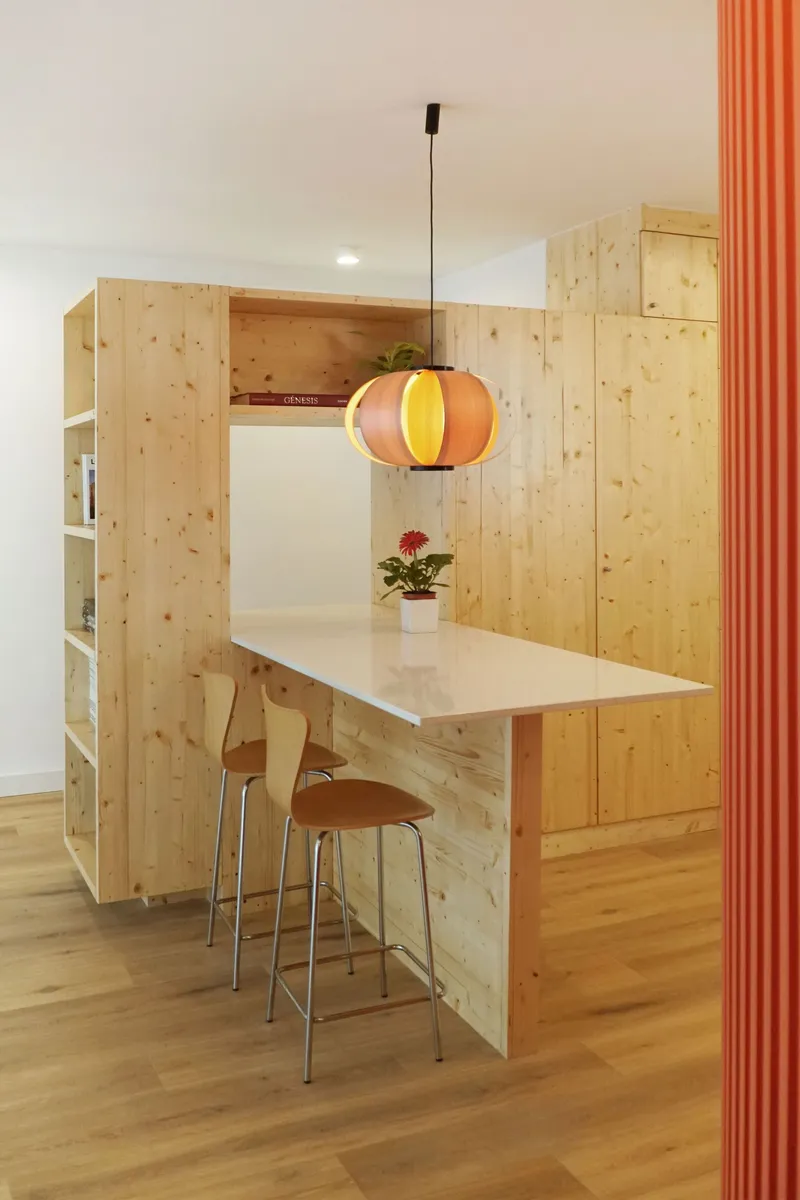


The kitchen wraps around one face of the curved core, borrowing its geometry to create a countertop that doubles as a breakfast bar. Cooktop and sink sit on the working side; stools line the social side. The arrangement is compact but never cramped, because the open plan allows sightlines to extend in every direction. You can cook while watching someone read by the courtyard window or chatting with a guest at the entrance.
Ceiling-recessed lighting washes the fluted surface evenly at night, replacing the daylight gradient with an artificial one that feels equally calibrated. The architects clearly thought about this apartment in both its daytime and nighttime modes, and the kitchen, as the social anchor, benefits from that attention.
Light from Two Facades

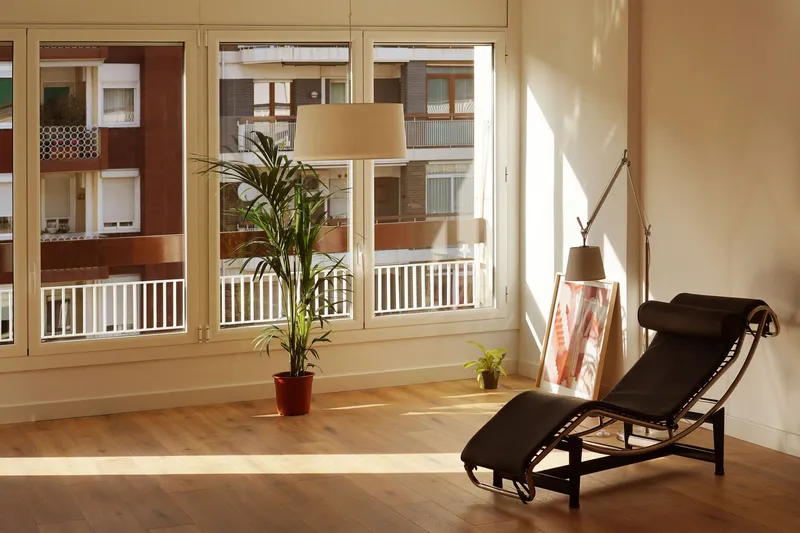

The square plan's west orientation means afternoon sun floods the street-facing rooms, while the courtyard facade provides softer, reflected light in the mornings. By removing the corridor, the architects created a continuous cross-section through which both sources of daylight can travel. Glazed interior doors and carefully positioned openings in the cabinetry allow light to hop from room to room, eliminating the need for artificial lighting during most of the day.
The courtyard-facing rooms are particularly well resolved. Tall windows frame views of the surrounding residential fabric without exposing the interior to direct solar gain. A lounge chair placed beside one of these windows becomes the apartment's quiet counterpoint to the bustling kitchen zone on the opposite side.
Balcony and Threshold
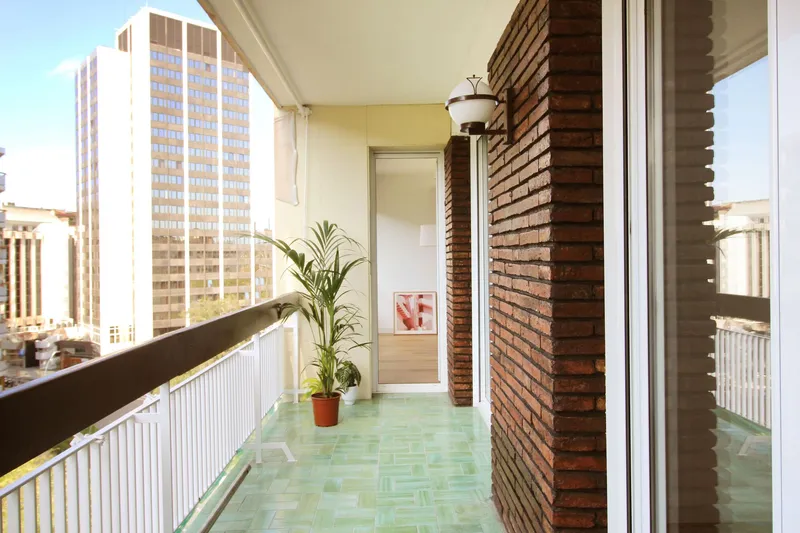
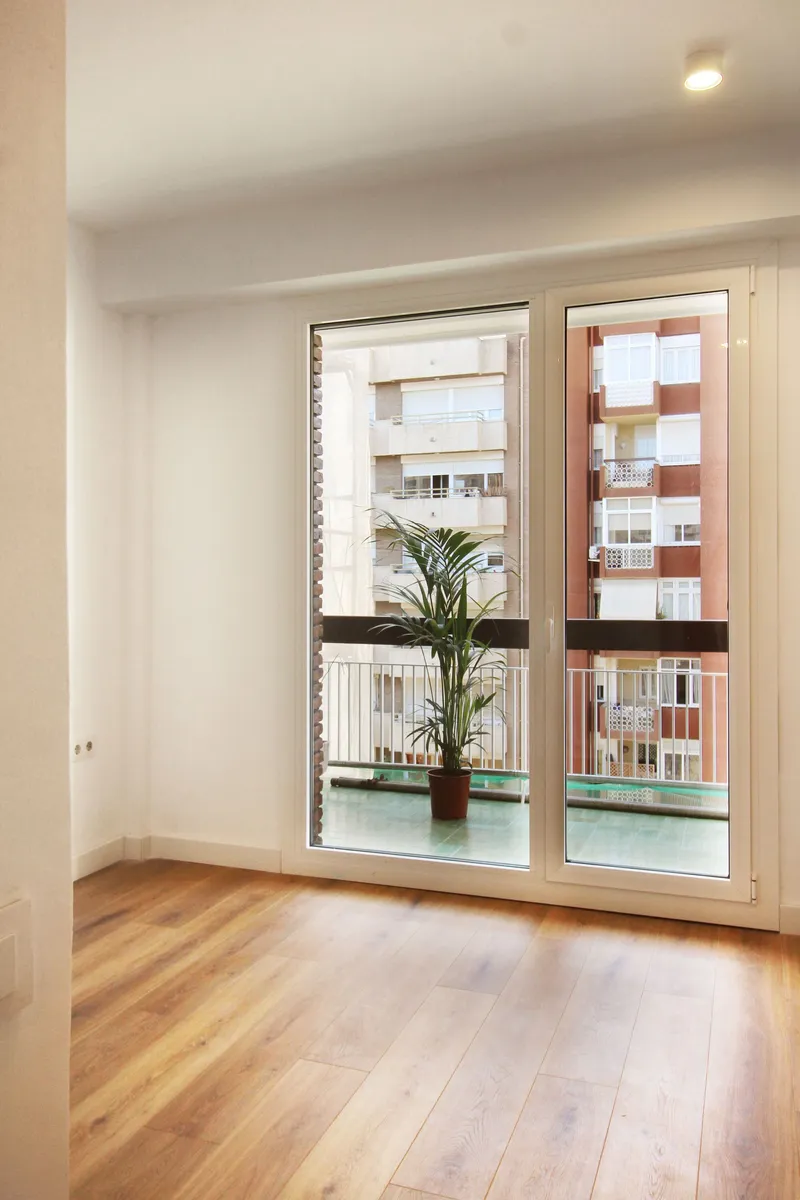

A covered balcony with green mosaic tile flooring and a perforated brick screen acts as a climatic buffer between inside and outside. The brick screen filters light and provides privacy without blocking air movement, a detail that feels indigenous to Barcelona's building culture rather than imported from a catalog. It is a small space, but its materiality is entirely distinct from the interior, signaling a genuine threshold rather than a blurred boundary.
Inside, the two main rooms are deliberately understated: white walls, timber floors, glazed doors to the balcony. They rely on the central core and its storage volumes for definition, which means they can absorb different uses over time without requiring any further intervention. Bedrooms, studios, guest rooms: the plan is agnostic because the architecture did its work elsewhere.
Bathroom Details

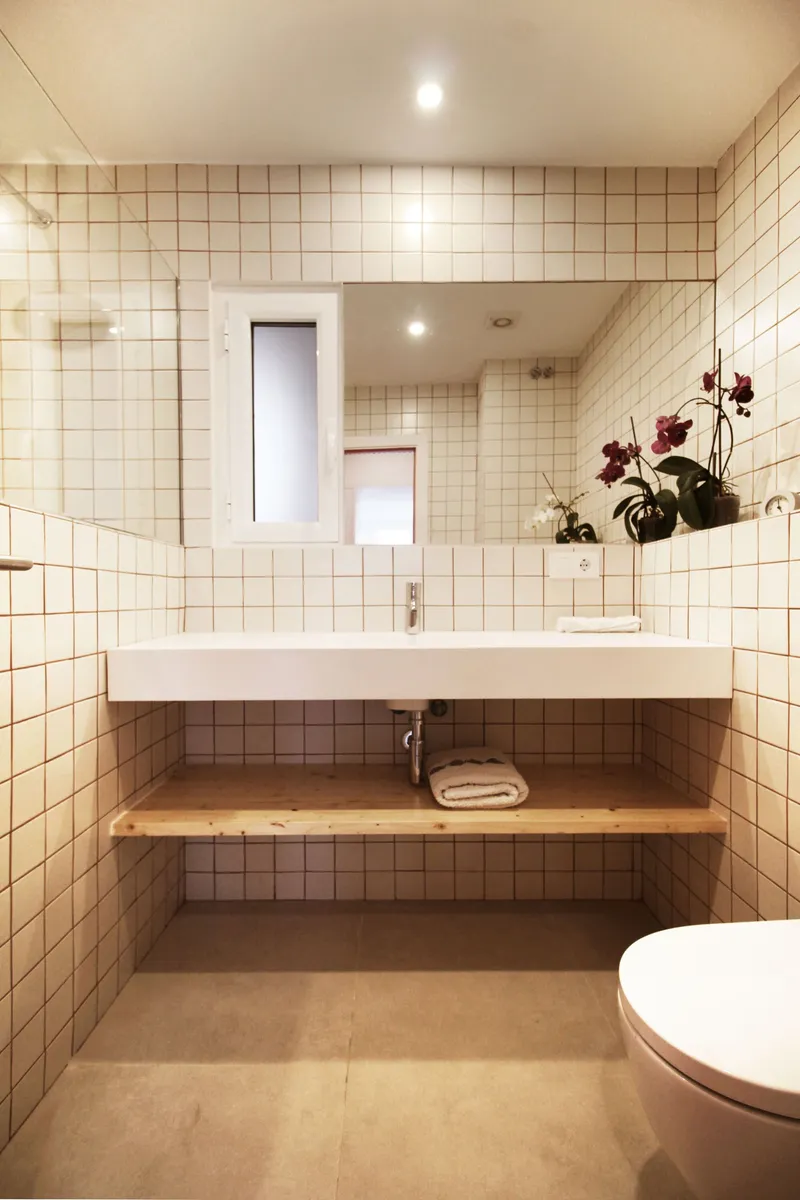
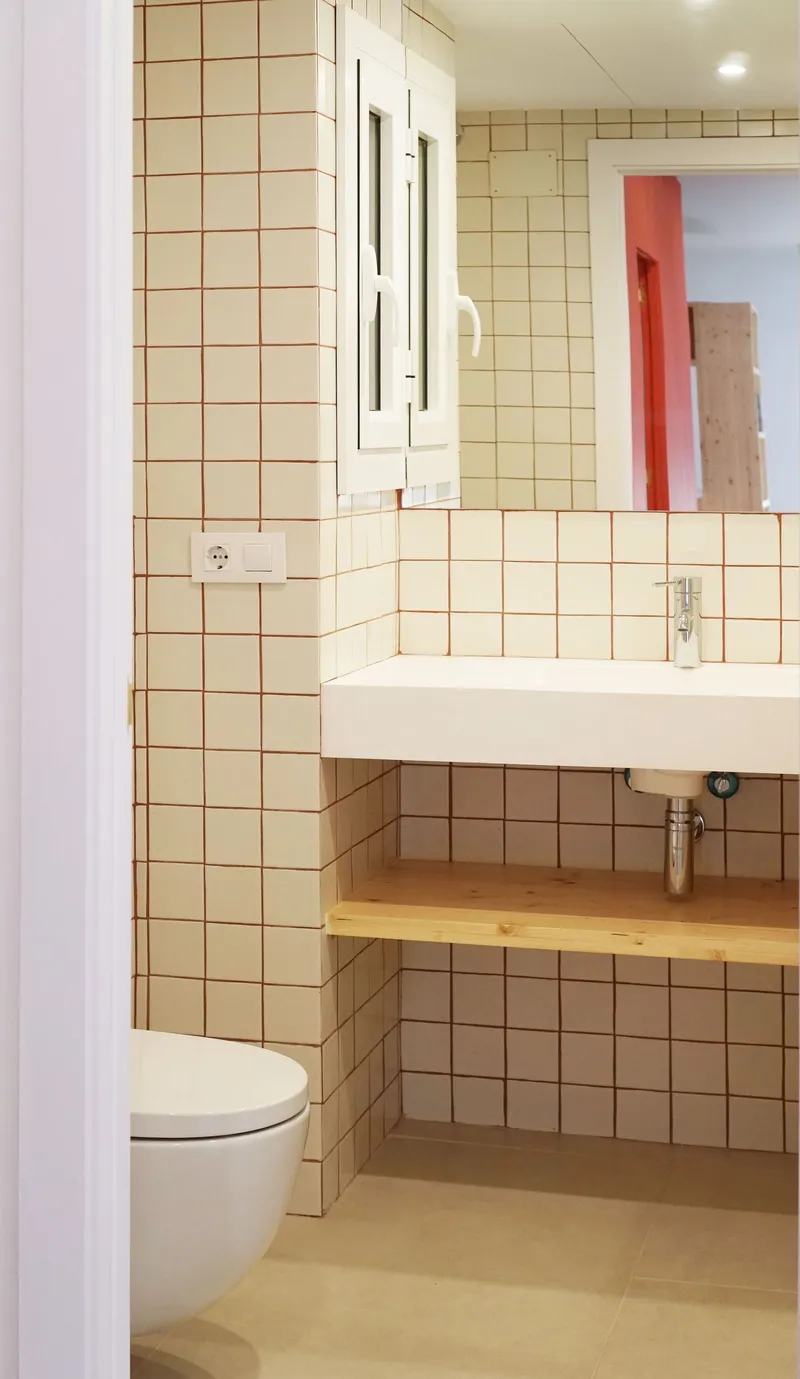
Accessed through one of the hidden doors in the fluted volume, the bathroom switches to a palette of cream square tiles and white fixtures. A timber shelf beneath the wall-hung sink keeps the material thread alive, and a recessed mirror cabinet avoids any projections into the tight floor area. The transition from the saturated color of the core to the calm neutrality of the bathroom is abrupt and effective. You step through the fluting and arrive somewhere entirely different.
Pendant Lamps and Furniture Details


Custom pendant lamps, built from layered wood veneer in segmented red and orange tones, deserve a closer look. They are miniature echoes of the fluted core: ribbed, warm, and handmade in feel. Hanging above the breakfast bar and in the kitchen zone, they compress the project's material logic into a single domestic object. It is a small touch, but it confirms that the architects were thinking at every scale, from the plan diagram down to the light fitting.
Plans and Drawings
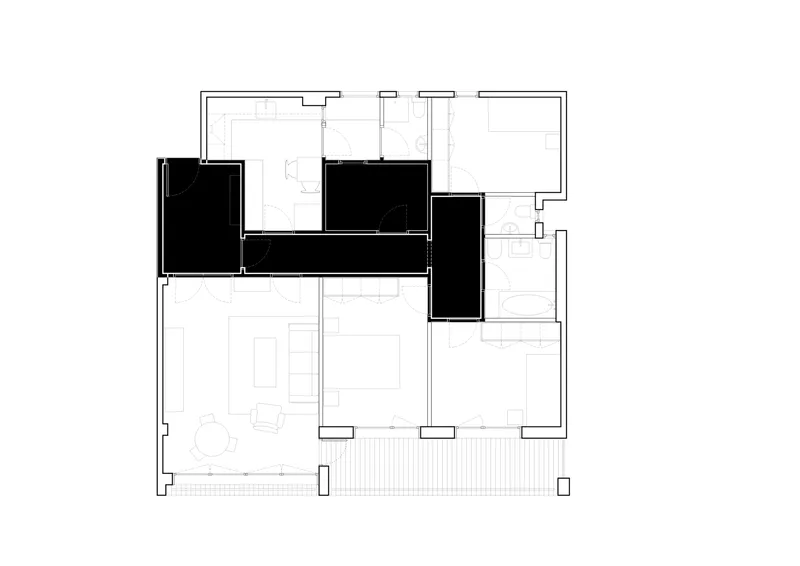
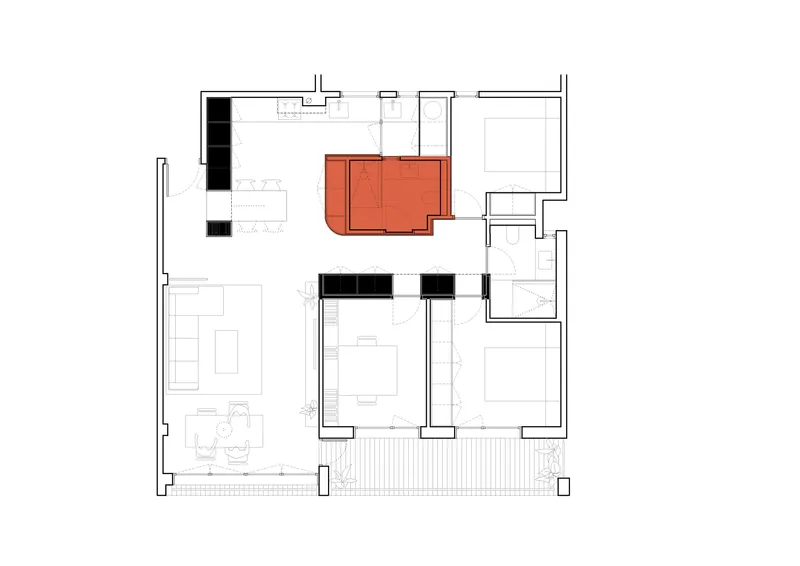

The floor plans make the strategy legible at a glance. In one version the curved volume is rendered in solid black, emphasizing its role as a new structural insert within the existing perimeter. In the color version it appears in orange, matching its built reality and clarifying which surfaces carry the fluted treatment. The axonometric drawing pulls the lid off the apartment to show how the core organizes every adjacent space: kitchen to one side, bathroom within, storage extending linearly to frame bedroom entries. It is a textbook example of one move doing many jobs.
Why This Project Matters
LC354 is a 100 m² apartment renovation, not a museum or a headquarters. That matters. The budget constraints and spatial limitations of domestic refurbishment force architects to be disciplined about where they spend their energy. Escudé and Gonzalez chose to concentrate everything into a single architectural element, the curved fluted core, and let the rest of the apartment remain quiet. That economy of means produces clarity, and clarity is what most small apartments desperately need.
The project also offers a useful counterargument to the minimalist refurbishment trend that strips apartments back to white walls and concealed storage. Here, the infrastructure is loud. It has color, texture, and presence. The toilet is inside the sculpture. The kitchen storage is part of the art piece. Rather than hiding the ordinary, the architects elevated it, and the apartment is better for it. In a neighborhood like Les Corts, where the urban fabric already resists the tidy logic of the grid, an interior that embraces formal exuberance feels entirely appropriate.
LC354 House Refurbishment by Al.Irene Escudé y Aleix Gz Call (Architects: Irene Escudé and Aleix Gonzalez). Barcelona, Spain. 100 m². Completed 2022. Photography by AI arquitectura.
About the Studio
Al.Irene Escudé y Aleix Gz Call
Share Your Own Work on uni.xyz
If projects like this are the kind of work you want to make, uni.xyz is a place to publish your own, find collaborators, and enter design competitions.


Popular Articles
Popular articles from the community


Opera on the Sea: Driftwood Logic Shapes a Timber Opera House on Estonia's Coast
Trevor Orgill's opera house translates the entangled drift of floating timber into a civic building where wood, water, and music converge.

Temporary Home for Dogs: A Reversed Zoo Rethinks Animal Shelter Architecture
In Bucharest, a sinuous corridor and freed landscape flip the logic of containment, designing a shelter that works to make itself unnecessary.

Faces of the Soviet Avant-Garde: Turning Moscow's Street Names into an Open-Air Museum
A network of sculptural installations across a Moscow residential district transforms forgotten architect names into spatial encounters with cultural memor

Tsunami Convergenics: Turning Catastrophic Ocean Forces into Underwater Housing Infrastructure
A speculative underwater settlement off the coast of Onagawa, Japan, treats tsunamis and typhoons as energy sources rather than threats.

Similar Reads
You might also enjoy these articles

Bao Huynh Watercolor Atelier: A Serene Art Retreat in Hội An
Bao Huynh Watercolor Atelier in Hội An blends multifunctional art spaces, sustainable design, local materials, and family-friendly living in a serene environment.

Atelier Macri Concept Store Interior Design by CASE-REAL
Atelier Macri store features a "ko" counter, walnut wood details, cork displays, blending retail, gallery, and seamless customer experiences.

Manuel Vargas Izquierdo Stadium and High-Performance Sports Center: Architectural Excellence in Jalpa de Méndez
The Manuel Vargas Izquierdo Stadium blends sustainable design, inclusive sports facilities, and cultural-inspired architecture, revitalizing Jalpa de Méndez’s public spaces.

KAKR Buluh Awar Hall: Revitalizing Community and Ecology Through Bamboo Architecture
Community built bamboo hall revitalizes Buluh Awar village, empowering youth, restoring ecology, celebrating vernacular craftsmanship through sustainable architecture and culture.

Explore Renovation Competitions
Discover active competitions in this discipline

Challenge to design mud housing for contemporary communities

Challenge to design luxury tourism on rails

VR headsets Storefront design competition

Designing a staircase for a client
Comments (0)
Please login or sign up to add comments
No comments yet. Be the first to comment!