
all(zone) Drapes a Three-Layered Tensile Canopy over Melbourne's Queen Victoria Gardens
A temporary pavilion of Thai fishing nets, transparent membrane, and waffle fabric brings Southeast Asian informality to Melbourne's parkland.


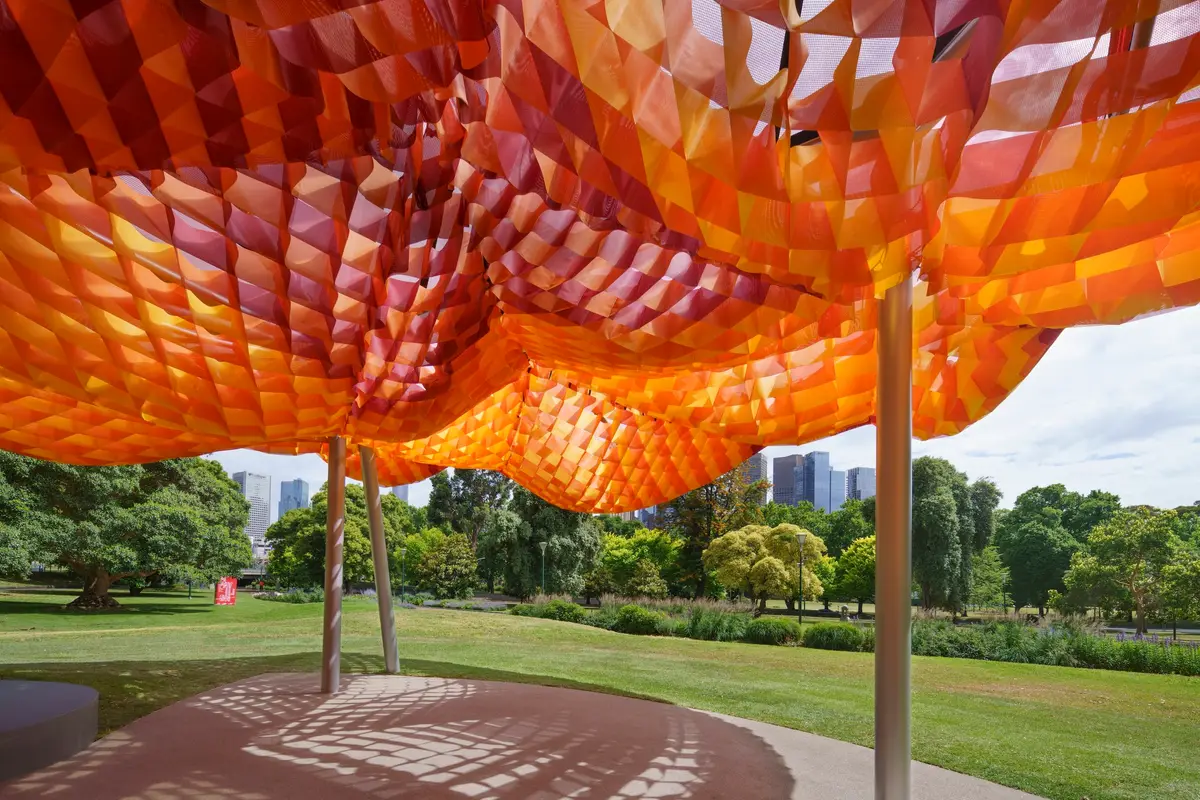
Every year since 2014, the Naomi Milgrom Foundation has commissioned an architect to design a temporary pavilion for Melbourne's Queen Victoria Gardens. For the ninth edition, the foundation turned to Bangkok-based practice all(zone), led by Rachaporn Choochuey, and the result is one of the most genuinely atmospheric structures the series has produced. Rather than an object demanding attention, MPavilion 2022 is closer to a textile event: three distinct canopy layers stretched across a steel ring beam on slender columns, filtering light and catching rain like a synthetic forest canopy.
What makes this project worth studying is its refusal to behave like a building. The outermost layer is made of Thai polyethylene fishing nets woven from red and yellow threads. Beneath that sits an STFE (polyarylate mesh) membrane, a material never before used in Australia, which is as transparent as glass but ten times lighter. At the bottom, 48 individual waffle-patterned fabric panels hang loosely enough to sway in the breeze. The three layers together produce an interior condition that shifts constantly with wind, light, and time of day. After Melbourne's severe pandemic lockdowns, the concept celebrated outdoor living by recreating the sensation of sitting under a large tree, with sunlight flickering through layered leaves.
A Canopy That Moves
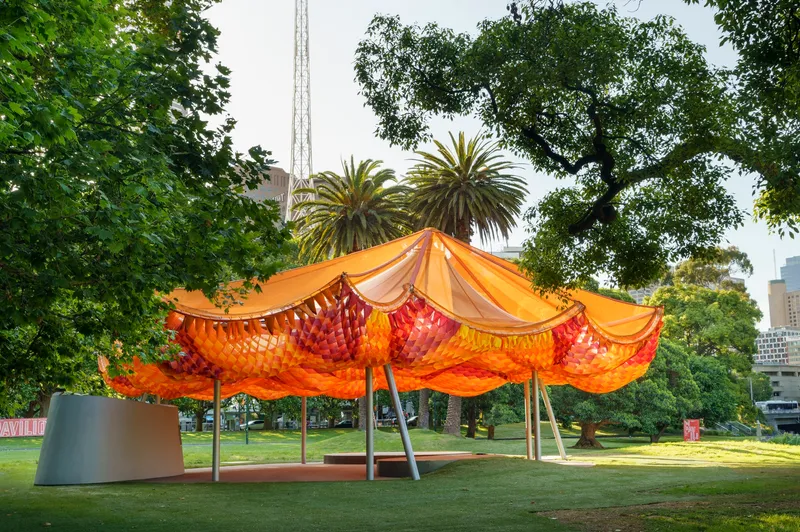


The pavilion's silhouette is deliberately asymmetric. Two conical, saddle-shaped peaks rise from the ring beam at different heights, ensuring no two approaches look the same. From a distance the structure reads as a hovering fabric surface, its scalloped edges curling upward between thin white columns. It sits lightly on the lawn, surrounded by mature palms and eucalyptus, and the lack of walls or enclosure makes it continuous with the park. The overall area is 325 square meters, generous enough for large gatherings but modest enough to avoid competing with the surrounding landscape.
all(zone) has worked with similar tensile fabric systems before, notably the Marmalade Sky pavilion at Bangkok's Wonderfruit festival in 2017, which used the same waffle technique. Bringing that approach to Melbourne required a new level of engineering rigor. TENSYS handled the fabric modelling, patterning, and testing through extensive computer simulation and physical prototyping, while AECOM provided structural engineering. Oasis Tension Structures and Makmax Australia fabricated and installed the system.
Three Layers, Three Materials

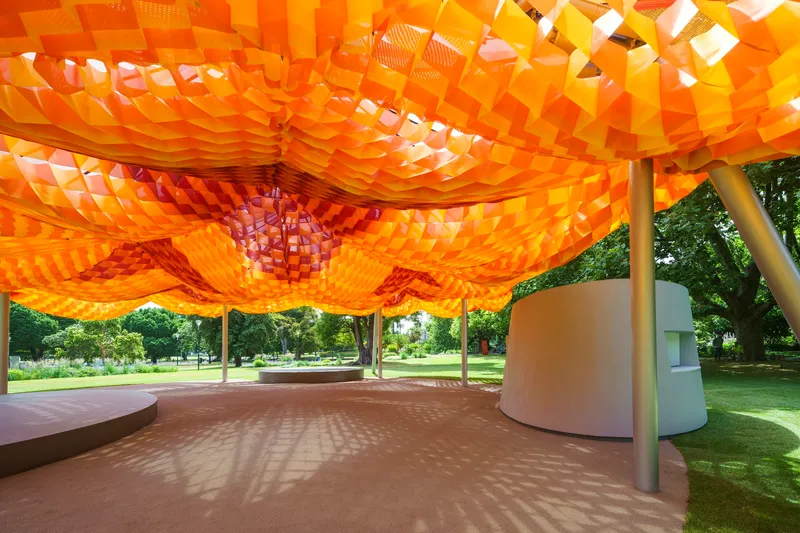

The layered canopy is the project's real innovation, and it rewards close inspection. The topmost fishing net acts as a scrim, breaking down direct sunlight into a warm, diffused glow while giving the exterior its distinctive orange-red texture. The STFE membrane beneath, supplied by French manufacturer Serge Ferrari, is the weatherproofing layer, catching rain and reducing glare without blocking light. At the bottom, the waffle fabric panels create the most visible interior effect: a tessellated ceiling of diamond-shaped perforations that casts intricate shadow patterns on the ground.
Because the 48 individual waffle sections are hung loosely rather than pulled taut, they respond to even light breezes. The result is that the interior is never static. Shadows shift, light quality changes, and the fabric itself ripples gently overhead. It is a deliberate strategy: all(zone)'s practice philosophy centers on providing climatic and occupational comfort with the minimum possible material, and on exploring lighter, more casual modes of architecture as a path toward sustainability.
After Dark
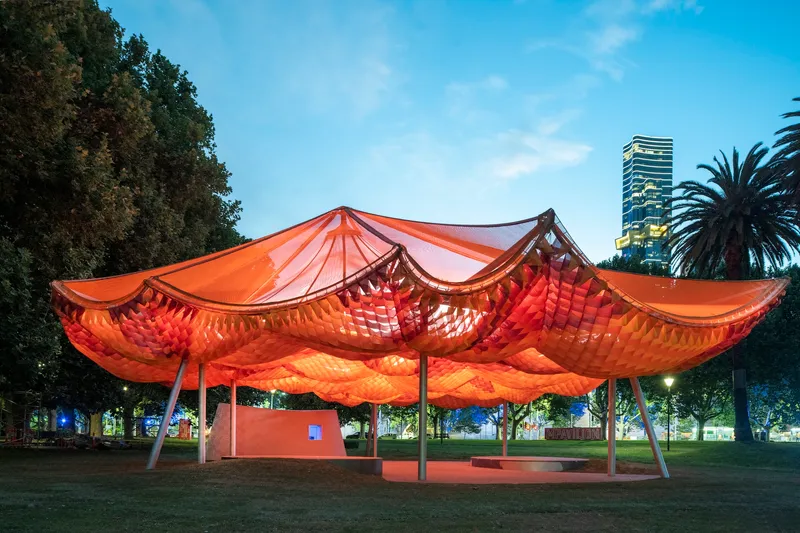


Melbourne-based lighting studio Bluebottle designed the nighttime illumination, and it transforms the pavilion into something entirely different. The fabric layers glow from within, shifting from warm amber to deep red depending on the viewing angle. Against the darkening sky, with the Arts Centre spire and city towers silhouetted behind, the pavilion becomes a lantern in the park. The lighting also reveals the transparency of the STFE layer more clearly, separating it visually from the fishing nets and the waffle fabric in a way that daylight tends to merge.
The pavilion hosted 352 free events involving over 600 collaborators during its season from December 2022 to April 2023, attracting more than 350,000 visitors. That density of programming underscores the success of the open, threshold-free plan: without walls or doors, the structure welcomed people passing through the park as easily as those arriving for a scheduled event.
Ground Plane and Program
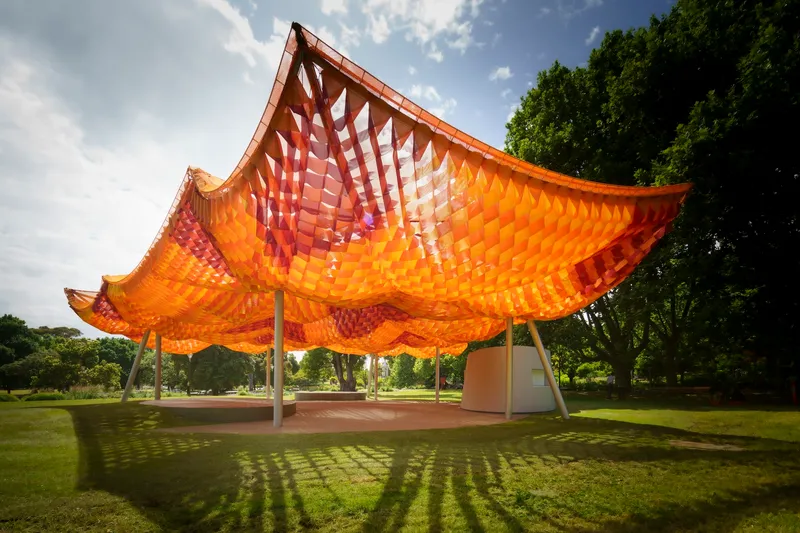

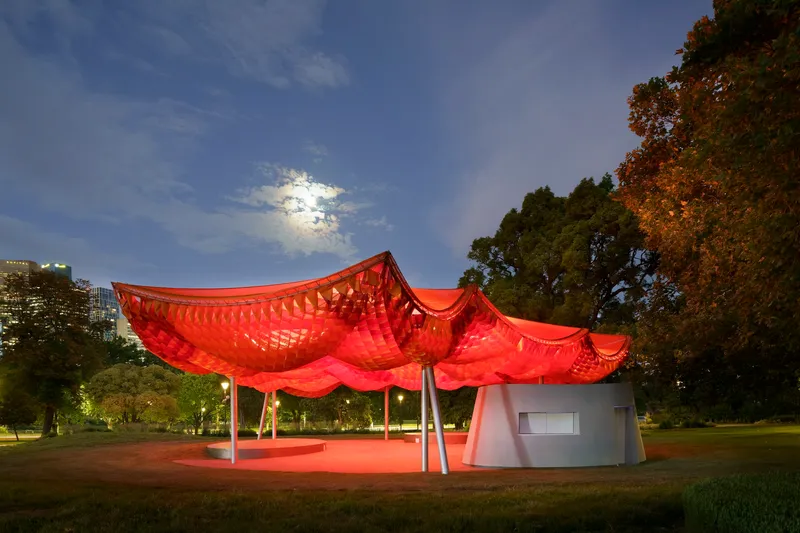
Beneath the canopy, the program is deliberately simple: one elliptical kiosk and two raised platforms. The kiosk is a conical volume with a polycarbonate sheet ceiling, painted in a new color each month from a palette of four selected by the architect. Limited permanent seating keeps the ground plane flexible, with extra seats added for scheduled events. The raised platforms double as informal stages or gathering spots, and the dappled shadows the canopy throws onto the paved ground become part of the spatial experience.
The design draws on the informal outdoor gatherings common in cities across Southeast Asia, where non-standard materials are used to create shelter in tropical climates. In Melbourne, the same spirit reads as a provocation: architecture does not have to be permanent, heavy, or enclosed to be meaningful. After its season in the Gardens, the structure was gifted to RMIT University and relocated to its Brunswick campus, a second life built into the commission's DNA.
Structural Ambition in Fabric
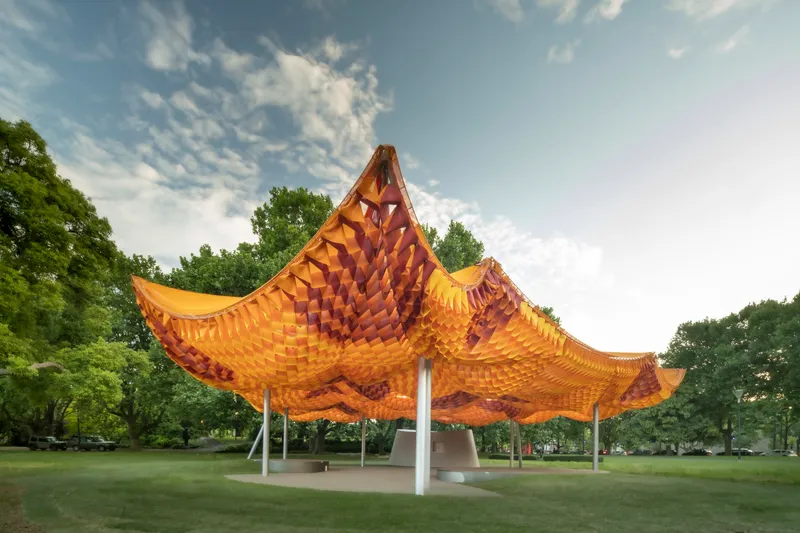

The twin peaks give the canopy its structural depth. A steel ring beam sits on thin metallic columns, and the tensile roof stretches upward to form two saddle-shaped cones. Secondary structural elements project from the ring beam, with panels connected by tensioned ropes to create the scalloped perimeter. The engineering is invisible in the finished result, which is exactly the point. The structure appears effortless, almost improvised, even though it required months of digital and physical modelling to achieve.
Introducing STFE technology to Australia for the first time was not a minor feat. The material had to be tested extensively for local wind and weather conditions, and the collaboration between TENSYS, AECOM, and the fabricators was critical. That this complexity is completely hidden behind the apparently casual, breezy character of the pavilion is a mark of real design sophistication.
Plans and Drawings


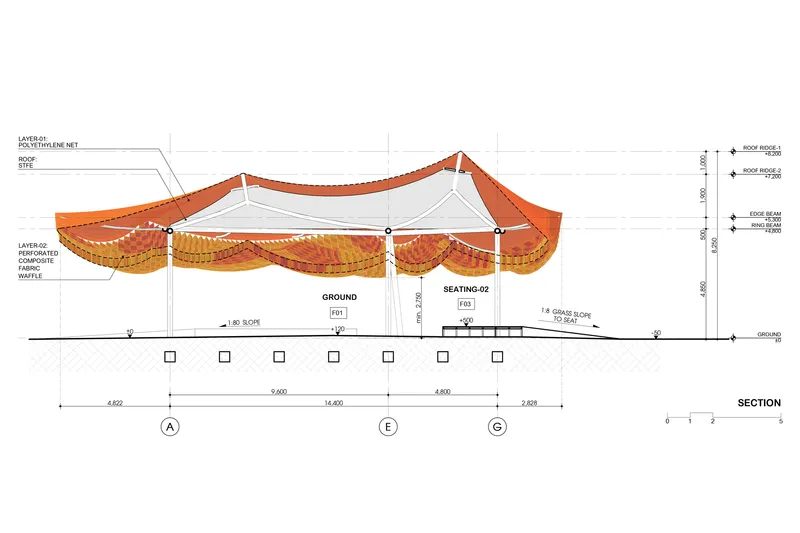

The exploded axonometric makes the three-layer system legible in a way the built pavilion intentionally resists. Fishing net on top, STFE membrane in the middle, waffle fabric at the bottom: each layer has its own structural logic and its own relationship to light and weather. The section drawing reveals how shallow the canopy actually is relative to its span, while the site plan shows its placement within the triangular park opposite the Arts Centre on St Kilda Road. The axonometric with dimensions details the seating platforms and grass berms that anchor the pavilion to its ground plane.
Why This Project Matters
MPavilion 2022 demonstrates that architecture can operate with radical lightness and still create powerful spatial atmosphere. all(zone) treated the commission not as an opportunity to build a sculptural object but as a chance to choreograph environmental conditions: moving air, filtered light, shifting shadows. The result is a pavilion that changes by the minute and never repeats itself, offering a fundamentally different relationship between structure and experience than the solid, static buildings surrounding it.
The broader argument embedded in the project is about material culture. Thai fishing nets, a transparent membrane developed for European tensile architecture, and a waffle fabric system refined at a Thai music festival converge in a Melbourne park. The combination is not exotic decoration. It is a functional, engineered response to sun, rain, and wind that happens to originate outside the Western canon of building materials. For a discipline still grappling with how to build less and matter more, all(zone)'s approach offers a persuasive, tangible answer.
MPavilion 2022 by all(zone). Located in Queen Victoria Gardens, Melbourne, Australia. 325 m². Completed in 2022. Photography by John Gollings and Casey Horsfield.
About the Studio
Share Your Own Work on uni.xyz
If projects like this are the kind of work you want to make, uni.xyz is a place to publish your own, find collaborators, and enter design competitions.


Popular Articles
Popular articles from the community


longwave studio Reorganizes a 112 m² Tainan Apartment Around the Daily Routines of a Family and Two Cats
In Tainan, Taiwan, birch plywood, rust-red furniture and a freestanding plaster wall link arrival, storage, work and family life in one apartment.

U.GA Architects Wraps an Oval Rooftop Pool in Curved Board-Formed Concrete on Busan's Jeollidan-gil
In Busan's Jeonpo-dong, a 454 m² mixed-use block stacks a neighborhood facility, guest rooms and an oval rooftop pool inside spiraling concrete walls.

Jaramillo Van Sluys Arquitectura and Urbanismo Turn a Demolished Registry Lot in Quito into an Orchard Plaza
In Quito's Centro Histórico, a 2,800 m² plaza exposes the San Agustín convent wall and redraws its lost Augustinian orchard in volcanic stone.

LT2A and OPEN Architectes Thread a Brick and Glass High School Through a Wooded Belgian Campus
In Braine-l'Alleud, a 3,000 m² wing for Collège Cardinal Mercier pairs pale brick with a glazed colonnade, deferring to a small chapel and a dense wood.

Similar Reads
You might also enjoy these articles


LAVA Architecten Gives Vocational Education a Sawtooth-Roofed Face on a Mechelen School Campus
In Mechelen, Belgium, a 2,053 m² STEM school on a 6×6 m grid turns workshops and classrooms into rooms that can be rearranged as teaching changes.

KEMA Studio Turns a Derelict Marvila Attic into a 60 m² Lighthouse Apartment Above Lisbon
In Lisbon's Marvila district, a rebuilt roof, four skylights and two plywood volumes turn an unlivable attic into a bright home facing the Tagus.

Pixel Gardens: One Repeated Module Stacked Into a Terraced Social Housing Tower for Famagusta
Salem Bader's shortlisted housing tower builds a vertical neighbourhood from one repeated module, offsetting units to carve terraces, light and air.

Bao Huynh Watercolor Atelier: A Serene Art Retreat in Hội An
Bao Huynh Watercolor Atelier in Hội An blends multifunctional art spaces, sustainable design, local materials, and family-friendly living in a serene environment.

Explore Pavilion Competitions
Discover active competitions in this discipline

Challenge to reimagine the Iron Throne

Photograph architecture without architects

Illustrate the lost glory of Angkor Wat - Render Challenge

Design challenge to reuse E-waste
Comments (0)
Please login or sign up to add comments
No comments yet. Be the first to comment!