
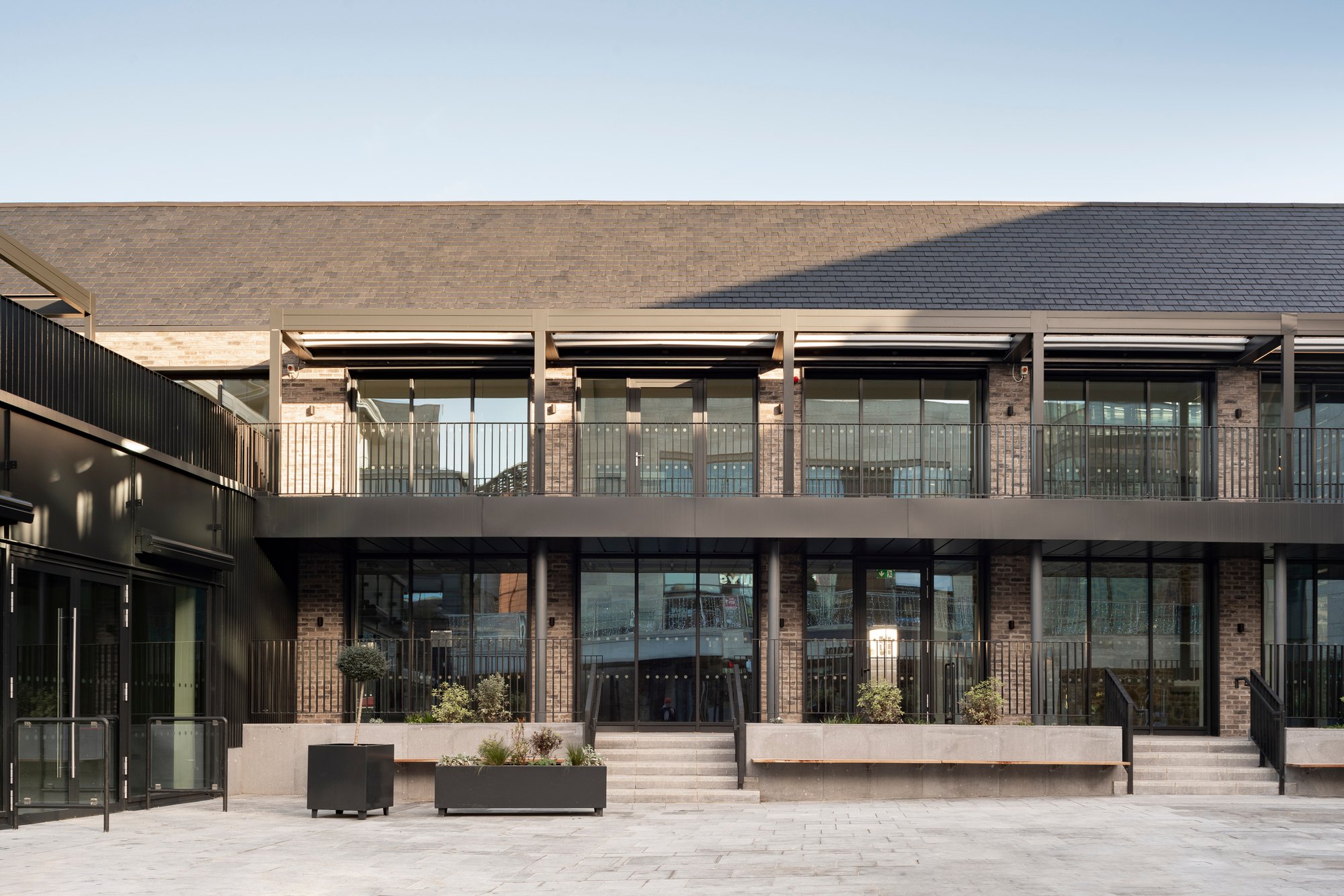
ALTU Architects Stitch Five Derelict Dublin Terraces into a Food Hall and Public Square
A late 19th century row in Dundrum gets a glazed extension, new courtyard, and Ireland's first BREEAM Excellent retail rating.

Five vacant terraced houses on Dublin's Sandyford Road had been quietly falling apart for years. Properties 1 through 5 of Ashgrove Terrace, red brick relics of the late 19th century, sat at an awkward seam between the historic main street of Dundrum Village and a modern food and beverage district to the rear. Their back gardens had become dead space: poorly lit, poorly landscaped, and lacking any active frontage. ALTU Architects saw the gap not as a leftover but as an opportunity to create a genuinely new piece of city.
Pembroke Square, completed in 2021, amalgamates all five houses into a single food hall and restaurant complex totalling roughly 1,418 square metres, then punches through the terrace to open a new public square behind it. The intervention is interesting not because it demolishes and replaces, but because it does the harder thing: it saves and repairs the existing brick shells, adds a double height glazed extension that echoes their pitched roof geometry in a contemporary idiom, and stitches the two urban conditions together with a courtyard that actually works as public space. It is the first retail project in Ireland to earn a BREEAM Excellent rating, and it achieves Nearly Zero Energy Building compliance while doing so.
Keeping the Street Face
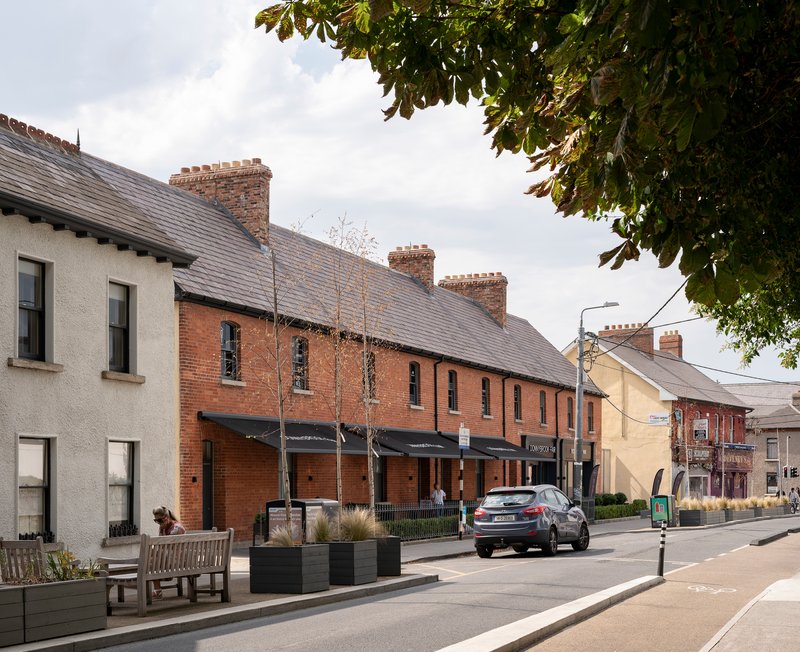
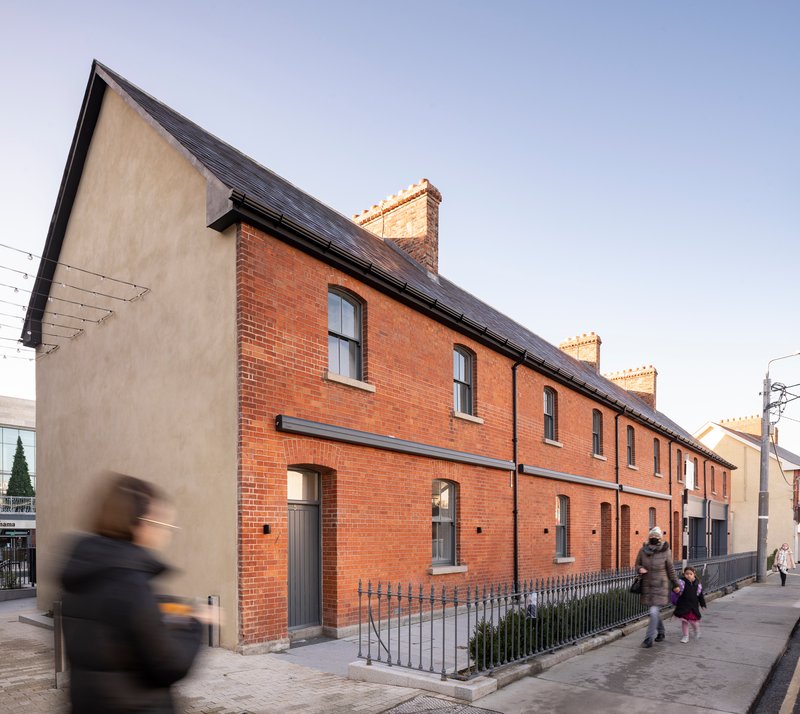
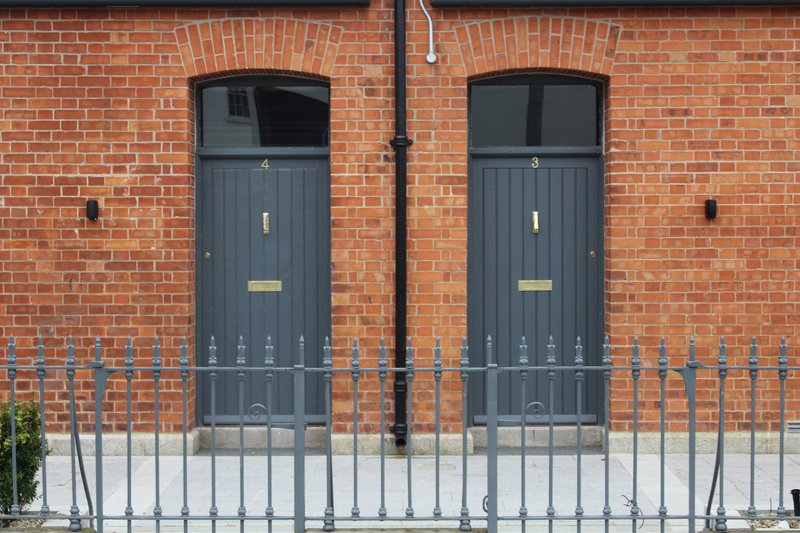
From Sandyford Road, the project reads almost as if nothing has happened. The red brick facades have been meticulously repointed with traditional lime-based materials, the timber sash windows refurbished, the slate roofs repaired and reused rather than replaced. Original iron railings and gates are back in place. Painted planter boxes with seasonal flowers line the pavement. The restraint here is deliberate: every kilogram of existing material that stays in the wall is a kilogram of embodied carbon that does not need to be manufactured again.
The entrance doors, with their arched transoms set behind metal railings, preserve the residential grain of the terrace even as the ground floor behind them opens into a commercial food hall. ALTU understood that the heritage value of this row is not in any single decorative element but in the collective rhythm of bays, gables, and chimneys lining the street.
The Glazed Extension as Echo
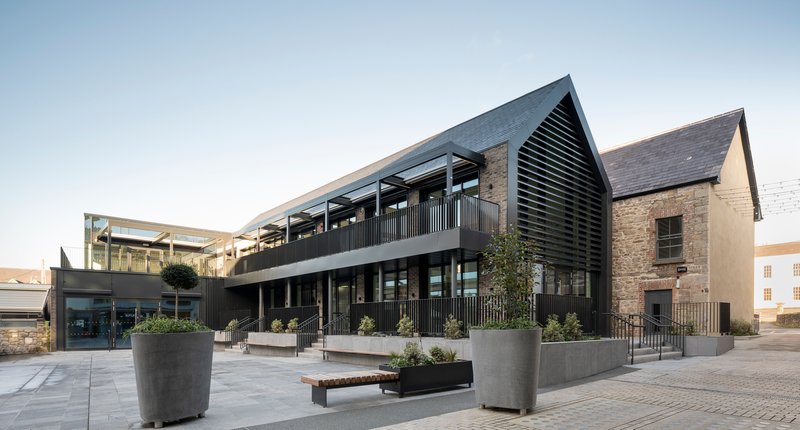
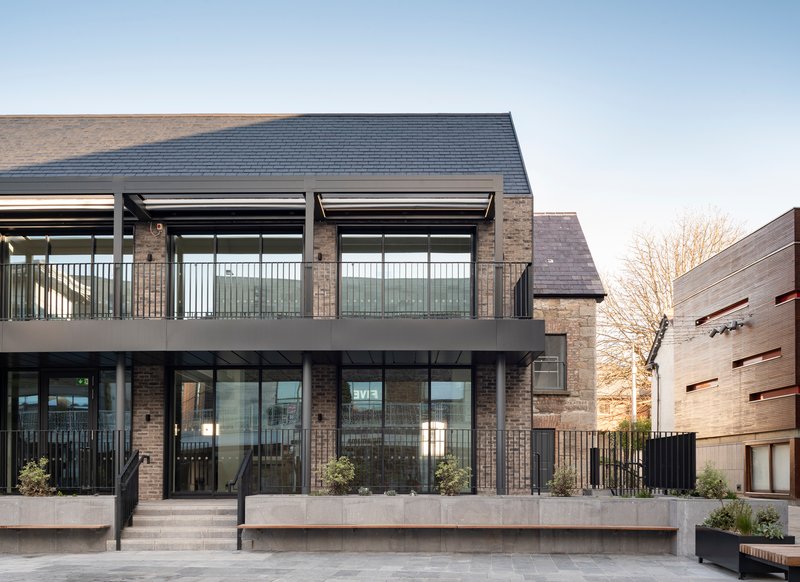
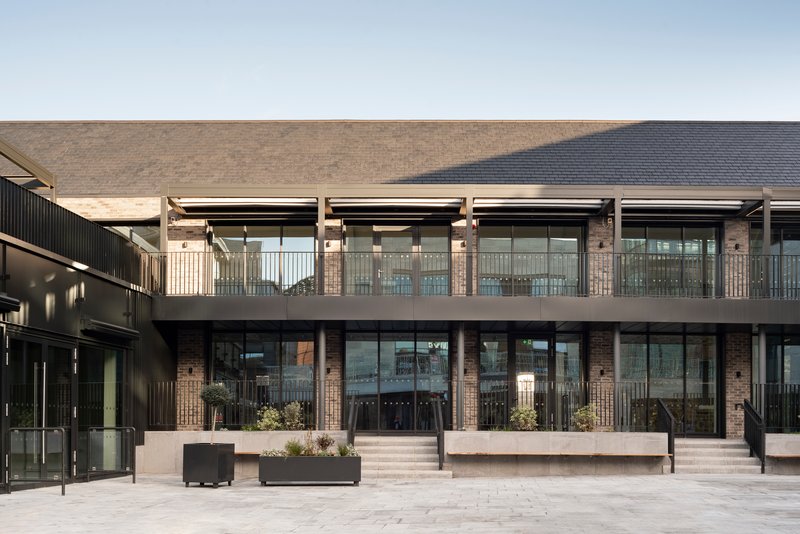
At the rear, where the back gardens once were, a two storey glazed extension rises. Its pitched roof form directly echoes the gable profiles of the original terrace, but translates them into full height glass panels with black metal railings and clerestory windows. The move is legible without being literal: you can read the relationship between old and new volumes from the courtyard, and the new structure never pretends to be something it is not.
Large glass openings pull daylight deep into the food hall interiors, and an upper terrace along the extension's south face provides outdoor seating at first floor level. The roof carries both green planting and solar photovoltaics, making productive use of the fifth elevation. A nearly zero energy building that is mostly glass is not a trivial engineering problem; it requires careful attention to solar gain, insulation at the opaque junctions, and mechanical ventilation strategy.
The Louvered Gable
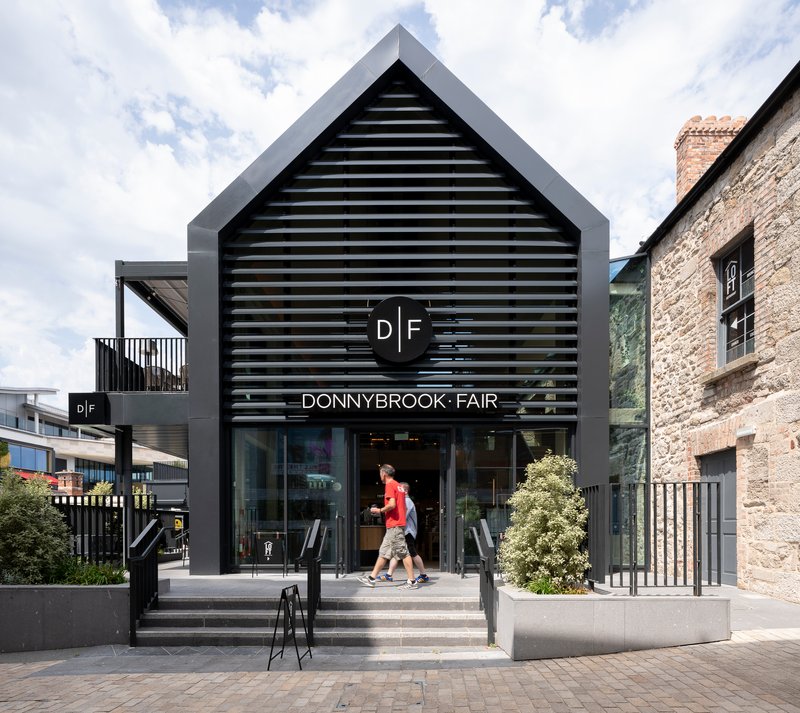
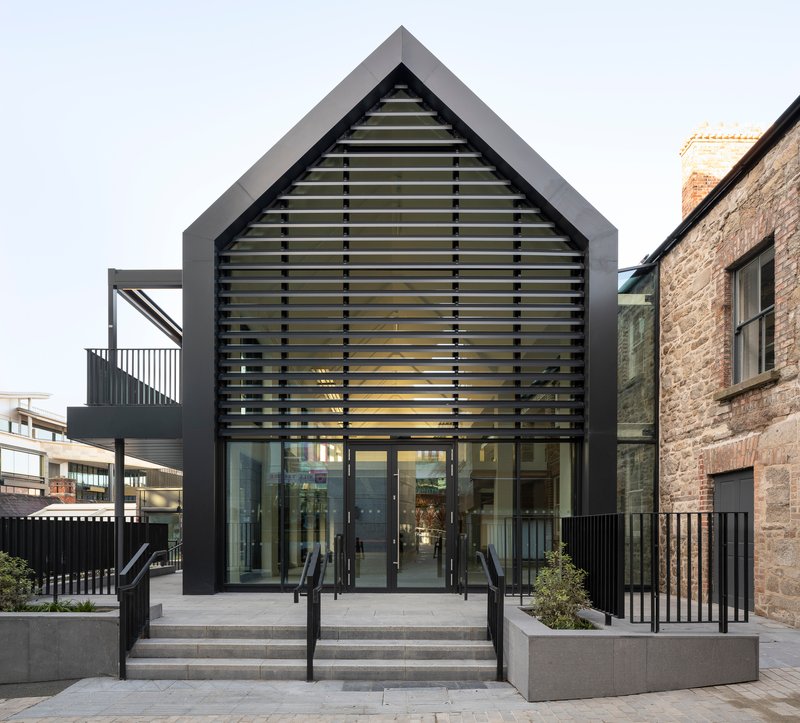
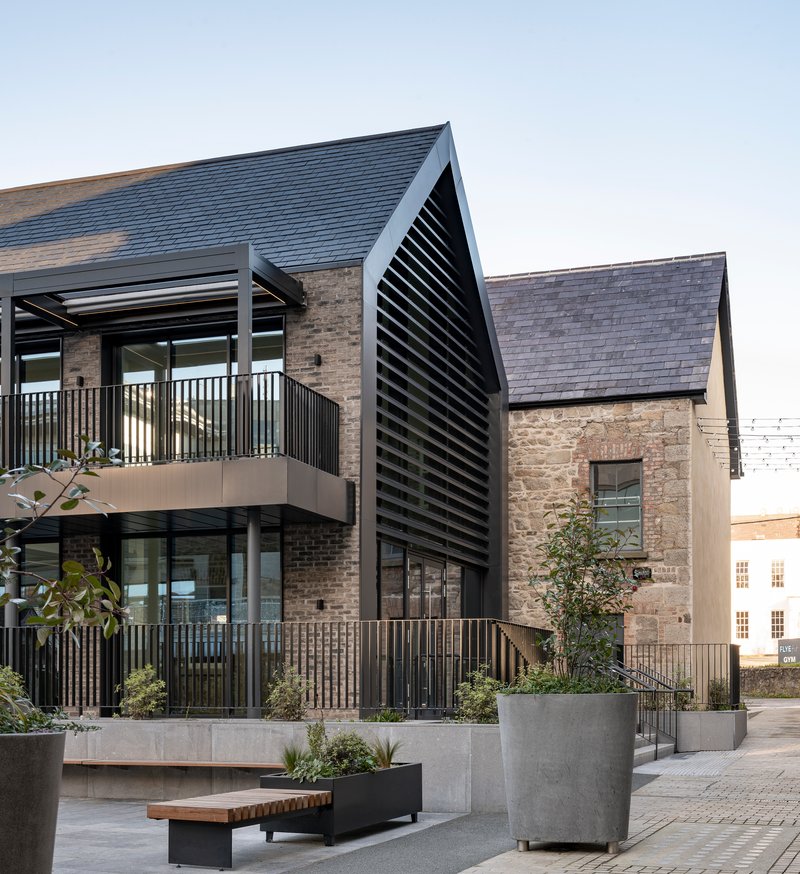
The most striking single element is the gable fronted entrance volume with its screen of horizontal black louvers. It anchors the corner of the new courtyard and acts as a hinge between the stone masonry wing of the original terrace and the glazed extension. The louvers control solar gain and glare while giving the facade a layered depth that shifts as you move past it.
Viewed from the courtyard, this gable becomes a kind of civic marker. It is tall enough to read from across the square, graphic enough to be memorable, and transparent enough that you can sense the interior volume behind it. Concrete steps lead up to the entrance, reinforcing the threshold between the open public space and the enclosed hall.
Inside the Vaulted Hall
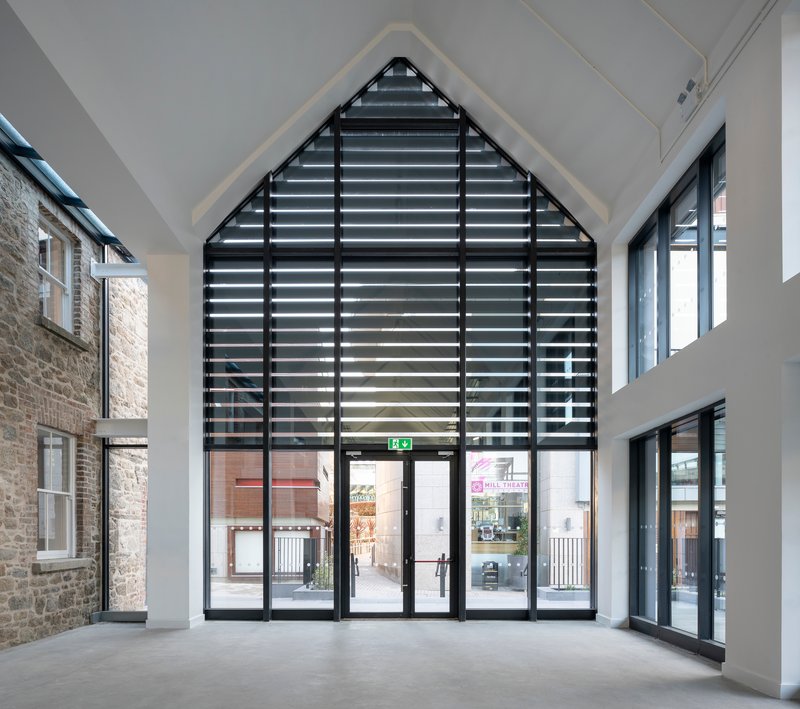
Inside, the pitched roof form is expressed as a vaulted ceiling, giving the food hall a generous civic scale that a flat ceiling could never achieve. The horizontal louver screen filters light into the gabled atrium, casting rhythmic shadows across the floor. Glazed doors open directly onto the courtyard, collapsing the boundary between interior dining and outdoor seating when weather permits.
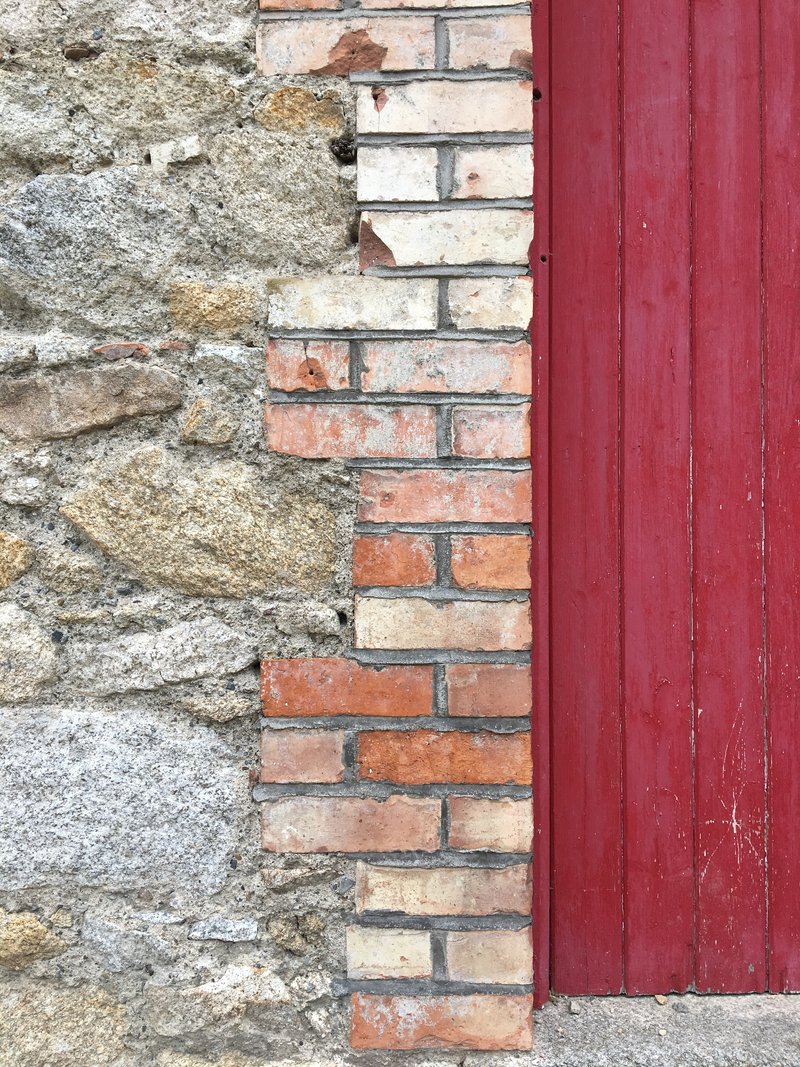
One of the most effective details is the retention of a random rubble stone wall from the original rear boundary. This wall runs continuously from outside to inside, becoming an interior feature that anchors the new space to the memory of the site. Where the salvaged stone meets brick infill and painted timber door surrounds, the layered history of the terrace is made visible without curation or artifice.
The Courtyard as Connector
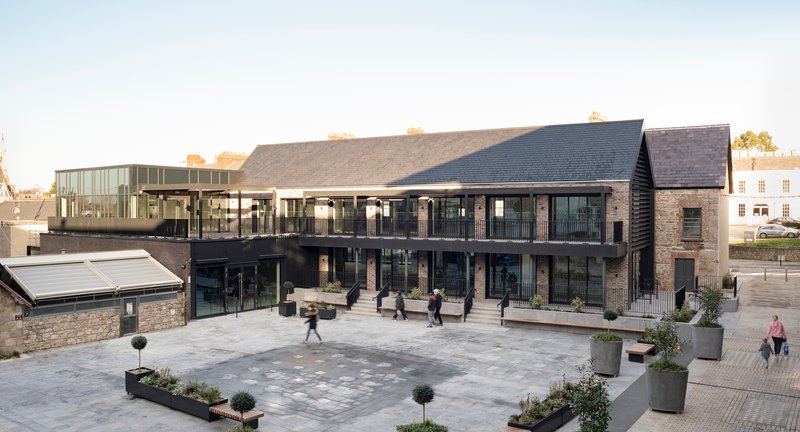
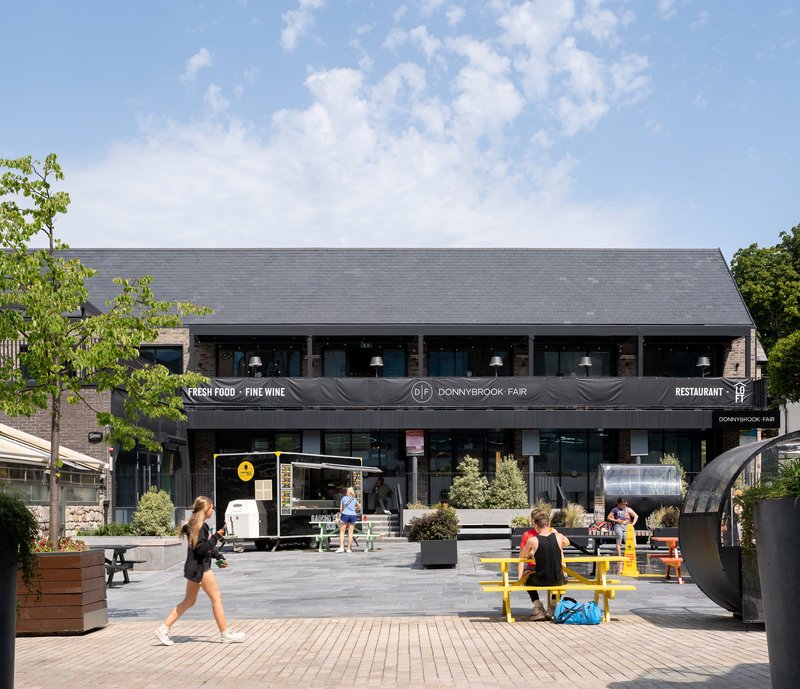
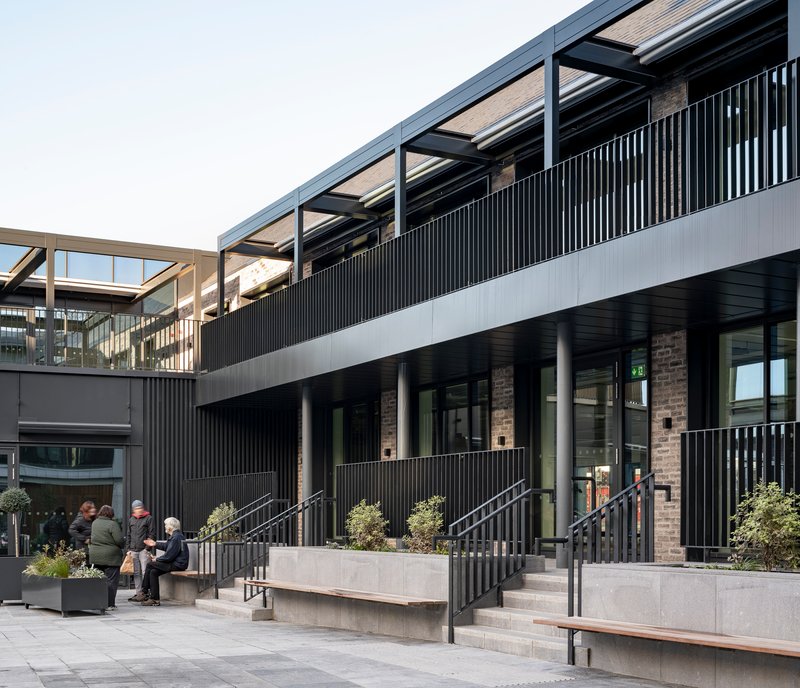
Pembroke Square, the courtyard itself, is the real project. Before the intervention, the space behind the terrace was a dead zone. Now it is a multipurpose public plaza with grey paving, planted concrete containers, benches, lighting, and a hidden water fountain that recycles over 99 percent of its water. Yellow picnic tables and casual seating make it a genuine gathering space rather than a polite threshold.
The courtyard connects two fundamentally different urban conditions: the fine grained residential street to the north and the larger scaled commercial district to the south. Entrances operate from both Sandyford Road and from the square, so the building functions as a permeable connector rather than a wall. Raised planters with metal railings and a cantilevered walkway with exposed structure define the edges without closing them off.
Storefront and Landscape Details
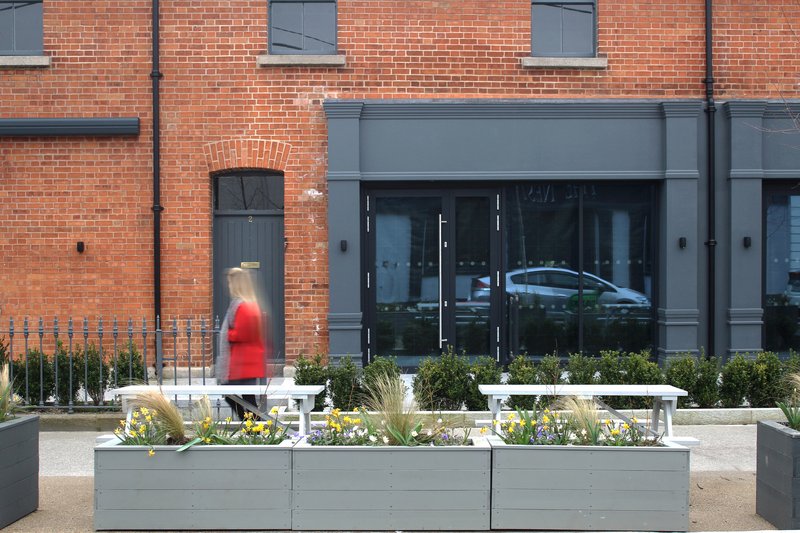
At ground level on the Sandyford Road side, grey metal framed storefronts have been inserted into the brick arches. The palette is deliberately restrained: grey panels, black metalwork, brick, and timber. Planter boxes with yellow flowers and ornamental grasses soften the commercial frontage and maintain a domestic scale that respects the original terrace character. These are small moves, but they accumulate into a streetscape that feels cared for rather than imposed.
Plans and Drawings
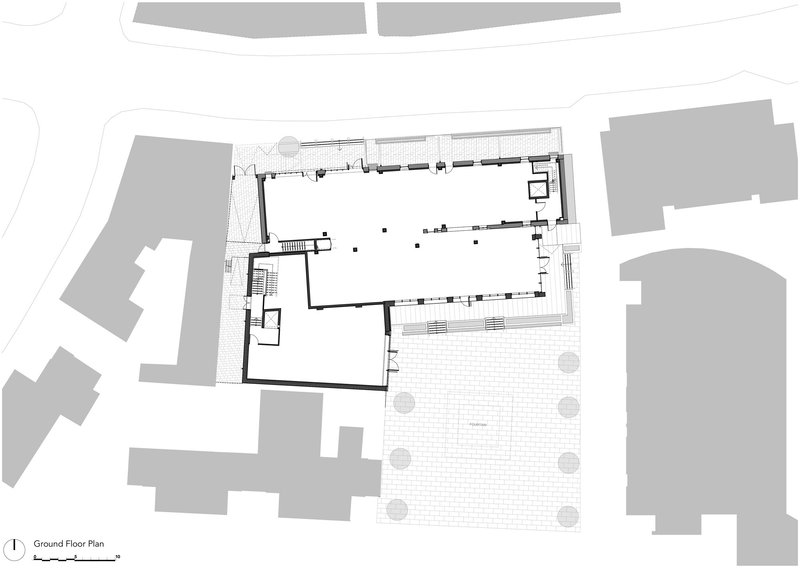
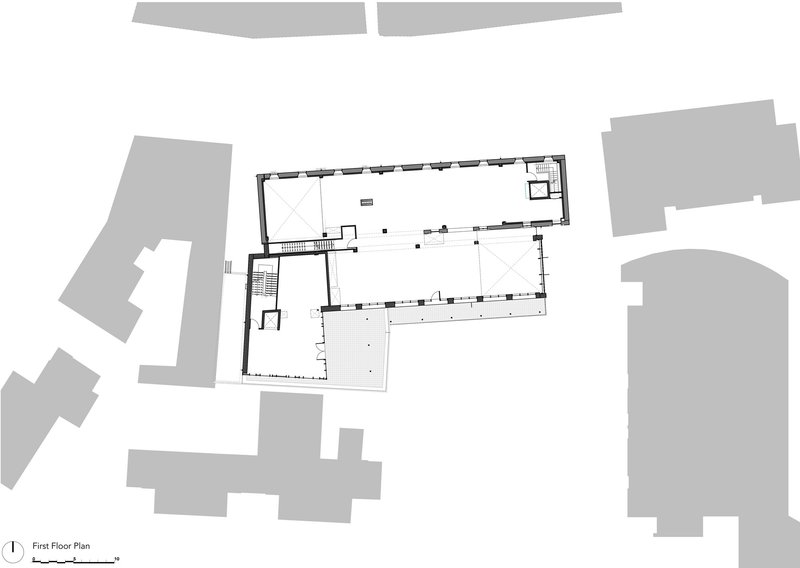
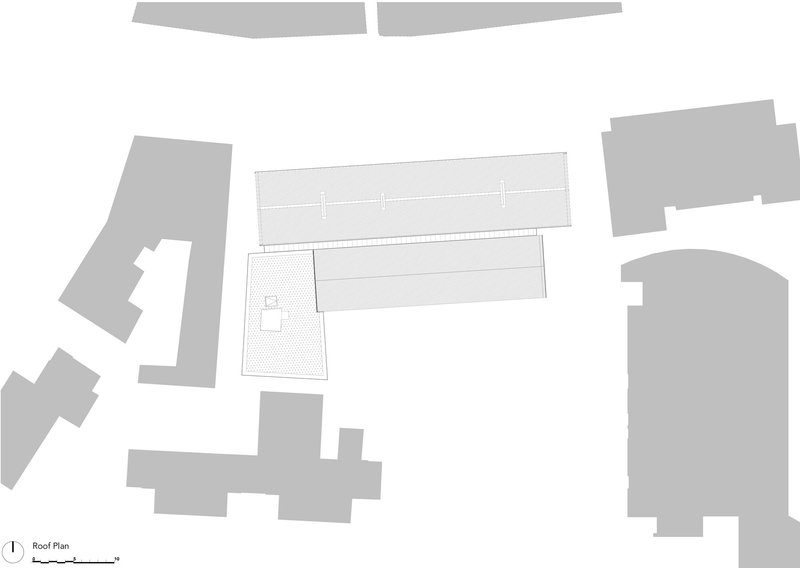
The ground floor plan reveals the L shaped volume wrapping the courtyard, with the five original house footprints legible along the north edge and the new extension filling the southwest corner. Trees and paved surfaces are carefully positioned to define outdoor rooms within the larger square. The first floor plan shows two rectangular halls connected by a circulation core with stair and lift, giving the food hall flexible, column free volumes. The roof plan confirms the twin gabled profile and locates a corner terrace with a tree well that brings planting up to the upper level.
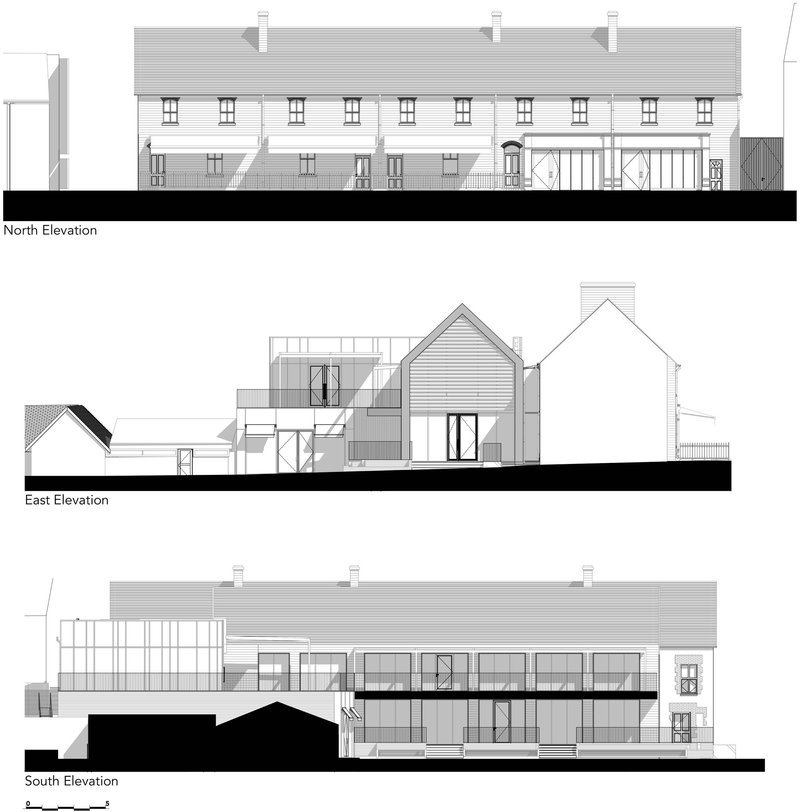
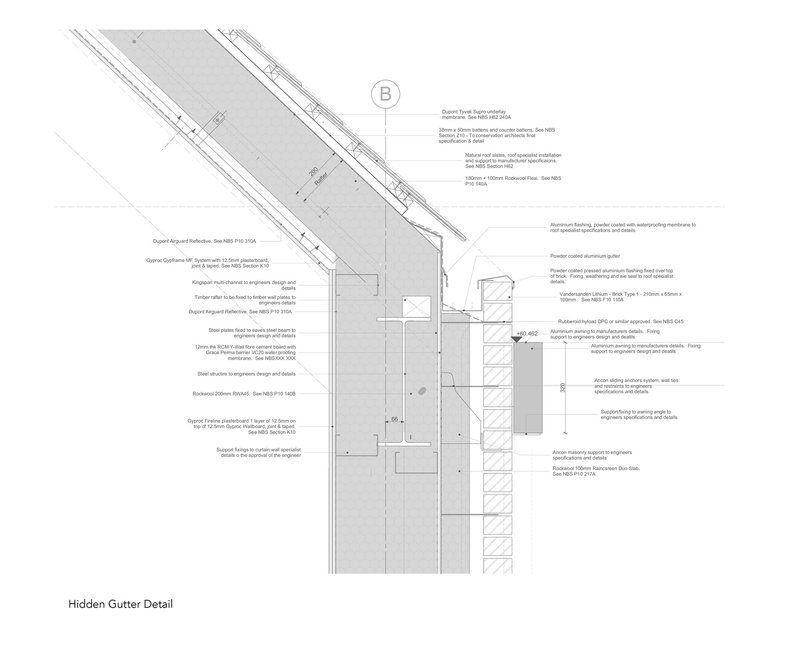
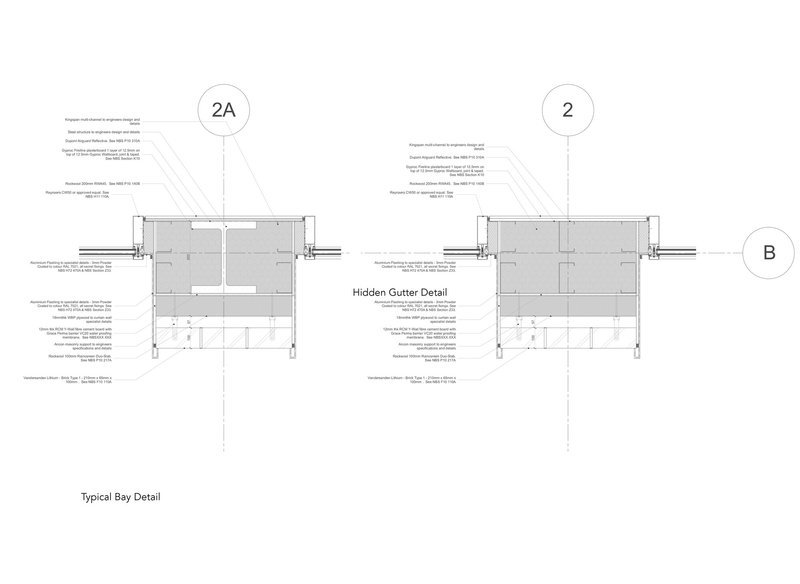
Elevation drawings of the north, east, and south facades show the careful calibration between horizontal siding on the new volumes and the gridded glazing that defines the extension. A sectional detail of the hidden gutter assembly reveals the engineering behind the clean roof junctions: drainage layers, membrane detailing, and insulation coordinated to eliminate visible downpipes on the courtyard face. The typical bay detail drawing documents the window wall construction with its horizontal and vertical framing members, confirming that the transparency of the facade is achieved through a precise, buildable system rather than a rendering fantasy.
Why This Project Matters
Pembroke Square matters because it demonstrates that heritage conservation and high performance sustainability targets are not opposing ambitions. By saving and repairing existing brick, stone, timber, and slate, ALTU Architects reduced embodied carbon while preserving the streetscape character of Dundrum Village. Then, by adding a nearly zero energy extension with green roof, photovoltaics, and a water recycling fountain, they brought the project to BREEAM Excellent, a first for Irish retail. The lesson is not that old buildings are automatically green, but that the combination of careful repair and smart extension can outperform demolition and replacement on both cultural and environmental metrics.
More broadly, the project offers a model for how to activate dead space at the back of urban terraces. Cities across Ireland and the UK are full of similar conditions: rows of vacant or underused houses with neglected rear plots that separate one urban zone from another. Pembroke Square shows that punching through the terrace, creating a genuine public courtyard, and programming the ground floor for food and hospitality can turn a liability into a destination. It is pragmatic urbanism at a modest scale, and it works.
Pembroke Square, Dublin, Ireland. Architect: ALTU Architects. Area: approximately 1,418 sqm. Completed: 2021. Photography: Donal Murphy.
About the Studio
Share Your Own Work on uni.xyz
If projects like this are the kind of work you want to make, uni.xyz is a place to publish your own, find collaborators, and enter design competitions.




Popular Articles
Popular articles from the community

Stanton Architects Sculpts a Curving Family Home into Sydney's Inner West Fabric
Five Dock House uses cantilevers, curved concrete, and layered courtyards to carve out privacy on a tight suburban lot in Sydney.
Inside a Timeless Mumbai Residence by Aether Studio
Aether Studio's 2,250 sq ft apartment in Malad, Mumbai uses marble, brass, boucle, and disciplined restraint to build a quiet retreat from the city.
Reincarnation Weaves a Three-Story Retreat into the Green Landscape of Rural Bangladesh
Ara Manor in Narsingdi dissolves the line between domestic architecture and its lush surroundings through screens, courtyards, and planted rooftops.
Eco Chapel: A Green Architecture Pavilion Designed in Symbiosis with the Forest
Eco Chapel uses green architecture to weave prayer, learning and reuse into a forest pavilion shaped by modular hexagonal canopies for life.


Similar Reads
You might also enjoy these articles

Freebird Residence by Alexis Dornier: A Tropical Modernist Sanctuary in Bali
Floating living pavilion above pool anchors H-shaped tropical villa, blending Japanese minimalism, sustainable strategies, lush landscape, and sculptural interiors.
127af Flips a Tiny Bagnolet Rowhouse Upside Down with a Handcrafted Roof Extension
A 55-square-meter terraced house on the edge of Paris gains a luminous upper living floor through lightweight timber and steel.
1.61 Design Workshop Wraps a 600-Square-Meter Café in Vietnam in Sculptural Burgundy Drama
Reden Café & Bistro pairs a helical staircase, mosaic floors, and deep red interiors to rethink Vietnamese hospitality space.

The Unbound Brain: A School Shaped by Cognitive Architecture
Cylindrical learning pods radiate like neurons from a central cortex, turning the floor plan into a spatial model of human thought.





Comments (0)
Please login or sign up to add comments
No comments yet. Be the first to comment!