
TAKK Studio and Iwetta Ullenboom Turn a Berlin Apartment into a Library You Can Live In
A 140-square-meter home inside Herzog & de Meuron's Am Tacheles complex organizes daily life around 700 books and one continuous wooden spine.


Berlin's Am Tacheles complex carries decades of cultural weight. The site once housed the Friedrichstraße Passages, then became the legendary Kunsthaus Tacheles squat, and now it is being reborn as a residential and cultural quarter shaped by Herzog & de Meuron, Grüntuch Ernst, and Brandlhuber Muck Petzet Architekten. Designing an interior for a fifth-floor apartment in that context means negotiating between the raw ambition of exposed concrete ceilings and the intimate demands of a home for a family that owns more than 700 books.
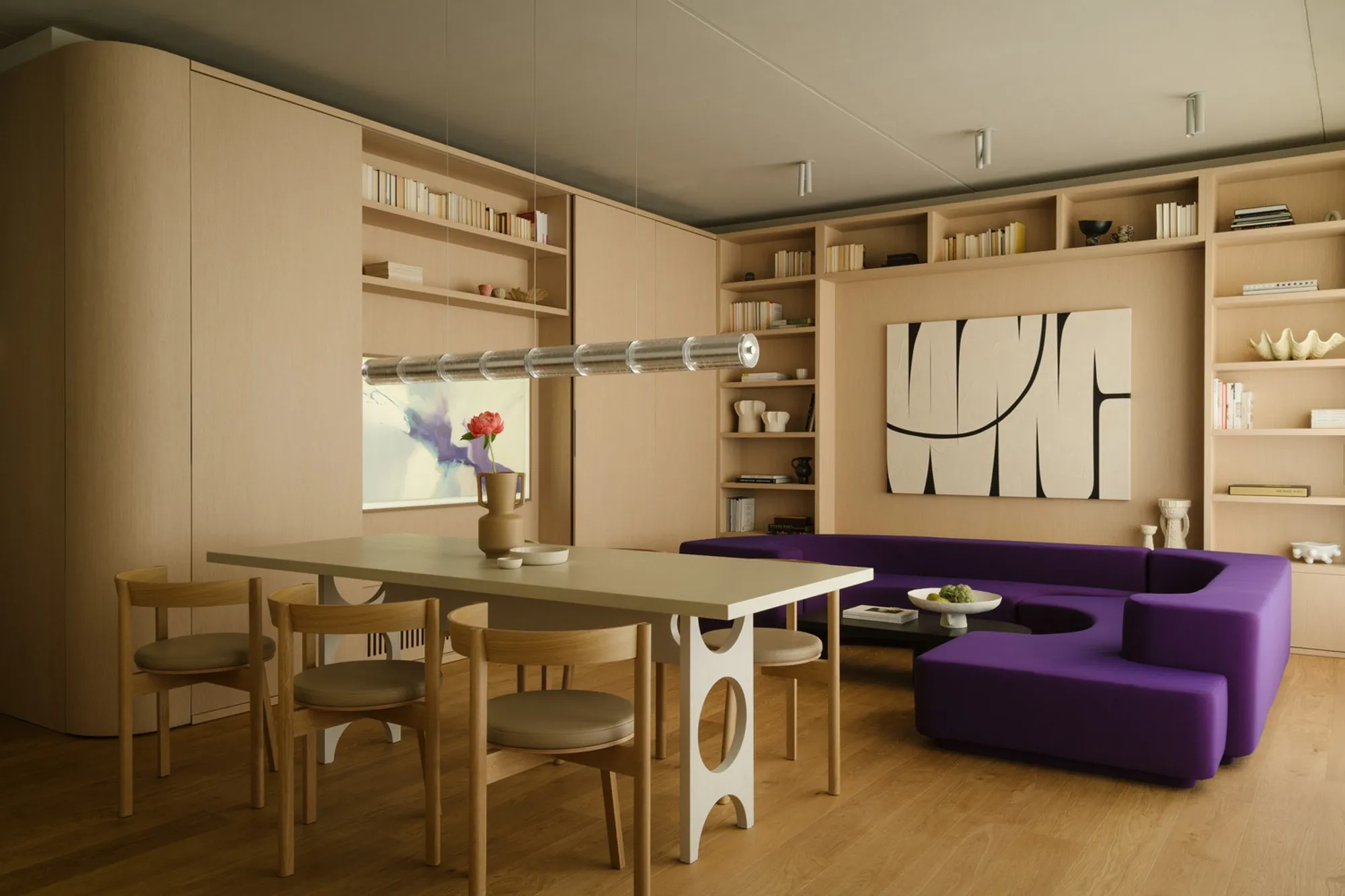
TAKK Studio and Iwetta Ullenboom found their answer in a single, continuous wooden structure that threads from the entrance corridor through the living room, swallowing storage, hiding bathroom doors, concealing a television, and finally erupting into a full library wall. The result is less an apartment with bookshelves and more a piece of furniture you inhabit. Every room is a chapter; the wood is the binding.
The Wooden Spine
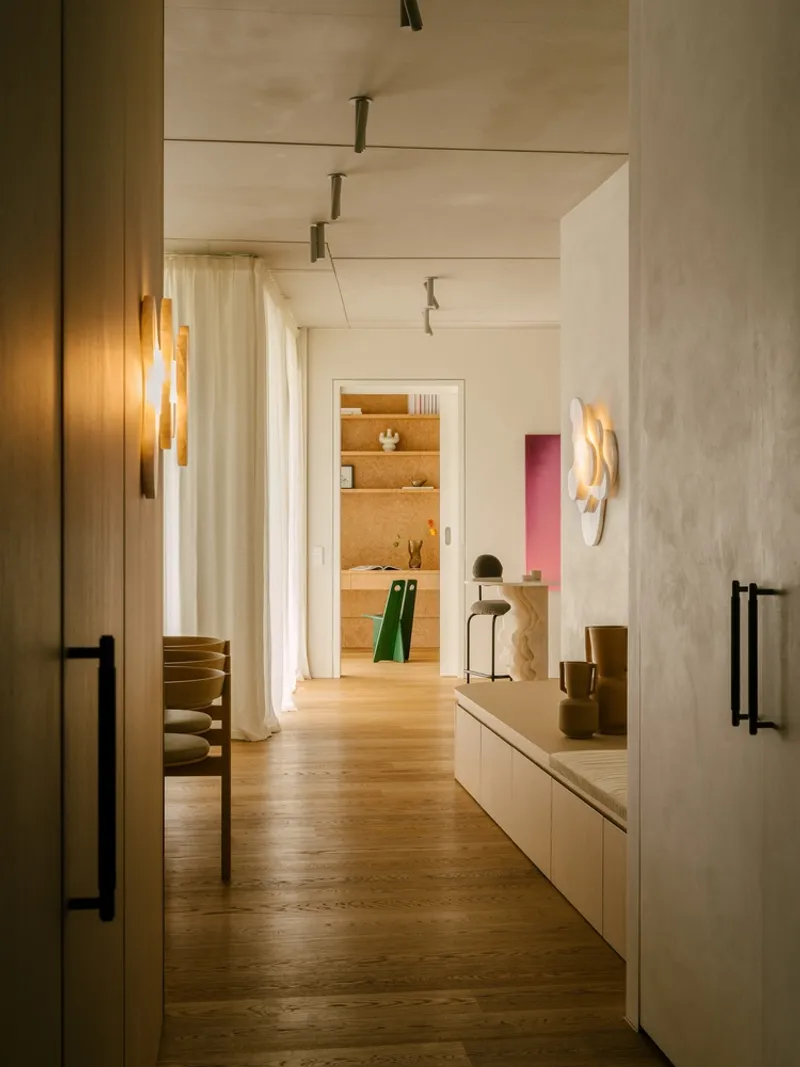
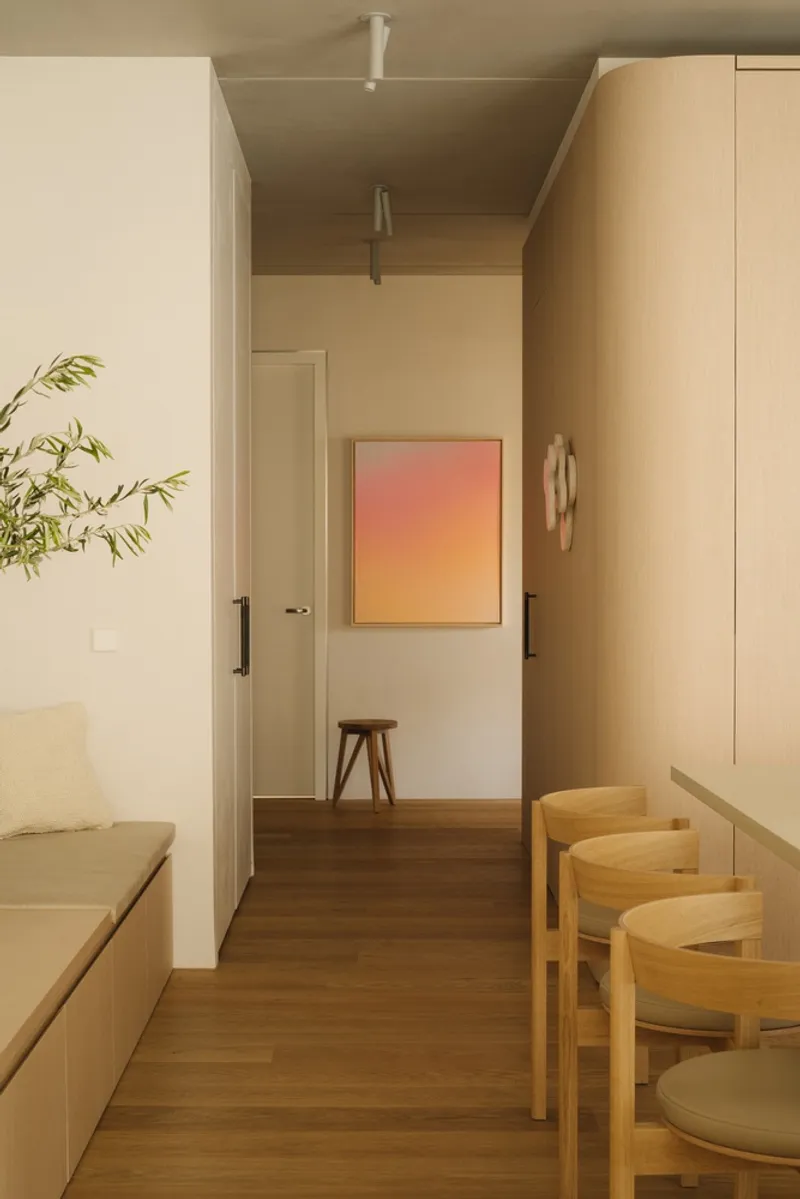
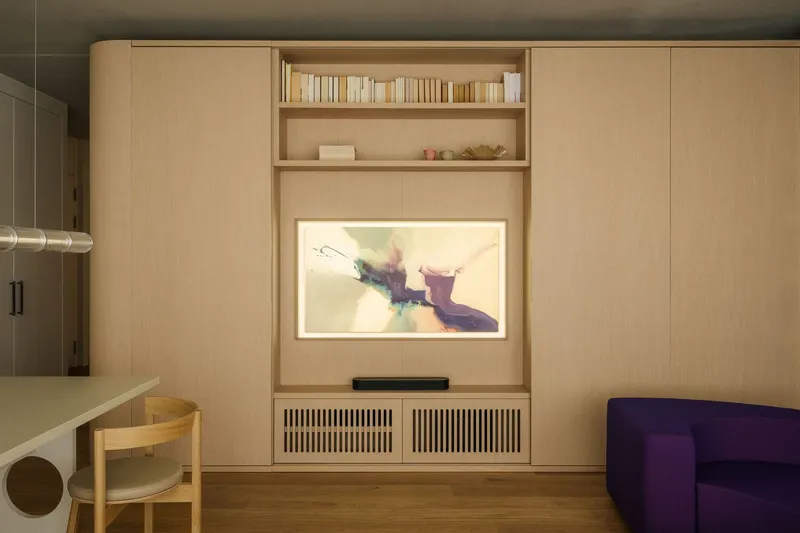
The corridor sets the tone immediately. A warm plywood volume runs along the wall, its rounded corners softening what could be a rigid cabinetry grid. As you move deeper into the apartment, that volume shifts roles: it holds books in one stretch, screens media equipment behind perforated panels in another, and frames a gradient painting by Peter-Maximilian Ronsdorf along the way. The consistency of the material makes these functional pivots feel inevitable rather than designed.
What makes the move genuinely smart is the concealment strategy. Bathroom doors disappear into the joinery. A television hides behind panels that look no different from the shelving around them. The architects clearly decided that the books, art, and objects on display should be the only visual events, and everything else should recede into the grain of the wood.
The Library Wall and Living Room
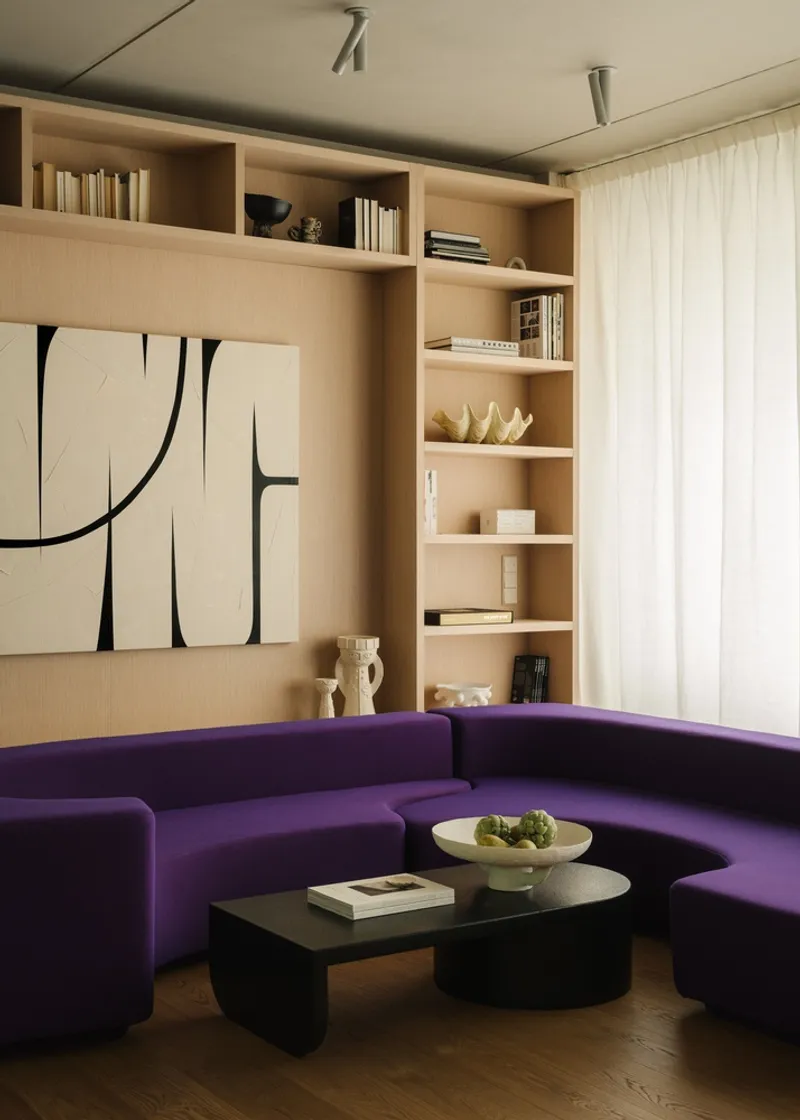
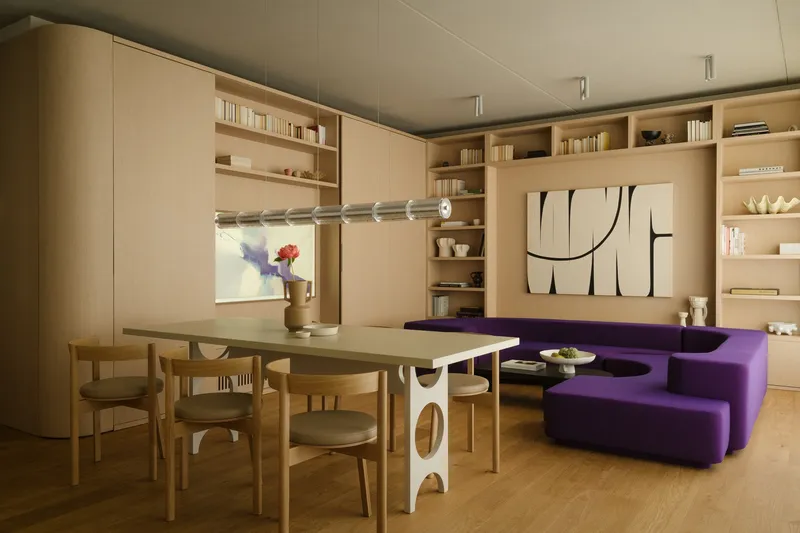
The wooden structure reaches its climax in the living room, where it becomes a floor-to-ceiling library wall. Shelves hold a curated mix of books, ceramics, and small artworks. Below them sits a deep purple sectional sofa, originally designed by Robert Pamio and reupholstered in Kvadrat fabric, its curved form pushing back against the orthogonal logic of the millwork. The tension between the two is productive: the sofa invites you to sink in and pull a book from the shelf above your head, which is exactly the point.
Overhead, the exposed concrete ceiling is left untouched. Lime plaster on the walls and the warmth of the plywood provide enough counterweight to keep the industrial surface from dominating. It reads as context rather than feature, a reminder of the building's bones without letting them dictate the mood.
Dining and Kitchen
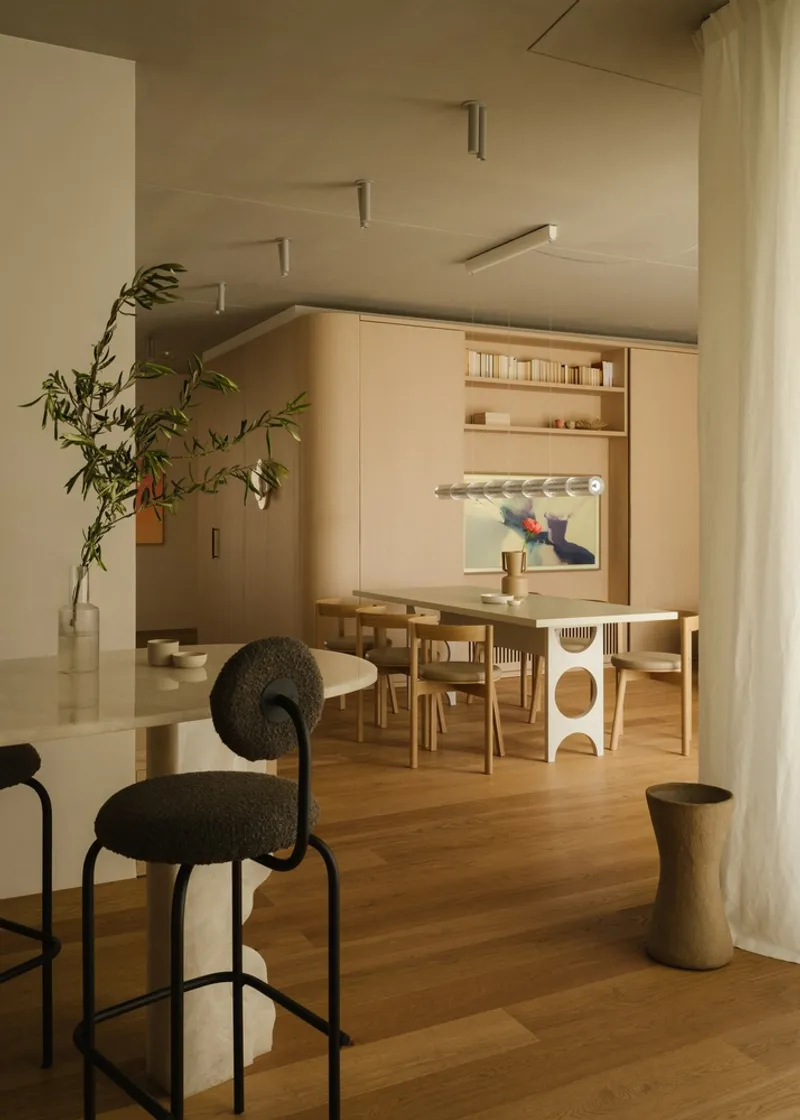
The dining area sits in a zone of natural light, sheer curtains diffusing the Berlin daylight across an oak table and a set of chairs by Loehr Furniture. A potted tree anchors one corner, and the composition feels restrained in a way that serves the food and the conversation rather than the architecture. The Poliform kitchen, finished in a nutmeg tone, stays in the background. Sculptural quartzite details on the table leg and custom wall lamps with wavy profiles add texture without competing for attention.
The Bedroom as Retreat
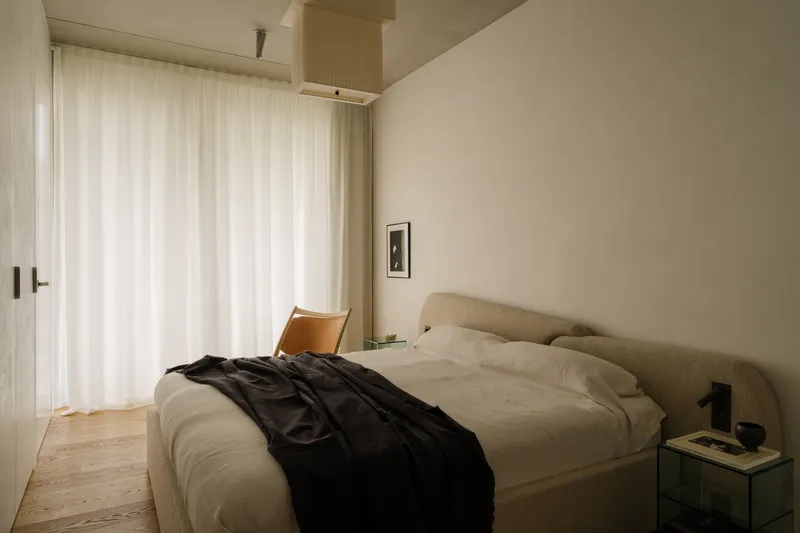
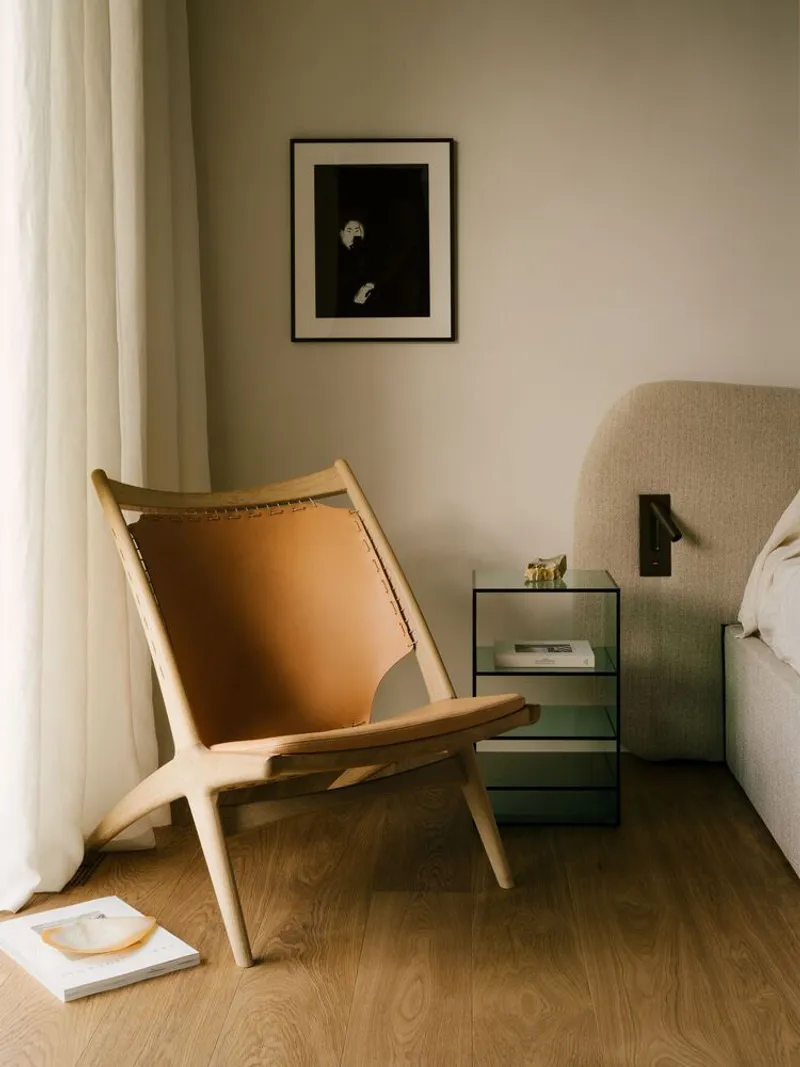
If the living room is the public library, the bedroom is the reading nook. The palette shifts cooler. An upholstered bed sits beneath what reads as a vaulted ceiling, daylight filtering through sheer curtains to create a wash of soft illumination. A timber column provides a sculptural vertical, and the green glass side tables catch light in a way that gives the room its only color accent.
A timber lounge chair with a leather sling seat sits in the corner, positioned beside a curtain and a small glass table. It is the kind of detail that separates a curated interior from a decorated one: the chair is not there to fill a corner but to create a second micro-program within the room, a place to sit with a book before sleep.
The Child's World
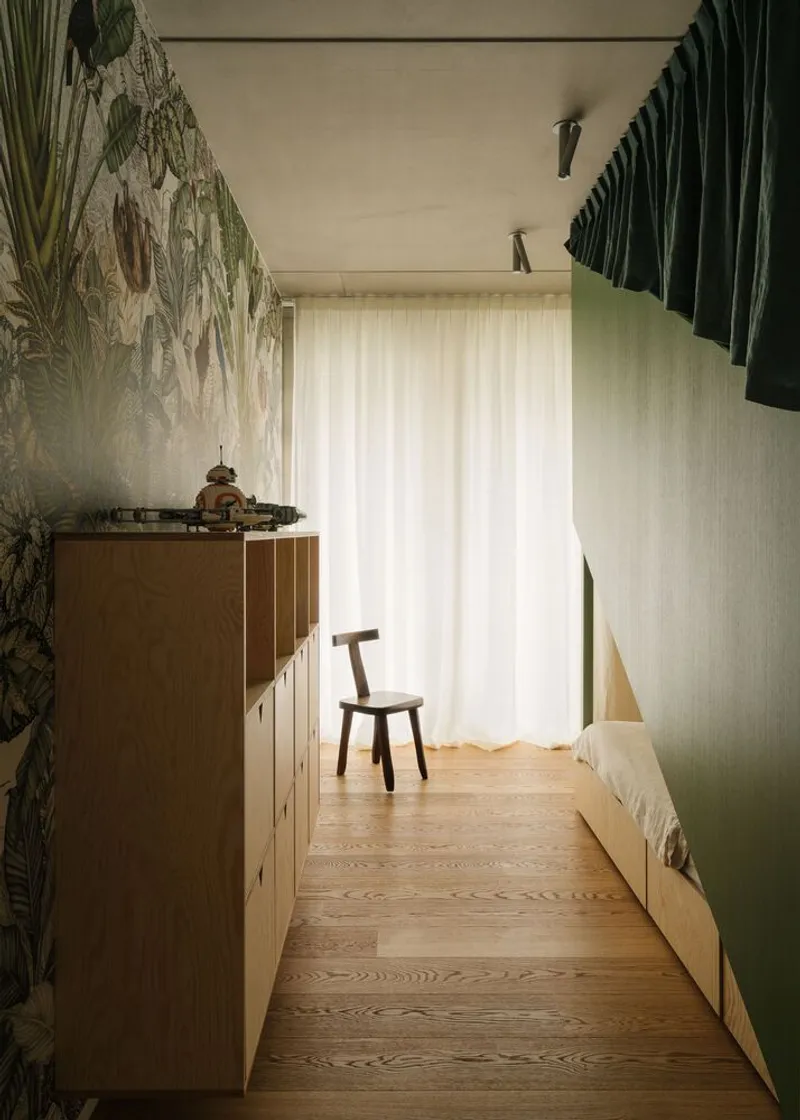
The children's room breaks from the restrained material logic with a tropical mural wallpaper and pleated green fabric ceiling panels. It is a deliberate departure, a room that announces itself as belonging to someone whose relationship with the apartment is fundamentally different. Timber cabinetry ties it back to the larger language of the home, but the climbing wall and the jungle motif make clear that this is a space designed for play, not contemplation.
The choice matters because it reveals the architects' understanding of audience. The parents get lime plaster and quartzite. The child gets a jungle. Both are considered. Neither is an afterthought.
Why This Project Matters
Residential interiors in prominent new-build complexes often default to one of two modes: either they defer entirely to the architecture of the building, or they paper over it with a lifestyle catalogue. TAKK Studio and Iwetta Ullenboom avoid both traps by introducing a single organizational idea, the continuous wooden structure, and then letting it absorb every pragmatic and aesthetic challenge the apartment throws at it. Storage, display, concealment, spatial sequence: it handles all of them without ever looking strained.
More importantly, the apartment takes its clients' identity seriously. A collection of 700 books is not a styling detail. It is a way of living that requires architecture to meet it on its own terms. By building the home around the library rather than fitting the library into the home, the designers created a space where reading is not an activity that happens inside the apartment but the reason the apartment exists at all. In a complex carrying the legacy of Kunsthaus Tacheles, that kind of cultural conviction feels right.
Am Tacheles Apartment by TAKK Studio and Iwetta Ullenboom. Located in Berlin, Germany. 140 m². Completed in 2024. Photography by Nate Cook.
About the Studio
TAKK Studio
Official website of TAKK Studio, one of the studios behind this project.
takkstudio.berlinShare Your Own Work on uni.xyz
If projects like this are the kind of work you want to make, uni.xyz is a place to publish your own, find collaborators, and enter design competitions.




Popular Articles
Popular articles from the community


Hill & Cross Opera: Sculptural Opera House Architecture Shaped by Tallinn’s Landscape and Identity
Hill & Cross Opera reimagines opera house architecture in Tallinn through its sculptural hill, civic plaza, glass wave and a luminous cross.

The Earth Pod: 3D Printed Homes for Resilient Refugee Communities
The Earth Pod reimagines refugee housing through 3D printed homes made from clay, combining resilience, self-sufficiency, and rapid shelter.

Co-life: Sustainable Architecture for Age-Friendly Community Living
Co-life reimagines sustainable architecture for seniors through courtyards, rammed earth, shared gardens, and spaces designed for belonging.

Play: Fragments of Their World
Familiar architecture becomes modular playground design, creating safe spaces where displaced children can learn, connect, imagine and play.


Similar Reads
You might also enjoy these articles


Hodi-Mandai Geram
Project Function: Preservation and revitalization of the Intangible heritage and socio-spatial identity of the Hodi by Housing, Cultural Memory Center, Sacred Grove, landscape, local tourism economy


Olio Towers: A Mid-Rise for Performers That Fuses Housing, Rehearsal, and Stage
Located blocks from Houston's Theater District, this modular tower stacks living units around a central performance atrium.

Oasis: Modular Green Housing Carved into Dhaka's Urban Fabric
A shortlisted Plugin Housing entry reclaims unauthorized settlements in Dhaka with stepped concrete volumes, green roofs, and ventilation-driven design.

Black Hole: A Floating Megastructure for the Post-Physical Era
Emiliano Mazzarotto envisions a spherical, self-scaling arena where e-sports, digital hotels, and holographic stadiums replace traditional public space.


Explore Interior Design Competitions
Discover active competitions in this discipline


Challenge to design luxury tourism on rails


Challenge to reimagine the Iron Throne


Photograph architecture without architects


VR headsets Storefront design competition
Comments (0)
Please login or sign up to add comments
No comments yet. Be the first to comment!