

Amphibious Commons: Flood-Resilient Housing That Treats Water as Ally, Not Enemy
A regenerative neighborhood model for Kerala that floats with floods and anchors community life through vernacular wisdom and bamboo construction.


What if the answer to catastrophic flooding isn't to resist water but to live with it? In Kerala, where monsoon floods and seasonal droughts define the rhythm of existence, the conventional instinct is to rebuild on higher ground or behind stronger walls. Amphibious Commons takes a radically different position: it treats water as an architectural element, designing homes and public spaces that adapt to rising levels rather than fighting them. The result is a neighborhood model where pathways become aqueducts, marketplaces convert into relief hubs, and dwelling clusters float on recycled buoyant materials when the rains come.
Designed by Zain Karsan, Amphibious Commons received an Honorable Mention in the HEAL+ competition, which called for regenerative housing solutions for Kerala's flood-affected communities. The proposal goes well beyond disaster recovery. It integrates Kerala's vernacular traditions of wells, courtyards, and communal ground planes with contemporary sustainable construction, creating a participatory framework where communities shape their own resilient environments.
A Docking Station Where Streets Meet the Waterline
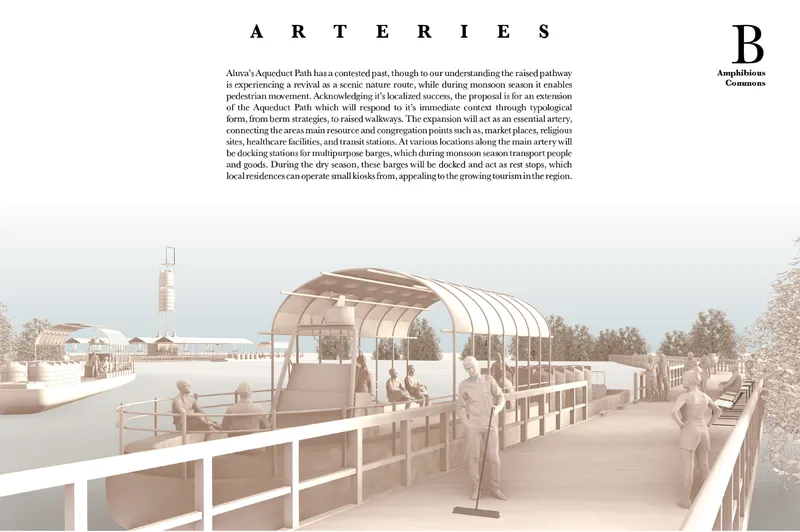
The covered waterfront docking station reveals the project's core logic: infrastructure that serves dual purposes depending on water conditions. Under normal circumstances, the sheltered walkway with its white railings functions as a pedestrian promenade, connecting neighborhoods along the water's edge. During floods, the same structure becomes a docking point for barges, maintaining critical movement and supply access when roads are submerged. The design doesn't look like emergency architecture. It looks like a place people would choose to spend time, which is precisely the point. Resilience works only when it's woven into the fabric of daily life, not stored in a warehouse for disaster day.
The Market Pavilion as Crisis Infrastructure
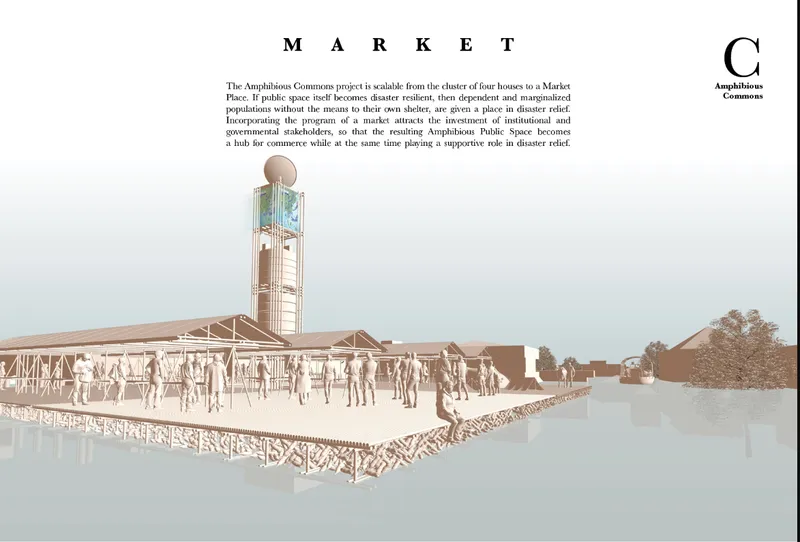
The market pavilion, anchored by a prominent tower along the waterfront promenade, operates as a center of trade and social exchange during ordinary times. When crisis arrives, the same space transforms into a relief hub: its open structure and elevated plane allow it to shelter displaced residents and distribute supplies. The tower serves as both a visual landmark and a vertical element that stays functional above high water lines. This duality, marketplace by day and emergency shelter by monsoon, is one of the project's strongest propositions. Public spaces that perform only one function are a luxury flood-prone regions cannot afford.
Bamboo, Laterite, and the Three-Story Dwelling Frame
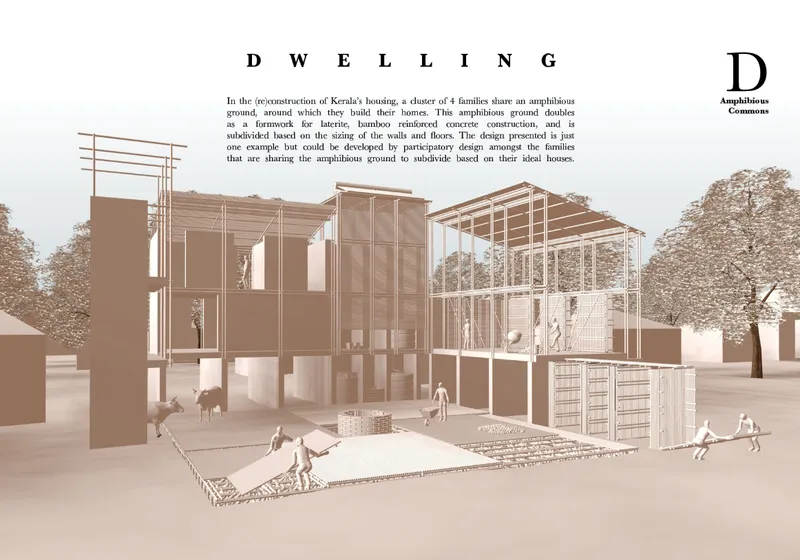
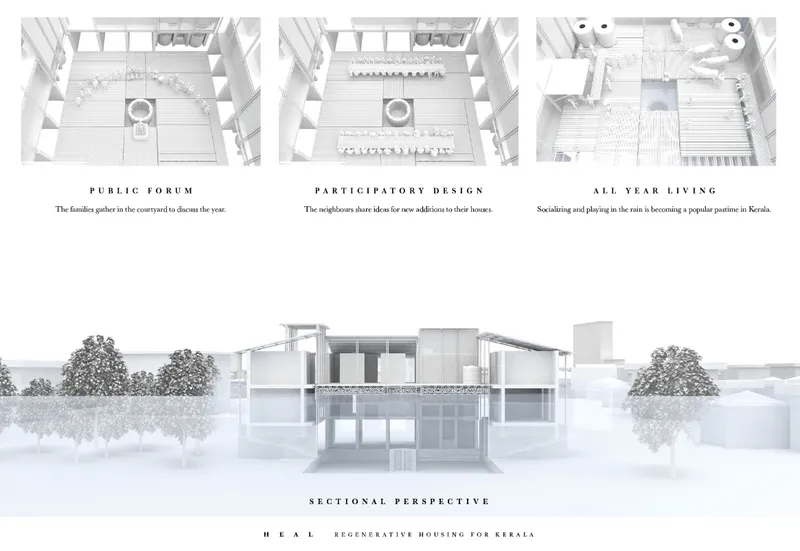
The three-story dwelling unit exposes its structural frame honestly: bamboo-reinforced laterite concrete forms the skeleton, while the ground level remains open for communal gathering. People cluster beneath the elevated living spaces, using the shared ground plane for daily interaction. The sectional drawing clarifies the spatial organization further, showing a central courtyard flanked by two-story living volumes with surrounding trees providing shade and ecological integration. The courtyard, drawn directly from Kerala's traditional residential typology, doubles as a deep water access point and social anchor.
Material choices here are deliberate and pragmatic. Bamboo is locally available, renewable, and structurally capable. Recycled buoyant materials, including plastic bottles and discarded vessels, provide floating capacity during floods. The emphasis on low-tech scalability means the system doesn't depend on specialized labor or expensive imports, making it replicable across flood-prone regions of India and Southeast Asia. This is not architecture that requires a crane; it is architecture that a community can build together.
Exploded Assembly: From Foundation to Roof
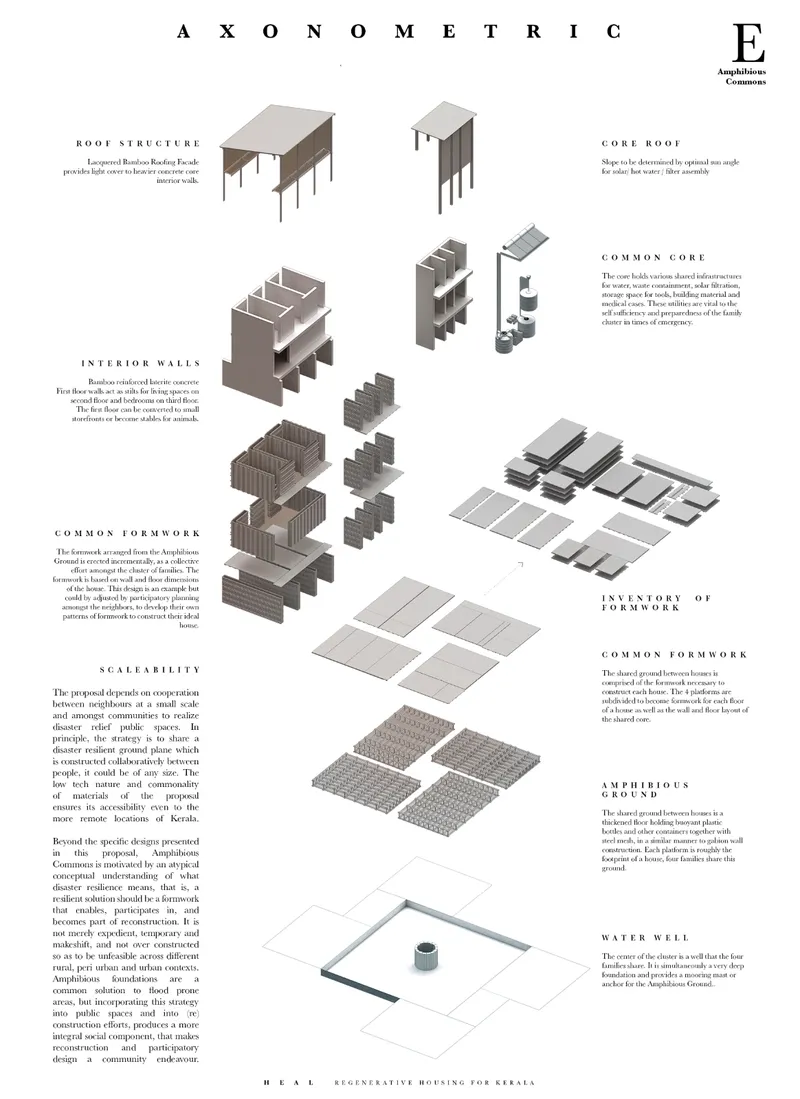
The axonometric exploded diagram strips the dwelling down to its component layers, from buoyant foundation through structural frame to roof assembly. What becomes legible is the modular logic: each layer is a discrete system that can be adapted, repaired, or replaced independently. The foundation accommodates rising water. The structural frame provides rigidity and elevation. The roof, echoing Kerala's traditional sloped profiles, manages monsoon rainfall. By presenting the building as an assembly of separable parts rather than a monolithic object, the project invites participatory construction. Communities can build incrementally, adding layers as resources and needs evolve.
Why This Project Matters
Amphibious Commons refuses the binary that dominates disaster architecture: the choice between emergency shelters that feel temporary and permanent housing that ignores the next flood. By designing for the full spectrum of water conditions, from drought to deluge, the project creates architecture that is legible and useful every day of the year. The integration of vernacular spatial types like courtyards and wells into a contemporary structural system demonstrates that cultural continuity and climate resilience are not competing goals.
What gives the proposal lasting significance is its commitment to social inclusivity. By centering participatory design and collective construction, Karsan ensures that resilient housing is not imposed on communities but built by them. The shared ground plane, the communal forums, the marketplace that doubles as a relief center: these are all spaces that require collective stewardship. In a world where climate adaptation is often framed as a technical problem requiring top-down engineering, Amphibious Commons argues that the most durable infrastructure is social.
View the Full Project
About the Designers
Designer: Zain Karsan
Enter a Design Competition on uni.xyz
uni.xyz runs architecture and design competitions year-round that reward proposals with spatial conviction and real site intelligence.
Project credits: Amphibious Commons by Zain Karsan HEAL+ (uni.xyz).


Popular Articles
Popular articles from the community

Opera by the Sea Estonia: Three Shells Dissolving Architecture into Tallinn's Coastline
A winning opera house proposal replaces monumental form with interconnected shells that blur the boundary between building, park and Baltic Sea.

Tsunami Convergenics: Turning Catastrophic Ocean Forces into Underwater Housing Infrastructure
A speculative underwater settlement off the coast of Onagawa, Japan, treats tsunamis and typhoons as energy sources rather than threats.

Cloaked Colonization: A Mobile Underwater Habitat That Moves Like a Fish
Micah Abaya's shortlisted EHC Pacific entry reimagines ocean settlement as a dispersed network of self-sustaining architectural organisms.
Temporary Home for Dogs: A Reversed Zoo Rethinks Animal Shelter Architecture
In Bucharest, a sinuous corridor and freed landscape flip the logic of containment, designing a shelter that works to make itself unnecessary.

Similar Reads
You might also enjoy these articles

Bao Huynh Watercolor Atelier: A Serene Art Retreat in Hội An
Bao Huynh Watercolor Atelier in Hội An blends multifunctional art spaces, sustainable design, local materials, and family-friendly living in a serene environment.

Atelier Macri Concept Store Interior Design by CASE-REAL
Atelier Macri store features a "ko" counter, walnut wood details, cork displays, blending retail, gallery, and seamless customer experiences.

Manuel Vargas Izquierdo Stadium and High-Performance Sports Center: Architectural Excellence in Jalpa de Méndez
The Manuel Vargas Izquierdo Stadium blends sustainable design, inclusive sports facilities, and cultural-inspired architecture, revitalizing Jalpa de Méndez’s public spaces.

KAKR Buluh Awar Hall: Revitalizing Community and Ecology Through Bamboo Architecture
Community built bamboo hall revitalizes Buluh Awar village, empowering youth, restoring ecology, celebrating vernacular craftsmanship through sustainable architecture and culture.

Explore Kerala Floods Competitions
Discover active competitions in this discipline

Challenge to design locus for the upliftment of human rights

Challenge to reimagine the Iron Throne

Photograph architecture without architects

Illustrate the lost glory of Angkor Wat - Render Challenge
Comments (0)
Please login or sign up to add comments
No comments yet. Be the first to comment!