

Amunt Martenson and heramarte Replace Four Garages with Five Apartments in a Karlsruhe Courtyard
A concrete infill building brings five compact dwellings to a landlocked inner courtyard in Karlsruhe, Germany, proving density can be intimate.


Four garages that could no longer be reached by car sat in the inner courtyard of an early twentieth-century apartment building in Karlsruhe. Amunt Martenson and heramarte saw that dead space as an opportunity: tear the garages out, pour a concrete volume into the same footprint, and stack five apartments where none existed before. The result, completed in 2025, is a 200 square meter building that treats urban densification not as a slogan but as a spatial problem to be solved at close range, wall to wall, window to window.
What makes the Gott Apartment Building genuinely interesting is not merely that it fills a gap. It is the way it negotiates an extremely constrained site with generosity. The entire buildable area becomes living space. There is no basement. Every square meter counts, yet the building still manages to offer terraces, double-height rooms, mezzanines, and views through layered thresholds that make tight quarters feel expansive. The architects chose durable, robust materials, concrete and plywood and agglomerated marble, knowing that a building near the university will see frequent tenant turnover. This is housing designed not for a magazine shoot but for the long haul.
Fitting Into the Gap
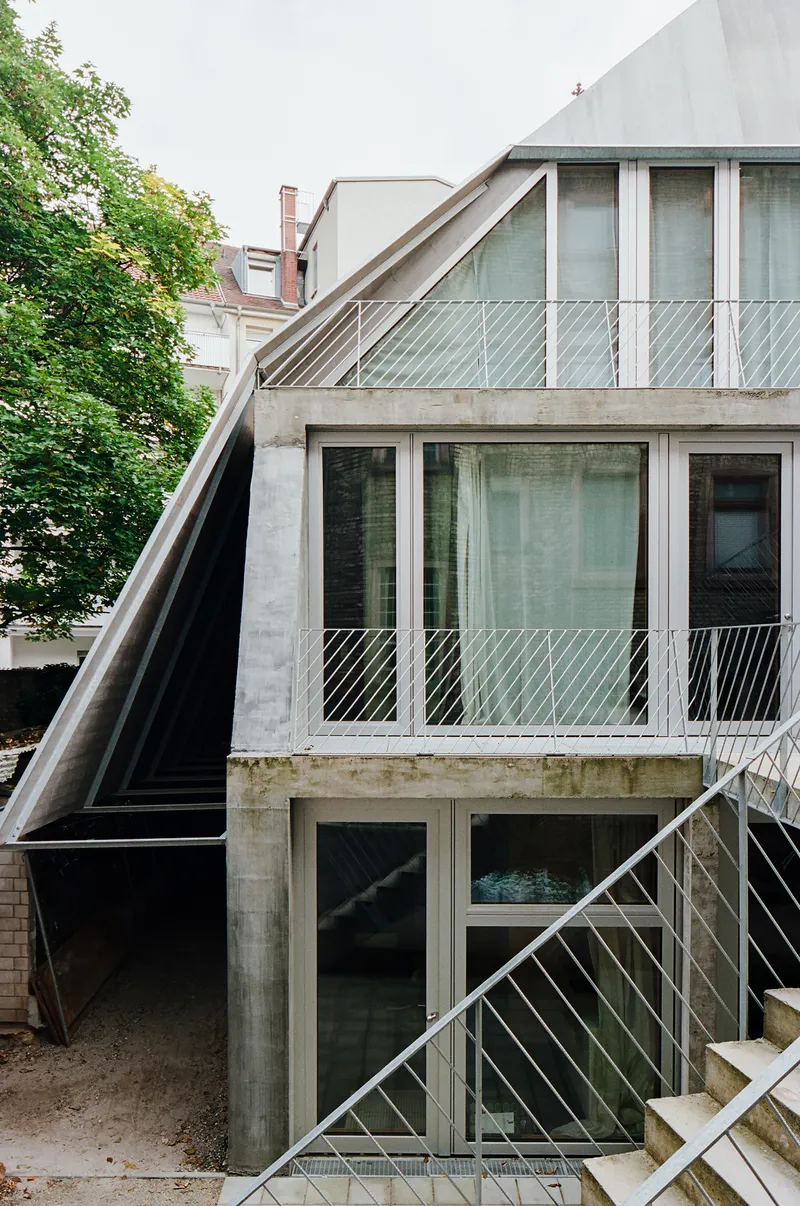
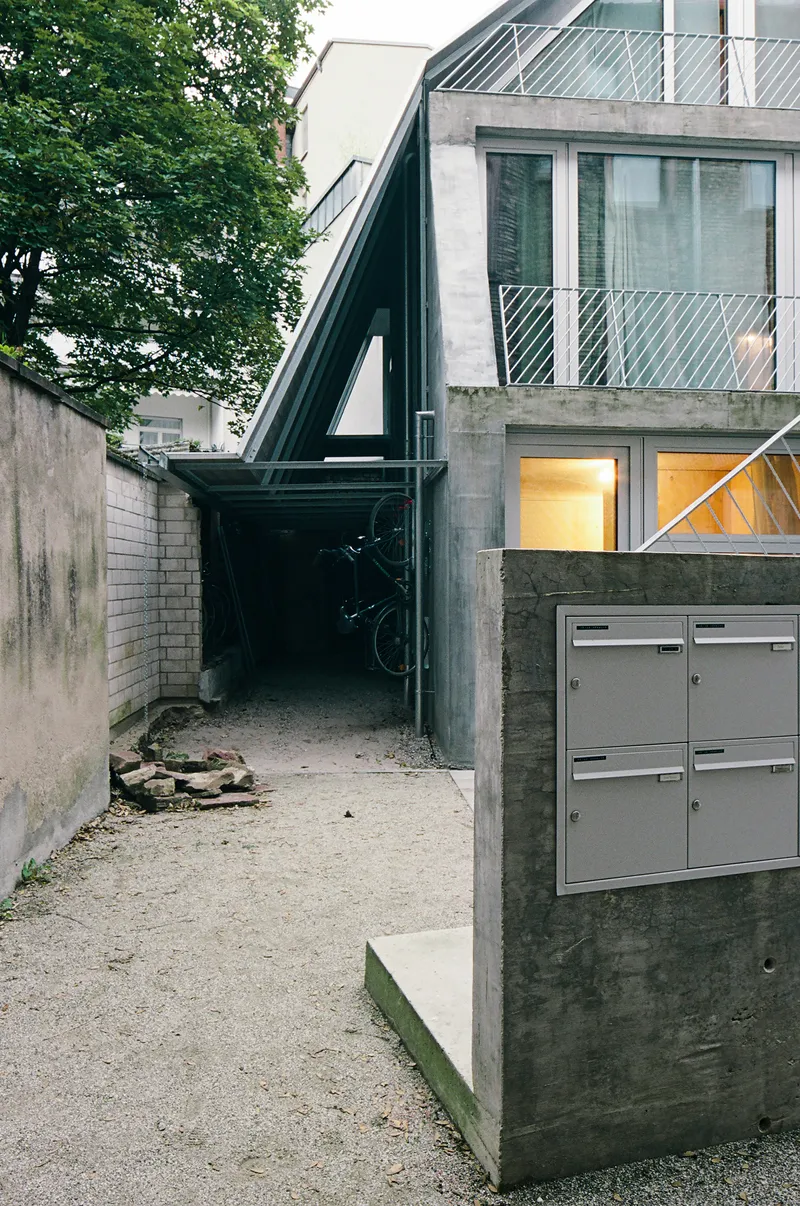
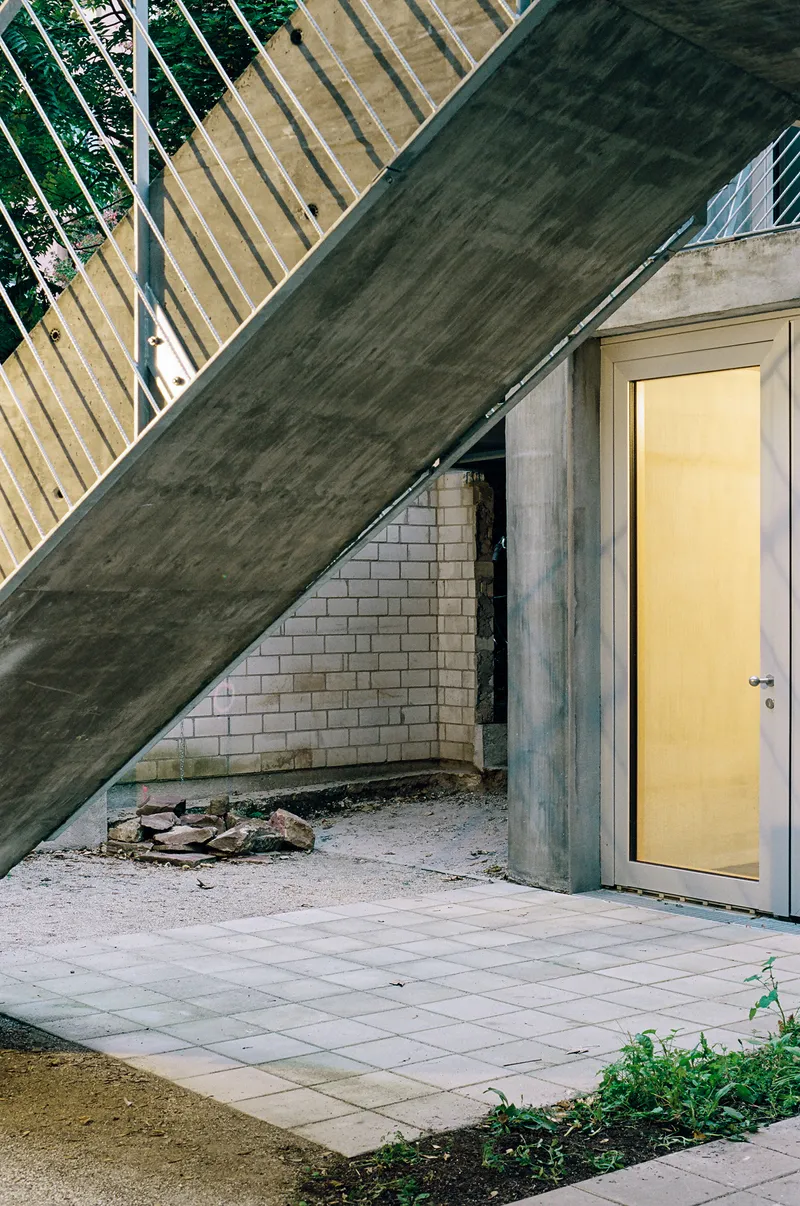
Arriving at the Gott building means passing through the existing front building. A black steel frame passageway leads into a gravel courtyard, and from there the new volume reveals itself gradually: an angular concrete mass tucked behind rendered walls and mature trees. The approach is deliberately understated. You encounter a mailbox, a canopy of branches, a paved threshold beneath a sloping concrete roof, and then the building proper. The architects did not try to announce the addition from the street. It exists for those who live inside the block.
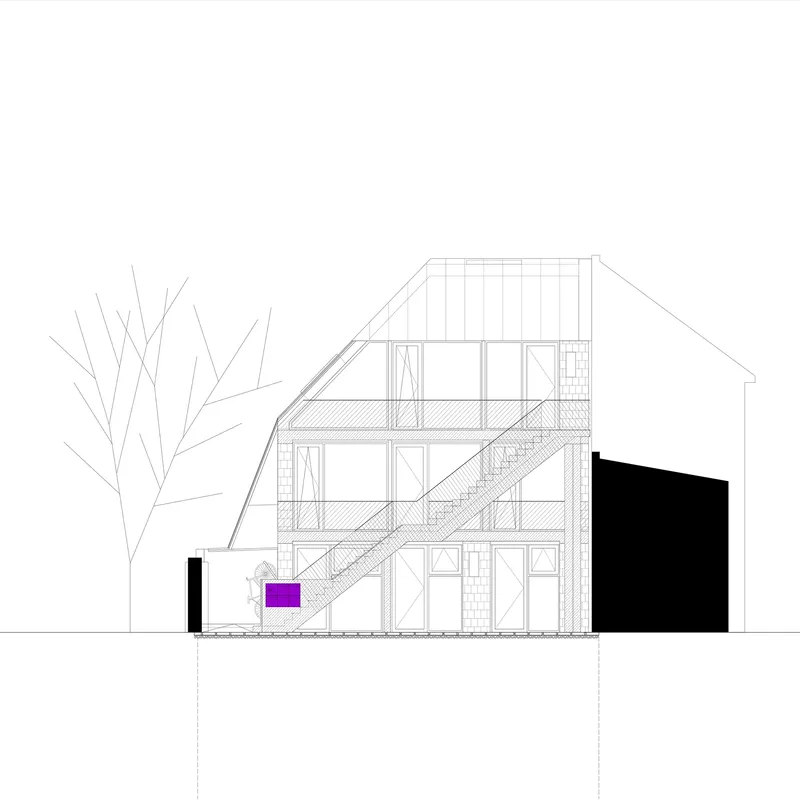
The rear facade reads as a diagram of the building's logic. Diagonal bracing, glazed balconies, and a metal staircase connect courtyard levels, making the circulation legible from outside. Concrete is left fair-faced, with the honesty of a material that does not pretend to be anything else. Against the older brick and rendered surfaces that surround it, the new volume holds its own without competing.
The Courtyard as Shared Room
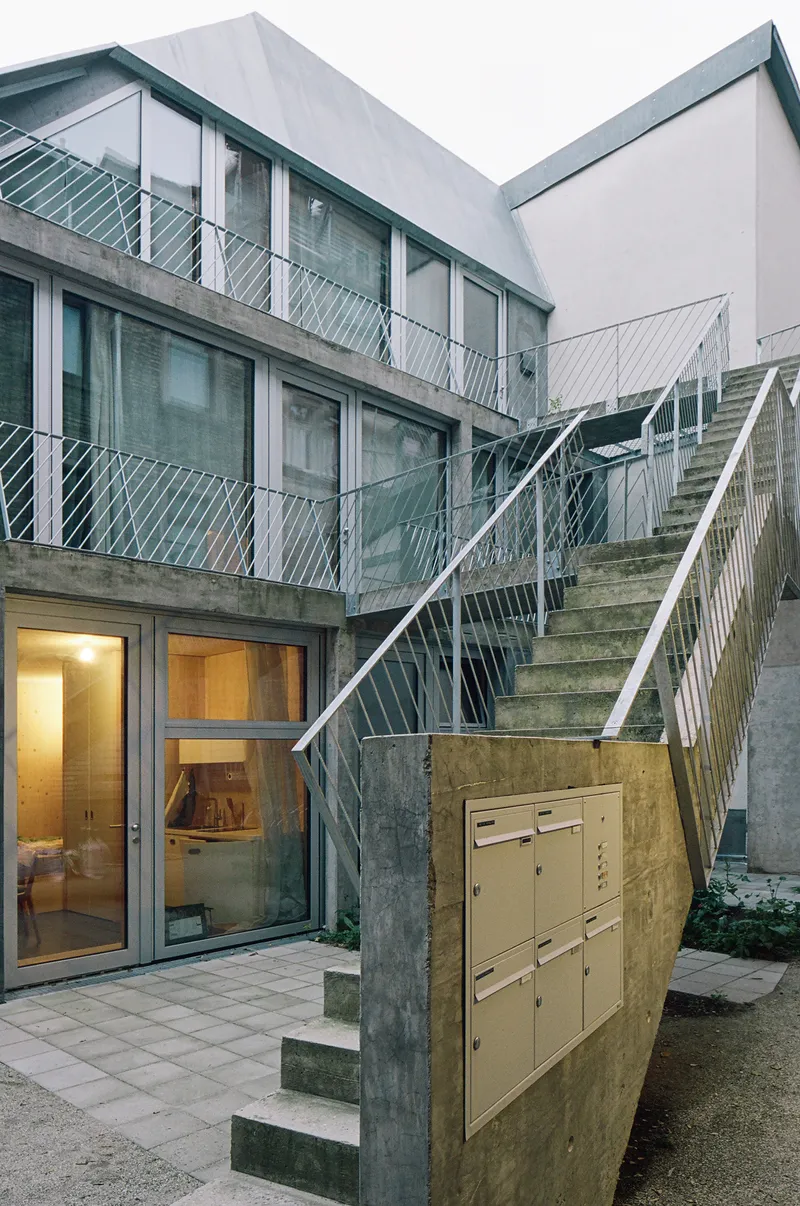
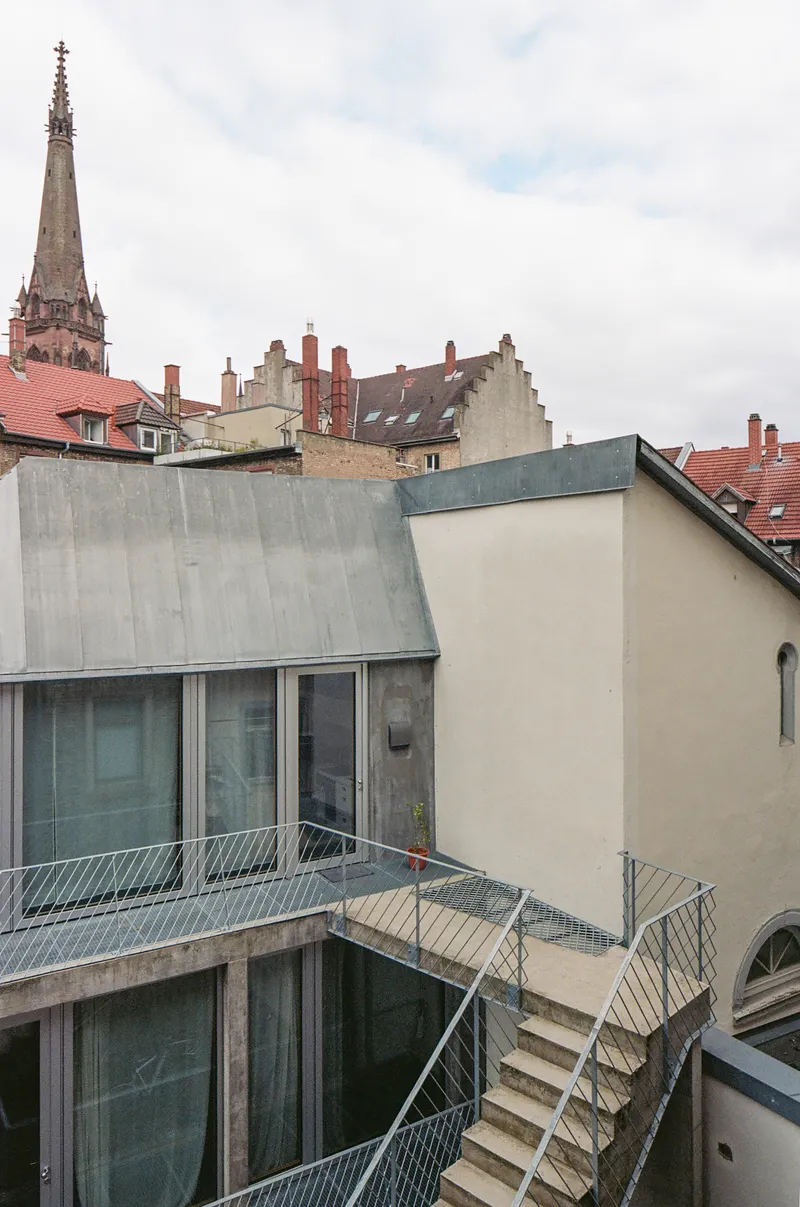
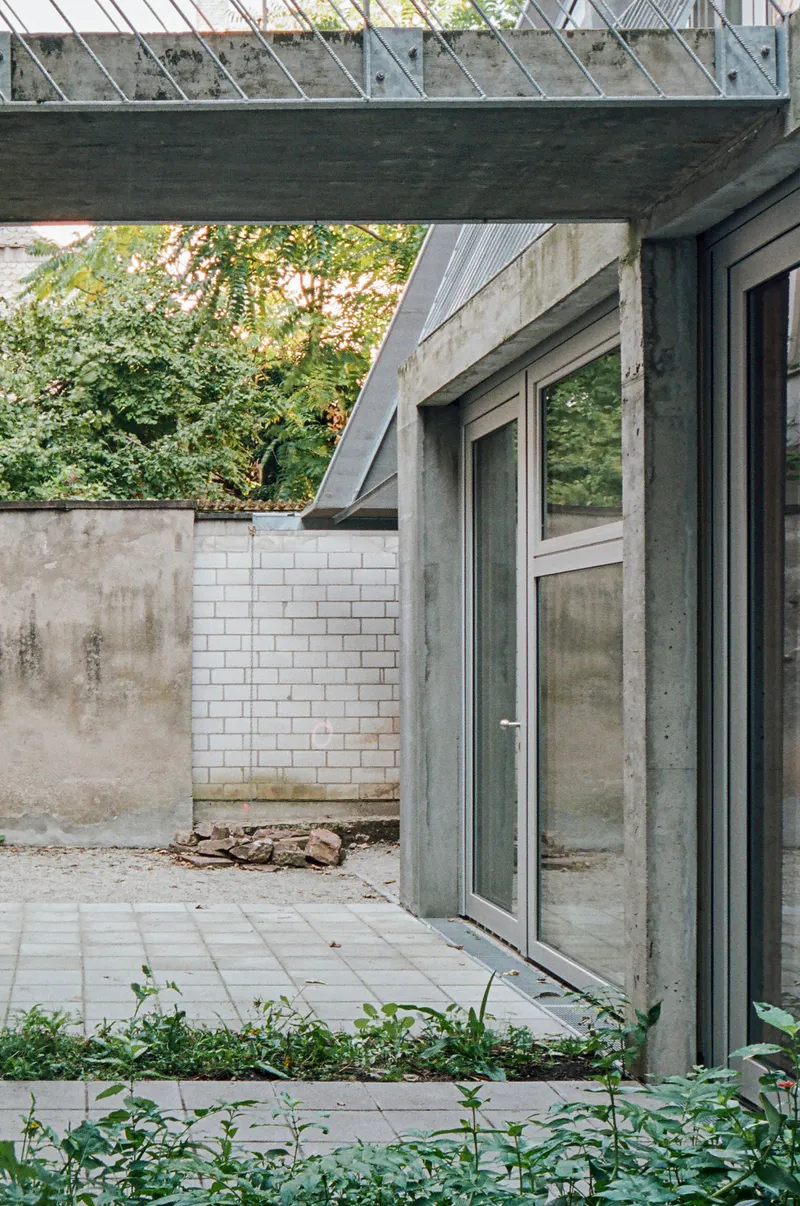
A courtyard building lives or dies by the quality of its in-between spaces, and Amunt Martenson and heramarte clearly understood the stakes. The concrete staircase with its white diagonal railings becomes a sculptural element ascending through the courtyard, connecting balconies and ground-level entries. Terrazzo paving, planted beds, and a careful sequence of concrete doorframes give the outdoor zones a sense of deliberate composition rather than leftover space.
The afternoon light captured in these courtyards reveals how the angled geometry of the roof and walls creates shifting shadow patterns across surfaces. An overhead metal grating filters light into a ground-level threshold. These are small moves, but they accumulate into an environment that feels designed for daily life rather than photographed spectacle.
Terraces and Exterior Circulation
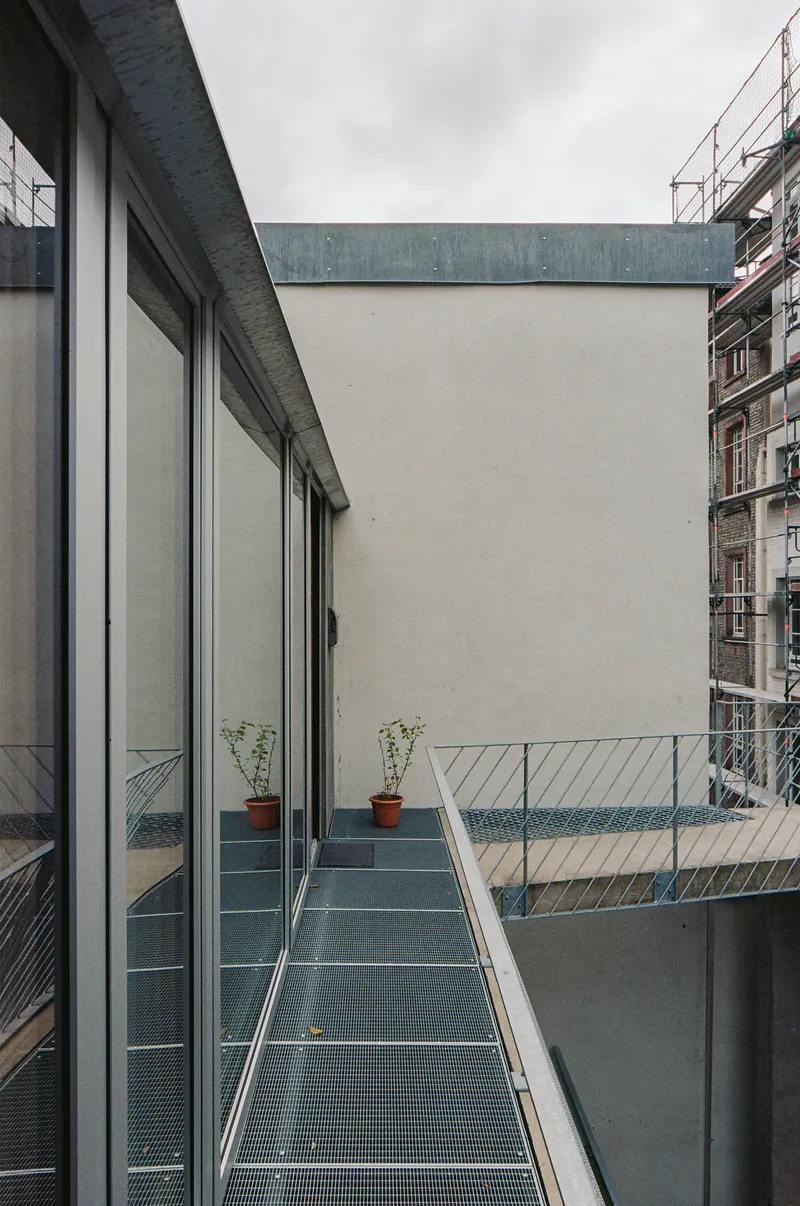
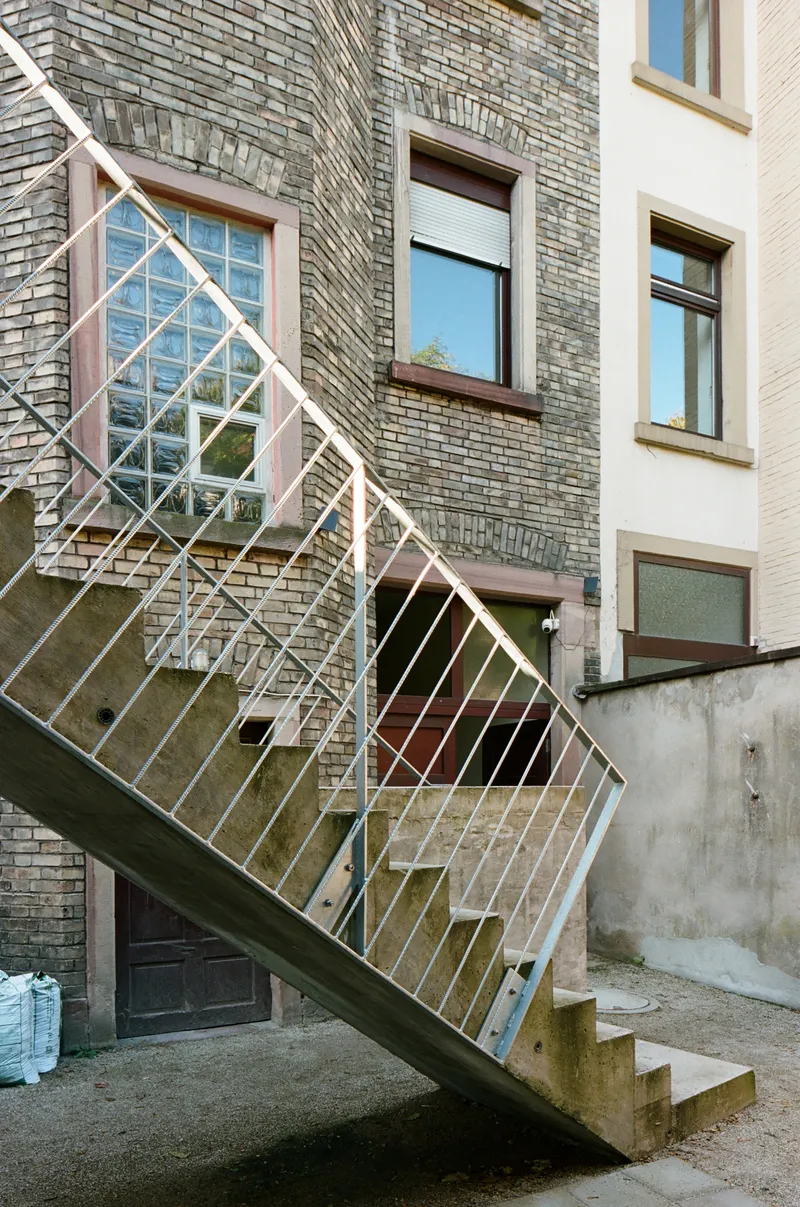
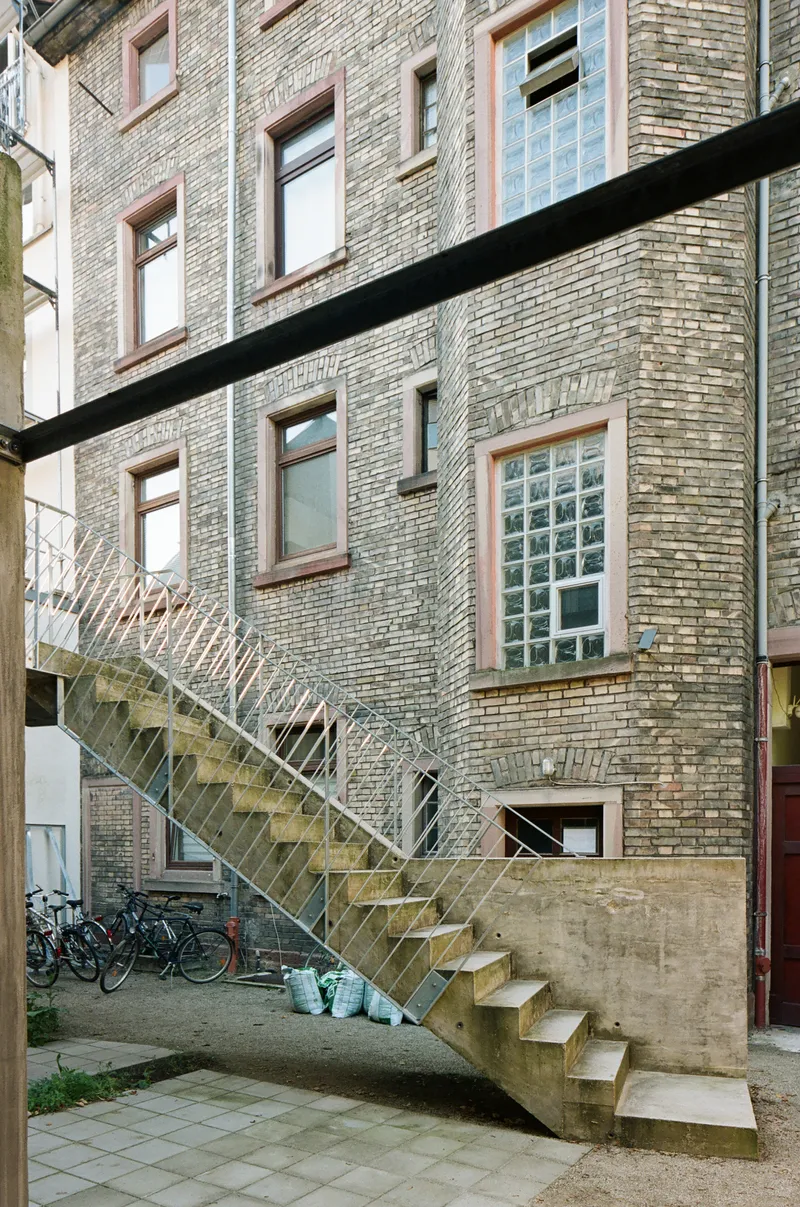
With no room for internal corridors, the architects pushed circulation outside. Steel staircases ascend against grey brick facades, and metal grate walkways serve as both access decks and terraces. Potted plants line the railings, bicycles park at the base, and the pink window frames of the neighboring facade peek through. It is an honest admission that in a building this tight, the boundary between private dwelling and shared infrastructure has to blur.
The multilevel terraces with their mesh railings offer overlapping views down into the courtyard and across the rooftops of the block. From the top level, a church spire rises beyond the angled concrete parapet. These outdoor spaces, compact as they are, give each apartment a relationship with the sky and the city that a landlocked courtyard building might otherwise deny.
Plywood Interiors and Double Heights
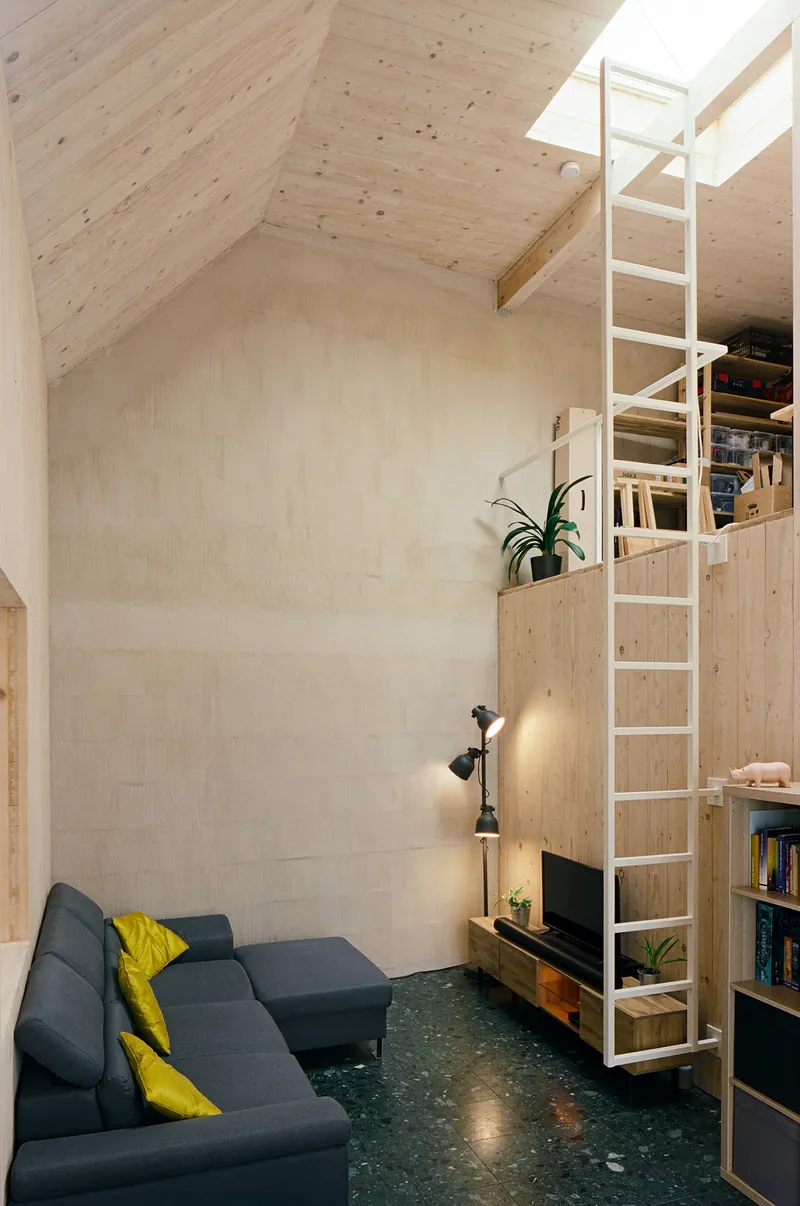
Inside, the apartments pivot from concrete to plywood. Walls and ceilings are lined in warm timber panels that transform compact rooms into something approaching a cabin sensibility. The most striking spatial move is the double-height living space with a plywood gable ceiling, a skylight overhead, and a white ladder climbing to a mezzanine. In a 200 square meter building containing five separate apartments, achieving this kind of vertical generosity is a minor act of defiance against the constraints.
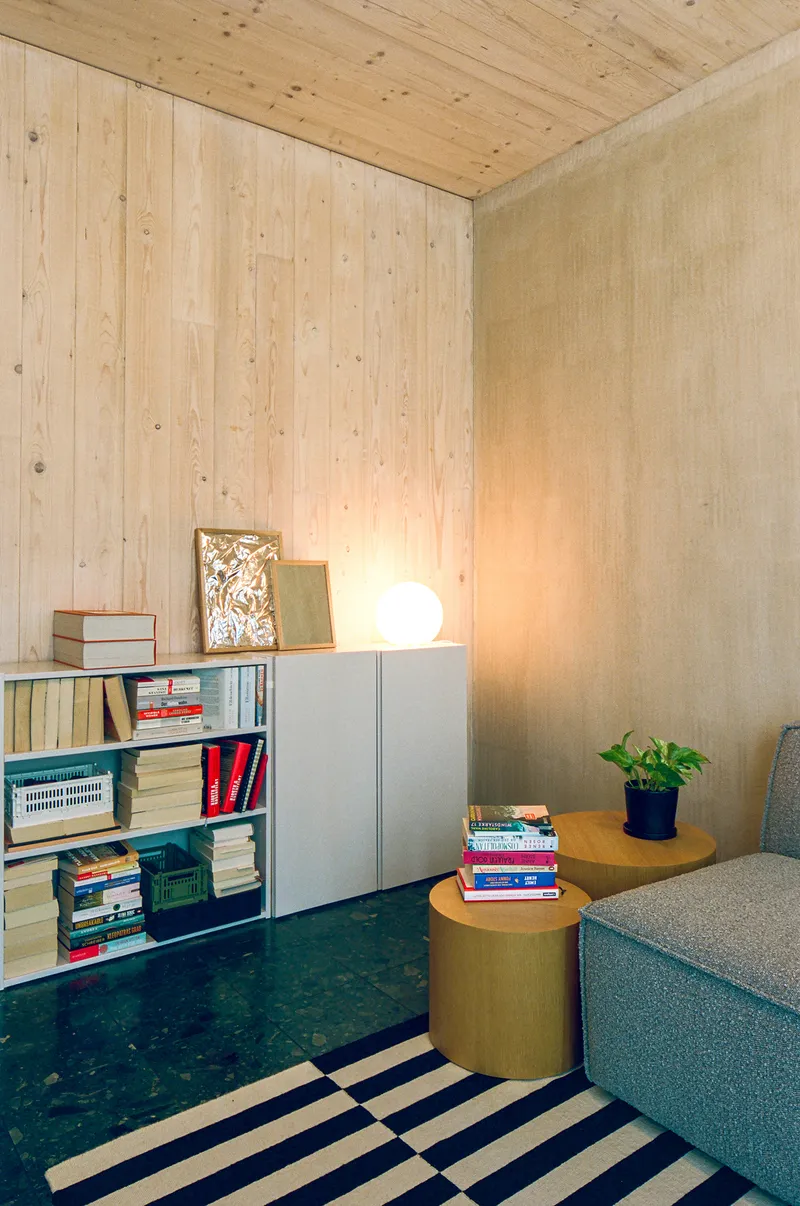
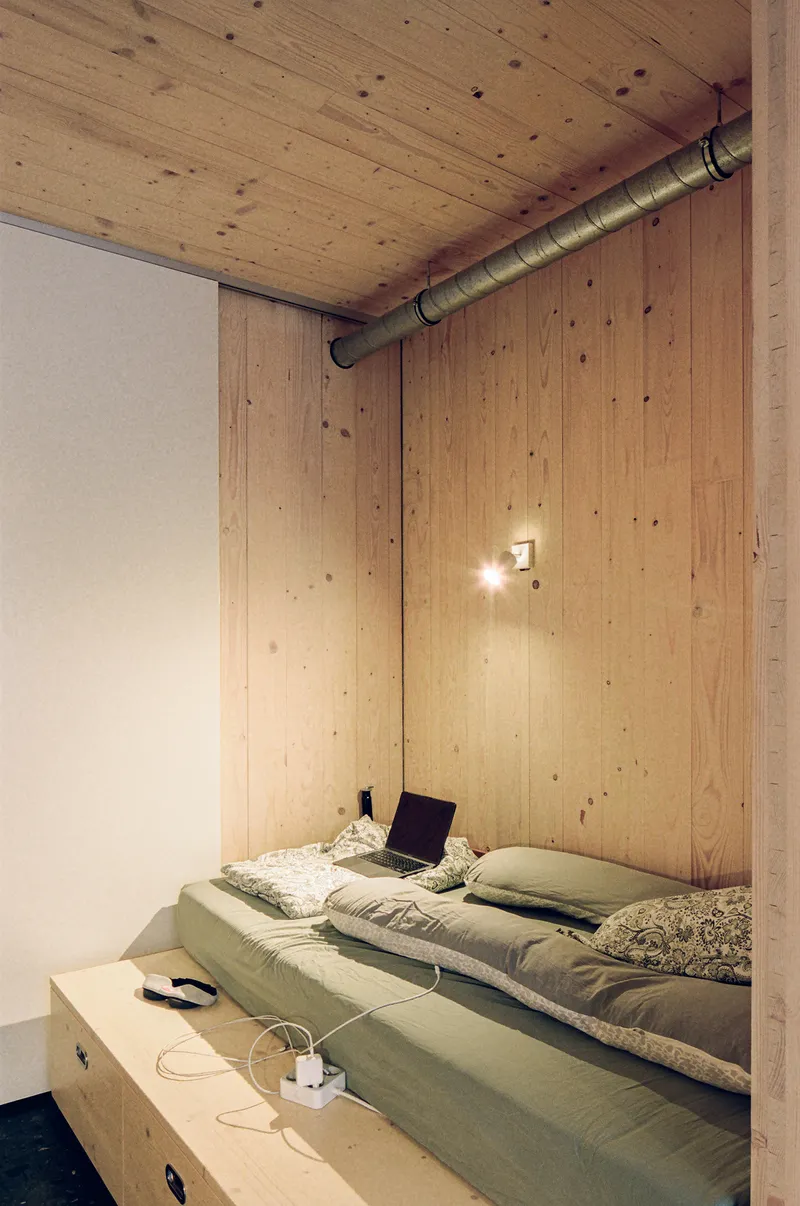
The reading nook with its low shelving, sphere lamp, and striped rug on terrazzo flooring reveals an attention to inhabitation that goes beyond mere floor plans. Sleeping platforms with raised plywood bases and exposed ventilation ducts along walls show the architects integrating the building's mechanical needs (decentralized ventilation with heat recovery in each unit) into the architectural language rather than hiding them. Nothing here is gratuitous.
Compact Kitchens and Threshold Moments
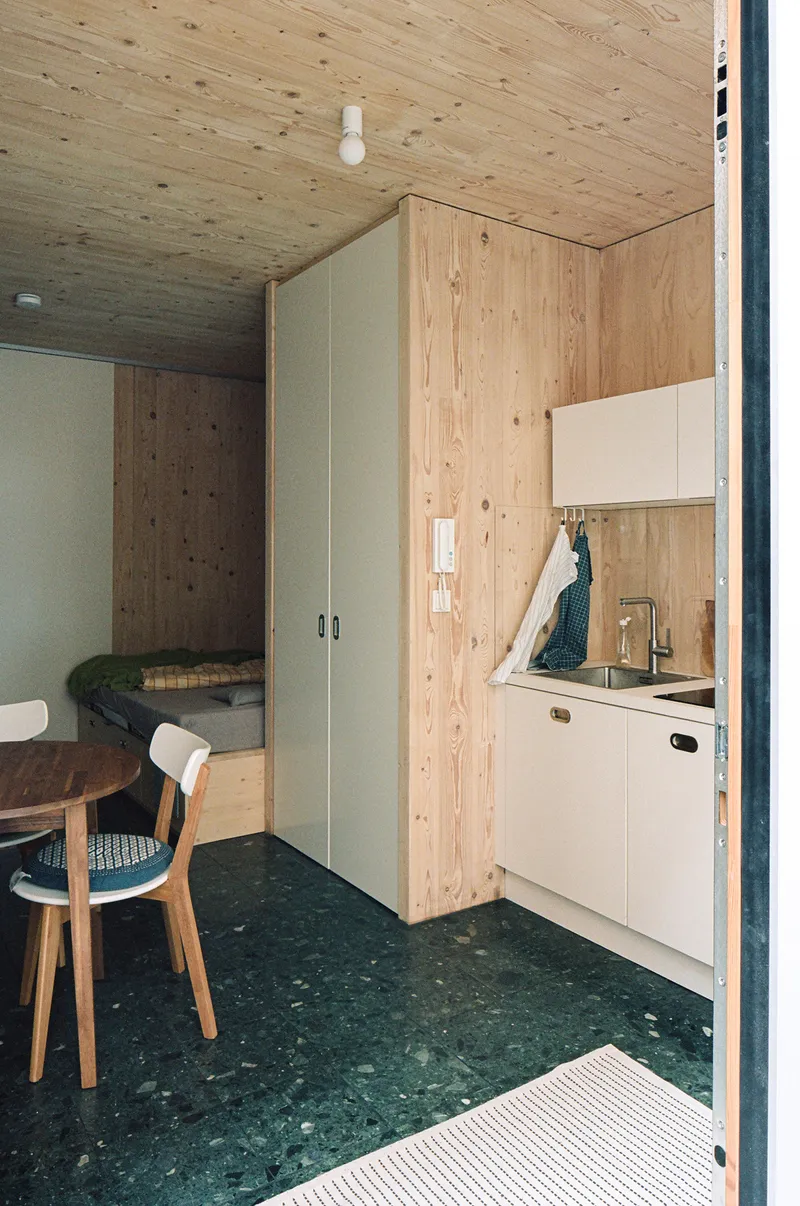
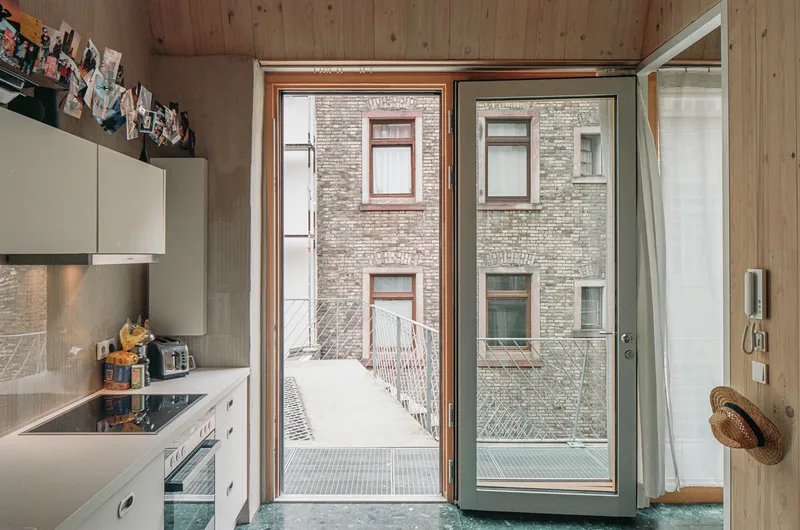
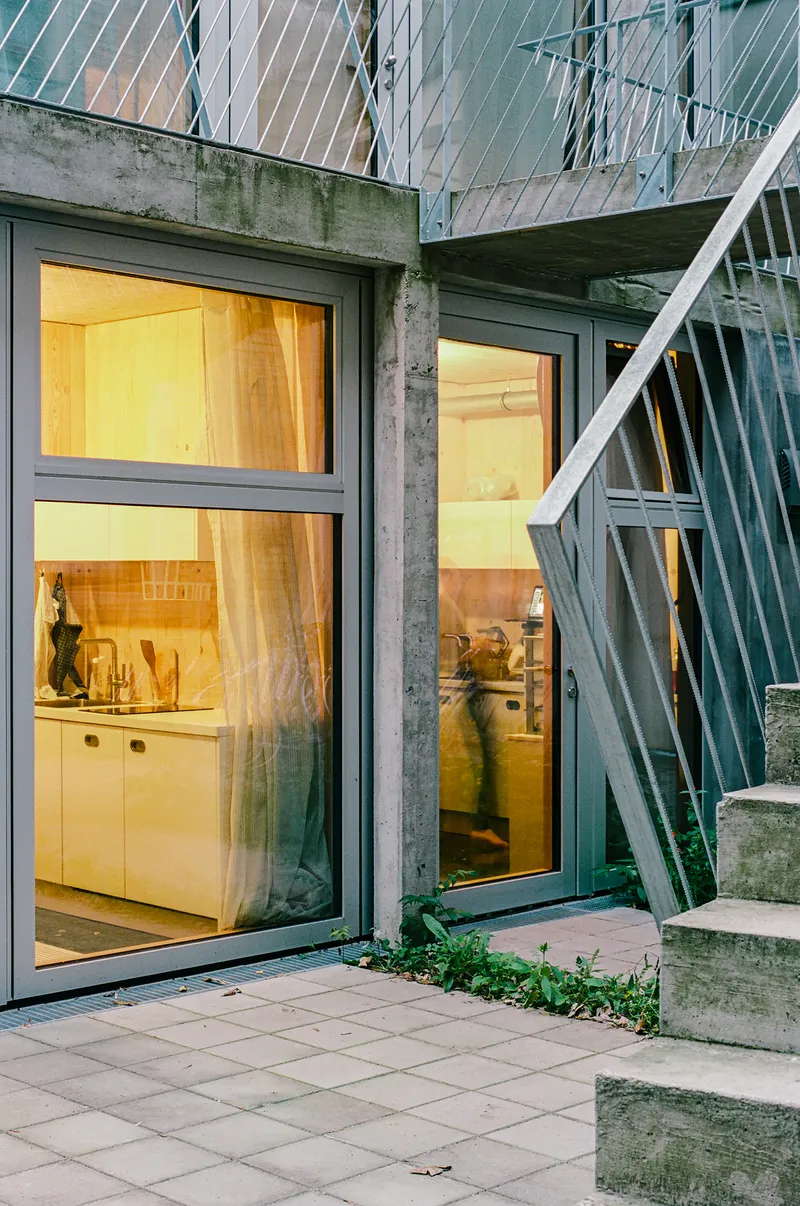
The kitchenettes are minimal: white cabinetry tucked into plywood walls, just enough counter and storage to function without wasting a centimeter. What saves these rooms from feeling cramped is the relationship to the outside. Timber-framed glass doors swing open onto metal grate terraces, and suddenly a kitchen that measures a few square meters borrows the entire courtyard as its extension. The dusk photograph of the illuminated interior seen through glass sliding doors, with a paved courtyard in the foreground, captures this reciprocity perfectly.
Throughout the building, doorways are treated as deliberate frames. A view through timber-clad rooms to green terrazzo flooring and a distant concrete wall becomes a sequence of layered planes. The architects use depth, not area, to create a sense of spaciousness. You look through rooms rather than standing in the middle of large ones.
Material Durability and Climate Logic
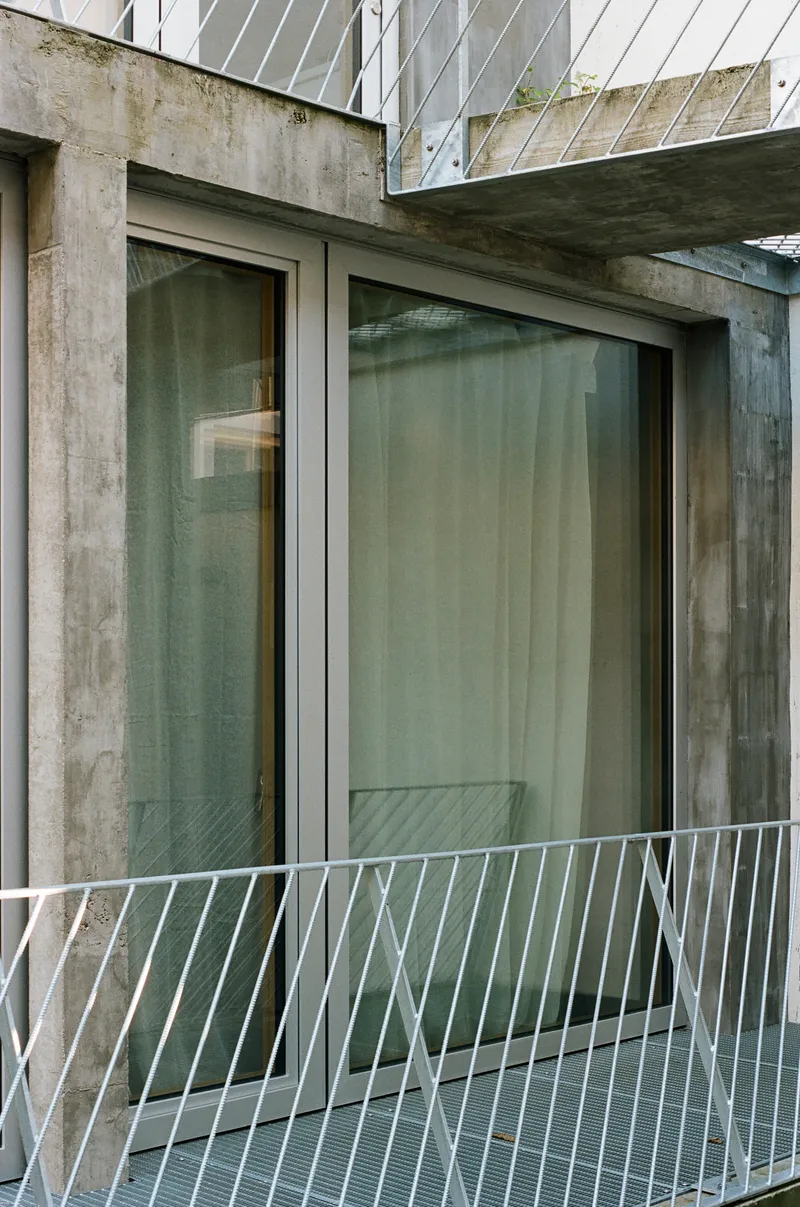

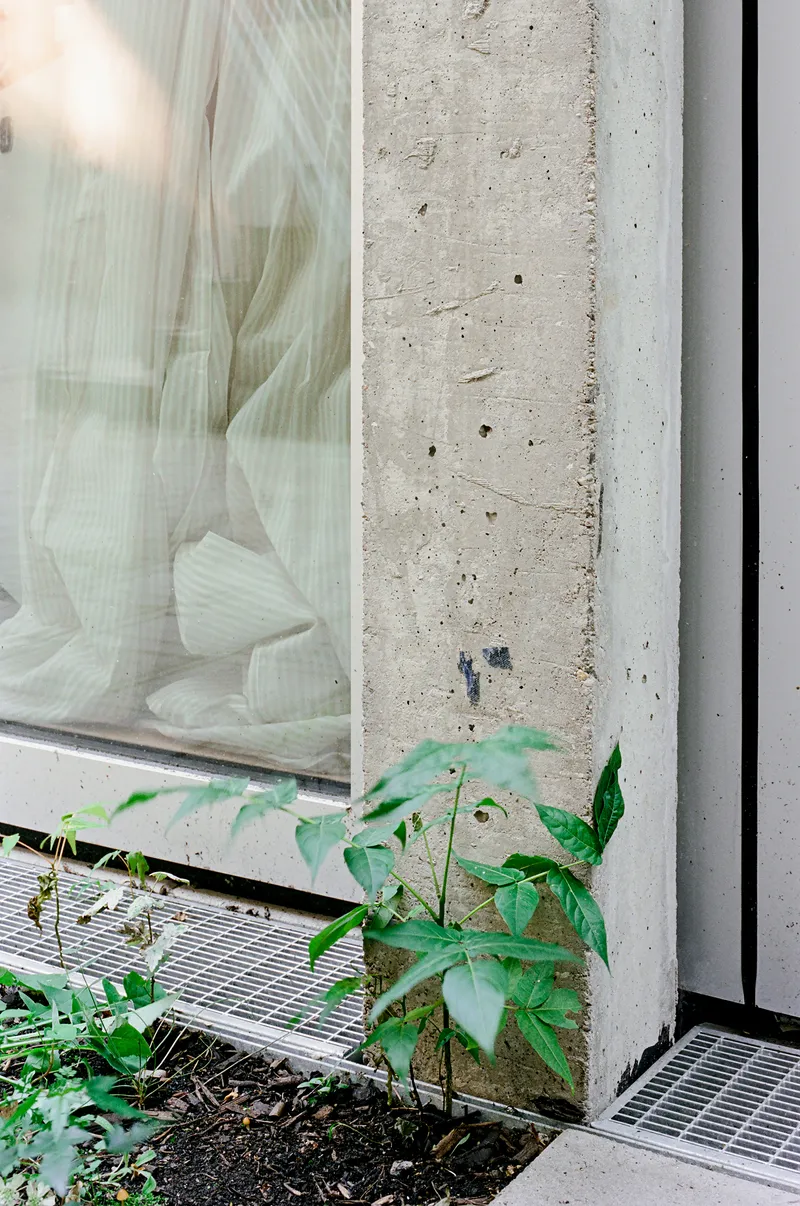
The material palette, concrete, plywood, agglomerated marble, metal grating, is chosen for endurance rather than novelty. Near a university, tenants cycle through quickly. Floors will be scuffed, walls will be bumped, and hardware will be tested. The mottled concrete floor meeting a timber window frame, a sewing table, and a sage green curtain in one apartment tells a story of a building already being lived in, already absorbing the marks of use without losing its character.
The energy strategy is equally pragmatic. Rather than installing a separate heating plant, the architects connected the rear building to the wood pellet system already serving the front building. Underfloor heating paired with unit-by-unit ventilation and heat recovery achieves low-energy standard without visible mechanical clutter. The planted beds at the base of the concrete walls and the sheer curtains visible through glazing suggest a building that manages comfort through layered strategies rather than brute-force systems.
Rooftop and Skyline
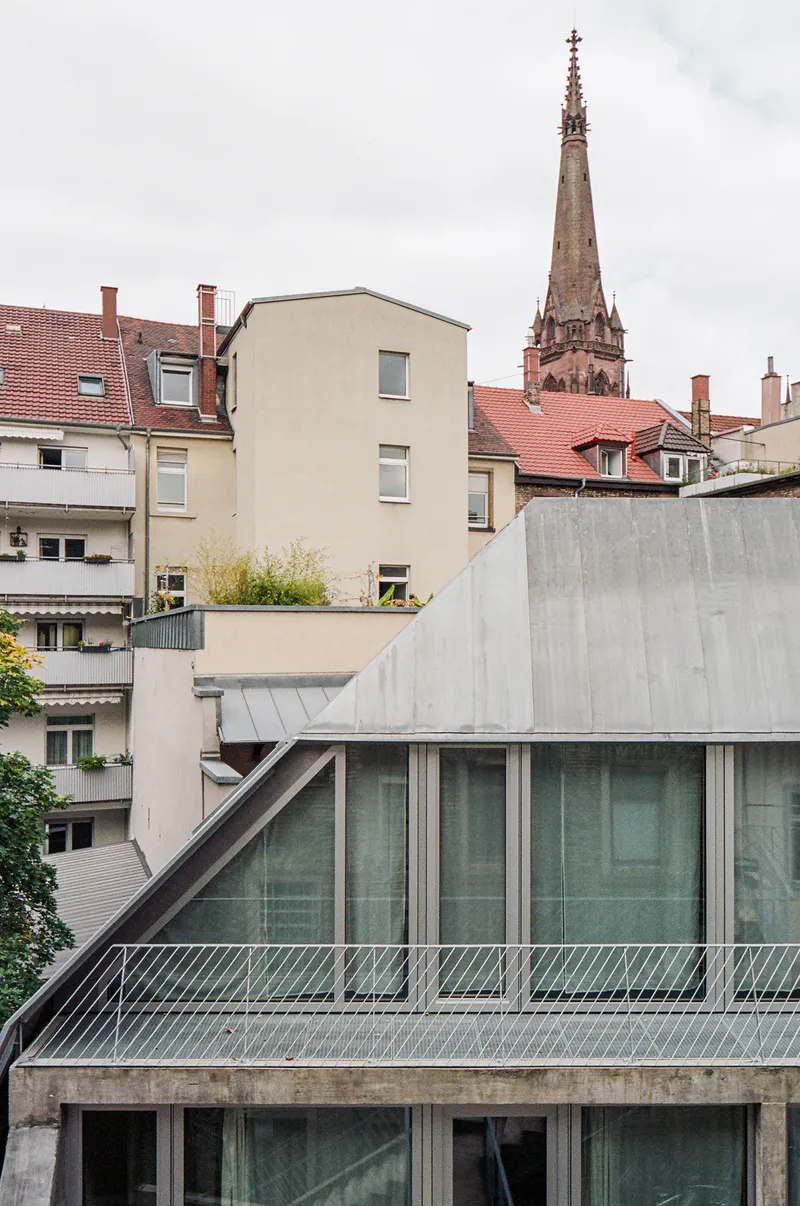
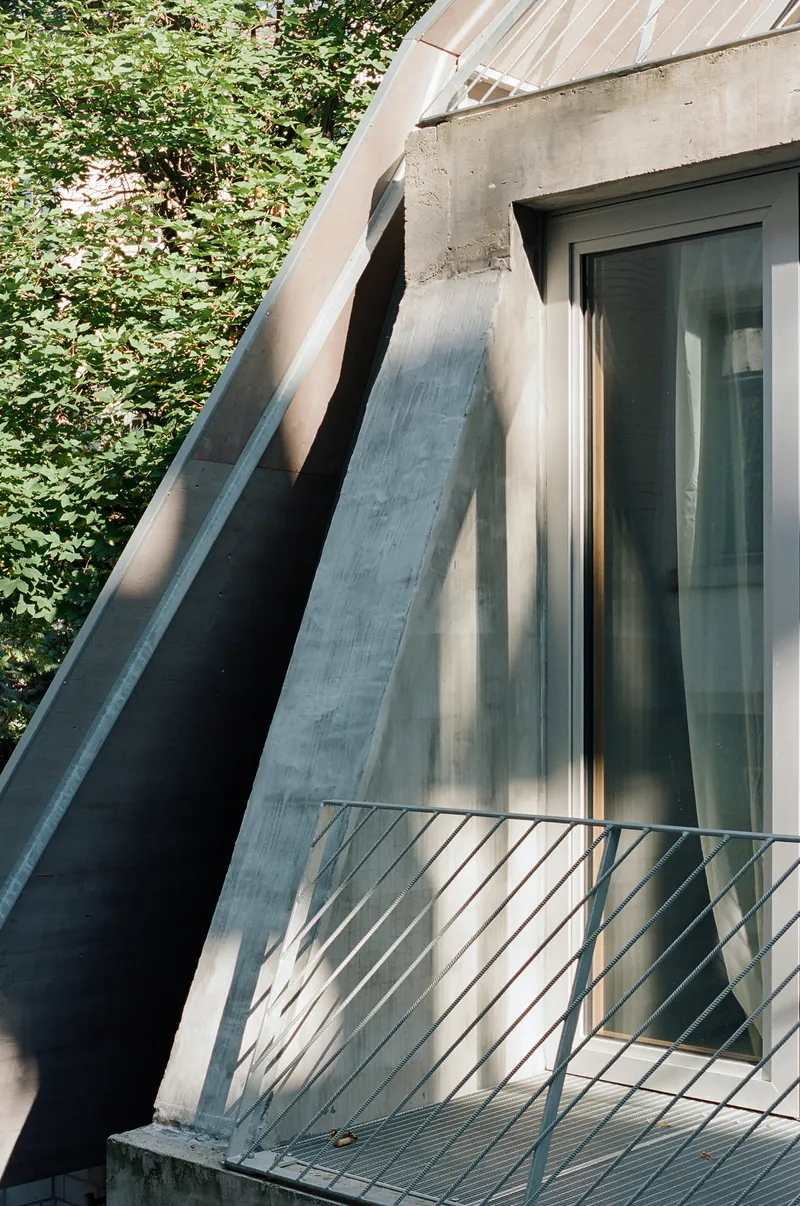
From above, the angled concrete volume sits like a carefully cut block among the clay tile roofs of the surrounding block. Its geometry is not arbitrary: the sloped roof responds to the buildable envelope and channels light into the uppermost apartments through skylights. Metal railings at the roof edge maintain the utilitarian vocabulary of the exterior stairs and terraces. Against the distant church spire, the new addition registers as a quiet contemporary presence in a traditional urban fabric.
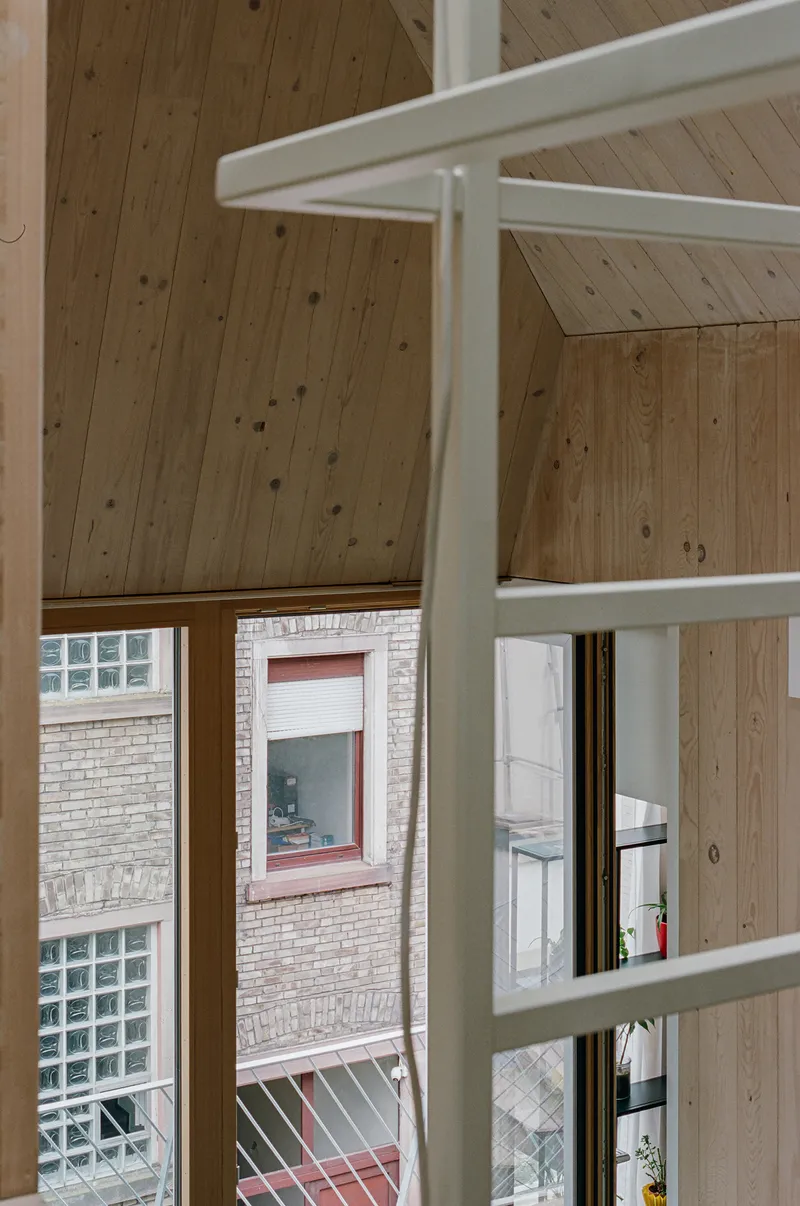
The white steel ladder frame against the exposed timber plank ceiling in the upper apartment captures the intersection of raw structure and inhabitable warmth that defines the entire project. Through the window, the neighboring brick facade is close enough to touch. This is what densification actually looks like: buildings in close conversation, sharing light and air across narrow gaps.
Plans and Drawings
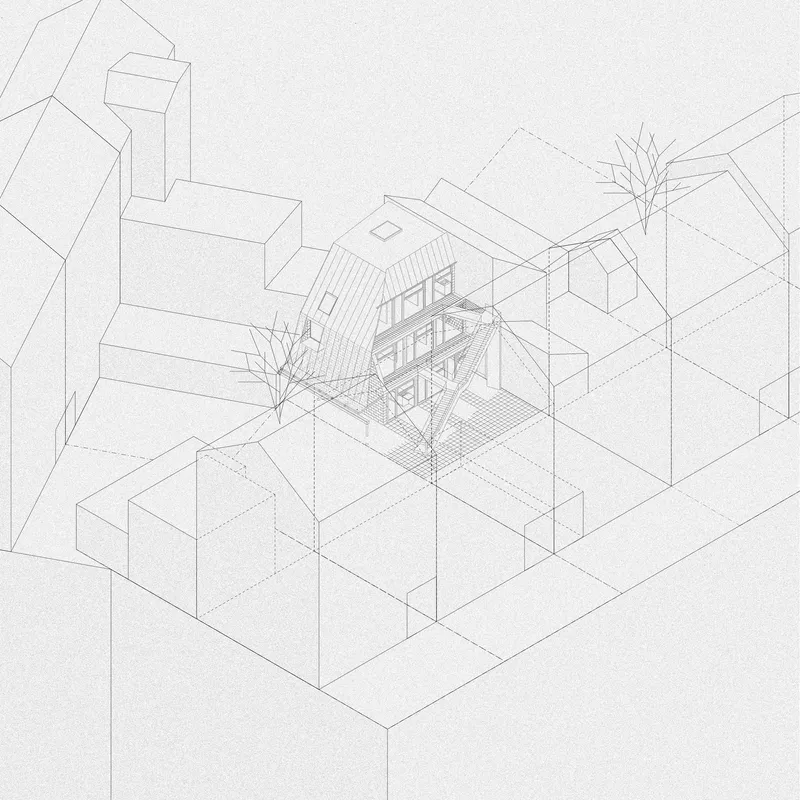
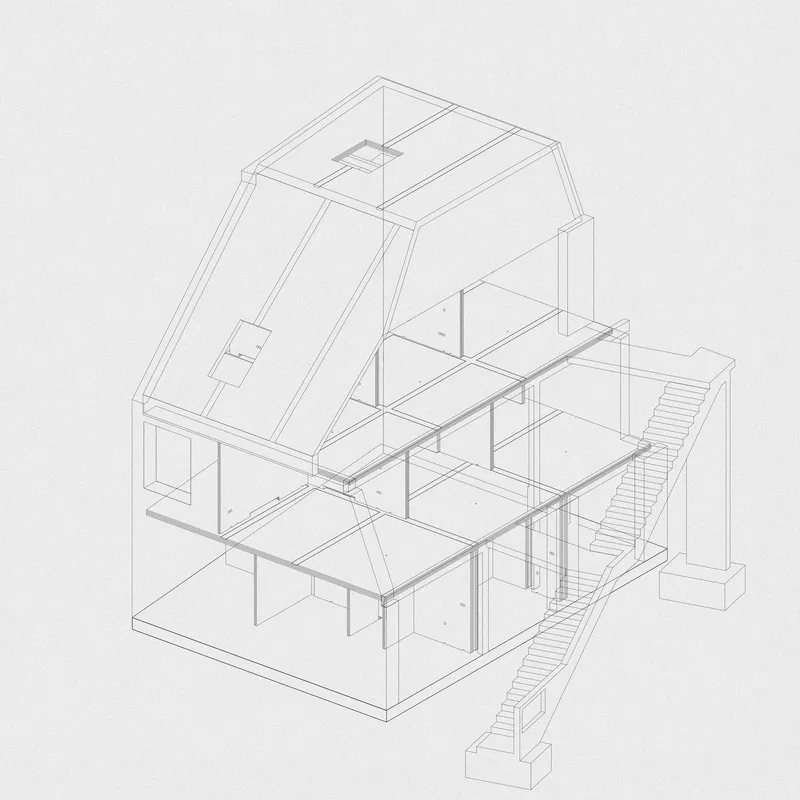
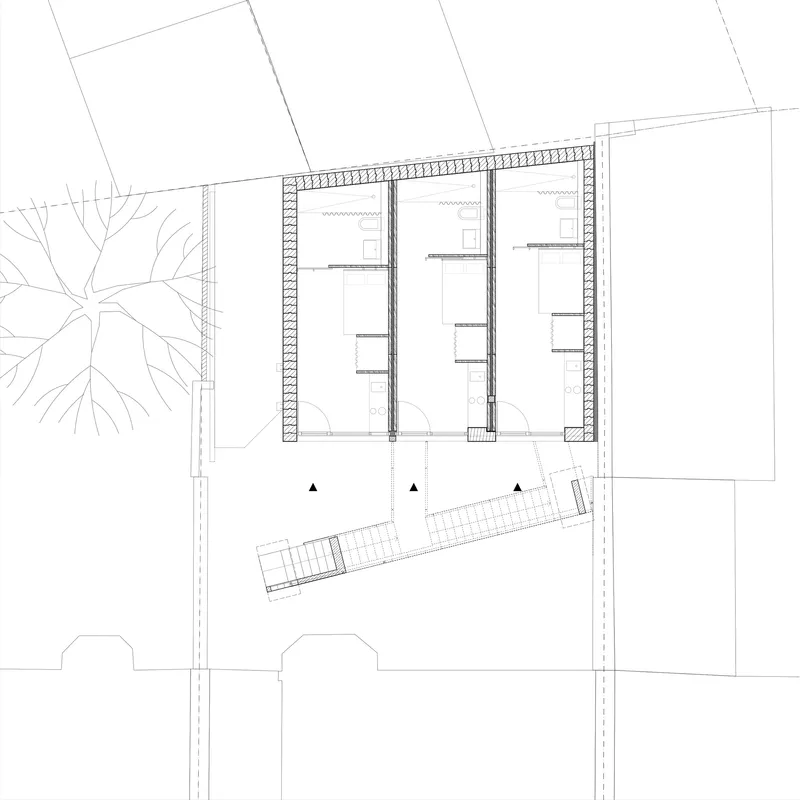
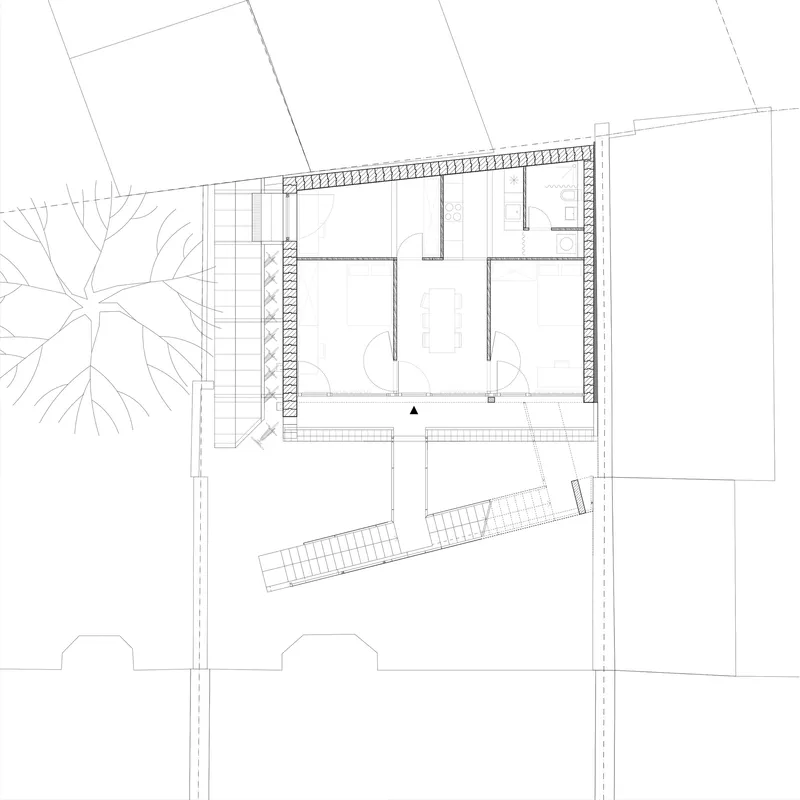
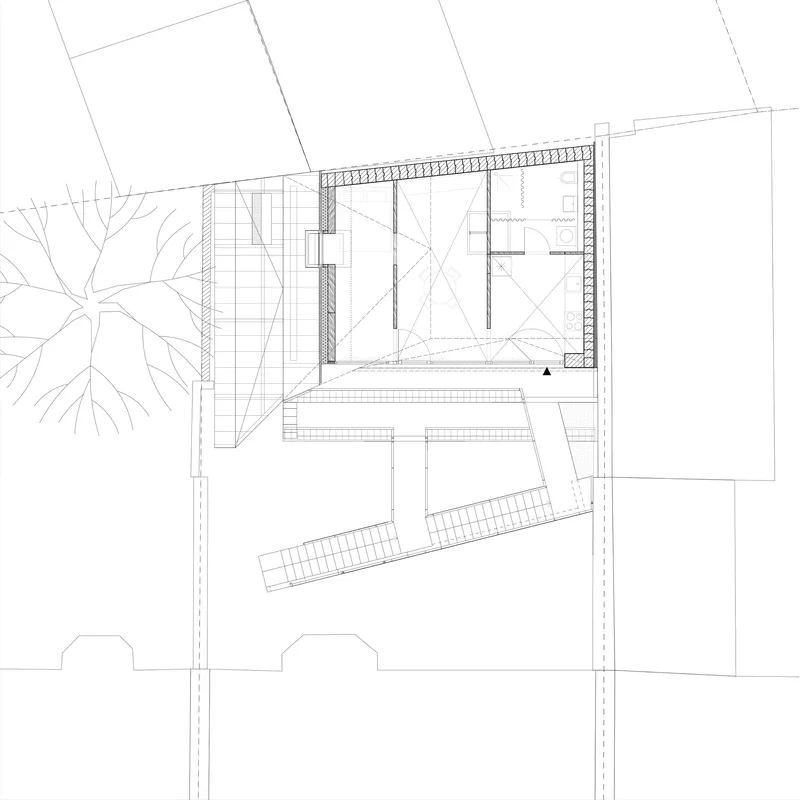
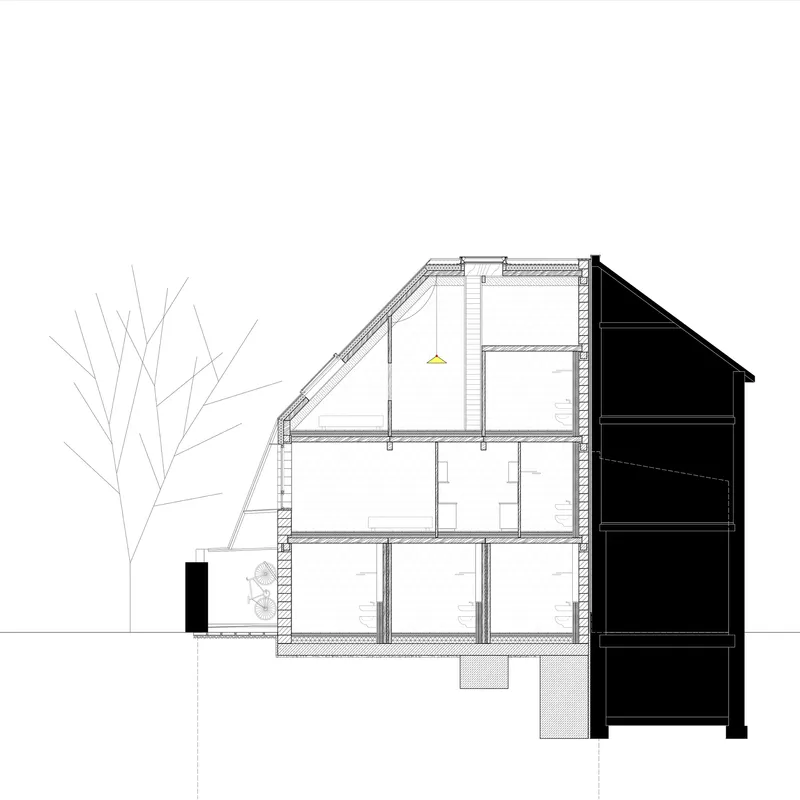
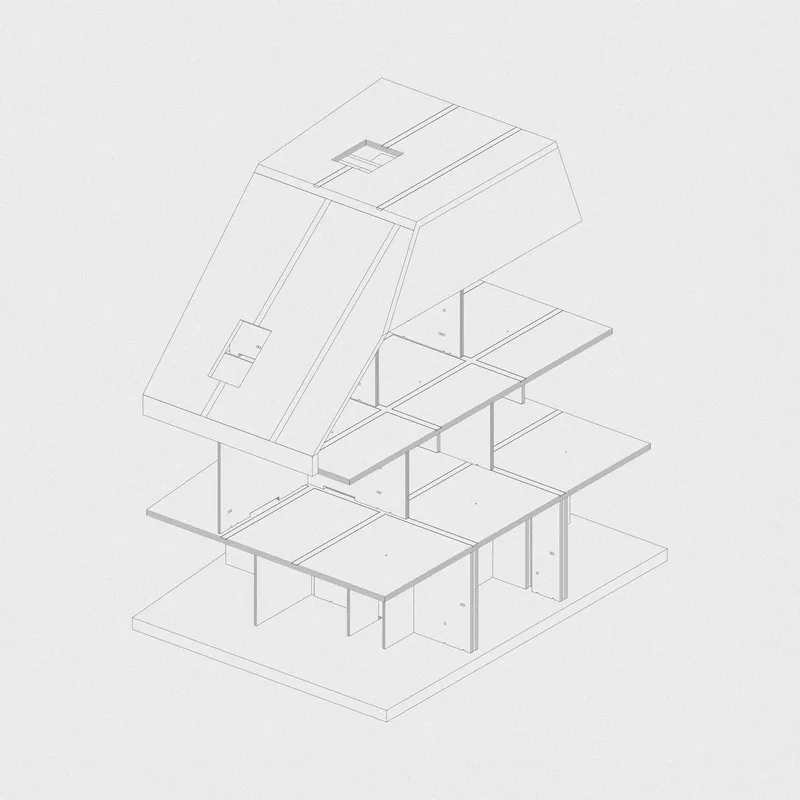
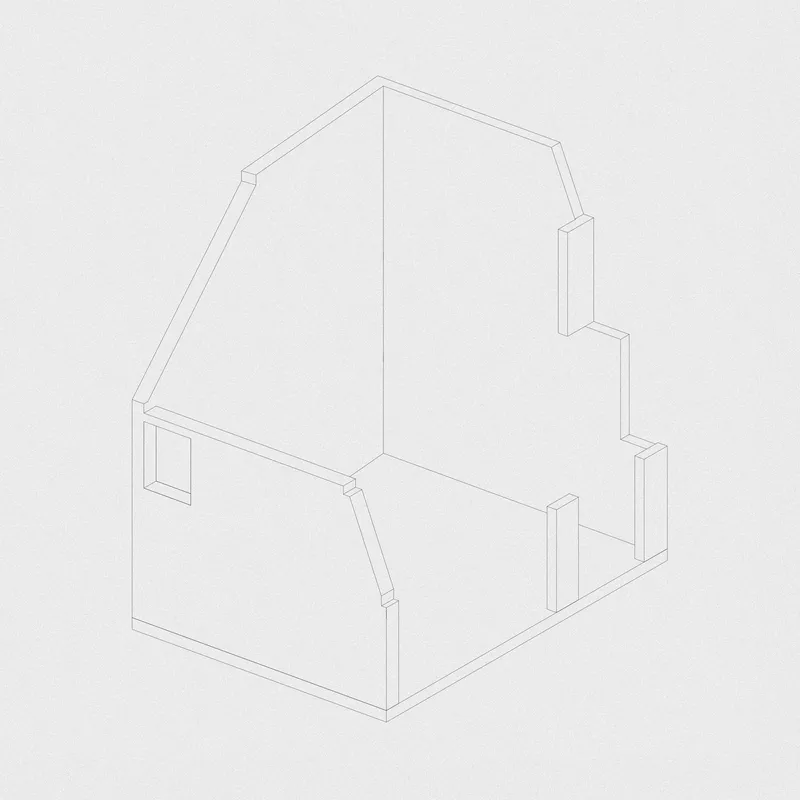
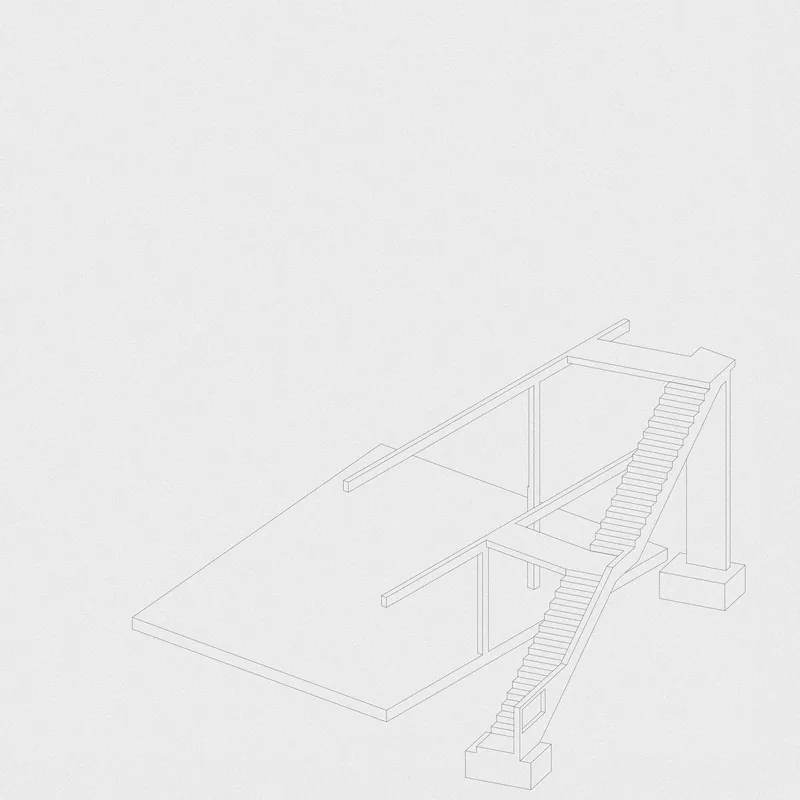
The axonometric drawings reveal what photographs cannot: the full extent to which the new building is embedded within the block. Surrounded on all sides by existing volumes, the Gott Apartment Building fills its footprint completely, with a diagonal staircase threading through all levels as the primary circulatory spine. The exploded axonometric separating the sloped roof envelope from the interior floor plates shows the structural independence of the addition. Three parallel rooms at ground level give way to two rooms on the first floor and an attic apartment above, each plan shifting slightly to capture light and air from different directions.
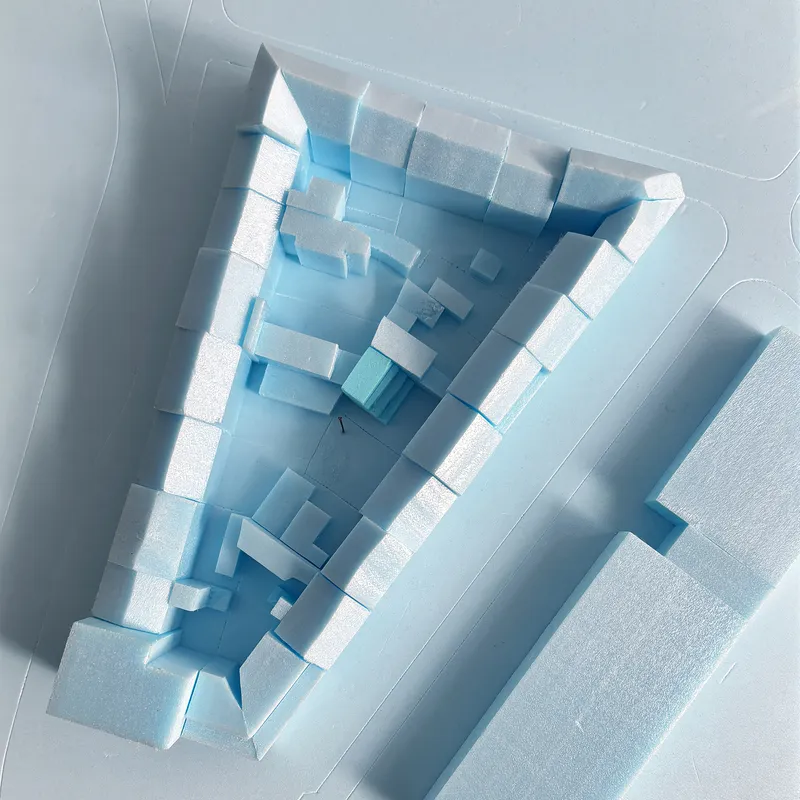
The section drawings are particularly revealing. The three-storey dwelling with its pitched roof occupies a volume that, from the courtyard, appears modest but internally offers surprising vertical variety. The diagonal staircase running through all levels explains the angular balustrades visible on the exterior: structure and circulation are one and the same. The physical model in white foam, photographed from above, shows the courtyard building as a precise surgical insertion, its perimeter walls touching but not bonding with the surrounding fabric. Structural engineering by imagine structure made this tight-fit concrete construction possible.
Why This Project Matters
The phrase "densifying the city from within" has become a planning cliché, trotted out at conferences and buried in municipal guidelines. The Gott Apartment Building is what it actually looks like when two offices take the idea seriously at the smallest possible scale. Five apartments in 200 square meters, on a site previously occupied by four useless garages, within the existing block structure of a German city. No demolition of the front building, no disruption to the street, no basement, no excess. It is an exercise in maximum restraint producing maximum yield.
What Amunt Martenson and heramarte demonstrate here is that infill housing does not have to be apologetic. The building has spatial ambition: double heights, framed views, layered thresholds, outdoor rooms. It has material conviction: concrete and plywood that will age well under heavy use. And it has environmental intelligence: shared heating infrastructure, unit-level ventilation recovery, and a footprint that adds zero sprawl to the city. If more courtyard garages across European cities met this fate, we would have both more housing and better neighborhoods.
Gott Apartment Building by Amunt Martenson and heramarte, Karlsruhe, Germany. 200 m², completed 2025. Photographs by Jacopo La Forgia.
About the Studio
Share Your Own Work on uni.xyz
If projects like this are the kind of work you want to make, uni.xyz is a place to publish your own, find collaborators, and enter design competitions.


Popular Articles
Popular articles from the community


David Ortega Stacks a Two-Story Mexico City Penthouse Around a Steel Stair and a Pergola-Shaded Roof Terrace
In Colonia Roma, a 300 m² penthouse uses oak joinery, a planted steel stair and a slatted roof pergola to make a new-build apartment feel like a house.

GROUP A Strips a 1969 Rotterdam Harbor Headquarters to Its Frame and Wraps It in Timber Louvers
In Rotterdam's M4H harbor district, Ferro Offices reuses a 1969 frame, adds one timber storey and reaches BREEAM-NL Outstanding.

LT2A and OPEN Architectes Thread a Brick and Glass High School Through a Wooded Belgian Campus
In Braine-l'Alleud, a 3,000 m² wing for Collège Cardinal Mercier pairs pale brick with a glazed colonnade, deferring to a small chapel and a dense wood.

U.GA Architects Wraps an Oval Rooftop Pool in Curved Board-Formed Concrete on Busan's Jeollidan-gil
In Busan's Jeonpo-dong, a 454 m² mixed-use block stacks a neighborhood facility, guest rooms and an oval rooftop pool inside spiraling concrete walls.

Similar Reads
You might also enjoy these articles


LAVA Architecten Gives Vocational Education a Sawtooth-Roofed Face on a Mechelen School Campus
In Mechelen, Belgium, a 2,053 m² STEM school on a 6×6 m grid turns workshops and classrooms into rooms that can be rearranged as teaching changes.

KEMA Studio Turns a Derelict Marvila Attic into a 60 m² Lighthouse Apartment Above Lisbon
In Lisbon's Marvila district, a rebuilt roof, four skylights and two plywood volumes turn an unlivable attic into a bright home facing the Tagus.

Pixel Gardens: One Repeated Module Stacked Into a Terraced Social Housing Tower for Famagusta
Salem Bader's shortlisted housing tower builds a vertical neighbourhood from one repeated module, offsetting units to carve terraces, light and air.

Bao Huynh Watercolor Atelier: A Serene Art Retreat in Hội An
Bao Huynh Watercolor Atelier in Hội An blends multifunctional art spaces, sustainable design, local materials, and family-friendly living in a serene environment.


Comments (0)
Please login or sign up to add comments
No comments yet. Be the first to comment!