

An Urban Forest: Replanting Ethiopia's Forest Chapel Tradition Inside the Dense City
Mazzeo and Pirazzi wrap a Tewahedo chapel in a walled wild garden, turning the climb from qitsir to meqdes into a ritual walk through shade.


Across Ethiopia, Orthodox churches often survive as islands of old-growth trees, small sacred groves that farmland and settlement have grown around. An Urban Forest takes that inheritance and turns it into an urban argument: if the city has erased its ecological systems, then the chapel should arrive with its forest attached. The proposal does not set a building in a landscape. It treats the forest as the sanctuary and lets the architecture sit inside it as one more living layer.
Designed by GIUSEPPE MAZZEO and Stefano Pirazzi, the project received an Editor's Choice distinction in the Eco-Chapel competition. Drawing on the Ethiopian Tewahedo tradition of chapels hidden within forests, the designers expand the brief well beyond a place of worship. Their scheme becomes a dense urban woodland, a community campus and a climate-responsive intervention, built from bamboo, straw, wood and stone and informed by vernacular precedents such as Dorze houses and the bamboo huts of the Shewa region.
A Perimeter Wall That Holds the City at Arm's Length


The masterplan's first move is a protective wall that encloses the forest and separates it from the surrounding urban condition. In the gateway view, rough dry stone gives way to a thatched entrance marked by colored posts and gold crosses, with willow branches softening the edge. The opening frames a deliberate change of register: outside is hard infrastructure, inside is shade, planting and slower movement. The descending stone steps beside a curved woven screen show how that calm continues once inside, where light filters through vegetation and the ground itself becomes part of the procession.
What makes the wall work is that it is not a fortress. Its job is acoustic and atmospheric as much as territorial. The designers describe the planted interior as a gradual transition between noisy streets and a quiet sacred core, and the wall is simply the line where that gradient begins. Paths then weave through the trees rather than cutting straight to the chapel, so arrival is earned over distance.
From Qitsir to Meqdes: Hierarchy as a Sequence of Thresholds
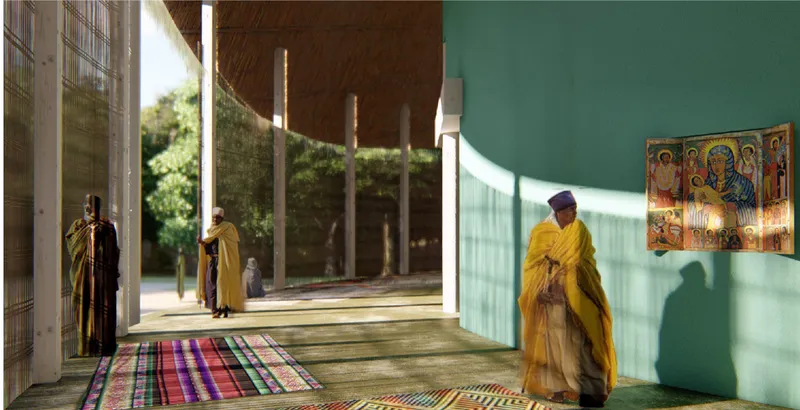

The strongest architectural decision is a faithful reading of Ethiopian Orthodox spatial hierarchy. Visitors first gather in the qitsir, the walled ceremonial courtyard, before entering the qine mehelet, the transitional ring that surrounds the chapel, and finally the meqdes, the innermost chamber that houses the tabot. The gallery walkway, laid with woven rugs and anchored by a painted triptych on a curved green wall, captures that middle zone well: a covered, sunlit ambulatory that is neither outside nor fully inside.
The exterior view of the thatched chapel, with white-robed worshippers gathered on the sandy ground, completes the logic. The chapel sits on the highest natural point of the site, a position chosen after analysis of topography, exposure, existing flat areas and tree clusters. That placement minimizes disturbance to the terrain while turning the approach into an ascent. Openness, enclosure and shadow change step by step, and movement itself becomes ritual.
Thatch, Reed and Timber Borrowed from Dorze and Shewa Builders
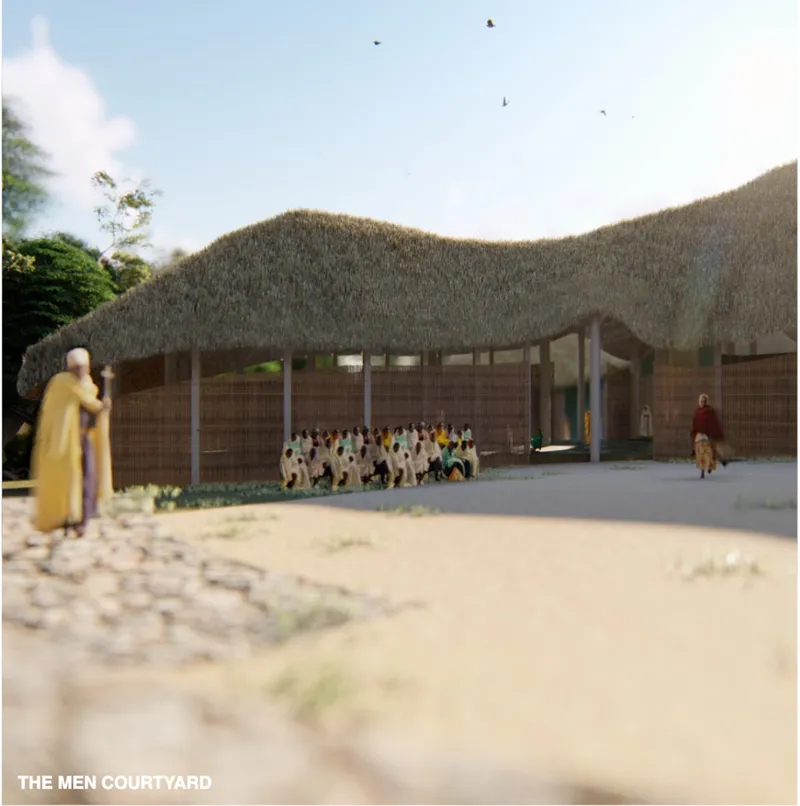
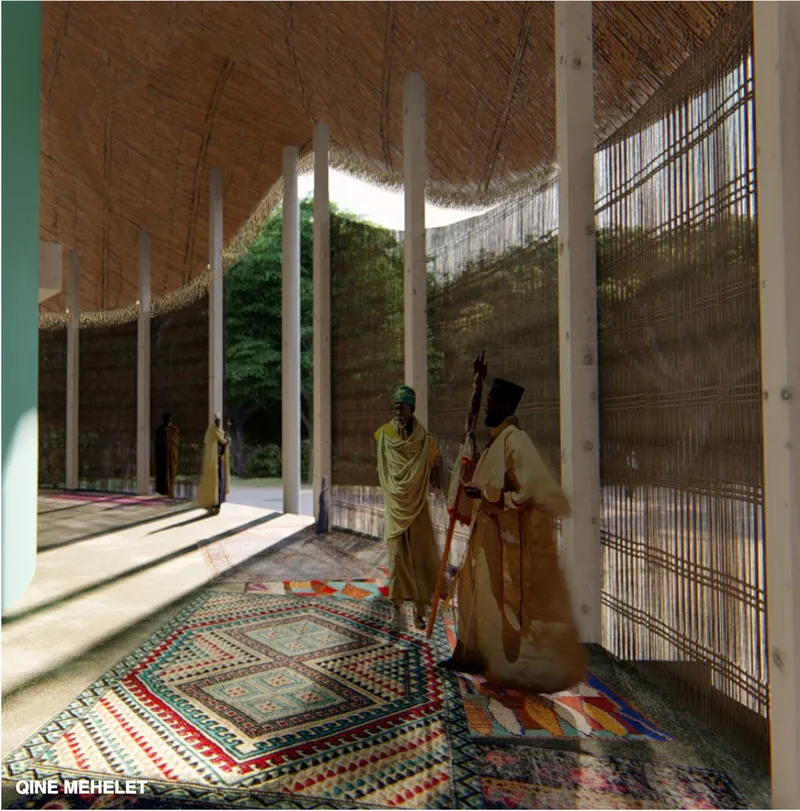
The undulating thatched roof drapes over low woven walls like a canopy that has grown out of the forest rather than been placed in it. Below, worshippers sit in an open courtyard, and the roofline reads as a continuation of the tree cover beyond. The colonnade view brings the material language into close focus: slender timber posts, woven reed screens and patterned rugs, with raking sunlight cutting through the gaps.
These are not decorative choices. The reliance on locally sourced bamboo, straw, wood and stone ties the project directly to Ethiopian vernacular construction, specifically Dorze houses and Shewa bamboo hut traditions. Woven screens filter light and air instead of sealing rooms off, which suits a scheme whose environmental performance depends on shade and ventilation. The architecture stays porous enough that the forest remains present everywhere.
Shaded Courtyards That Keep the Forest Occupied All Day
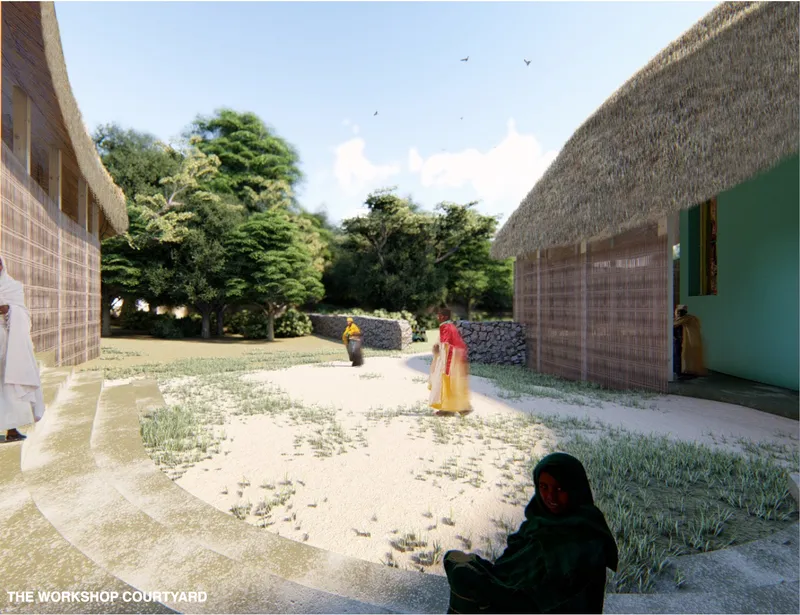
The final rendering steps back to show a sandy courtyard held between two thatched buildings, with curved stone steps and figures in bright cloth crossing the open ground. This is the everyday face of the project. Beyond the chapel, the designers distribute meditation areas, workshops, cafés, gathering courtyards, priest residences and shaded public spaces through the site, giving the community reasons to be here on days with no service.
The surrounding landscape, densely planted with local tree species in what the designers call a "wild garden," carries much of the environmental load. It works as a green lung for the city, improving air quality and producing cooler microclimates over the outdoor rooms. The courtyards are flexible and open-air, so rest, dialogue, education and contemplation can share the same ground as worship.
Why This Project Matters
Many eco-chapel proposals treat sustainability as a performance layer added to a sacred object. Mazzeo and Pirazzi invert that order. Their starting point is a living tradition in which the forest and the church are already inseparable, and they use it to argue that urban spiritual space and urban ecology can be the same project. The ecological ambition is credible precisely because it is culturally specific.
The scheme also shows how vernacular reference can do more than set a mood. The qitsir, qine mehelet and meqdes sequence organizes the plan, the topography decides where the chapel stands, and Dorze and Shewa building methods shape the walls and roofs. The result is a sanctuary that cools the city, gathers its community and still preserves the slow, layered approach to the sacred that gives it meaning.
View the Full Project
About the Designers
Designers: GIUSEPPE MAZZEO, Stefano Pirazzi
Enter a Design Competition on uni.xyz
uni.xyz runs architecture and design competitions year-round that reward proposals with spatial conviction and real site intelligence.
Project credits: An Urban Forest” by GIUSEPPE MAZZEO, Stefano Pirazzi Eco-Chapel (uni.xyz).


Popular Articles
Popular articles from the community


Extended Shell: Retrofitting Kolkata's Balconies as Living Urban Thresholds
A modular retrofit system recovers the social and environmental intelligence of Kolkata's historic verandas for contemporary Park Street residents.

Opera by the Sea Estonia: Three Shells Dissolving Architecture into Tallinn's Coastline
A winning opera house proposal replaces monumental form with interconnected shells that blur the boundary between building, park and Baltic Sea.

Tsunami Convergenics: Turning Catastrophic Ocean Forces into Underwater Housing Infrastructure
A speculative underwater settlement off the coast of Onagawa, Japan, treats tsunamis and typhoons as energy sources rather than threats.

Cloaked Colonization: A Mobile Underwater Habitat That Moves Like a Fish
Micah Abaya's shortlisted EHC Pacific entry reimagines ocean settlement as a dispersed network of self-sustaining architectural organisms.

Similar Reads
You might also enjoy these articles

Healing Façade: A Modular Chapel System That Restores Ethiopia's Sacred Forests
Winner of the Eco-Chapel competition, this circular timber façade collects water from air to rebuild soil and reforest degraded Ethiopian landscapes.
Kaffeebühnen: Where Coffee Shop Architecture Becomes a Civic Stage in Vienna
A linear sequence of timber boxes, transparent shells, and open yards turns the Viennese café tradition into a public performance space.
Eco Chapel: A Modular Forest Pavilion That Grows Like the Landscape It Protects
Hexagonal timber modules weave through existing trees, turning a chapel into a living system for prayer, education, and reforestation.


Urban Forest: A Vertical Ecosystem for 5,000 Workers in Singapore's Changi Business Park
Radially stacked pods and layered green decks turn a 7-acre plot into 47 acres of ecological workspace projected for 2040.

Comments (0)
Please login or sign up to add comments
No comments yet. Be the first to comment!