

Anchorage Road Artist Studio by Ballman Khapalova
A compact, light-filled artist studio by Ballman Khapalova, blending sustainability, adaptive reuse, and landscape integration overlooking the Hudson River.


Nestled in the serene landscape of Germantown, New York, the Anchorage Road Artist Studio by Ballman Khapalova stands as a masterful example of thoughtful, site-responsive design. Designed for artist Natasha Sweeten, this 680-square-foot painting studio and office prioritizes efficiency, sustainability, and a deep connection to nature, offering a private sanctuary for creativity.

A Compact Studio Immersed in Nature
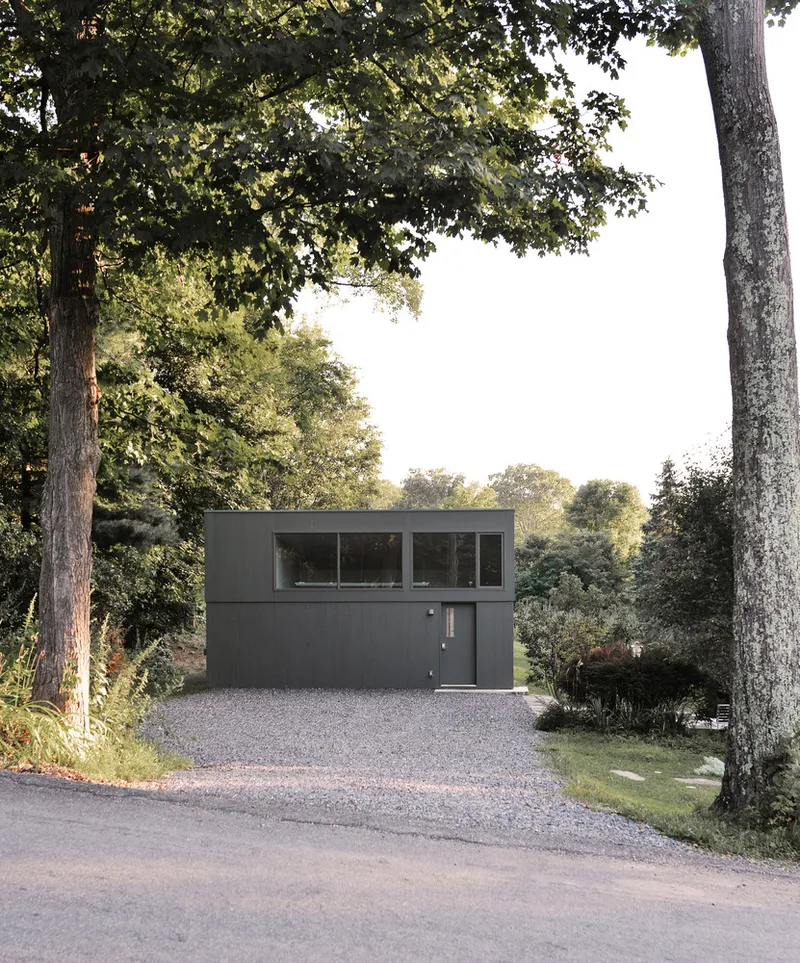
The Anchorage Road Artist Studio by Ballman Khapalova is a 680-square-foot creative retreat designed for artist Natasha Sweeten. Nestled on a steep, wooded slope beside a restored 19th-century farmhouse in Germantown, New York, the studio was conceived as a modest, efficient, and light-filled space that harmonizes with its surrounding landscape.

The design prioritizes economy and environmental sensitivity, opening up to both north and south light to support the artist’s dual needs for painting and focused office work. These orientations not only optimize natural illumination but also strengthen the building’s visual and spatial connection with the Hudson Valley landscape.
Integration with Topography and Landscape
Positioned carefully on a hillside, the studio follows the natural slope of the terrain, allowing the roofline to descend gracefully with the land. This subtle form conceals the building’s mass from neighboring properties while creating an ideal angle for solar panel installation on the south-facing façade.
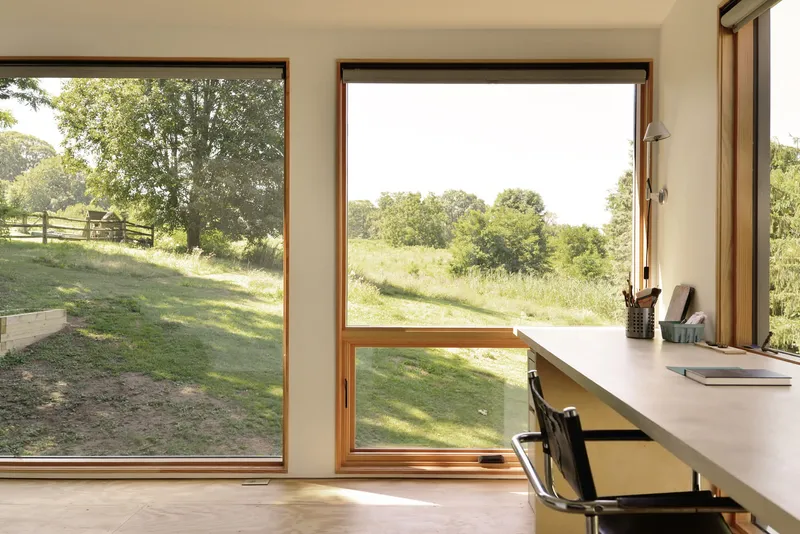
The entry courtyard, shared with the adjacent farmhouse, is defined by mature trees that frame the approach and foster a sense of intimacy and retreat. As the ground falls away, the studio’s elevated floor seems to float within the landscape—offering sweeping views across the sloping backyard, surrounding meadows, and the Hudson River beyond.
Material Honesty and Functional Simplicity
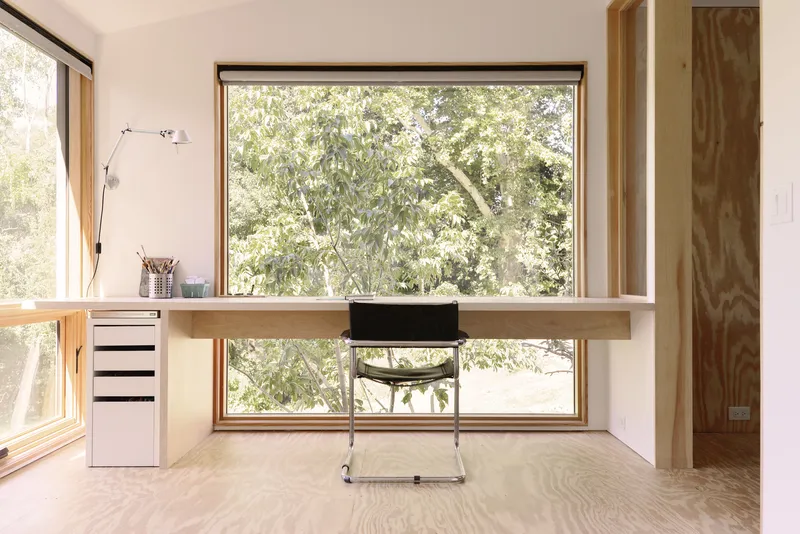
Ballman Khapalova’s design emphasizes durability, flexibility, and minimalism. The interior surfaces are clad entirely in CDX plywood, extending from the floors to the walls. This continuous material expression provides a warm yet utilitarian backdrop suited to the demands of an artist’s workspace—resilient, adaptable, and unpretentious.
A north-facing clerestory window introduces soft, diffused light ideal for painting, while maintaining privacy from the exterior. The balance of natural light and enclosure creates a calm, meditative atmosphere conducive to creative focus.

Hidden Storage and Private Functionality
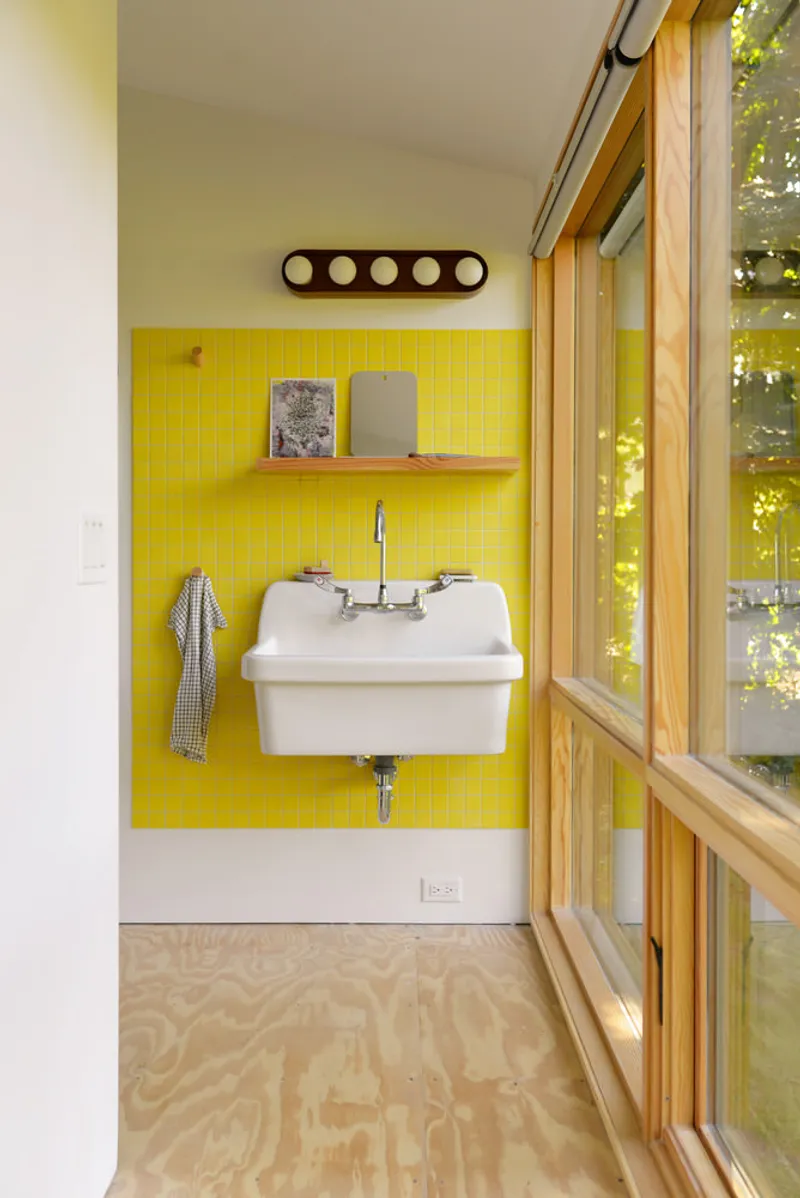
Behind the studio’s east wall lies a double-height storage volume, where the exposed structural framing doubles as open shelving for tools, materials, and canvases. This space transitions into a compact bathroom suite with a shower, toilet, and utility sink—each illuminated by floor-to-ceiling glazing on the southern façade.
This thoughtful layering of utility and openness ensures that the studio remains both highly functional and visually connected to its environment, blurring the boundaries between working, resting, and observing.

Adaptive Reuse and Sustainable Construction
The project is rooted in adaptive reuse principles. The new structure sits atop the existing foundation of a 1950s garage, reactivating dormant infrastructure while minimizing the site’s environmental footprint. An existing cistern was ingeniously repurposed to house the studio’s mechanical systems, further reinforcing a circular approach to construction.
External features such as a tool wall, firewood bench, and access to underfloor storage integrate seamlessly within the piers that support the south face of the studio—merging practicality with architectural elegance.


A Floating Sanctuary for Artistic Creation
The Anchorage Road Artist Studio encapsulates Ballman Khapalova’s sensitivity to context, sustainability, and human scale. By blending minimalist materials, strategic natural lighting, and adaptive reuse, the architects have crafted a sanctuary that feels both grounded in the land and elevated above it—a serene and efficient workspace designed to nurture creativity in dialogue with nature.
All photographs are works of Ballman Khapalova


Popular Articles
Popular articles from the community


LT2A and OPEN Architectes Thread a Brick and Glass High School Through a Wooded Belgian Campus
In Braine-l'Alleud, a 3,000 m² wing for Collège Cardinal Mercier pairs pale brick with a glazed colonnade, deferring to a small chapel and a dense wood.

Jaramillo Van Sluys Arquitectura and Urbanismo Turn a Demolished Registry Lot in Quito into an Orchard Plaza
In Quito's Centro Histórico, a 2,800 m² plaza exposes the San Agustín convent wall and redraws its lost Augustinian orchard in volcanic stone.

David Ortega Stacks a Two-Story Mexico City Penthouse Around a Steel Stair and a Pergola-Shaded Roof Terrace
In Colonia Roma, a 300 m² penthouse uses oak joinery, a planted steel stair and a slatted roof pergola to make a new-build apartment feel like a house.

longwave studio Reorganizes a 112 m² Tainan Apartment Around the Daily Routines of a Family and Two Cats
In Tainan, Taiwan, birch plywood, rust-red furniture and a freestanding plaster wall link arrival, storage, work and family life in one apartment.

Similar Reads
You might also enjoy these articles


Hodi-Mandai Geram
Project Function: Preservation and revitalization of the Intangible heritage and socio-spatial identity of the Hodi by Housing, Cultural Memory Center, Sacred Grove, landscape, local tourism economy


Olio Towers: A Mid-Rise for Performers That Fuses Housing, Rehearsal, and Stage
Located blocks from Houston's Theater District, this modular tower stacks living units around a central performance atrium.

Oasis: Modular Green Housing Carved into Dhaka's Urban Fabric
A shortlisted Plugin Housing entry reclaims unauthorized settlements in Dhaka with stepped concrete volumes, green roofs, and ventilation-driven design.

Black Hole: A Floating Megastructure for the Post-Physical Era
Emiliano Mazzarotto envisions a spherical, self-scaling arena where e-sports, digital hotels, and holographic stadiums replace traditional public space.

Explore Residential Building Competitions
Discover active competitions in this discipline

Challenge to design mud housing for contemporary communities

Challenge to reimagine the Iron Throne

Photograph architecture without architects

Illustrate the lost glory of Angkor Wat - Render Challenge
Comments (0)
Please login or sign up to add comments
No comments yet. Be the first to comment!