
Andrade Morettin Wraps a São Paulo School Around Courtyards That Teach as Much as the Classrooms
In Campo Belo, a lightweight steel-and-concrete elementary school treats its gardens, materials, and open air as active participants in learning.

Schools often claim to value outdoor learning, then shove a patch of turf behind a cafeteria and call it done. The Aubrick School in São Paulo's Campo Belo neighborhood does something genuinely different. Designed by Andrade Morettin Arquitetos Associados, the 3,909-square-meter building organizes its entire program around a sequence of courtyards that function less like leftover voids and more like the school's circulatory system. Trees grow through multiple levels, children play basketball beneath glazed canopies, and balconied corridors overlook the action so that the boundary between inside and outside dissolves floor by floor.
What makes the project compelling is the dual mandate it had to satisfy. Aubrick previously operated out of several small, scattered buildings. The brief called for consolidation and for a physical space that could embody the school's pedagogical model. Lead architects Vinicius Andrade, Marcelo Morettin, Marcelo Maia Rosa, and Renata Andrulis responded by making the gardens the protagonists: not decorative buffers but spaces where materials, light, and scale become didactic agents. The result is a building that respects the residential grain of Campo Belo while packing a surprisingly rich spatial experience into a tight 2,129-square-meter site.
A Neighborhood-Scale Facade
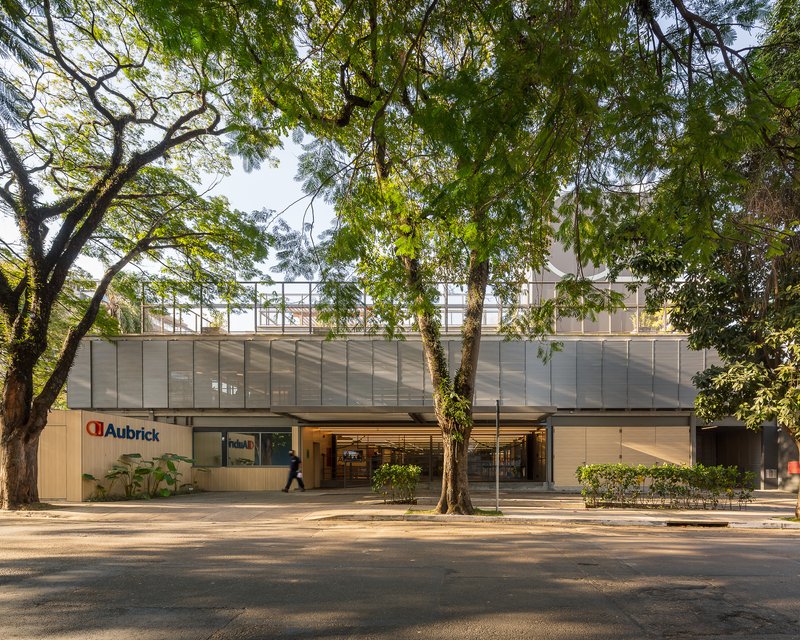
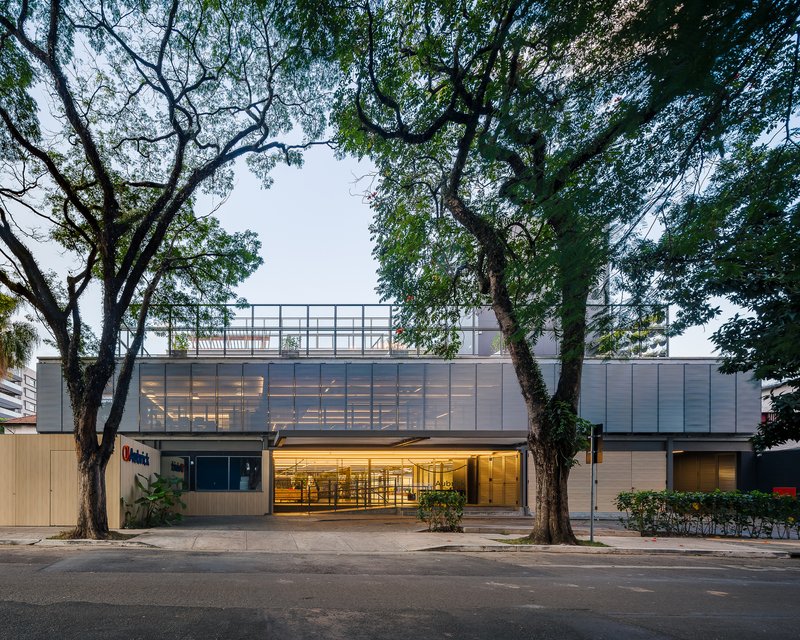
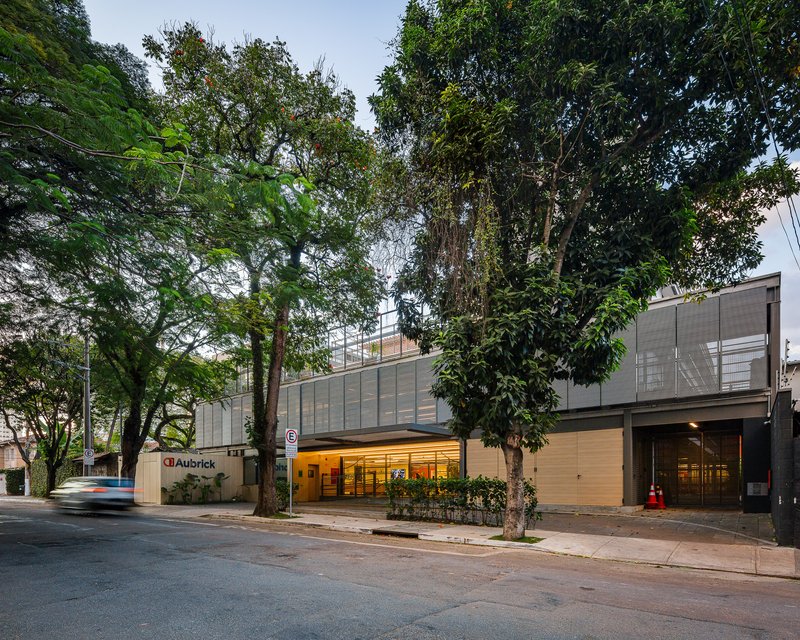
Campo Belo has been reshaped by the real estate market in recent decades, and the Aubrick School pushes back against that trend with deliberate modesty. The street facade holds to two stories, preserving the scale of its residential neighbors. Translucent upper panels glow softly at dusk while timber cladding at the entrance keeps things warm and approachable. Mature trees flanking the sidewalk are retained, framing the building so that it reads as a careful insertion rather than a declaration.
The choice of a lightweight metallic structure is visible here, too. The facade is thin, almost screen-like, suggesting that the real substance of the building lies behind it. You sense the depth of the courtyards even before you enter.
Courtyards as Infrastructure
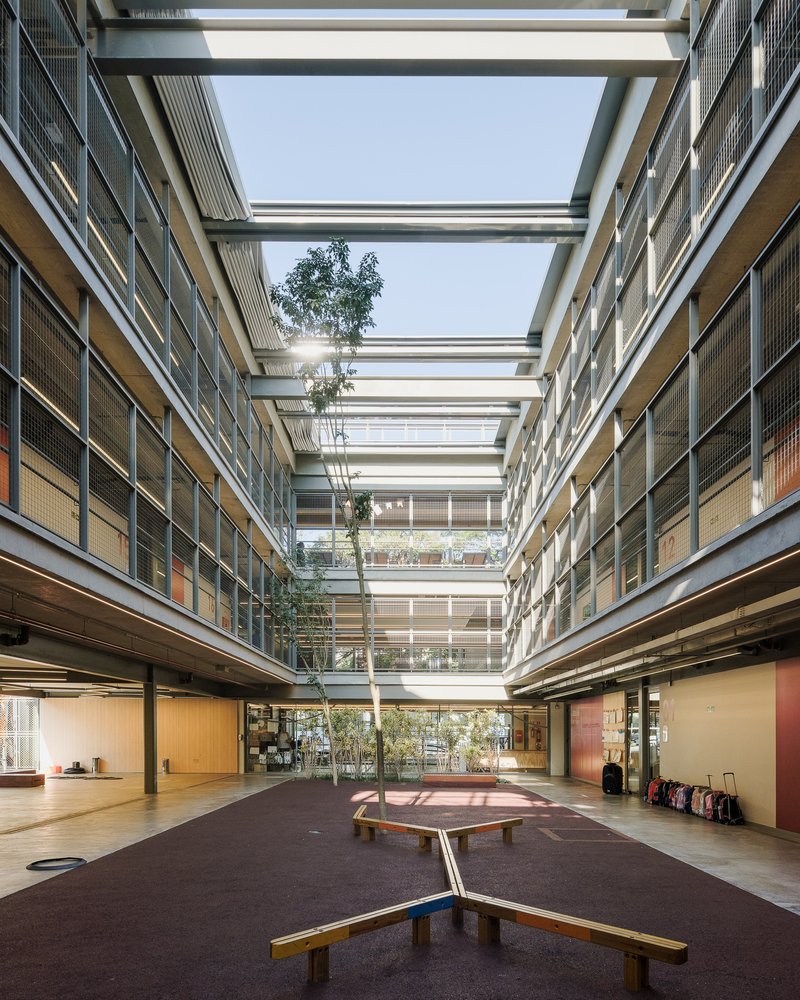
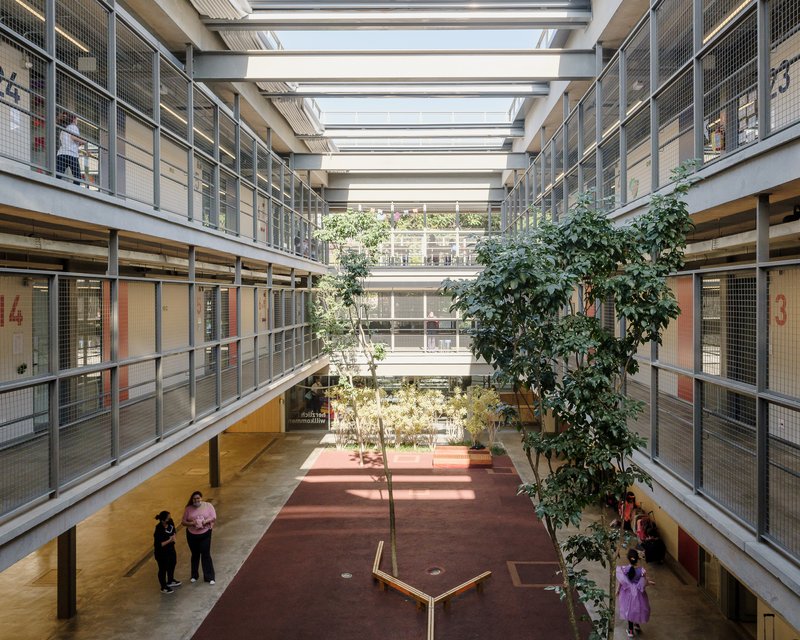
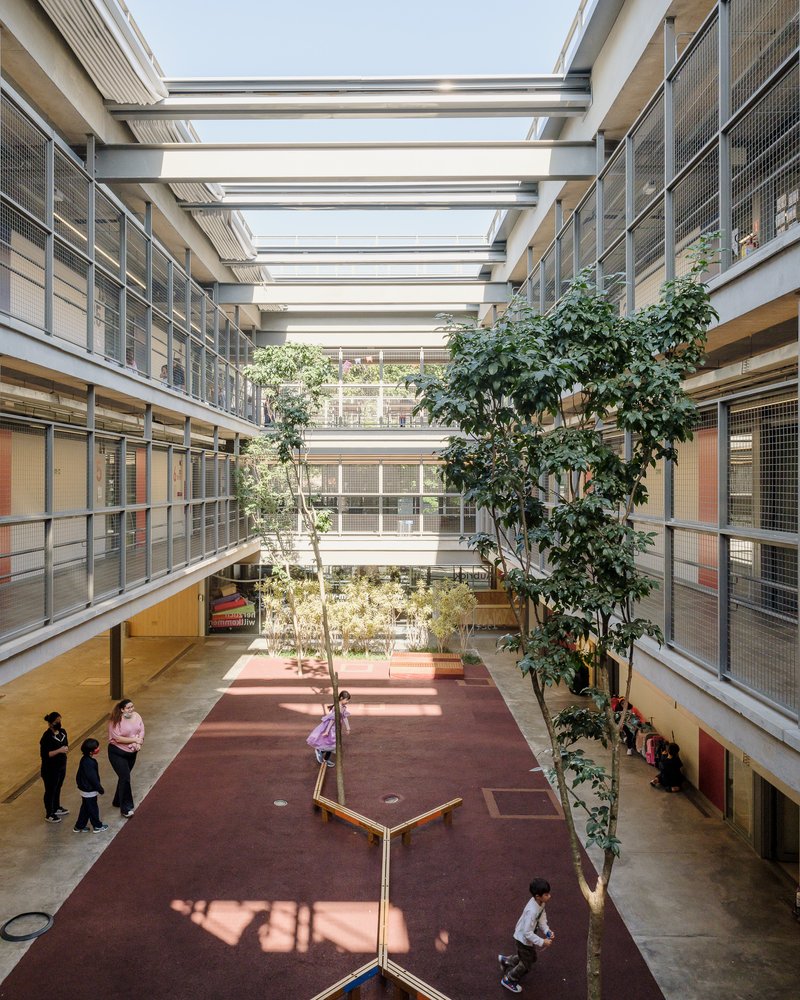
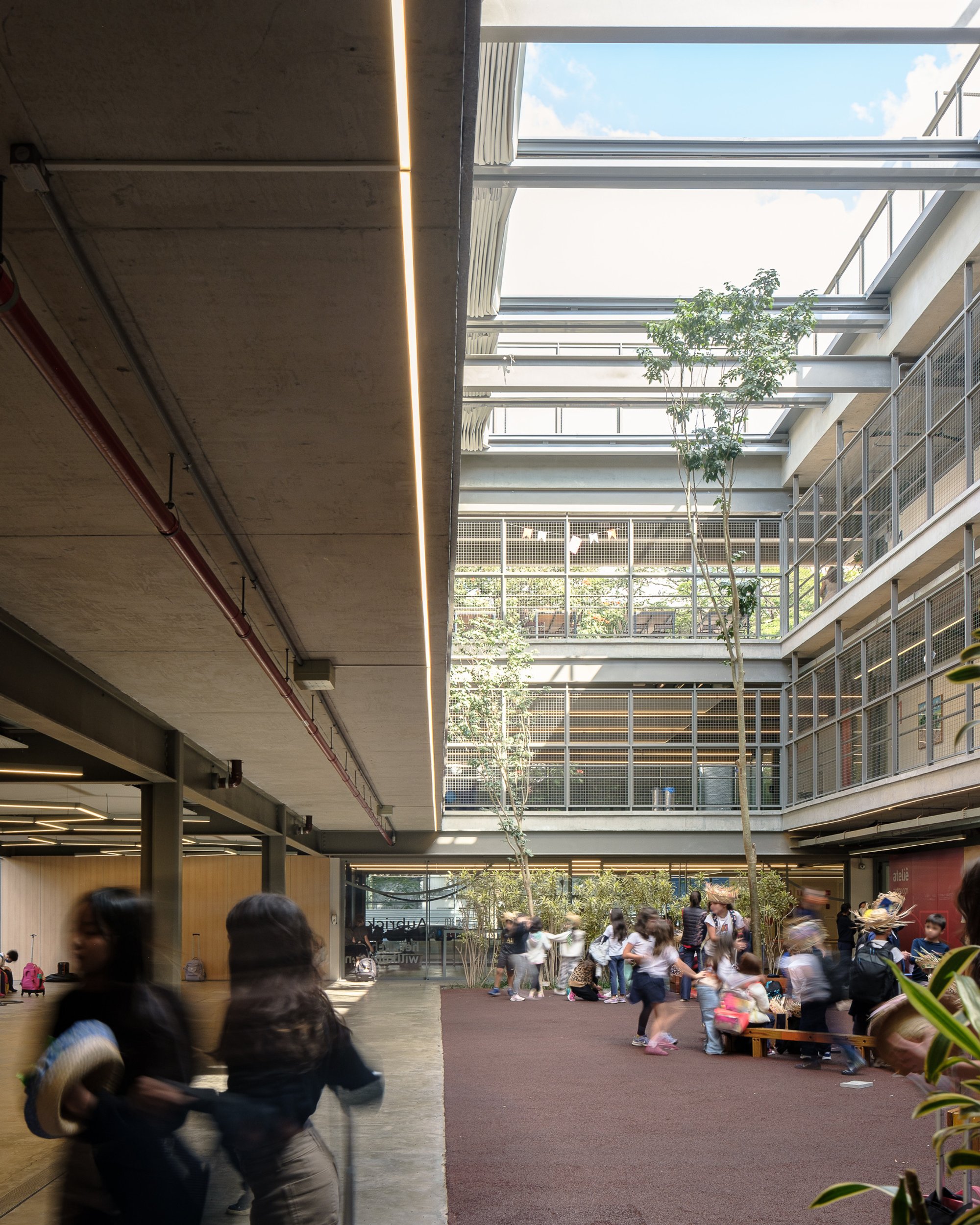
The central courtyard is the project's most powerful space. Planted trees rise through horizontal roof beams that span four levels, and timber benches line the ground plane. The courtyard is not a single volume but a layered one: circulation balconies, wire mesh railings, and concrete beams at different heights create a section that reads as much vertical garden as atrium. Light enters through skylights and filters down through the tree canopy, producing constantly shifting shadow patterns on the maroon floor surface below.
Crucially, the courtyards are not residual space carved out of a floor plate. They are the organizing logic. Classrooms and program spaces ring the perimeter, and the courtyards pull air, light, and social life into the center. A retractable roof over one patio gives the school control over climate without sacrificing openness. The result is a passive ventilation strategy embedded in the plan, not bolted on as an afterthought.
Learning in the In-Between
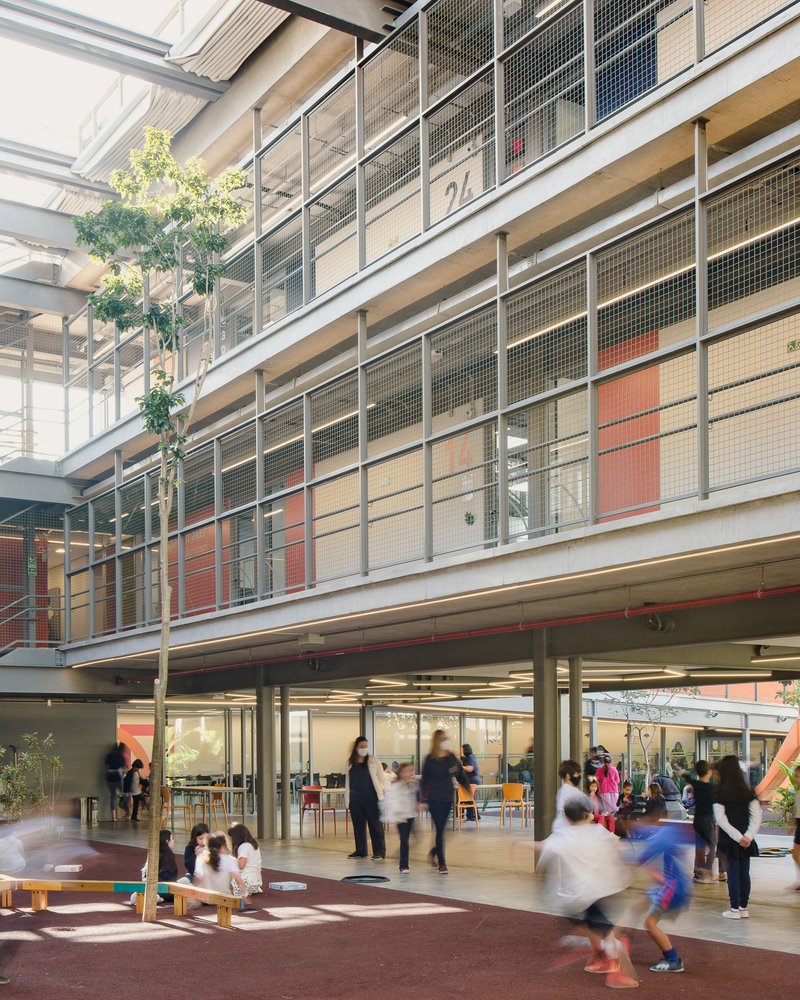
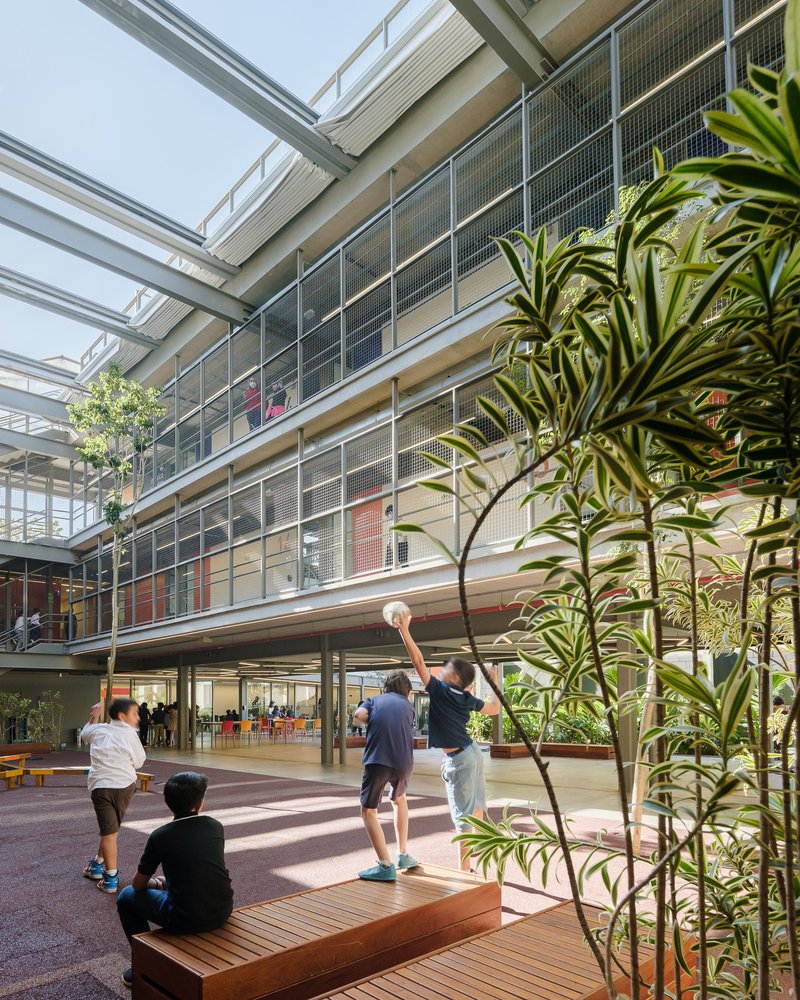
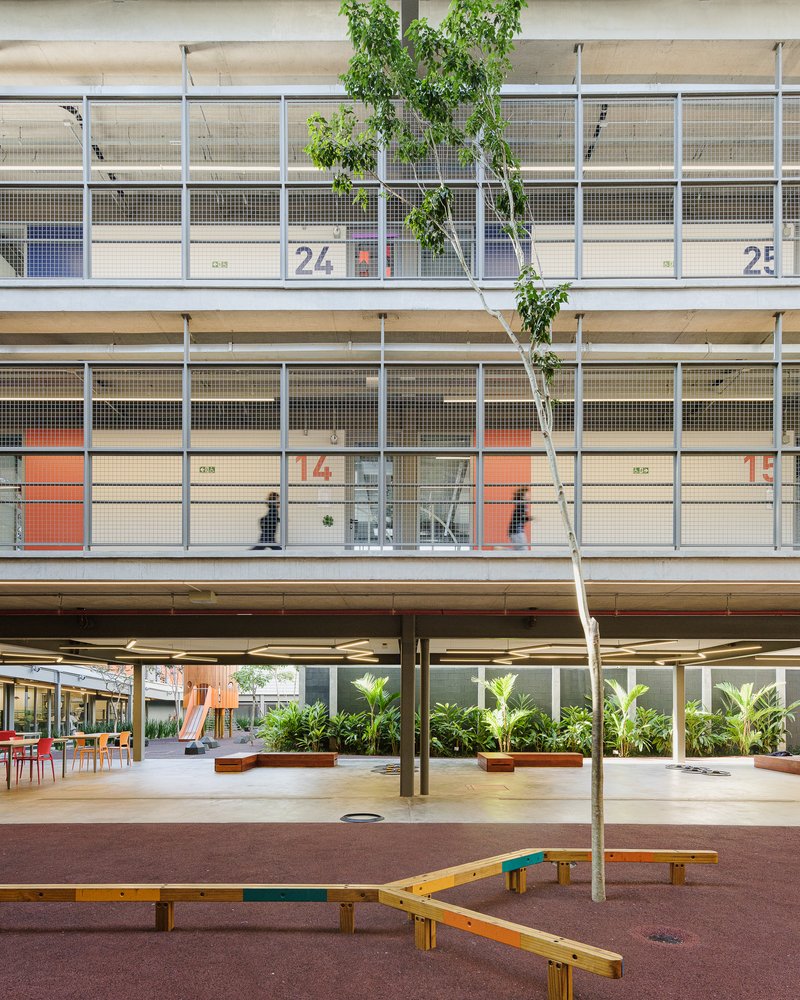
Some of the most telling photographs show children in motion blur, gathered in the courtyard or playing basketball beneath planted trees and a glazed canopy. These are not staged images of recess. They show the building performing exactly as intended: the thresholds between classrooms and open air are so porous that informal learning, play, and socializing happen simultaneously at every level.
Numbered classroom doors and orange accent panels identify different cycles and activity types through a system of colored surfaces. It is a form of wayfinding that doubles as visual pedagogy, teaching children to read spatial codes. The mesh screens fronting the balconies allow classrooms to monitor courtyard activity and vice versa, creating a culture of mutual visibility rather than surveillance.
Material Honesty and Domestic Scale
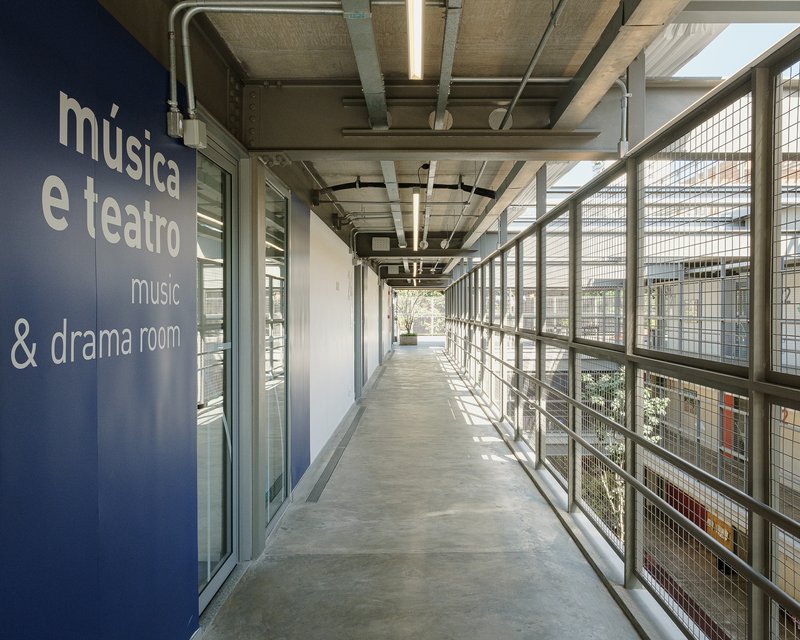
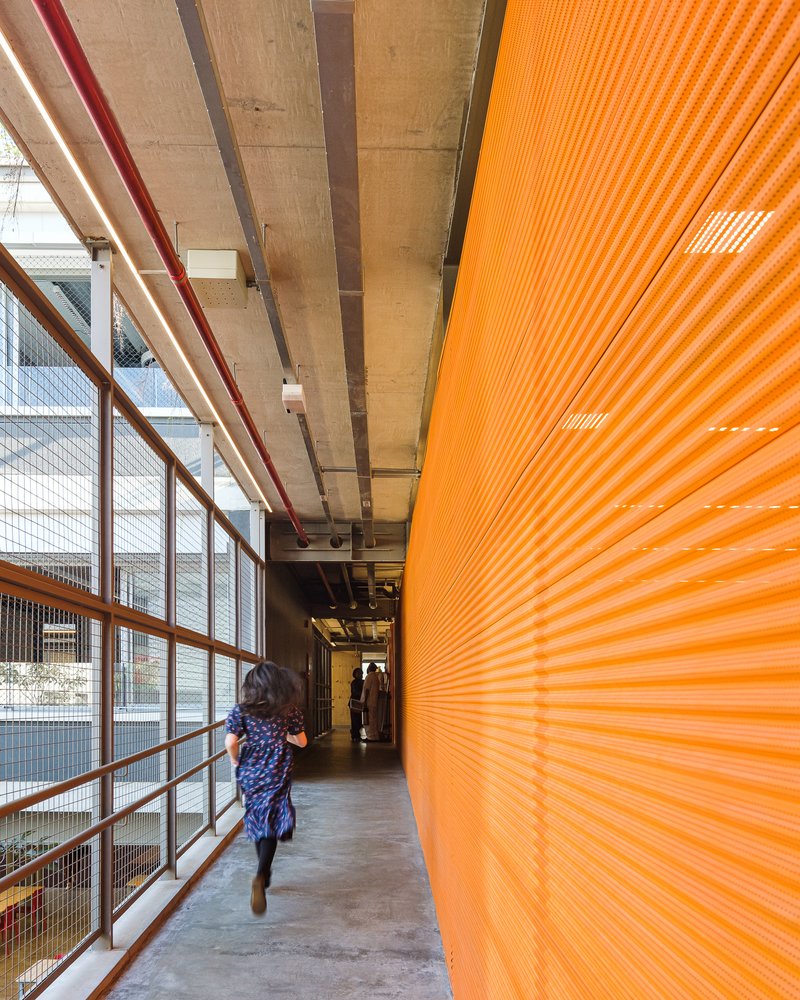
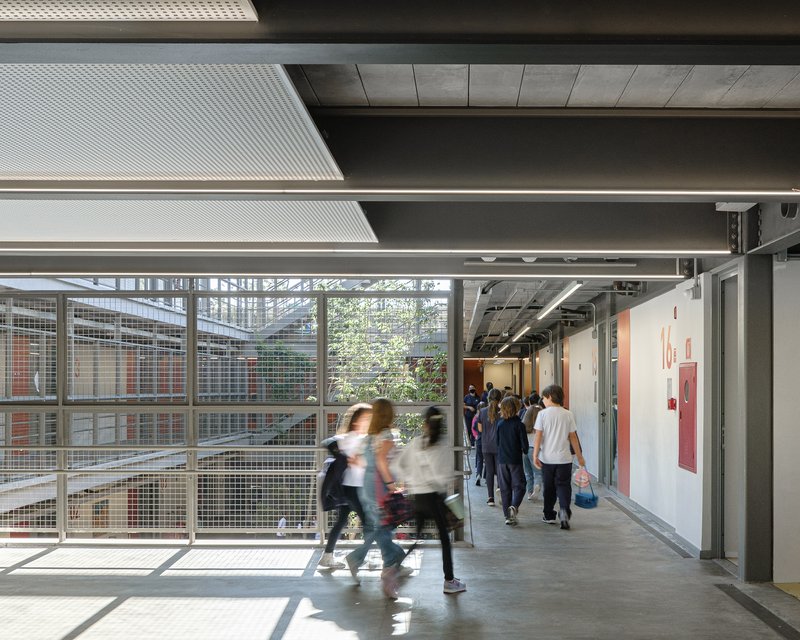
The palette is deliberately diverse: exposed concrete ceilings with visible ducts, orange corrugated wall panels, mesh balustrades, and generous amounts of wood. Andrade Morettin treats materials as didactic agents, each one legible and distinct so that children can understand what holds their building up, what keeps the rain out, and what provides warmth. There is no false ceiling to hide the structure, no plasterboard to smooth over the joints. The architecture is an open book.
At the same time, the wood elements and warm colors prevent the exposed structure from feeling industrial. The architects describe the atmosphere as domestic and gentle, and that reads clearly in the corridors. The slender steel columns and concrete beams keep spans long and sightlines open without the heaviness that a conventional reinforced-concrete frame would impose.
The Gymnasium as Counterpoint
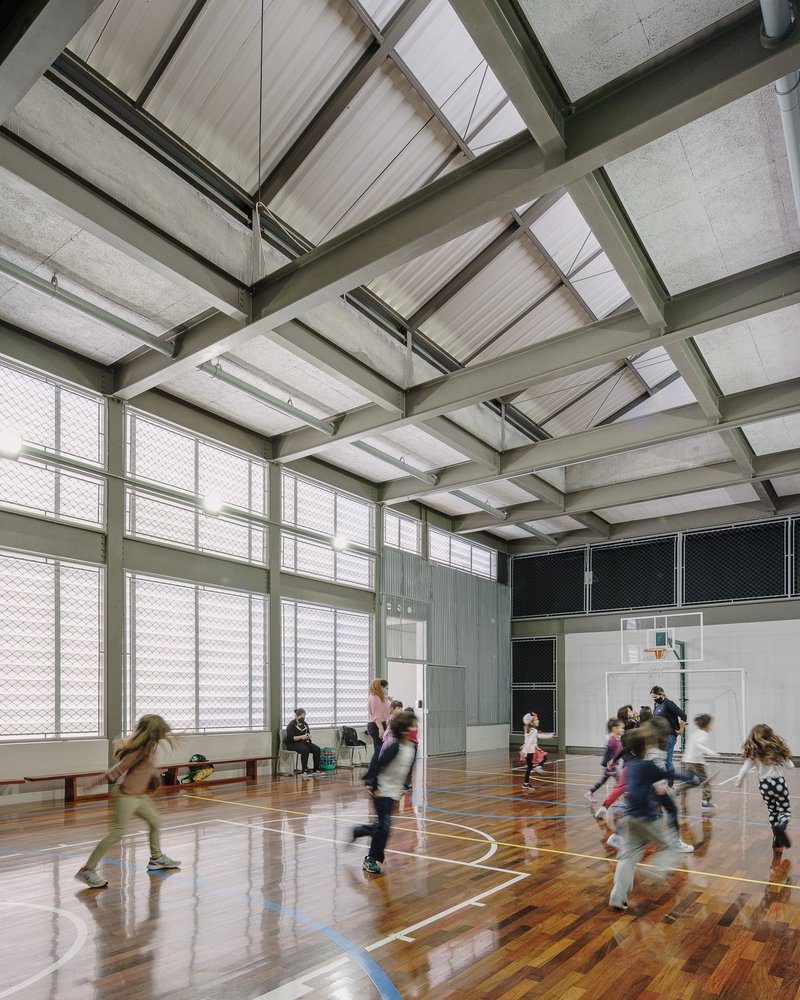
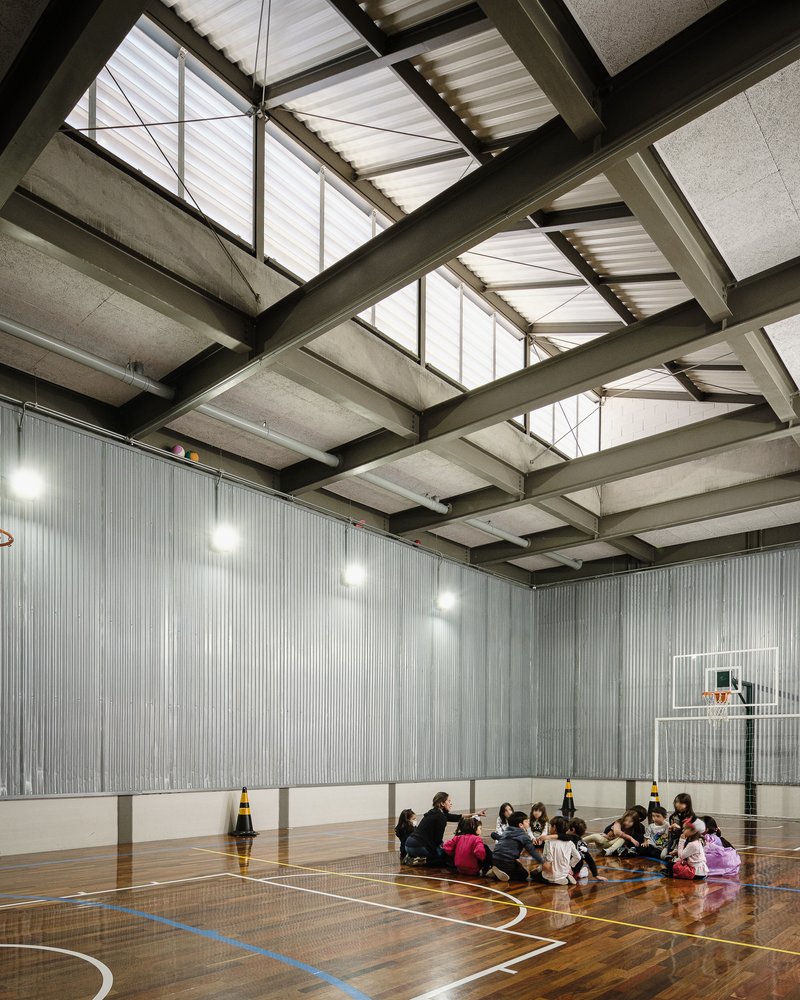
Two sports courts occupy the central volume at ground level, and their interior is one of the most spatially generous rooms in the building. Exposed concrete ceiling trusses span the full width, and triangular skylights punch daylight into the space without glare. Timber flooring and wire mesh windows complete the material story: honest, legible, and tough enough to handle years of use.
The gymnasium section is notable for the way it locks into the courtyard sequence. You move from open air to enclosed volume and back again without a sense of rupture. The architects used the gym's height to anchor the adjacent classroom wings, letting the building step up from two stories at the street to a taller internal volume before stepping back down. It is a smart way to hide bulk on a tight site.
Plans and Drawings
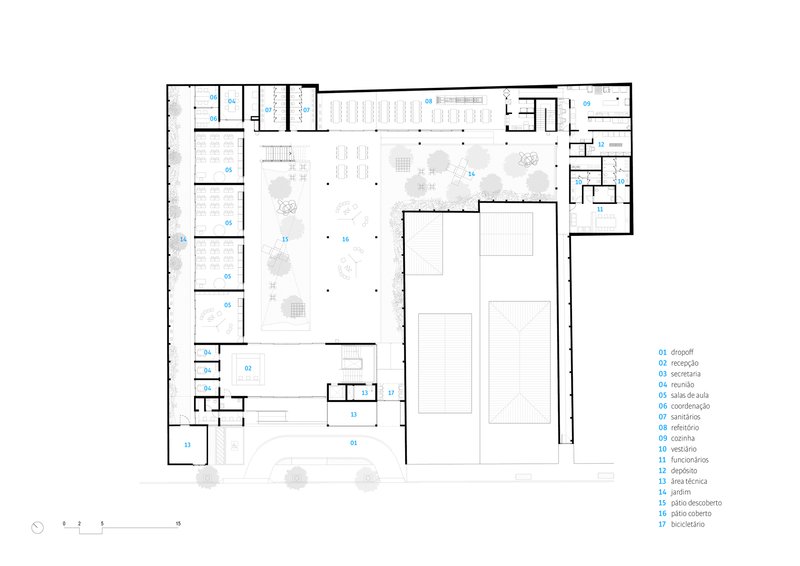
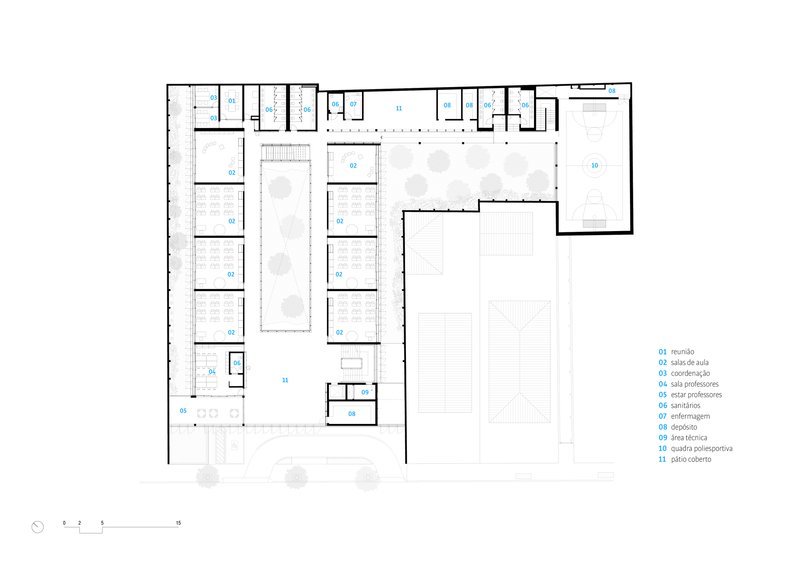
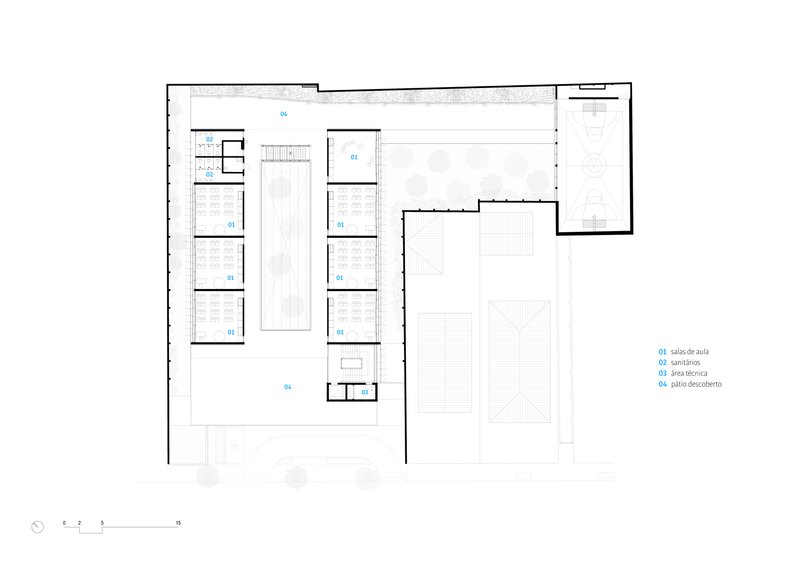
The floor plans reveal the courtyard logic with precision. At ground level, classrooms line the perimeter while two sports courts fill the central volume, and the open areas between them read as continuous landscape. The first floor lifts classrooms above the gymnasium, and circulation zones bridge across the courtyard void. By the second floor, a terrace appears, confirming that the roof is treated as usable pedagogical space rather than wasted area.
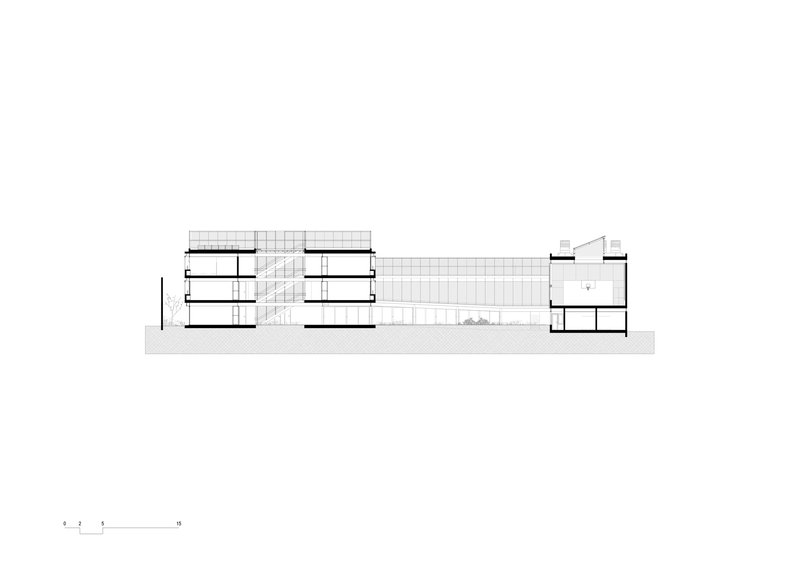
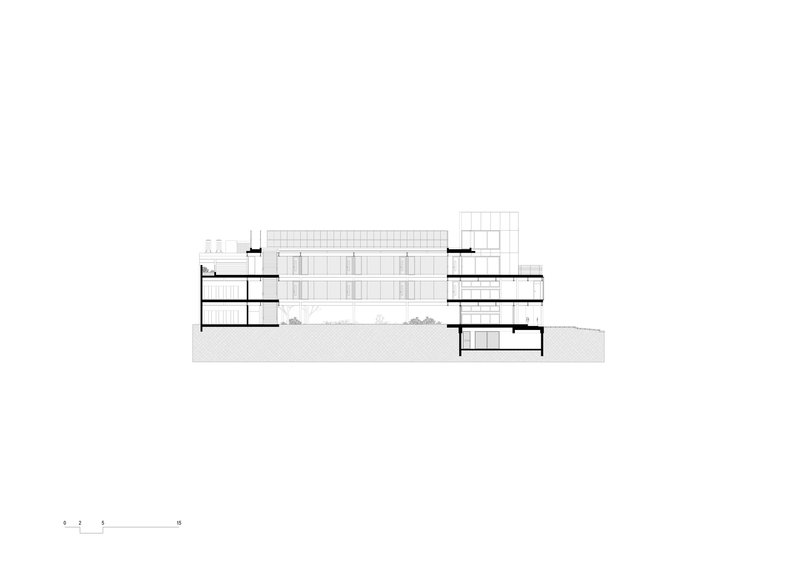
The two sections are perhaps the most revealing drawings. They show the flanking classroom wings connected by a gridded atrium courtyard whose glass-enclosed volume admits daylight across all levels. The slenderness of the metallic structure is apparent here: columns and beams are drawn almost as lines, giving the sections an airiness that matches the experience of being inside the building.
Why This Project Matters
The Aubrick School is a rebuke to the idea that an urban elementary school has to be a sealed box with a playground annexed. By treating courtyards as the primary spatial experience and classrooms as the lining, Andrade Morettin flips the usual hierarchy. The result is a building where passive climate strategy, pedagogical ambition, and neighborhood sensitivity are not separate agendas but facets of the same plan. The lightweight steel structure enabled fast construction on the school's schedule, but it also produced an architecture that feels genuinely light: thin railings, slender columns, and long views across courtyard voids.
In a city where institutional buildings often default to fortress typologies, the Aubrick School chooses transparency. Mesh screens, glazed canopies, and open staircases invite visual connection across every level. The materials are legible enough for a child to understand, and the spatial sequence is varied enough to keep an adult architect interested. That combination is rarer than it should be, and it is why this project deserves close attention.
Aubrick School, São Paulo, Brazil. Designed by Andrade Morettin Arquitetos Associados. Lead architects: Vinicius Andrade, Marcelo Morettin, Marcelo Maia Rosa, and Renata Andrulis. Area: 3,909 m². Completed 2021. Photography by Pedro Kok.
About the Studio
Share Your Own Work on uni.xyz
If projects like this are the kind of work you want to make, uni.xyz is a place to publish your own, find collaborators, and enter design competitions.




Popular Articles
Popular articles from the community

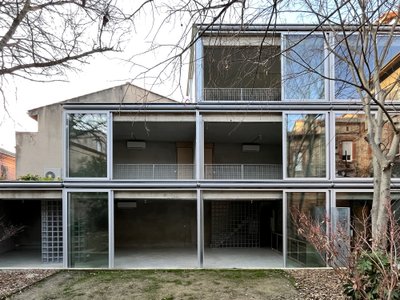
BAST Slots a Four-Story Glass House into a Narrow Gap Between Toulouse Townhouses
In the dense Bonnefoy district, a stepped infill building merges home and office while preserving a majestic hackberry tree.
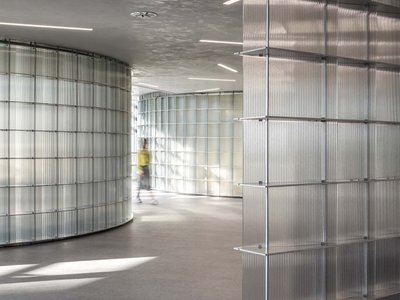
HCCH Studio Wraps a Shanghai High-Rise Office in Curved Walls of Translucent Glass
A 1,000 square meter fit-out in Lujiazui replaces the typical tech-office palette with layered glass, micro-cement, and quiet rigor.
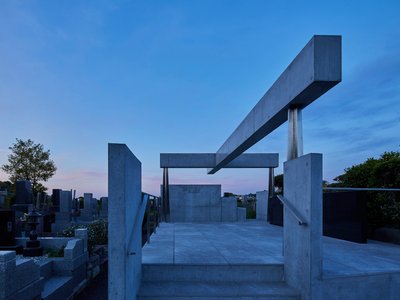
Takeshi Hosaka Architects Suspends a Concrete Cross Above a Yokohama Cemetery
A 28-square-meter burial renovation in Yokohama lifts the symbol of resurrection into the sky so mourners see it against heaven.
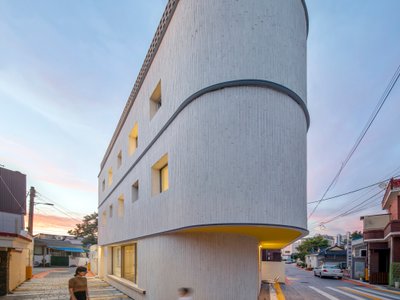
YOAP Architects Round a Corner in Yeongcheon with a Cylindrical Community Hub
A 197-square-meter brick and ribbed-clad tower turns a forgotten alley corner in South Korea into a public garden with a low threshold.
Similar Reads
You might also enjoy these articles

127af Flips a Tiny Bagnolet Rowhouse Upside Down with a Handcrafted Roof Extension
A 55-square-meter terraced house on the edge of Paris gains a luminous upper living floor through lightweight timber and steel.
1.61 Design Workshop Wraps a 600-Square-Meter Café in Vietnam in Sculptural Burgundy Drama
Reden Café & Bistro pairs a helical staircase, mosaic floors, and deep red interiors to rethink Vietnamese hospitality space.

The Unbound Brain: A School Shaped by Cognitive Architecture
Cylindrical learning pods radiate like neurons from a central cortex, turning the floor plan into a spatial model of human thought.
Revival Vernacular Architecture: Rammed Earth Settlements for the Sahara
A modular desert community in Mauritania that fuses passive cooling techniques with earthen construction and local craftsmanship.


Explore Educational Building Competitions
Discover active competitions in this discipline




The Global Benchmark for Architecture Dissertation Awards


Challenge to design public laboratory
Comments (0)
Please login or sign up to add comments
No comments yet. Be the first to comment!