
Andrés Jaque Wraps a Six-Storey Vertical School in Cork to Let Madrid's Children Learn from the Building Itself
In northern Madrid, Office for Political Innovation builds a school as a naked ecosystem where exposed systems become pedagogy.

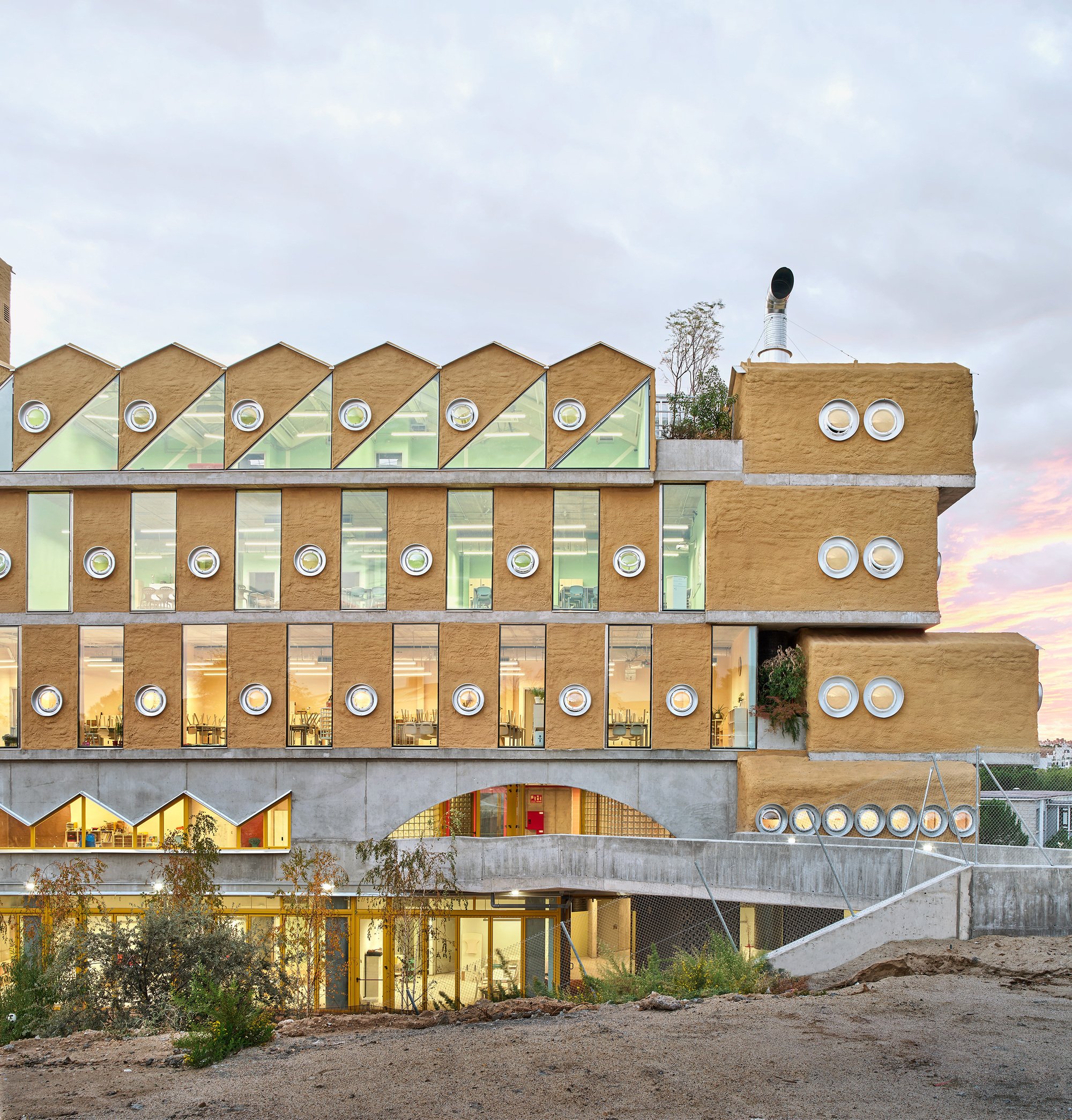
Most school buildings work hard to hide their guts. Drop ceilings conceal ductwork, wall linings bury wiring, claddings smooth over structure. Andrés Jaque / Office for Political Innovation took the opposite approach with Reggio School in Madrid's Encinar de los Reyes district, stripping away nearly half the typical facade, roof, and partition material to produce a building that is, by intention, naked. Every pipe, conduit, wire, and grille is visible. The architecture does not decorate; it explains.
The result is a six-storey vertical city for children, organized so that the youngest students occupy the ground floor and older ones ascend through progressively more complex environments, culminating in interconnecting science laboratories and an indoor garden nourished by reclaimed water tanks on the upper levels. The entire envelope is wrapped in projected cork, a material solution Jaque's office developed specifically for this project, covering 80 percent of the exterior in a 14.2 cm layer that doubles Madrid's thermal insulation requirements. It is a school that performs its own ecology, and it wants you to watch.
A Cork Skin Designed for More Than Insulation
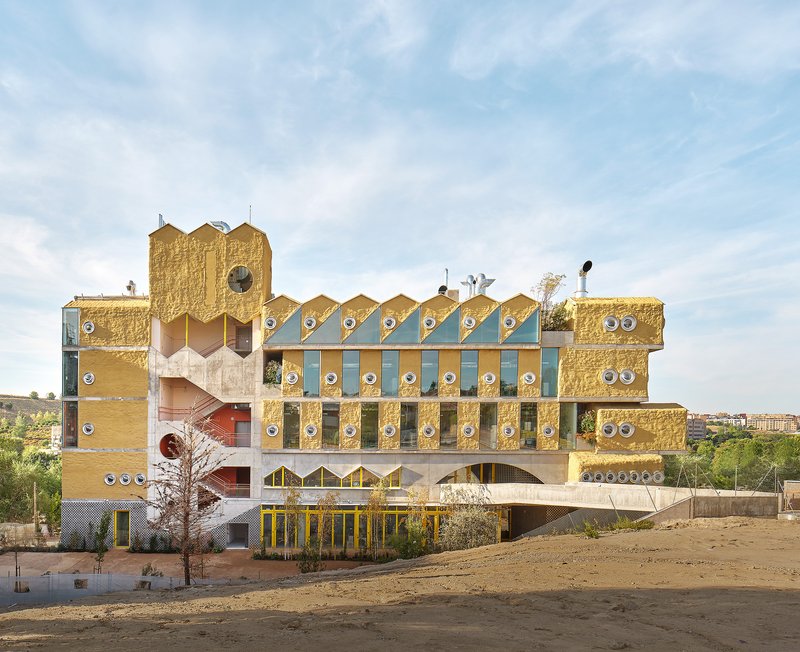
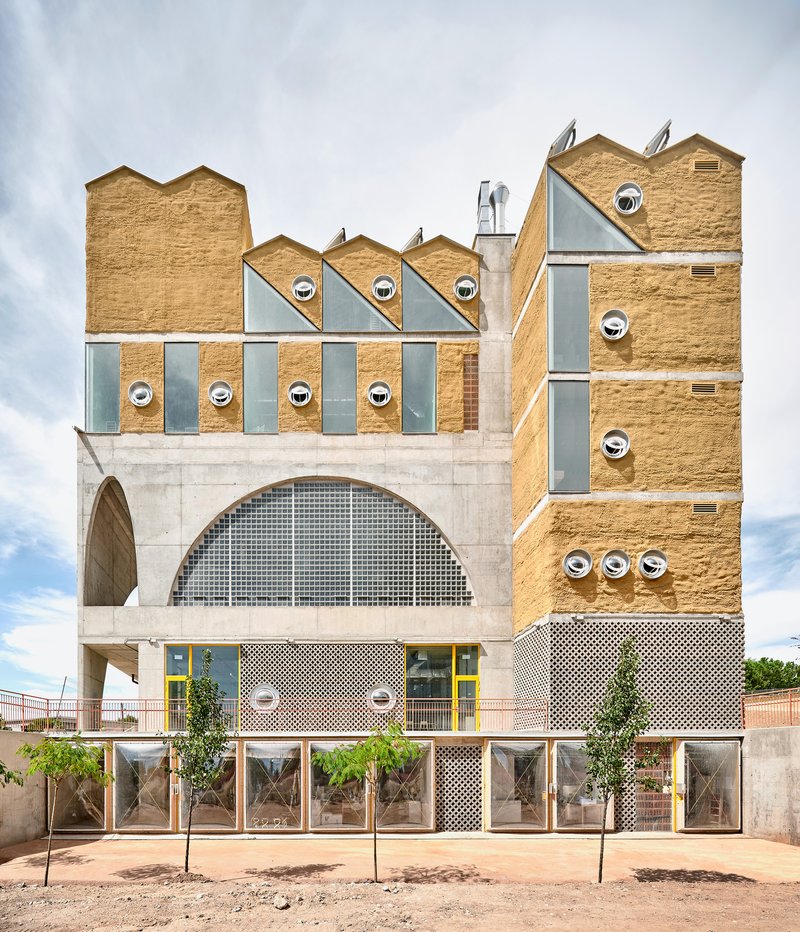
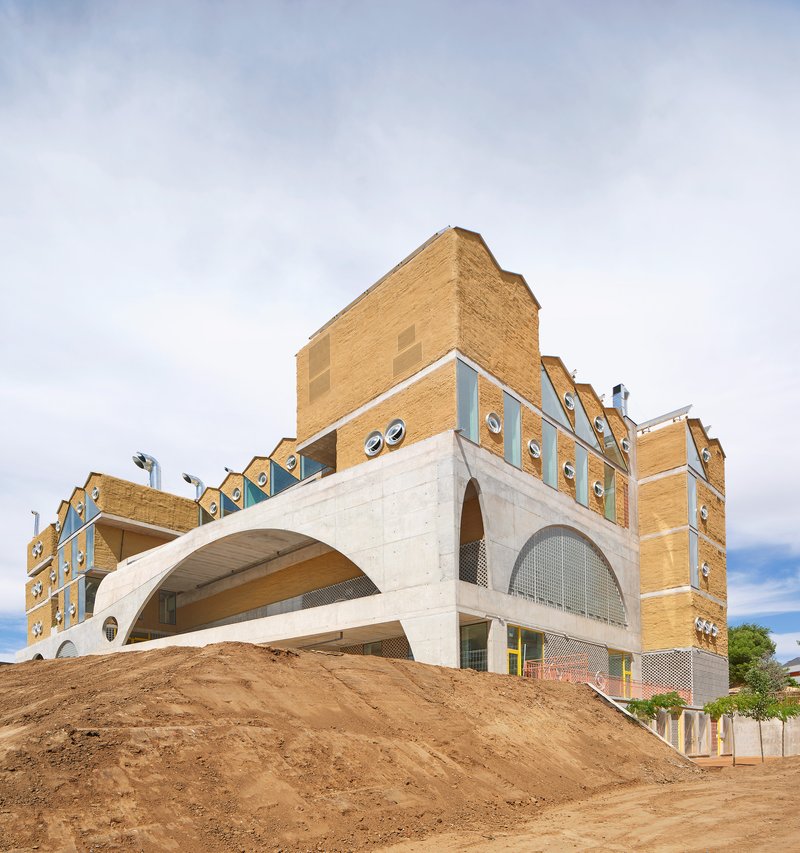
The facade reads as a palimpsest of materials, each one legible: arched concrete at the base, lightweight perforated brick in alternating panels, polycarbonate bubble portholes for natural ventilation, and that thick cork skin binding it all together. The cork is not a smooth veneer. Its irregular surface is intentionally designed to accumulate organic material over time, hosting microbiological fungi, mosses, and eventually supporting insect and bird life. The building will age into its own small biome.
With an R-value of 23.52, the cork layer passively cuts heating energy consumption by 50 percent. Paired with the decision to forgo air conditioning entirely, relying instead on mechanical ventilation and those distinctive porthole openings, the envelope strategy makes the school legible as an argument about resource use. You can see how the building breathes.
Structural Arches and the Weight of Civic Ambition
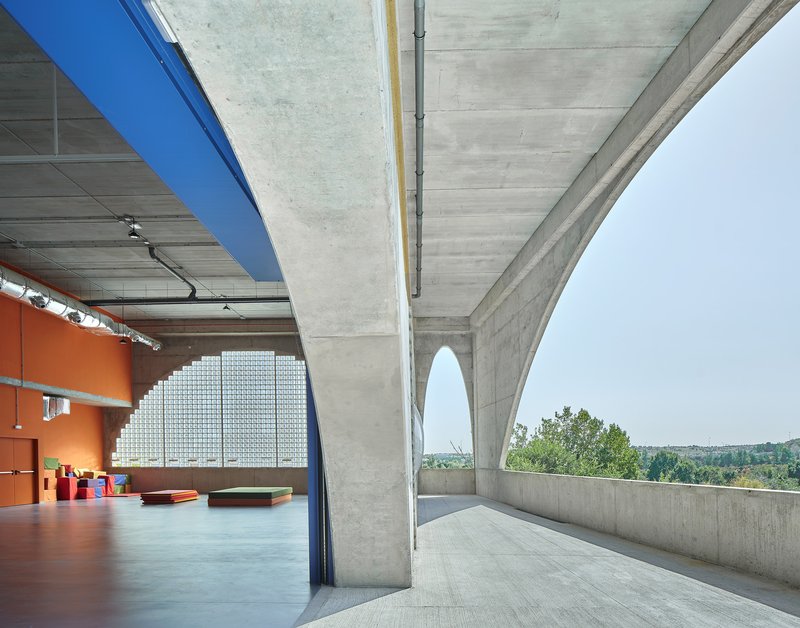
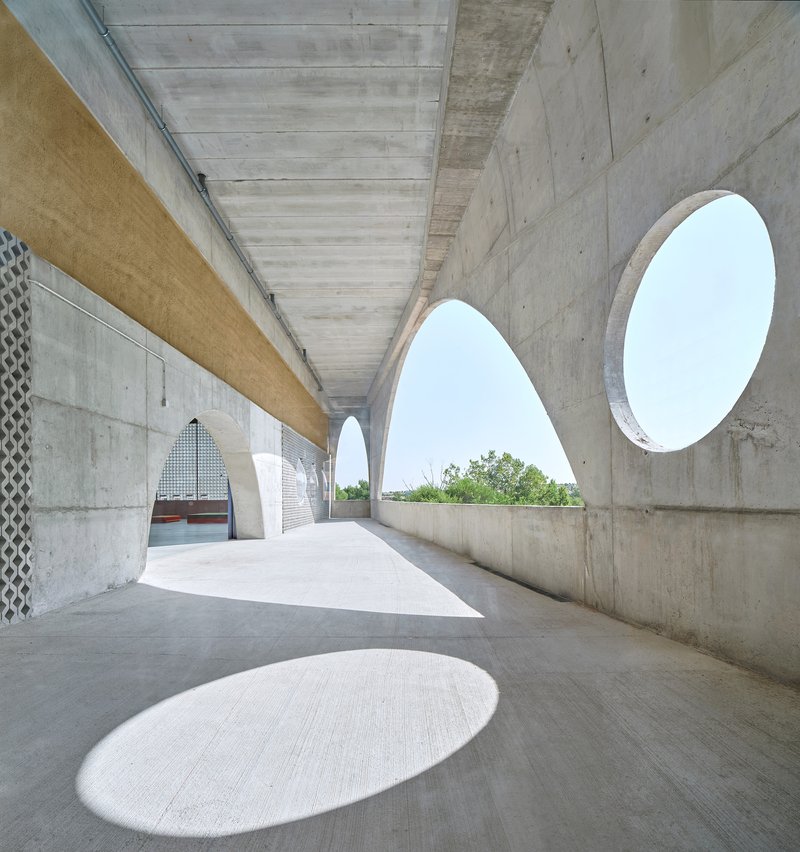
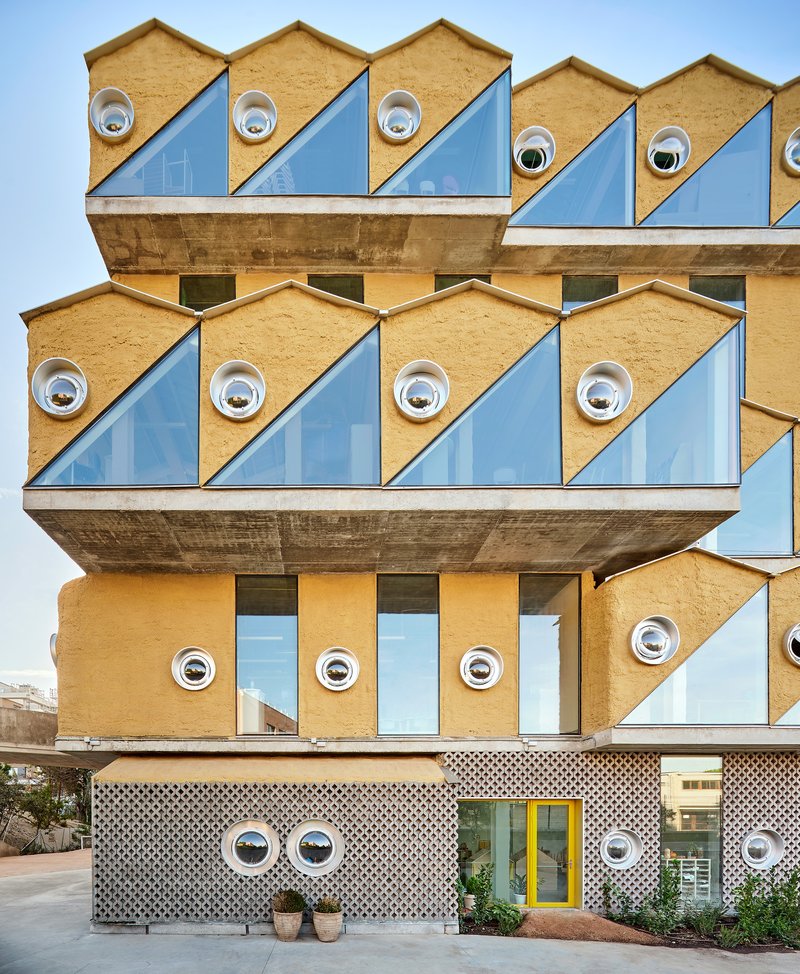
Concrete arches carry the building's upper mass down to pilotis, reducing the need for steel reinforcement and cutting embedded structural energy by a third compared to conventional reinforced concrete. The arches are not decorative gestures; they are load-bearing infrastructure exposed to view, activating what Jaque describes as a tradition of bridges and civic works. Structural engineer Iago González Quelle of Qube Ingeniería de Estructuras helped reduce wall thickness by more than 150 mm on average.
The board-formed concrete is left raw wherever it appears, from covered corridors with oval openings to deep archways that frame the tree line beyond the site. The effect is simultaneously monumental and transparent. Children walk under spans that belong to the vocabulary of aqueducts, and the building trusts them to notice.
An Agora on the Second Floor
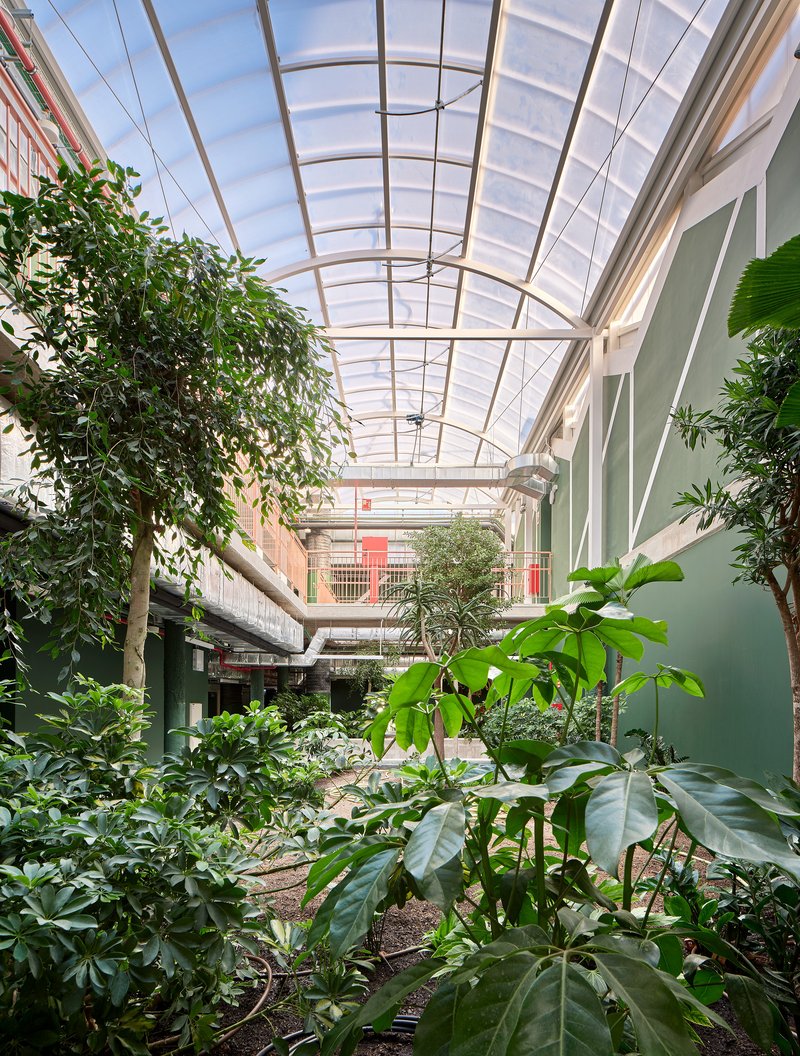
Borrowing the Veneto villa concept of the piano nobile, Jaque places the school's main social space on the second level: a vast, eight-metre-high void spanning 470 square metres that functions as a "cosmopolitical agora." The glazed atrium, dense with plantings between balconies, gives the void a greenhouse atmosphere. A library and a double-height sports and assembly hall sit at this same level, making it the civic heart of a building that stacks 32 classrooms across its six floors.
The decision to formalize a school's commons as a void rather than a corridor is what separates Reggio School from institutions that merely preach community. Here the void is literal, generous, and unavoidable. Every vertical trip through the building passes through it.
Classrooms as Ecosystems
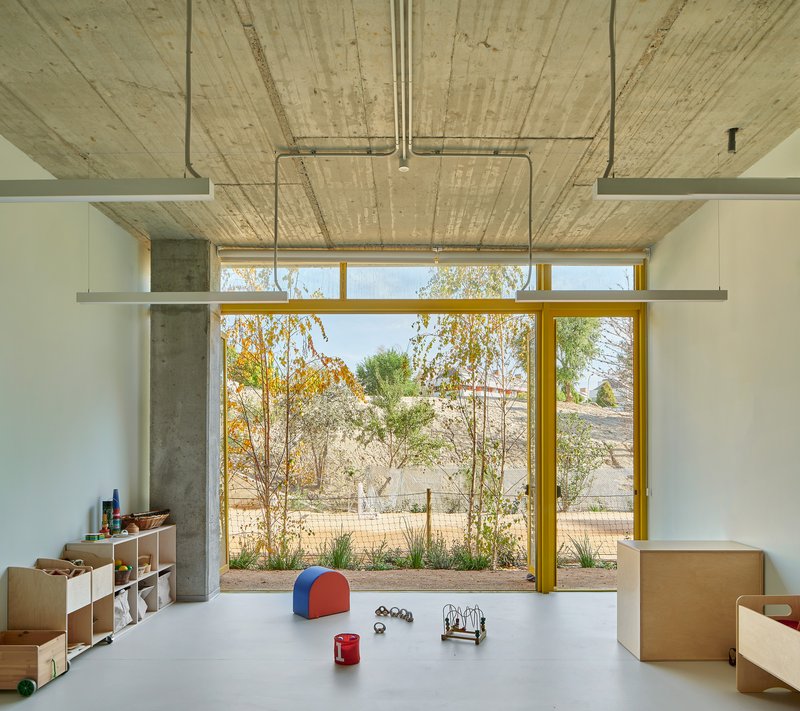
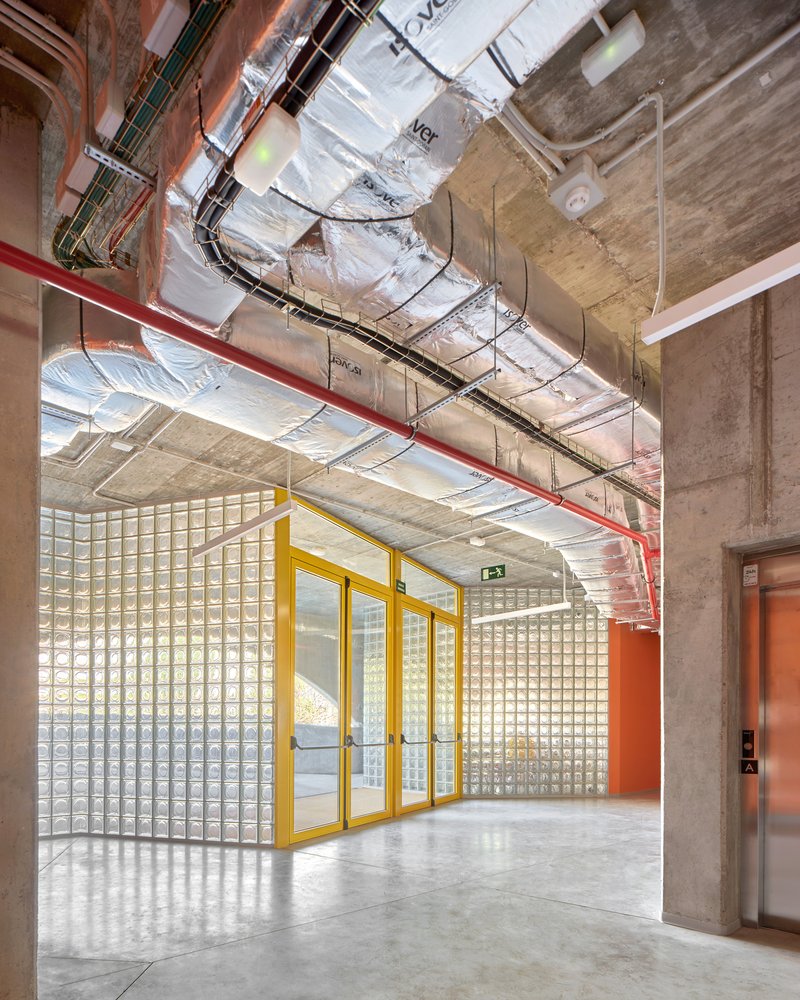
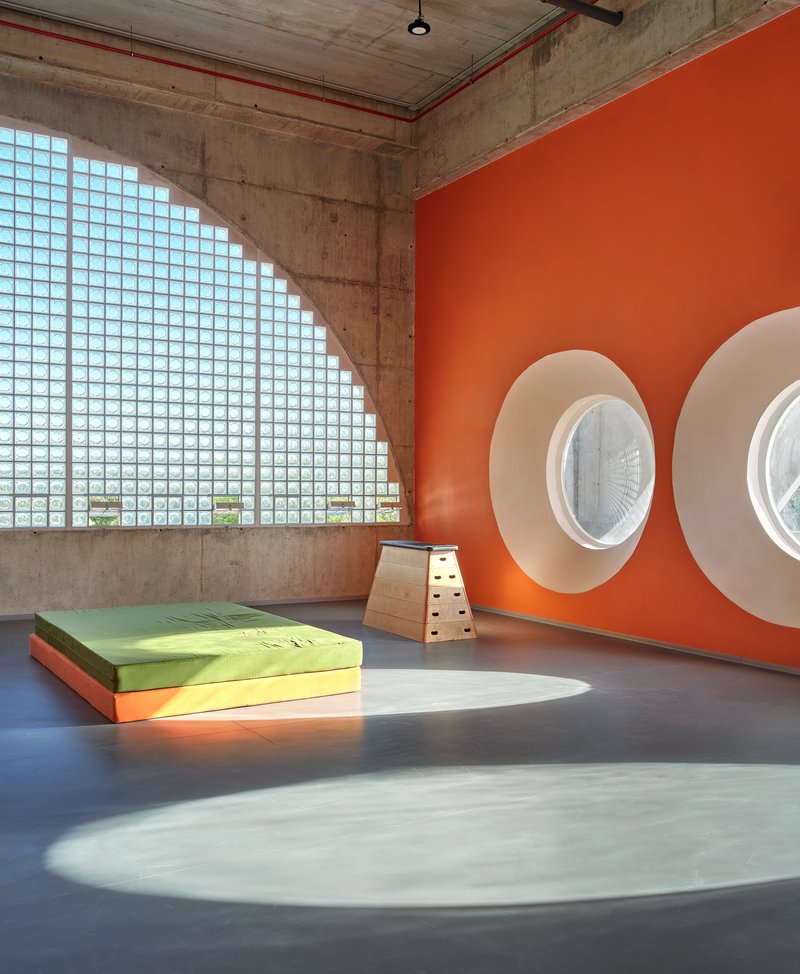
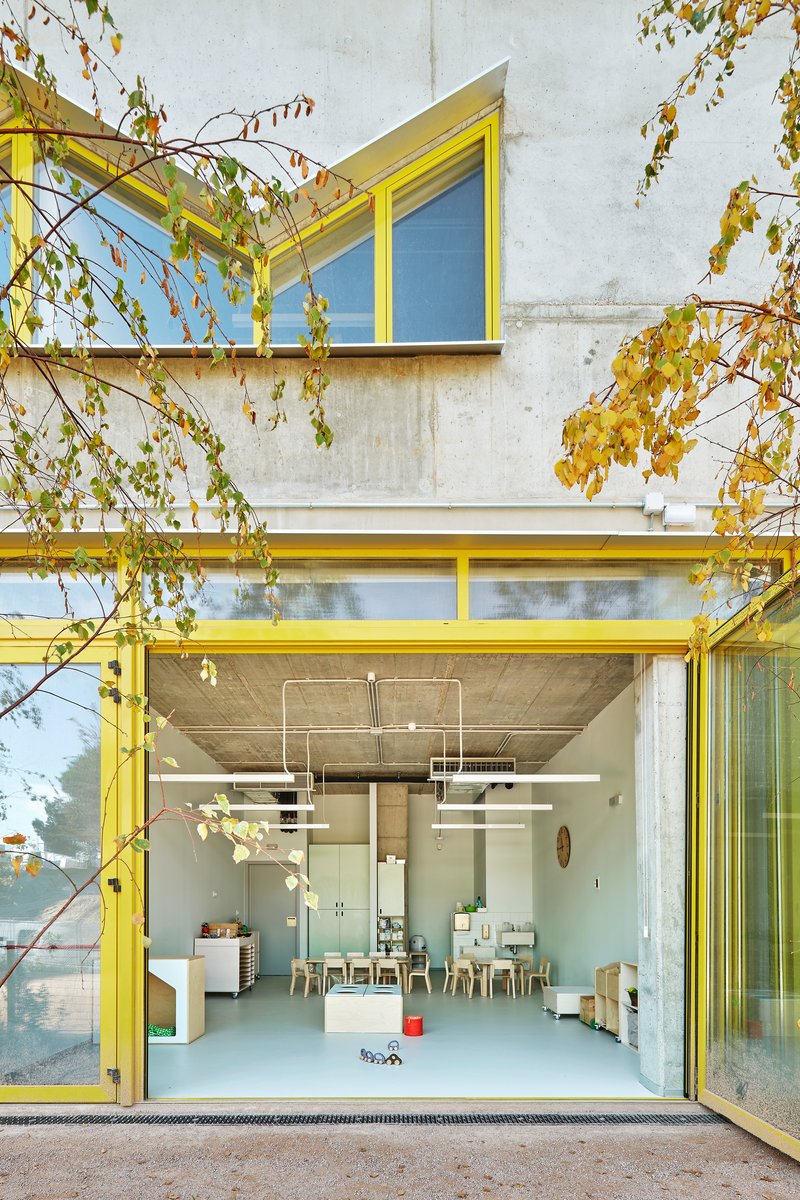
Inside the classrooms, the same ethic of exposure holds. Yellow-framed glazing opens onto planted courtyards, and exposed concrete ceilings carry their conduits in full view. Glass block partitions filter light into hallways lined with visible ductwork and painted in high-contrast orange. The color palette, yellow frames, blue triangular panels on the exterior, orange interiors, reads as deliberate and warm without resorting to the infantilizing palettes typical of school design.
The Reggio Emilia pedagogical philosophy, named for the Italian city and developed by Loris Malaguzzi, treats the environment as a "third teacher." Jaque takes this literally. If a child can see how water reaches a tap or how air enters a room, the building becomes curriculum. The absence of drop ceilings and wall linings is not austerity; it is an educational choice with a 48 percent material reduction as its dividend.
Vertical Landscape and Living Roofs
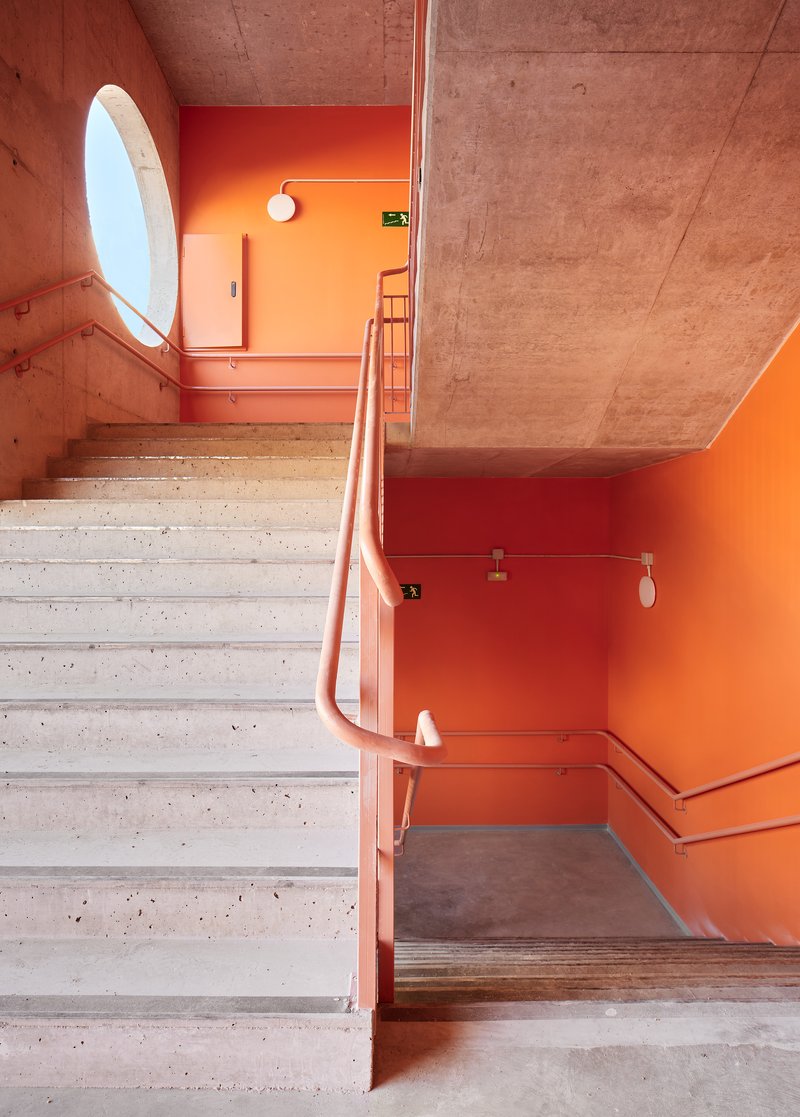
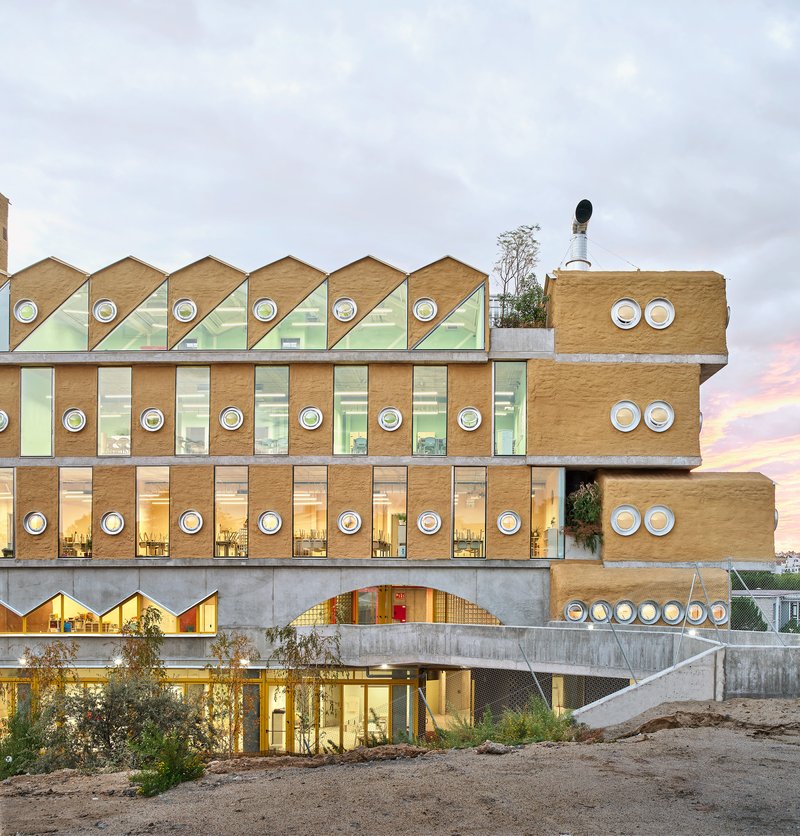
The compact vertical form minimizes the building's footprint and radically reduces its facade-to-volume ratio, a move that optimizes foundations on a sloping site near Madrid's main north-south axis. Small gardens at ground level were designed with a network of ecologists and edaphologists to attract butterflies, insects, birds, and bats. On the upper levels, reclaimed water and soil tanks nourish an indoor garden beneath a greenhouse structure, so older students share their learning environment with living systems.
Circulation through the building, via concrete staircases marked by circular windows and tubular steel handrails, reinforces the vertical city metaphor. Ascending is not just moving between floors; it is moving through ecosystems of increasing complexity, from rammed earth playgrounds at grade to science labs and living rooftops at the top.
Plans and Drawings
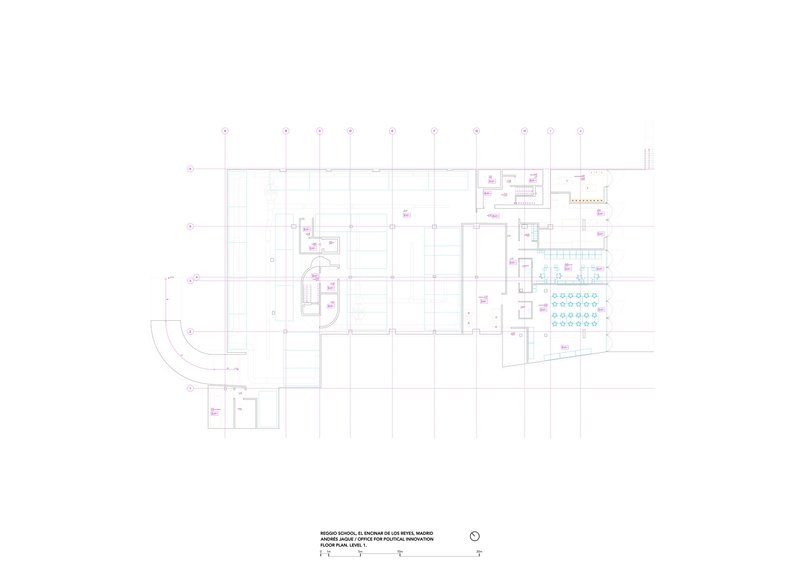
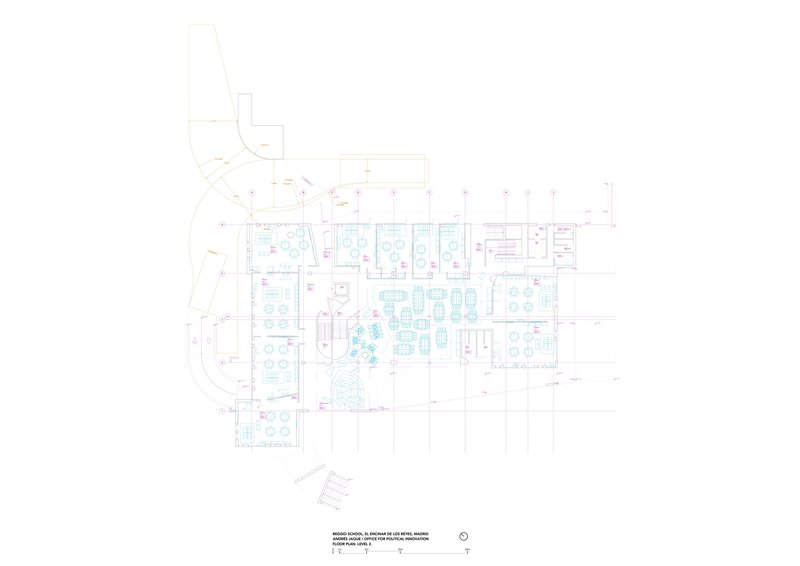
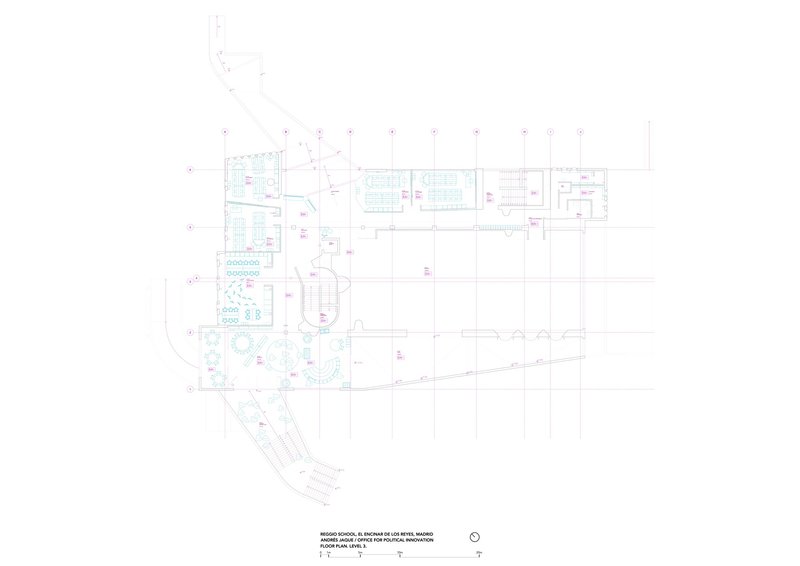
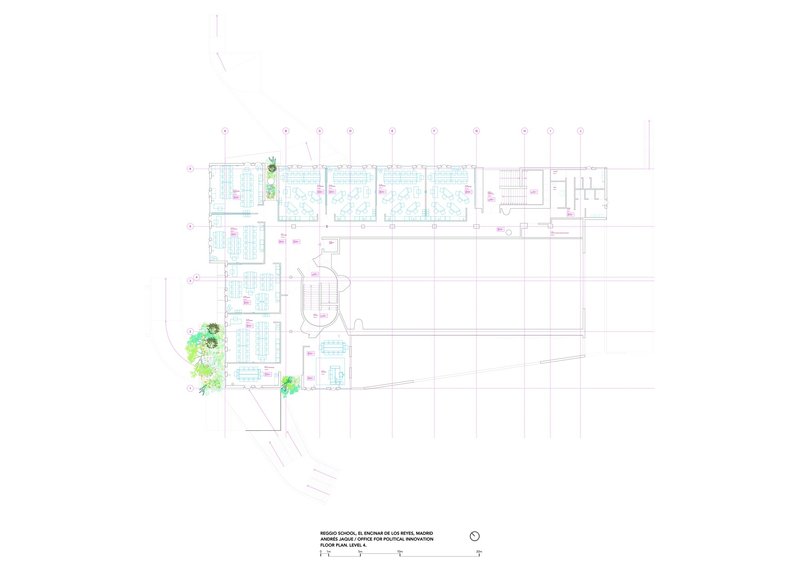
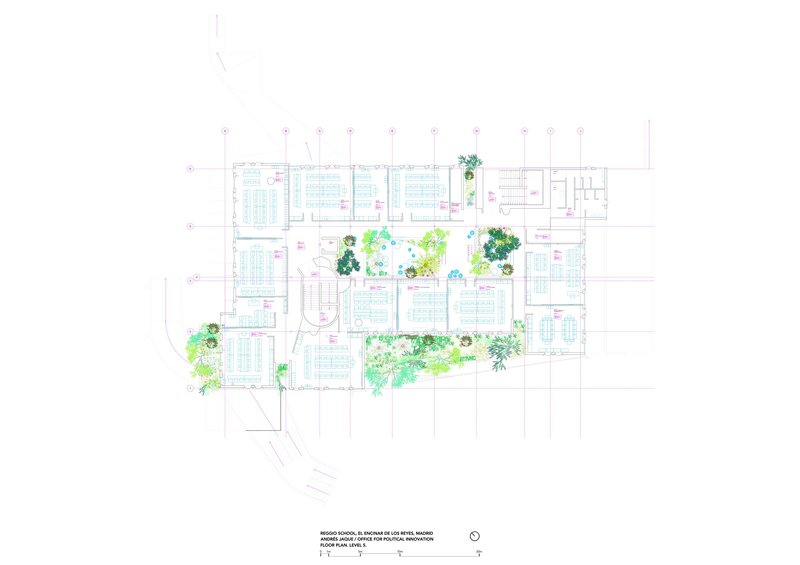
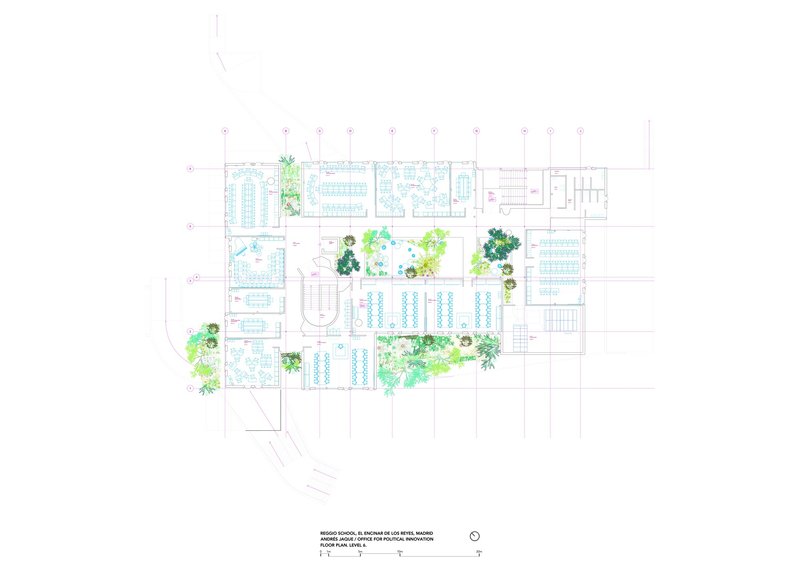
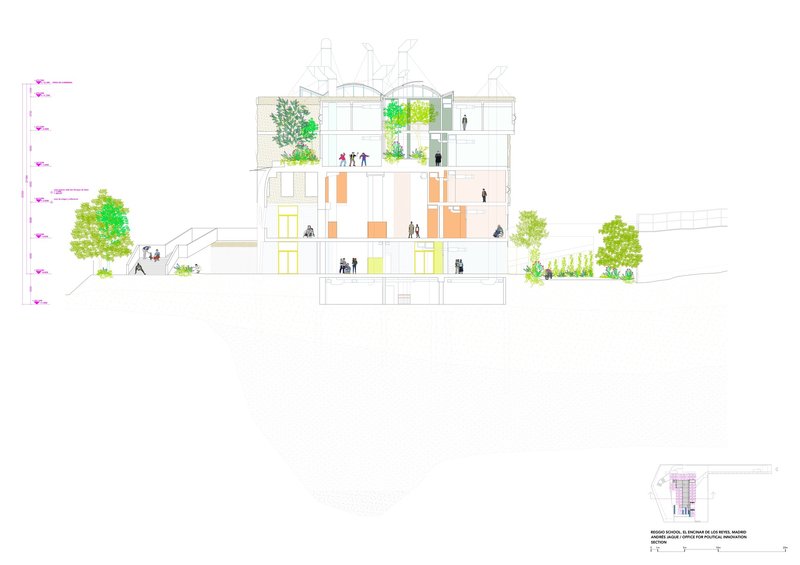
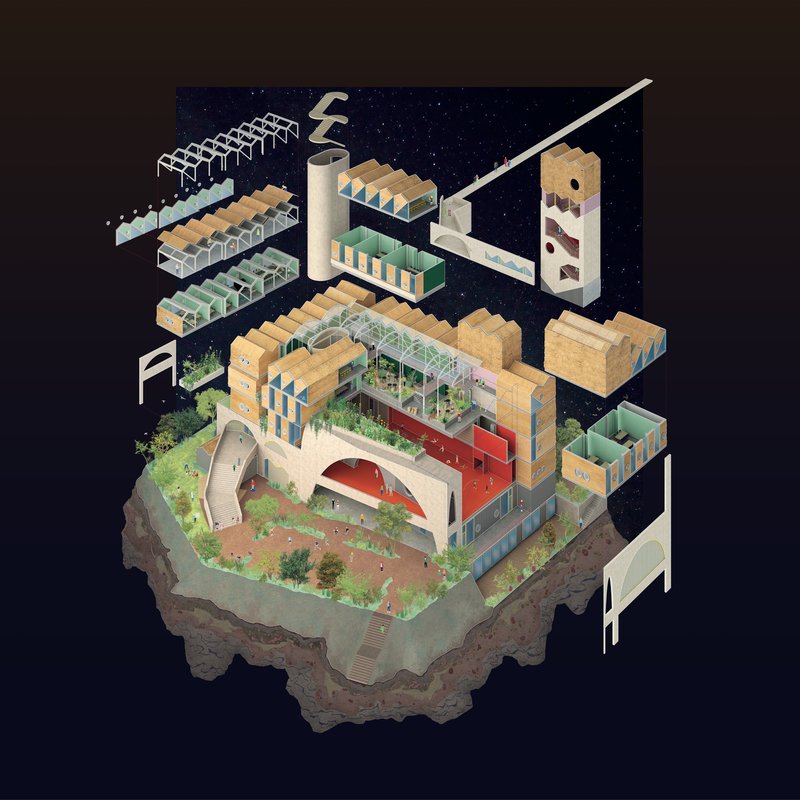
The floor plans reveal how each level negotiates a different relationship between classroom clusters, circulation cores, and planted courtyards. Curved service areas and angled wing extensions keep the plan from settling into repetition, while the central stair acts as a consistent spine. The section drawing is especially telling: it shows the full four-level stack with rooftop gardens, the double-height agora void, and scale figures that make the eight-metre ceiling height visceral. The axonometric exploded view unpacks the structural logic, separating floors, frames, and planted courtyards into discrete layers that clarify how the building assembles.
Why This Project Matters
Reggio School matters because it refuses the premise that a school for young children should be simple. Jaque's building is dense with systems, materials, and spatial variety, and it treats that complexity as a pedagogical resource rather than a problem to be hidden. The decision to eliminate claddings, drop ceilings, and raised floors is both an environmental strategy and an ethical position: children deserve to see how the world is put together.
More broadly, the project demonstrates that sustainability arguments and spatial ambition are not in tension. A 33 percent reduction in structural embedded energy, passive heating cuts of 50 percent, and a facade designed to grow its own ecology, these are not compromises. They are the generative constraints that produced the building's distinctive character. In a sector where school architecture too often defaults to cheerful mediocrity, Reggio School proposes something harder and more generous: architecture that trusts children to be curious about architecture.
Reggio School by Andrés Jaque / Office for Political Innovation, Madrid, Spain. 6,702 m² gross floor area. Completed 2022. Photography by José Hevia.
About the Studio
Share Your Own Work on uni.xyz
If projects like this are the kind of work you want to make, uni.xyz is a place to publish your own, find collaborators, and enter design competitions.



Popular Articles
Popular articles from the community

gru.a Builds a 70 m² Timber Shelter That Opens Like a Farm Door in Brazil's Valley of the Vines
In the mountainous region near Rio de Janeiro, a compact retreat uses plywood panels and deep eaves to blur the line between inside and out.
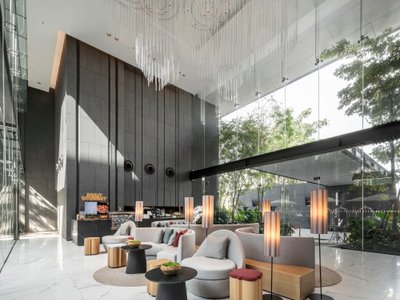
IDIN Architects Wraps a Hua Hin Hotel Around a Private Courtyard to Escape the City
Dusit D2 Hua Hin turns an urban infill site in Thailand's family vacation heartland into a self-contained resort through courtyard planning.
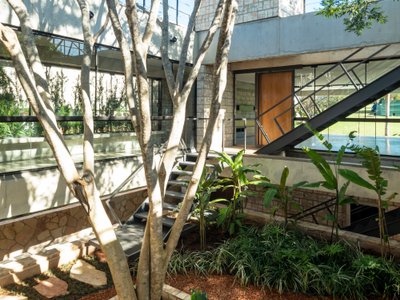
OMCM arquitectos Builds a Summer House in Paraguay from Quarry Waste Blocks and Three Sacred Trees
In the young hillside neighborhood of Altos, a 696-square-meter concrete volume hovers on six pillars around three preserved native Yvyraju trees.
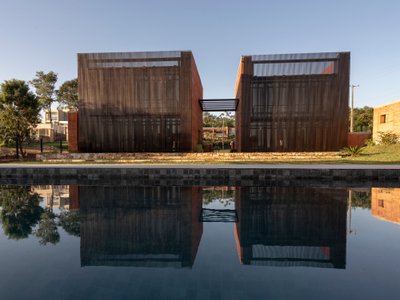
BAUEN Builds Two Rammed Earth Volumes in Paraguay Inspired by the Ovenbird's Nest
In San Bernardino, a house of compacted earth channels the instinct of a constructive bird to shelter life from the Paraguayan summer.


Similar Reads
You might also enjoy these articles

127af Flips a Tiny Bagnolet Rowhouse Upside Down with a Handcrafted Roof Extension
A 55-square-meter terraced house on the edge of Paris gains a luminous upper living floor through lightweight timber and steel.
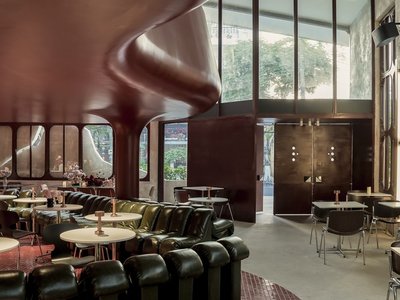
1.61 Design Workshop Wraps a 600-Square-Meter Café in Vietnam in Sculptural Burgundy Drama
Reden Café & Bistro pairs a helical staircase, mosaic floors, and deep red interiors to rethink Vietnamese hospitality space.

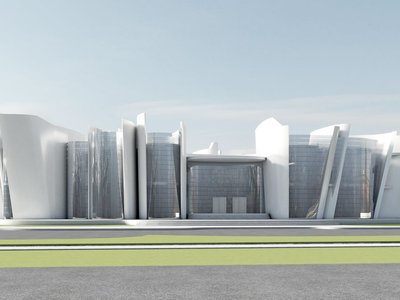
The Unbound Brain: A School Shaped by Cognitive Architecture
Cylindrical learning pods radiate like neurons from a central cortex, turning the floor plan into a spatial model of human thought.
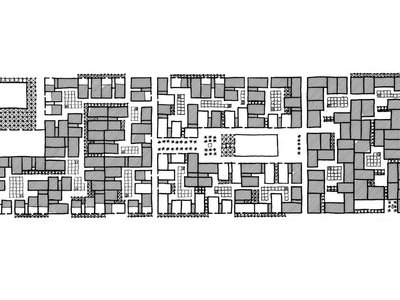
Revival Vernacular Architecture: Rammed Earth Settlements for the Sahara
A modular desert community in Mauritania that fuses passive cooling techniques with earthen construction and local craftsmanship.


Explore Educational Building Competitions
Discover active competitions in this discipline




The Global Benchmark for Architecture Dissertation Awards


Challenge to design public laboratory
Comments (0)
Please login or sign up to add comments
No comments yet. Be the first to comment!