
Angam: Where Tamil Script Becomes Architecture in Chennai
A cultural enrichment space in Chennai translates Tamil linguistic heritage, festival rituals, and agrarian identity into landform architecture.


What happens when you treat a written language as a design system? Angam starts with that provocation, lifting the curved, rhythmic strokes of Tamil script off the page and bending them into roof geometries, circulation routes, and the proportions of interior volumes. The result is a cultural enrichment space that reads like a sentence: each spatial sequence unfolds with the cadence of a language spoken by over 80 million people, turning linguistic heritage into something you walk through rather than read.
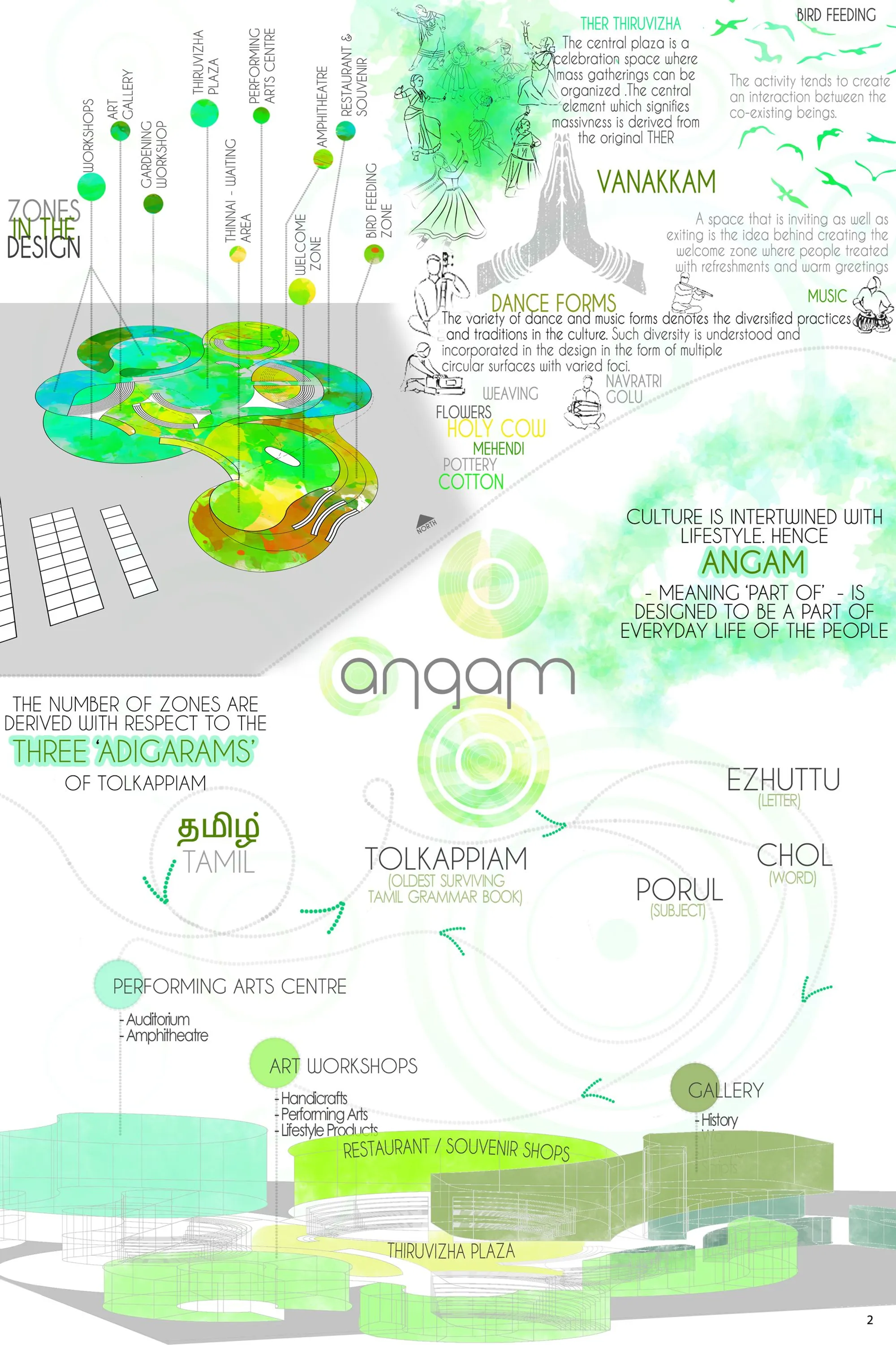
Designed by 72degN Design Studio and published on uni.xyz, Angam is sited within the urban fabric of Chennai, where it attempts to serve as a bridge between Tamil tradition and contemporary cultural production. The project layers multiple sources of inspiration: the monumental energy of the Ther Thiruvizha chariot festival, the threshold geometry of kolam patterns, and the agrarian landscape that has shaped Tamil identity for centuries. These references are not decorative appliqués. They structure the plan, define the public ground, and generate the building's living green roofscape.
A Floor Plan That Reads Like a Cultural Map
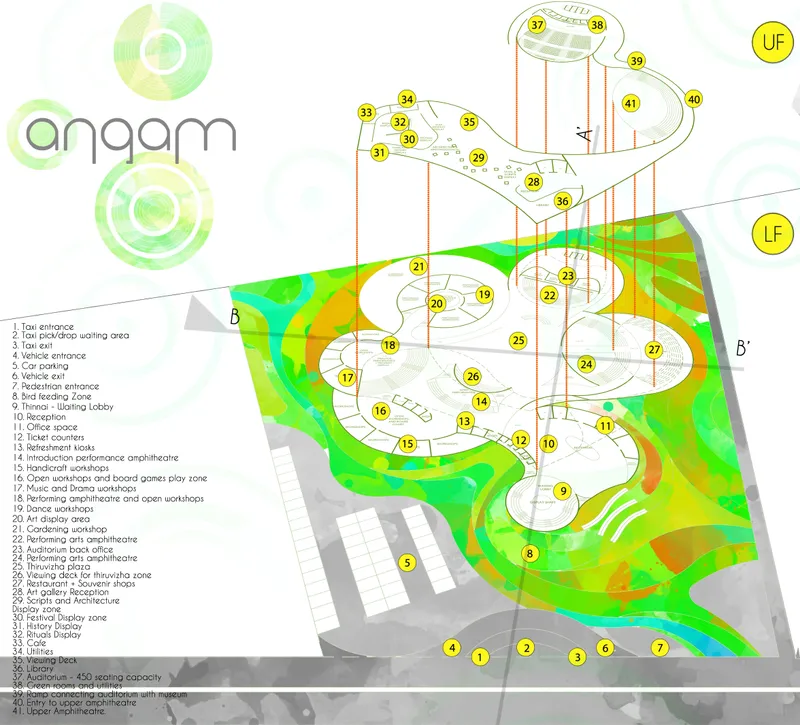

The plan reveals a network of interconnected circular and curvilinear volumes, each numbered and color-coded according to its programmatic role. These are not discrete pavilions but overlapping zones that flow into one another, recalling the way kolam patterns link node to node in continuous lines. The topographic color overlay in the plan is telling: it suggests that the building is less an object placed on the ground and more a landform that rises from it. Numbered program zones distribute art galleries, handicraft studios, dance and music spaces, workshops, and cultural retail throughout the organism, encouraging visitors to drift between making, watching, and participating.
The section drawings reinforce this reading. Arched interior volumes swell and compress like breath, their profiles clearly derived from the soft curves of Tamil letterforms. A topographic color gradient beneath the section line confirms the landform strategy: the structure emerges from the earth, its green roof folding and rising to create rooftop walkways, natural skylights, vegetated areas, and viewpoints that overlook the plazas and courtyards below. Light enters through carefully placed openings that frame the sky and produce shifting patterns of shadow across the interior.
Lattice Canopy and Sculptural Columns Define the Public Ground
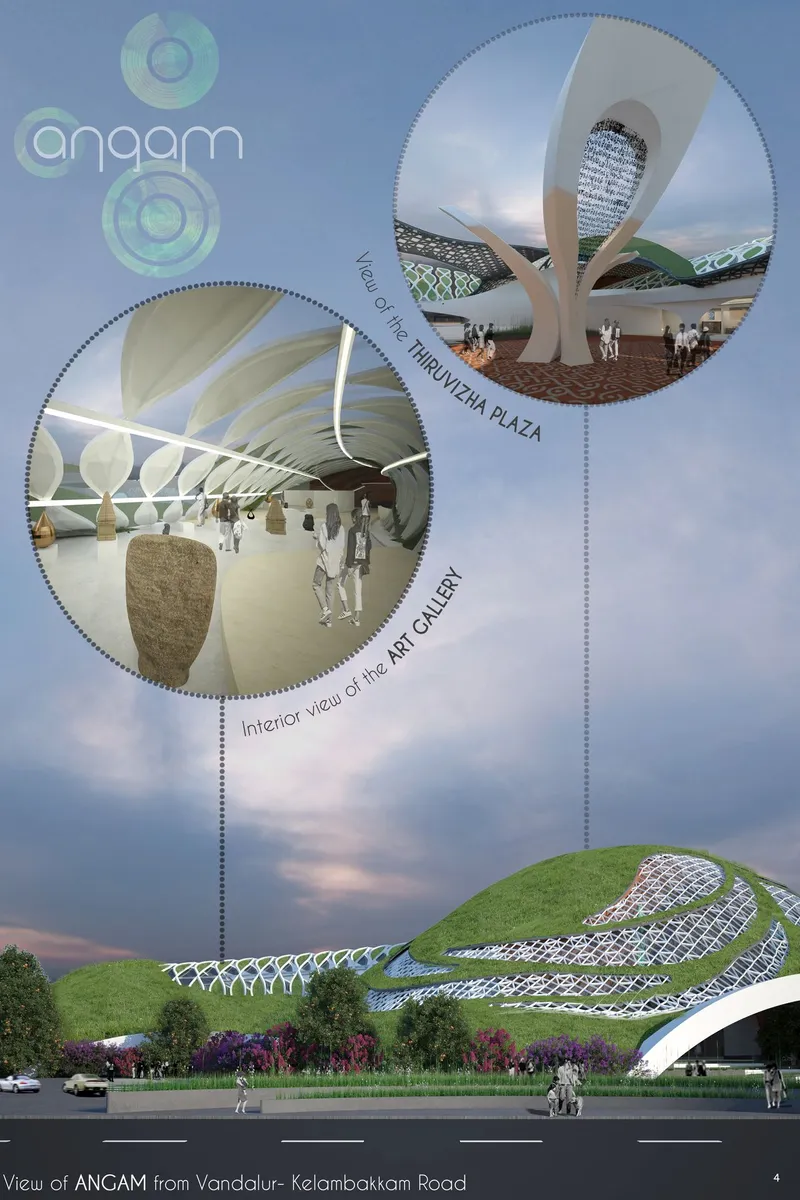
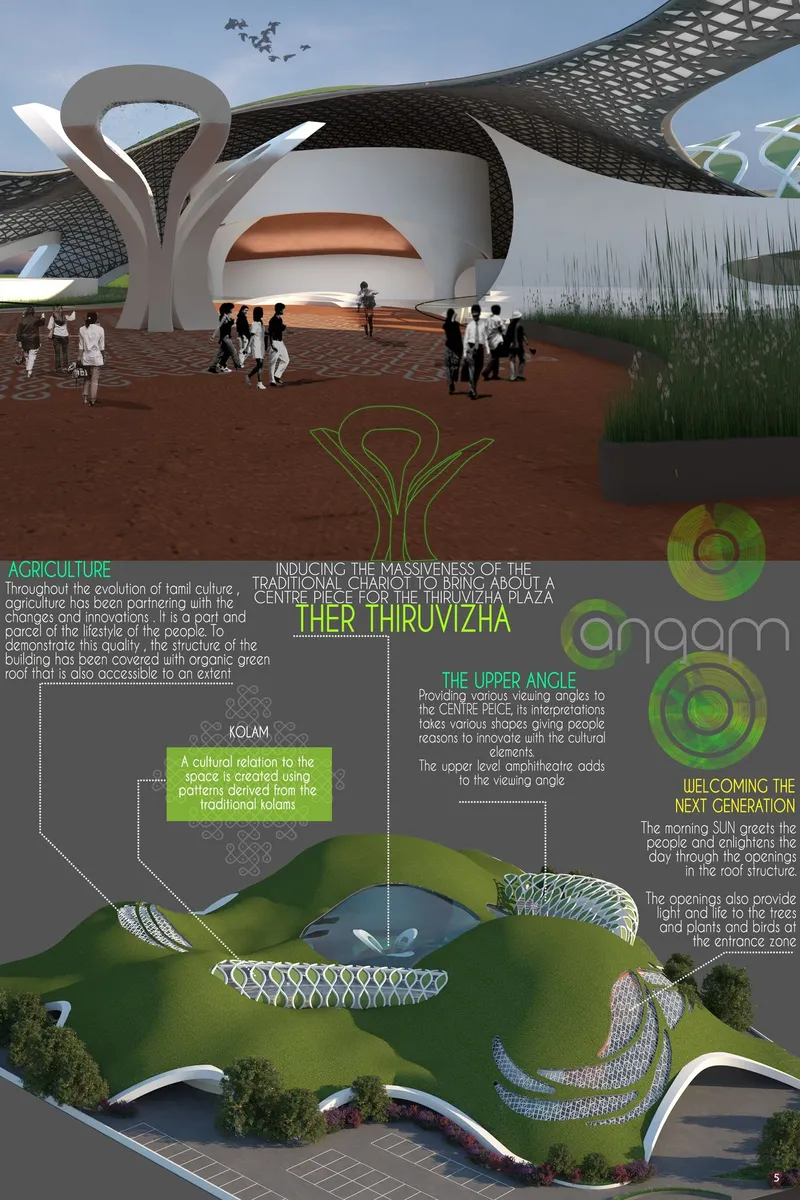
The exterior renderings show Angam meeting the street with white sculptural columns that branch upward to support a lattice roof canopy. The columns carry a deliberate organic logic: they taper, split, and curve in ways that recall both tree forms and the vertical energy of the Ther Thiruvizha chariot. The lattice overhead filters sunlight into dappled patterns on the paved surface below, creating a shaded public threshold that feels inviting without being enclosed. Pedestrians, vegetation, and street activity occupy the same frame, suggesting a building that does not wall itself off from Chennai's urban intensity.
The Thiruvizha Plaza, visible in the rendering, acts as the project's cultural anchor. Inspired by the communal spectacle and monumental presence of the chariot festival, this open space is designed for gathering, performance, and ritual. A vertical sculptural element anchors the plaza, functioning as a cultural beacon that draws people into the heart of the campus. Multi-level viewing decks, an introductory performance amphitheatre, and an open-air weekend theatre surround this central node, each supporting both traditional arts and contemporary events.
Patterned Ceilings and Planted Interiors Collapse Inside and Outside
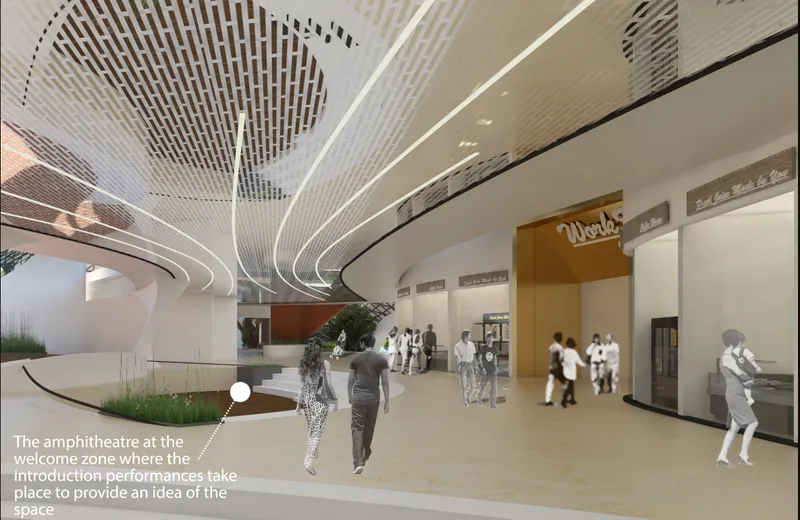

Inside, the lobby space reveals coffered ceiling panels perforated with geometric patterns that recall kolam motifs. Linear light strips run between the coffers, casting even illumination across a floor plane punctuated by planted beds. The planting is not incidental; it reinforces the project's agrarian symbolism and continues the landscape-as-architecture strategy that defines the exterior. Figures move through the space at a deliberate pace, suggesting interiors scaled for contemplation rather than throughput.
A corridor deeper in the building intensifies this spatial quality. Reflective flooring doubles the arched openings and sculptural white columns, producing a symmetry that amplifies the sense of depth. Ceiling light patterns shift from geometric coffers to softer, more organic arrangements, marking a transition between programmatic zones. The material palette is restrained: white surfaces and soft curves dominate, allowing natural and artificial light to become the primary experiential medium. Interactive boards, play zones, culinary kiosks, and heritage shops line these routes, turning the corridor into a productive cultural street rather than mere circulation.
Why This Project Matters
Angam's strength lies in the specificity of its cultural source material. Rather than gesturing vaguely toward "tradition" or "identity," the project isolates concrete elements of Tamil heritage, from the morphology of its script to the geometry of its threshold rituals, and translates each into an architectural operation. Script becomes roof profile. Kolam becomes landscape pattern. Festival becomes plaza. Agriculture becomes green roof. Each translation is legible without being literal, which is the difficult territory where cultural architecture either succeeds or collapses into pastiche.
The project also demonstrates how landform architecture can serve a cultural program. By merging building and ground plane, Angam avoids the institutional posture of a museum or performance hall sitting on a plinth. Instead, it offers a terrain that visitors ascend, descend, and inhabit, blurring the line between spectator and participant. For a space dedicated to living cultural production, where artisans work, performers rehearse, and communities gather, that spatial generosity matters more than any single formal gesture.
View the Full Project
About the Designers
Designer: 72degN Design Studio
Enter a Design Competition on uni.xyz
uni.xyz runs architecture and design competitions year-round that reward proposals with spatial conviction and real site intelligence.
Project credits: Angam by 72degN Design Studio.



Popular Articles
Popular articles from the community


The Musturak Paradise: Senior Living Architecture for a Connected Future in Temara, Morocco
The Musturak Paradise reimagines senior living architecture in Temara via private homes, social spaces, culture, community, and shared care.

Co-Life: Senior Housing Design That Reconnects Older Adults With the City
Co-Life reimagines senior housing design through healing gardens, shared streets, workshops, and a sustainable community across generations.

Conexión: Biophilic Design Reimagines High-Rise Living in Hong Kong
Conexión reimagines high-rise living in Hong Kong through biophilic design, green facades, shared spaces, daylight, water and nature within.

Co-life: Sustainable Architecture for Age-Friendly Community Living
Co-life reimagines sustainable architecture for seniors through courtyards, rammed earth, shared gardens, and spaces designed for belonging.

Similar Reads
You might also enjoy these articles
The Musturak Paradise: Senior Living Architecture for a Connected Future in Temara, Morocco
The Musturak Paradise reimagines senior living architecture in Temara via private homes, social spaces, culture, community, and shared care.

The Leaf Center: Cultural Center Architecture for Social Integration in Amsterdam
Cultural center architecture becomes a bridge at The Leaf Center, connecting international students with Amsterdam through art and exchange.
Conexión: Biophilic Design Reimagines High-Rise Living in Hong Kong
Conexión reimagines high-rise living in Hong Kong through biophilic design, green facades, shared spaces, daylight, water and nature within.

Wander to Wonder: Modular Playground Design for Children in Kutupalong Refugee Camp
Wander to Wonder uses modular playground design to create flexible, imaginative play spaces for children in Kutupalong refugee camp.

Explore Cultural Hub Competitions
Discover active competitions in this discipline


Challenge to design luxury tourism on rails


Challenge to reimagine the Iron Throne


Photograph architecture without architects


VR headsets Storefront design competition
Comments (0)
Please login or sign up to add comments
No comments yet. Be the first to comment!