
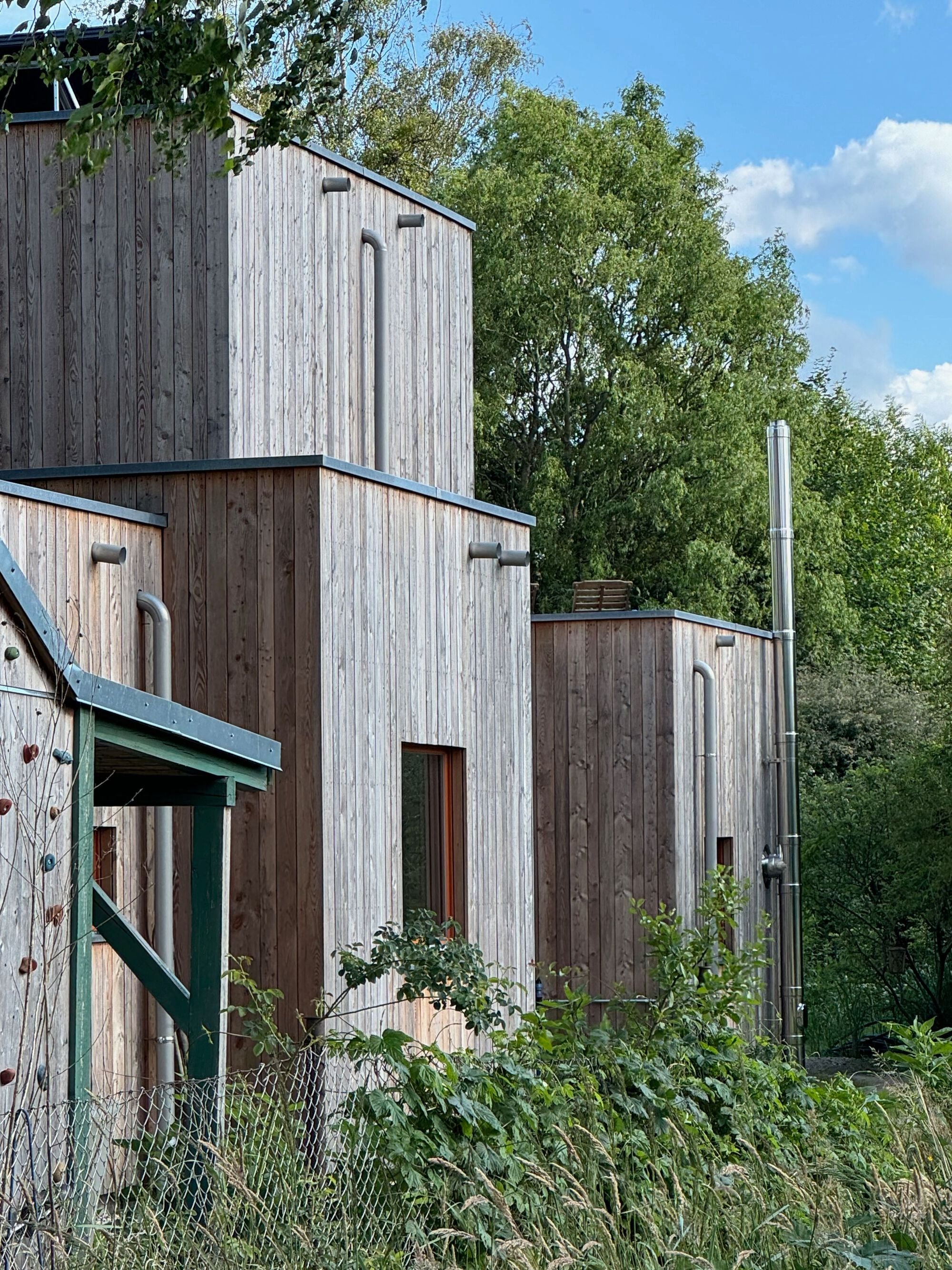
ANNABAU Scatters Five Timber Towers Across a Wooded Plot in Brandenburg
A 145-square-meter house in Falkensee breaks into five larch-clad volumes that weave between existing trees and open onto garden courtyards.

Most single-family houses try to be one thing: a consolidated box under a single roof, maximizing floor area for the budget. ANNABAU, led by architect Moritz Schloten, took the opposite approach in Falkensee, a small city in Brandenburg's Havelland region. Instead of one volume, the firm designed five, each a different size, clustered together on a long, narrow plot thick with mature trees. The result is a house that feels less like a building and more like a small settlement, its 145 square meters threaded between trunks and branches without felling a single tree.
What makes Falkensee II genuinely interesting is how it reframes domestic space as a landscape event. The staggered volumes create narrow passages and courtyard-like gaps along the east and west sides of the site, blurring the line between interior rooms and garden. Heated by solar thermal energy and a wood-burning stove, clad in rough-sawn untreated larch, and topped with green roofs, the house is also a quiet argument for low-tech sustainability. It doesn't shout about its environmental credentials; it just sits among the trees as though it belongs there.
Five Volumes, One House
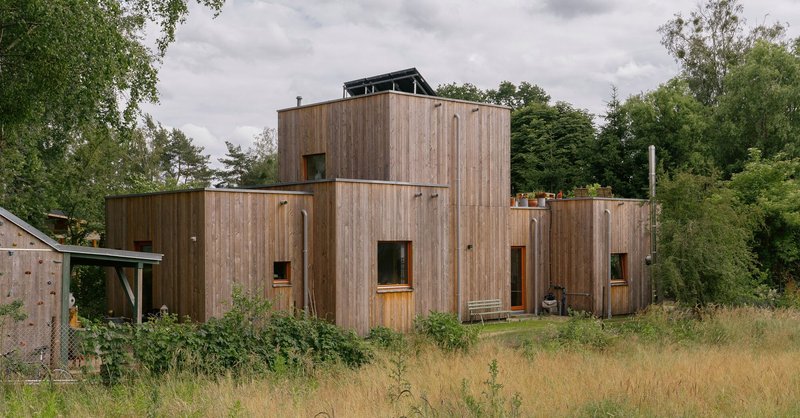
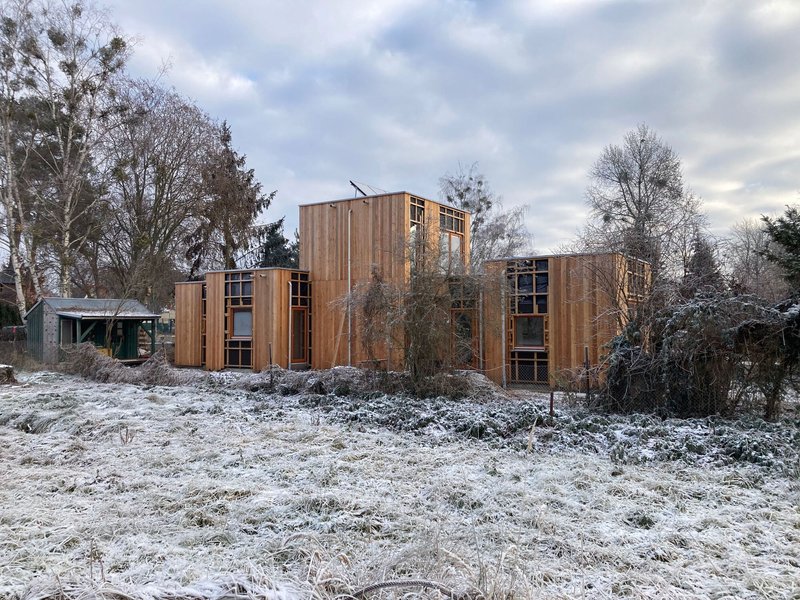
The five cubes vary in height and footprint, producing an irregular silhouette that echoes the uneven canopy above. Seen from a distance, especially under winter snow, the cluster reads as a group of agricultural outbuildings rather than a single residence. That ambiguity is intentional. By breaking the program into discrete pieces, ANNABAU gives each room a direct relationship with the garden and deep sightlines into the surrounding landscape.
The positioning of each volume responds directly to the existing trees on the 1,600-square-meter plot. Rather than clearing the site and designing freely, the architects mapped the root zones and canopy spread first, then fit the house into the leftover space. It's a reversal of the usual hierarchy between building and landscape, and it shows: the trees are clearly the dominant presence, with the house playing a supporting role.
Larch Skin and the Logic of Aging
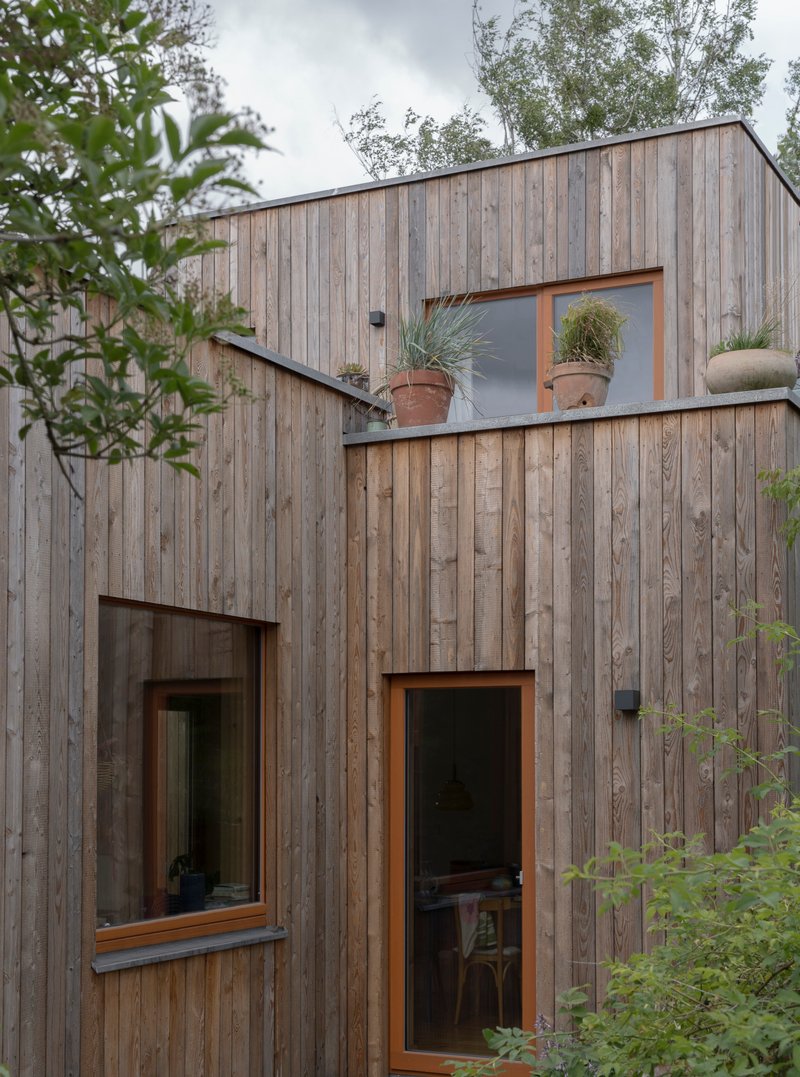
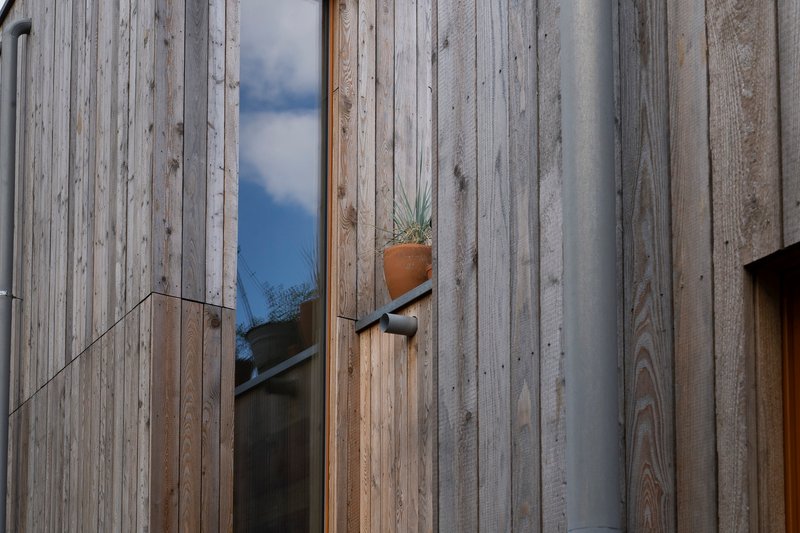
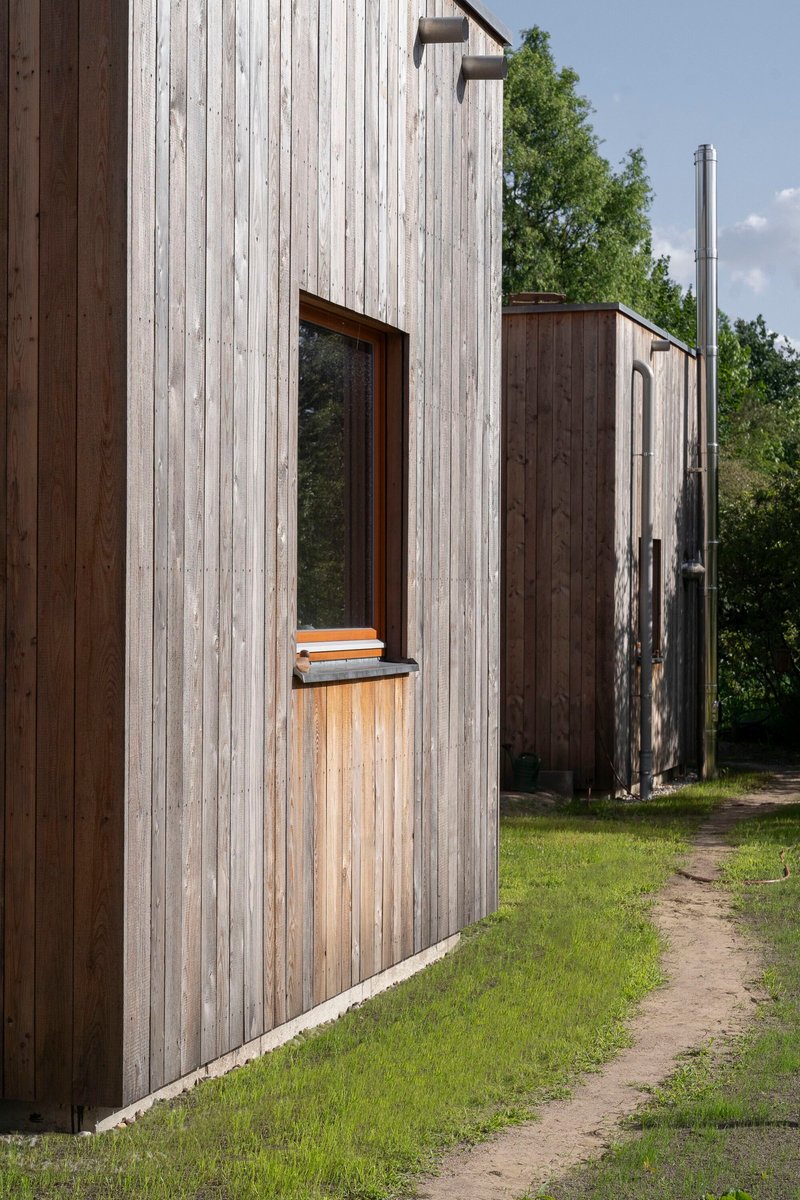
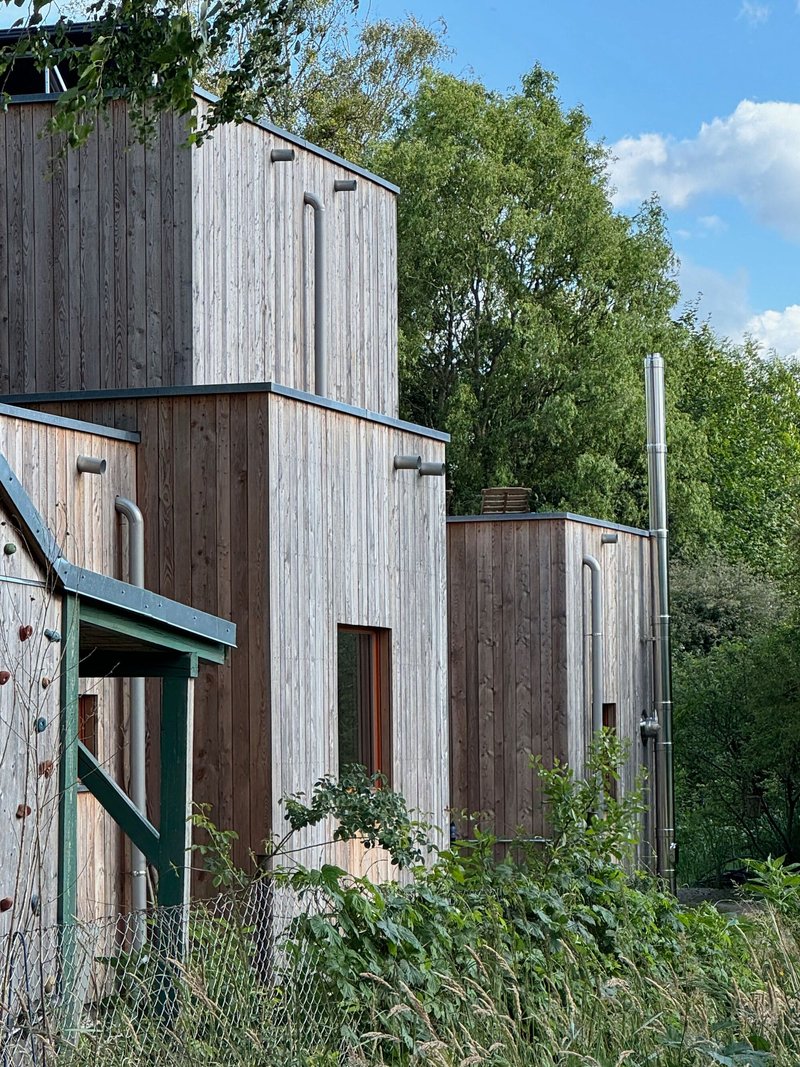
The facade is rough-sawn larch, left untreated. Already in the photographs you can see the silvering that comes with exposure to sun and rain, each face of each volume weathering at its own pace depending on orientation. The effect is tonal variation across the cluster: warmer honey on the sheltered sides, cooler grey where the weather hits hardest. It gives the house a texture that paint or stain could never replicate.
Window openings are punched sparingly and often stacked vertically, reinforcing the tower-like proportions. Small exterior shelves hold terracotta pots and grasses, a detail that softens the otherwise austere cladding. A metal flue pipe rising from one volume is the only element that breaks the strict material palette, its industrial finish a deliberate counterpoint to the organic timber surfaces.
Garden Rooms and In-Between Spaces
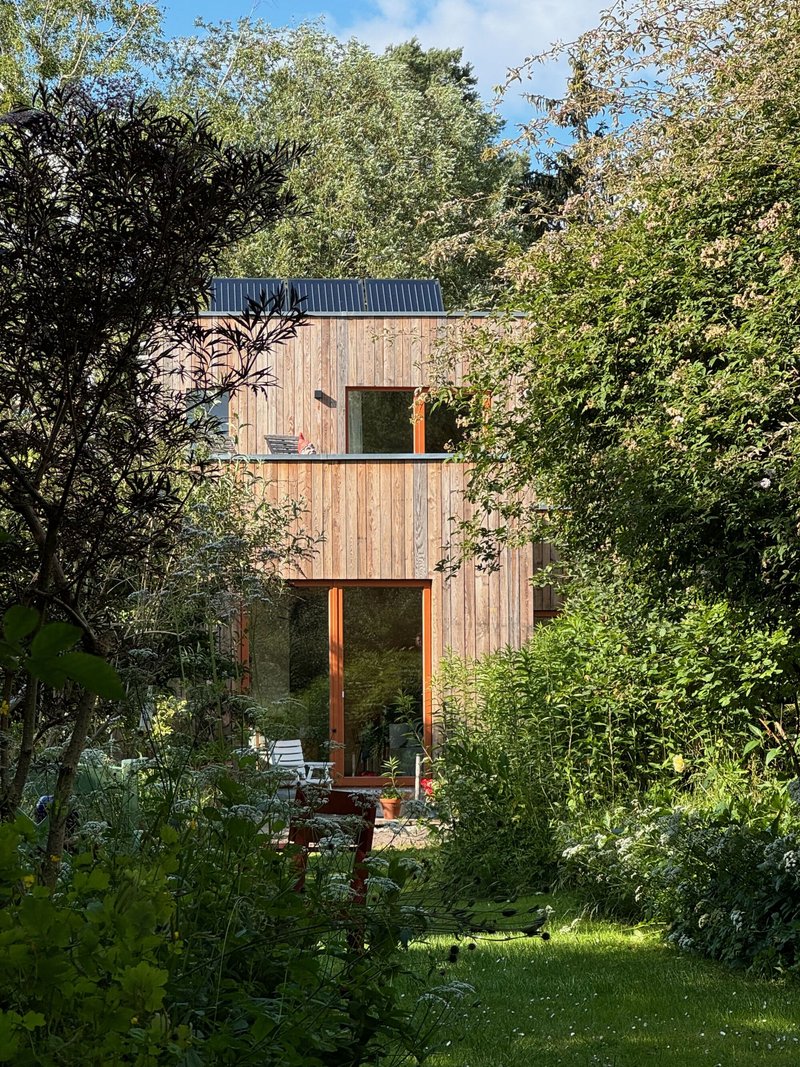
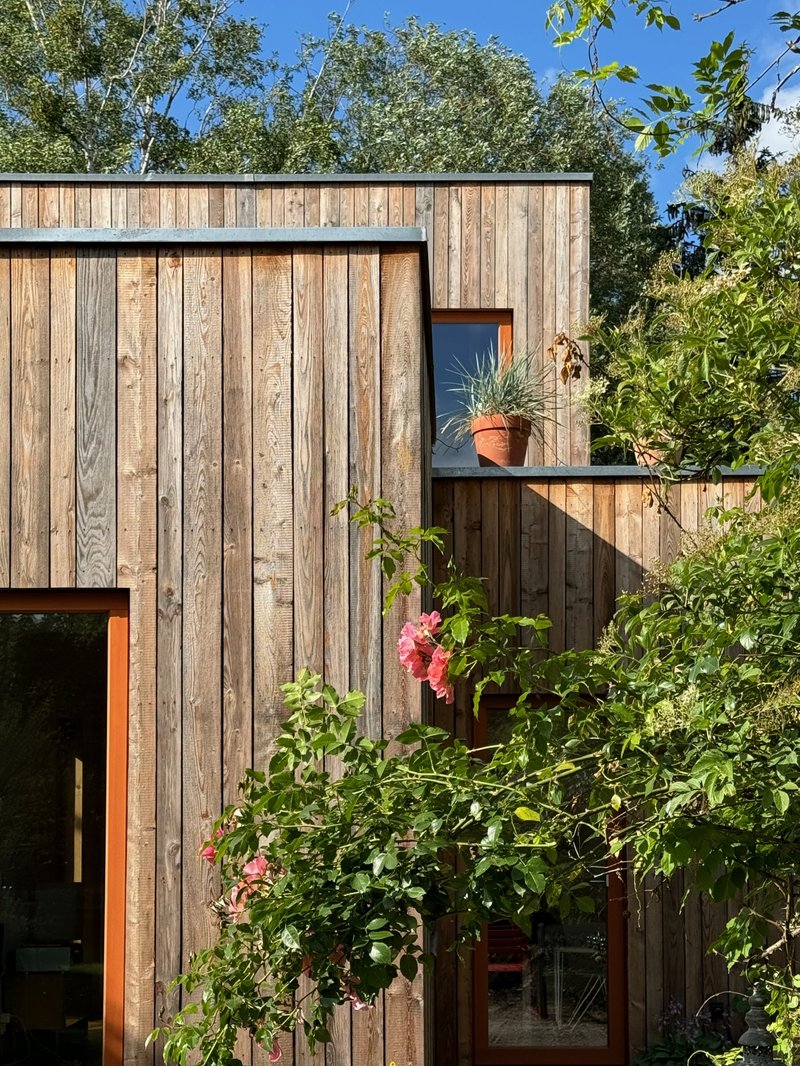
The gaps between volumes are as important as the rooms inside them. ANNABAU describes these as courtyard-like intermediate spaces, and the photographs confirm the idea: dense garden planting presses right up against the timber walls, and a southeast terrace connects two of the southern volumes to extend the living area outdoors. The house is less a boundary between inside and outside and more a series of thresholds.
Flowering roses, ornamental grasses, and lush foliage frame certain facades so completely that the timber cladding becomes a backdrop to the garden rather than the main event. Over the years, as the planting matures and the larch continues to silver, the line between architecture and landscape will only grow softer.
Interior Warmth and Material Continuity
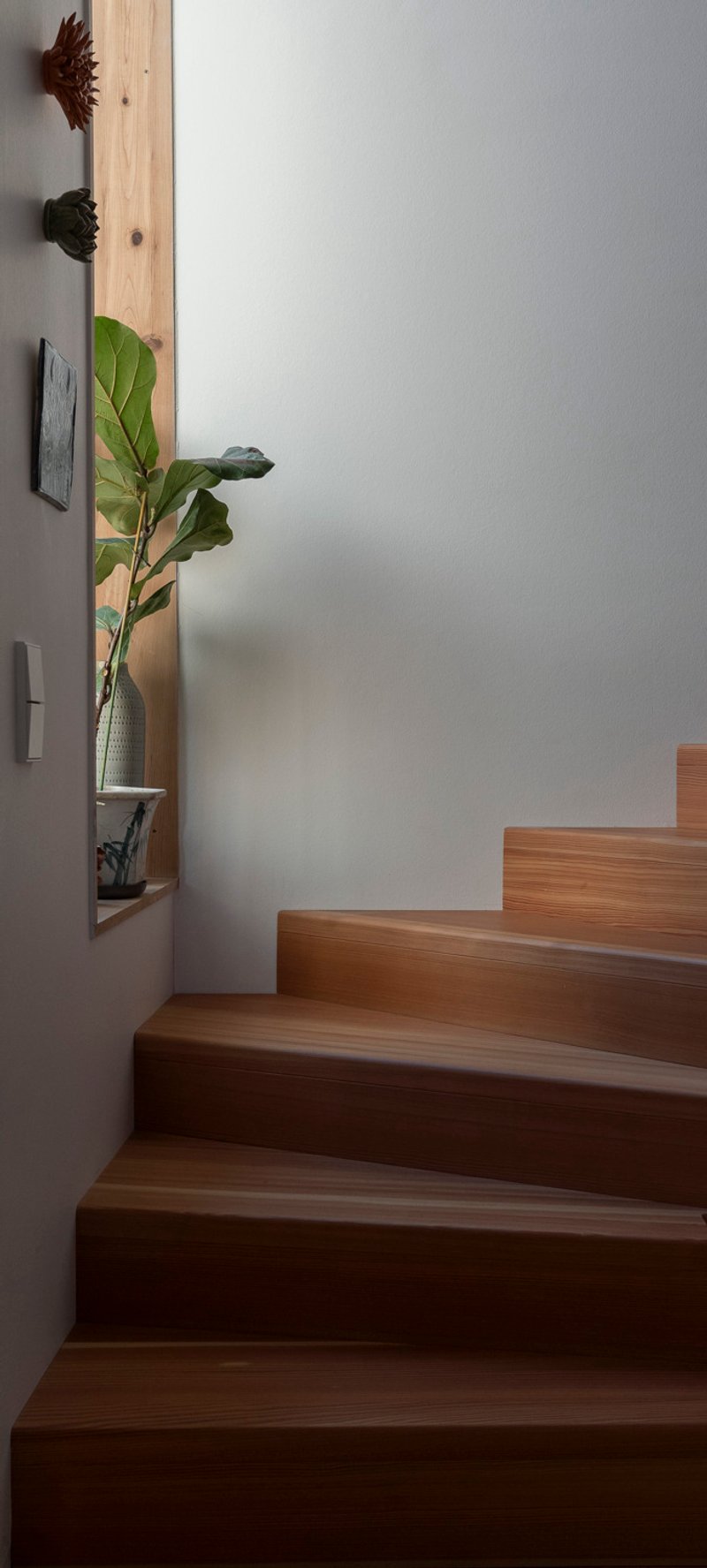
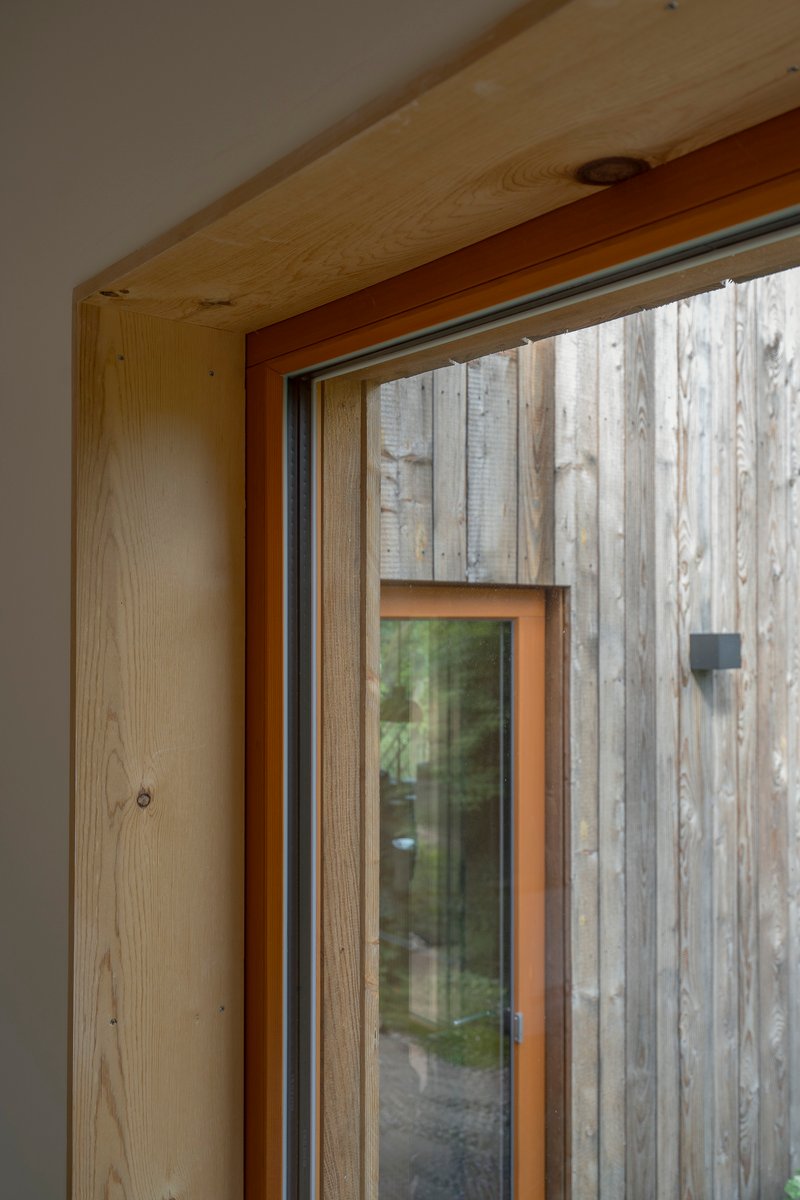
Inside, the material language shifts to white walls and timber detailing. A staircase with exposed wood treads connects the levels within one of the taller volumes, and the deep window jambs and soffits are lined in the same larch used on the exterior. Looking out through one of these openings, the view layers interior timber, exterior cladding, and garden vegetation into a single frame. It's a simple move, but it creates a visual continuity that holds the whole project together.
The interiors are compact by necessity. At 145 square meters spread across five volumes, no single room is large, but each one is given a carefully considered relationship to light and landscape. It's the kind of economy that comes from treating space as a precious resource rather than a commodity.
Green Roofs and Low-Tech Energy
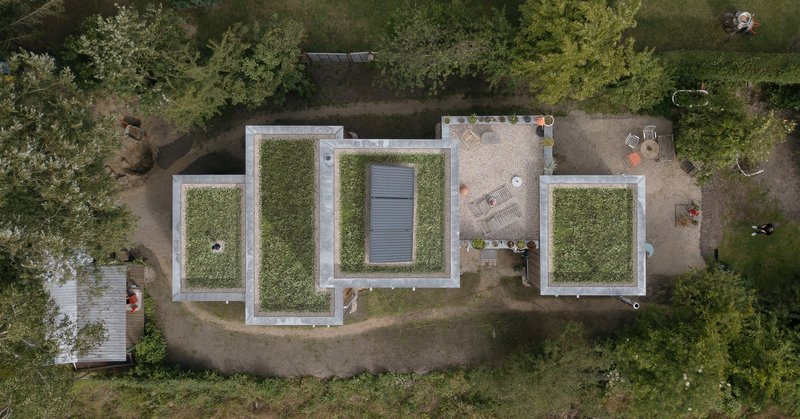
The aerial view reveals what you can't see from the ground: all five volumes carry green roofs, their grass surfaces bounded by white parapets and punctuated by at least one skylight. From above, the house nearly disappears into the site, its rooftops merging with the surrounding meadow. A generous rooftop terrace offers a second outdoor living level above the garden.
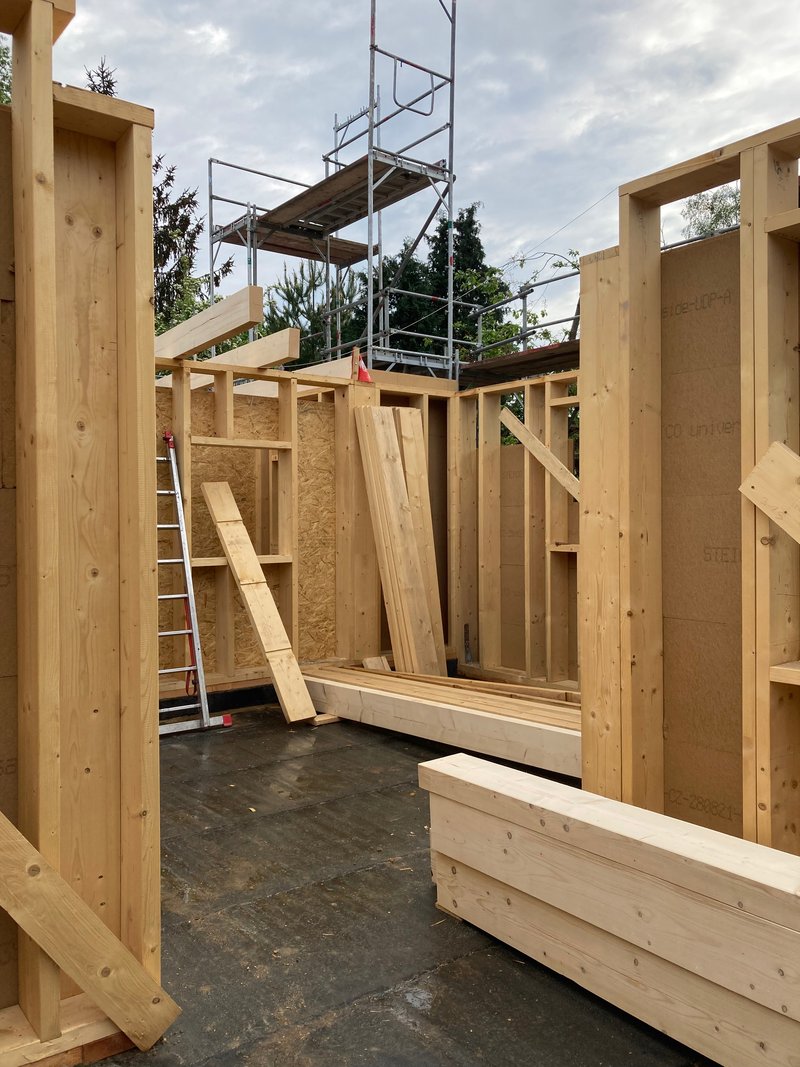
The construction photograph shows the timber frame mid-assembly: exposed studs, OSB sheathing, and cellulose blown-in insulation cavities waiting to be filled. The post-and-beam system is straightforward and replicable, with nothing proprietary about the joinery or detailing. Combined with the solar thermal heating and wood-burning stove, the energy strategy is deliberately low-tech. ANNABAU is betting that simplicity, not gadgetry, is the more durable path to sustainability.
Plans and Drawings
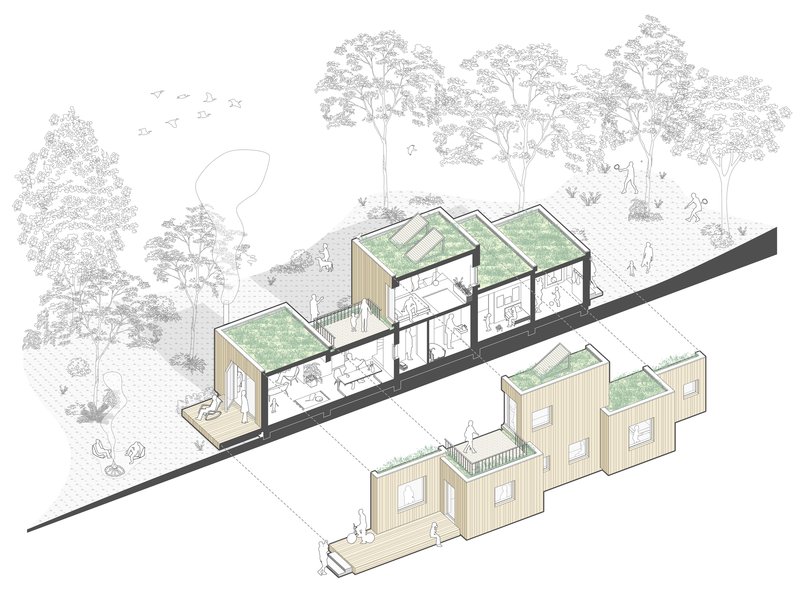
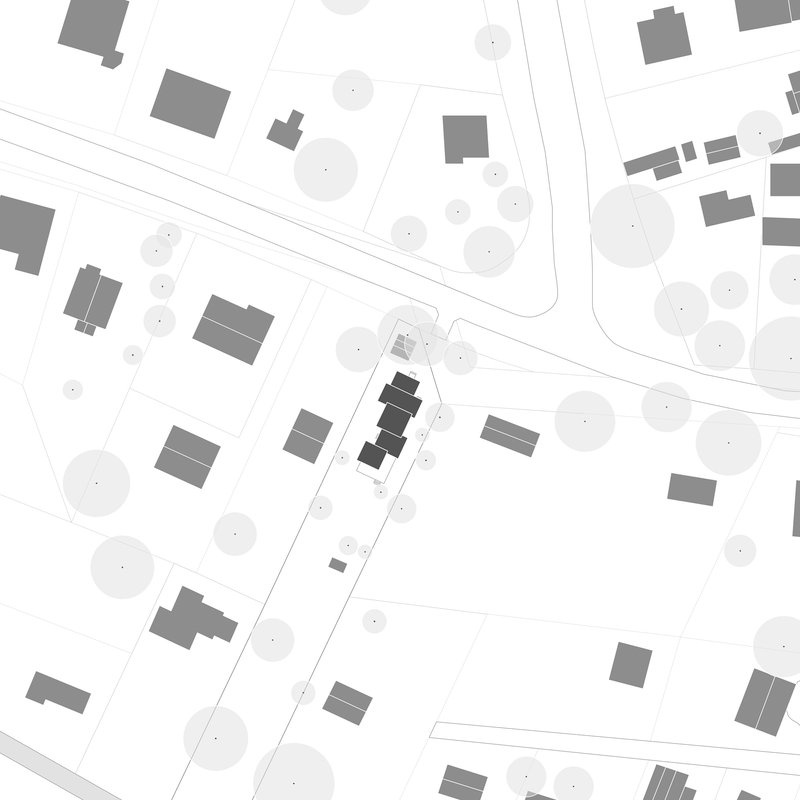
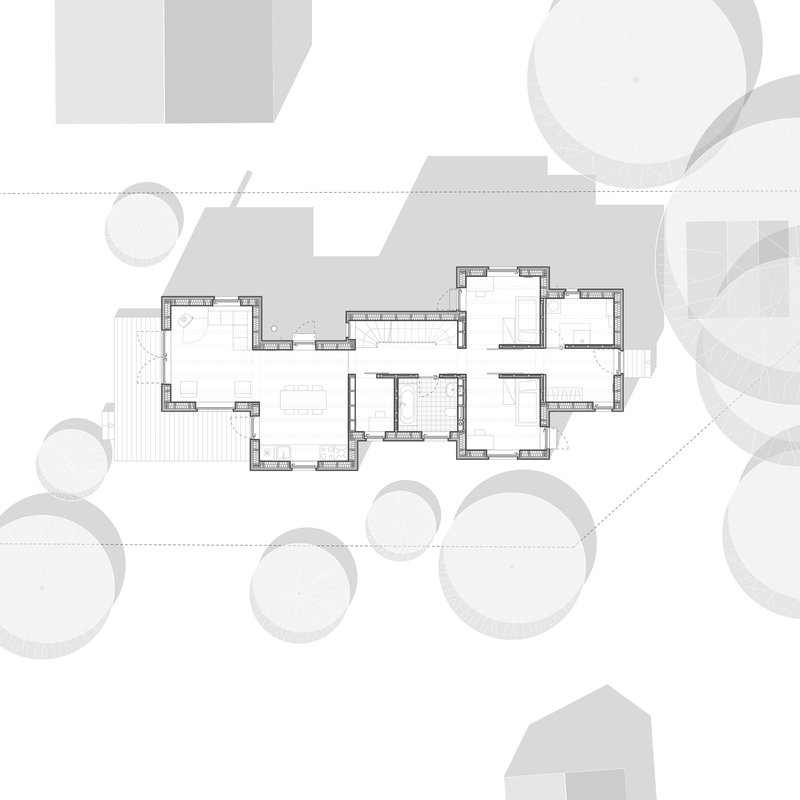
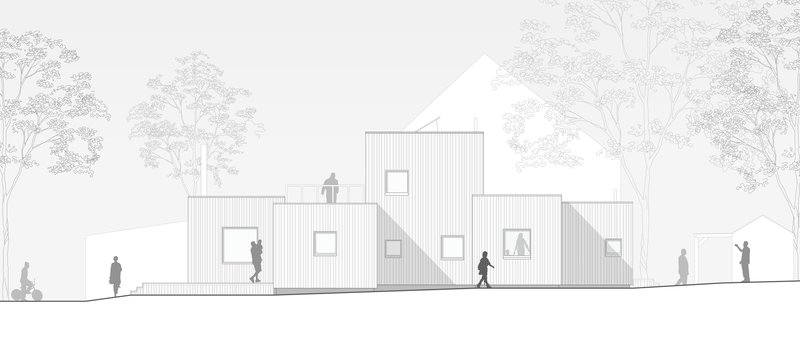
The axonometric drawing makes the spatial logic legible: five cubes of different heights, rotated slightly off one another, with green roofs settling them into the tree canopy. The site plan reveals the long, narrow geometry of the plot and the diagonal street frontage that prompted the staggered arrangement. In the floor plan, the interconnected rooms cluster around a central stair core, and the surrounding tree canopies are drawn with the same care as the walls, underscoring ANNABAU's claim that the landscape was the primary design driver.
The elevation drawing confirms the vertical emphasis of the individual volumes and the careful scattering of windows. Silhouetted figures at ground level give a sense of scale: these are modest towers, not monuments, and their domestic proportions are part of what makes the project feel approachable rather than heroic.
Why This Project Matters
Falkensee II matters because it demonstrates that a house can be radically fragmented without becoming impractical. Breaking the program into five volumes is a risk. It increases surface area, complicates circulation, and multiplies the number of foundations, walls, and roof assemblies. But ANNABAU uses that fragmentation to gain something that a conventional plan cannot offer: a house that lives inside its garden rather than next to it. Every room is a corner room. Every threshold opens onto a different microclimate of shade, sun, or breeze.
The project is also a useful counterpoint to the prevailing assumption that sustainable architecture requires complex systems. Here, the toolkit is old-fashioned: larch, cellulose, a wood stove, a green roof, and enough common sense to leave the trees standing. It won't win awards for technological innovation, but it will age well, both materially and conceptually. In ten years, when the larch has gone fully silver and the roses have climbed to the second floor, Falkensee II will look less like a new house and more like something that was always there.
Falkensee II Single-Family House by ANNABAU (lead architect: Moritz Schloten). Falkensee, Germany. 145 m². Completed 2022. Photography by Christian Damman.
About the Studio
Share Your Own Work on uni.xyz
If projects like this are the kind of work you want to make, uni.xyz is a place to publish your own, find collaborators, and enter design competitions.




Popular Articles
Popular articles from the community

A.N. Tombazis and K-Studio Bury a Luxury Resort into a Peloponnese Hillside
Mandarin Oriental Costa Navarino scatters 99 earth-sheltered rooms across 140 hectares above the Bay of Navarino in Pilos, Greece.
UNA Barbara e Valentim Plants Four CLT Bungalows in a Fragile Ceará Landscape
Prefabricated eucalyptus timber cabins touch down lightly on the sandy, biodiverse coast of Barroquinha, Brazil.

CRACK: Winery Architecture Carved Into the Landscape
CRACK reimagines winery architecture as a buried path through vineyard terrain, linking production, tasting, lodging, landscape and culture.
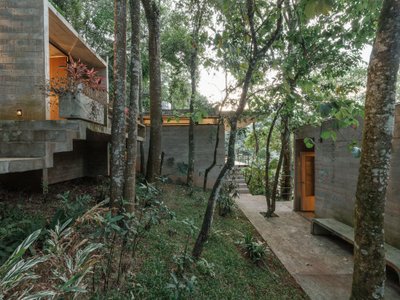
Terra e Tuma Scatters Four Concrete Pavilions Through the Atlantic Forest in Mairiporã
A fragmented compound of music studio, art studio, chapel, and living quarters preserves every tree on a steep forested hillside near São Paulo.


Similar Reads
You might also enjoy these articles
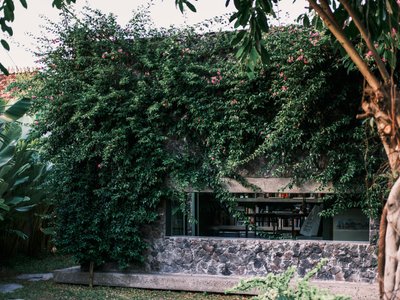
Private Villa in Ubud by BAMM ARCHITECTS: Contemporary Design Amidst Bali’s Jungle
Private Villa in Ubud blends contemporary design with tropical landscape, featuring open-air pavilion, stone and wood materials, suspended master bedroom, and jungle pool views.
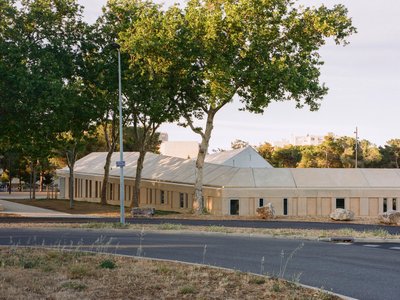
School Group Samuel Paty in Béziers: A Contemporary Educational Campus by Ateliers O-S Architectes and NAS Architecture
Samuel Paty School in Béziers features concrete massing, porous courtyards, metal structures, and landscaped playgrounds, creating a child-scaled, light-filled learning environment.
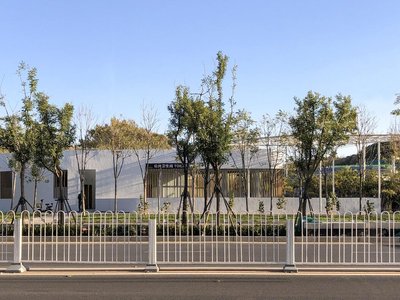
Four Public Pavilions in Beijing by Aurélien Chen and CSCEC
Four park pavilions in Beijing combine public services with floating roofs, acting as subtle urban signals integrated into landscape contextually.
LÁ-SÁCH House by Atelier tho.A
Compact tropical tube house-library with polycarbonate louvers, flexible interiors, concrete core, crafted materials, and community-focused alley setback.

Explore Landscape Design Competitions
Discover active competitions in this discipline




The Global Benchmark for Architecture Dissertation Awards


Challenge to design mud housing for contemporary communities
Comments (0)
Please login or sign up to add comments
No comments yet. Be the first to comment!