

Another Way to Accompany: A Yarn Canopy That Weaves Memory into Urban Life
A biophilic cemetery reimagines death as continuity, wrapping remembrance and ecology beneath an undulating mesh structure.


What if a cemetery didn't feel like an ending? "Another Way to Accompany" proposes a radical shift: a landscape where the dead become the air you breathe, the shade that cools you in summer, the fragrance drifting through a grove of trees. At its core is a yarn-like mesh canopy that drapes across an urban site, its undulating geometry symbolizing the interwoven connections between life and memory. The structure does not wall off grief; it folds it into the city, creating a space that belongs as much to the living as to those being remembered.
Designed by Windy AO, 赵兮, Yang Xinyu, and 雪李, the project earned runner-up honors in the Circle of Life competition. The brief called for rethinking how death is spatialized, and this team responded with a biophilic architecture that integrates nature with the built environment, transforming the cemetery from a place of separation into a sustainable, inclusive piece of urban infrastructure.
A Canopy That Rises Like Terrain

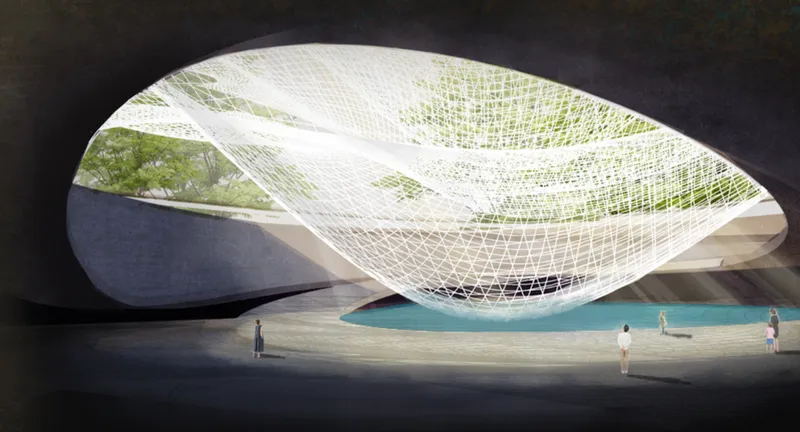
The defining gesture is the mesh canopy itself, a flowing surface that lifts and dips across a grass field like a second ground plane. Visitors walk beneath it in a misty atmosphere where the boundary between built structure and natural landscape dissolves. The yarn-like material filters light without blocking it, producing soft, dappled conditions underneath. It is not monumental in the way cemeteries traditionally are; instead, it is atmospheric, inviting slow movement and quiet contemplation.
Inside, the draped roof creates a cathedral-like interior without walls. A reflecting pool sits below, doubling the canopy overhead and extending the sense of enclosure downward into the ground. Water, light, and mesh work together to produce a space that feels both sheltered and open. The effect is less about architectural spectacle and more about emotional calibration: a place tuned to the specific register of remembrance.
Layered Sections: Planted Roofs Above, Infrastructure Below

The section drawing reveals the project's ambition beyond its visible surface. The roof is not a single membrane but a layered system with planted surfaces that support vegetation, linking the canopy to the ecological cycles of the site. Below grade, the design accommodates underground parking, acknowledging the urban realities of access and logistics without allowing them to dominate the experience at ground level. This vertical stacking of program, from memorial landscape to functional infrastructure, is what makes the project genuinely urban rather than pastoral fantasy.
Folding Logic: From Flat Sheet to Spatial Landscape
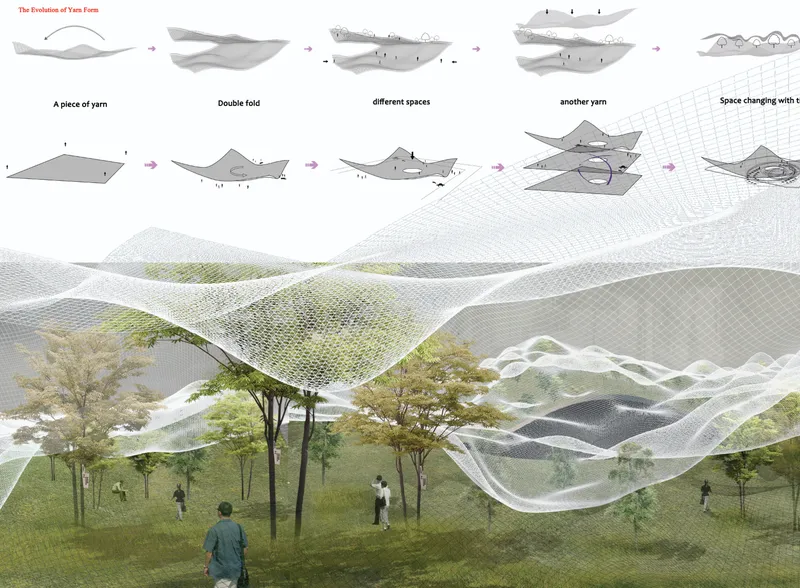
A diagrammatic sequence illustrates how the roof form is generated through a folding operation, transforming a flat plane into the undulating canopy that defines the project. The folds are not arbitrary; they create valleys that collect rainwater and peaks that allow trees to push through the structure, blurring the line between architecture and horticulture. The diagram, set above a view of the site with existing trees, makes it clear that the design responds to what is already there rather than imposing a form from outside.
Sheltering Trees and Water: Close-Range Biophilia
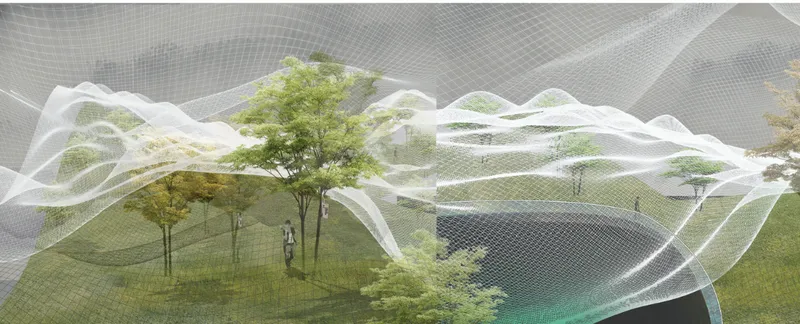
At close range, the layered mesh canopy becomes something almost textile: a woven screen that shelters mature trees and a water feature below. The relationship between the structural mesh and the organic forms of tree canopies is deliberately ambiguous. Which is the architecture, and which is the landscape? The project refuses to answer cleanly, and that refusal is its strongest move. Nature is not decorating the building; it is co-producing the space. The fragrance of the trees, the sound of water, the filtered light through mesh and leaf together compose the memorial experience.
Why This Project Matters
Cemeteries occupy an uncomfortable position in contemporary urbanism. They consume land, resist densification, and enforce a separation between the living and the dead that many cultures are beginning to question. "Another Way to Accompany" challenges all three of these norms by proposing a cemetery that is also a park, an ecological system, and a piece of urban infrastructure. Its biophilic approach is not decorative greenwashing; it is structural, embedding nature into the spatial logic of remembrance so that the dead literally continue as the environment the living inhabit.
The team's conceptual clarity is what sets this entry apart. The yarn metaphor could easily have remained surface-level symbolism, but here it drives material choices, structural logic, and the experiential quality of the space. Memory, the project argues, is not a thing stored in a marble slab. It is a condition that surrounds you: woven overhead, reflected underfoot, breathed in with every visit. That is a powerful proposition, and it earned its place as a runner-up in a competition asking how architecture might rethink the circle of life.
View the Full Project
About the Designers
Designers: Windy AO, 赵兮, Yang Xinyu, 雪李
Enter a Design Competition on uni.xyz
uni.xyz runs architecture and design competitions year-round that reward proposals with spatial conviction and real site intelligence.
Project credits: Another Way to Accompany by Windy AO, 赵兮, Yang Xinyu, 雪李 Circle of Life (uni.xyz).


Popular Articles
Popular articles from the community


ETEH Reworks the Shared Spaces of São Domingos School in Brazil Around Timber, Color and Hanging Plants
At São Domingos School in Brazil, 436 m² of hall, refectory and library are recast with timber joinery, a yellow and blue code and trailing greenery.


Aquadapt: An Underwater Habitat That Rewrites Its Rooms by the Hour
Curved modules ring the seabed while one shell shifts from breakfast room to cinema, farm and football pitch as residents' needs change.

The Amber Palace Opera: A Geological Fiction Surfaces on Tallinn's Baltic Waterfront
Pierre Brillard reimagines a Baltic legend as a public landscape, opera house, and waterfront promenade rooted in Tallinn's coastal identity.

FCC Arquitectura Expands a Portuguese Granite House with a Board-Marked Concrete Wing
In Portugal, JV House pairs a cleaned-up whitewashed and granite dwelling with a timber-shuttered concrete extension, courtyards and a garden pool.

Similar Reads
You might also enjoy these articles

Vereda Arquitetos Renovates a 40-Square-Meter Apartment Inside Niemeyer's Copan Building
A compact unit in São Paulo's most iconic residential tower gets a material overhaul that pairs exposed concrete with bold blue Formica.

Shakur's House: Exposed Brick as an Interior Organiser in a 168 m² Mashhad Residence
Brick moves indoors in this Mashhad residence, where masonry walls, glass partitions and teal planes sequence a compact home without closing it off.

Day and Night Park: A Time-Based Urban Newsstand in Beijing
A temporary urban newsstand in Beijing blending travel, light, and reading through poetic colors, compact form, and community-focused design.

Modernist Patio Renovation in El Masnou, Barcelona by Oliver Segura Arquitectura + Cebrià Arquitectura
Modernist patio renovation blending tradition and innovation with a movable pool, leveled floors, and Catalan materials in El Masnou.

Explore Nature Inspired Competitions
Discover active competitions in this discipline

Challenge to design a portable theatre

Challenge to design a portable music platform

Challenge to design an open learning module for the elderly

Design challenge to reuse E-waste
Comments (0)
Please login or sign up to add comments
No comments yet. Be the first to comment!