

Anti-Ghetto Library: Redefining the Library as a Vertical Social Condenser in Poland
A stepped, multi-programmed civic building that balances monumentality with intimacy, linking city to forest through adaptive reuse principles.


What happens when a library stops being a quiet box of books and becomes a vertical campus that absorbs the functions of a museum, conference center, community kitchen, gaming zone, and co-working space? The Anti-Ghetto Library proposes exactly that: a staggered mass that rises from the ground like a social condenser, distributing public life across terraces and programmatic thresholds. It is an architecture that refuses the single-use label, instead positioning the library as an instrument of civic repair, designed to reintegrate fragmented urban territories and counteract social isolation.
Designed by Beyza Capal and situated in Poland, the project draws on the tension between the country's historical memory and its aspirational future. The building occupies a site where urban fabric meets forest edge, and the architecture responds to both conditions with distinct faces: open and stepped toward the city, closed and introspective toward nature. Juror Jaap Wiedenhoff, Partner and Senior Consultant at ABT Netherlands, described the basic idea as "quite good" while noting the density of overlapping concepts. That density, however, is precisely what makes the proposal worth examining.
A Stepped Mass Between City and Forest
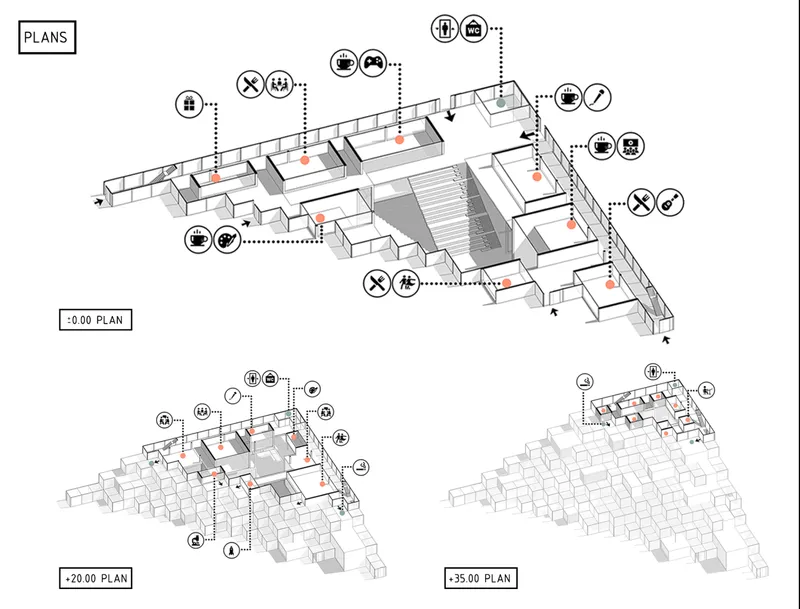
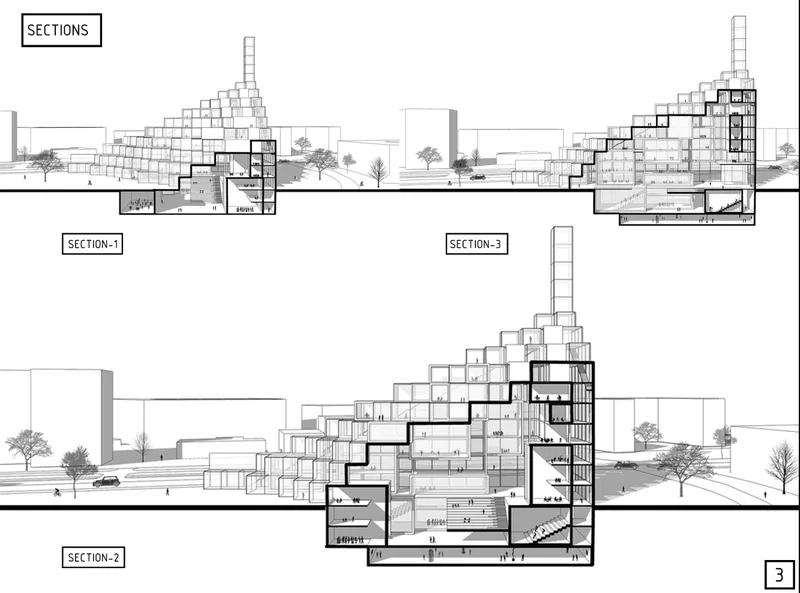
The axonometric and section drawings reveal the building's core organizational logic. Three stacked programmatic levels cascade in a staggered formation, creating terraces that mediate between interior program and exterior landscape. The approach facade functions almost like a street: stepped, permeable, and kinetic, drawing pedestrians through a sequence of open thresholds before they enter the building. On the opposite side, facing the forest, the massing tightens into a more closed and contemplative posture. This dual identity is the project's strongest spatial argument, a built metaphor for the balancing act between noise and calm, past and future.
At the base, the most interactive zones, including the museum and conference hall, generate foot traffic and public engagement. As the building rises, programs become progressively quieter: reading rooms, study pods, and isolated work areas occupy the upper levels. A circulation spine runs vertically through the entire assembly, acting simultaneously as structural core and symbolic connector. It is a tower of movement that stitches the social life of the ground to the solitude of the sky.
An Atrium That Breathes Light Through Multiple Levels
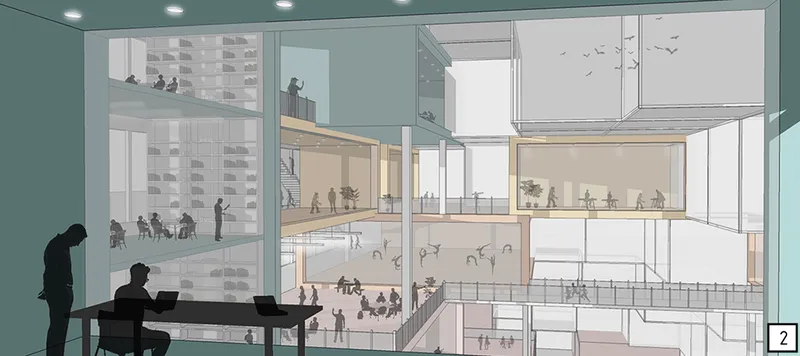
The interior perspective sketch captures a multi-level atrium flooded with natural light from above. Occupants populate various floors, visible to one another across open edges and mezzanines. This is not accidental. The atrium works as a social instrument, making the building's collective life legible to anyone inside it. You see people studying, gathering, moving between levels, and the architecture frames all of it. The vertical openness also supports the project's passive energy ambitions: daylighting penetrates deep into the plan, while the stepped section encourages cross-ventilation across floors.
Spatial Layering and the Rhythm of Daily Use
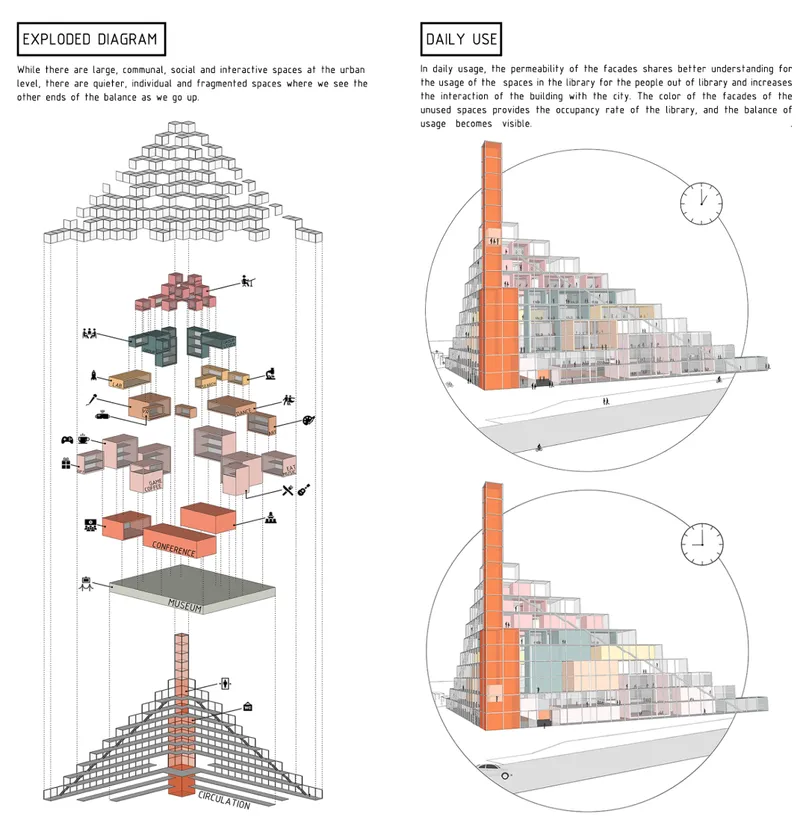
The exploded axonometric diagram and sectional vignettes lay bare the building's adaptive and modular design logic. Each program zone is treated as a discrete module within the larger assembly, allowing for a reading of the building as a kit of parts rather than a monolith. Particularly compelling is the color-coded facade system, which visually reflects usage patterns throughout the day. As occupancy shifts from conference halls in the morning to gaming zones in the evening, external color tones change, signaling active zones to passersby. The building communicates its own rhythm to the city, turning interior life into a legible public broadcast.
Brick Screens and Collective Gathering on the Grand Stair
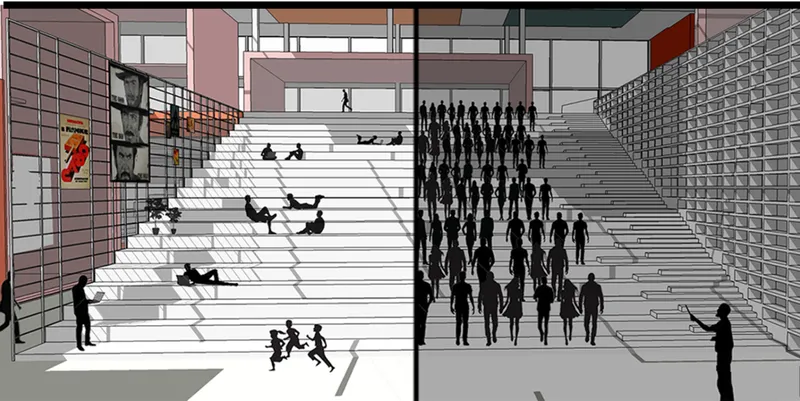
The wide interior stair, flanked by brick screening walls, is one of the project's most evocative spaces. It operates as both circulation and forum: occupants gather on the steps, linger at the landings, and use the stair as a social space in its own right. The brick screens filter light and views without sealing off the interior, maintaining the permeability that defines the entire approach facade. This is where the building's ambition as a social condenser becomes most tangible. The stair is not a corridor. It is a room.
Why This Project Matters
The Anti-Ghetto Library tackles a question that most library competitions sidestep: what does a library owe to the neighborhood around it? Capal's answer is expansive. By loading the program with community kitchens, co-working zones, gaming areas, and museum galleries alongside traditional reading spaces, the project argues that a library's primary material is not books but people. The stepped massing, the dual-faced relationship to city and forest, and the color-responsive facade all serve that argument with spatial precision.
Wiedenhoff's critique about conceptual dispersion is fair. Not every idea here lands with equal clarity, and the sheer programmatic density risks diluting the elegant simplicity of the balancing metaphor. But the ambition is worth defending. In a discipline that often treats libraries as monuments to silence, this project insists on friction, overlap, and encounter. It proposes the library not as a retreat from the city, but as the city itself, compressed and stacked into a single civic address.
View the Full Project
About the Designers
Designer: Beyza Capal
Enter a Design Competition on uni.xyz
uni.xyz runs architecture and design competitions year-round that reward proposals with spatial conviction and real site intelligence.
Project credits: "Anti-Ghetto Library by Beyza Capal.


Popular Articles
Popular articles from the community

Tsunami Convergenics: Turning Catastrophic Ocean Forces into Underwater Housing Infrastructure
A speculative underwater settlement off the coast of Onagawa, Japan, treats tsunamis and typhoons as energy sources rather than threats.
Temporary Home for Dogs: A Reversed Zoo Rethinks Animal Shelter Architecture
In Bucharest, a sinuous corridor and freed landscape flip the logic of containment, designing a shelter that works to make itself unnecessary.
Manzana Morphosis: Stretching Barcelona's Grid into a Living Landscape for 2050
A radical reworking of the Eixample manzana turns density into a tool for generous public space, vertical ecology, and environmental performance.

Cloaked Colonization: A Mobile Underwater Habitat That Moves Like a Fish
Micah Abaya's shortlisted EHC Pacific entry reimagines ocean settlement as a dispersed network of self-sustaining architectural organisms.

Similar Reads
You might also enjoy these articles

Shakur's House: Exposed Brick as an Interior Organiser in a 168 m² Mashhad Residence
Brick moves indoors in this Mashhad residence, where masonry walls, glass partitions and teal planes sequence a compact home without closing it off.

Day and Night Park: A Time-Based Urban Newsstand in Beijing
A temporary urban newsstand in Beijing blending travel, light, and reading through poetic colors, compact form, and community-focused design.

Modernist Patio Renovation in El Masnou, Barcelona by Oliver Segura Arquitectura + Cebrià Arquitectura
Modernist patio renovation blending tradition and innovation with a movable pool, leveled floors, and Catalan materials in El Masnou.

Alto Residencial Coop: Cooperative Housing Development in Santiago de Compostela by Carbajo Barrios Arquitectos
A linear cooperative housing complex blending white volumes and perforated metal façades, enhancing community living, natural light, privacy, and urban integration.


Comments (0)
Please login or sign up to add comments
No comments yet. Be the first to comment!