

ARC Arctic: Modular Domed Settlements for Ellesmere Island's Polar Extremes
A scalable urban ecosystem on Ellesmere Island pairs reconfigurable modules with multilayer dome membranes and hyperloop transit.


Building a city at the edge of the habitable world demands a fundamentally different logic of urban growth. ARC Arctic proposes that logic: a section-based masterplan where every module can function independently or lock into a larger network, all sheltered beneath dome-shaped multilayer membranes engineered to retain heat, harvest solar energy during polar nights, and resist the full spectrum of Arctic precipitation. The settlement targets Ellesmere Island, one of the most remote and climatically severe territories on Earth, and treats that severity not as a limitation but as the primary design driver.
Designed by Azamat Rakhimbirdiev, ARC Arctic was shortlisted in the EHC - Arctic competition. The project goes well beyond a single building or shelter typology; it lays out a complete urban ecosystem with residential courtyards, research hubs, educational zones, leisure facilities, underground gardens, and a hyperloop transit system connecting every sector. It is, in effect, a prototype for autonomous polar habitation at city scale.
Reconfigurable Sections on a Protected Flat Terrain


The masterplan reads like a circuit board for survival. Each section is designed to be reconfigurable in arbitrary numbers and arrangements, allowing the settlement to scale from a small research outpost to a fully populated urban district without a fundamental redesign. Sited on a protected flat terrain, the layout distributes residential complexes alongside administrative, municipal, and research hubs, with shopping, catering, entertainment centers, and dedicated educational zones for schools and kindergartens filling out the programme. Artificial ponds and green infrastructure soften the plan, offering ecological and psychological counterpoints to the surrounding ice.
Connectivity between sections relies on a hyperloop transit system capable of moving both goods and people across the settlement at speed. Below ground, pedestrian networks and metro lines link vital areas, while segway-friendly paths ensure accessibility for inhabitants with limited mobility. The ambition here is total internal mobility without exposure to polar conditions, a prerequisite for any settlement that expects to retain a permanent population.
Layered Domes: Membrane, Solar Panels, and Underground Gardens
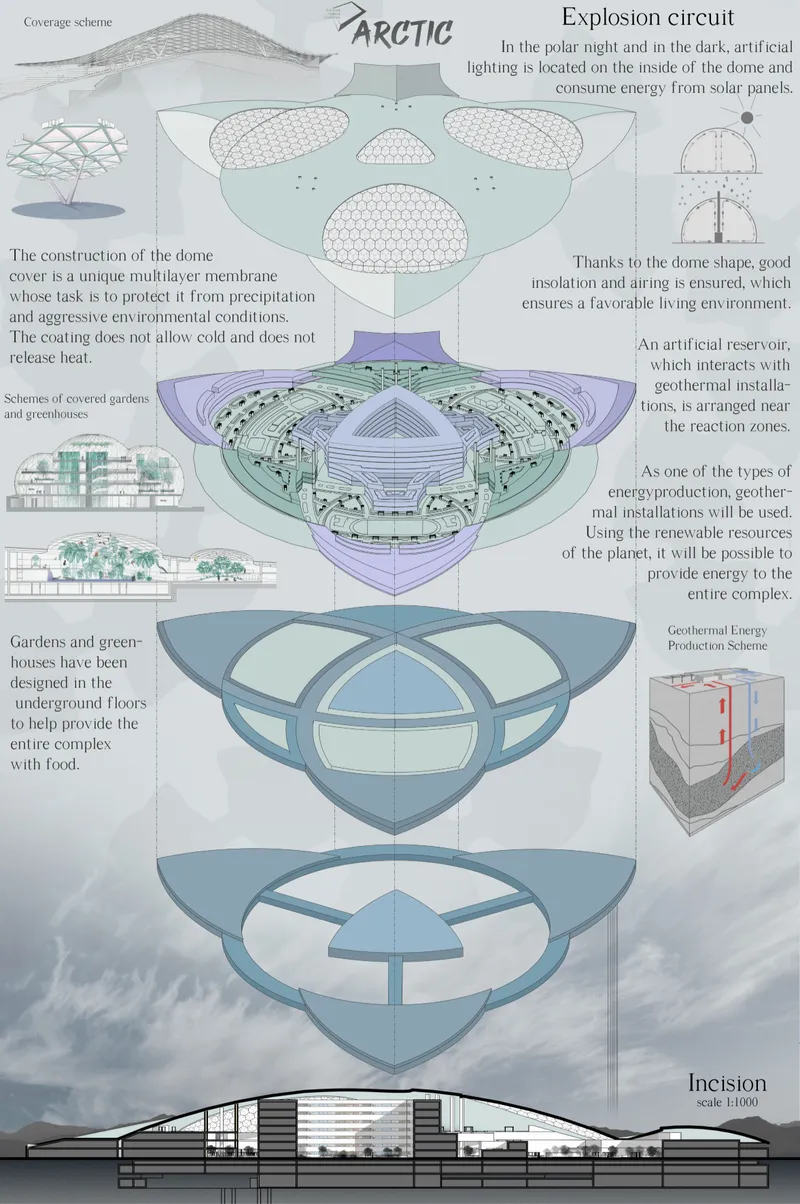
The exploded axonometric reveals the real ingenuity of the proposal. Each module is encapsulated in a dome-shaped multilayer membrane that performs several roles simultaneously: it retains heat and blocks cold penetration, hosts internal solar panels that provide lighting during the months-long polar night, and shelters covered gardens and greenhouses on underground levels to sustain food production year-round. The layered section moves from geothermal energy systems at the base, through inhabitable programme, up to the membrane canopy, creating a vertical gradient from energy source to environmental envelope.
Geothermal energy works alongside artificial reservoirs and wind and solar sources to make every sector self-sustaining. The strategy avoids dependence on any single energy type, a critical redundancy in an environment where equipment failure in winter is not an inconvenience but a survival threat. By stacking food production, energy generation, and climate control into the same structural section, Rakhimbirdiev's design keeps supply chains short and entirely internal.
Scalability as a Survival Strategy
What distinguishes ARC Arctic from many extreme-climate proposals is its insistence on modularity as a form of resilience. A single failed section does not compromise the settlement because each unit sustains itself through its own energy systems and food production. Growth happens by addition, not by overhaul. Rakhimbirdiev frames this as a direct response to shifting population needs and territorial expansion, acknowledging that any Arctic settlement will need to flex over decades as climate conditions, research priorities, and resource availability change.
Why This Project Matters
ARC Arctic takes the question of polar habitation seriously enough to address it at the scale of a city rather than a cabin. The integration of hyperloop transit, geothermal energy loops, underground agriculture, and dome-enclosed modules into a single coherent masterplan demonstrates a systems-level thinking that most Arctic proposals lack. Each design decision, from the multilayer membrane to the segway-accessible underground paths, follows from the central premise that extreme environments require extreme redundancy.
Rakhimbirdiev's shortlisted entry in the EHC - Arctic competition offers a credible blueprint for how architecture might respond to climate adversity not by retreating from it, but by building self-sustaining urban ecosystems within it. As polar territories become more strategically and scientifically significant, proposals like ARC Arctic shift from speculative exercise to necessary planning. The work signals that modular, energy-autonomous settlements are not just feasible for the Arctic; they may be the only typology that makes long-term sense.
View the Full Project
About the Designers
Designer: Azamat Rakhimbirdiev
Enter a Design Competition on uni.xyz
uni.xyz runs architecture and design competitions year-round that reward proposals with spatial conviction and real site intelligence.
Project credits: ARC Arctic by Azamat Rakhimbirdiev EHC - Arctic (uni.xyz).


Popular Articles
Popular articles from the community


Manzana Morphosis: Stretching Barcelona's Grid into a Living Landscape for 2050
A radical reworking of the Eixample manzana turns density into a tool for generous public space, vertical ecology, and environmental performance.

The Amber Palace Opera: A Geological Fiction Surfaces on Tallinn's Baltic Waterfront
Pierre Brillard reimagines a Baltic legend as a public landscape, opera house, and waterfront promenade rooted in Tallinn's coastal identity.

Cloaked Colonization: A Mobile Underwater Habitat That Moves Like a Fish
Micah Abaya's shortlisted EHC Pacific entry reimagines ocean settlement as a dispersed network of self-sustaining architectural organisms.

Opera on the Sea: Driftwood Logic Shapes a Timber Opera House on Estonia's Coast
Trevor Orgill's opera house translates the entangled drift of floating timber into a civic building where wood, water, and music converge.

Similar Reads
You might also enjoy these articles

Day and Night Park: A Time-Based Urban Newsstand in Beijing
A temporary urban newsstand in Beijing blending travel, light, and reading through poetic colors, compact form, and community-focused design.

Modernist Patio Renovation in El Masnou, Barcelona by Oliver Segura Arquitectura + Cebrià Arquitectura
Modernist patio renovation blending tradition and innovation with a movable pool, leveled floors, and Catalan materials in El Masnou.

Alto Residencial Coop: Cooperative Housing Development in Santiago de Compostela by Carbajo Barrios Arquitectos
A linear cooperative housing complex blending white volumes and perforated metal façades, enhancing community living, natural light, privacy, and urban integration.
Vil Genis School by BPA ARCHITECTURE – Massy, France
Vil Genis School in Massy, France, features sustainable design, south-facing classrooms, community integration, accessible spaces, and modern educational architecture.

Explore Arctic Competitions
Discover active competitions in this discipline

Challenge to design a shop stop sunk in the city

Challenge to design public laboratory
Comments (0)
Please login or sign up to add comments
No comments yet. Be the first to comment!