

Arcaded Mid-Air: Scaffold Arcades That Turn Cities Into Vertical Playgrounds
A modular scaffold installation reinterprets the arcade as vertical urban furniture, stacking pools, trampolines, and planted terraces above the street.


What if the arcade, one of architecture's oldest public typologies, grew upward instead of outward? Arcaded Mid-Air takes the familiar rhythm of arched bays and stacks them into scaffold towers that host rooftop pools, trampolines, spiral climbing paths, and planted terraces. The result is a provocation: that vertical space in dense cities is not just for offices and apartments but for the fragmented moments of leisure that urban life keeps squeezing out.
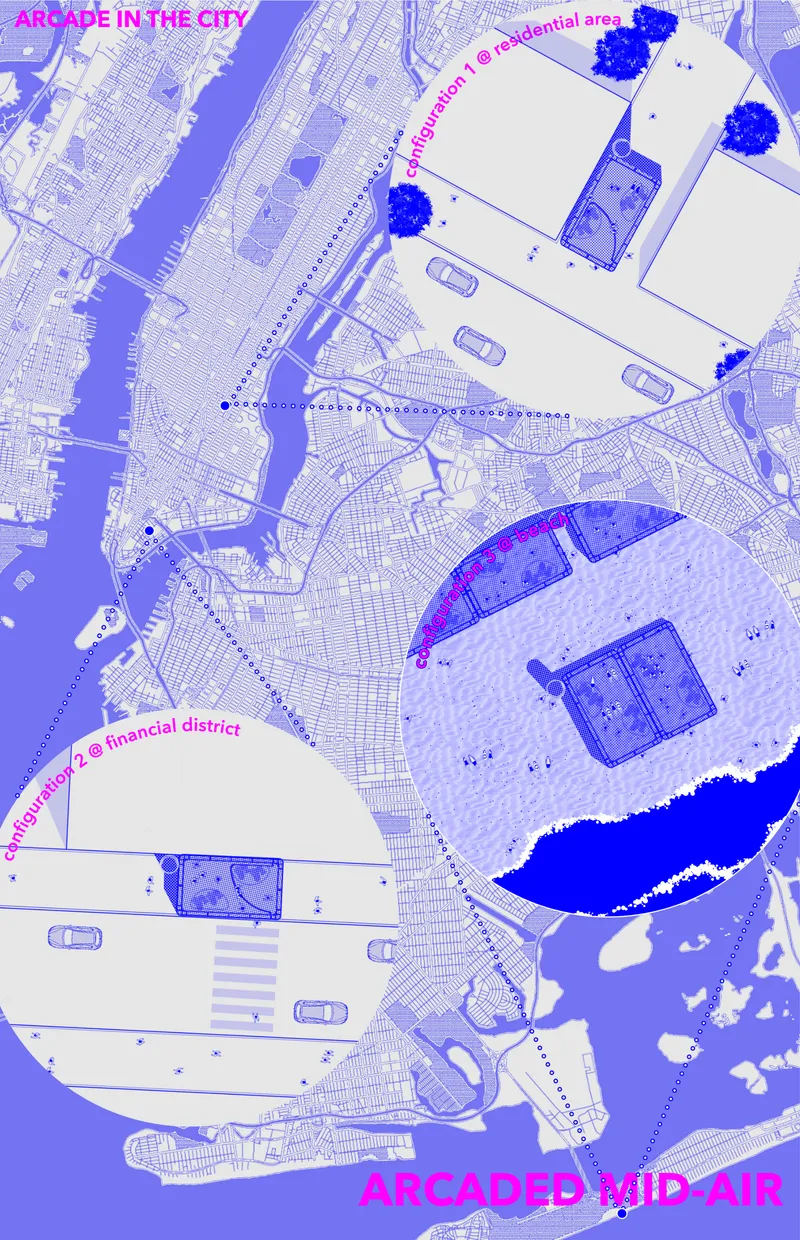
Designed by Feiyi Bie and Xinyu Yi, the project was shortlisted in Elevate 2019, a competition that challenged designers to rethink elevated experiences in public space. Their response is a family of modular, prefabricated structures conceived for deployment across radically different urban scenarios: business districts, residential neighborhoods, and beachfront promenades. Each configuration rearranges the same kit of parts to produce a different kind of vertical public room.
The Cloud Ladder: Spiraling Up Through Section
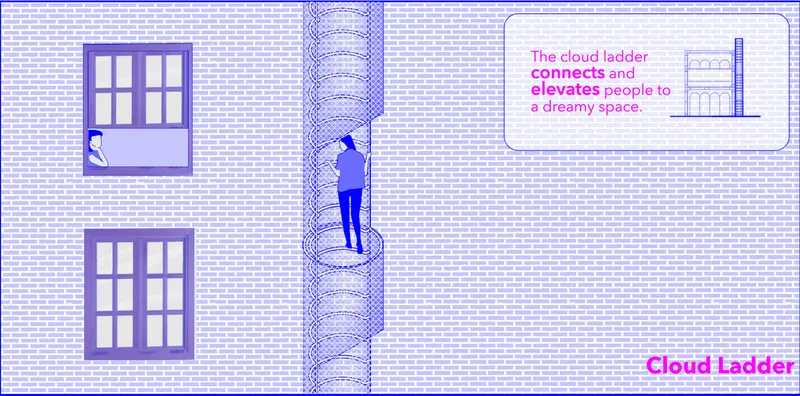
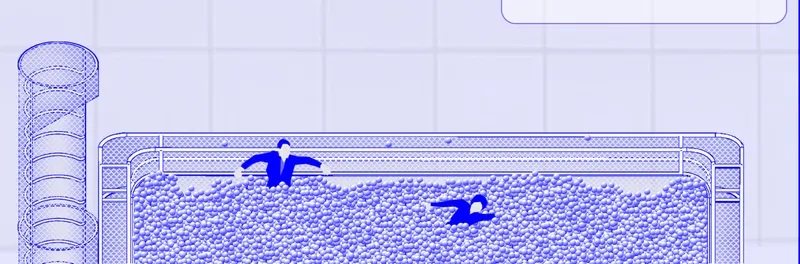
The section drawings reveal how the designers think about vertical circulation as experience rather than utility. A cylindrical spiral tower, which they call the Cloud Ladder, threads through two floors and connects users to elevated platforms. It is not a staircase in any conventional sense; it is a vertical pathway designed to slow the body down and reorient spatial awareness upward. In one variant, the spiral opens onto a rooftop pool where swimmers occupy a plane that would normally be reserved for mechanical equipment or empty air.
These sections are honest about how the structure works. The scaffold framing is exposed and repetitive, giving each bay an arched profile that reads as a contemporary arcade. Windows and openings punctuate the bays at different heights, so sightlines shift as a person climbs. The pool variant is particularly bold: placing a body of water at the top of a lightweight scaffold structure demands that the architecture justify its own ambition.
Stacking Programs: Pools, Plants, and Trampolines
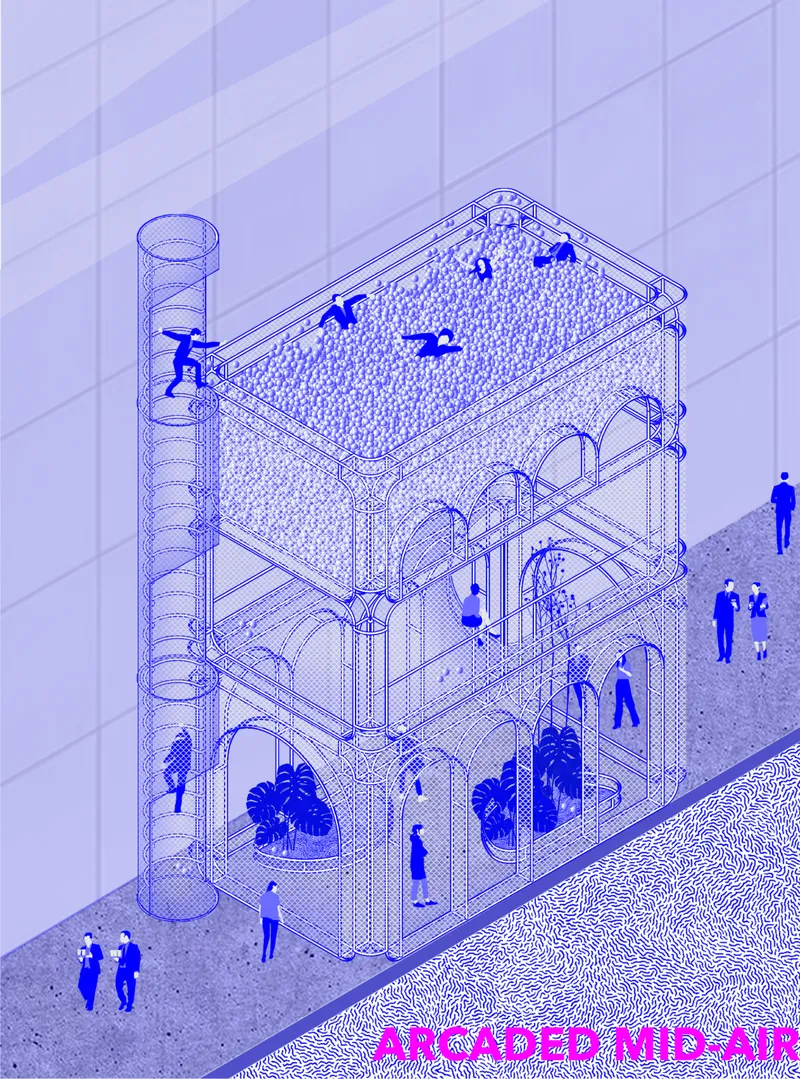
The isometric drawing of the multilevel pavilion lays out the full programmatic ambition. A pool occupies the upper volume, planted beds line the intermediate terraces, and figures populate stairs that wrap around the perimeter. Every surface does something. The structure operates as vertical urban furniture, a term the designers use deliberately to position it between building and object, permanent and temporary.
The site plan anchors one configuration to a waterfront location, with detail callouts showing how the installation's footprint relates to existing building masses. This is where the modular premise becomes legible: the same structural bay can be clustered tightly in a dense commercial block or spread along an open promenade. The waterfront siting also gives the rooftop pool a visual logic, connecting the contained water above to the open water at the site's edge.
Exploded Parts: How the Kit Comes Together
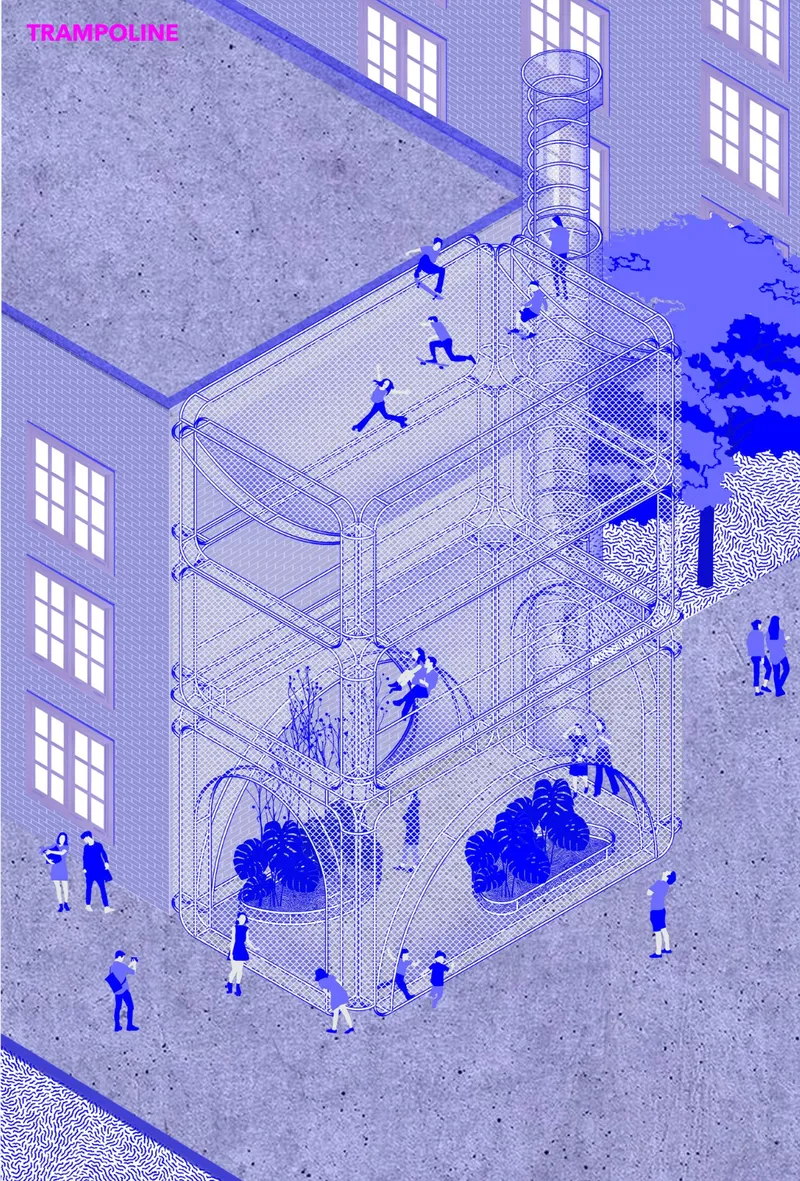
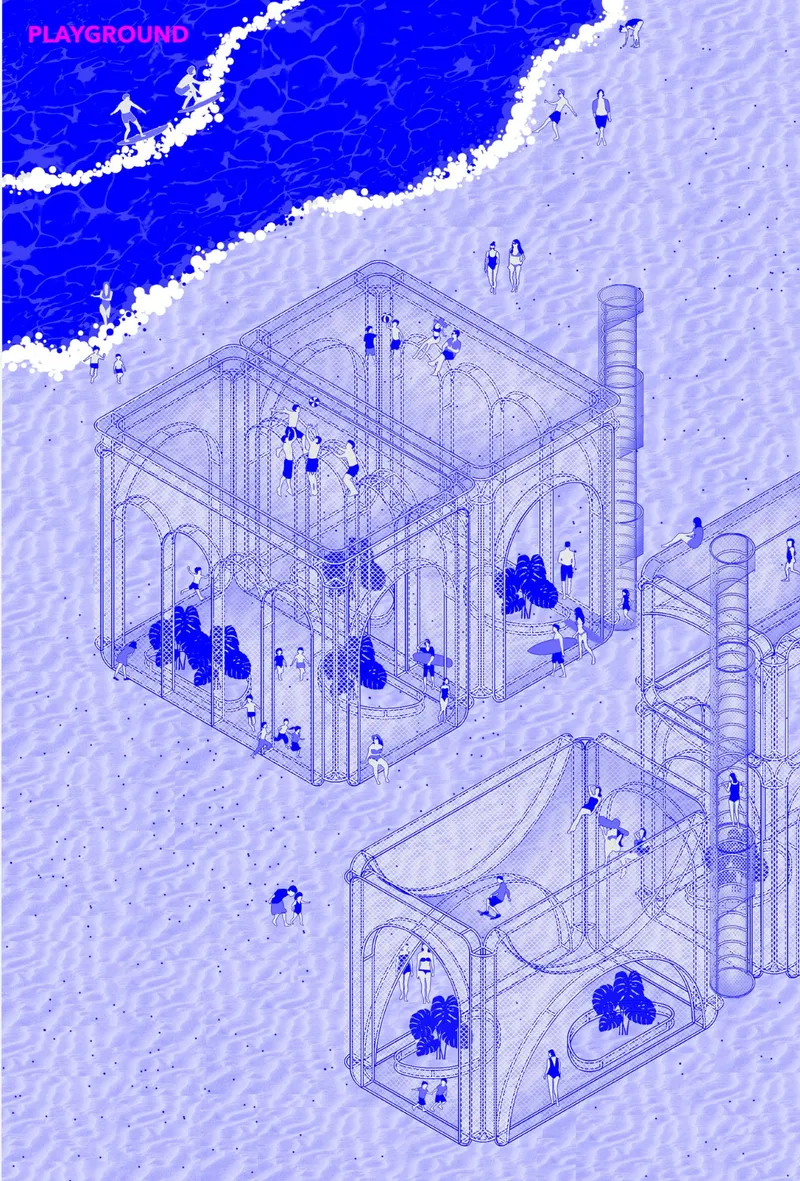
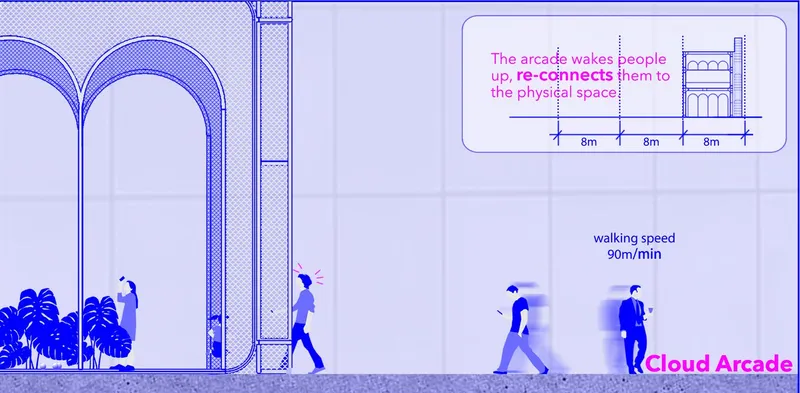
An isometric of the outdoor variant introduces the trampoline level, an element the designers describe under their broader concept of the Cloud Arcade, which is intended to awaken spatial awareness through physical play. The spiral tower reappears here as a connective spine, linking the trampoline platform to lower gathering spaces. Figures bounce, climb, and lounge at various heights, and the drawing does a good job of communicating that these are not separate floors but a continuous landscape of activity unfolding vertically.
The exploded axonometric peels apart two stacked volumes to show their planted interiors and pool elements independently. This drawing is the clearest statement of the modular logic: each volume is a self-contained environment that can be combined, rotated, or deployed solo. The prefabricated scaffold framing makes this feasible. It also makes the project inherently temporary and relocatable, which is a meaningful quality for a public installation that needs to earn its place in the city rather than claiming it permanently.
Arched Elevations and Structural Repetition
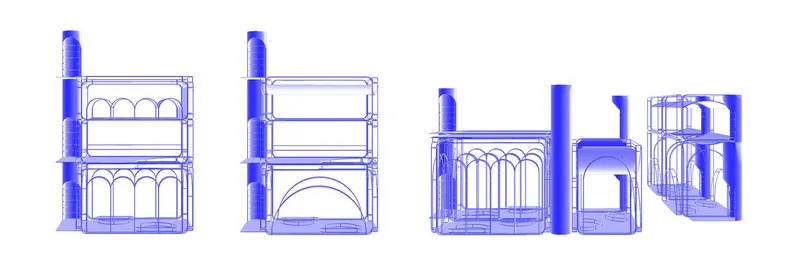
The elevation drawings crystallize the project's visual identity. Arched arcades march across the facade in stacked structural bays, topped by chimney-like elements that give the silhouette a surprising domesticity. The repetition is the point: it recalls the rhythm of historic arcades while making clear that this is a scaffold system, not a masonry one. The arches lend a sense of permanence and civic weight to what is, structurally, a lightweight and demountable framework.
The contrast between the formal language of the arch and the industrial reality of the scaffold is where the project generates its tension. It asks whether an ephemeral structure can carry the same public significance as a stone colonnade. The elevation suggests it can, precisely because the arched bay is so deeply embedded in collective memory as a threshold between public and semi-public space.
Why This Project Matters
Arcaded Mid-Air matters because it treats leisure as infrastructure. In cities where every square meter of ground is contested, the proposal to stack play, rest, and social encounter vertically is not whimsical; it is pragmatic. The scaffold system keeps costs and material commitments low while allowing configurations tuned to specific sites, from dense commercial cores to open waterfronts. That flexibility is what separates a speculative provocation from a deployable idea.
Feiyi Bie and Xinyu Yi have produced a project that respects the arcade as a civic typology while liberating it from the ground plane. The Cloud Ladder, the Cloud Arcade, and the various programmatic insertions (pools, trampolines, planted terraces) are not gimmicks layered onto a structure; they are the reasons the structure exists. By making the act of climbing into something pleasurable and social, the project reframes vertical circulation as the main event rather than a means to an end.
View the Full Project
About the Designers
Designers: Feiyi Bie, Xinyu Yi
Enter a Design Competition on uni.xyz
uni.xyz runs architecture and design competitions year-round that reward proposals with spatial conviction and real site intelligence.
Project credits: ARCADED MID-AIR by Feiyi Bie, Xinyu Yi Elevate 2019 (uni.xyz).


Popular Articles
Popular articles from the community


Architekt Andreas Gruber Scatters 23 Dark Timber Chalets Across a South Tyrolean Forest Edge
In Molini di Tures, Amonti Chalets breaks a resort into a hamlet of gabled timber houses, with parking, storage and services pushed into the slope.

longwave studio Reorganizes a 112 m² Tainan Apartment Around the Daily Routines of a Family and Two Cats
In Tainan, Taiwan, birch plywood, rust-red furniture and a freestanding plaster wall link arrival, storage, work and family life in one apartment.

LT2A and OPEN Architectes Thread a Brick and Glass High School Through a Wooded Belgian Campus
In Braine-l'Alleud, a 3,000 m² wing for Collège Cardinal Mercier pairs pale brick with a glazed colonnade, deferring to a small chapel and a dense wood.

U.GA Architects Wraps an Oval Rooftop Pool in Curved Board-Formed Concrete on Busan's Jeollidan-gil
In Busan's Jeonpo-dong, a 454 m² mixed-use block stacks a neighborhood facility, guest rooms and an oval rooftop pool inside spiraling concrete walls.

Similar Reads
You might also enjoy these articles


Aquadapt: An Underwater Habitat That Rewrites Its Rooms by the Hour
Curved modules ring the seabed while one shell shifts from breakfast room to cinema, farm and football pitch as residents' needs change.

Play: Fragments of Their World: Remembered Architecture Rebuilt as a Modular Playground for Refugee Camps
Tom Gardner abstracts domes, arches and towers from the homelands of displaced families into a kit of child-scaled play parts for camp settlements.
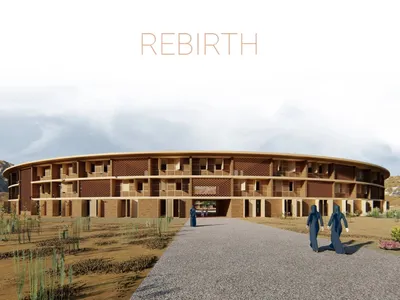
REBIRTH: A Circular Settlement Where Afghan Widows and Their Children Rebuild Life Together
A shortlisted Resile entry turns the circle into a protective ring of timber and brick, gathering homes, classrooms and gardens around a shared landscape.
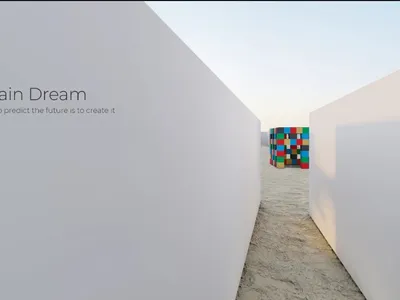
The Main Dream: A Recycled Plastic Kit That Lets Refugee Children Build Their Own Playground
Thirty-centimetre interlocking cubes that connect on three axes turn play into construction, letting children author the spaces they occupy.

Explore Urban Space Competitions
Discover active competitions in this discipline

Challenge to design locus for the upliftment of human rights

Challenge to design a shop stop sunk in the city

Design challenge to equip cities with modern furniture

Challenge to reimagine the Iron Throne
Comments (0)
Please login or sign up to add comments
No comments yet. Be the first to comment!