
Archicentre Folds an Origami Roof Over a Brick Sports Complex in Iskandar Puteri
A 13,000-square-metre community sports facility in Malaysia's Estuari township pairs perforated clay brickwork with a faceted metal canopy.

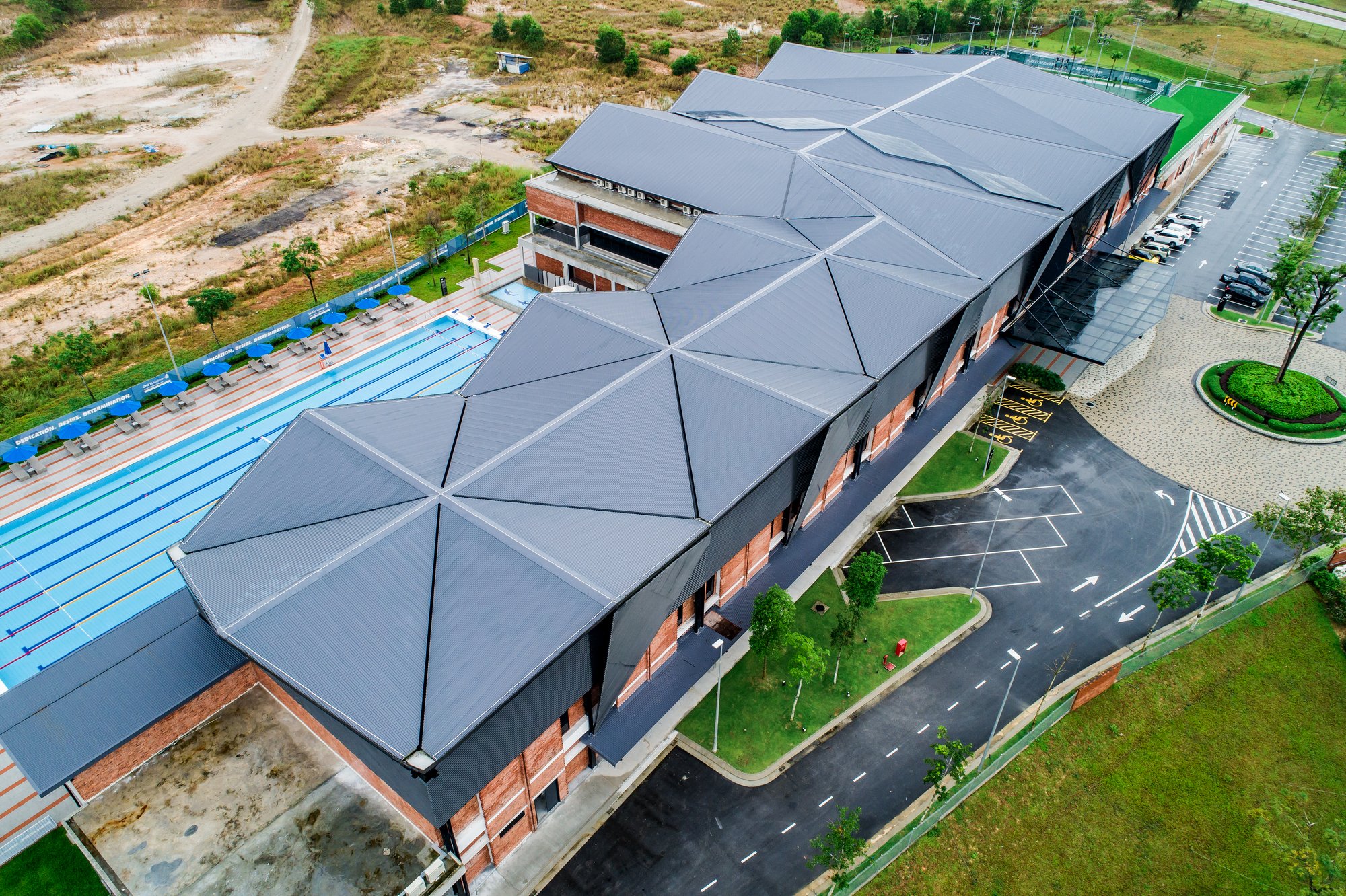
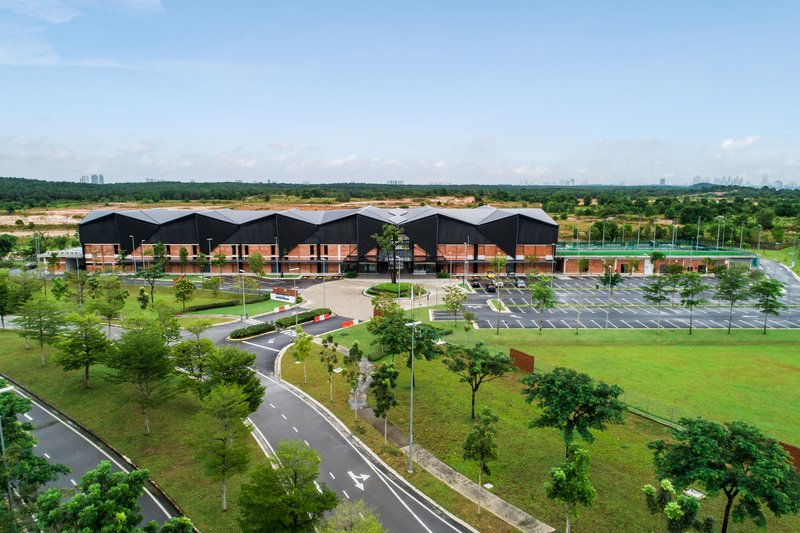
Sports buildings in tropical climates face a basic contradiction: they need to enclose large volumes of air for courts and pools, yet they cannot seal those volumes without turning them into ovens. The Estuari Sport Complex, designed by Hong Kong and Johor-based practice archicentre, resolves this tension with two moves that define the entire project. A series of origami-folded metal roof planes cap the building with a dramatic silhouette visible across the 387-acre Estuari township, while the walls below are assembled from perforated raw clay brickwork that lets wind pass straight through the envelope.
The result is a 13,279-square-metre facility that houses an Olympic-sized swimming pool, five tennis courts, five badminton courts, two squash courts, a martial arts studio, a rock-climbing wall, yoga and spinning studios, and a pool café, all organized across two levels that sandwich a transparent public entry hall. Located within Puteri Harbour in Johor state, the complex doubles as a private community club for conferences, exhibitions, and even weddings. What makes it genuinely interesting is not the program list but how archicentre manages to give a building this large a sense of porosity and lightness, deploying regional material logic rather than air-conditioned brute force.
An Origami Roofline That Signals from a Distance
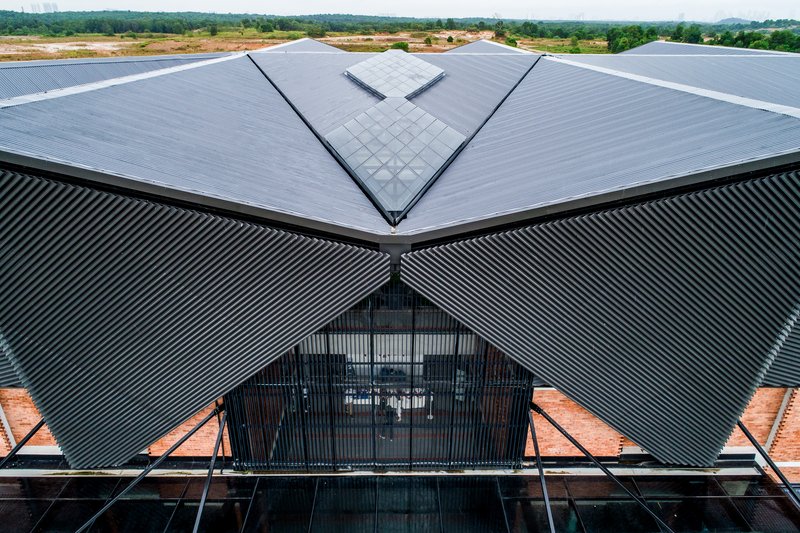
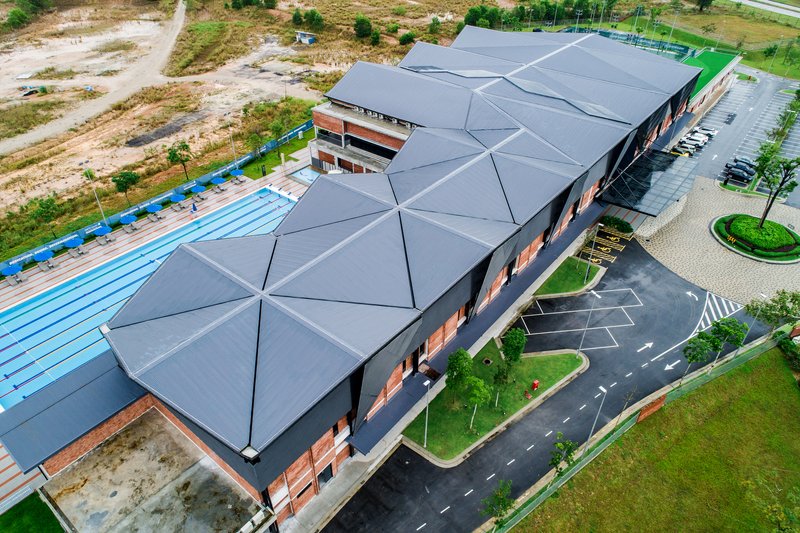
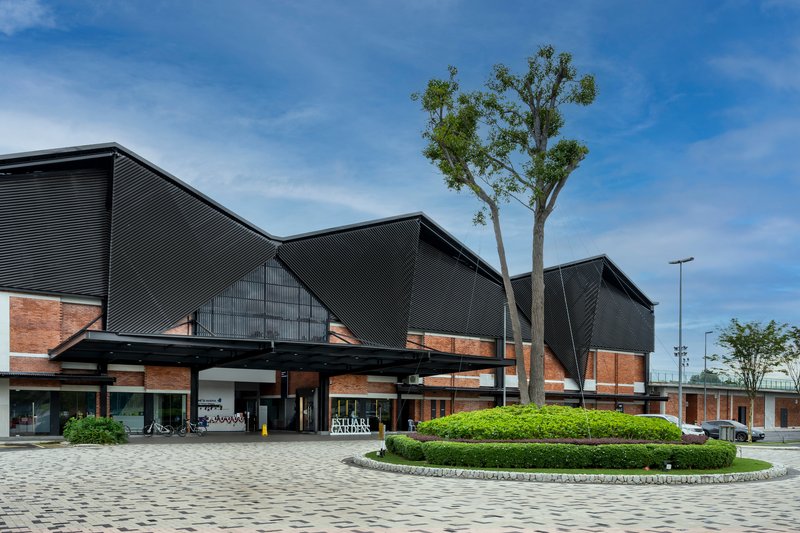
From the air, the complex reads as a cluster of sharp triangular facets rather than a single monolithic box. Corrugated metal cladding wraps each folded plane, creating a roofscape that catches light differently throughout the day. The faceted geometry is not decorative whimsy: it allows archicentre to introduce diamond-shaped glass openings at the ridges, pulling natural light deep into the sports halls below without the glare penalties of conventional skylights.
The multi-gabled silhouette also keeps the building's profile surprisingly low. Despite enclosing double-height court volumes, the complex never reads as a hulking shed from ground level. Instead, it sits comfortably alongside the tree-lined roadways and open parkland of the Estuari township, its roof peaks echoing the slopes of a landscape that tilts toward a nearby lake to the south.
Brick Walls That Breathe
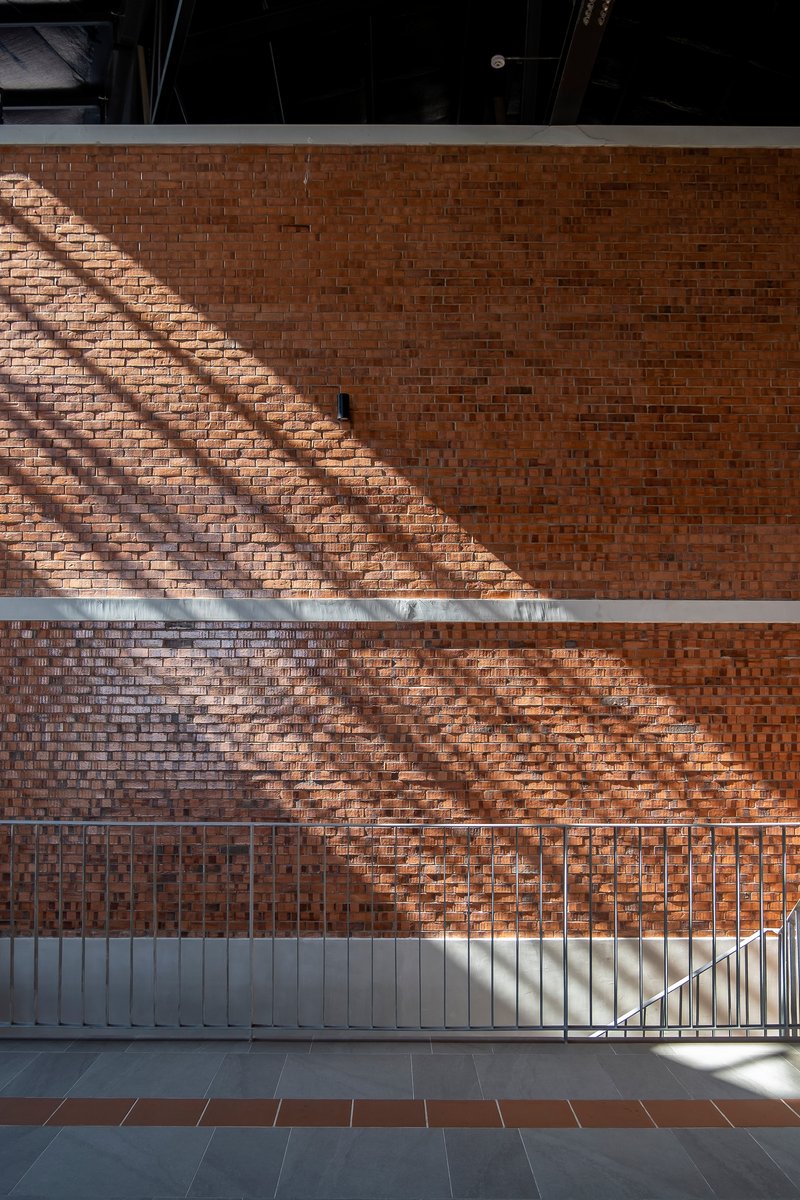
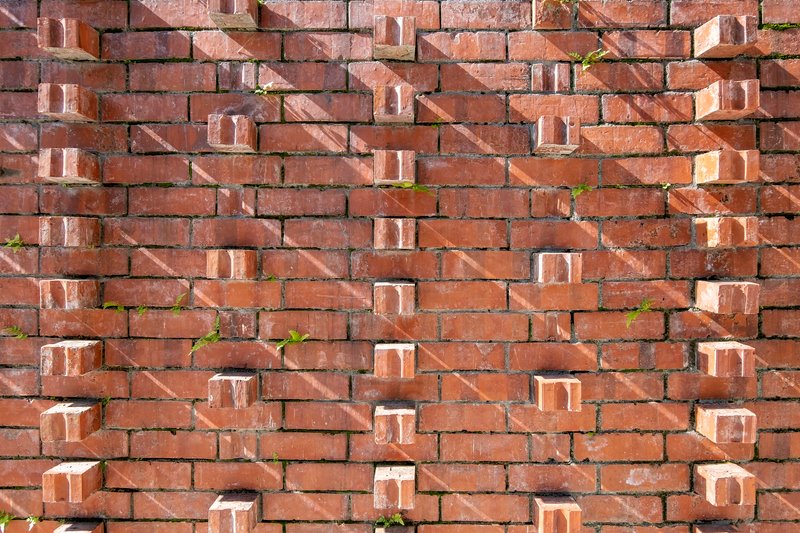
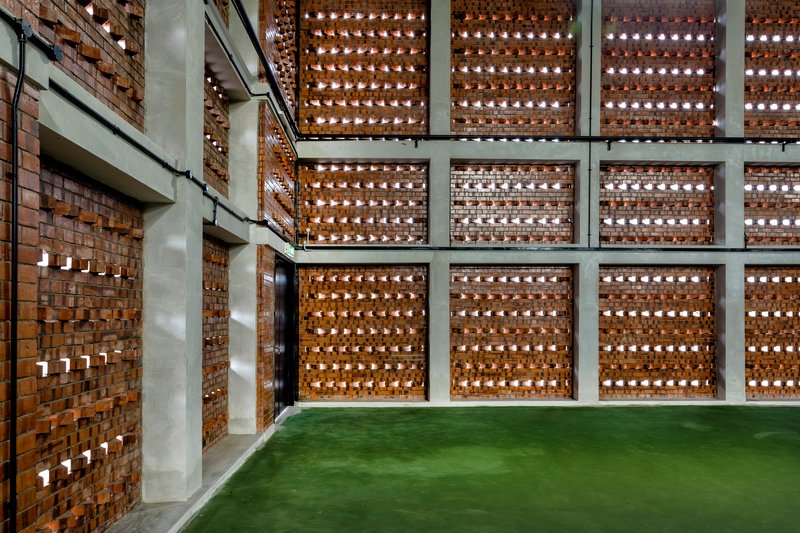
The perforated brickwork is the project's most tactile achievement. Archicentre uses light brick surface cladding arranged in patterns that range from tightly bonded panels to open screens with visible gaps between courses. In some locations, header bricks protrude from the wall face at regular intervals, casting fine diagonal shadows that shift with the sun's angle. In others, the openings are large enough that small plants have already colonized the joints, softening what could be a relentlessly industrial material palette.
These brick screens are not curtain walls hung off a hidden frame. They sit within a concrete structural grid that is left deliberately visible, framing the perforated panels like oversized picture frames. The effect is a layered facade with genuine depth: concrete structure, then brick infill, then filtered light and wind. On the north and west elevations, archicentre supplements the brick with large louvred walls to maximize uninterrupted cross-ventilation, a passive cooling strategy that reduces dependency on mechanical systems in a climate where humidity is the real adversary.
The Entry Atrium as a Hinge Between Worlds
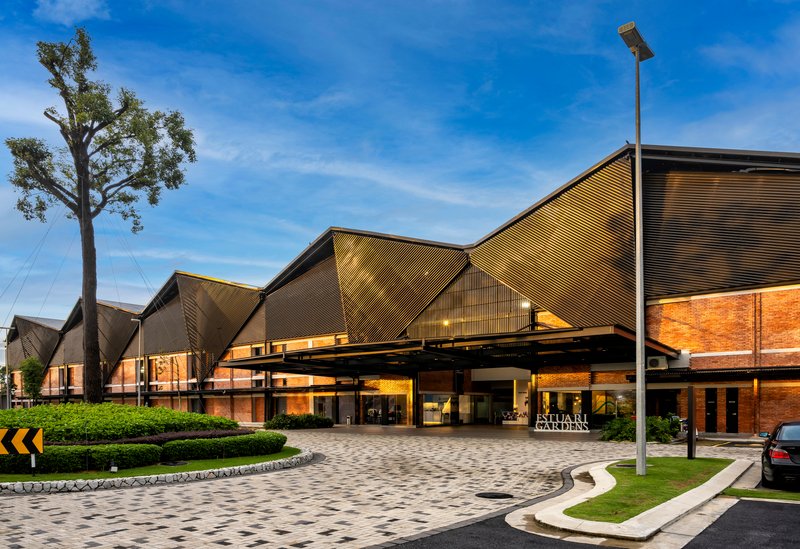
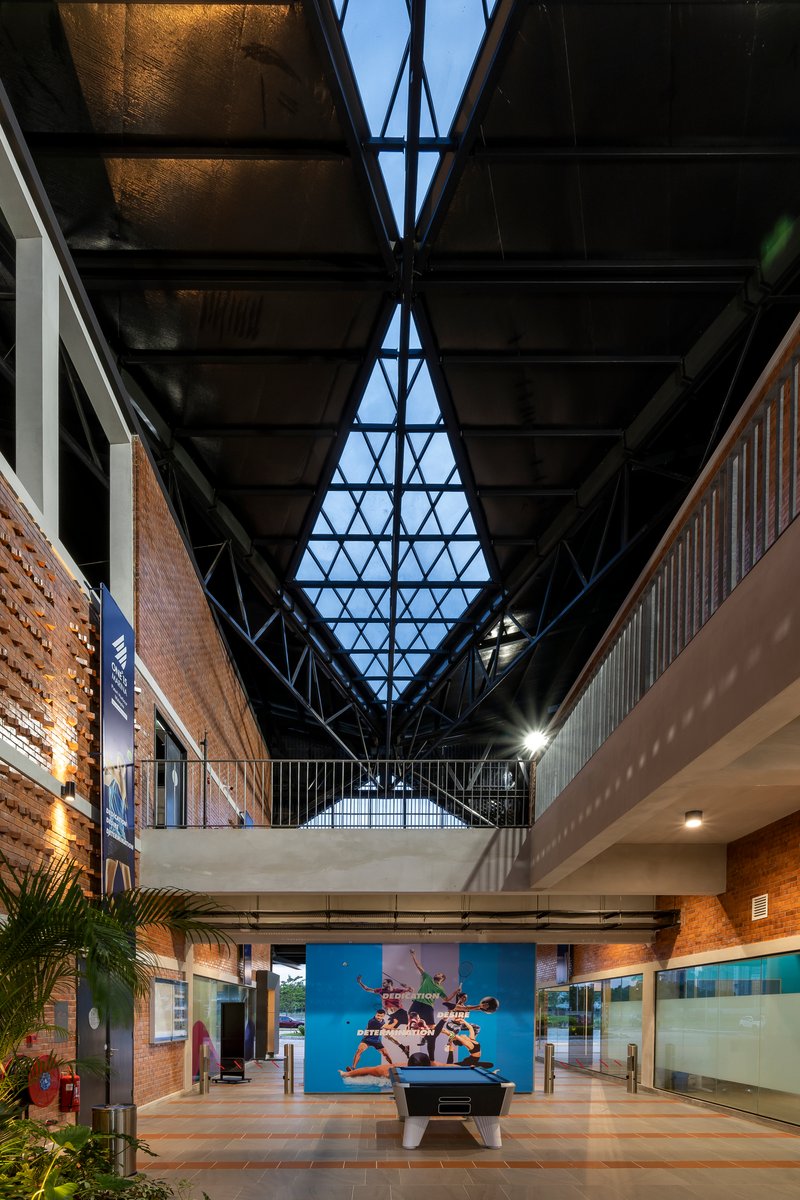
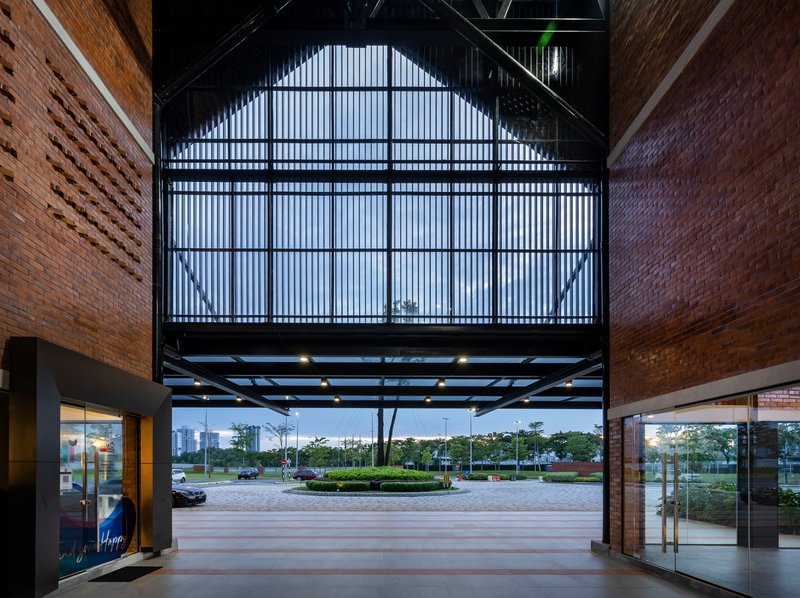
The two main volumes of the building, the lower-ground courts and the upper-level studios, are separated by a glazed entry space that functions as a visual and spatial hinge. At dusk, this central atrium glows against the darker mass of the brick walls. A triangular skylight framed by black steel trusses crowns the space, reinforcing the origami geometry overhead while flooding the arrival sequence with diffused light.
Translucent corrugated panels and steel framing at the perimeter of the atrium create a lantern effect, making the building legible from the forecourt even after dark. The folded metal canopy over the entry porch extends outward to shelter a paved drop-off area planted with mature trees, easing the transition from car to building in a township where driving is the default mode of arrival.
Courts and Pool: Scale Without Claustrophobia
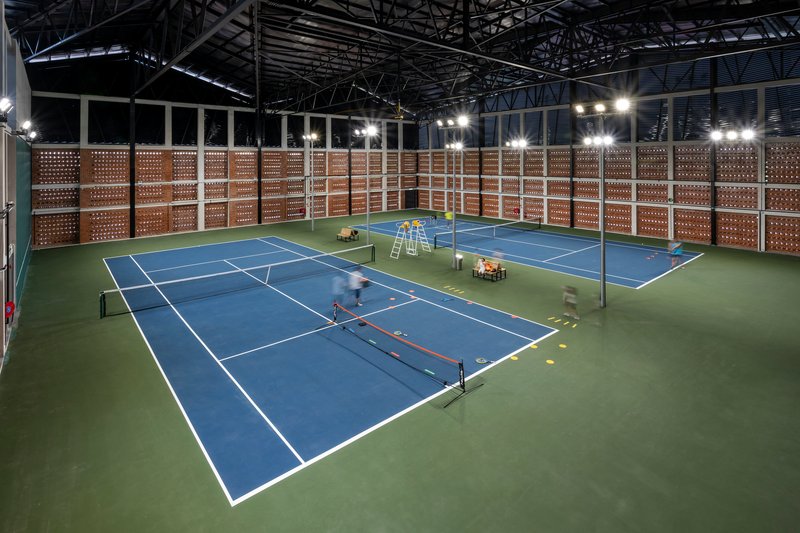
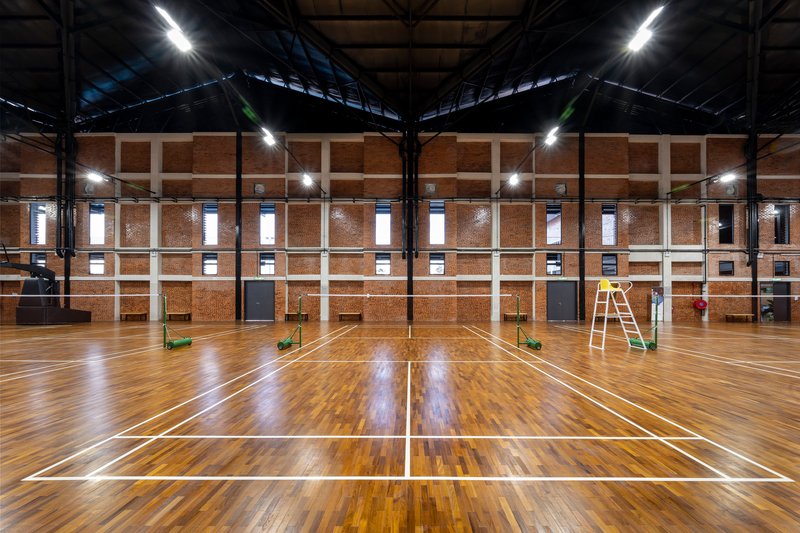
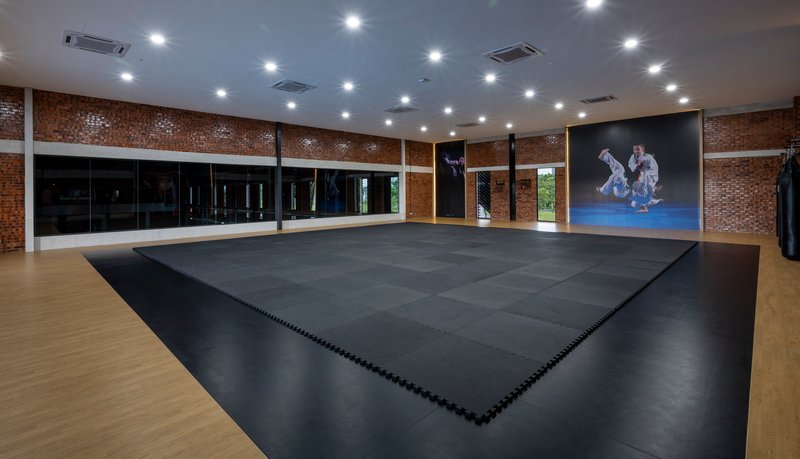
The interior sports halls demonstrate how the perforated brick strategy pays dividends at the scale of a full court. In the tennis hall, two blue courts sit beneath an exposed steel truss roof, flanked on both sides by brick screens that admit filtered daylight and moving air. The hall feels open and airy despite being fully enclosed. The same principle governs the training hall, where black mat flooring meets perforated brick walls under a recessed ceiling, and the badminton courts, which use timber flooring and the same tectonic language.
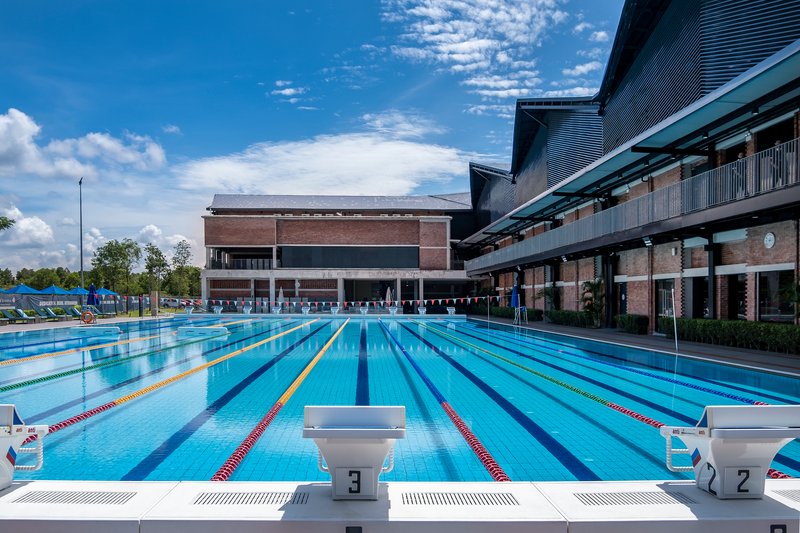
Outside, the 50-metre FINA-compliant swimming pool is positioned to take advantage of the site's southern exposure toward the lake. A brick pavilion anchors one end of the pool deck, its material continuity tying the outdoor facilities back to the main building. Starting blocks and lane markers confirm that this is a competition-grade facility, not a leisure afterthought.
Corridors as Inhabited Thresholds
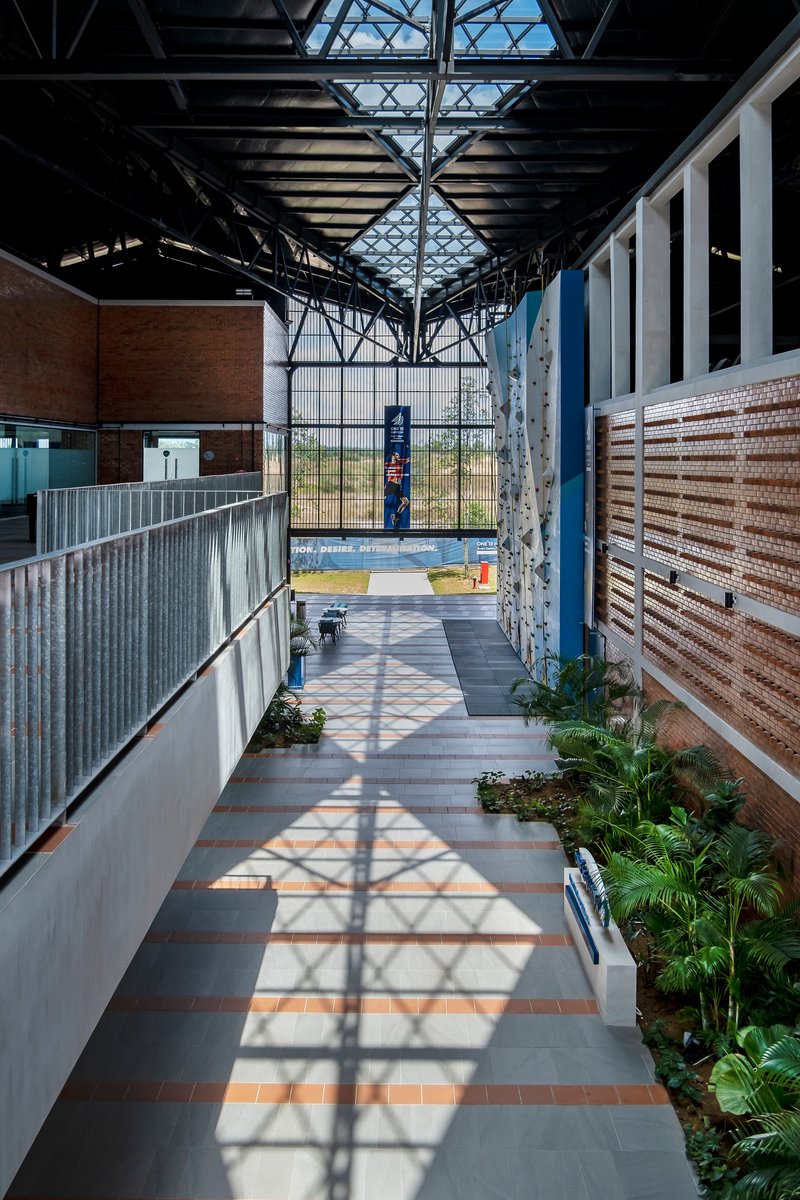
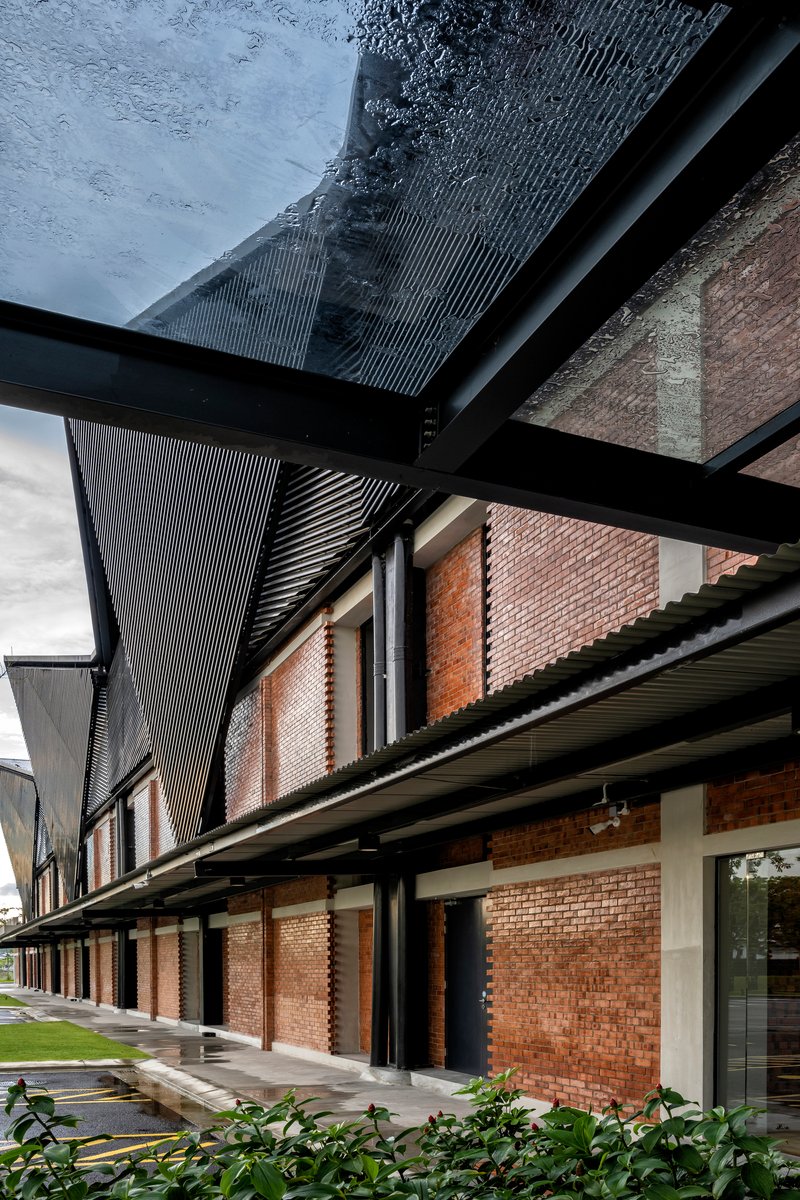
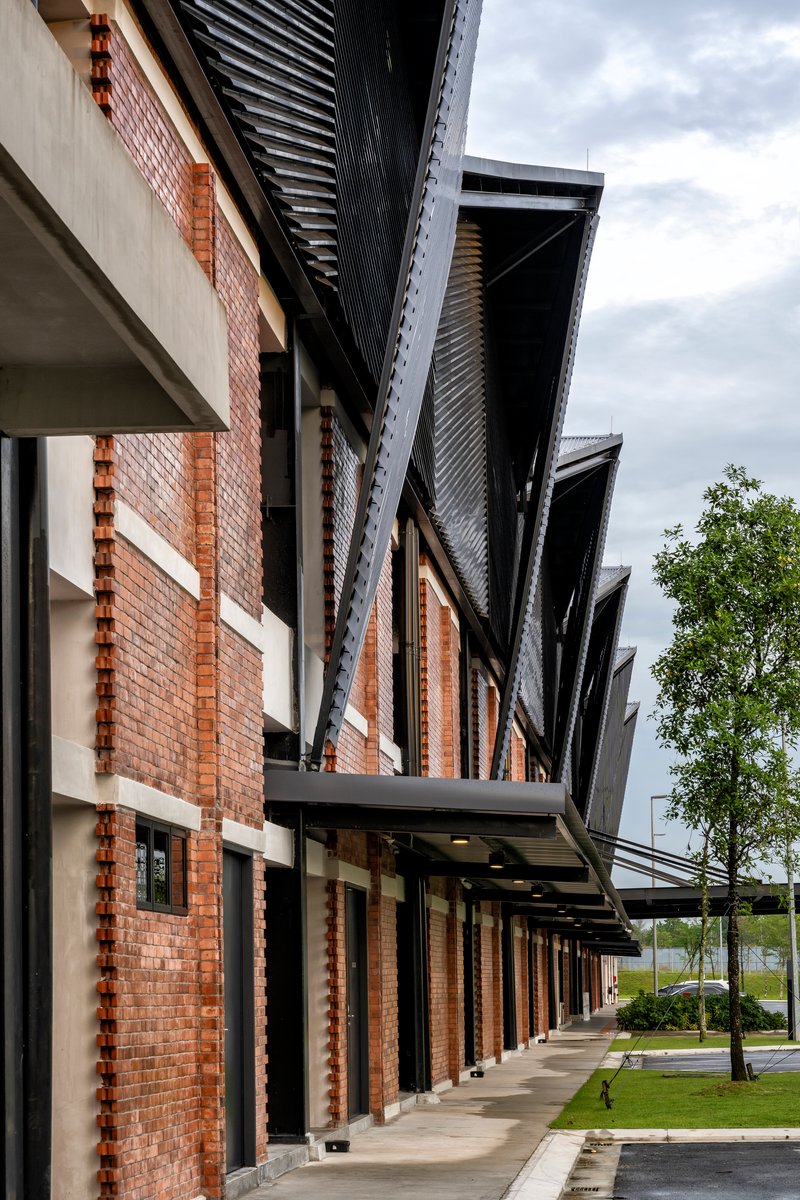
Archicentre treats circulation not as leftover space but as a design opportunity. Covered walkways run along the brick facades beneath corrugated metal eaves, their black steel beams casting rhythmic shadows onto the paving below. Interior corridors are similarly generous, with planted beds inserted between exposed steel trusses and glazed end walls that frame views out to the park.
These in-between spaces are where the building's passive climate strategy becomes most tangible. Walking through the corridors, you feel the breeze moving through the louvred walls, see the patterned light shifting on the brick, and register the temperature drop that comes from shade and airflow rather than refrigerant. It is a persuasive argument for what archicentre calls the translation of regional metaphors into green architecture.
Facade and Materiality Up Close
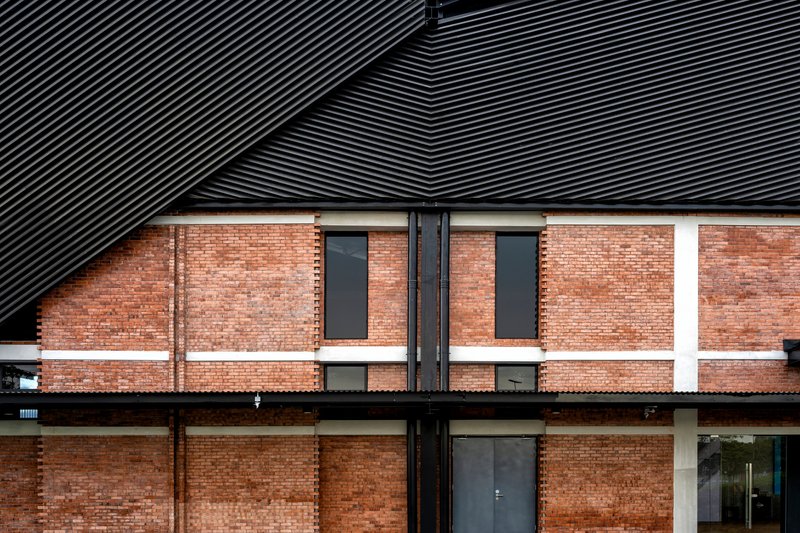
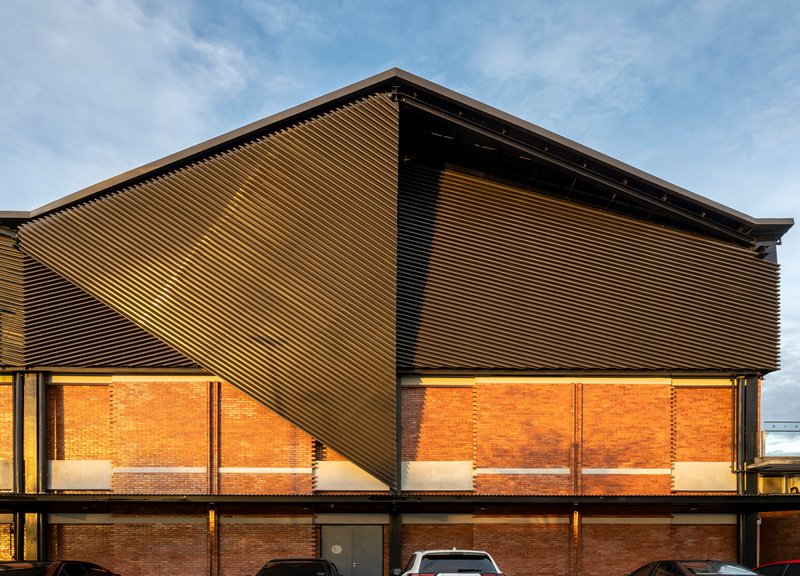
At close range, the interplay between warm brick and cold metal becomes the building's signature texture. Horizontal banding on the brick walls creates shadow lines that counterpoint the vertical ribs of the corrugated cladding above. At dusk, the upper metal volume catches the last light while the brick base recedes into shadow, inverting the typical heavy-base-light-top reading of a two-storey building.
Inside, the martial arts studio and adjacent training rooms show the same attention to surface: perforated brick screens washed with recessed ceiling lights produce a warm ambient glow that avoids the flat, institutional quality of most sports interiors. The material palette is deliberately restrained: brick, concrete, black steel, corrugated metal. Nothing competes for attention, and everything ages gracefully.
Plans and Drawings
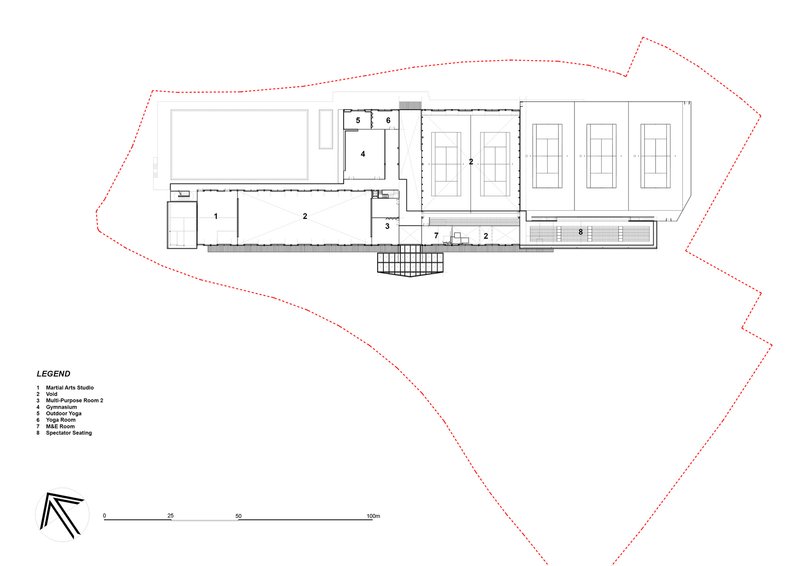
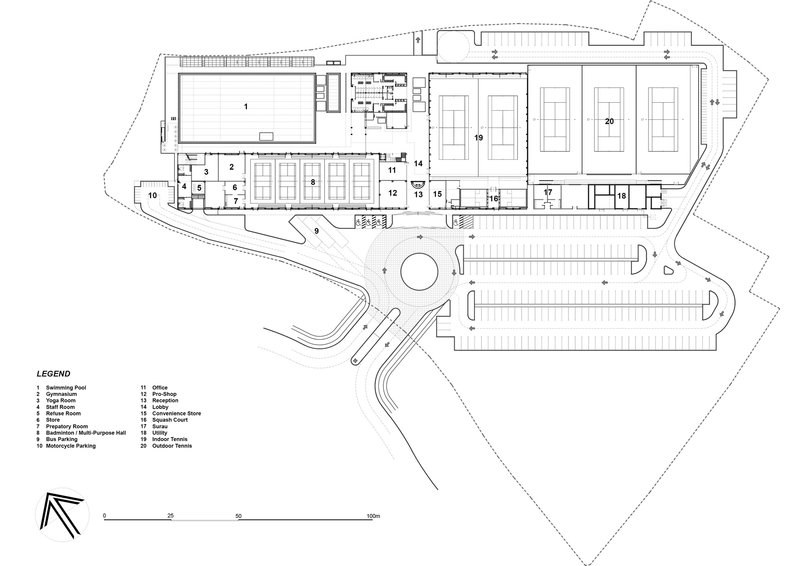
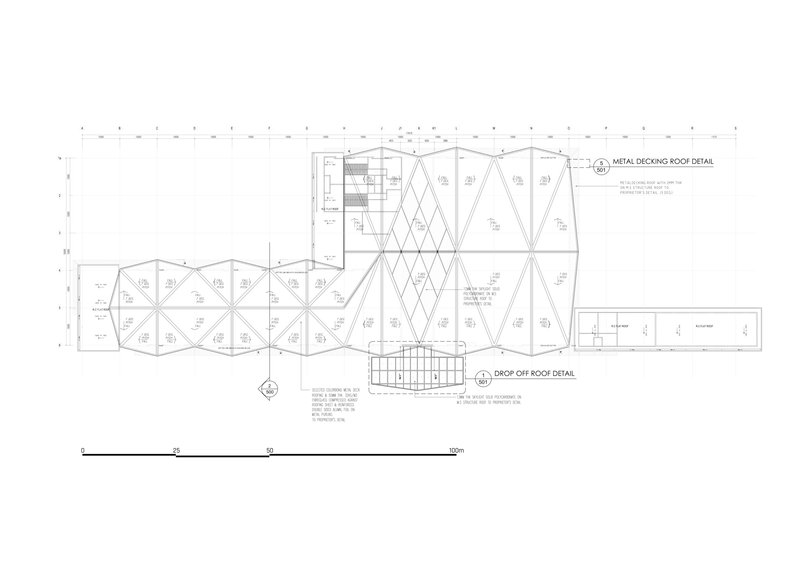
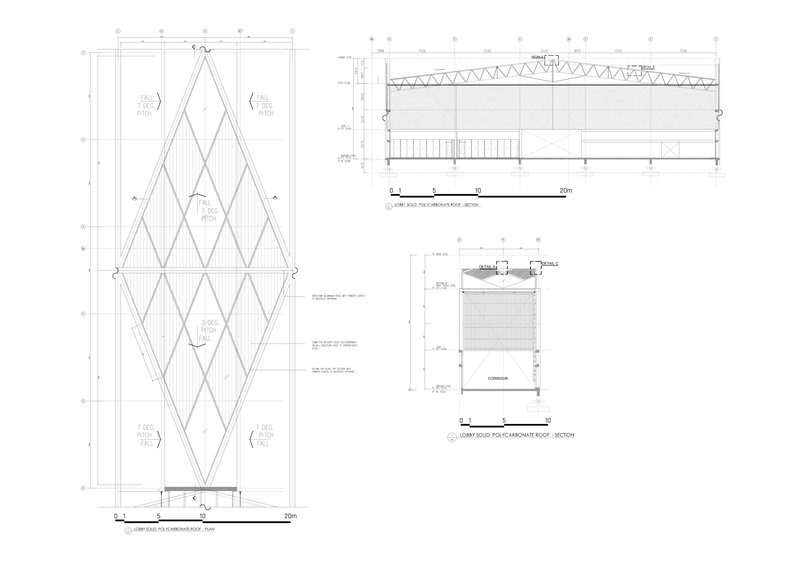
The floor plans reveal the project's organizational logic with clarity. A linear spine of studios and multipurpose rooms runs along one edge of the site, while the larger court volumes occupy the center and the pool sits to the south. Parking wraps the perimeter, acknowledging the suburban, car-dependent reality of the Estuari township without letting it dominate the architecture. The roof plan is especially instructive: the undulating geometry of the metal decking is not a single continuous surface but a series of discrete folds, each calibrated to the span and program below.
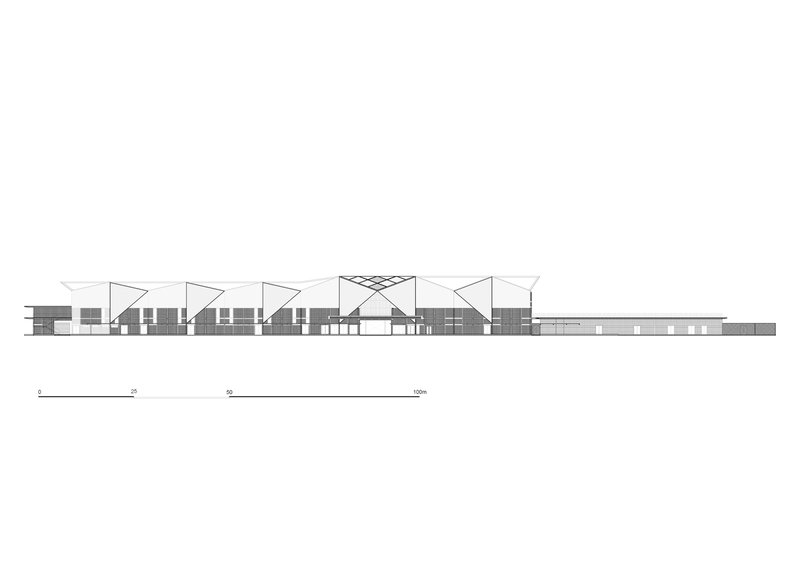
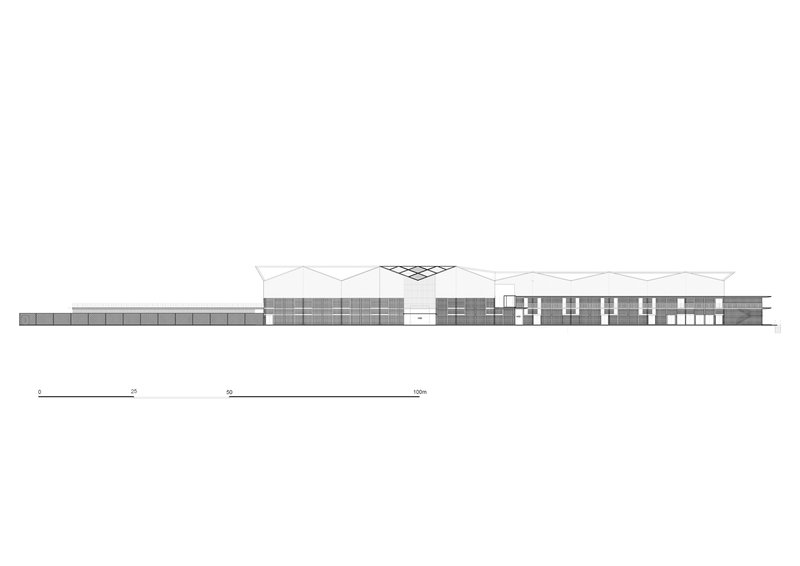
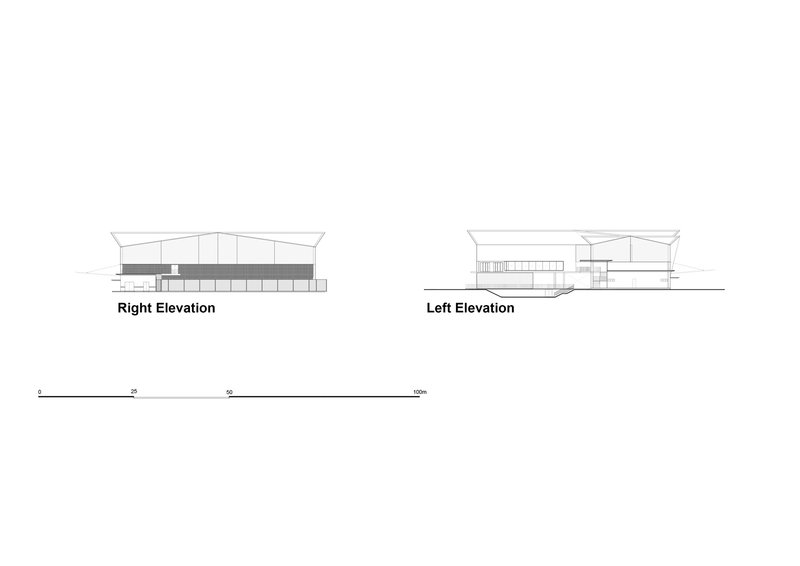
Elevations confirm the building's commitment to horizontality. Despite the peaked roof forms, the dominant reading is a long, low bar stretched across the landscape. The diamond-patterned facade sections and structural details in the drawings show how the brick screens are integrated into the concrete frame, and how the roof assembly transitions from steel trusses to corrugated metal decking to the glass diamonds that puncture the ceiling. These are not complex details, but they are executed with a consistency that holds the entire project together.
Why This Project Matters
Tropical sports buildings are too often sealed boxes that fight their climate with energy-intensive mechanical systems. The Estuari Sport Complex argues convincingly for another way. By folding the roof to introduce zenithal light, perforating the walls to invite cross-ventilation, and orienting the major facades to catch prevailing winds, archicentre delivers a facility that performs at competition level without abandoning passive design principles. The building proves that regional material strategies, brick screens, louvred walls, shaded corridors, can operate at an institutional scale without sacrificing architectural ambition.
More broadly, the project challenges the assumption that community sports facilities in rapidly developing Southeast Asian townships must default to generic, developer-grade boxes. The origami roof, the textured brick, and the carefully framed views of parkland and lake give Estuari's residents a building that rewards close attention and repeated use. It is not a signature gesture dropped from above; it is an architecture shaped by its site, its climate, and the everyday rituals of the people who swim, play, and gather inside it.
Estuari Sport Complex by archicentre. Iskandar Puteri, Johor, Malaysia. 13,279 m². Completed 2020. Photography by H.Lin Ho.
About the Studio
Share Your Own Work on uni.xyz
If projects like this are the kind of work you want to make, uni.xyz is a place to publish your own, find collaborators, and enter design competitions.




Popular Articles
Popular articles from the community

RDTH architekti Rips Out Nearly Every Wall in a Prague Apartment and Replaces Them with Furniture
A 101-square-meter post-war flat in Prague trades rigid partitions for a single rotated furniture block, curtains, and glass concrete.

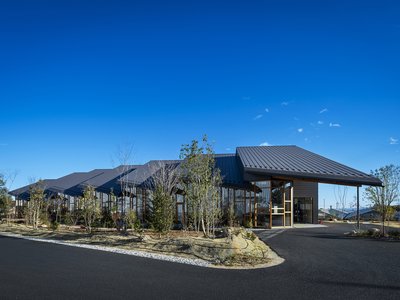
20 Most Popular Office Building Projects of 2025
From biophilic workspaces in India to net-positive energy offices in New Delhi, 20 office building projects that defined architecture in 2025.
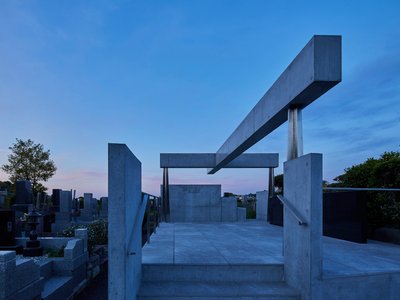
Takeshi Hosaka Architects Suspends a Concrete Cross Above a Yokohama Cemetery
A 28-square-meter burial renovation in Yokohama lifts the symbol of resurrection into the sky so mourners see it against heaven.
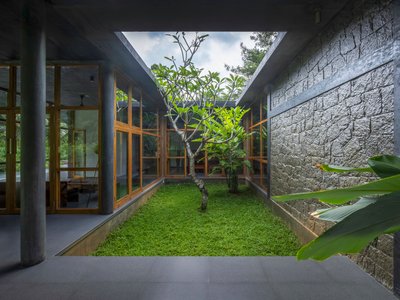
3dor Concepts Wraps a Kerala Home in Mirrored Concrete Arcs Around a Courtyard Tree
In the Western Ghats foothills of Thamarassery, a 270 m² single-story house uses two curved volumes to frame nature as its center.

Similar Reads
You might also enjoy these articles

127af Flips a Tiny Bagnolet Rowhouse Upside Down with a Handcrafted Roof Extension
A 55-square-meter terraced house on the edge of Paris gains a luminous upper living floor through lightweight timber and steel.
1.61 Design Workshop Wraps a 600-Square-Meter Café in Vietnam in Sculptural Burgundy Drama
Reden Café & Bistro pairs a helical staircase, mosaic floors, and deep red interiors to rethink Vietnamese hospitality space.
The Unbound Brain: A School Shaped by Cognitive Architecture
Cylindrical learning pods radiate like neurons from a central cortex, turning the floor plan into a spatial model of human thought.
Revival Vernacular Architecture: Rammed Earth Settlements for the Sahara
A modular desert community in Mauritania that fuses passive cooling techniques with earthen construction and local craftsmanship.


Explore Sports Architecture Competitions
Discover active competitions in this discipline




The Global Benchmark for Architecture Dissertation Awards


The Global Benchmark for Graduation Excellence

Challenge to design a barrier free sports center


Challenge to design an outdoor ice-rink and park
Comments (0)
Please login or sign up to add comments
No comments yet. Be the first to comment!