
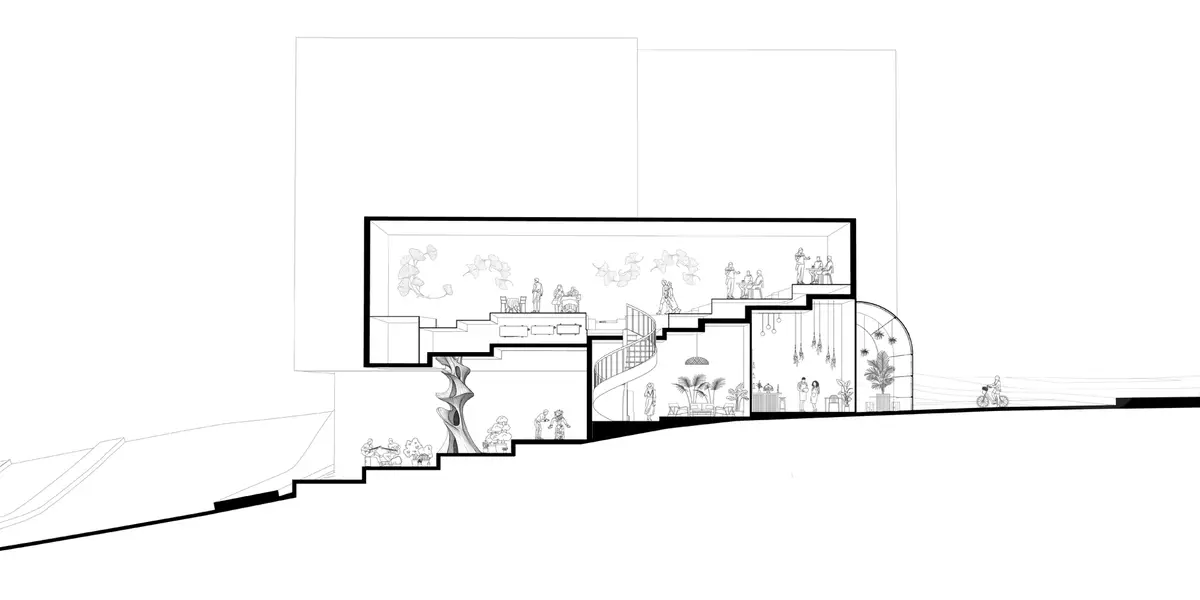
Art Nouveau Architecture: Redefining Spaces for Artful Living
Embrace the artistry of Art Nouveau architecture where creativity meets everyday life, inspiring spaces that connect communities.


Art Nouveau was never only about curves. It was an argument that art should not live in museums but in the chair you sit on, the street lamp you walk past, and the door handle you touch every morning. More than a century later, L'Éclat de l'Art, designed by Bhavya Ohri and Jayesh More, takes that argument seriously and builds a theatre-restaurant in Lisbon where the dining room, the stage, and the public landscape are all designed as a single continuous work of art.
The project won the Artful Dining competition on uni.xyz by treating the brief as a chance to revive Art Nouveau's core proposition: that dining, performance, and public life should not be separated by walls. The design places three principles at the centre of the scheme, and each principle gets its own built space.
The Site: A Slope in Lisbon
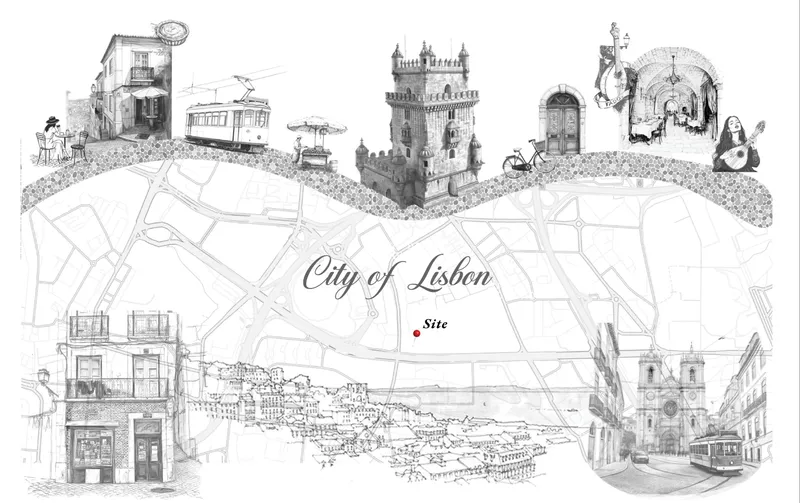
The site collage is the project's most personal drawing. Pen-and-ink vignettes of Lisbon landmarks, the Belém Tower, trams, Azulejo shopfronts, and street cafes, are arranged around a street map of the city centre. The site is marked along the river. The drawing is not a render. It is a reading. The designers are saying: before we place a building here, look at the city around it, because the building has to belong to this particular Lisbon, not a generic European capital.
That reading matters because Lisbon already has its own Art Nouveau inheritance. The Azulejo tile traditions, the iron balconies, and the wrought-metal kiosks that still line its historic squares are all part of a lineage the project wants to continue. L'Éclat de l'Art is not importing a style. It is extending one that is already in the street.
Principle 1: Art Accessible to All
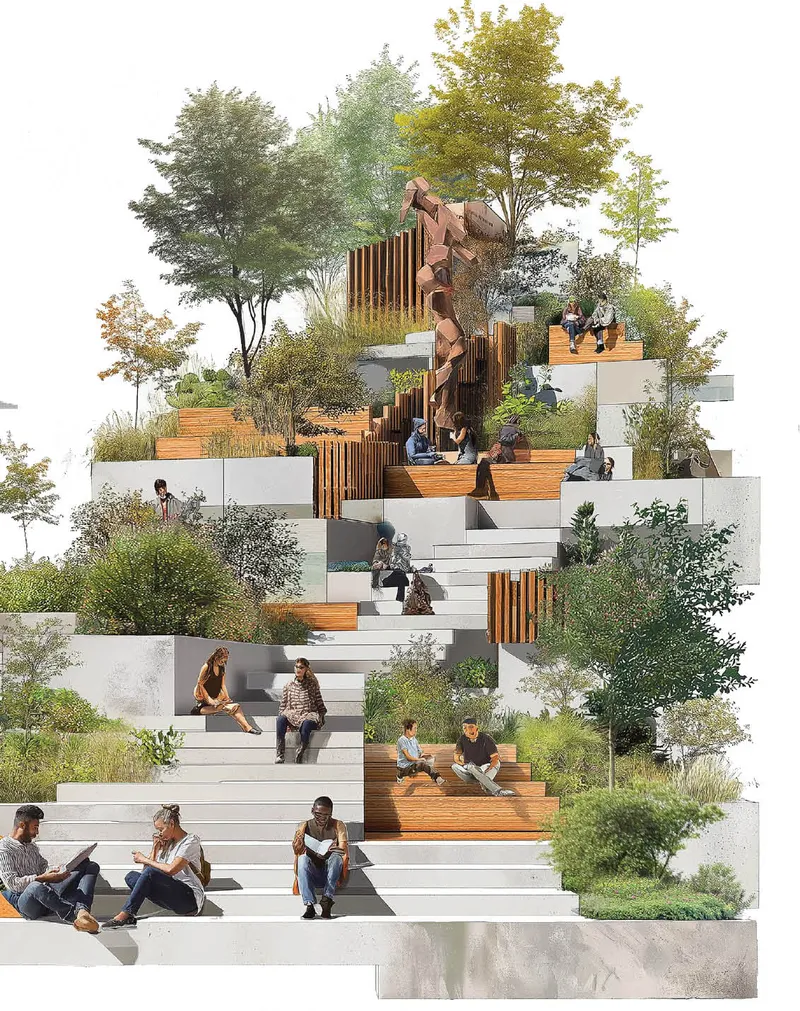
The stepped landscape render demonstrates the first principle in built form. A multi-level platform of concrete terraces rises up the slope, planted with trees and grasses, shaded by timber pergolas. Residents and visitors sit on every level, reading, talking, and eating. There is no ticket, no reservation, no boundary between the people who are dining and the people who are passing through. The landscape is the ground floor, and the ground floor belongs to the street.
This is the most important move in the project. Art Nouveau was born from the rise of a middle class that wanted art in its ordinary life, and the stepped public landscape is the built equivalent of that ambition. The building does not sit on the site. It is the site, folded upward into terraces that happen to serve food and host performances on their way up.
Principle 2: Total Work of Art
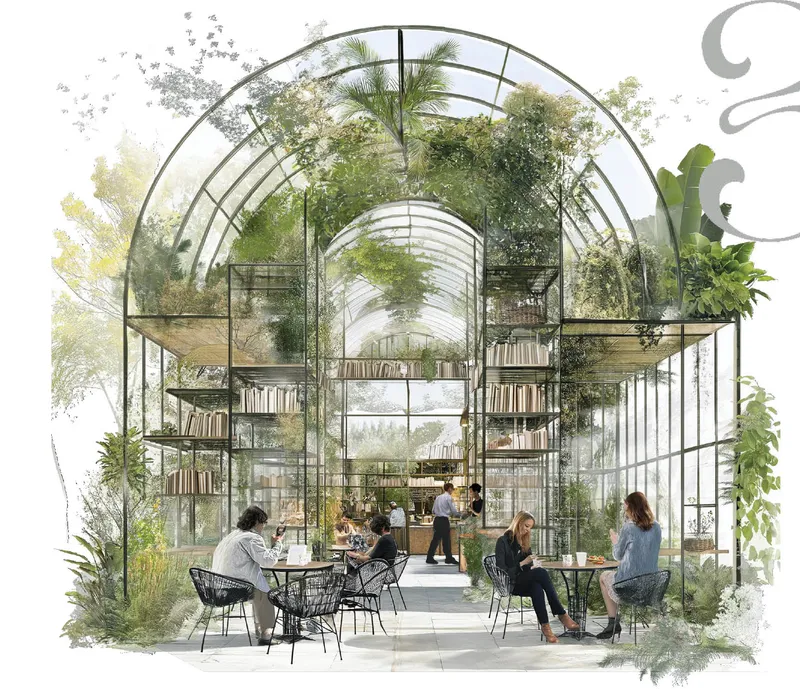
The glasshouse cafe illustrates the second Art Nouveau principle: the Gesamtkunstwerk, or total work of art. A vaulted iron-and-glass pavilion is filled with climbing plants and bookshelves. Cafe tables sit among the greenery. The pavilion is the building and the interior and the garden at once. There is no separation between architecture, furniture, landscape, and programme. Every element is part of a single composition.
This is the most direct homage to historic Art Nouveau in the project. The iron frame, the glass vault, the integration of plants into structure, and the warm timber furniture are all references to the winter gardens and cafes of Brussels, Paris, and Vienna circa 1900. The drawing updates the tradition rather than copying it. The space reads as a library, a cafe, and a greenhouse at once, which is exactly how an Art Nouveau master would have mixed them.
Principle 3: Art in Everyday Life

The theatre-restaurant render is the project's most ambitious image. A flowing bronze shell encloses a tiered dining hall. A large sculpted fish-like element is suspended above the stage. Rippling stone steps lead down to round banquet tables. The geometry is pure Art Nouveau: no right angles, no repeating modules, every surface curved and carved as if water had shaped the room over centuries. This is where dining becomes performance, and the building becomes an event.
The third principle is the argument that art belongs in daily life, and the dining hall is the project's proof. You do not enter this room to see a show. You enter to eat, and the show happens around you: the kitchen is on display, the stage is on display, the architecture itself is on display. Eating dinner becomes an artful act because the setting refuses to let you treat it as background.
Why This Project Won
The Artful Dining brief asked entrants to imagine what it means to dine artfully. Most responses proposed beautiful restaurants. L'Éclat de l'Art proposed a public building that includes a restaurant as one of its programmes, and that difference is why it won. The project does not decorate a meal. It redesigns the relationship between food, performance, and the city, and it does so by reviving a century-old movement with conviction.
For anyone studying Art Nouveau as a living design philosophy rather than a historical style, L'Éclat de l'Art is a useful reference. It does not copy the curves of Horta, Guimard, or Gaudí. It recovers the ambition that made their work possible: the belief that architecture, art, and everyday life should be inseparable, and that a single building can make all three feel like the same project.
View the Full Project
About the Designers
Designers: Bhavya Ohri, Jayesh More
Enter a Design Competition on uni.xyz
If Art Nouveau architecture, hospitality design, or the fusion of craft and public space is the kind of work you want to pursue, uni.xyz runs competitions year-round that reward projects grounded in cultural context and material ambition.
Project credits: L'Éclat de l'Art by Bhavya Ohri and Jayesh More. Winner, Artful Dining (uni.xyz).


Popular Articles
Popular articles from the community


FCC Arquitectura Expands a Portuguese Granite House with a Board-Marked Concrete Wing
In Portugal, JV House pairs a cleaned-up whitewashed and granite dwelling with a timber-shuttered concrete extension, courtyards and a garden pool.


Singing Woman: An Opera House That Performs Before the Curtain Rises
Ovidiu Cristian Pavel's conceptual opera house translates Estonia's choral identity into a sculpted waterfront landmark facing the Baltic Sea.

The Amber Palace Opera: A Geological Fiction Surfaces on Tallinn's Baltic Waterfront
Pierre Brillard reimagines a Baltic legend as a public landscape, opera house, and waterfront promenade rooted in Tallinn's coastal identity.

graciastudio Turns a Viewless Tijuana Lot Inward Around a Courtyard of Concrete, Timber and Trees
In Tijuana, Jorge Gracia's GA2 House stacks a timber-clad private floor over exposed concrete and replaces a missing view with a planted interior patio.

Similar Reads
You might also enjoy these articles

Vereda Arquitetos Renovates a 40-Square-Meter Apartment Inside Niemeyer's Copan Building
A compact unit in São Paulo's most iconic residential tower gets a material overhaul that pairs exposed concrete with bold blue Formica.

Shakur's House: Exposed Brick as an Interior Organiser in a 168 m² Mashhad Residence
Brick moves indoors in this Mashhad residence, where masonry walls, glass partitions and teal planes sequence a compact home without closing it off.

Day and Night Park: A Time-Based Urban Newsstand in Beijing
A temporary urban newsstand in Beijing blending travel, light, and reading through poetic colors, compact form, and community-focused design.

Modernist Patio Renovation in El Masnou, Barcelona by Oliver Segura Arquitectura + Cebrià Arquitectura
Modernist patio renovation blending tradition and innovation with a movable pool, leveled floors, and Catalan materials in El Masnou.

Explore Art Nouveau Competitions
Discover active competitions in this discipline

Challenge to design luxury tourism on rails

VR headsets Storefront design competition

Bring back Drive In's

Designing a staircase for a client
Comments (0)
Please login or sign up to add comments
No comments yet. Be the first to comment!