
Aslam Sham Architects Build a 2,200 m² Kerala Home That Refuses to Shout
In Thikkoti, raw concrete, exposed brick, and double-height voids compose a house where restraint is the real luxury.


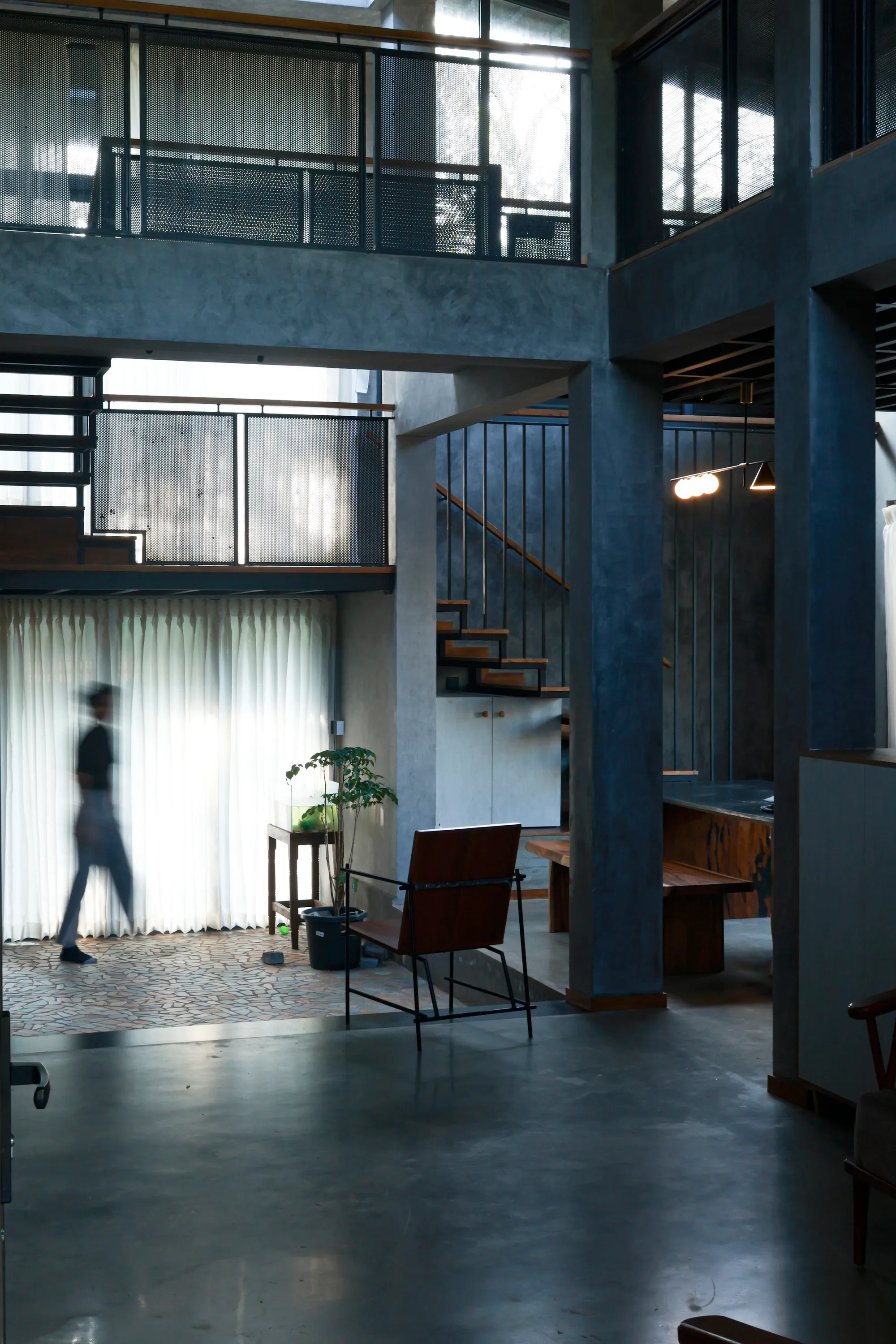
At 2,200 square meters, the Subtle House in Thikkoti, Kerala, is enormous by any residential standard. Yet Aslam Sham Architects, led by Aslam Karadan and Sham Salim, have managed to make it feel like something other than a monument to excess. The house earns its name: it recedes into its surroundings, presenting a perforated brick screen to the street and reserving its spatial drama for the interior, where a series of double-height voids, mezzanine bridges, and filtered daylight do the work that flashy materials and overwrought forms would do elsewhere.
The four-bedroom program, supplemented by a home office and study, is organized around a central void that stitches the ground floor to the upper levels. Raw concrete ceilings, exposed brick walls, polished concrete floors, and steel staircases set a material palette that is deliberately austere. There is no marble cladding, no curtain wall, no ornamental roof. What the architects call an "unsophisticated appearance" is really a disciplined one, and it produces interiors that reward slow observation rather than a quick Instagram scroll.
A Street Facade That Screens Rather Than Displays
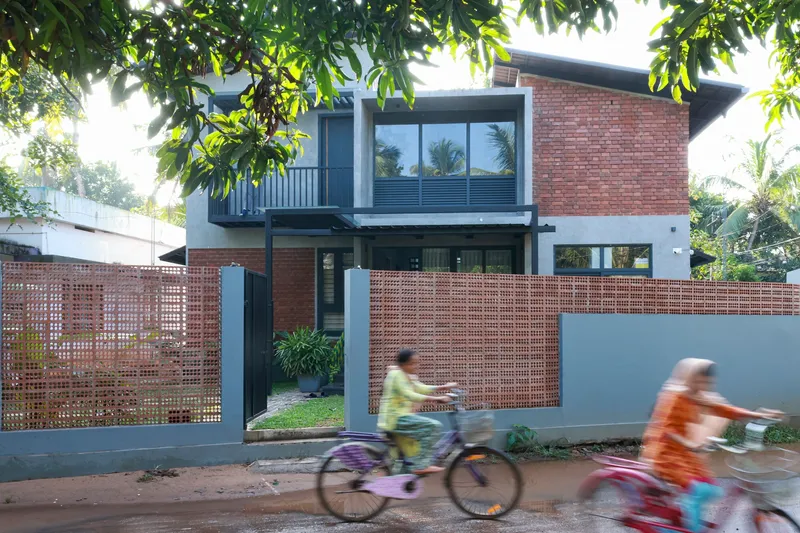
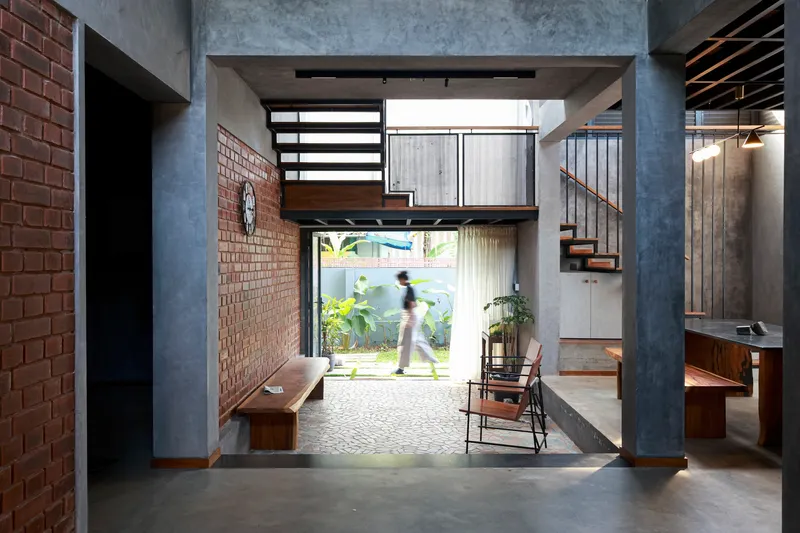
From the road, the Subtle House is largely opaque. A perforated brick screen runs across the primary facade, filtering views in and out while modulating the harsh Kerala sun. Cyclists pass by almost unaware of the scale of the residence behind the wall. Step through the threshold, however, and the compression releases: an entry hall framed by concrete columns opens toward a garden at the rear, immediately establishing the inside-outside axis that governs the entire plan.
The move is strategic. Privacy from the street is non-negotiable in dense Indian residential contexts, but the architects refuse to achieve it with a blank wall or a compound gate. The brick screen breathes, admits light, and gives the house a civic texture that blank concrete never could.
The Central Void as Spatial Engine


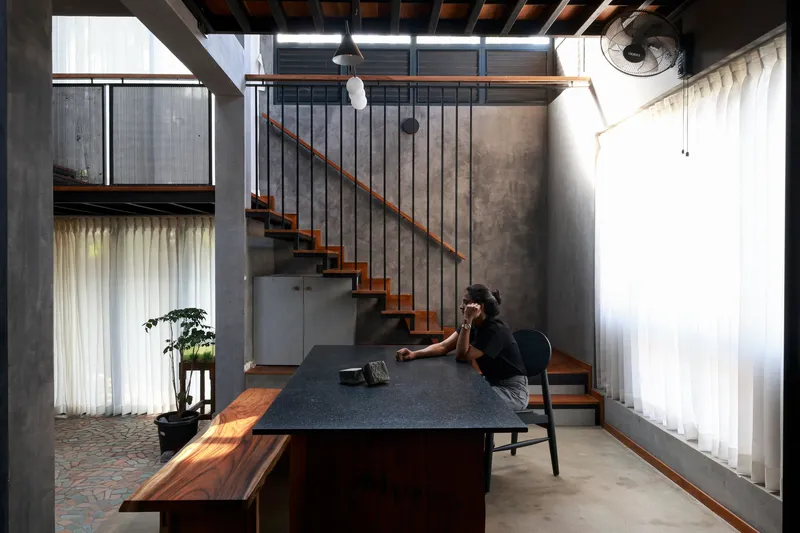
The heart of the house is a three-level void threaded with mezzanine bridges and steel staircases. Natural light drops through skylights and clerestories, washing the concrete surfaces with shifting warmth throughout the day. Sheer curtains soften the light further and add a domestic softness that keeps the interiors from tipping into warehouse territory. This void is not decorative; it is the primary mechanism for ventilation, daylighting, and visual connection between floors.
What we find most compelling is the layering of occupation within this volume. A figure descends a staircase while another sits at the dining table below; someone crosses a bridge overhead. The house is always revealing its inhabitants to one another across levels, creating a sense of communal life even in a very large home. The stacked balconies visible in image eight show this most clearly: three tiers of concrete edges, each holding the possibility of a person watching or being watched.
Raw Materials, Honest Joints


The material palette is ruthlessly limited. Concrete structure is left exposed. Brick walls are unplastered. Steel staircases are painted black and their grid treads left visible. Timber surfaces appear at the dining table, stair treads, and the study floor, providing warmth where the body makes direct contact. A close look at the pebble floor beneath a rounded timber table reveals the one moment of playful texture in an otherwise spare composition.
There is a risk with this approach: raw concrete and exposed brick can become their own kind of pretension, a calculated roughness that costs more than plaster. But here the consistency of the palette across every room, every level, every threshold suggests a genuine conviction rather than a trend-driven aesthetic. The joints are honest; the formwork marks on the concrete are deliberate.
Light, Corridors, and the Rhythm of the Upper Level


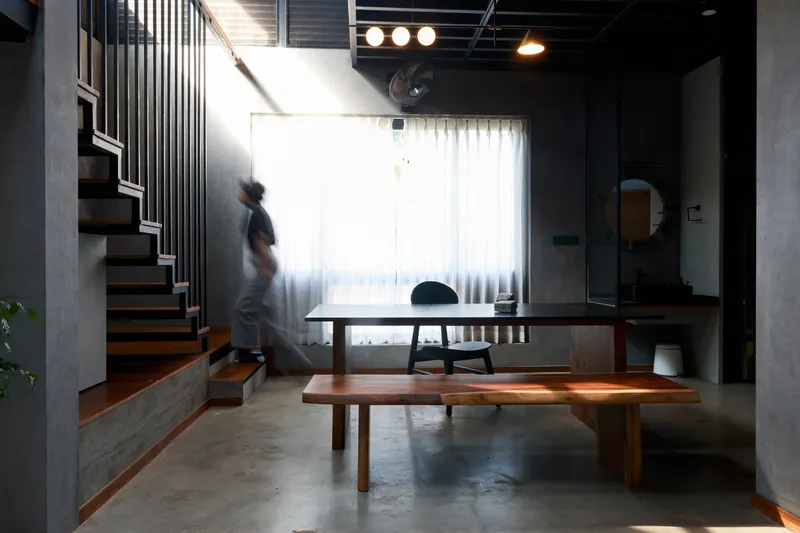
The upper-level corridor is one of the most evocative spaces in the house. A skylight runs along the concrete ceiling, casting a blade of natural light that tracks across the walls as the day progresses. Two figures move through this corridor in image two, and the light makes them luminous against the grey surfaces. It is a simple architectural device, but its execution here is precise: the slot is narrow enough to be directional, wide enough to light the entire passage without glare.
The study room, by contrast, gets its light from a full-height glazed wall facing the garden. With timber flooring, concrete ceiling beams, and two occupants working at a low desk, it reads as the most domestic room in the house. The architects seem to understand that not every room needs the spatial intensity of the central void; the study is quiet, horizontal, and deliberately smaller in scale.
Plans and Drawings
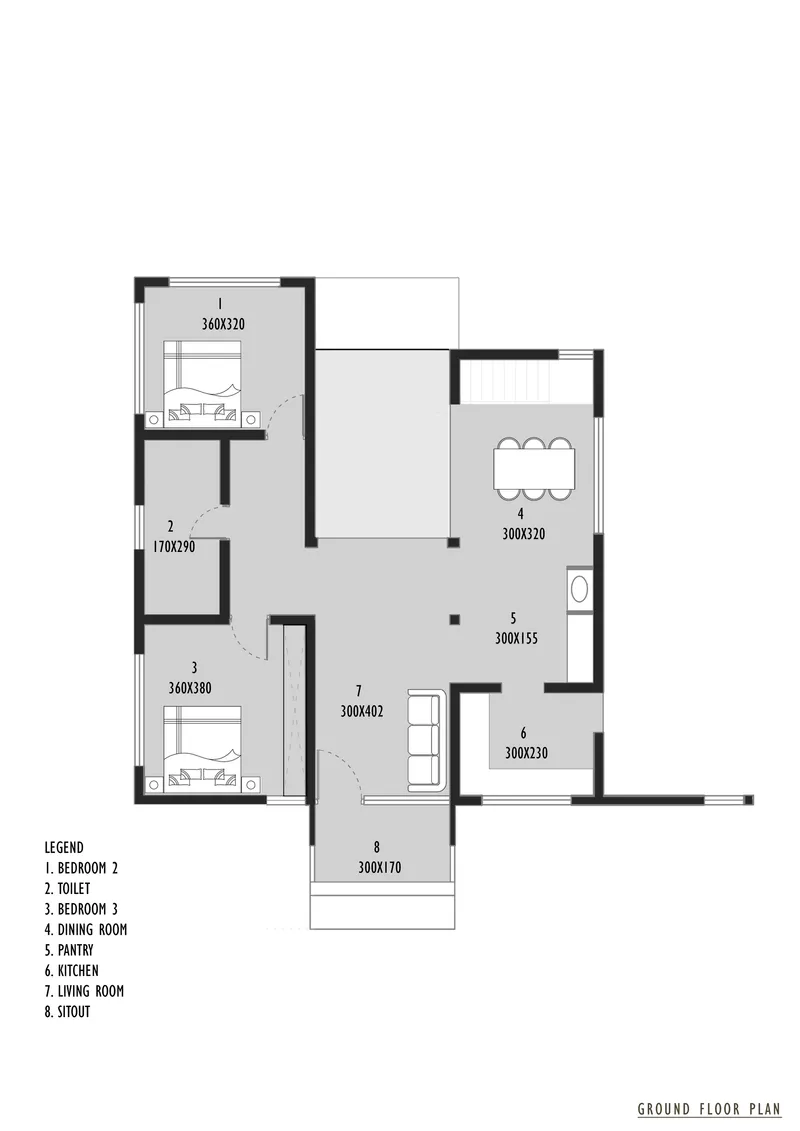


The ground floor plan reveals a pinwheel organization: two bedrooms, a living room, dining room, and kitchen wrap around the central void and staircase, with a secondary stout space completing the ring. Circulation is fluid; there are few hard corridors, and the rooms flow into one another through wide openings. The first floor plan shows the remaining bedrooms, the study area, and a deck that overlooks the double-height living space below.
The section drawing is the most revealing. It exposes the split-level logic that the photographs only hint at: floors step up and down in half-levels, creating spatial variety within what reads from the exterior as a simple two-story volume. The elevation drawing, meanwhile, confirms the restrained roof profile and the textured brick and concrete facade, set among trees that will eventually soften the building's edges further.
Why This Project Matters
Large houses in India often default to one of two modes: overt luxury or gated anonymity. The Subtle House charts a third path, one where spatial generosity is decoupled from material extravagance. By investing in voids, light, and honest construction rather than cladding and ornament, Aslam Sham Architects demonstrate that restraint at this scale is not only possible but legible. You understand the intent the moment you walk in.
The project also matters as an example of climate-responsive design that does not announce itself with louvers and fins. The brick screen, the skylights, the double-height volume, and the garden setback all contribute to passive cooling and natural ventilation in Kerala's humid tropical climate. These are not green features bolted on; they are the architecture itself. That integration, more than any single detail, is what makes the Subtle House worth studying.
Subtle House by Aslam Sham Architects (Aslam Karadan, Sham Salim), Thikkoti, Kerala, India. 2,200 m², completed 2022. Photography by Abhimanyu KV.
About the Studio
Share Your Own Work on uni.xyz
If projects like this are the kind of work you want to make, uni.xyz is a place to publish your own, find collaborators, and enter design competitions.




Popular Articles
Popular articles from the community


The Musturak Paradise: Senior Living Architecture for a Connected Future in Temara, Morocco
The Musturak Paradise reimagines senior living architecture in Temara via private homes, social spaces, culture, community, and shared care.

Co-Life: Senior Housing Design That Reconnects Older Adults With the City
Co-Life reimagines senior housing design through healing gardens, shared streets, workshops, and a sustainable community across generations.

Riyadh For All: Intergenerational Urban Design for Active Aging in Rabat
Riyadh For All reimagines urban design in Rabat with intergenerational co-living, adaptive courtyards, and Moroccan cultural exchange today.

Play: Fragments of Their World
Familiar architecture becomes modular playground design, creating safe spaces where displaced children can learn, connect, imagine and play.


Similar Reads
You might also enjoy these articles

Bao Huynh Watercolor Atelier: A Serene Art Retreat in Hội An
Bao Huynh Watercolor Atelier in Hội An blends multifunctional art spaces, sustainable design, local materials, and family-friendly living in a serene environment.

Atelier Macri Concept Store Interior Design by CASE-REAL
Atelier Macri store features a "ko" counter, walnut wood details, cork displays, blending retail, gallery, and seamless customer experiences.

Manuel Vargas Izquierdo Stadium and High-Performance Sports Center: Architectural Excellence in Jalpa de Méndez
The Manuel Vargas Izquierdo Stadium blends sustainable design, inclusive sports facilities, and cultural-inspired architecture, revitalizing Jalpa de Méndez’s public spaces.

KAKR Buluh Awar Hall: Revitalizing Community and Ecology Through Bamboo Architecture
Community built bamboo hall revitalizes Buluh Awar village, empowering youth, restoring ecology, celebrating vernacular craftsmanship through sustainable architecture and culture.


Comments (0)
Please login or sign up to add comments
No comments yet. Be the first to comment!