
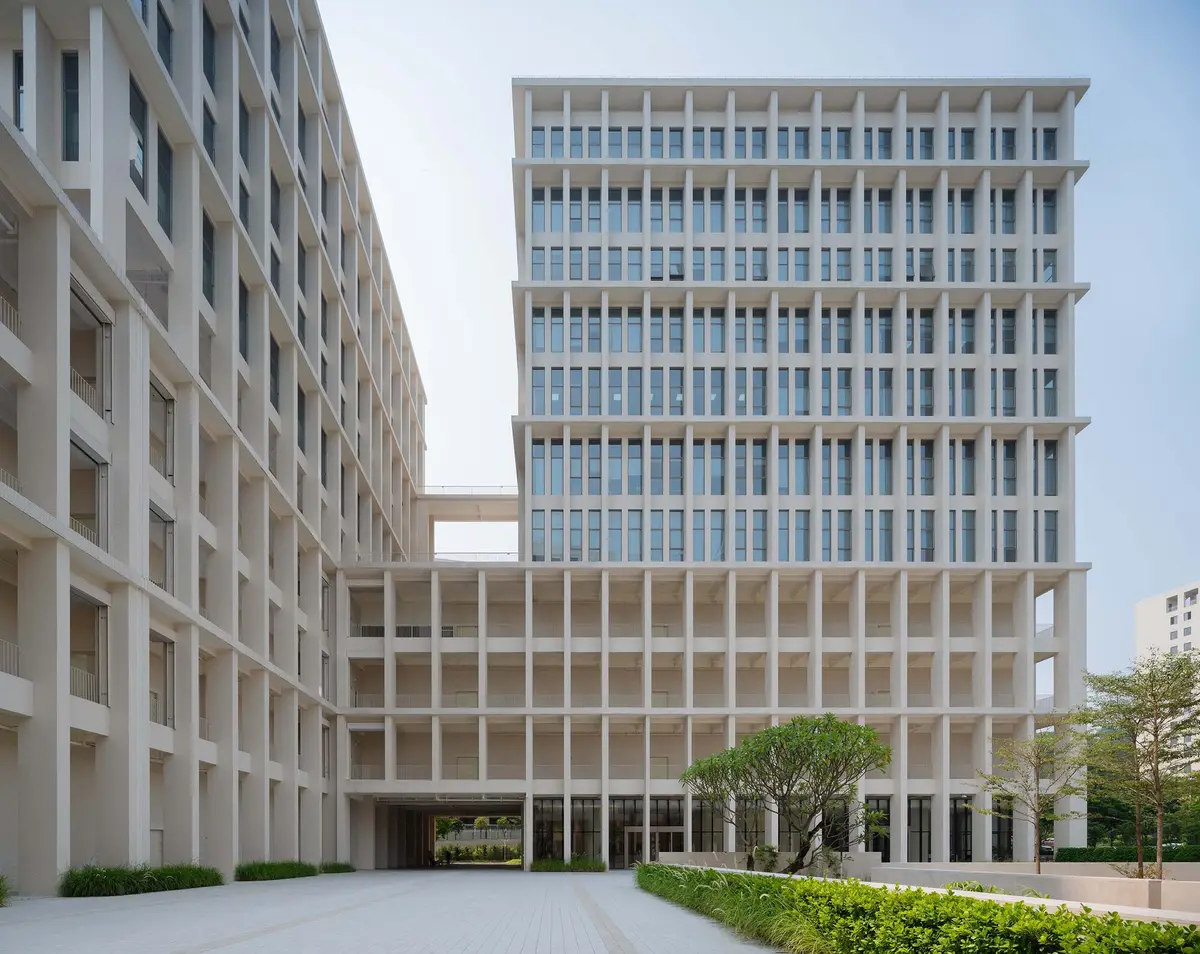
Atelier L Channels Guangzhou's Qilou Arcades into a 60,000 m² Industrial Campus
Wondfo's Shenzhou Road expansion in Guangzhou reinterprets traditional arcade architecture to shelter a manufacturing headquarters from subtropical weather


Industrial campuses rarely get to be this considered. The Wondfo Shenzhou Road Campus in Guangzhou, designed by Atelier L under lead architects Dake Li and Nan Lei, is a 60,000 square meter expansion for a medical diagnostics company that manages to feel less like a factory compound and more like a civic quarter. Four tower volumes rise from a shared podium on a former quarry site, their facades wrapped in matte beige brick tiles and deep loggias that owe a clear debt to the city's Qilou arcade tradition: the covered, balconied walkways that have sheltered pedestrians from Guangzhou's rain and sun for over a century.
What makes the project genuinely interesting is the constraint it worked under. Atelier L inherited a predetermined master plan and building massing, along with a demanding 3.0 floor area ratio on a lot of just 14,290 square meters. Rather than fighting that density, the architects turned it into an opportunity. They unified every surface, from exterior cladding to interior lobbies, in a single warm-toned material palette, and organized the entire campus around a raised central plaza threaded with sunken gardens, quarry boulders pulled from the foundation excavation, and an integrated driveway system that keeps vehicles peripheral. The result is a project where density produces enclosure rather than compression.
Qilou Logic at Industrial Scale
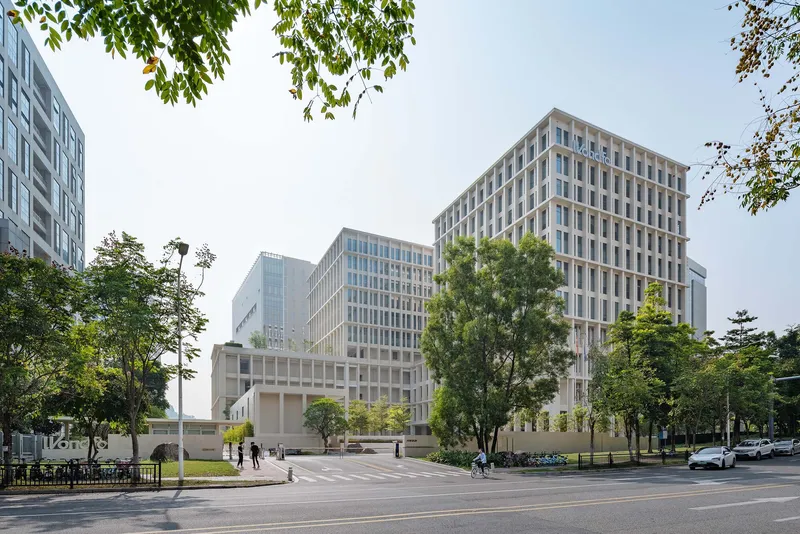
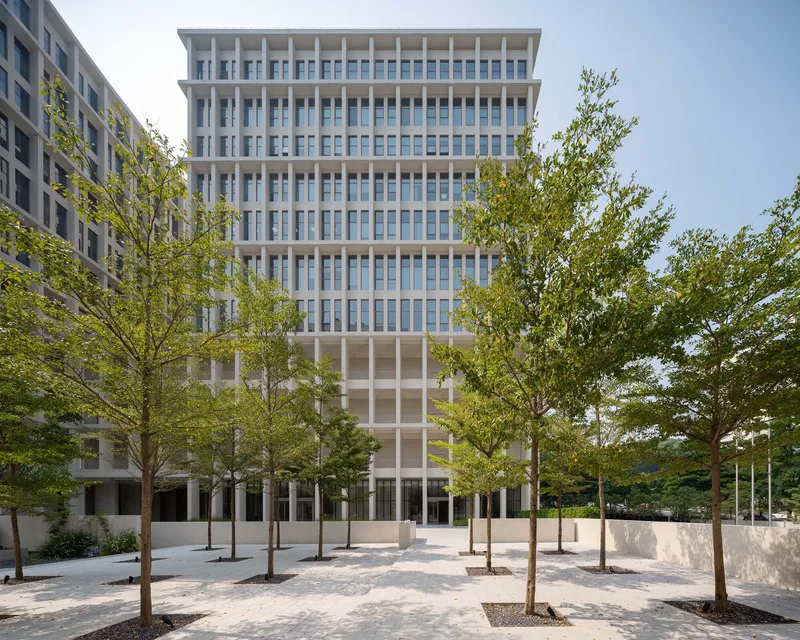
Guangzhou's Qilou buildings are typically two to four stories tall, their ground-floor arcades forming continuous shaded corridors above the sidewalk. Atelier L scales that logic up dramatically. The deep window recesses and horizontal eaves that wrap each tower create a gridded facade that reads, at a distance, like a stack of loggias. Each recess shelters its window bay from direct sun and driving rain, turning passive climate strategy into the primary visual motif. Viewed from street level, framed by mature trees, the towers register as a single coherent urban wall rather than isolated objects.
The consistency is the point. Where many corporate campuses differentiate their buildings for wayfinding, Atelier L does the opposite, applying the same matte beige brick tile and the same proportional grid across all four volumes. The effect is of a neighborhood that grew according to a shared set of rules, which is exactly what Qilou districts look like when they work.
A Podium That Does the Heavy Lifting
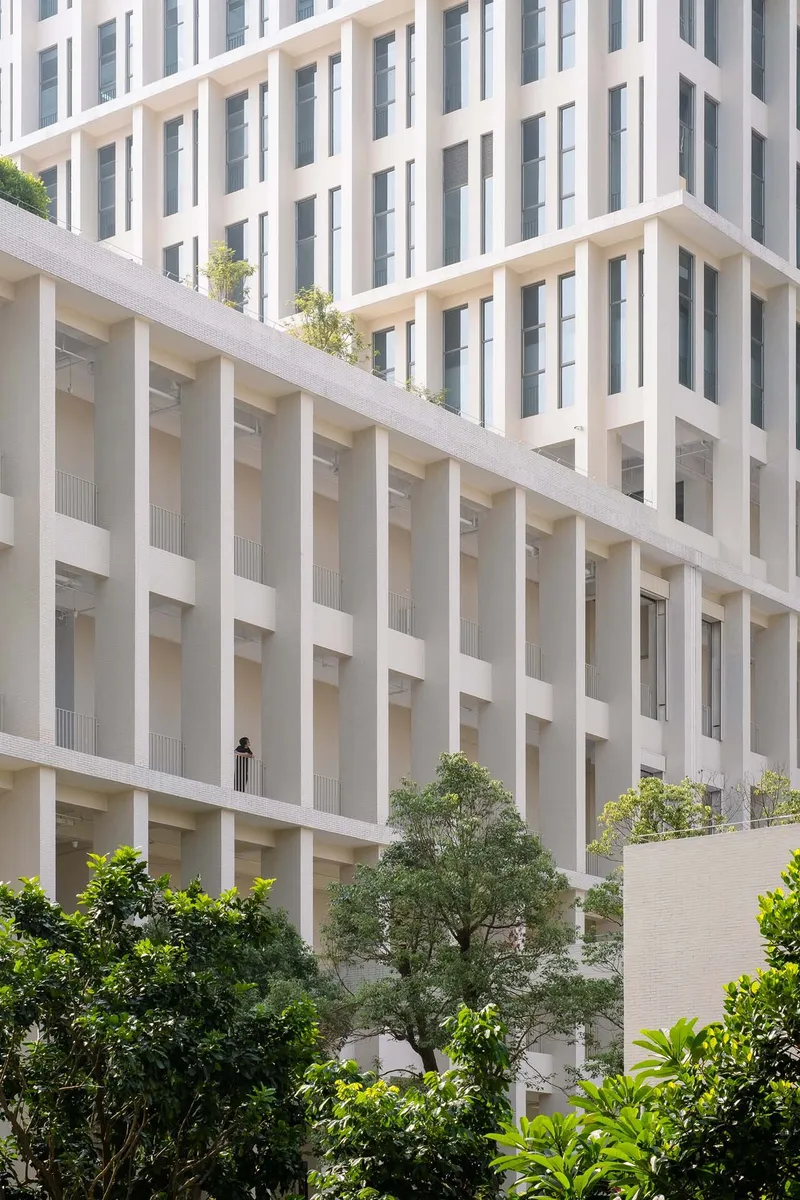
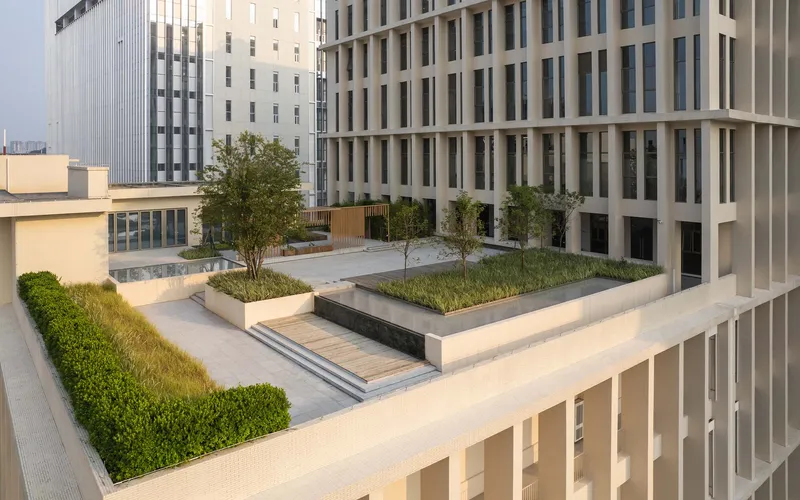
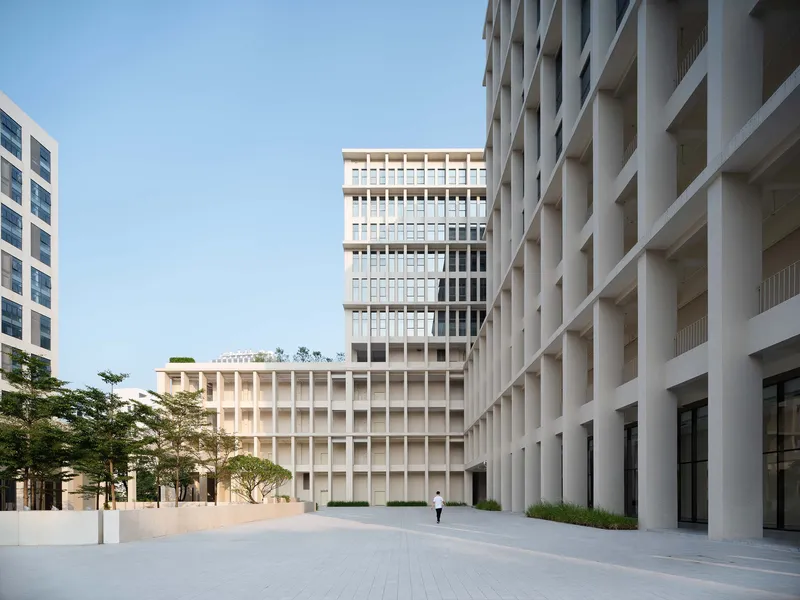
The horizontal base is where most of the campus's programmatic ambition lives. An exhibition hall at the entrance completes a U-shaped layout, while a lobby, multifunctional hall, and tea room sit within the podium volume. All buildings share a raised ground floor, a decision driven partly by flooding risk on the former quarry site, but one that also elevates the central plaza into something more deliberate than a gap between buildings. Landscape walls at the raised perimeter define the edges without blocking views.
The precast concrete facades at podium level shift register from the towers above. Vertical fins and columns introduce a taller, more porous rhythm that lets the base breathe, pulling daylight into the public-facing spaces while maintaining visual weight. Dense planting at the podium perimeter softens the transition from street to campus, and raised planted beds on the terraces extend the landscape upward.
Courtyards and Quarry Stones
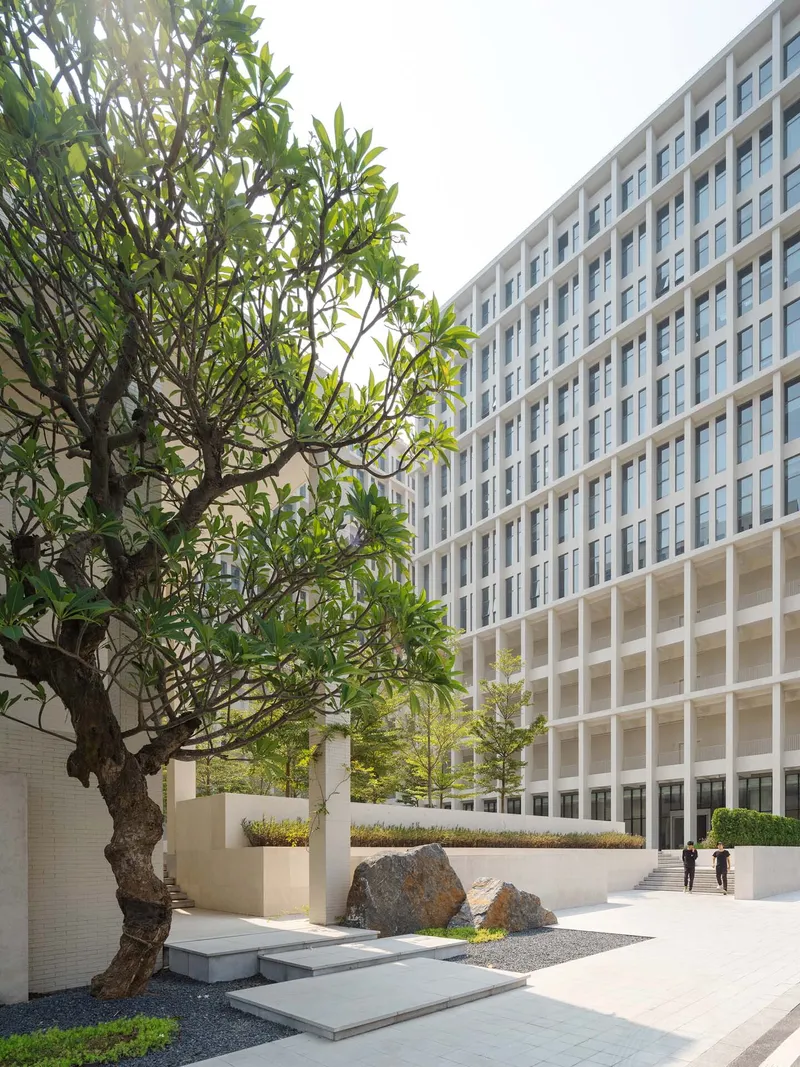
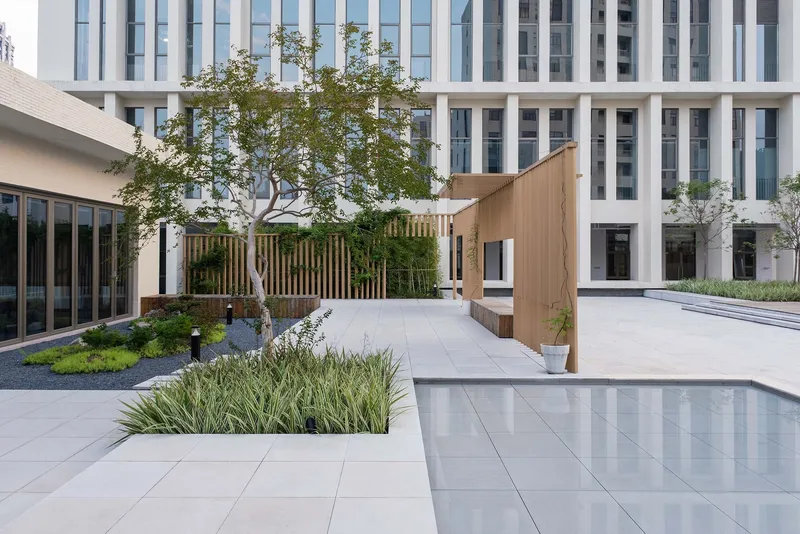
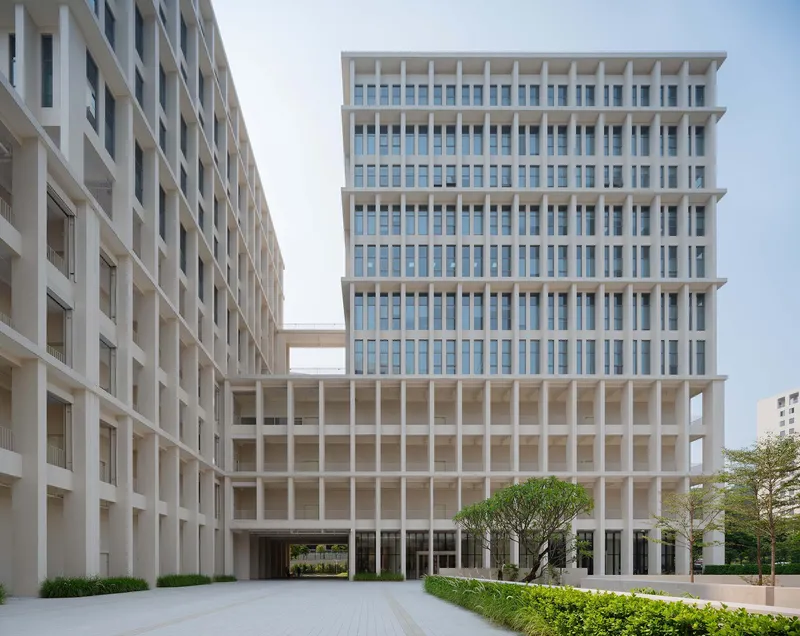
During foundation excavation, the team unearthed boulders from the site's former life as a quarry. Rather than hauling them away, Atelier L placed them in designed landscape scenarios throughout the campus: gravel beds beneath the towers, planted courtyards framed by timber screening, and garden vignettes that feel closer to a scholar's garden than a corporate park. A gnarled tree rising from a stone-and-gravel bed at the base of a tower facade is the kind of detail that signals genuine attention to the genius loci the architects wanted to preserve.
The courtyards between tower blocks are connected by elevated walkways, producing a continuous loop of covered outdoor space at the upper podium level. Walking through the campus means alternating between tight, shaded passages and open courts filled with grasses and trees. It is a sequence borrowed from traditional garden design, applied here to a manufacturing headquarters with enough conviction to actually work.
Interior Warmth
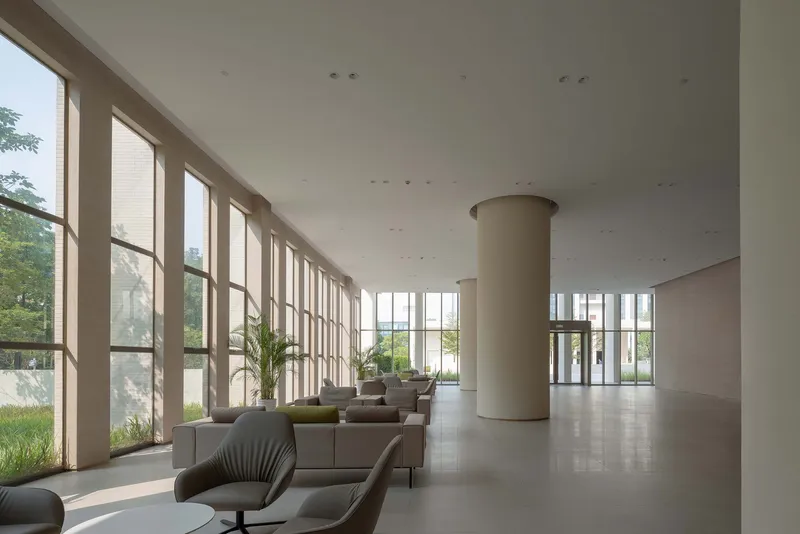
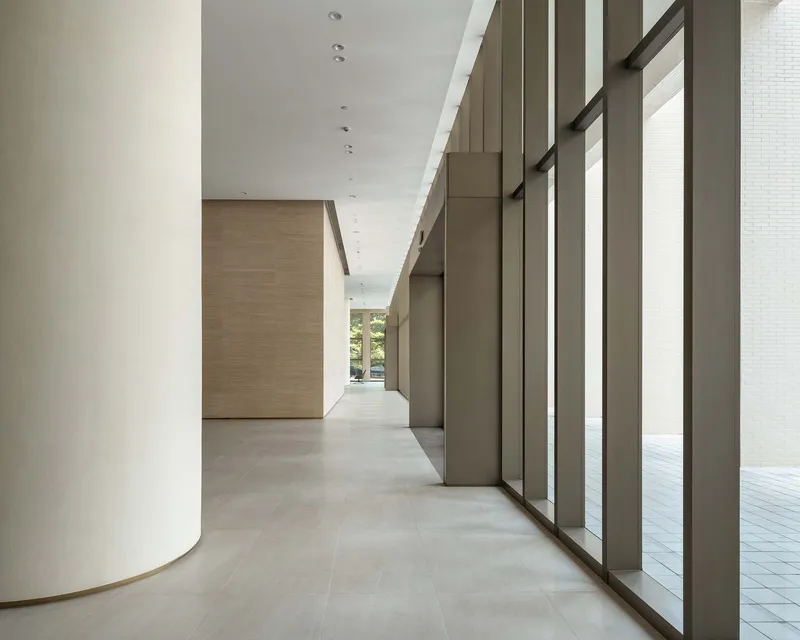
The unified material palette carries through to the interior without losing its nerve. Lobby spaces feature tall floor-to-ceiling windows, cylindrical columns, and pale stone flooring that keeps the warm exterior tone continuous. Bronze metal screens introduce a finer grain of detail at the corridor scale, filtering light and view in a way that echoes the deep facade recesses outside. The consistency between exterior and interior is worth noting because so many projects of this type treat the facade as a wrapper and the interior as a separate conversation.
Daylight management is handled gently. The deep loggias reduce glare on the upper floors, while the lobby volumes use their full-height glazing to pull soft, indirect light deep into the plan. Lounge seating scattered informally through the lobby suggests a workplace culture that values pause, which is a small but telling programming decision for a manufacturing campus.
Plans and Drawings
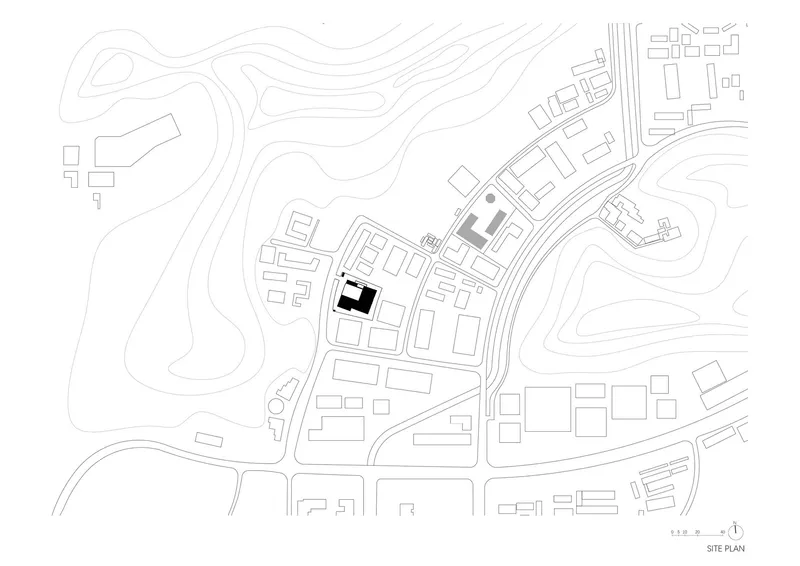
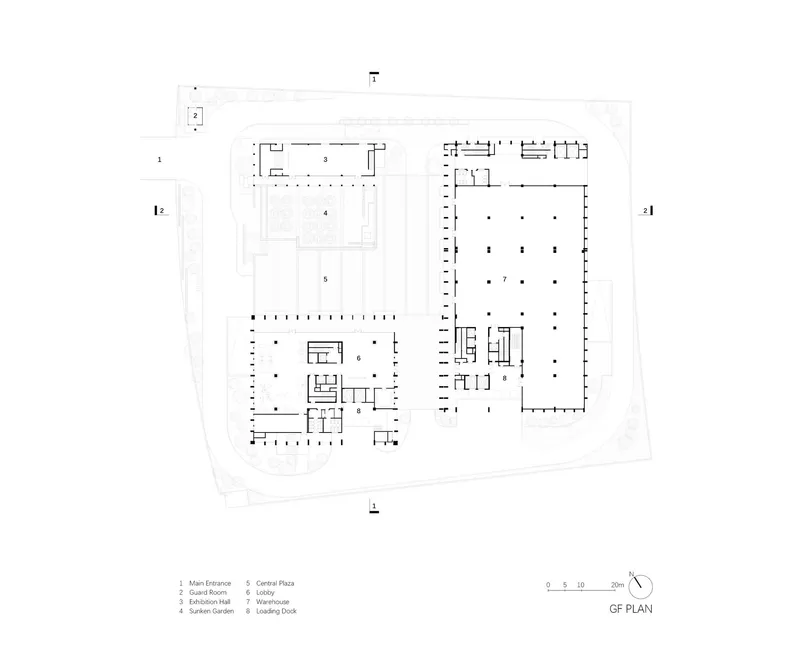
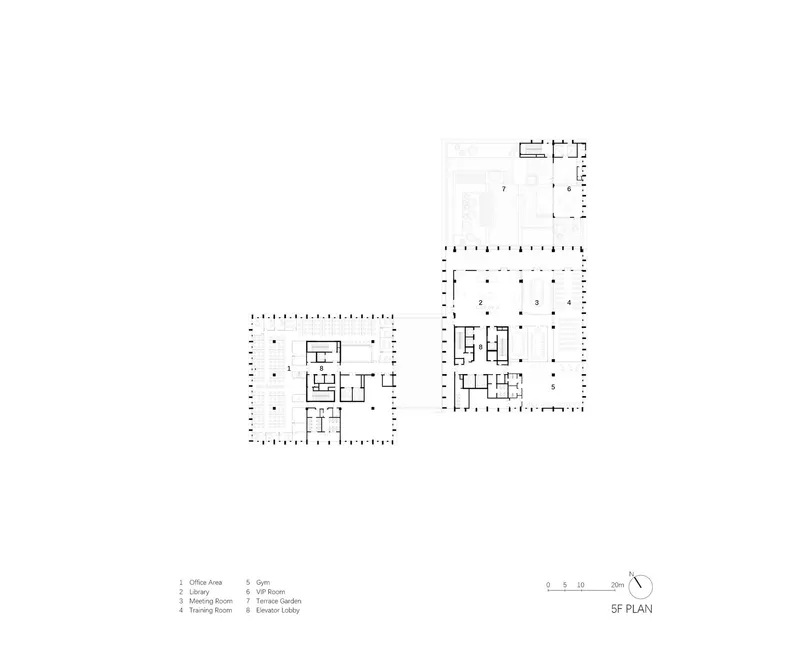
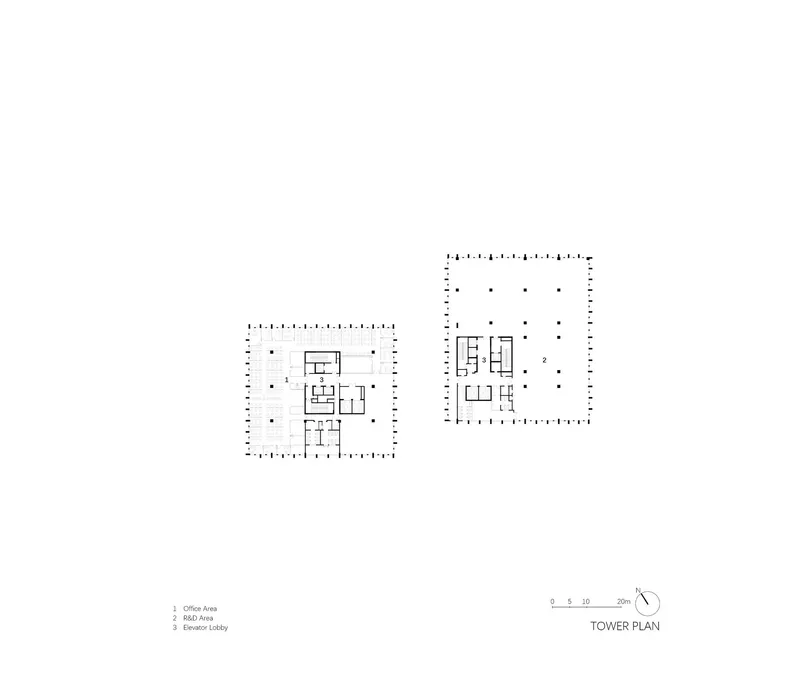
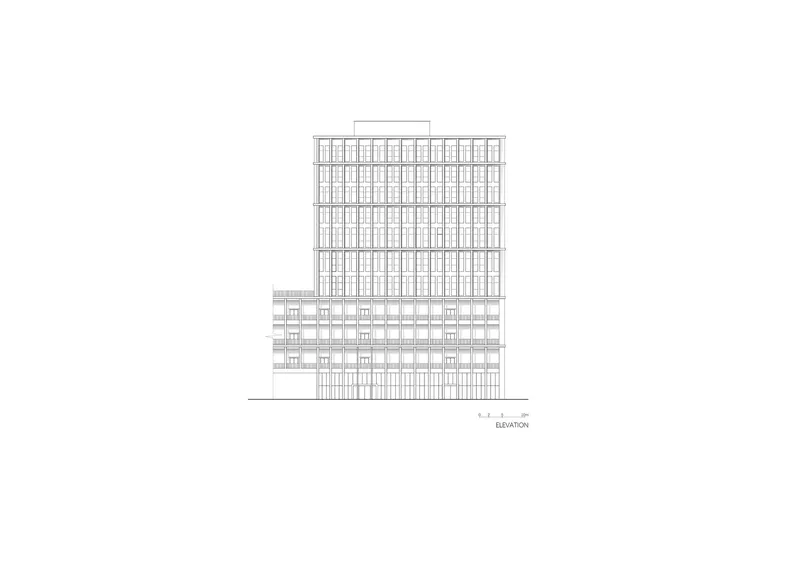
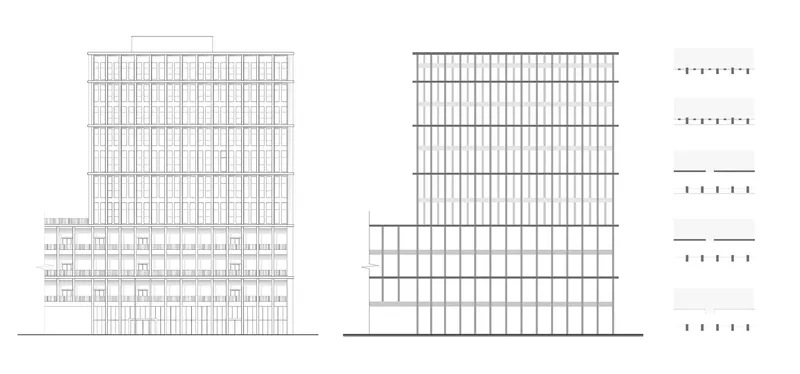
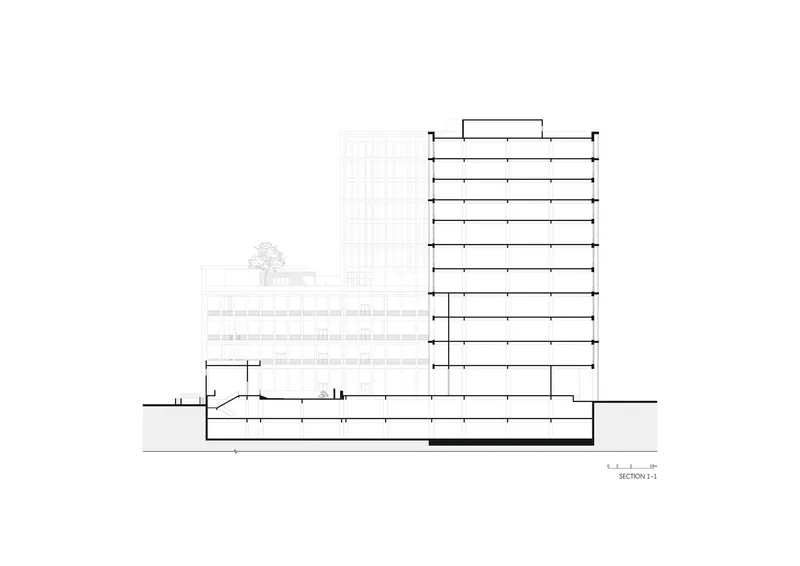
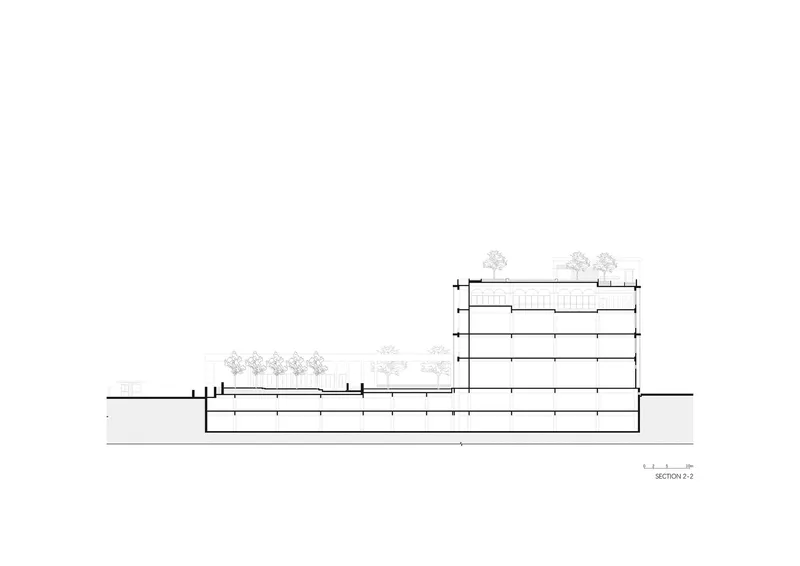
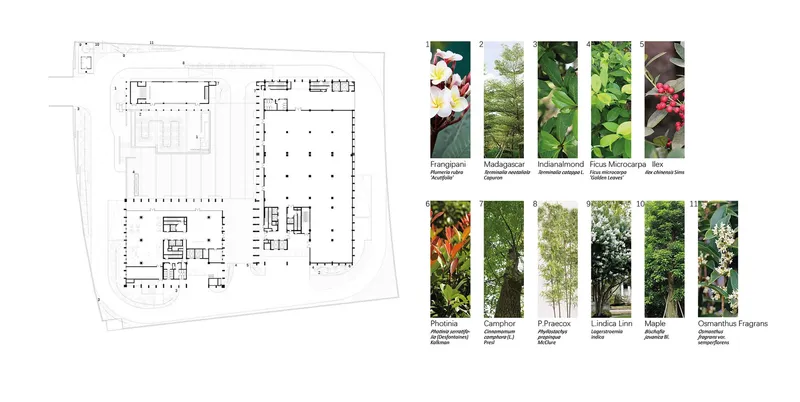
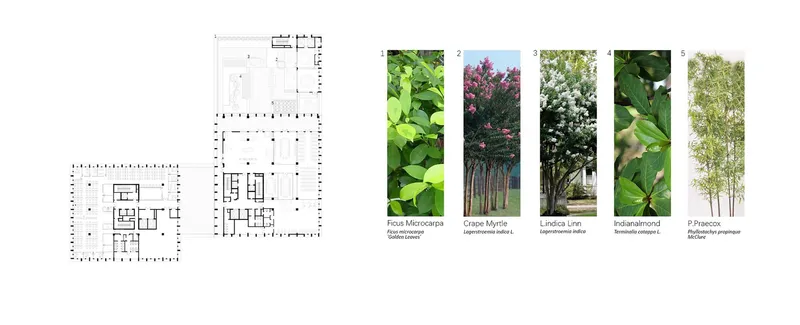
The site plan reveals how tightly the four towers are packed onto the lot, and how much the raised plaza and integrated driveway do to make that density livable. Ground floor plans show the courtyard voids that pull air and light into the podium, while the upper floor plans demonstrate a straightforward office layout organized around central cores. The sections are particularly revealing: they show the relationship between the horizontal base, its planted terraces, and the tower volumes above, clarifying how the landscape rises with the architecture rather than sitting beside it.
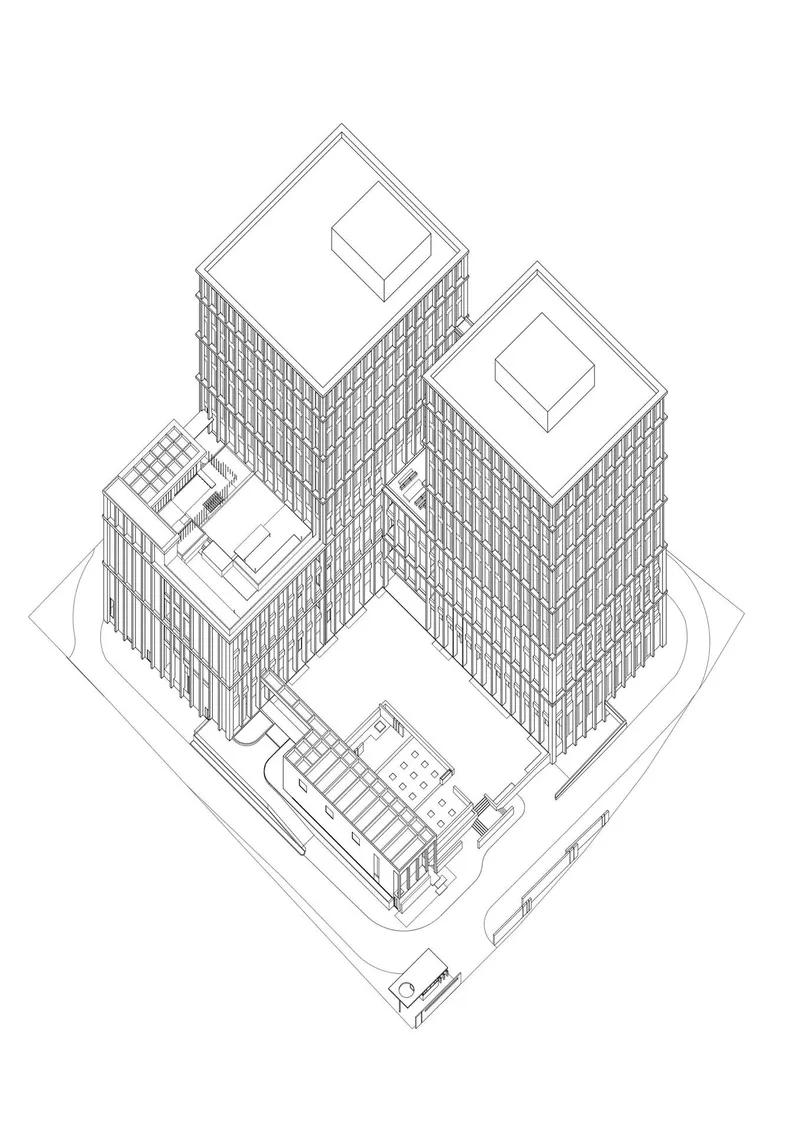
The axonometric drawing is the most useful single image for understanding the project as a whole. It shows four towers with consistent vertical facade detailing sitting on a shared base, rooftop elements punctuating the skyline, and a botanical palette integrated directly into the architectural drawings. That last detail, the companion panels showing plant species alongside floor plans, signals an office that treats landscape as a co-equal design discipline rather than an afterthought.
Why This Project Matters
The Wondfo campus matters because it demonstrates that density constraints and inherited master plans do not have to produce generic results. Atelier L found a single, regionally grounded idea, the Qilou arcade, and applied it with enough discipline and invention to turn a manufacturing headquarters into something that contributes to its urban context. The decision to reuse quarry boulders and to raise the entire campus above flood level shows a design team that read the site's history and hydrology as closely as its zoning envelope.
More broadly, the project offers a model for how Chinese industrial campuses might evolve beyond the default formula of glass curtain walls and token plazas. By rooting the facade in a local building tradition, unifying materials from exterior to interior, and treating landscape as integral rather than decorative, Atelier L has produced a campus that belongs specifically to Guangzhou. In a building type that usually belongs nowhere, that specificity is the most valuable thing the project achieves.
Wondfo Shenzhou Road Campus, designed by Atelier L (lead architects Dake Li and Nan Lei), Guangzhou, China. 60,008 m². Completed 2022. Photography by Chao Zhang.
About the Studio
Share Your Own Work on uni.xyz
If projects like this are the kind of work you want to make, uni.xyz is a place to publish your own, find collaborators, and enter design competitions.


Popular Articles
Popular articles from the community


Cloaked Colonization: A Mobile Underwater Habitat That Moves Like a Fish
Micah Abaya's shortlisted EHC Pacific entry reimagines ocean settlement as a dispersed network of self-sustaining architectural organisms.

Tsunami Convergenics: Turning Catastrophic Ocean Forces into Underwater Housing Infrastructure
A speculative underwater settlement off the coast of Onagawa, Japan, treats tsunamis and typhoons as energy sources rather than threats.
Extended Shell: Retrofitting Kolkata's Balconies as Living Urban Thresholds
A modular retrofit system recovers the social and environmental intelligence of Kolkata's historic verandas for contemporary Park Street residents.

Opera by the Sea Estonia: Three Shells Dissolving Architecture into Tallinn's Coastline
A winning opera house proposal replaces monumental form with interconnected shells that blur the boundary between building, park and Baltic Sea.

Similar Reads
You might also enjoy these articles

Pixel Gardens: One Repeated Module Stacked Into a Terraced Social Housing Tower for Famagusta
Salem Bader's shortlisted housing tower builds a vertical neighbourhood from one repeated module, offsetting units to carve terraces, light and air.

Bao Huynh Watercolor Atelier: A Serene Art Retreat in Hội An
Bao Huynh Watercolor Atelier in Hội An blends multifunctional art spaces, sustainable design, local materials, and family-friendly living in a serene environment.

Atelier Macri Concept Store Interior Design by CASE-REAL
Atelier Macri store features a "ko" counter, walnut wood details, cork displays, blending retail, gallery, and seamless customer experiences.

Manuel Vargas Izquierdo Stadium and High-Performance Sports Center: Architectural Excellence in Jalpa de Méndez
The Manuel Vargas Izquierdo Stadium blends sustainable design, inclusive sports facilities, and cultural-inspired architecture, revitalizing Jalpa de Méndez’s public spaces.


Comments (0)
Please login or sign up to add comments
No comments yet. Be the first to comment!