
Atelier Téqui Architects Builds a Low-Tech Timber Research Lab for Ecology in the French Countryside
A sober Douglas fir research facility near Nemours houses modular Ecolabs for CNRS and ENS scientists studying ecosystems at close range.

There is something quietly radical about designing a scientific research building that refuses to look scientific. The Écotron Île-de-France, completed in 2016 by Atelier Téqui Architects, sits in a meadow outside Saint-Pierre-lès-Nemours as though it grew there: a long, low bar of heat-treated Douglas fir that reads more like an agricultural shed than a laboratory. That restraint is deliberate. Commissioned by the CNRS and ENS, the 1,050 m² facility houses modular experimental chambers called Ecolabs, each a 25 m² unit containing one laboratory cell and three environmental cells. Researchers use them to study real ecosystems under controlled conditions. The building is meant to serve them, not upstage the landscape they study.
What makes the project worth scrutiny is its stubborn commitment to coherence between program and means. An ecology lab built with a wood boiler, a green roof, HQE certification, and a construction cost of €2.2 million excluding tax. The architecture is sober and minimal in expression but generous in layout and light. Every decision, from the openwork timber cladding to the extruded aluminum thermal break windows to the adjustable exterior blinds, follows from a desire to keep the ecological footprint low and the spatial quality high. It is a building that practices what its occupants preach.
A Timber Bar in the Meadow
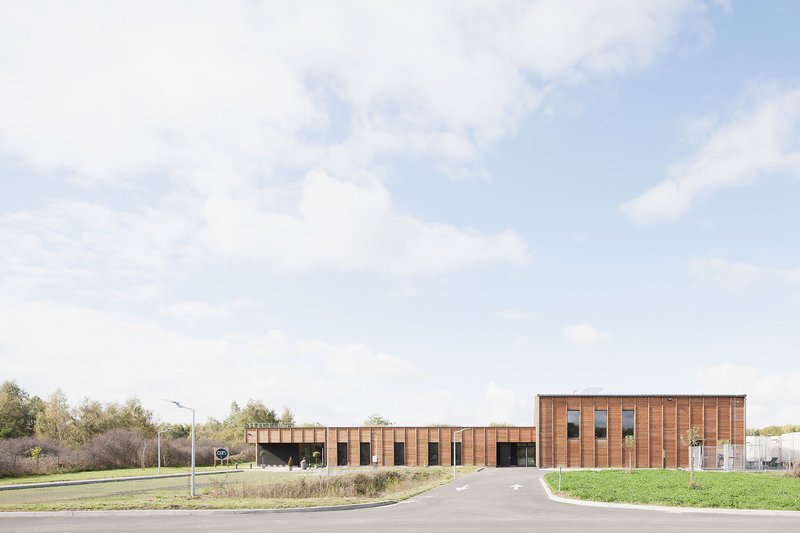
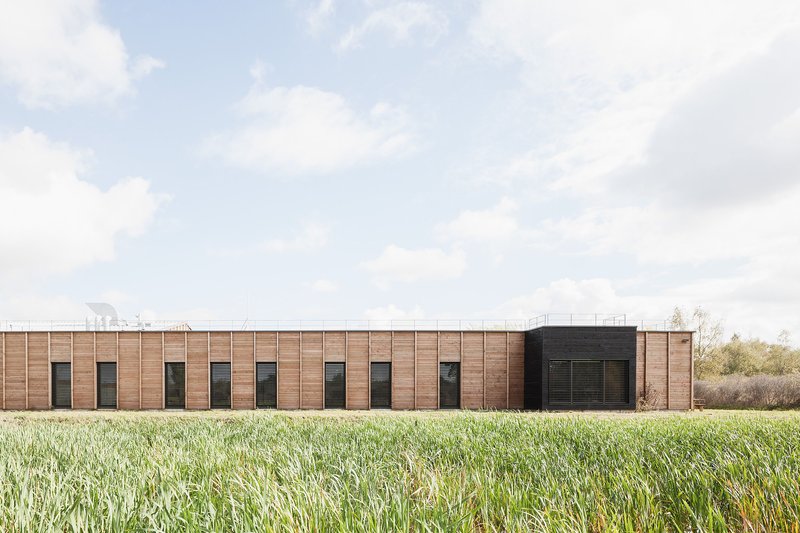
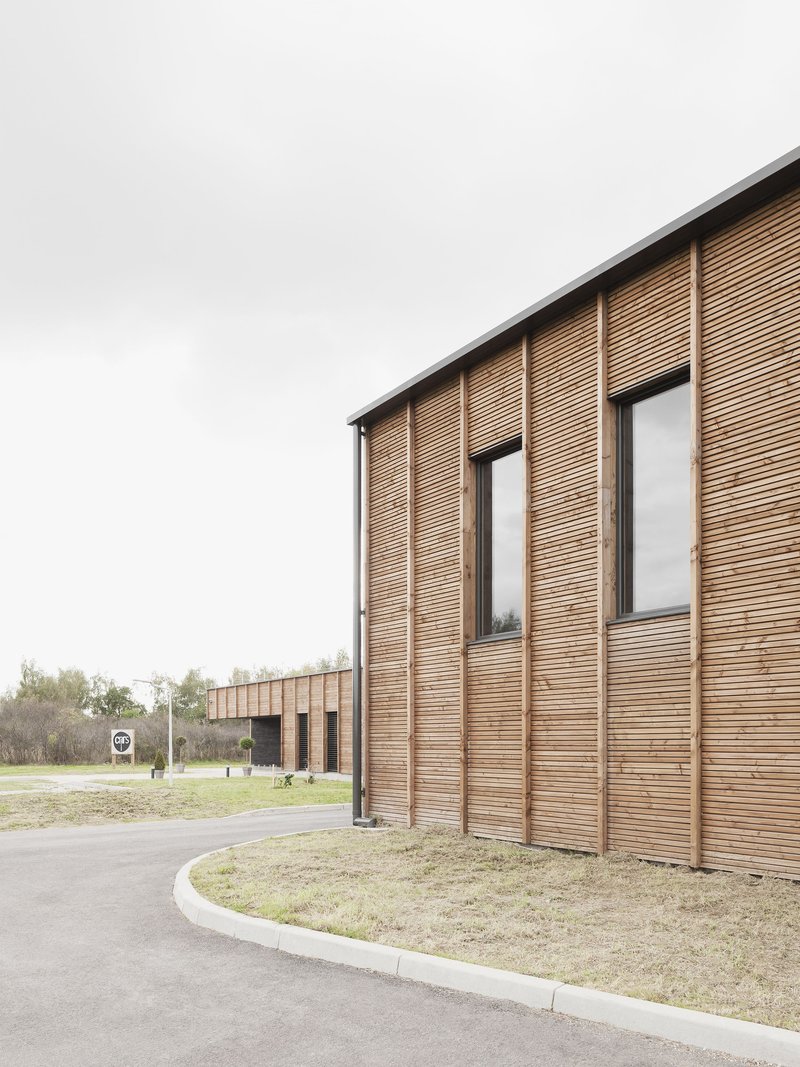
The building presents itself as a horizontal datum against the sky, its proportions closer to a barn than an institution. Heat-treated Douglas fir cladding, arranged in visible vertical slats, gives the facade a textured grain that shifts in tone with the weather and the season. The rhythm of tall, narrow window openings breaks the length without disrupting the calm. From a distance, the timber reads as a single material gesture. Up close, the alternation between opaque cladding and glazed panels becomes apparent, as does the structural logic of vertical uprights that organize the facade into bays.
Atelier Téqui chose wood not for aesthetic warmth but for environmental integration. The site is dominated by wild natural surroundings, preserved from urban nuisances, and a concrete or steel building would have been an intrusion. The timber structure minimizes embodied energy while allowing the building to settle visually into its context. The curved access road and modest bicycle parking area reinforce the sense that this is a facility designed for quiet, focused work rather than public display.
Green Roof and Climate Control
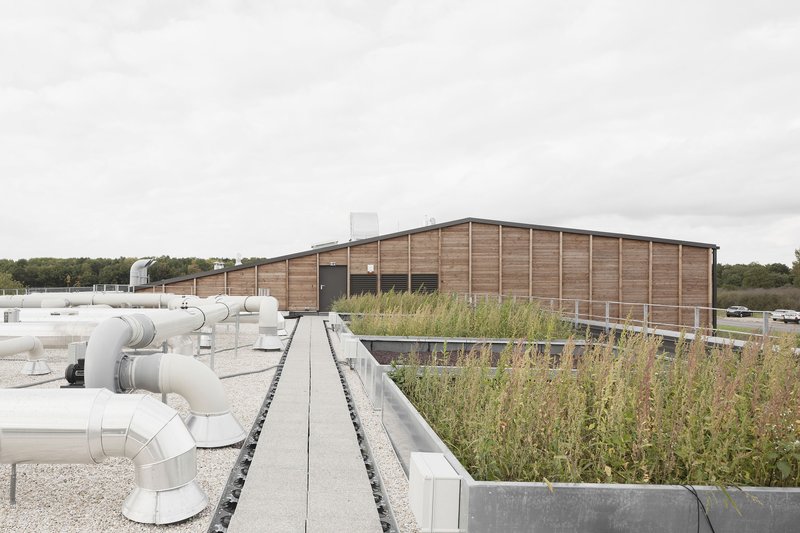
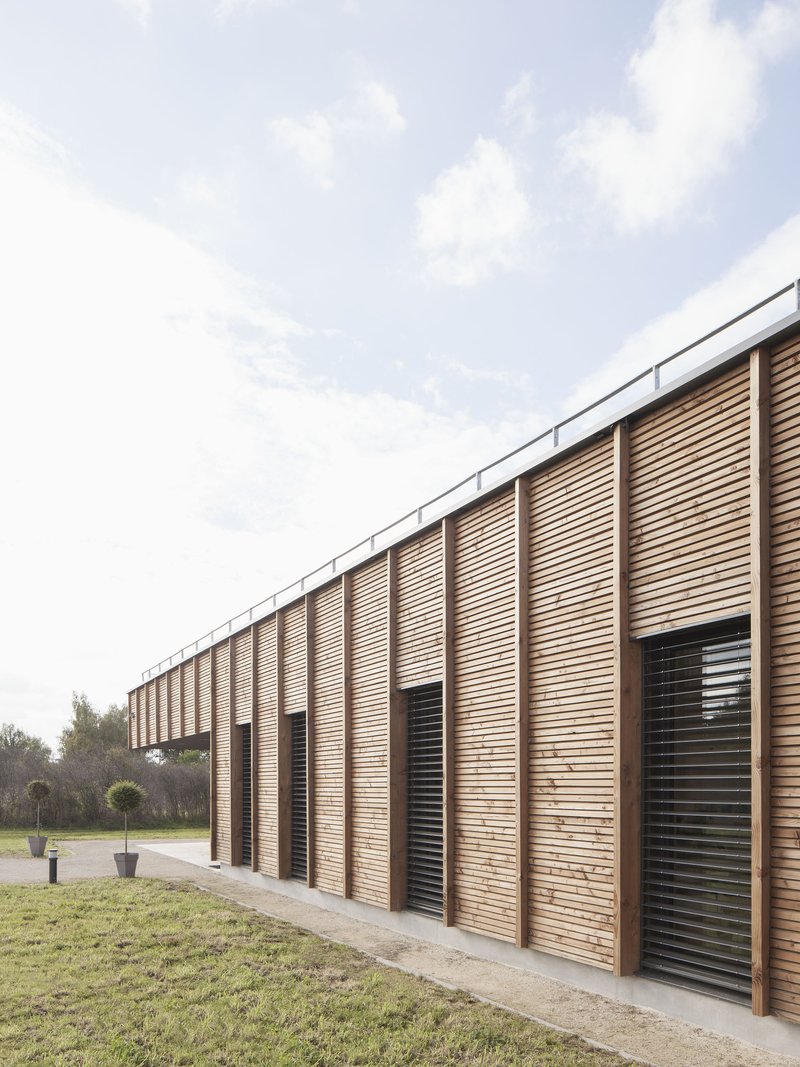
From above, the building reveals its second skin: a planted green roof punctuated by white ventilation ducts. The vegetated surface handles stormwater and adds a layer of thermal mass, while the ducts serve the controlled-environment chambers below. Heating and hot water come from a wood boiler, keeping the energy loop within the logic of the wood structure. The exterior blinds, with adjustable slats on all facade openings, provide solar protection and room occultation without relying on mechanical cooling.
The curved facade visible in the rooftop shot shows how the timber slats wrap around corners, integrating black ventilation louvers into the cladding pattern. The building breathes through its skin. This is low-tech environmental design at its most resolved: no photovoltaic panels on display, no wind catchers, just a well-insulated wood box that uses passive strategies and simple active systems to keep researchers comfortable and experiments stable.
The Interior Courtyard
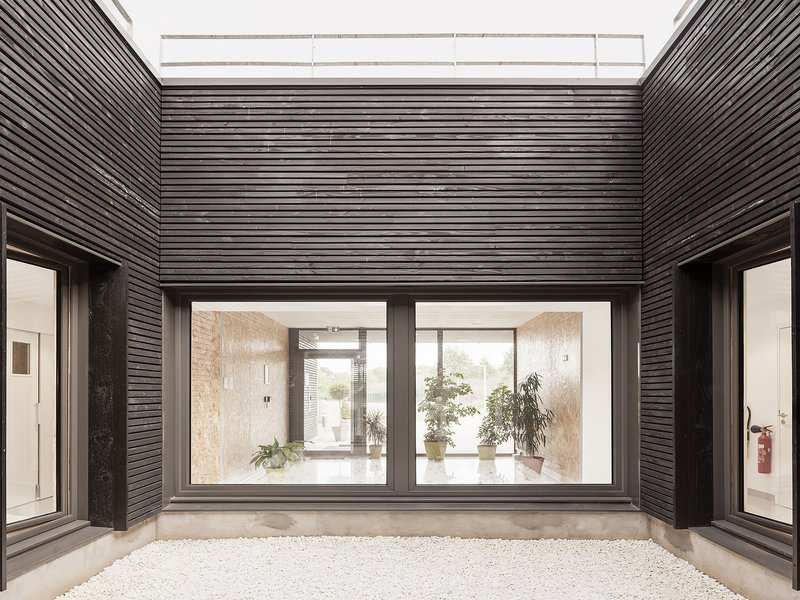
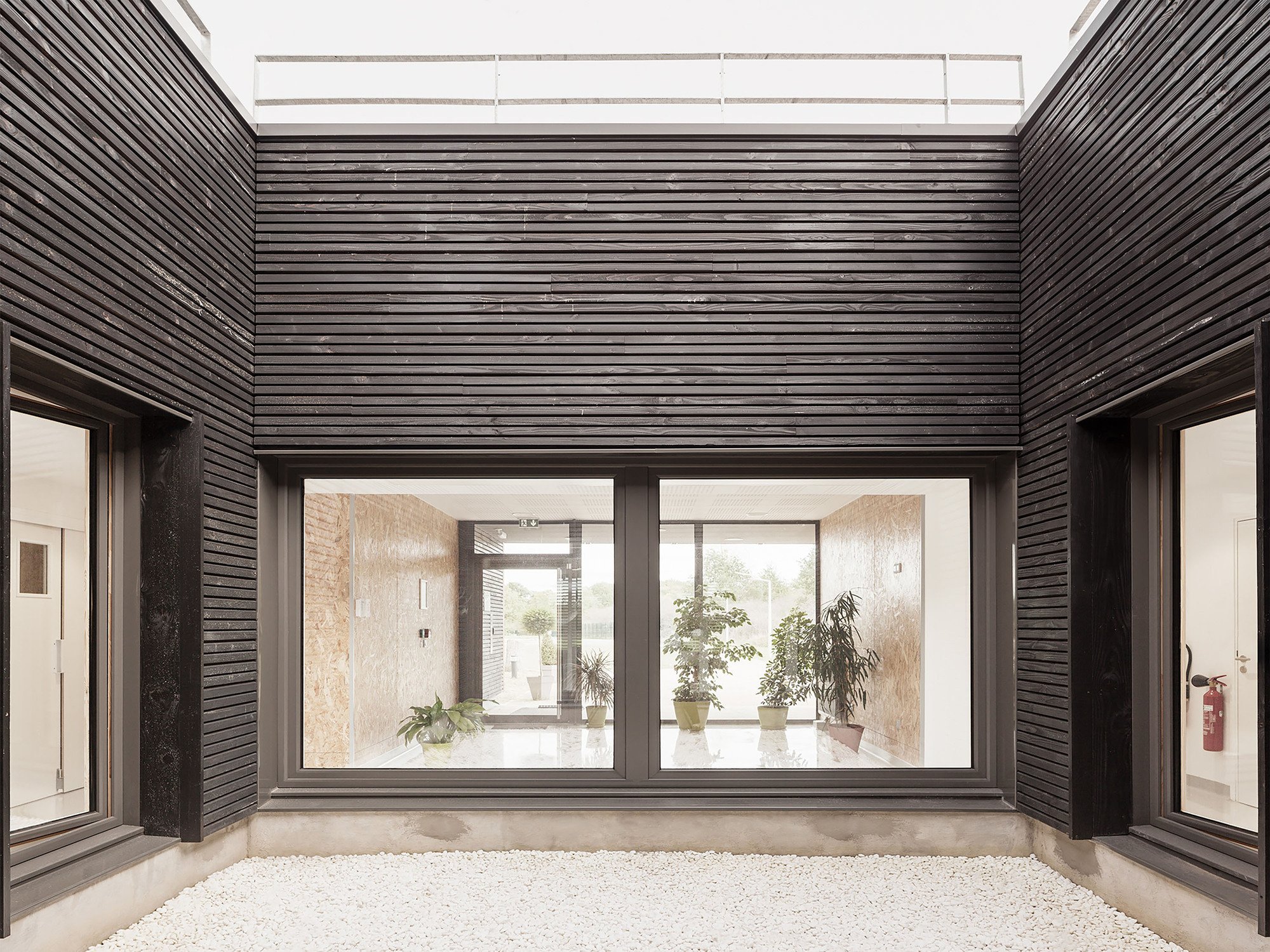
The most atmospheric spaces in the building face inward. An interior courtyard, clad in horizontally slatted charred timber, creates a microclimate between the lab volumes. Glazed doors open onto this pocket of filtered light, and potted plants line the threshold. The contrast between the exterior cladding (vertical, light Douglas fir) and the courtyard walls (horizontal, darkened wood) is subtle but effective. It signals a shift from public face to private core.
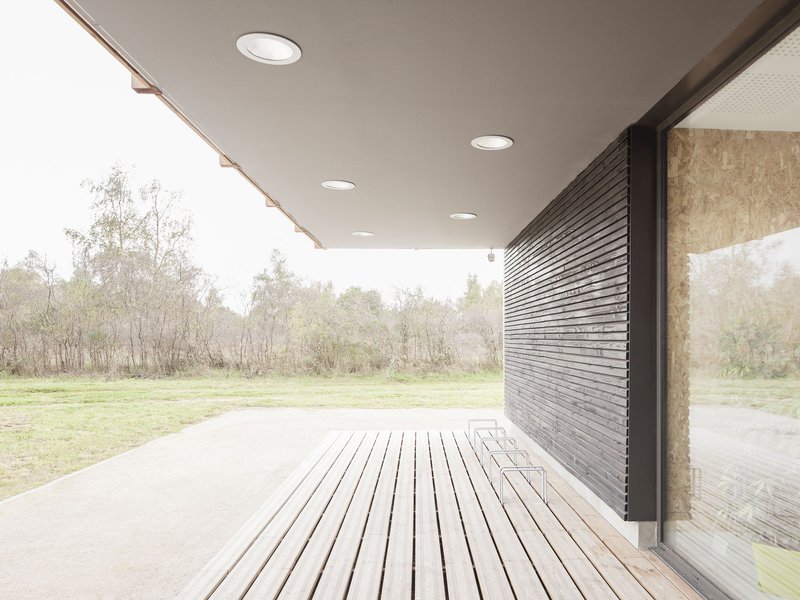
A covered timber deck extends this threshold condition further, opening toward the misty meadow landscape beyond. Horizontal slatted flooring and charred wood cladding frame a view that could be a painting. These transitional zones, neither fully inside nor fully outside, give researchers a place to pause. In a building devoted to the meticulous control of environmental variables, these uncontrolled moments of air and light feel essential.
Laboratories and Ecolabs
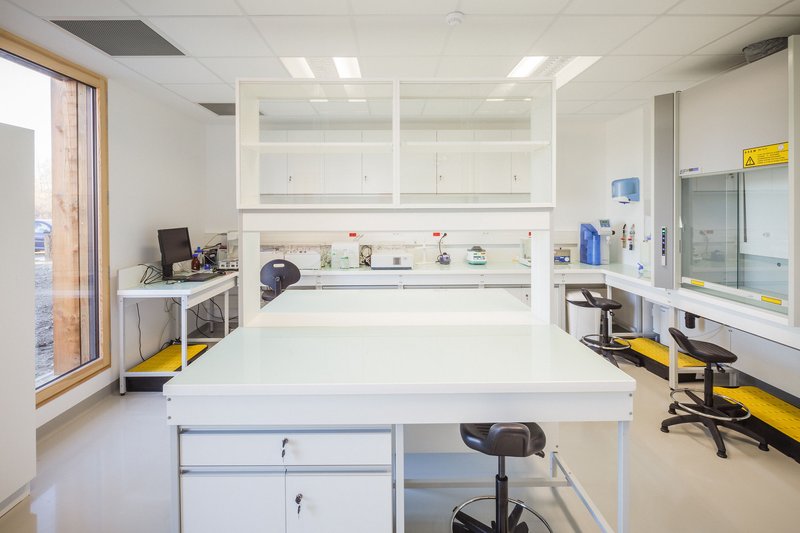
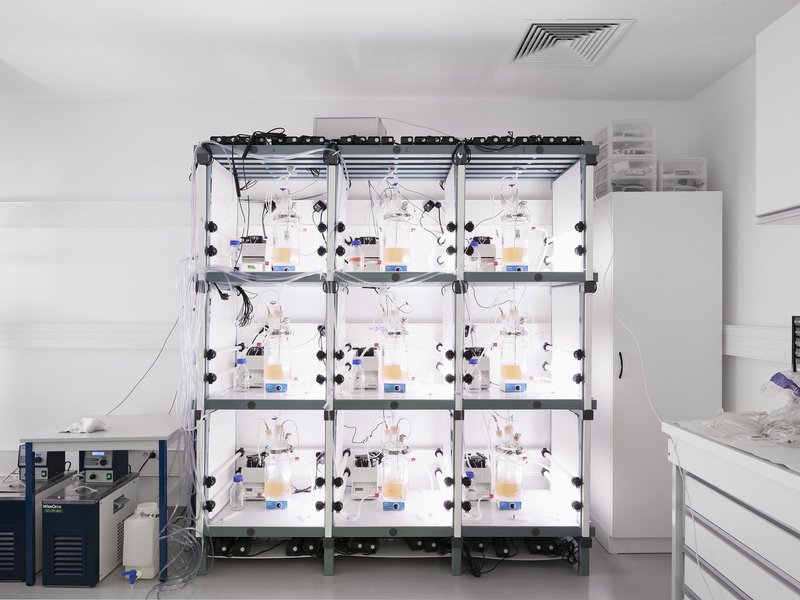
Inside, the program is clinical but not cold. Standard laboratory spaces feature white surfaces, central benches, overhead storage, and task stools. The finishes are deliberately neutral to keep the focus on the work. But the real invention is the Ecolab modules: a wall fitted with a three-by-three grid of transparent modular chambers, each containing experimental equipment, tubing, and controlled micro-ecosystems. Six of these Ecolabs, containing eighteen environmental cells in total, form the experimental core of the facility. Each cell holds 16 m³ of atmosphere and 1.5 m² of ecosystem.
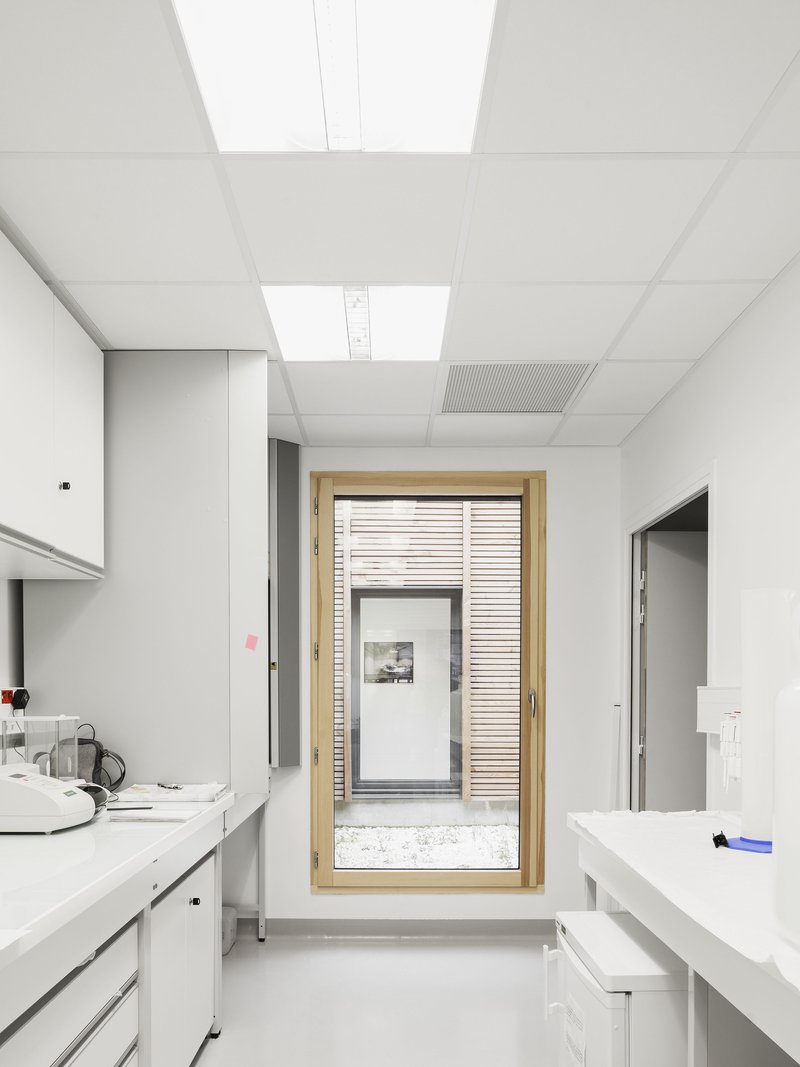
The laboratory corridor captures the tonal palette of the interior: white worktops, timber-framed windows, and views through horizontal louvres to a gravel courtyard beyond. There is a clarity to the section that keeps circulation legible and daylight present even in the deepest parts of the plan. The oriented strand board wall panels in the hallways are an honest expression of the wood construction system, left exposed rather than concealed behind plasterboard.
Corridors and Common Spaces
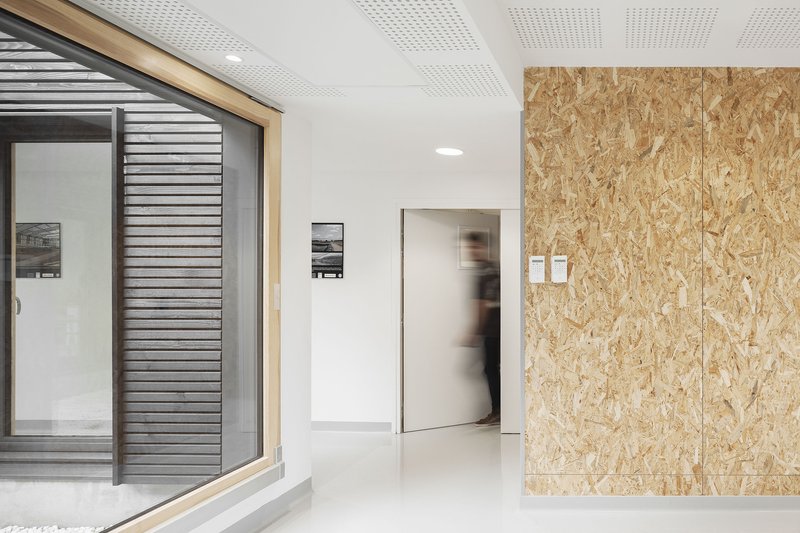
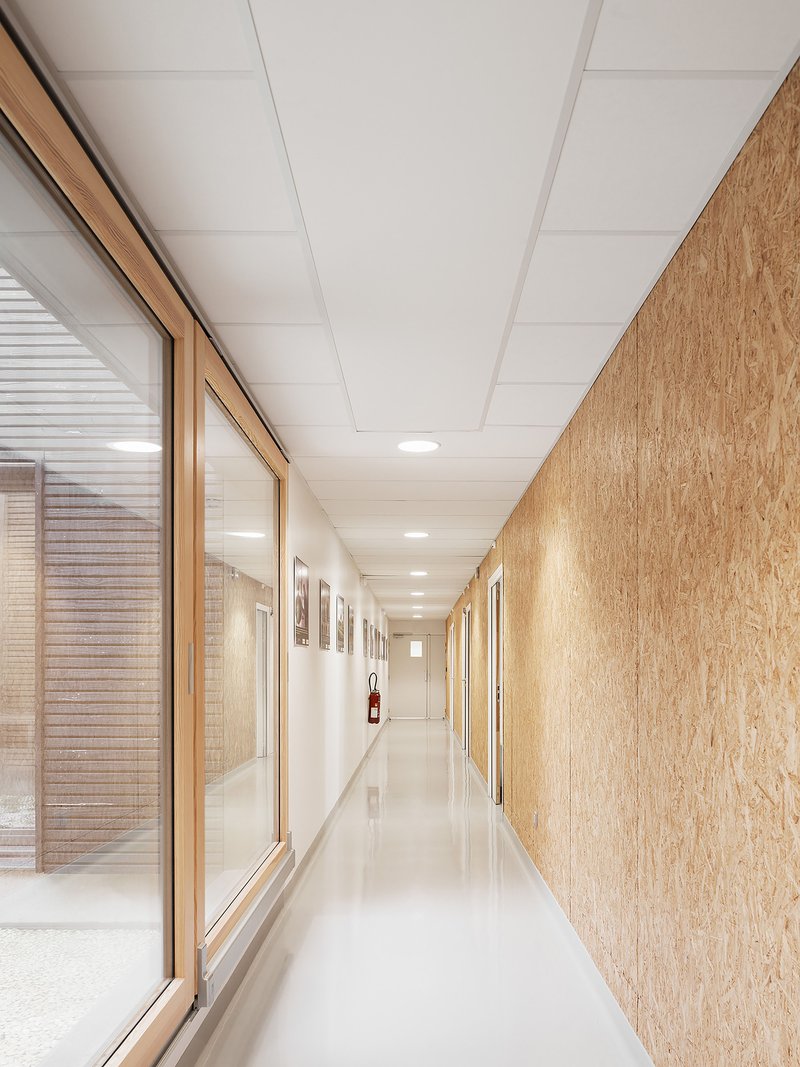
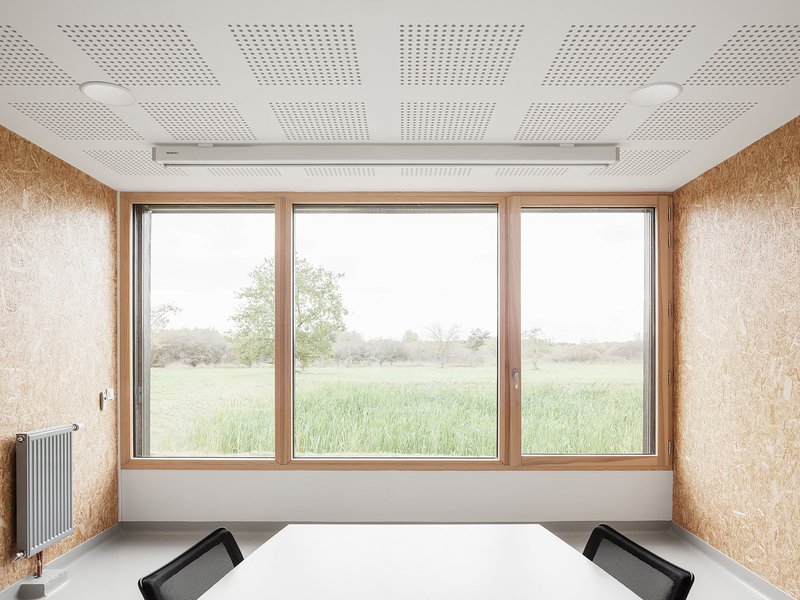
The building's circulation is a single long corridor running the length of the bar, with timber-framed glazing on one side and plywood paneling on the other. Recessed ceiling panels absorb sound without adding visual clutter. A meeting room at one end features perforated acoustic ceiling panels and triple windows that frame panoramic views of the green fields under overcast skies. These are workspaces designed for concentration, not inspiration. The architecture stays quiet so the thinking can be loud.
The blurred figure walking through a doorway in the hallway shot captures the scale and mood of the building perfectly. It is a place for moving through, pausing, then returning to the bench. The OSB panels, the recessed lighting, the careful proportions of door openings: everything is calibrated to reduce friction. At €2,095 per square meter of floor area, the budget discipline is visible in the material choices, but it never feels like austerity.
Plans and Drawings
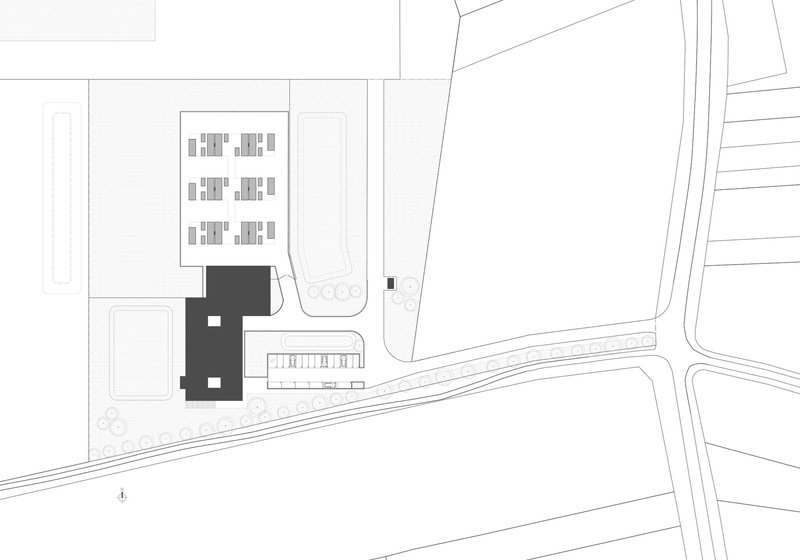
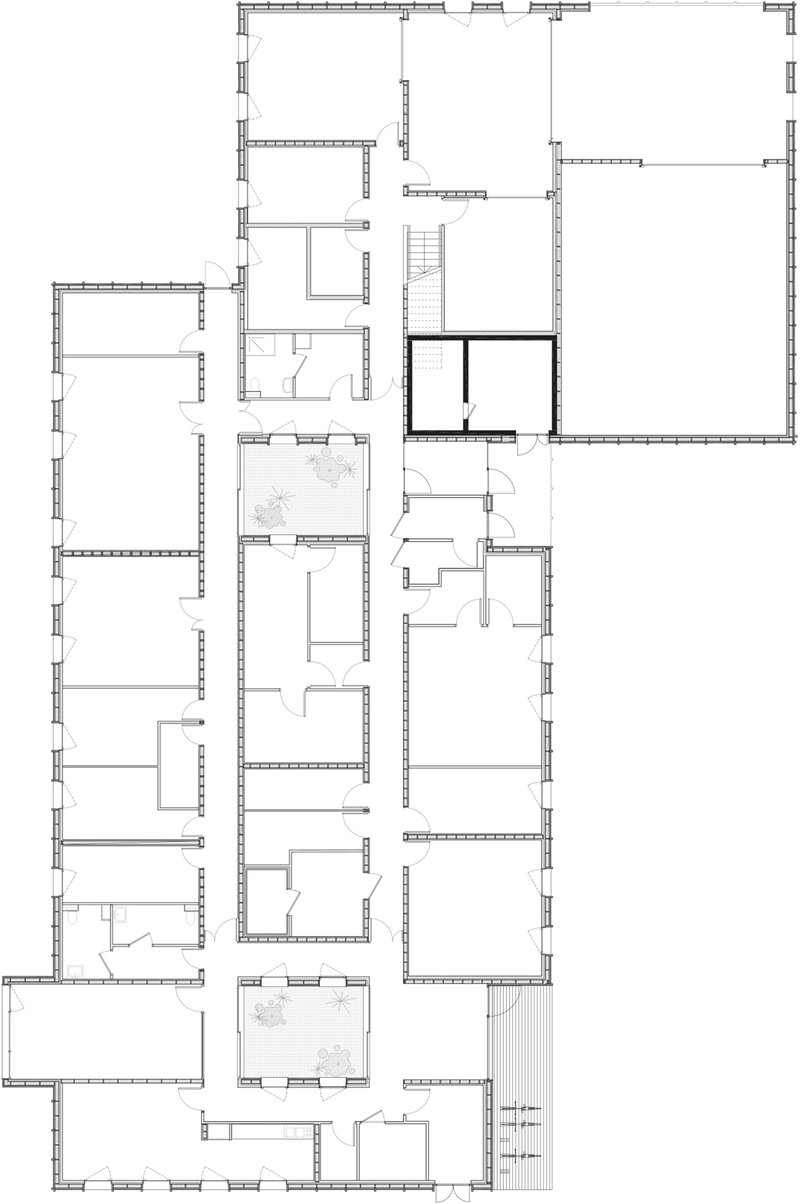
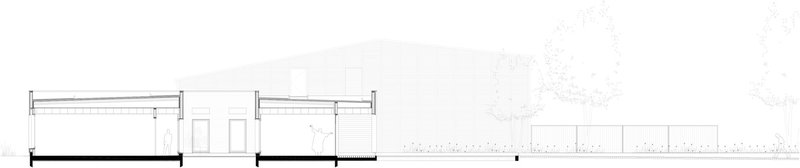
The site plan reveals the building's positioning near a curved roadway, with its two dark volumes oriented to maximize frontage toward the meadow while maintaining a service relationship with adjacent structures. The floor plan shows rooms and circulation spaces arranged around a central stairwell, with the Ecolab modules clustered together for shared servicing. The section drawing confirms the modest ceiling heights and the way the tree canopy along the building's length rises above the roofline, reinforcing the sense that the architecture defers to its setting.
What the drawings make clear is how little formal ambition drives the plan. There are no dramatic double-height spaces, no cantilevered volumes, no gestural moves. The organization is rational, almost diagrammatic: labs here, offices there, Ecolabs in between, courtyard at the center. The architecture earns its interest from material and environmental intelligence, not from compositional gymnastics.
Why This Project Matters
The Écotron Île-de-France is a reminder that the most convincing sustainable buildings are often the least photogenic. There are no swooping curves, no dramatic cantilevers, no green walls for Instagram. Instead, there is a wood boiler, a green roof, adjustable blinds, and a timber structure that does its job without fuss. The HQE certification is earned through performance, not spectacle. For architects wrestling with how to make laboratory buildings that are both technically demanding and environmentally responsible, this project offers a credible model.
Atelier Téqui's achievement here is one of proportion and discipline. They have made a building that looks like it belongs in the landscape, serves the precise needs of ecological research, and cost about what a well-detailed house would cost per square meter. The Ecolab concept, with its modular chambers and controlled environments, demands technical precision in climate management, yet the building that houses them feels relaxed and open. That tension between scientific control and architectural generosity is what makes the Écotron worth studying.
Écotron Île-de-France Research Centre & Laboratory by Atelier Téqui Architects, Saint-Pierre-lès-Nemours, France. 1,050 m². Completed 2016. Photography by Schnepp Renou and 11h45.
About the Studio
Share Your Own Work on uni.xyz
If projects like this are the kind of work you want to make, uni.xyz is a place to publish your own, find collaborators, and enter design competitions.




Popular Articles
Popular articles from the community

Milan Crossover: Sustainable Architecture for a New Fashion Culture in Milan
Milan Crossover transforms fashion culture through sustainable architecture, linking material libraries, remake studios, and public runways.

Kaffeebühnen: Coffee Shop Architecture Designed as a Civic Stage Between Vienna’s City and Park
Kaffeebühnen turns coffee shop architecture into a civic stage, linking Vienna’s park edge, urban life, warm timber yards, and coffee craft.
Eco Chapel: A Green Architecture Pavilion Designed in Symbiosis with the Forest
Eco Chapel uses green architecture to weave prayer, learning and reuse into a forest pavilion shaped by modular hexagonal canopies for life.
IKC de Geluksvogel: Sustainable School Architecture Designed for Free Movement and Digital Learning
IKC de Geluksvogel turns sustainable school architecture into a flexible Maastricht campus for digital learning, nature, and free movement.


Similar Reads
You might also enjoy these articles
Freebird Residence by Alexis Dornier: A Tropical Modernist Sanctuary in Bali
Floating living pavilion above pool anchors H-shaped tropical villa, blending Japanese minimalism, sustainable strategies, lush landscape, and sculptural interiors.
127af Flips a Tiny Bagnolet Rowhouse Upside Down with a Handcrafted Roof Extension
A 55-square-meter terraced house on the edge of Paris gains a luminous upper living floor through lightweight timber and steel.
1.61 Design Workshop Wraps a 600-Square-Meter Café in Vietnam in Sculptural Burgundy Drama
Reden Café & Bistro pairs a helical staircase, mosaic floors, and deep red interiors to rethink Vietnamese hospitality space.

The Unbound Brain: A School Shaped by Cognitive Architecture
Cylindrical learning pods radiate like neurons from a central cortex, turning the floor plan into a spatial model of human thought.


Explore Educational Building Competitions
Discover active competitions in this discipline




The International Standard for Design Portfolios


The Global Benchmark for Architecture Dissertation Awards


The Global Benchmark for Graduation Excellence


Challenge to design public laboratory
Comments (0)
Please login or sign up to add comments
No comments yet. Be the first to comment!