
Atelier Wen'Arch Threads a Perforated Pavilion Through the Ruins of a Huizhou Village
In Longmen County's Zhongxin Village, curved walls and circular portals stitch together old foundations, a Qing Dynasty feng shui wall, and a century-old o

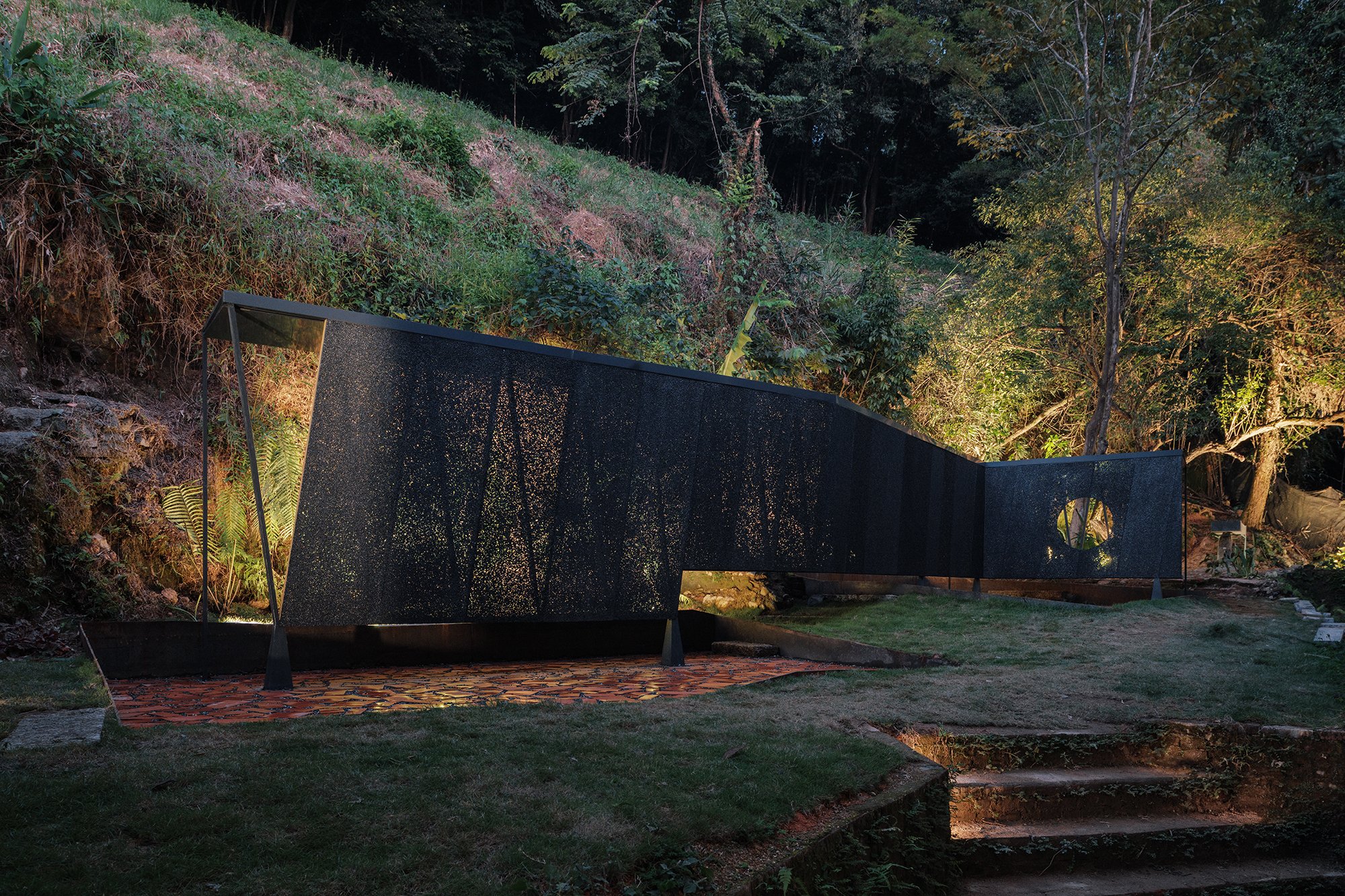
Between a late Qing Dynasty feng shui wall and a dense Lingnan forest, two houses once stood on a narrow terrace in Zhongxin Village before collapsing into ruin and being repurposed as chicken coops. Atelier Wen'Arch was asked to do something with this leftover sliver of ground as part of the Nankunshan-Luofushan Rim Pioneer Zone architectural art program in Huizhou. What they built is not a building in any conventional sense. It is a 221 square meter landscape instrument: a sequence of curving, perforated black walls that wrap around the old foundations, frame an ancient osmanthus tree, and punch circular openings toward the mountain forest beyond.
The real interest here is in how the project treats ruin not as something to restore or demolish, but as a spatial given, a permanent neighbor. The new structure never sits on top of the old walls. It curves alongside them, creating courtyards and thresholds where crumbling masonry and dark metal panels coexist without any pretense of unity. The result is a strange and compelling hybrid: part garden folly, part memorial, part village gathering space, with the atmosphere of a place that has always been negotiating between habitation and wilderness.
Ruin as Companion
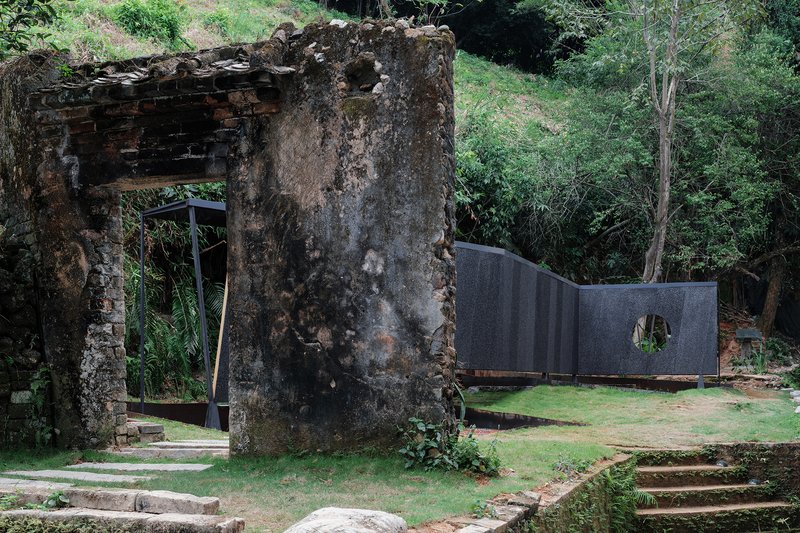
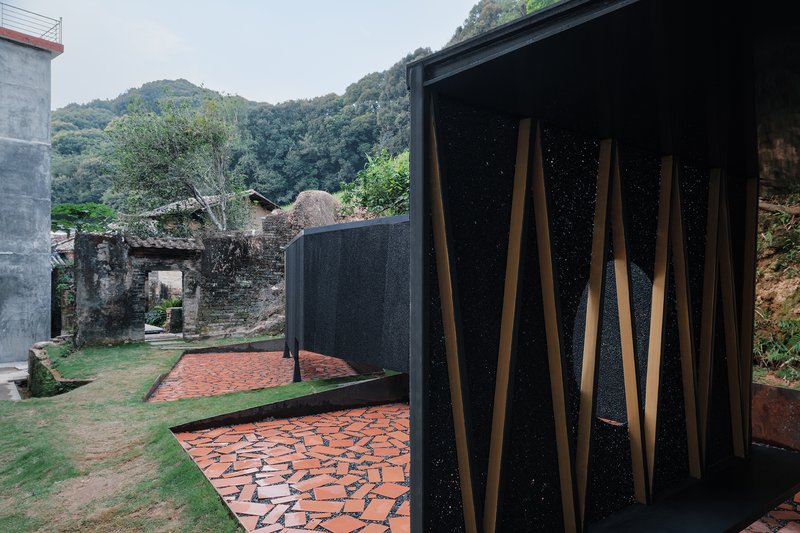
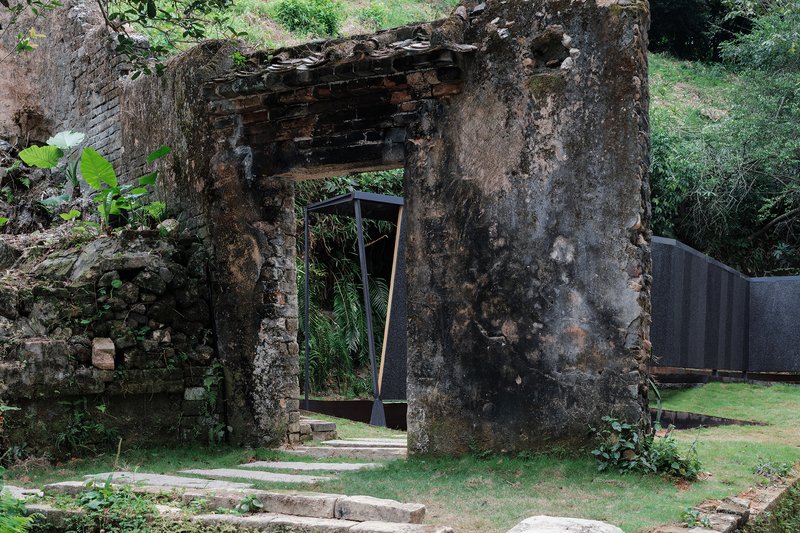
The most striking decision in this project is how the old stone ruins are left almost entirely intact. Collapsed walls, moss-covered masonry gateways, and weathered foundations sit openly alongside the new intervention. A metal-framed door punched into a crumbling stone wall is one of the few moments where old and new physically touch. Elsewhere, the curved black walls simply run parallel, defining a gap that feels like a breath held between two different centuries.
There is no nostalgia at work here. The ruins are not prettified or stabilized into tasteful garden features. They remain rough, overgrown, structurally ambiguous. The new walls, by contrast, are precisely fabricated and immaculately dark. The tension between the two conditions is the project's real material.
The Circular Aperture
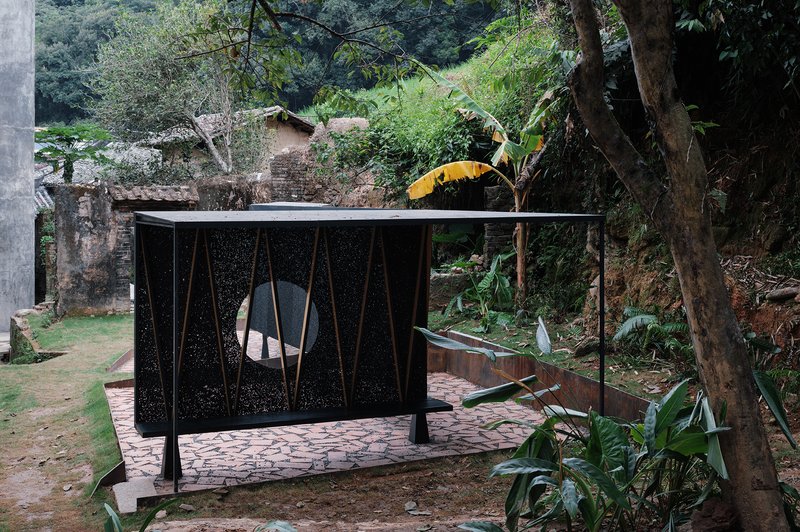
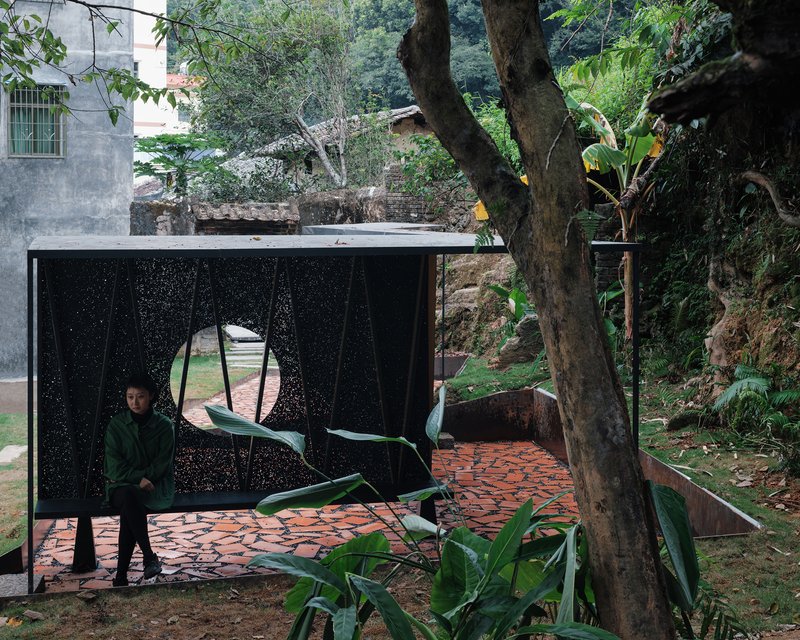
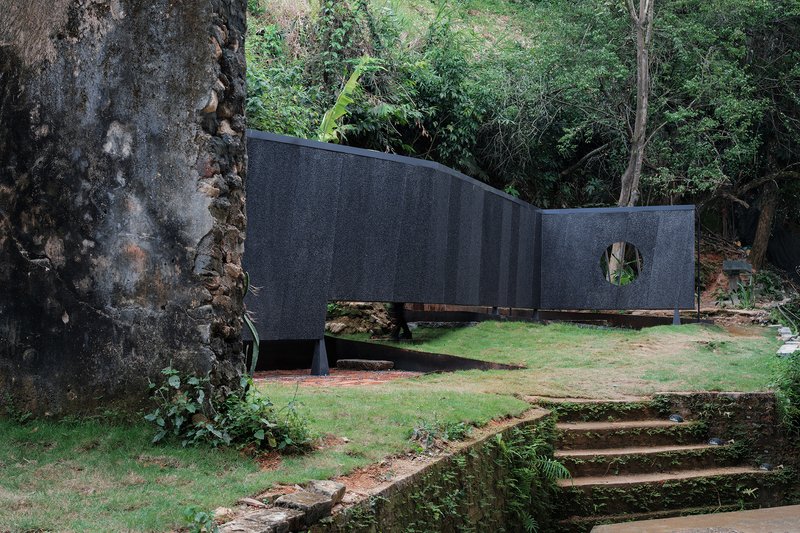
Circular openings recur throughout the project, cut into the curving black walls at different scales and heights. Some are large enough to walk through, functioning as portals between courtyard zones. Others sit higher, framing branches of the osmanthus tree or patches of sky. The move borrows from the traditional Chinese moon gate, but the execution, punched through perforated metal rather than carved from stone, strips the gesture of its usual decorative weight.
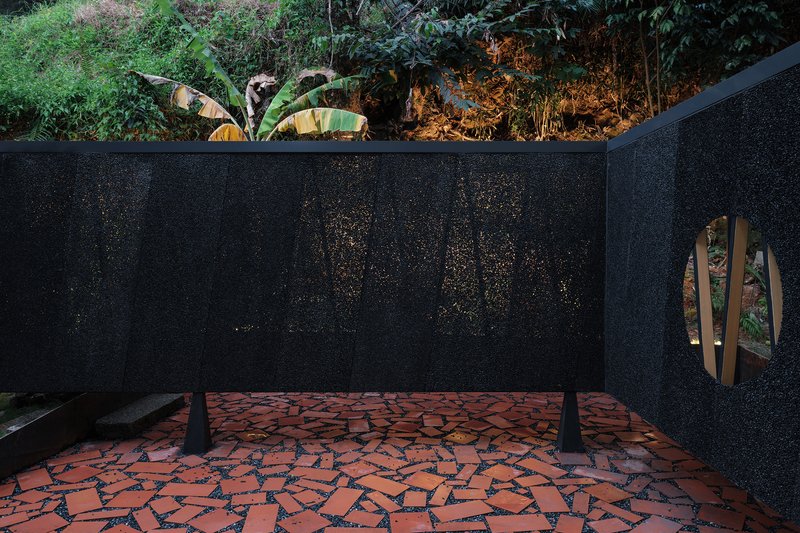
These openings do real work in the spatial sequence. They force you to look through the walls rather than simply past them. From the interior of the pavilion, the circular aperture on the forest side becomes a concentrated lens onto the hillside, collapsing depth and framing the jungle in a disc of controlled greenery. At dusk, when the interior lighting glows through the perforated panels, the circles reverse: they become bright eyes staring out into the forest.
Screens, Slats, and Surface
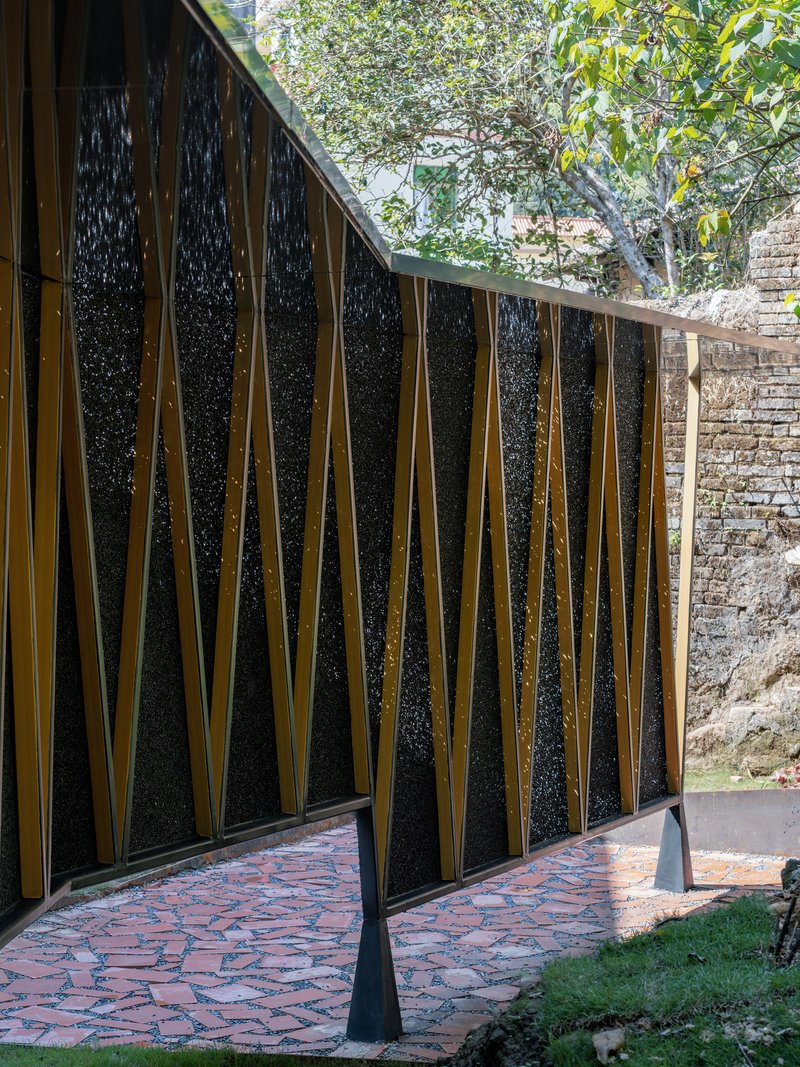
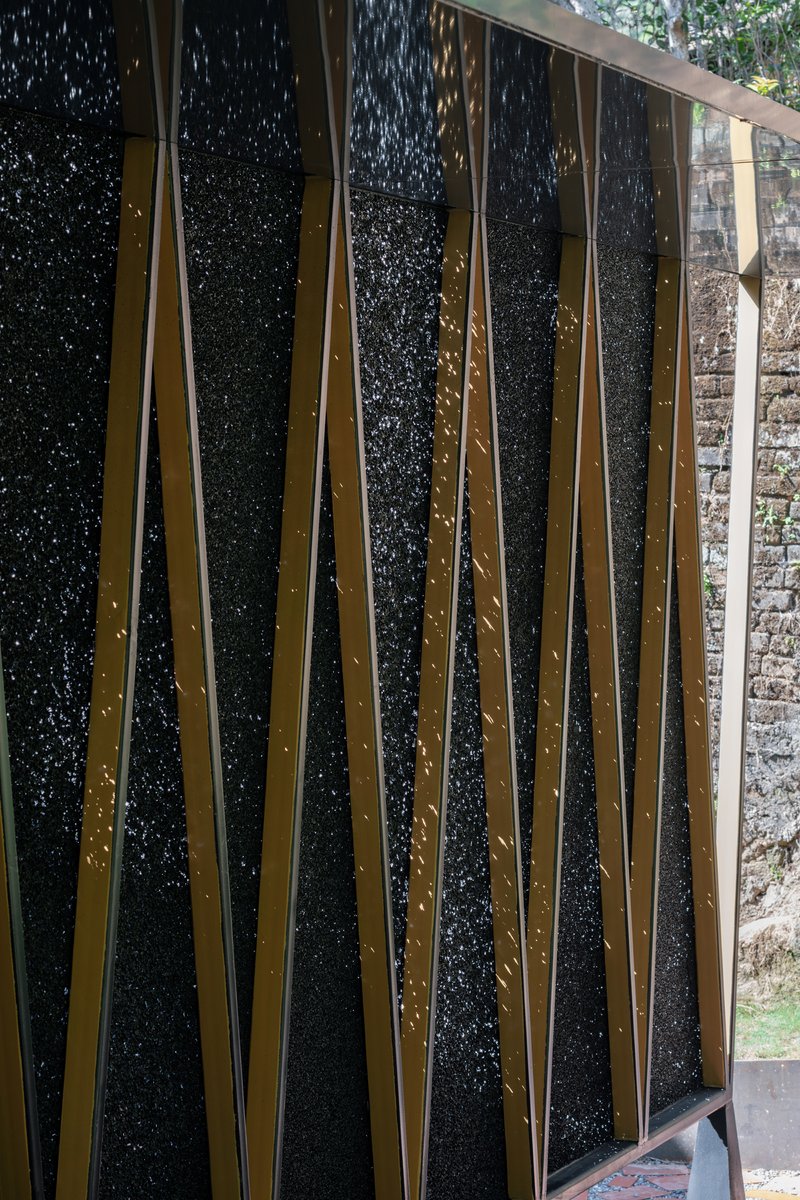
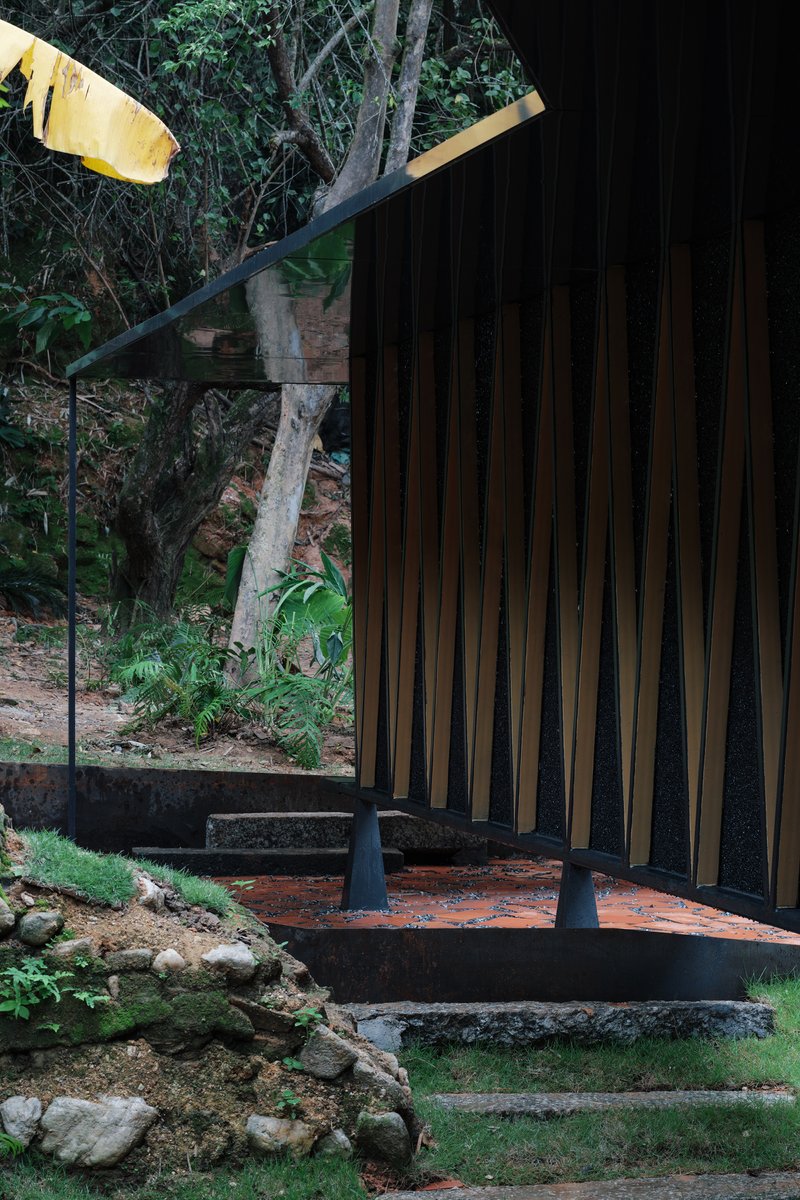
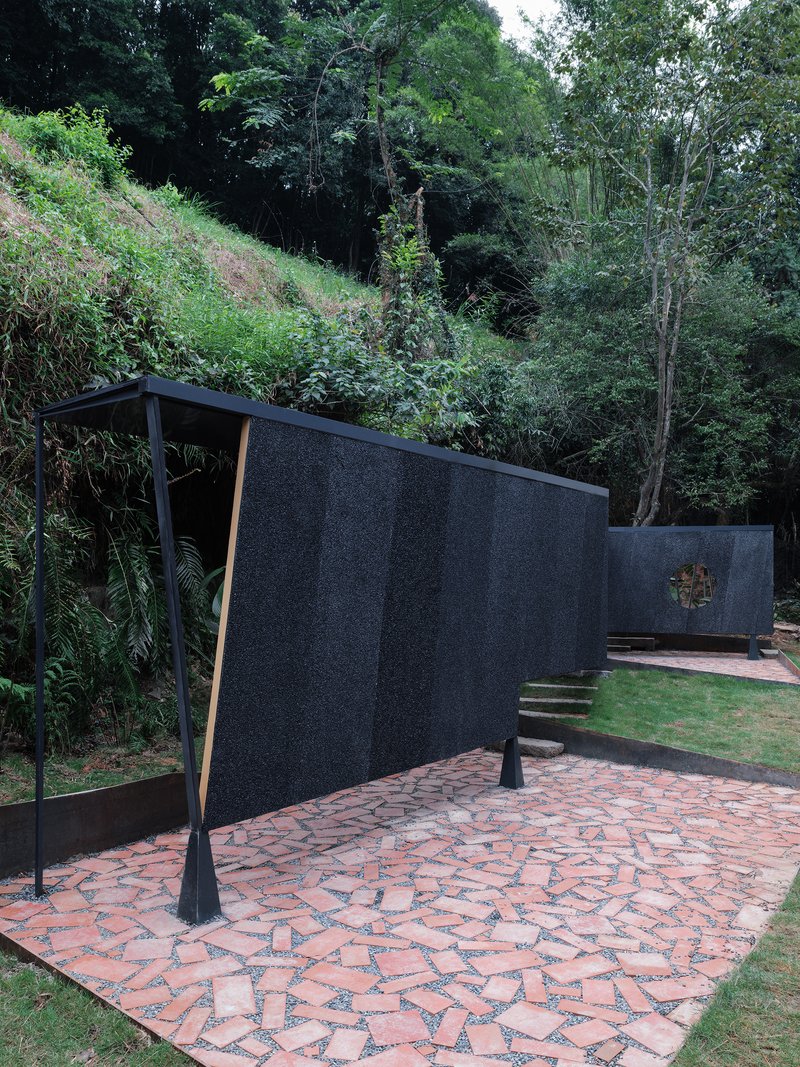
The wall system itself rewards close inspection. Textured black panels, appearing to be a dark terrazzo or composite material, are held in place by crossed bronze-colored metal straps with visible rivets. The diagonal bracing reads as both structural logic and ornamental pattern. At a distance, the walls appear monolithic and heavy. Up close, the layering of perforated metal, timber slats, and bronze framing reveals a surprisingly delicate assembly.
Vertical timber slats are inserted at intervals, filtering light and air through the wall thickness. Where the slats run continuously, the pavilion becomes a screened room. Where they stop, the perforated metal takes over, offering a denser, more opaque enclosure. The alternation between open and closed, between timber warmth and metal coolness, keeps the sensory experience shifting as you move along the terrace.
Ground Plane and Threshold
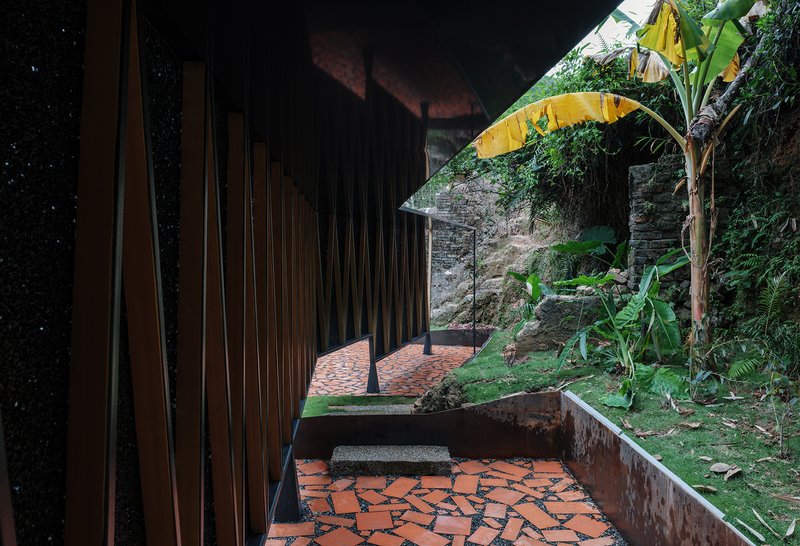
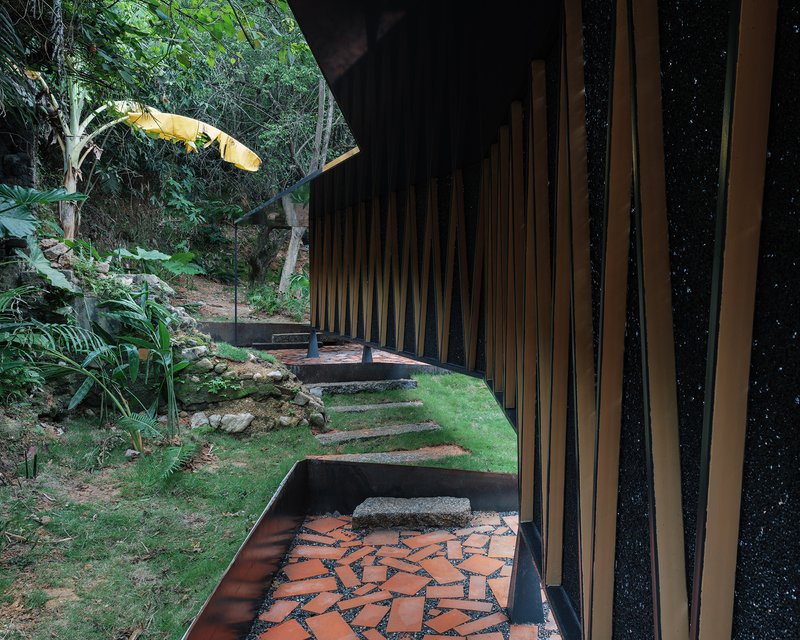
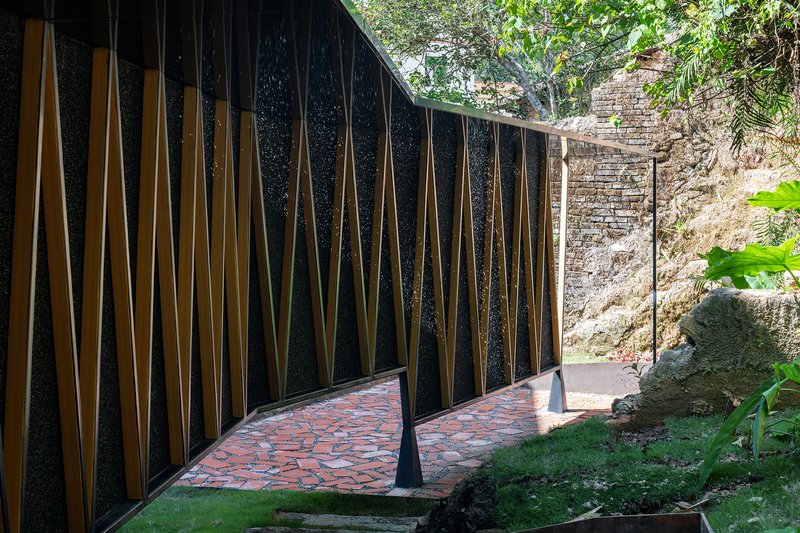
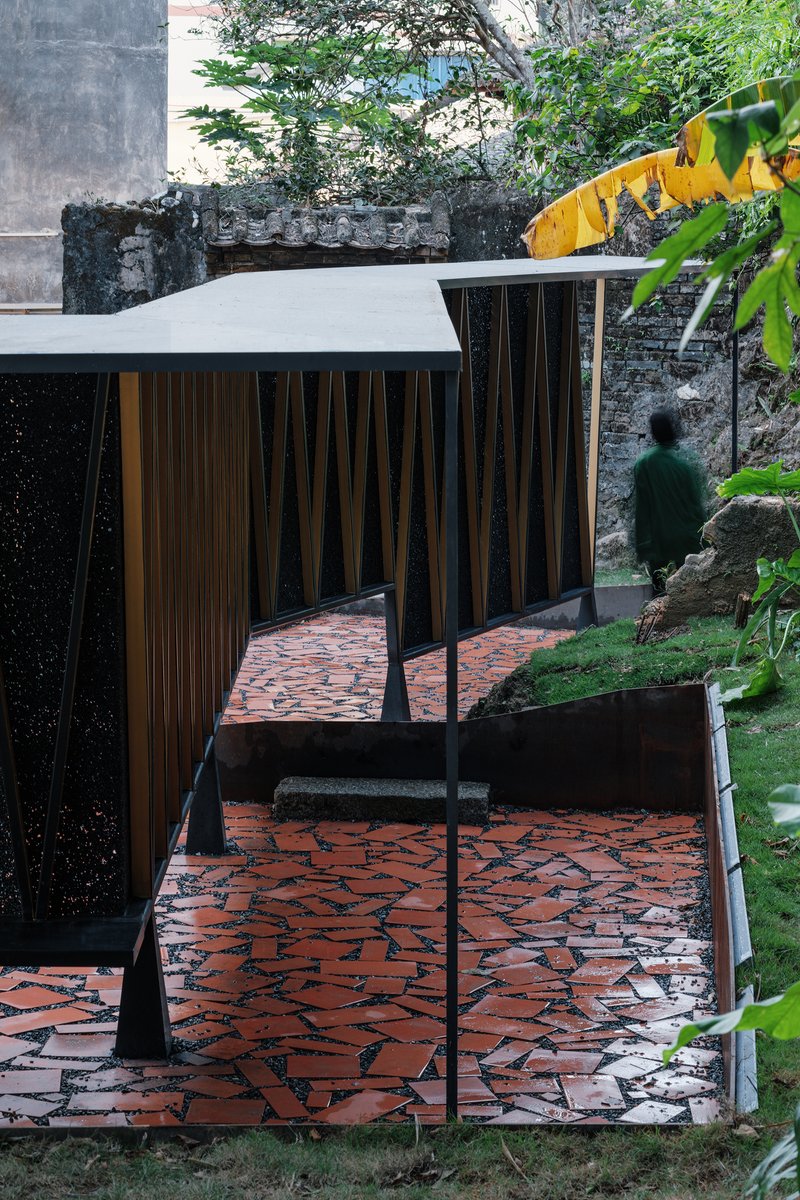
Red terracotta pavers and herringbone brick paving define the ground plane, setting up a warm chromatic counterpoint to the dark walls above. The choice of broken red tile, laid in loose patterns rather than precise grids, gives the floor a handmade quality that mediates between the roughness of the ruins and the precision of the new structure. Stone steps connect different terrace levels, following the natural slope of the site.
A covered walkway with a timber slat screen leads visitors from the village side toward the hillside, establishing the primary threshold. The transition is gradual: you pass from open village fabric into the filtered light of the screen corridor, then out onto the terrace where the full composition of walls, ruins, and forest becomes legible. It is a procession designed for walking speed, not vehicular arrival.
Interior and Inhabitation
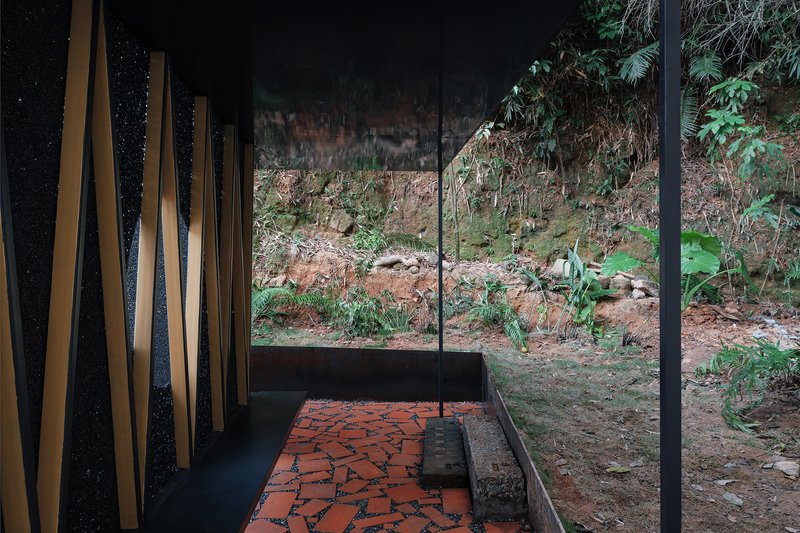
The sheltered spaces within the pavilion are modest in scale. A white canopy overhead reflects light downward, creating a soft brightness that contrasts with the dark walls. The timber slat screens allow the forest to remain a constant visual presence, even from the most enclosed moments. Fallen leaves drift in through the gaps, a reminder that this is a structure designed to be colonized by its landscape rather than sealed against it.
A covered terrace combines a red mosaic floor with black terrazzo walls, creating an interior room that is simultaneously inside and outside. Circular openings in the terrazzo walls frame foliage like paintings, and the space reads as a kind of open-air salon for the village: protected from rain, open to the breeze, and overlooking the forest canopy.
Landscape Choreography
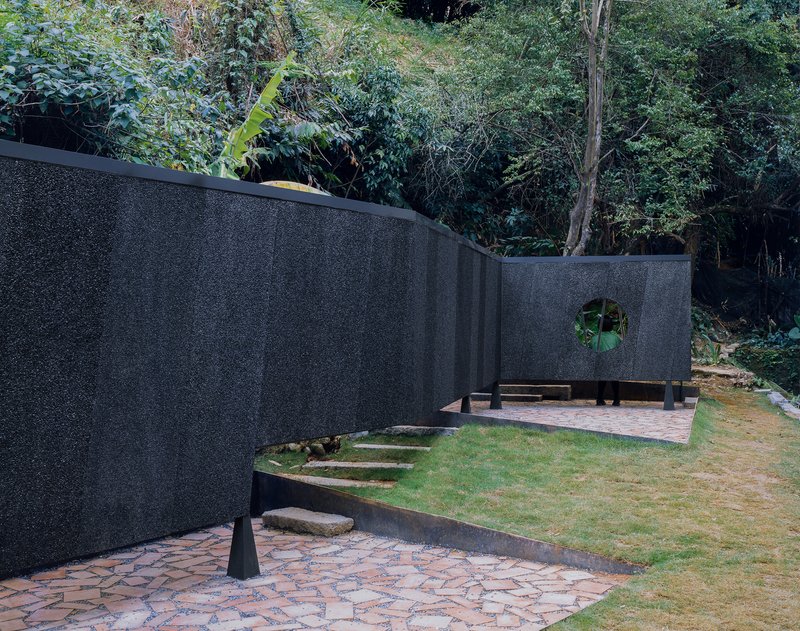
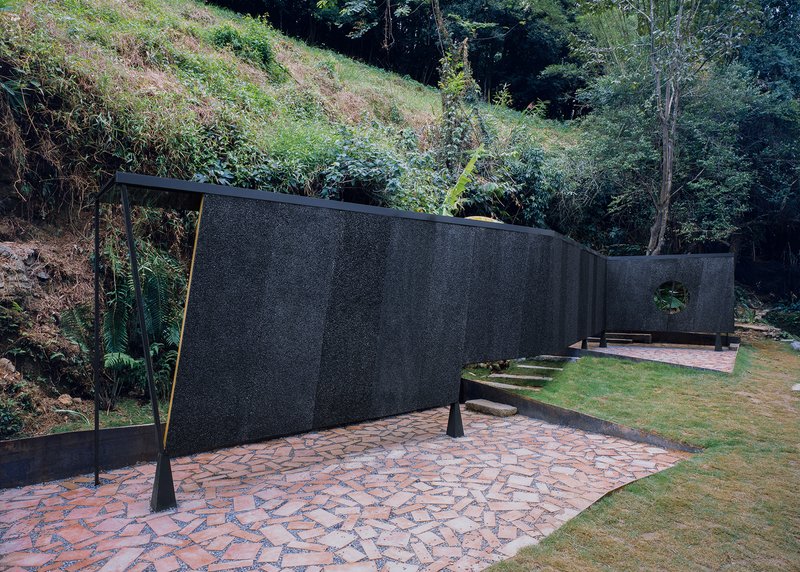
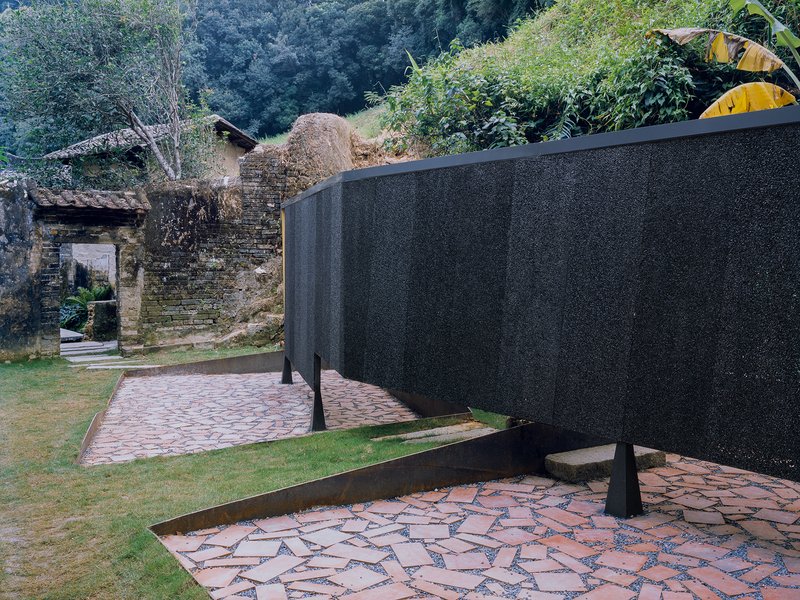
Seen from above or at a distance, the project's curving plan becomes legible as a landscape strategy rather than an architectural one. The paired walls create a sinuous spine that divides the terrace into a sequence of outdoor rooms: some paved, some planted, some left as rough grass. Stone steps and terraced banks connect these zones to the surrounding hillside, blurring the boundary between intervention and topography.
The patterned paving changes from zone to zone, marking different programmatic intensities. Where the paving is dense and geometric, the space invites gathering. Where it fades into grass and gravel, the space becomes contemplative, solitary. The curving walls act as guides, gently directing movement without ever closing off options. You can always step off the path and into the forest.
The Pavilion at Night
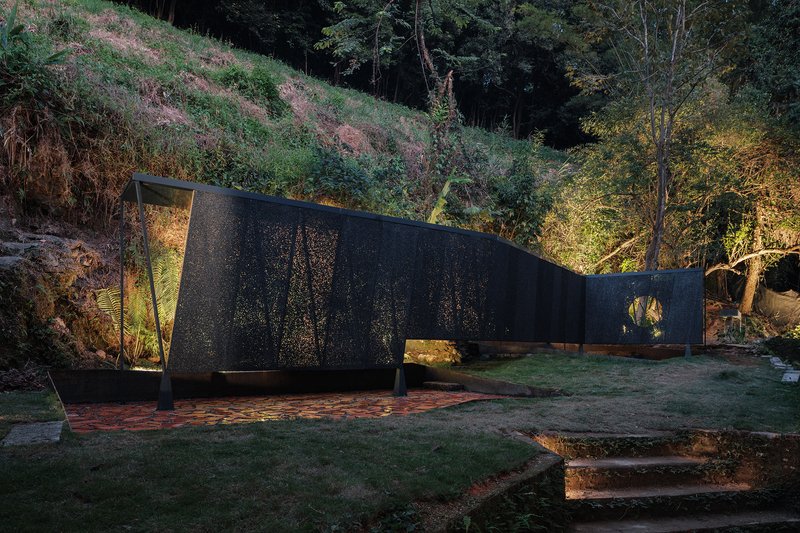
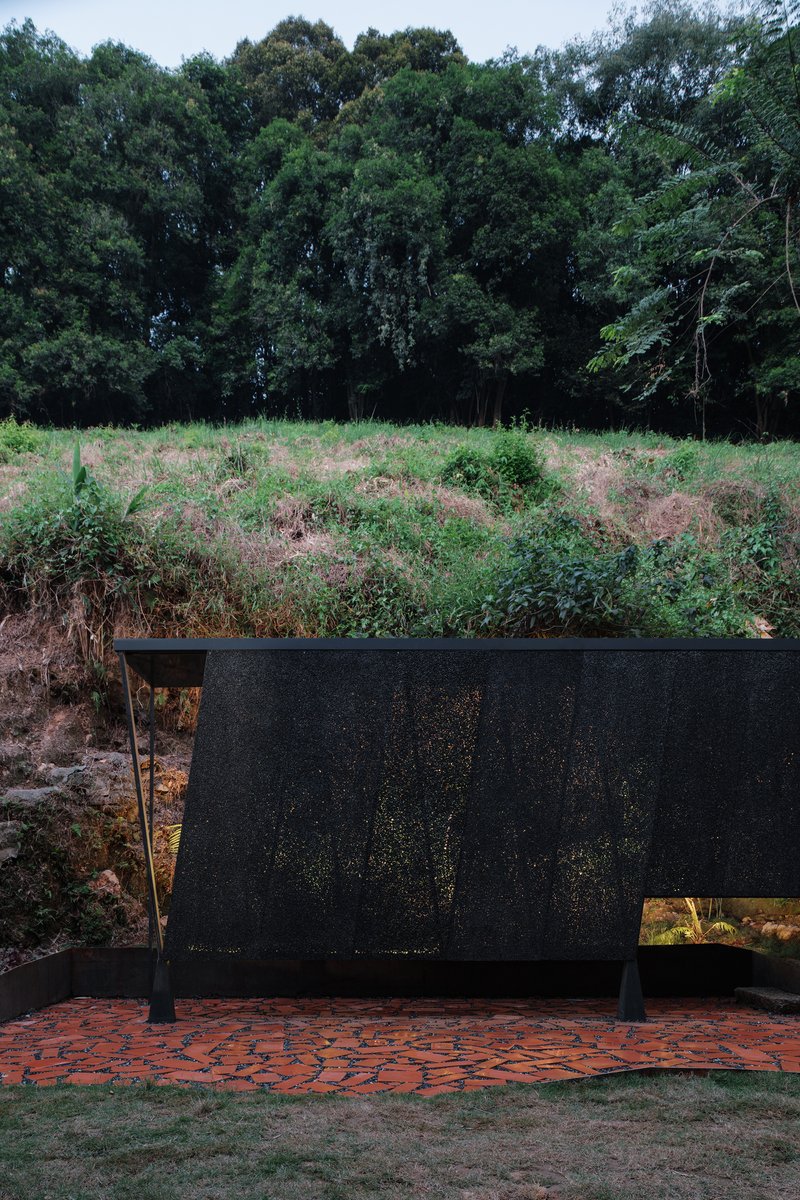
At dusk, the project undergoes a tonal inversion. Interior lighting transforms the perforated panels from opaque barriers into glowing surfaces, broadcasting warm light through thousands of tiny holes. The dark mass that dominates during the day dissolves into a luminous lantern against the forested hillside. The circular openings become the brightest points, drawing the eye and marking the pavilion's presence from across the village.
The freestanding screen walls, which read during the day as sculptural objects on the brick terrace, take on a theatrical quality after sunset. Their angled support struts cast long shadows, and the herringbone paving catches reflected light in soft patterns. It is a reminder that installations of this kind are not single-experience spaces. They are designed to be encountered repeatedly, across seasons and hours, each visit revealing a different mood.
Plans and Drawings
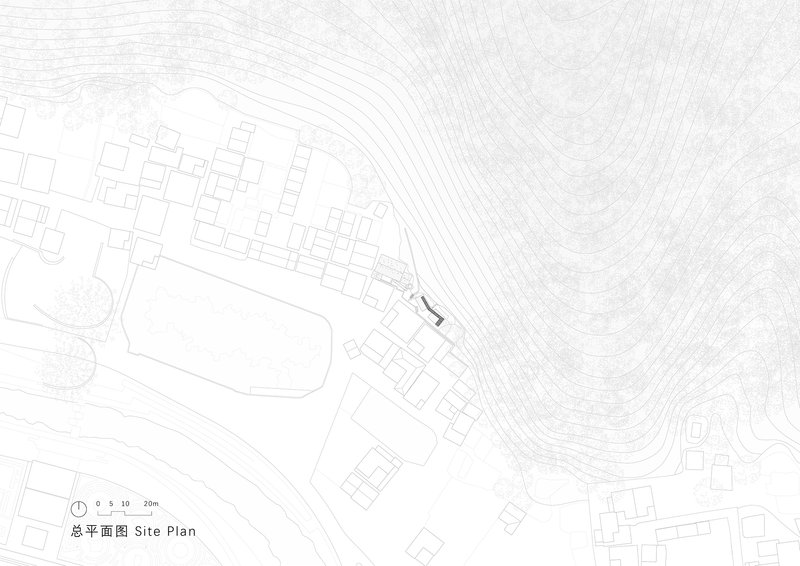
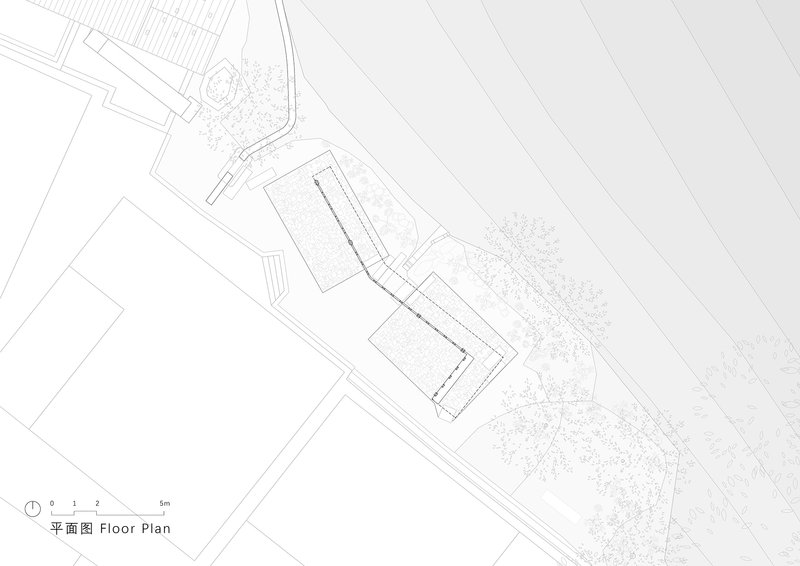
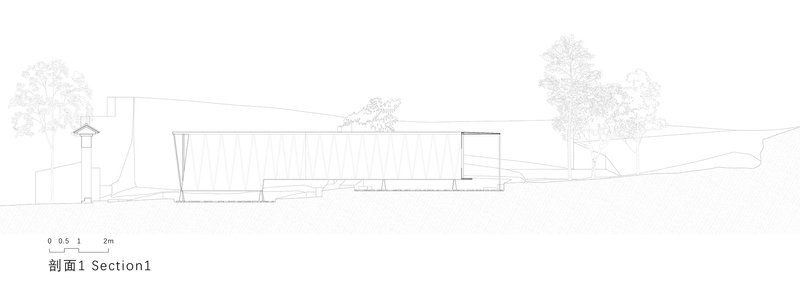
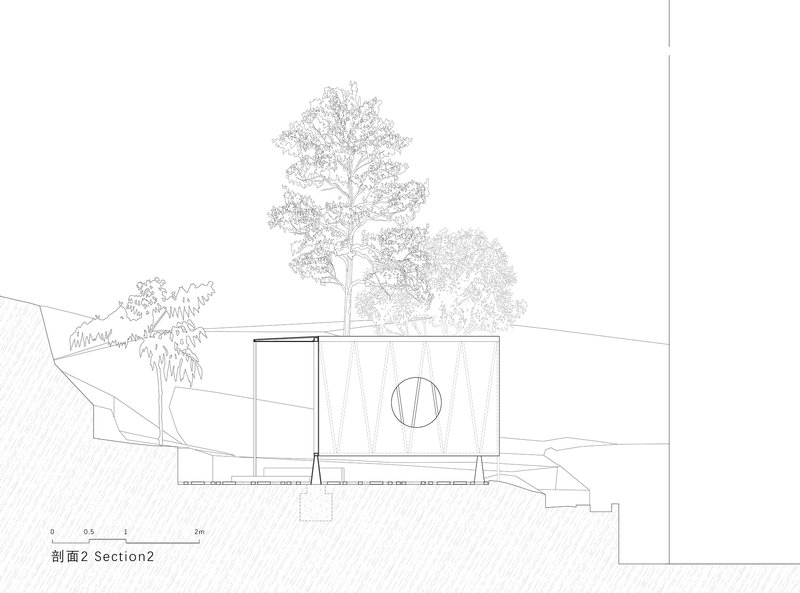
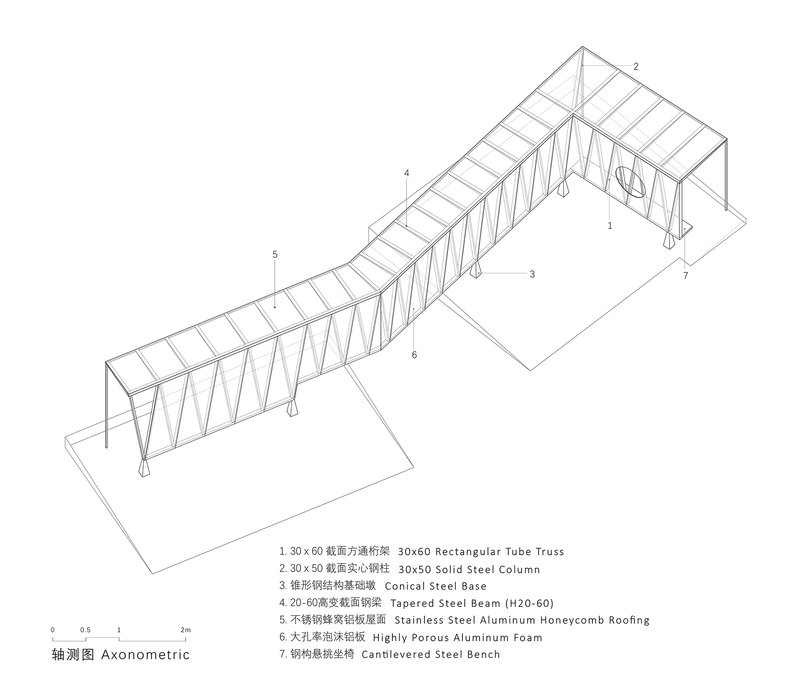
The site plan confirms what the photographs suggest: the structure occupies a narrow band between the village fabric and the forested hillside, wrapping around existing contour lines rather than flattening them. The floor plan reveals an elongated, curving volume with a central circulation spine connecting the different courtyard zones. Two sections show the project's deliberately low profile: horizontally stretched, barely rising above the surrounding vegetation and the silhouettes of trees.
The axonometric drawing is the most revealing. It exposes the structural logic behind the curving canopy: a diagrid truss system supported by slender columns, creating wide spans beneath a thin roof plane. The diagonal bracing visible in the construction details is not decorative but integral to the structural behavior of the curved shell. It is an elegant system that achieves apparent heaviness with actual lightness.
Why This Project Matters
Rural architectural art programs in China have produced their share of glossy pavilions that photograph well and engage poorly with their surroundings. Osmanthus Yard avoids that trap by making the existing conditions, the ruins, the tree, the feng shui wall, the slope, into active participants rather than backdrop. The new structure exists in dialogue with what was already there, and that dialogue is unresolved in productive ways. The crumbling masonry and the precision-cut metal never merge into a comfortable whole. They remain in tension, and that tension is what gives the project its atmosphere.
At 221 square meters, this is a small intervention with an outsized ambition: to demonstrate that a village's marginal spaces, its collapsed houses and forgotten terraces, can become the site of meaningful public life without being erased or sentimentalized. The osmanthus tree that gives the project its name has been here for a century. The new walls curve around it, shelter it, and frame it, but they do not own it. That posture of deference, built in dark metal and red tile, is what makes the project worth watching.
Osmanthus Yard by Atelier Wen'Arch, Zhongxin Village, Longmen County, Huizhou, China. 221 m², completed 2025. Photography by Hao Chen.
About the Studio
Share Your Own Work on uni.xyz
If projects like this are the kind of work you want to make, uni.xyz is a place to publish your own, find collaborators, and enter design competitions.




Popular Articles
Popular articles from the community

Stanton Architects Sculpts a Curving Family Home into Sydney's Inner West Fabric
Five Dock House uses cantilevers, curved concrete, and layered courtyards to carve out privacy on a tight suburban lot in Sydney.

IKC de Geluksvogel: Sustainable School Architecture Designed for Free Movement and Digital Learning
IKC de Geluksvogel turns sustainable school architecture into a flexible Maastricht campus for digital learning, nature, and free movement.
Reincarnation Weaves a Three-Story Retreat into the Green Landscape of Rural Bangladesh
Ara Manor in Narsingdi dissolves the line between domestic architecture and its lush surroundings through screens, courtyards, and planted rooftops.
The Faith: Modular Architecture for Play, Learning, and Hope in Kutupalong Refugee Camp
A modular playground architecture project in Bangladesh where play, learning, safety, and hope rebuild childhood inside a refugee camp anew.


Similar Reads
You might also enjoy these articles
Freebird Residence by Alexis Dornier: A Tropical Modernist Sanctuary in Bali
Floating living pavilion above pool anchors H-shaped tropical villa, blending Japanese minimalism, sustainable strategies, lush landscape, and sculptural interiors.
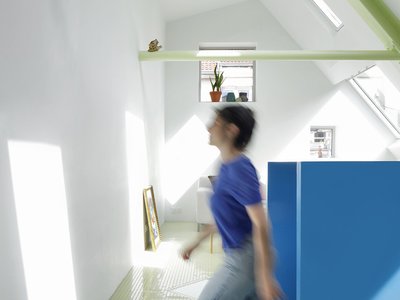
127af Flips a Tiny Bagnolet Rowhouse Upside Down with a Handcrafted Roof Extension
A 55-square-meter terraced house on the edge of Paris gains a luminous upper living floor through lightweight timber and steel.
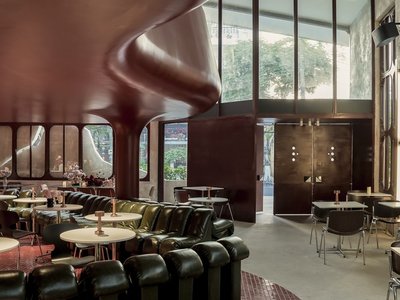
1.61 Design Workshop Wraps a 600-Square-Meter Café in Vietnam in Sculptural Burgundy Drama
Reden Café & Bistro pairs a helical staircase, mosaic floors, and deep red interiors to rethink Vietnamese hospitality space.

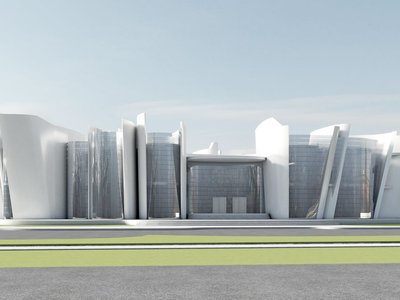
The Unbound Brain: A School Shaped by Cognitive Architecture
Cylindrical learning pods radiate like neurons from a central cortex, turning the floor plan into a spatial model of human thought.


Explore Installations Competitions
Discover active competitions in this discipline




The International Standard for Design Portfolios


The Global Benchmark for Architecture Dissertation Awards


The Global Benchmark for Graduation Excellence


Challenge to design a portable theatre
Comments (0)
Please login or sign up to add comments
No comments yet. Be the first to comment!