

Athenaeum: A Plankton-Inspired Learning Hub Rising from the Water
Kinga Krawczyk's shortlisted design draws on cyanobacteria morphology to shape a multi-level cultural center that glows like ocean plankton at night.


What happens when a building takes its cues from one of Earth's oldest living organisms? Athenaeum answers that question by modeling its entire architectural form on cyanobacteria, the blue-green algae that pulse through aquatic ecosystems. The design begins as an open cluster pattern, evolves into a wavy structural grid, and finally solidifies into a building that appears to grow out of the water. At night, the structure glows against its coastal setting like bioluminescent plankton, turning architecture into a living signal at the edge of land and sea.
Designed by Kinga Krawczyk, this project was a shortlisted entry in the Athenaeum competition. The brief called for a new kind of space for learning, creativity, and discovery. Krawczyk responded with a multi-level program that sinks below the waterline for cultural and gastronomic experiences, opens at ground level for circulation and learning, and rises to first-floor laboratories for hands-on exploration. The result is a building whose section reads like a topographic cross-cut through water, earth, and air.
A Coastal Beacon Glowing Against the Starlit Bay

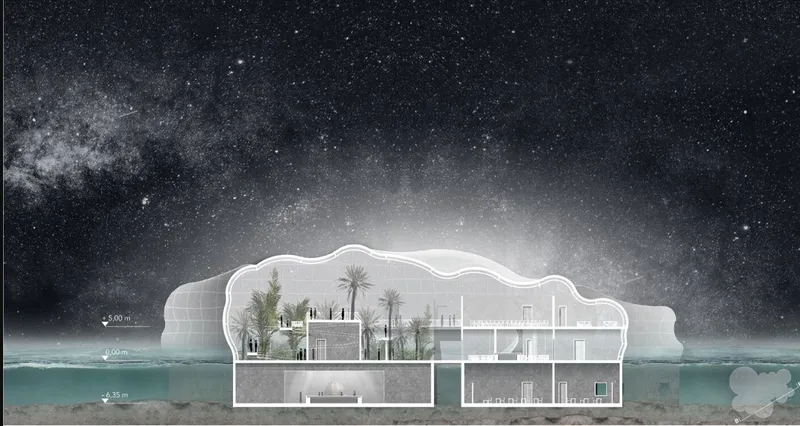
The night view reveals Athenaeum's most theatrical quality: its capacity to illuminate the shoreline. Situated in a bay framed by mountain silhouettes and dense greenery, the building reads as a warm interruption in an otherwise dark coastal edge. The section drawing clarifies how this effect is achieved. A cloud-shaped envelope, partially submerged, supports planted terraces that cascade toward the waterline. Light escapes through the permeable skin of the structure, reinforcing the plankton analogy. The building does not merely sit on the water; it participates in it, with submerged portions housing the culture and gastronomy program at the underwater level.
Undulating Roof and Layered Levels at the Waterline
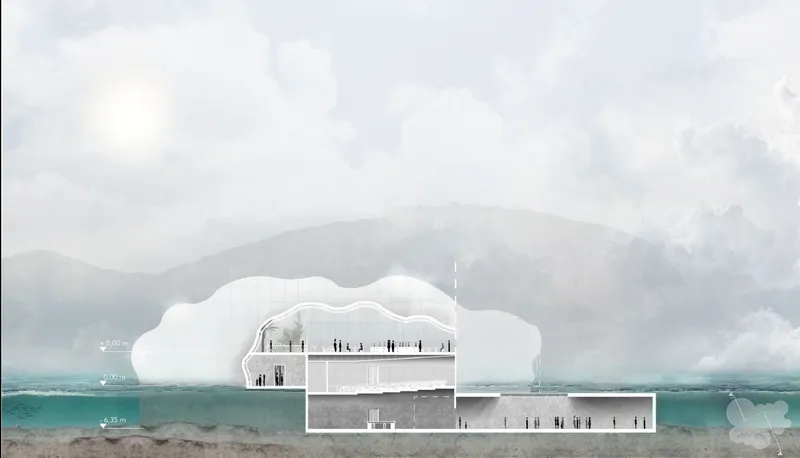
A second section cut exposes the undulating roof profile more clearly. The interior is organized across three distinct levels: an underwater cultural zone, a ground floor of learning and rest spaces, and a first floor dedicated to laboratories and utility rooms. The wavy roof does more than establish visual identity; it creates variable ceiling heights throughout the interior, giving each program area a different spatial character. Where the roof dips close to the waterline, mist appears to soften the threshold between building and bay, dissolving the hard line between architecture and landscape.
A Skylit Gallery Centered on Architectural History
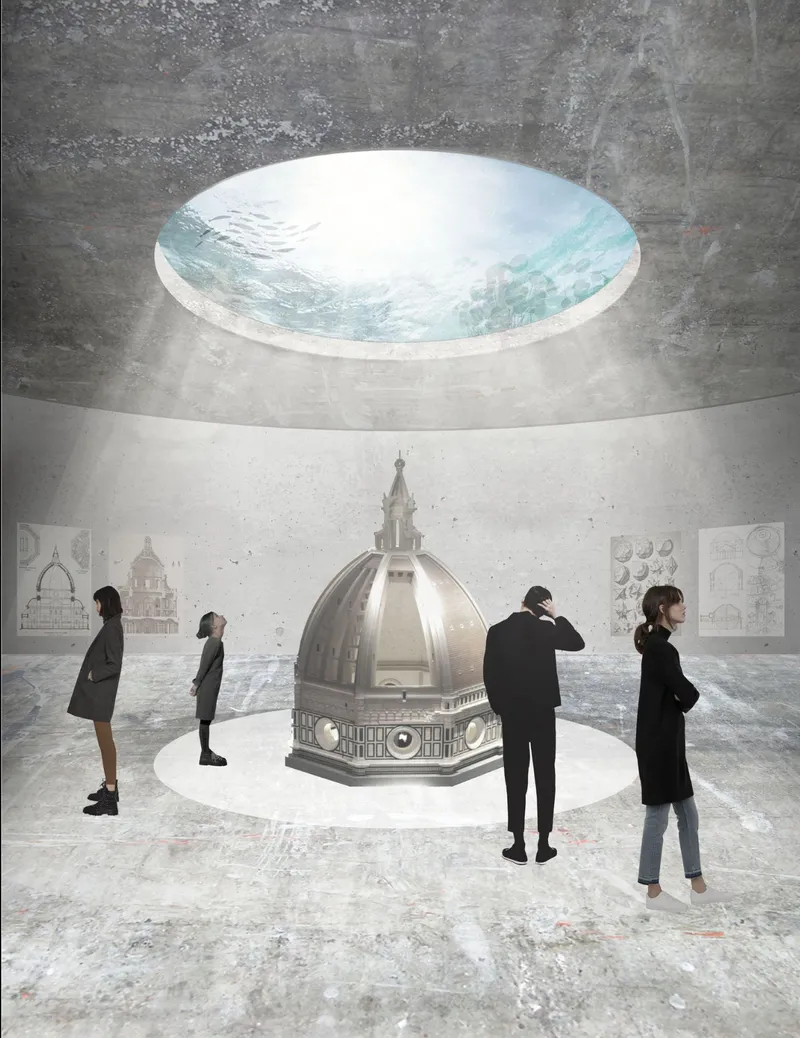
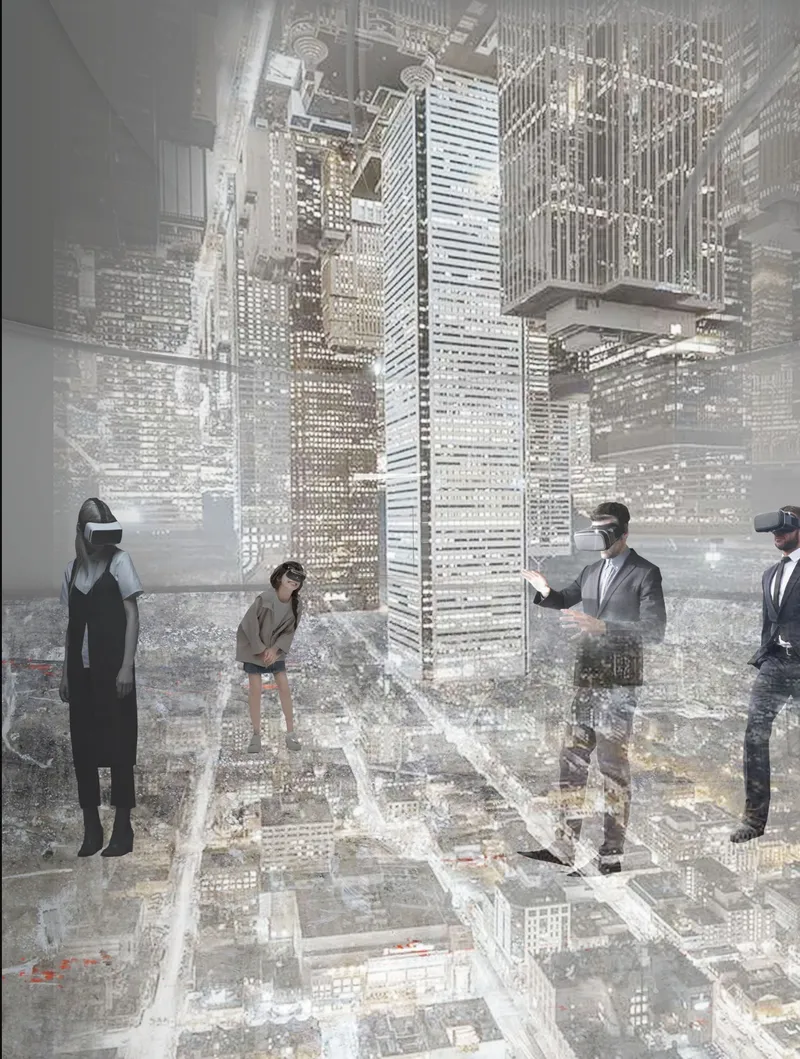
The interior gallery is organized around a circular oculus that funnels natural light onto a scale model of Florence's dome, placing visitors in direct dialogue with architectural heritage. Four silhouetted figures provide a sense of scale: the room is generous, contemplative, and tuned to a single focal point. Nearby, the virtual room takes a different approach entirely. A transparent floor reveals a layered cityscape beneath the viewer's feet while tower models hang suspended at eye level, creating an immersive environment where visitors can step into architectural marvels from skyscrapers to ancient monuments through virtual reality technology. The contrast between these two rooms captures Krawczyk's ambition: honoring history while reaching for futures not yet built.
Site Strategy: Urban Fabric Meets Curved Shoreline Park
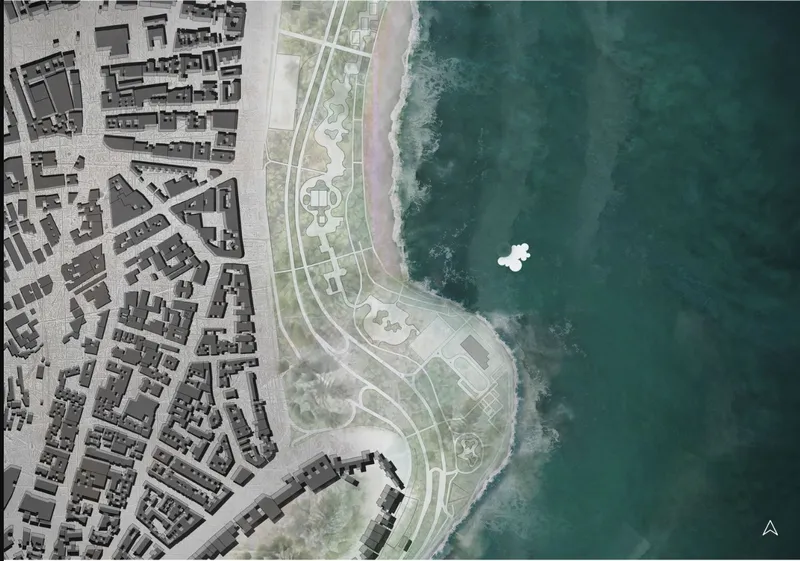

The site plan and aerial view together explain Athenaeum's urban logic. The building occupies the precise seam where dense city fabric meets a curved shoreline park and beach. Green peaks rise behind the urban mass, and a bay opens in front. Krawczyk positions the structure so that it mediates between these two conditions, serving as both a terminus for the urban grid and a gateway to the waterfront. The organic silhouette, so distinct in the sections, reads from above as a natural extension of the coastline rather than a foreign object dropped onto the shore. It is a careful calibration: the building does not dominate its landscape but instead claims just enough presence to draw people from the city toward the water.
Why This Project Matters
Organic architecture risks becoming a label applied to any building with a curved surface. What distinguishes Athenaeum is the rigor of its biological reference. Cyanobacteria are not chosen for their aesthetic alone; they are foundational organisms in aquatic ecosystems, and the building adopts their logic of open clustering and fluid interconnection. The design traces a clear path from microscopic pattern to spatial organization, and each programmatic level follows the logic of that pattern rather than overriding it.
More importantly, Krawczyk treats the building's relationship with water as structural, not decorative. The underwater level is not a gimmick; it anchors the cultural program in a literal immersion that reinforces the project's thesis about learning through environment. As a shortlisted competition entry, Athenaeum demonstrates that biomimicry in architecture can move beyond surface metaphor and into genuine spatial strategy, producing buildings that learn from nature at the level of organization rather than ornament.
View the Full Project
About the Designers
Designer: Kinga Krawczyk
Enter a Design Competition on uni.xyz
uni.xyz runs architecture and design competitions year-round that reward proposals with spatial conviction and real site intelligence.
Project credits: Athenaeum by Kinga Krawczyk Athenaeum (uni.xyz).



Popular Articles
Popular articles from the community


Hill & Cross Opera: Sculptural Opera House Architecture Shaped by Tallinn’s Landscape and Identity
Hill & Cross Opera reimagines opera house architecture in Tallinn through its sculptural hill, civic plaza, glass wave and a luminous cross.

Co-life: Sustainable Architecture for Age-Friendly Community Living
Co-life reimagines sustainable architecture for seniors through courtyards, rammed earth, shared gardens, and spaces designed for belonging.

Co-Life: Senior Housing Design That Reconnects Older Adults With the City
Co-Life reimagines senior housing design through healing gardens, shared streets, workshops, and a sustainable community across generations.

AL-JANNAH: Sustainable Architecture and Permaculture for Afghan Widows
AL-JANNAH uses sustainable architecture and permaculture to create resilient oasis of housing, learning, work and renewal for Afghan widows.
Similar Reads
You might also enjoy these articles

Day and Night Park: A Time-Based Urban Newsstand in Beijing
A temporary urban newsstand in Beijing blending travel, light, and reading through poetic colors, compact form, and community-focused design.

Modernist Patio Renovation in El Masnou, Barcelona by Oliver Segura Arquitectura + Cebrià Arquitectura
Modernist patio renovation blending tradition and innovation with a movable pool, leveled floors, and Catalan materials in El Masnou.

Alto Residencial Coop: Cooperative Housing Development in Santiago de Compostela by Carbajo Barrios Arquitectos
A linear cooperative housing complex blending white volumes and perforated metal façades, enhancing community living, natural light, privacy, and urban integration.
Vil Genis School by BPA ARCHITECTURE – Massy, France
Vil Genis School in Massy, France, features sustainable design, south-facing classrooms, community integration, accessible spaces, and modern educational architecture.





Comments (0)
Please login or sign up to add comments
No comments yet. Be the first to comment!