

Aulets and Aixopluc Build a Timber School in Mallorca Modeled on Mediterranean Monasteries
A progressive school in Marratxinet channels monastic courtyard typologies and offsite CLT construction to create a climatic oasis.


Schools designed for progressive pedagogy tend to announce themselves with bright colors, quirky geometries, or some other signifier of childhood exuberance. The Arimunani School in Marratxinet, a small town 18 kilometers from Palma de Mallorca, takes the opposite approach. Designed by Aulets Arquitectes and Aixopluc, the building draws its organizing logic not from a catalog of contemporary educational architecture but from the courtyard monasteries that have managed heat, wind, and light across Mallorca for centuries. The result is a quiet timber frame that treats climate as the first design problem and lets everything else follow.
What makes the project genuinely interesting is the directness of that translation. The architects studied how monastic cloisters in Mallorca create microclimatic refuges, pockets of shade and cross ventilation that turn a hot, dry landscape into something habitable without mechanical assistance. They then rebuilt that logic in radiata pine, using roughly 130 cubic meters of CLT and 56 cubic meters of glulam sourced from certified forests in the Basque Country. The entire timber structure was assembled in two weeks, finished just before COVID-19 shuttered construction sites across Spain. This is a school that was designed to be a climate refuge first and a building second.
A Monastery Without the Monks
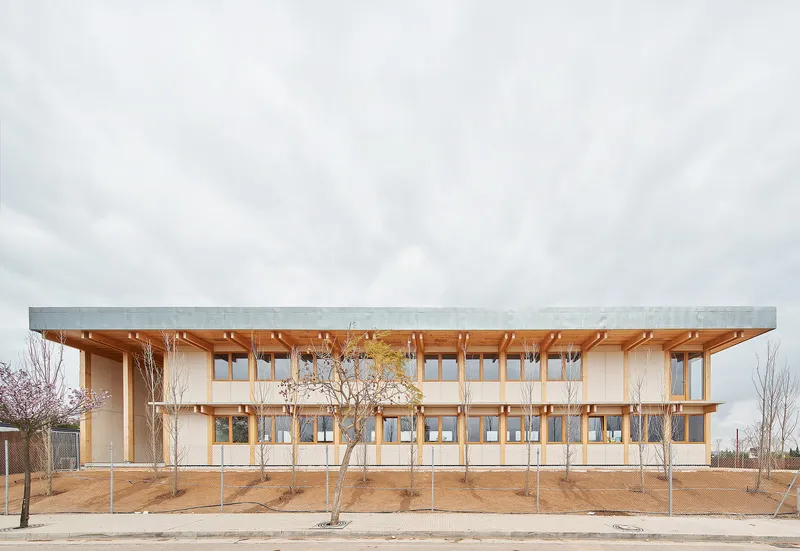
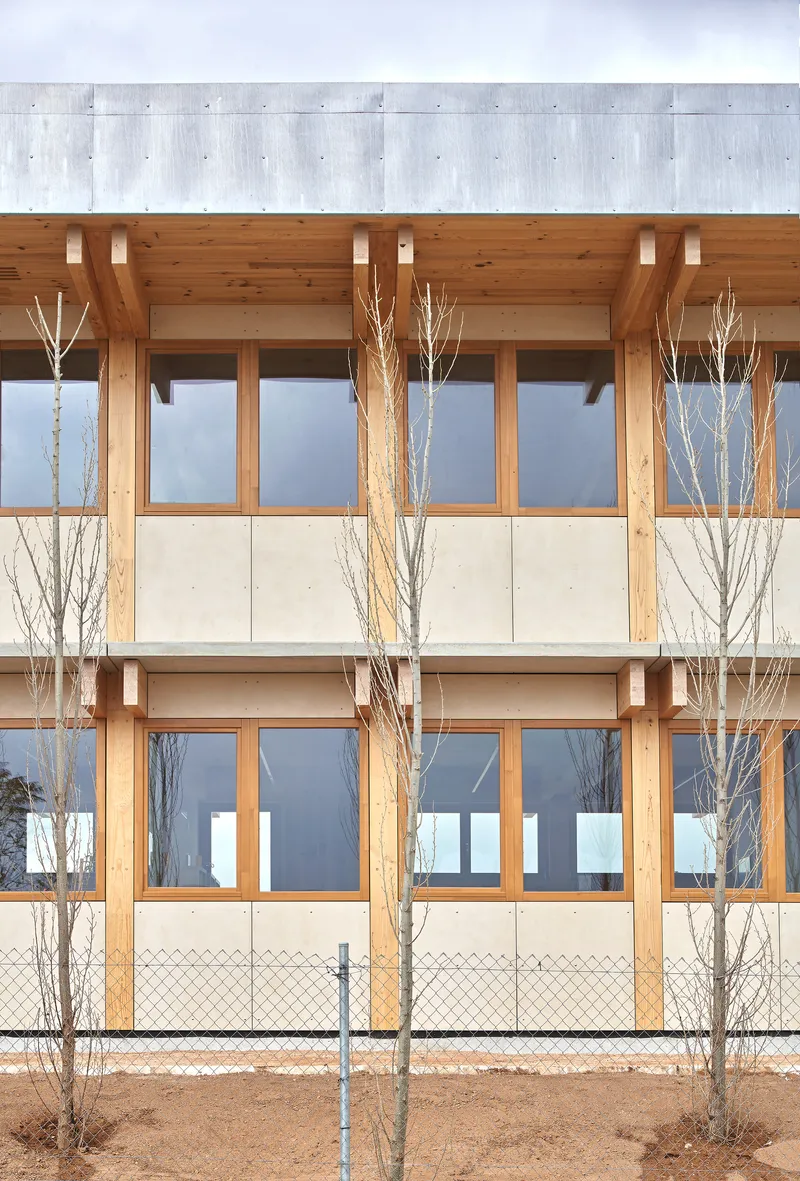
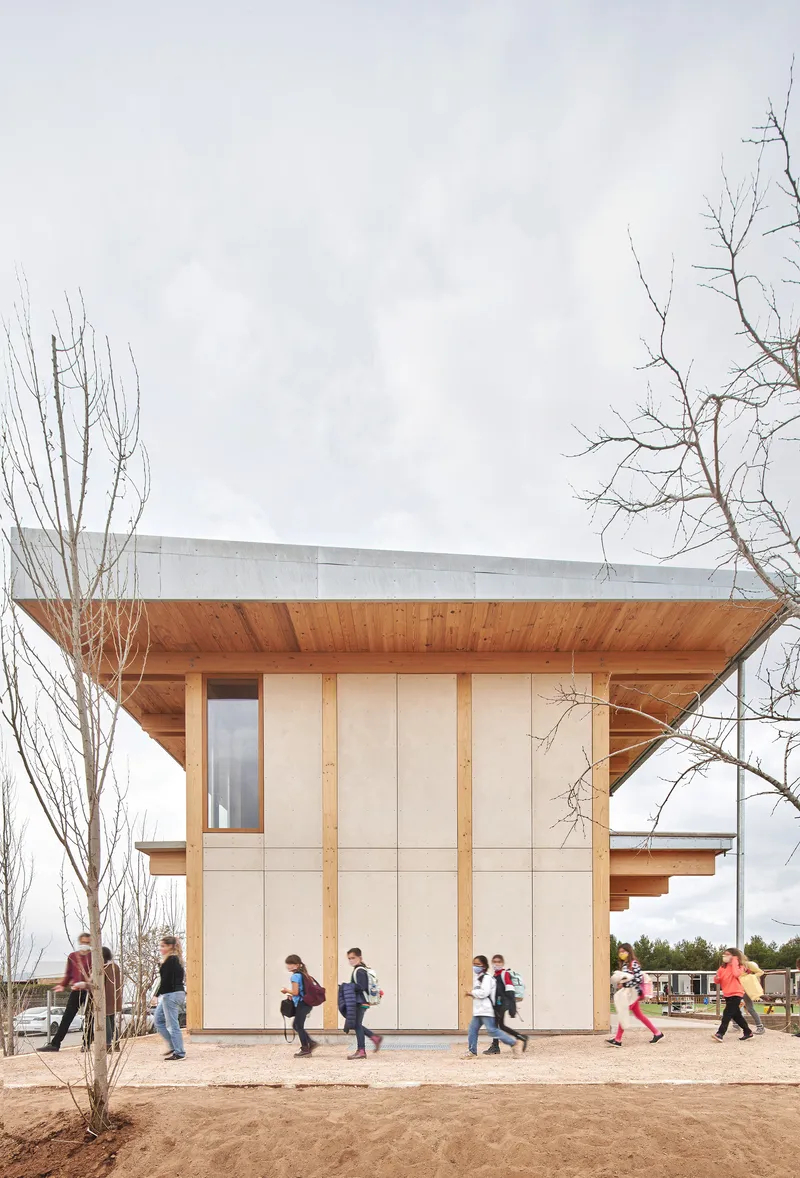
The two-story volume reads as a simple linear bar, its facade organized by a regular grid of timber bays and horizontal banding that owes more to agricultural buildings than to school typologies. Newly planted trees stand in bare earth around the perimeter, still years away from providing the shade canopy the architects designed for. That temporal dimension is part of the concept: the landscape is intended to grow into its role, eventually creating a second layer of protection from summer radiation alongside the deep overhanging eaves.
The building wraps around an inner courtyard that serves as the heart of the school, connecting directly to open-plan classrooms and functioning as both outdoor teaching space and climatic buffer. In summer, the sea breeze known locally as the embat circulates through the open plan, drawn across the courtyard and through the building. In winter, the courtyard captures solar radiation while the building's mass blocks cold northerly winds. It is a passive strategy executed with real commitment.
Timber as Structure and Argument
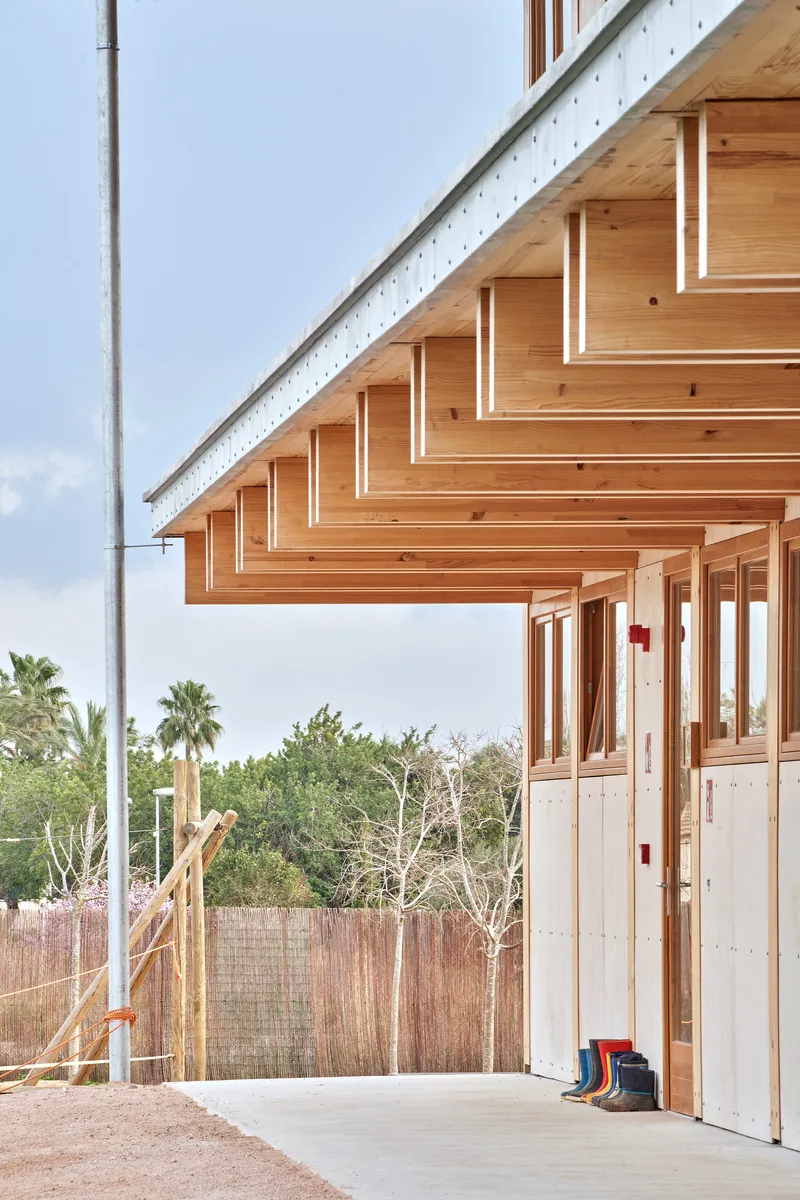
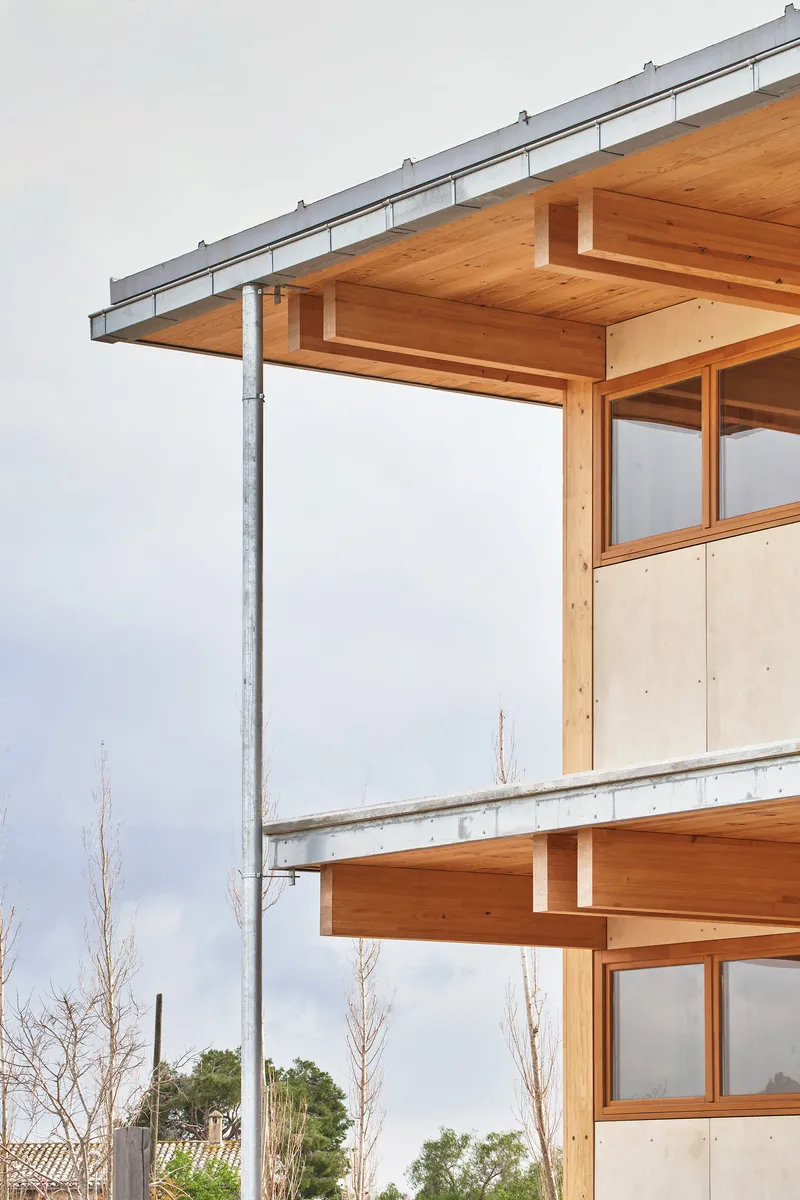
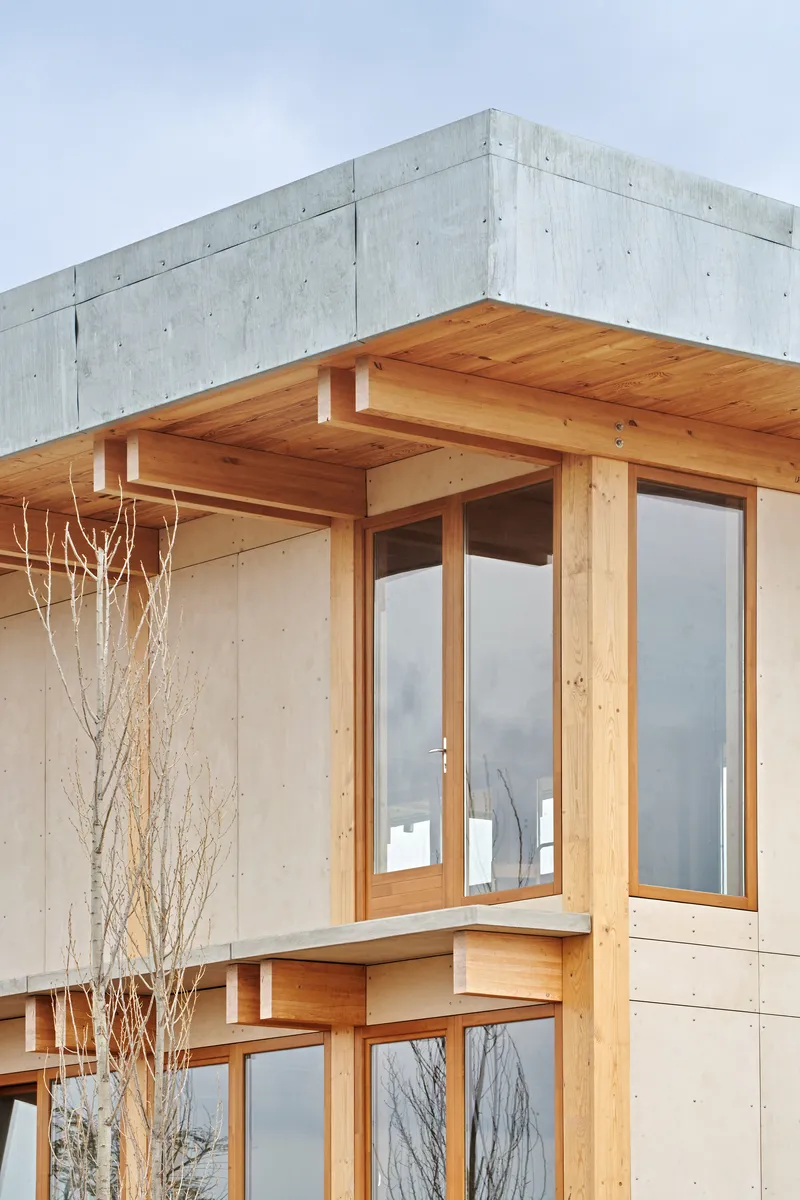
The structural system is a porticoed frame of glulam pillars and girders carrying vertical loads down to the foundation, with CLT slabs absorbing horizontal loads and producing the diaphragmatic bracing that keeps the building stable. Zinc plates protect the eaves and cantilevers, and outer panels of wood shavings bonded with cement give the facade its muted, almost industrial texture. Every material choice reinforces the same thesis: that biosphere-sourced materials can deliver a 65 percent reduction in CO2 emissions compared to conventional construction.
The honesty of the exposed timber is striking. Projecting beams, stacked floor plates, and steel columns at the corners are all left visible, turning the building into a kind of teaching aid about how structures work. For a school grounded in Paulo Freire's philosophy of participatory, democratic education, the legibility of the construction is not incidental. Children can see how the building holds itself up, which is a more useful lesson than most posters on a classroom wall.
Inside the Open Plan
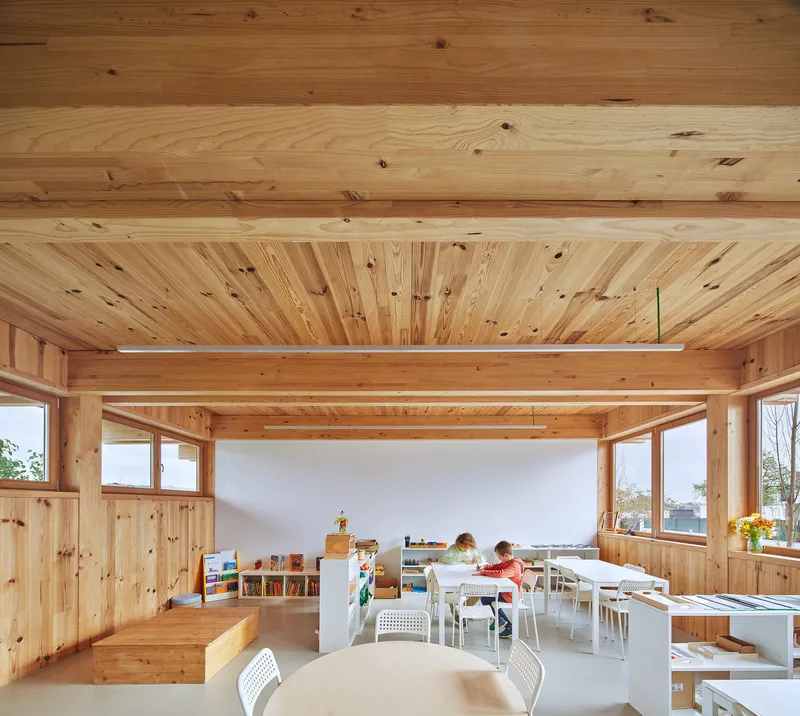
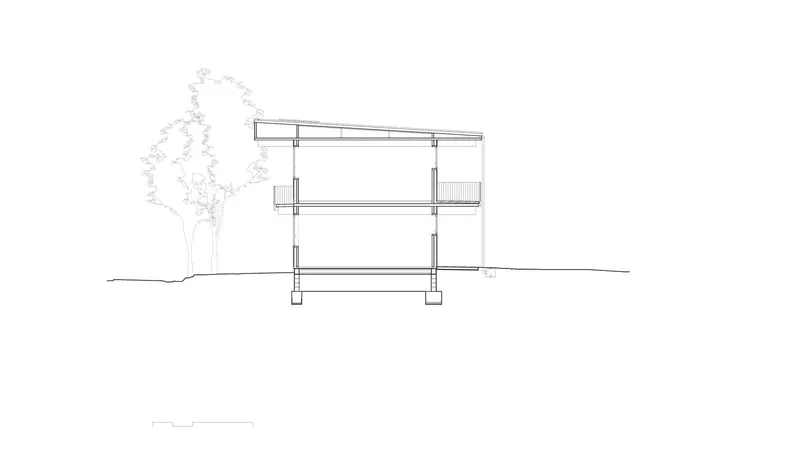
The classrooms are open plan, a direct spatial translation of the school's progressive pedagogy. Children aged three to eight share spaces defined by furniture arrangement rather than walls, with exposed timber ceiling beams running overhead and natural light entering from multiple orientations. The architects claim the building needs no artificial lighting during daytime hours, a bold statement that the section drawings support: the combination of courtyard orientation, window placement, and shallow floor plates keeps every workspace within reach of daylight.
Linoleum floors and timber windows complete the material palette inside. There is a deliberate absence of ornamentation. The warmth of the space comes entirely from the wood grain of the structure itself and from the quality of light, which shifts through the day as the sun moves across the courtyard. Teaching activity is designed to happen anywhere on the site, indoors or out, and the architecture supports that fluidity without forcing it.
Phased Construction, Pragmatic Coexistence
The building was divided into phases to match the school's own growth timeline, a pragmatic decision that shapes both the plan and the site strategy. The first phase, completed between 2018 and 2020, coexists with rented prefabricated modules that fill the gaps until the second phase (2021 to 2022) catches up. This is not the kind of detail most architecture publications celebrate, but it reflects the reality of building a school on a progressive education budget: you build what you can afford, then you keep going.
The offsite timber construction system made this phasing possible. Prefabricated CLT and glulam elements arrived on site ready for assembly, minimizing disruption to an active school. The two-week assembly timeline is remarkable not as a feat of speed but as evidence that the structural logic was resolved thoroughly before a single beam was lifted.
Plans and Drawings
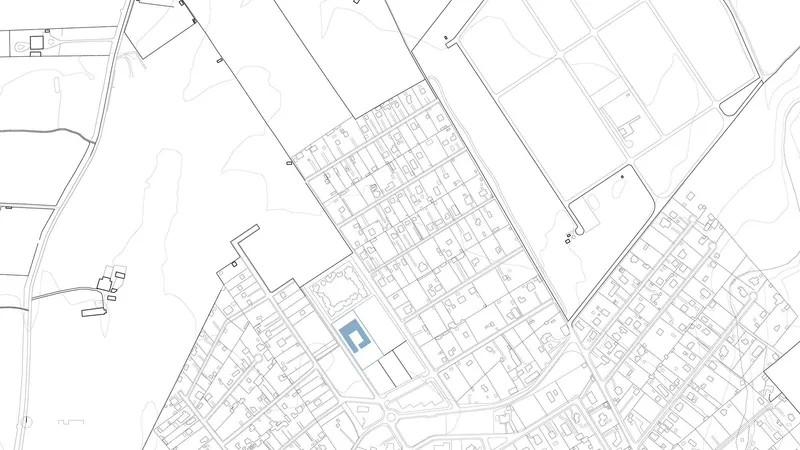
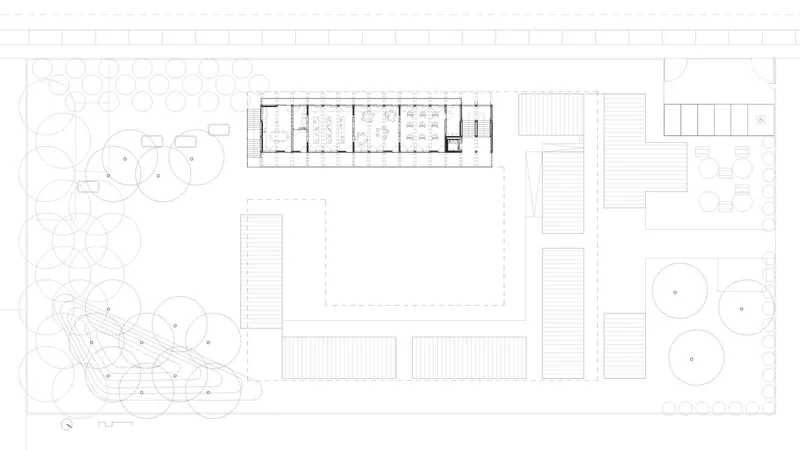
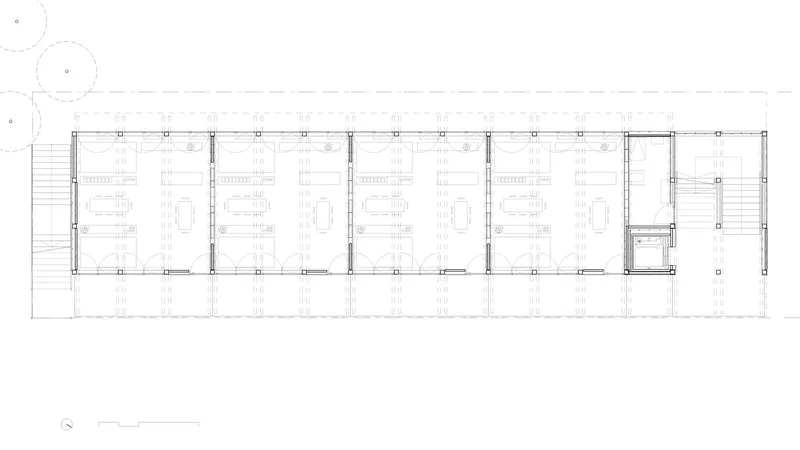
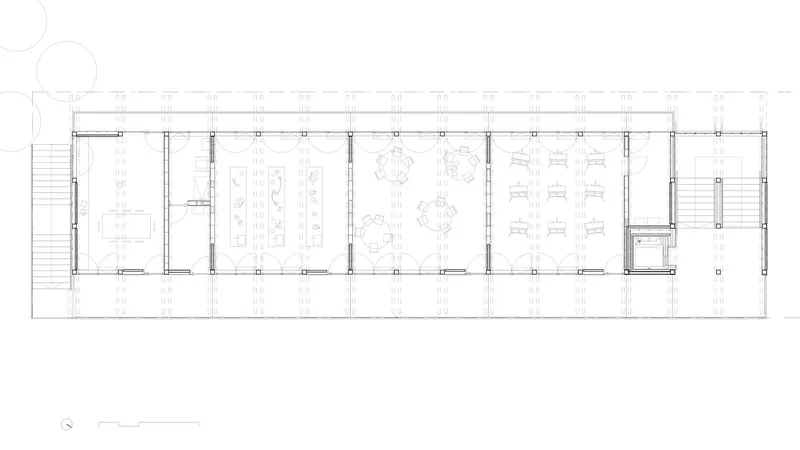
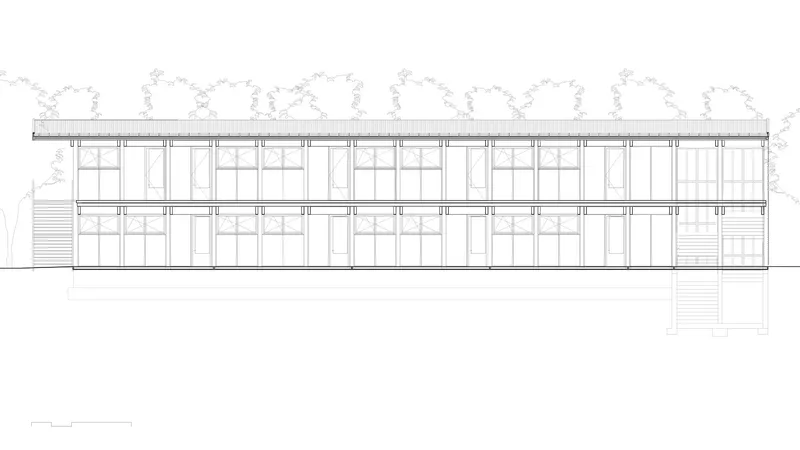
The site plans reveal how the rectangular building footprint sits within Marratxinet's diagonal street grid, rotated to optimize solar orientation rather than conforming to the surrounding urban geometry. The courtyard reads clearly in plan as the organizing void around which all circulation and program wraps. Floor plans show the repetition of structural bays that gives the building its modular logic: classrooms, dining spaces, and gathering areas all fit within the same column grid, confirming that the architecture prioritizes flexibility over fixed program.
The section drawing is the most revealing of the set. It shows the two-story timber frame in profile, with the proportional relationship between floor-to-ceiling height, eave depth, and the height of the planted trees drawn to the same scale. The architects were clearly thinking about the building and its landscape as a single climatic system. The elevation, with its grid of window openings and vegetation line above, reinforces the reading of a building designed to disappear gradually into its site as the trees mature.
Why This Project Matters
The Arimunani School matters because it demonstrates that low-carbon timber construction and passive climate strategy are not luxury upgrades for well-funded institutions. They are, in the right hands, the most practical and economical way to build. Aulets Arquitectes and Aixopluc did not invent any new technology here. They studied a building type that has worked in this climate for a thousand years, chose materials that could be fabricated off site and assembled quickly, and organized the plan around the movement of sun and wind. The architecture is rigorous without being precious.
For a school rooted in the belief that education should be participatory and democratic, the building itself participates. It teaches through its exposed structure, its relationship to weather, its courtyard that is simultaneously classroom and garden. As the trees grow and the landscape fills in, the building will become less visible and more effective. That patience, the willingness to design a building that improves over decades rather than peaking on opening day, is the most radical thing about the project.
Arimunani School by Aulets Arquitectes (Francisco Cifuentes, Sebastià Martorell) and Aixopluc (David Tapias). Marratxinet, Spain. 2,350 m². Completed 2019. Photography by José Hévia.
About the Studio
Share Your Own Work on uni.xyz
If projects like this are the kind of work you want to make, uni.xyz is a place to publish your own, find collaborators, and enter design competitions.


Popular Articles
Popular articles from the community


Singing Woman: Contemporary Architecture Inspired by Estonia’s Voice and the Sea
Singing Woman turns Estonia’s song culture into flowing opera house architecture, blending public life, landscape, sea, and national memory.

Opera on the Sea: Driftwood Logic Shapes a Timber Opera House on Estonia's Coast
Trevor Orgill's opera house translates the entangled drift of floating timber into a civic building where wood, water, and music converge.

Manzana Morphosis: Stretching Barcelona's Grid into a Living Landscape for 2050
A radical reworking of the Eixample manzana turns density into a tool for generous public space, vertical ecology, and environmental performance.
Temporary Home for Dogs: A Reversed Zoo Rethinks Animal Shelter Architecture
In Bucharest, a sinuous corridor and freed landscape flip the logic of containment, designing a shelter that works to make itself unnecessary.

Similar Reads
You might also enjoy these articles

Bao Huynh Watercolor Atelier: A Serene Art Retreat in Hội An
Bao Huynh Watercolor Atelier in Hội An blends multifunctional art spaces, sustainable design, local materials, and family-friendly living in a serene environment.

Atelier Macri Concept Store Interior Design by CASE-REAL
Atelier Macri store features a "ko" counter, walnut wood details, cork displays, blending retail, gallery, and seamless customer experiences.

Manuel Vargas Izquierdo Stadium and High-Performance Sports Center: Architectural Excellence in Jalpa de Méndez
The Manuel Vargas Izquierdo Stadium blends sustainable design, inclusive sports facilities, and cultural-inspired architecture, revitalizing Jalpa de Méndez’s public spaces.

KAKR Buluh Awar Hall: Revitalizing Community and Ecology Through Bamboo Architecture
Community built bamboo hall revitalizes Buluh Awar village, empowering youth, restoring ecology, celebrating vernacular craftsmanship through sustainable architecture and culture.

Explore Children School Competitions
Discover active competitions in this discipline

Challenge to design a portable theatre

Challenge to design a portable music platform

Challenge to design public laboratory

Challenge to design an open learning module for the elderly
Comments (0)
Please login or sign up to add comments
No comments yet. Be the first to comment!