
Autistic Care
Design of the childcare centre

Architecture of exclusion
The space around us has a fundamental impact on the activities we do every day, the decisions we make, as well as on our well-being and quality of life. The way workplaces and schools are designed determines how we function, work and learn on a daily basis. Office and classroom layouts influence the way in which the users interact. It is important that in these situations every user has equal opportunities and that the space does not generate distinctions between them. When considering the needs of people with disabilities in our design, we remember about ramps, lifts and other solutions that facilitate access in the building. However, we are not always aware that there are still many architectural barriers that disqualify many potential users. For people on the autism spectrum, the environment in which they live is particularly important to their functioning. Unfortunately, there are no many regulations or standards that specify how to design an autism-friendly environment. Especially today, when the consequences of constant, excessive sensory stimulation are experienced not only by people on the spectrum, it is crucial to introduce appropriate solutions.
Spectrum
Taking up this particular competition topic was motivated by the need to learn more about barrier-free design. The first step was to learn more about the specifics of the disorder and try to understand the behaviour and perception of the world by autistic people. We can distinguish many characteristics that condition the design process, the main ones being sensory sensitivity, a tendency towards repetition or difficulties in interpersonal relations. During the process I drew on Magda Mostafa's research in this area.( ASPECTSS® etc.)
Location
Although the needs of the users on the spectrum were a priority, it was very important to me that the building remained in harmony with its surroundings. Aspects that have been considered in the design include the urban layout of the surrounding area, the history of the neighbourhood and the structural systems used in Middlefield.
The process
One of my first ideas was to design the building to cover the entire buildable area of the plot, cutting organic shapes from its volume to relate to the scattered buildings around, while creating internal gardens. The whole building would then be a transition zone between the inserted floor-to-ceiling volumes of the rooms.
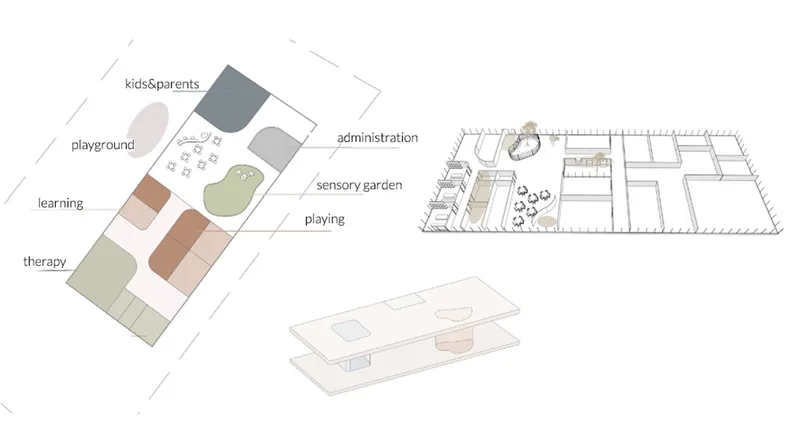 First concepts schemes
I abandoned this idea because of the terrain, which forced the building to pile up, which I wanted to avoid (because of the barriers). In the process, I developed many modifications to this concept, eventually turning it upside down.
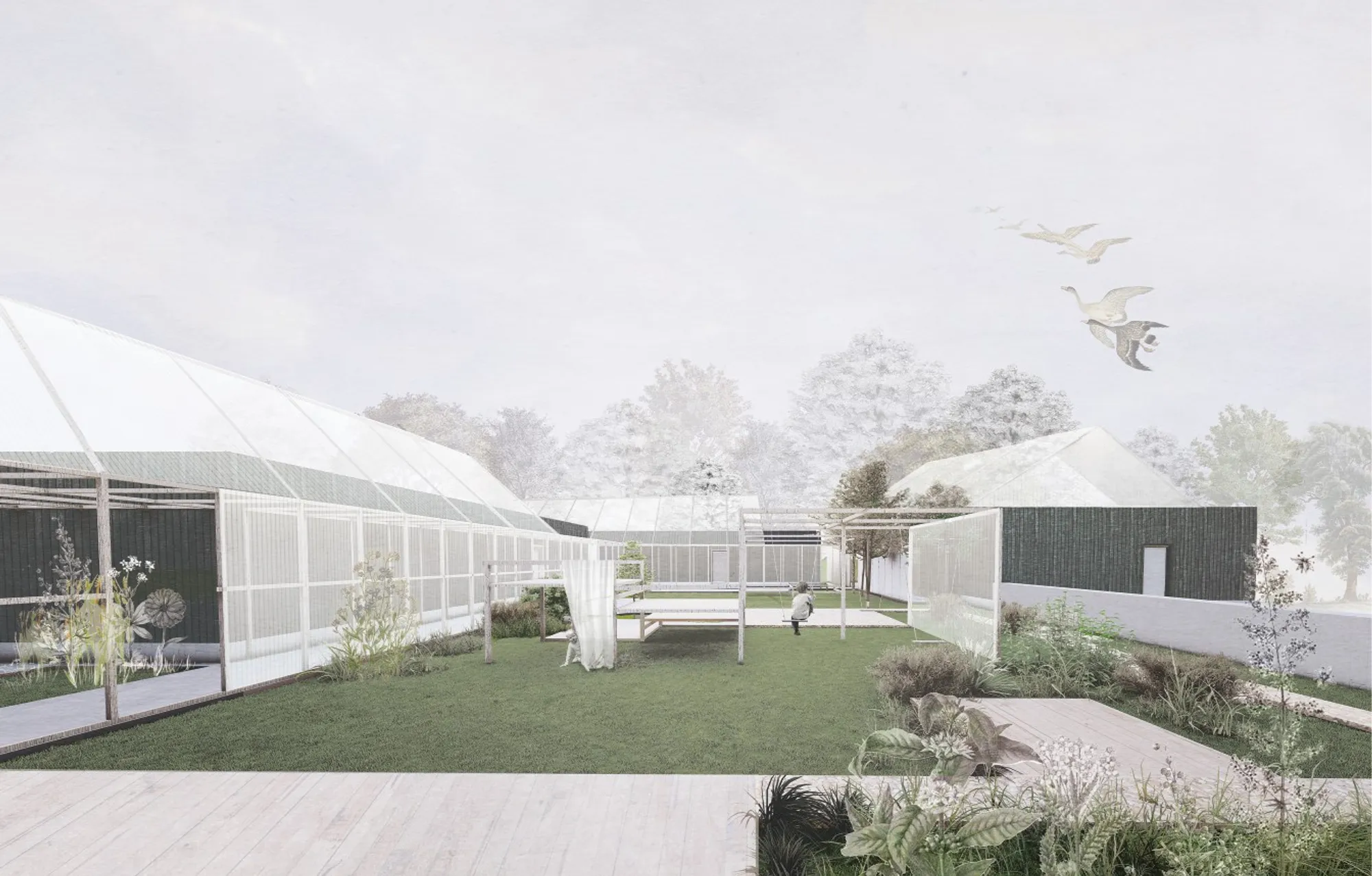
The origin of the current project was the idea of a sensory path that would gently lead the user from the outside world to a therapeutic environment. I arranged the spaces starting from the loudest and accessible to the largest group of people, to the most quiet and requiring concentration. Inspired by the layout of local farms and bungalows, I decided to spread the zones into separate buildings. I also wanted a flat area where the children could play outside. This has resulted in a layout where everything starts with the main building, where management takes place, picking up children, receiving visitors etc. However, the heart of the project is a little further away - in the three buildings where children will spend most of their time and the courtyard between them. In order to make a clear visual distinction between the function of the main building and the smaller buildings, I decided to give the latter a cottage-like shape by designing sloping roofs. I also see this as a symbol that will allow the child to become attached to the particular house in which he or she is to be cared for.
The whole setup is designed on a 4x4m grid, to ensure it will be modular and repetitive.
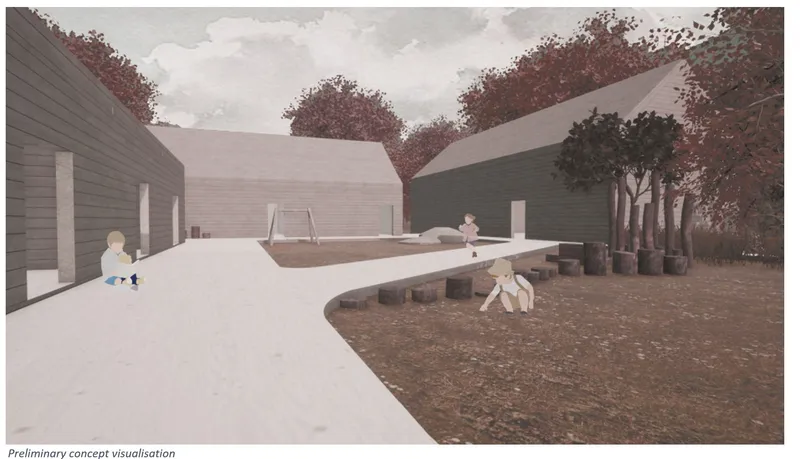
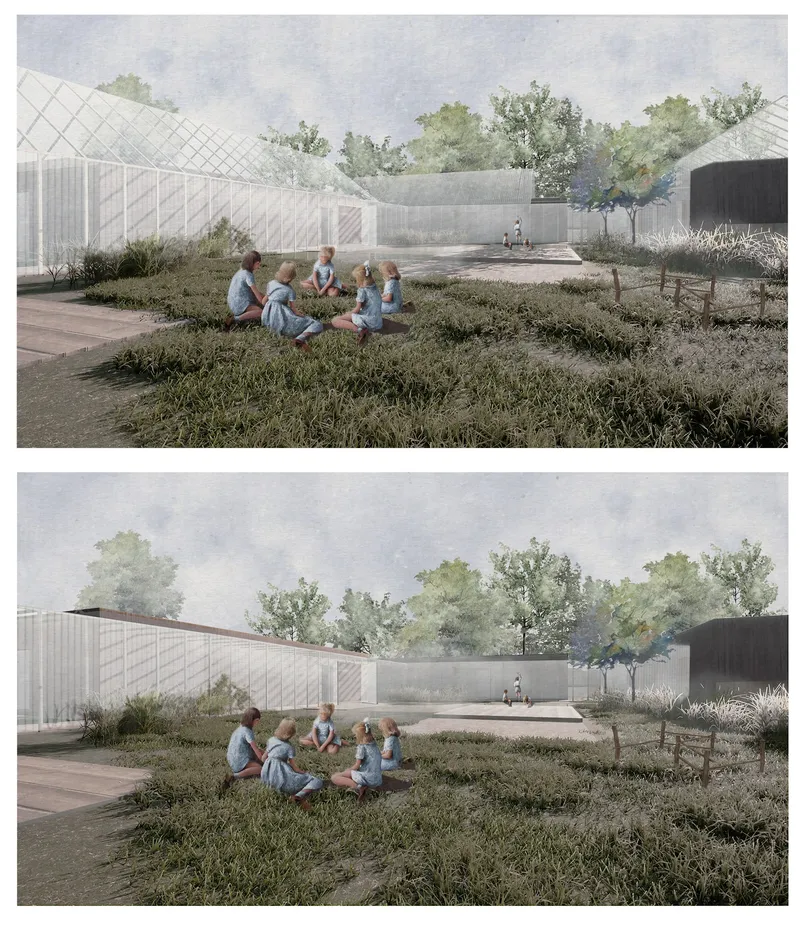 Two ways pavillon can be developed.
Main building
It contains a lobby, offices, dining rooms with facilities, changing rooms and a room for physical therapy. There is also a technical area that is embedded in the ground, due to its volume - so that it does not dominate the surroundings. The proposed structural system for the building is a timber frame structure with a stepped layout due to the terrain. Both in front of the entrance to the building and inside, shelter spaces have been designed in the form of wall niches or offset sitting places.
Pavillon
It is a ‘second skin’ surrounding the buildings and symbolizing the care given to children. It also provides a transition zone essential for acclimatization between spaces with divergent level of sensory control. Pavillon can be adjustable to different weather conditions by adding or removing polycarbonate panels. Material has been chosen on the basis of its thermal properties and light filtering. Additionaly it is very light, so can be moved easily. It is also considered as a occassion for development of the buildings - the space above the box buildings, but belowed the sloping roofs of pavillon, can be used as space for garden with vegetables or as space accomodated for volunteers working in the centre.
Children’s houses
These are the two first buildings after leaving the main building. Each one is destined for 15 group of children and divided to a play zone and learning zone. In the first one we have natural sidelight, and in the learning zone overhead lighting, additionaly filtrated by the polycarbonate panels above, for less distraction. Zones are also distinguished by the colors of floor and moveable acoustical wall, which is also escape space, just as the terrace attached to the building.
Therapy house
The last building is specified for the therapy sessions – individual and in groups. There are two cabinets for face to face meetings and room for sensory therapy intended for group classes. It is connected to the sensory garden on the terrace. This building is accessible from the courtyard and pavillon for children that spend a whole day in the centre, and from the outside for children and parents commuting just for therapy. It is designed in a way that you have to go out the same way you came in – it means that no stranger can access the inner yard.
Courtyard
Just as the whole design the inner yard is designed on a grid to maintain predictability and repetitivness. It consists of playground being the extension of the pavillon construction, terraces as gathering and observation point, escape spaces and the green spaces. The whole project, starting with the wooden construction, by the wooden elevations and interiors of the buildings, is designed from natural materials and the colors are adjusted so they are the most suitable for the users in spectrum.




Popular Articles
Popular articles from the community


Co-life: Sustainable Architecture for Age-Friendly Community Living
Co-life reimagines sustainable architecture for seniors through courtyards, rammed earth, shared gardens, and spaces designed for belonging.

The Musturak Paradise: Senior Living Architecture for a Connected Future in Temara, Morocco
The Musturak Paradise reimagines senior living architecture in Temara via private homes, social spaces, culture, community, and shared care.

Play: Fragments of Their World
Familiar architecture becomes modular playground design, creating safe spaces where displaced children can learn, connect, imagine and play.

Lunar Spiral: Space Architecture Shaped by the Mathematics of the Universe
Lunar Spiral reimagines space architecture through Fibonacci geometry, lunar regolith, levitating habitats, and self-sustaining Moon living.


Similar Reads
You might also enjoy these articles

Day and Night Park: A Time-Based Urban Newsstand in Beijing
A temporary urban newsstand in Beijing blending travel, light, and reading through poetic colors, compact form, and community-focused design.

Modernist Patio Renovation in El Masnou, Barcelona by Oliver Segura Arquitectura + Cebrià Arquitectura
Modernist patio renovation blending tradition and innovation with a movable pool, leveled floors, and Catalan materials in El Masnou.

Alto Residencial Coop: Cooperative Housing Development in Santiago de Compostela by Carbajo Barrios Arquitectos
A linear cooperative housing complex blending white volumes and perforated metal façades, enhancing community living, natural light, privacy, and urban integration.
Vil Genis School by BPA ARCHITECTURE – Massy, France
Vil Genis School in Massy, France, features sustainable design, south-facing classrooms, community integration, accessible spaces, and modern educational architecture.


Comments (0)
Please login or sign up to add comments
No comments yet. Be the first to comment!