
Back to Earth: A Vertical Cemetery That Composts the Dead into Urban Forest
A spiraling composting tower transforms human remains into fertile soil, challenging how cities memorialize the departed and reclaim land.


What if death could build a forest? Back to Earth proposes a radical alternative to burial and cremation: a vertical composting tower that converts human remains into nutrient-rich soil within 30 days, then channels that soil into an urban forest at the building's base. The tower is not a mausoleum. It is an active ecological machine wrapped in the spatial rituals of farewell, remembrance, and regeneration. It collapses the timeline between grief and growth into a single architectural sequence.
Designed by Xiaofan Wu and Xu Cindy, the project received an Honorable Mention in the Circle of Life competition. The brief called for rethinking humanity's relationship with death through architecture, and Wu and Cindy responded with a structure that treats the body not as something to preserve or destroy, but as material for new life. Their design leverages Recompose technology, which uses only one-eighth the energy of cremation and dramatically reduces CO2 emissions, to create an entirely new architectural typology: the composting tower.
A Spiraling Tower of Fins Rising from a Memorial Plaza
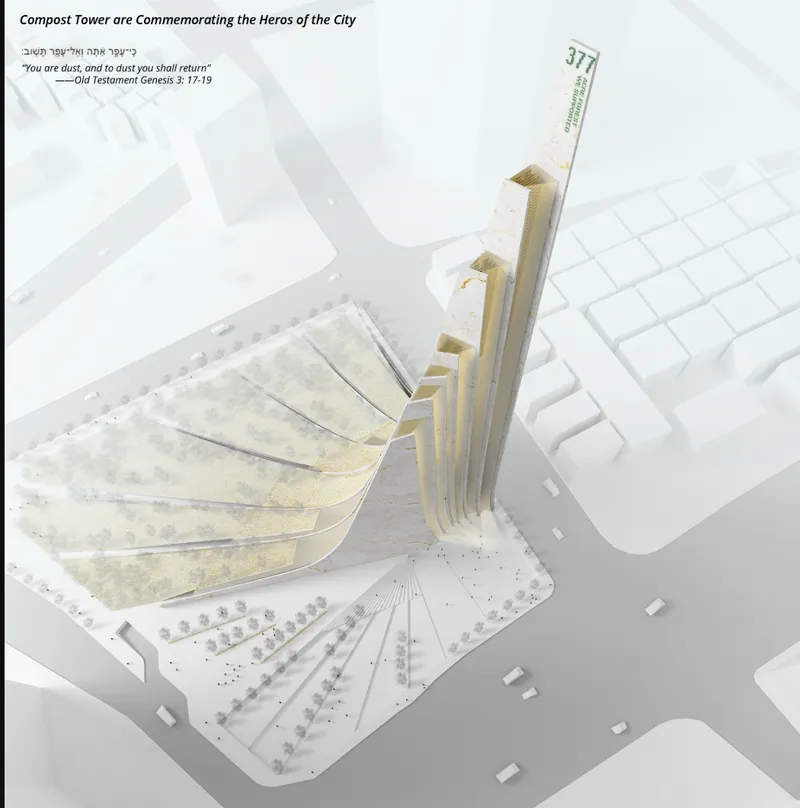
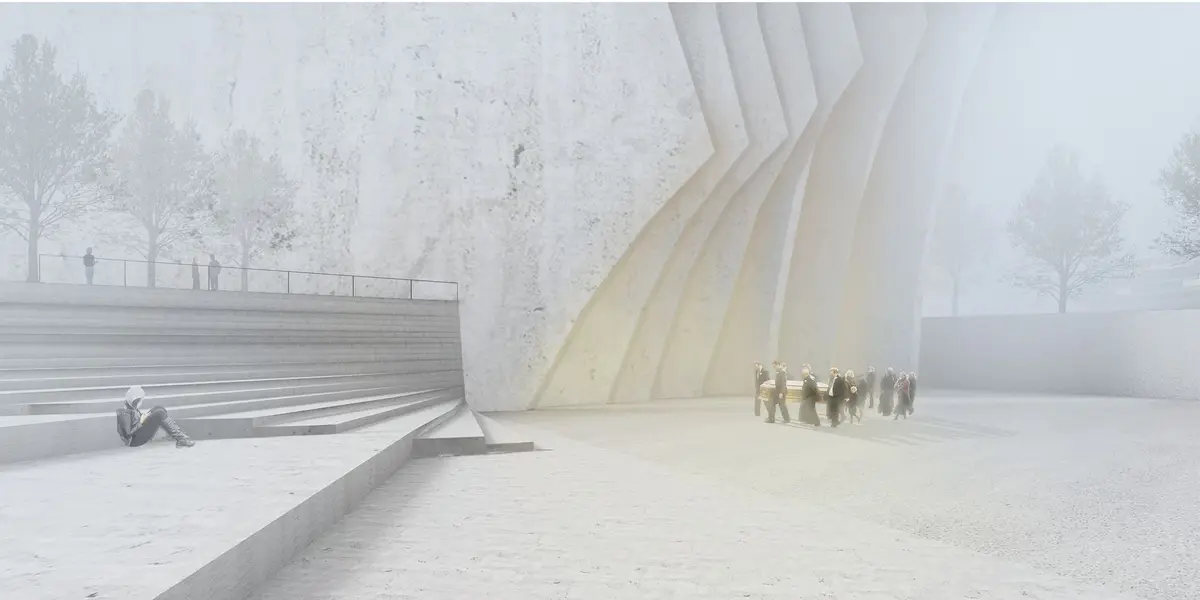
From above, the tower reads as a cluster of radiating fin-like walls that spiral outward from a central core, creating deep vertical channels of light and shadow. The aerial axonometric reveals how these fins organize the internal program while giving the exterior a tectonic rhythm that avoids monolithic heaviness. At the tower's base, a planted memorial plaza extends outward, blurring the boundary between architecture and landscape. This is the urban forest that the composted soil feeds: a living, growing monument to every person processed within the tower.
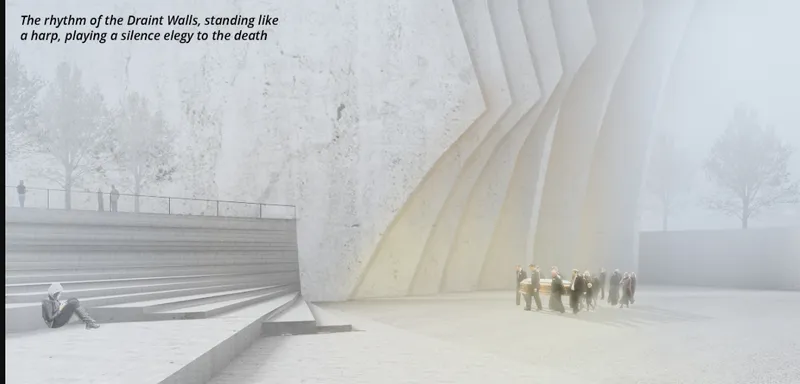
At ground level, the layered vertical fins meet a stepped plaza where visitors move through winter fog, the atmosphere deliberately contemplative. The entry sequence is designed with multi-path entrances inspired by global cultural and religious practices, representing diversity in how different communities approach death. The journey begins in the Memorial Hall, a serene entry space for reflection, then flows through the Farewell Room where loved ones say goodbye, before ascending into the tower's upper levels. The massing is assertive but porous, allowing glimpses through to the sky and greenery beyond.
An Urban Obelisk Sited Among the Living

Seen from street level, the tower rises as a tapered concrete obelisk at a busy urban intersection, surrounded by traffic and residential towers in hazy daylight. The siting is deliberate and provocative. Rather than sequestering death on the city's periphery, the designers place it squarely within the daily fabric of urban life. The tapering form draws the eye upward, reinforcing the symbolic ascension that the designers describe as mirroring the soul's journey. But it also functions pragmatically: the narrowing profile reduces the building's footprint at the top, where the composting chambers give way to lighter program, while the wider base accommodates the memorial and farewell spaces that require generous floor area.
Corridors of Light and Memory
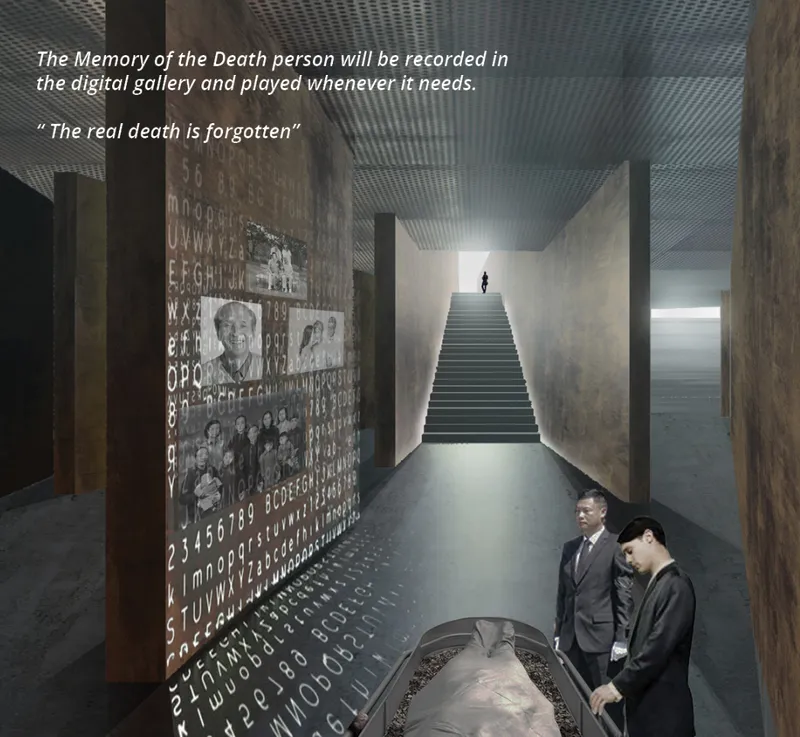
Inside the tower, an interior corridor becomes a Digital Memory Gallery where projected memorial images wash across the walls. Two visitors stand beside an illuminated staircase, their figures small against the scale of the archive. Drawing from Mexican death culture, which defines death in three stages (physical death, burial, and being forgotten), the designers ensure that the third and final death never occurs. Personal memory archives are stored digitally and made accessible to loved ones indefinitely. The corridor is both a passage and a destination: a space where the living can return to encounter the departed not as frozen portraits but as curated narratives of lives lived.
From Body to Soil in 30 Days
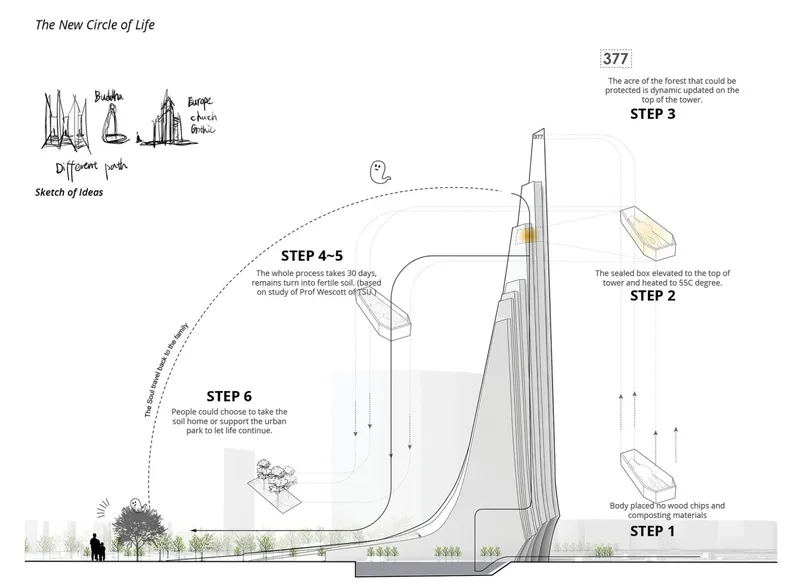
The section drawing lays bare the tower's operational logic. Annotated steps trace the full composting process: from body placement at the upper levels, through the 30-day decomposition cycle within the tower's core chambers, to the return of fertile soil at the base. Each floor corresponds to a phase in the process, moving from arrival to transformation, from sorrow to regeneration. The section reads almost like a biological diagram, making visible the metabolic exchange that the building facilitates between the human body and the earth. The composted soil can be taken home by families or donated to nourish the urban forest below, ensuring that every person, regardless of wealth or status, contributes to the city's ecological renewal.
The clarity of this diagram is one of the project's strongest moves. It refuses to mystify the process. The architecture is legible as a system: inputs, transformations, outputs. The spiral structure reflects growth, remembrance, and ecological cycles simultaneously, and the section communicates this without ambiguity.
Why This Project Matters
Back to Earth confronts two crises at once: the unsustainable land use of traditional cemeteries and the carbon footprint of cremation. In dense cities where land scarcity is acute, the vertical composting tower offers a spatial model that gives land back rather than claiming it permanently. The urban forest at the base is not ornamental landscaping; it is the direct product of the building's function, a feedback loop between death and growth that makes the ecological argument tangible and visible.
What distinguishes Wu and Cindy's proposal is their insistence that sustainability and dignity are not in tension. The Memorial Hall, the Farewell Room, the Digital Memory Gallery: these spaces honor the emotional weight of death without retreating into sentimentality. The architecture serves grieving families and the planet in the same gesture. It is a building that asks whether our final act can be one of generosity, returning to the earth not as a burden but as nourishment.
View the Full Project
About the Designers
Designers: Xiaofan Wu, Xu Cindy
Enter a Design Competition on uni.xyz
uni.xyz runs architecture and design competitions year-round that reward proposals with spatial conviction and real site intelligence.
Project credits: uni.xyz by Xiaofan Wu, Xu Cindy Circle of Life (uni.xyz).


Popular Articles
Popular articles from the community


Faces of the Soviet Avant-Garde: Turning Moscow's Street Names into an Open-Air Museum
A network of sculptural installations across a Moscow residential district transforms forgotten architect names into spatial encounters with cultural memor
Tsunami Convergenics: Turning Catastrophic Ocean Forces into Underwater Housing Infrastructure
A speculative underwater settlement off the coast of Onagawa, Japan, treats tsunamis and typhoons as energy sources rather than threats.

Manzana Morphosis: Stretching Barcelona's Grid into a Living Landscape for 2050
A radical reworking of the Eixample manzana turns density into a tool for generous public space, vertical ecology, and environmental performance.

Cloaked Colonization: A Mobile Underwater Habitat That Moves Like a Fish
Micah Abaya's shortlisted EHC Pacific entry reimagines ocean settlement as a dispersed network of self-sustaining architectural organisms.

Similar Reads
You might also enjoy these articles

Day and Night Park: A Time-Based Urban Newsstand in Beijing
A temporary urban newsstand in Beijing blending travel, light, and reading through poetic colors, compact form, and community-focused design.

Modernist Patio Renovation in El Masnou, Barcelona by Oliver Segura Arquitectura + Cebrià Arquitectura
Modernist patio renovation blending tradition and innovation with a movable pool, leveled floors, and Catalan materials in El Masnou.

Alto Residencial Coop: Cooperative Housing Development in Santiago de Compostela by Carbajo Barrios Arquitectos
A linear cooperative housing complex blending white volumes and perforated metal façades, enhancing community living, natural light, privacy, and urban integration.

Vil Genis School by BPA ARCHITECTURE – Massy, France
Vil Genis School in Massy, France, features sustainable design, south-facing classrooms, community integration, accessible spaces, and modern educational architecture.

Explore Vertical Cemetery Competitions
Discover active competitions in this discipline

Design Challenge - Contemporary interpretation of a religious complex

Challenge to design locus for the upliftment of human rights

Design challenge to reuse E-waste
Comments (0)
Please login or sign up to add comments
No comments yet. Be the first to comment!