
Bagchi Karunashraya: A Hospice of Compassion in India
Mindspace designed a 130,000 ft² palliative care campus in Bhubaneswar built from local laterite, organised around reflecting pools and quiet courtyards.

Karunashraya means abode of compassion, and that is the premise the project is built on. The Bagchi Karunashraya Palliative Care Center, a 130,000 square foot campus completed in 2024 by Mindspace in Bhubaneswar, Odisha, is a hospice that provides free end-of-life care. The architecture has to do something that hospital architecture almost never tries to do: make dying feel less alone.
The studio, led by P. N. Medappa, has approached this with real discipline. Instead of designing a medical facility and then softening it with landscaping and art, Mindspace has built a piece of architecture whose primary tool is silence. The building recedes. The site, the water, and the light do most of the work.
Laterite as a Regional Gesture
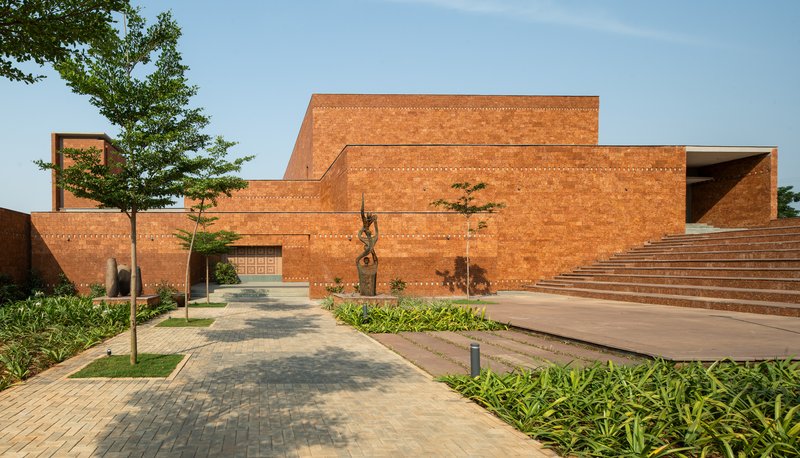
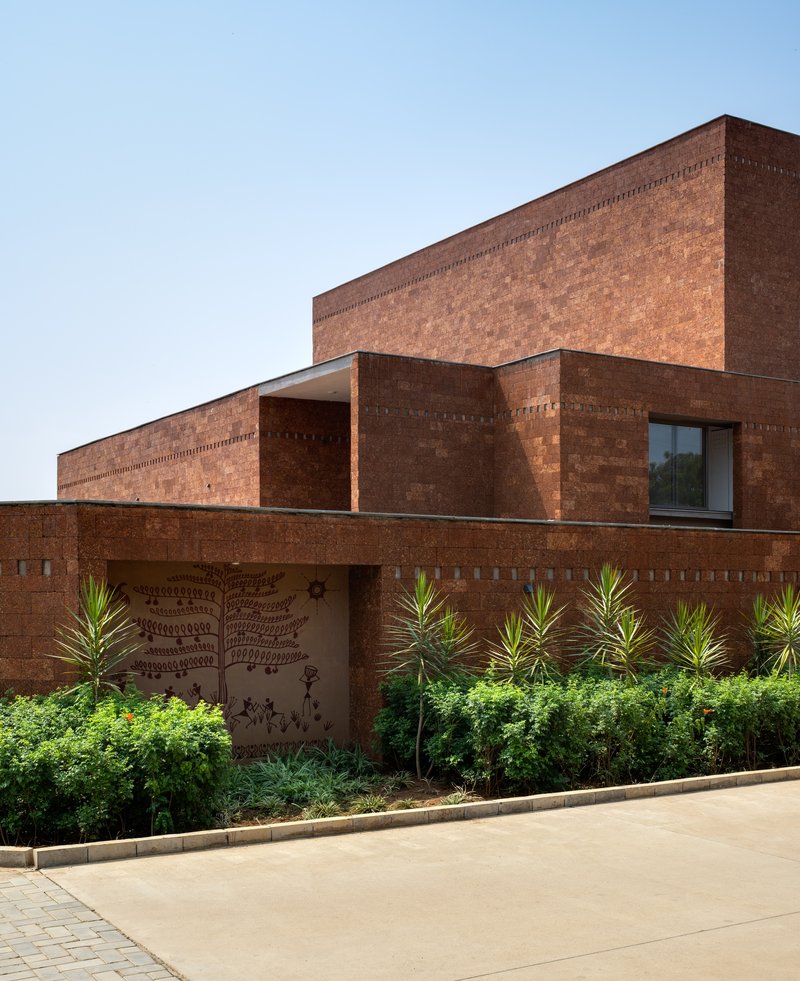
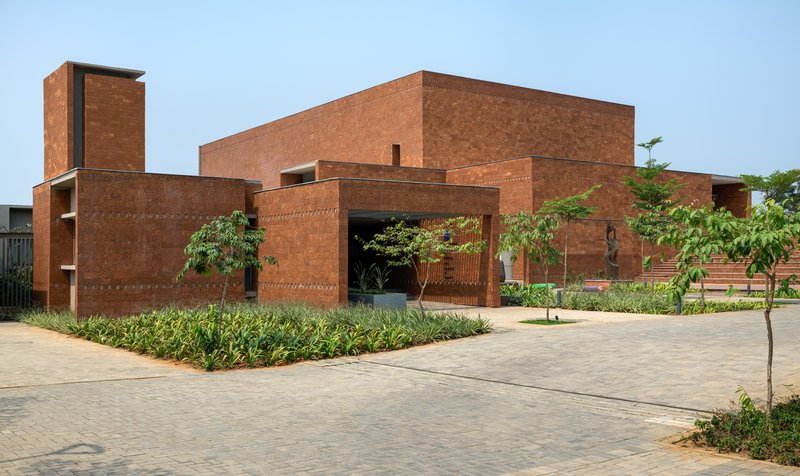
The dominant material of the project is the local red laterite stone, cut and laid in small modular blocks that give the exterior walls a warm, porous texture. Laterite is common in this part of India, easy to source, and slowly weathers to a darker shade over time. Walking the photographs, you can almost feel the surface temperature: warm in the early sun, cool in the shadows.
The decision to use laterite is not a branding move. It is a carbon move. The stone comes from quarries a short distance away, requires minimal processing, and ties the building to the same geological layer as the site itself. A hospice built from a material that will age the way its surrounding earth ages is saying something about time, even if it does not announce it.
A Campus Organised Around Water
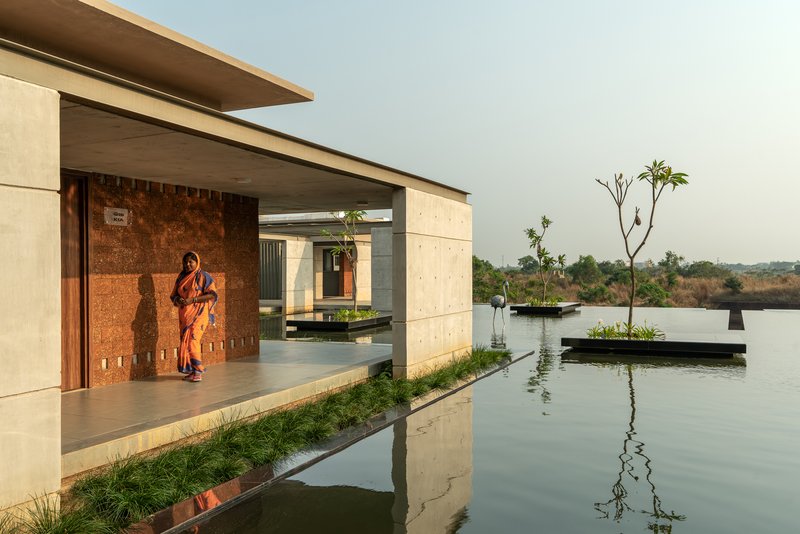
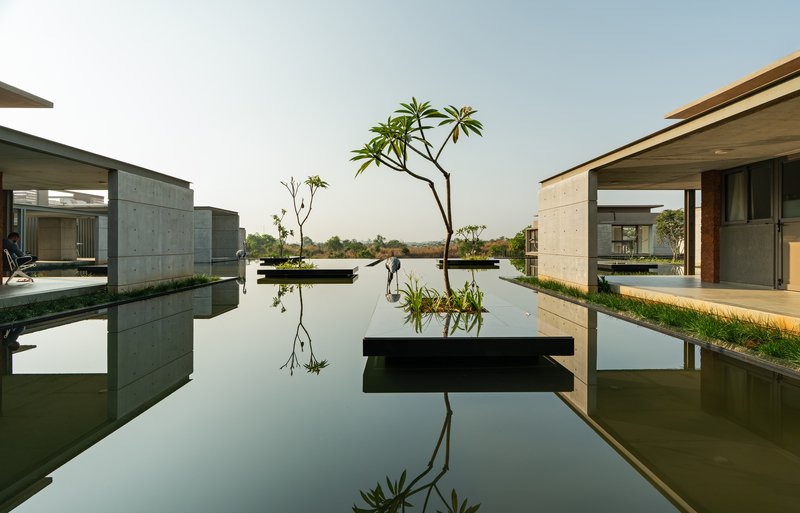
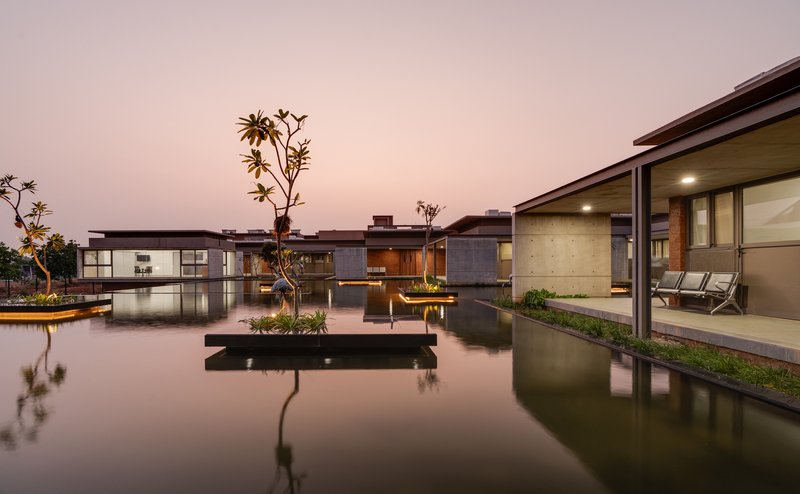
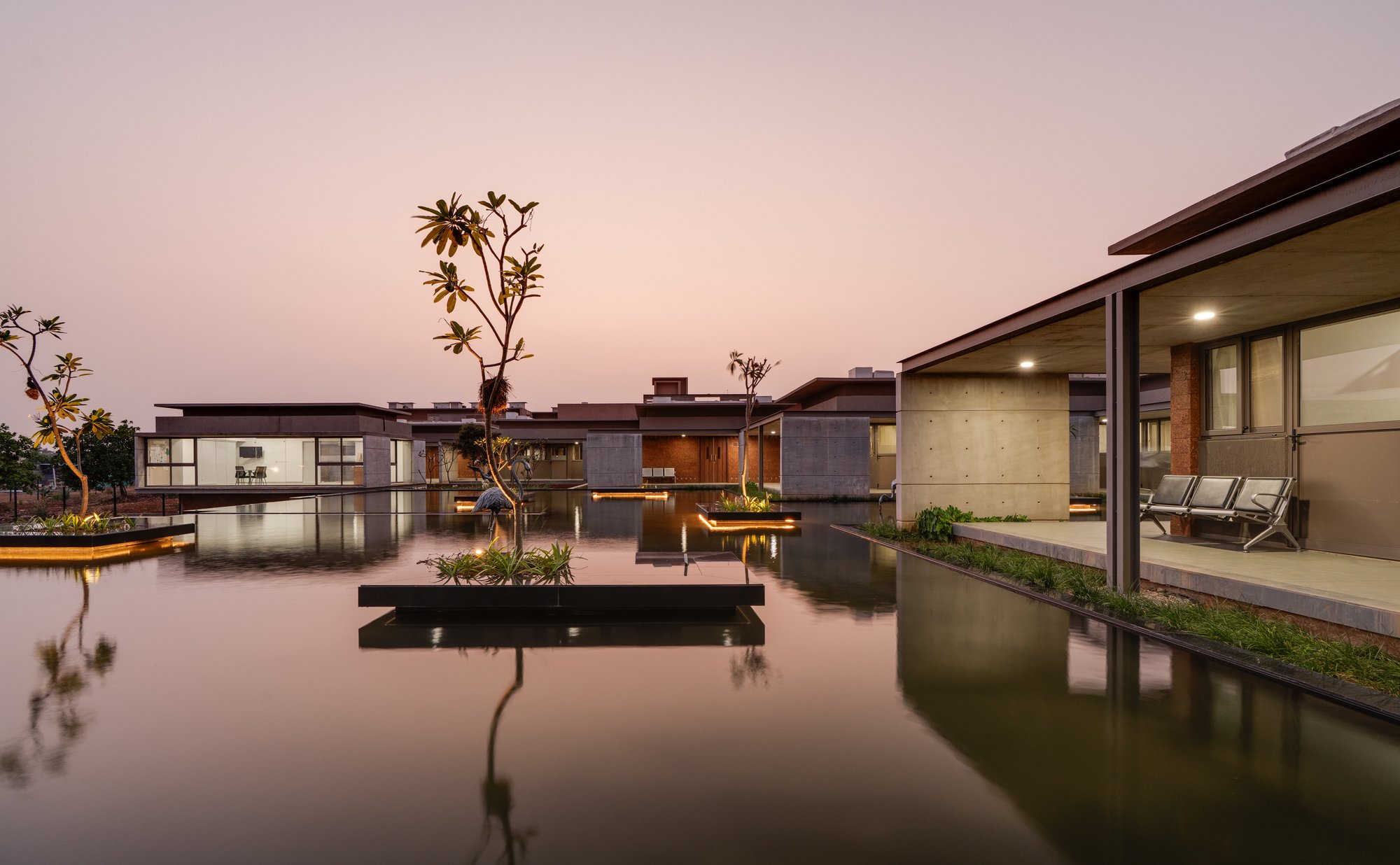
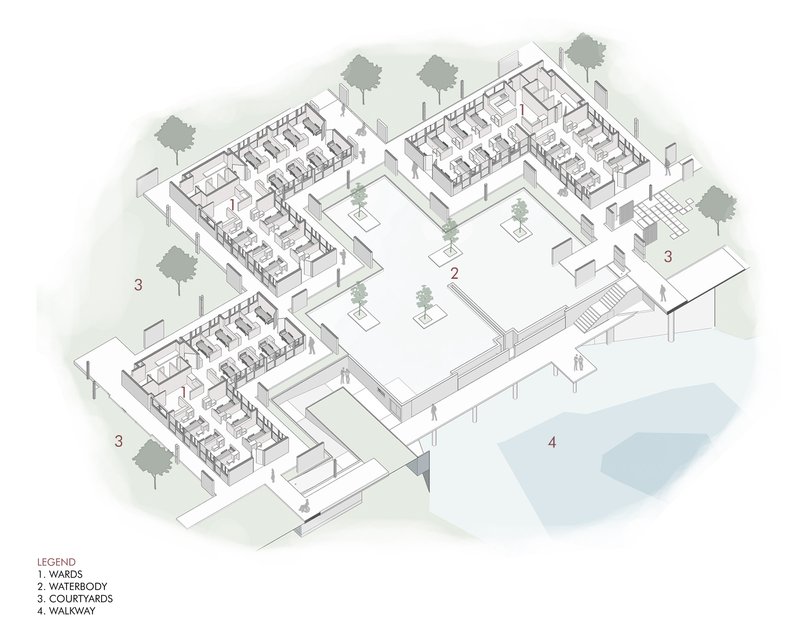
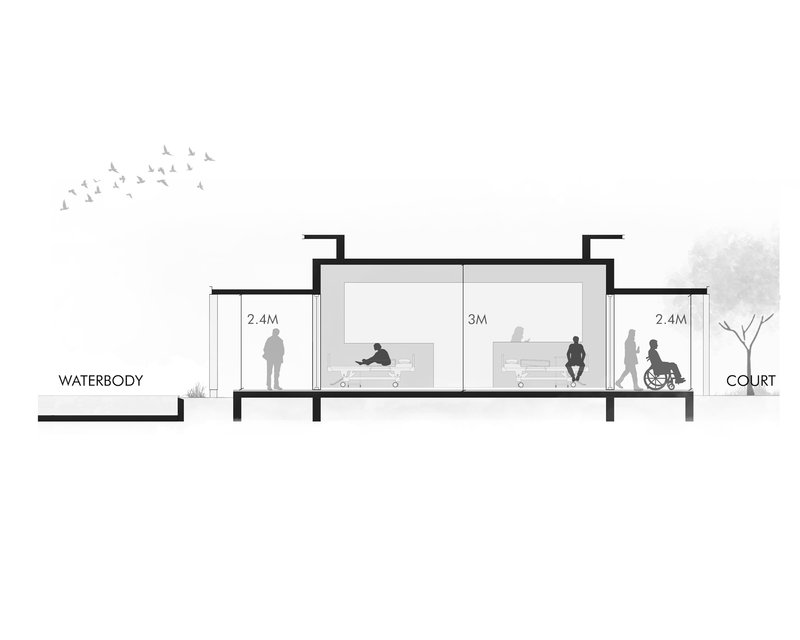
The most distinctive feature of the project is a large reflecting pool that runs through the centre of the ward complex. Small planters float on the water, catching the evening light. The ward wings open directly onto the pool, so every patient room has a view of still water and, beyond it, the sky.
Reflecting water is an old idea in Indian architecture. Bagchi Karunashraya uses it for its functional effect: calm, temperature moderation, and reflected light. But the symbolic weight is unavoidable. Water represents life, healing, and the passage of time. In a hospice, it becomes the visual element that patients and their families look at for hours. That kind of design decision is worth more than almost any other programmatic gesture the architects could have made.
Courtyards and the Low Horizon
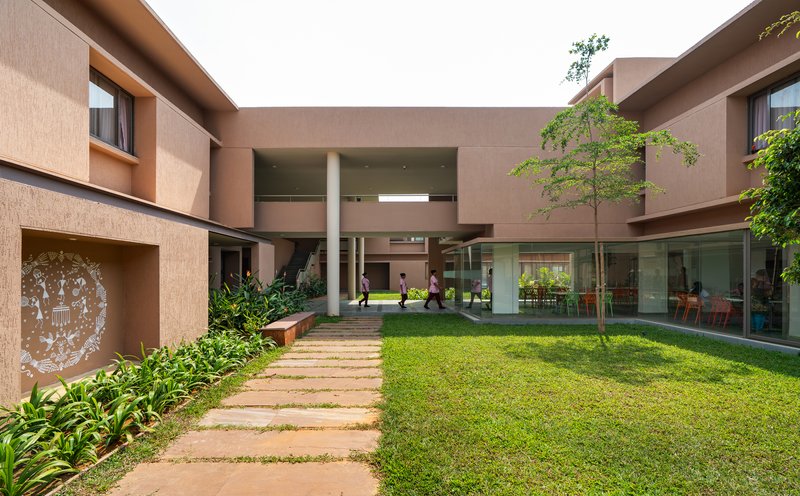
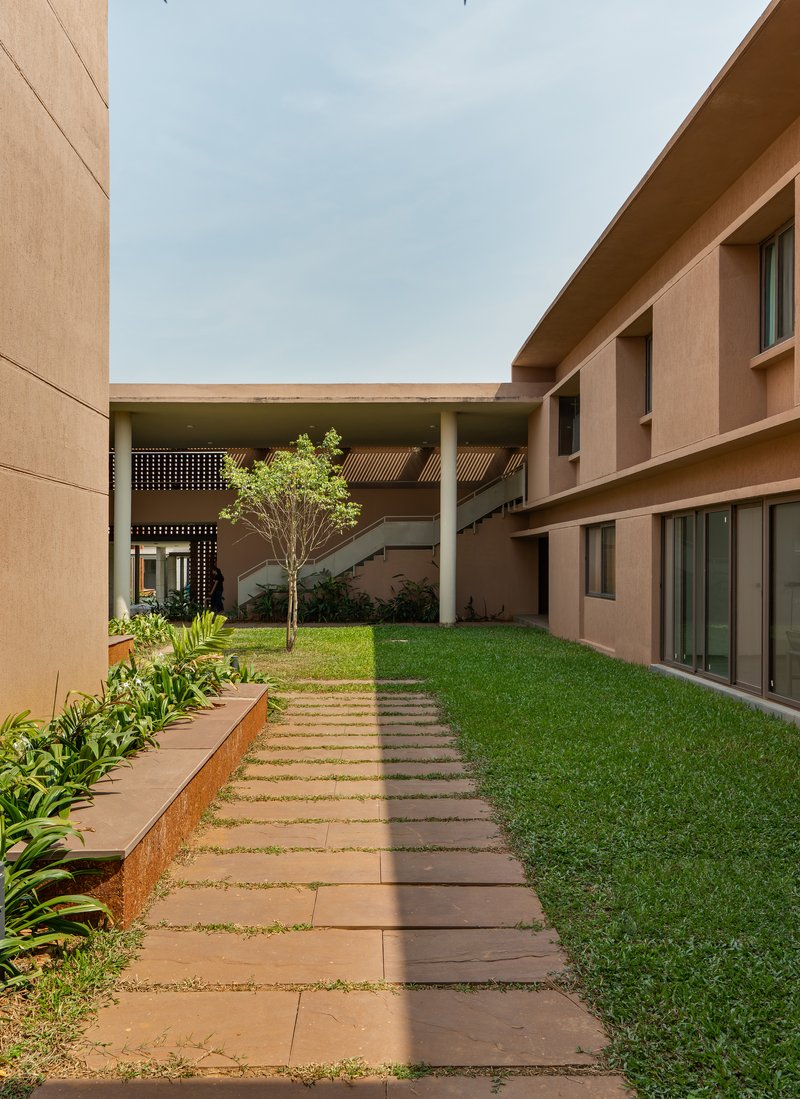
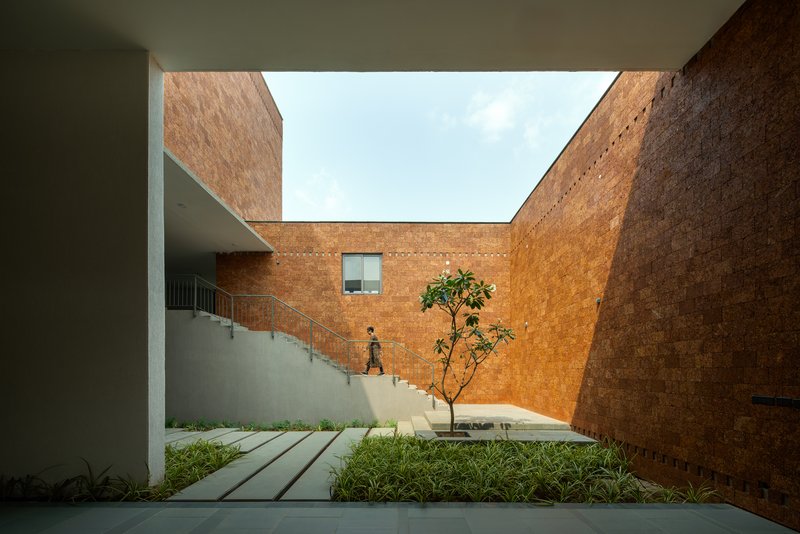
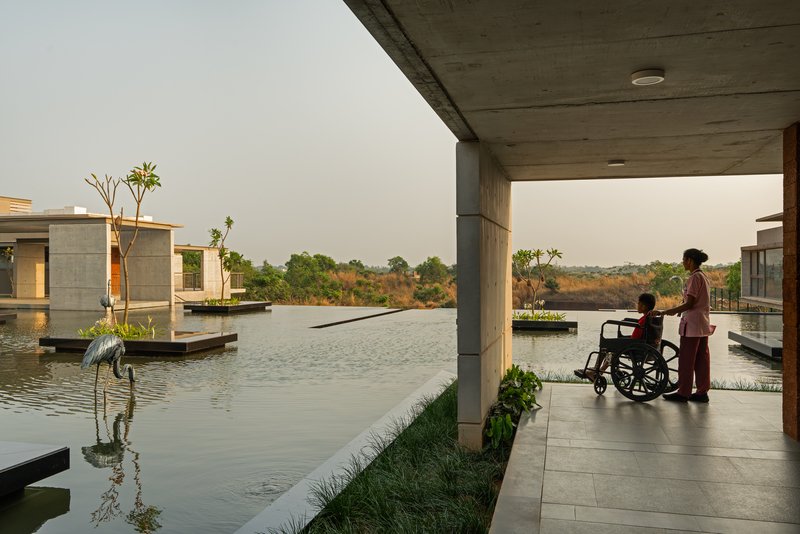
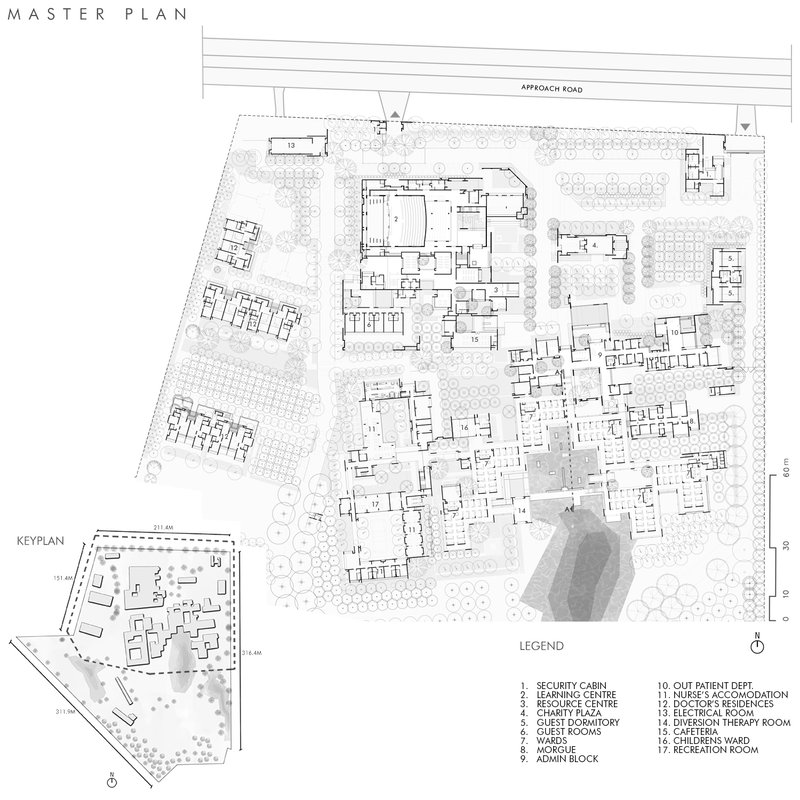
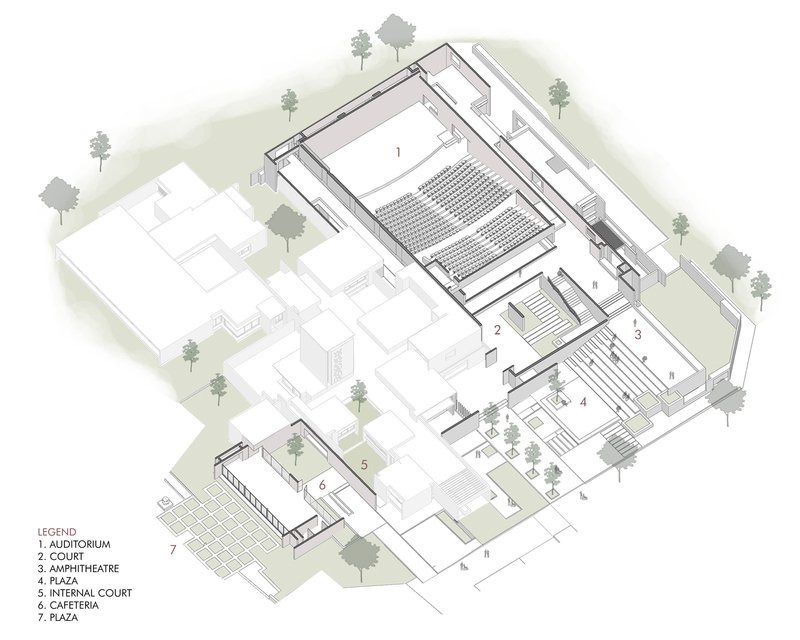
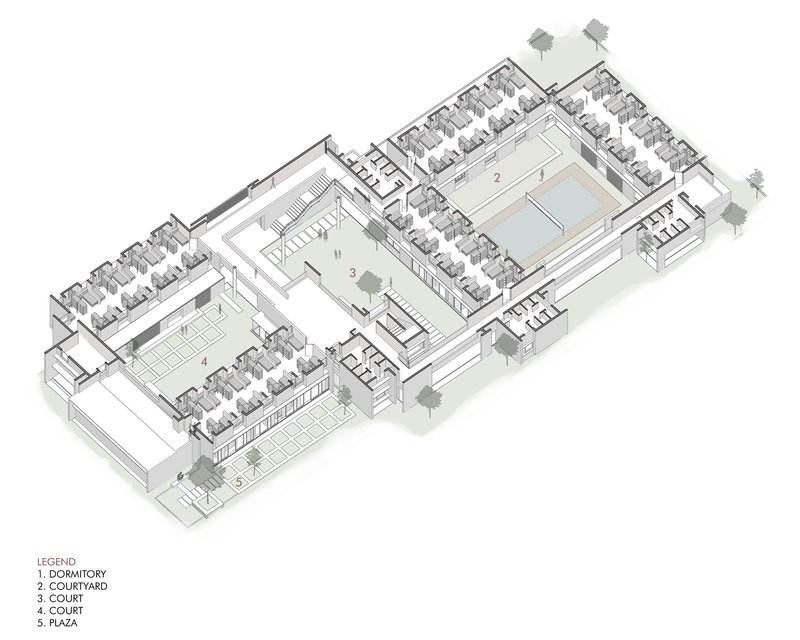
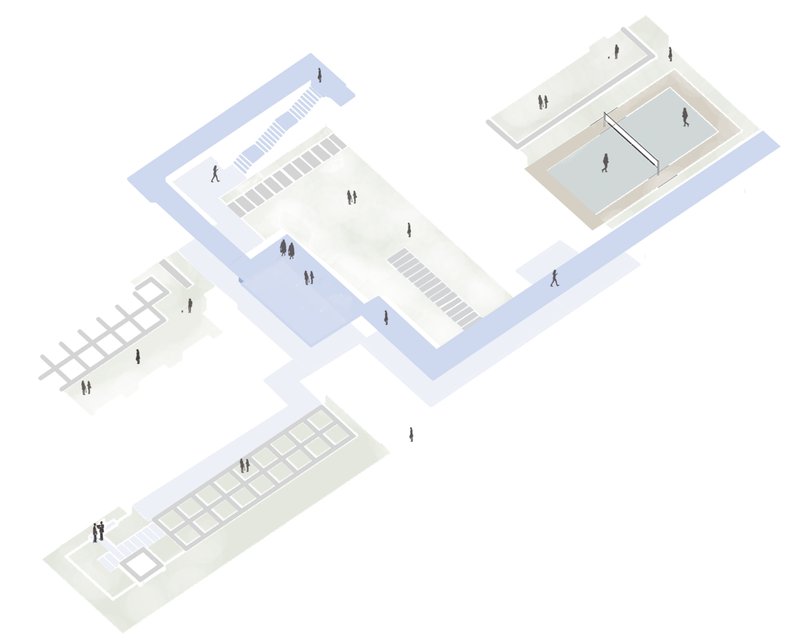
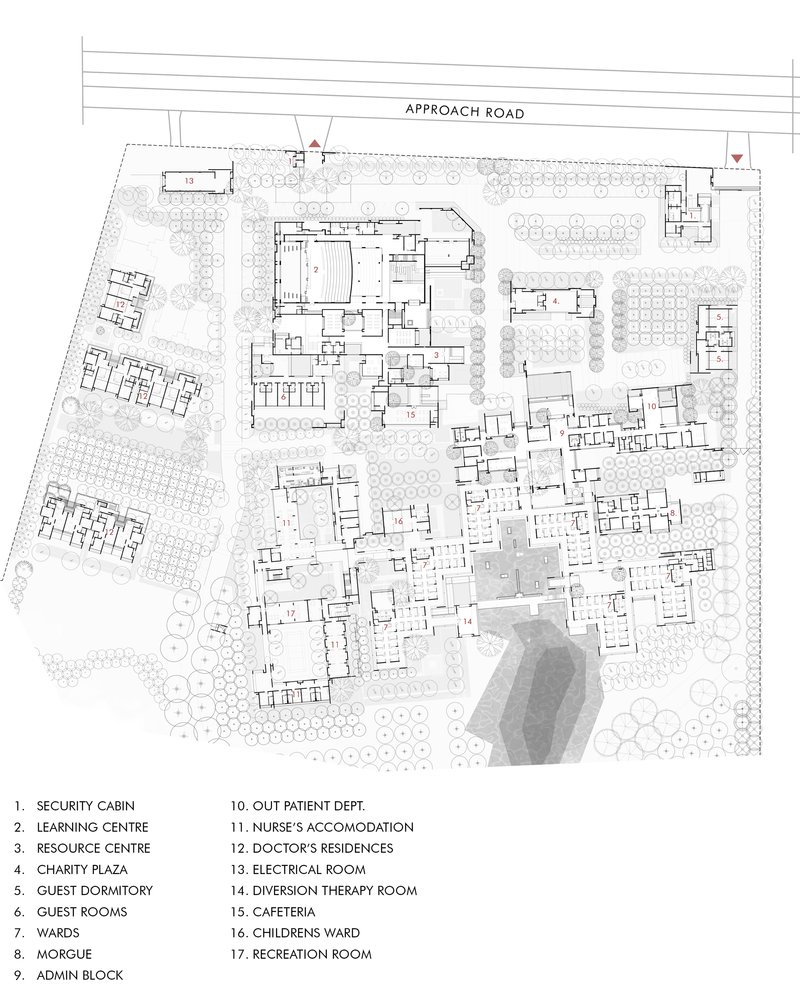
The plan breaks the programme into a network of low courtyards rather than stacking it into a single building. Each ward wing opens onto a small inner court. Service areas have their own courts. The public zones (auditorium, OPD, learning centre) are grouped around a larger outdoor plaza. This pattern keeps every room close to daylight and a piece of landscape, which is the single most important thing a palliative care environment can offer.
The courtyards are planted with native species, pavers of red sandstone cut the lawns into walking paths, and a few young trees anchor each space. There is nothing fussy or over-designed here. The plants will grow and the paths will wear. The courtyards are designed to get better over time, not to peak at the opening.
Perforated Walls and Veiled Light
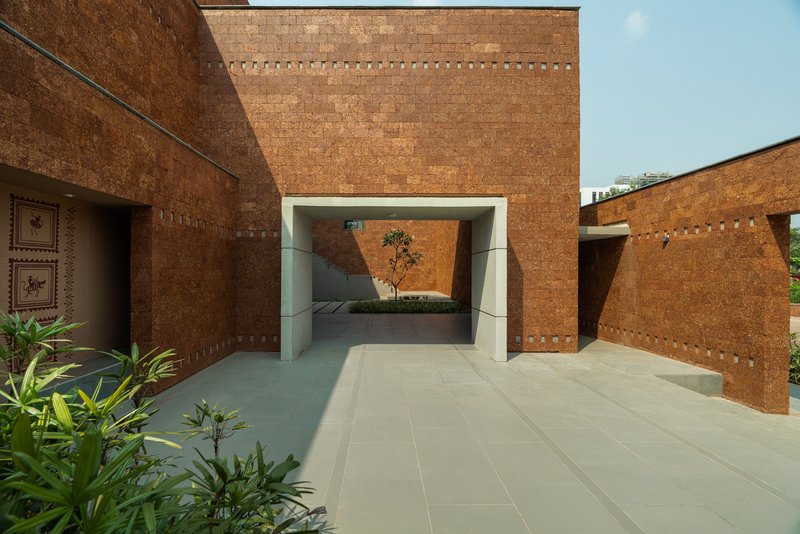
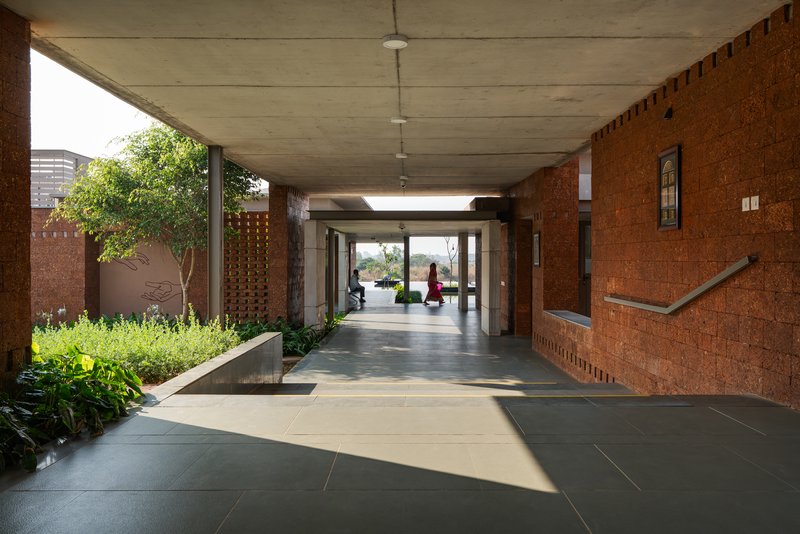
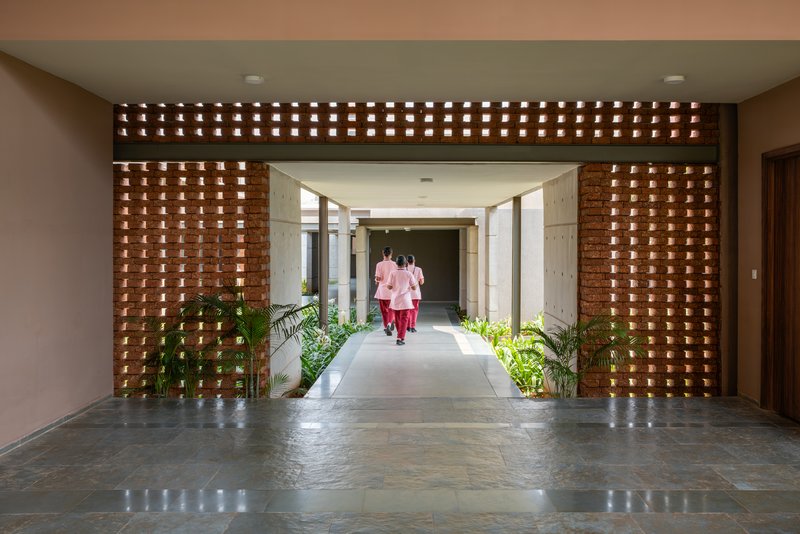
Between the laterite volumes, Mindspace inserts perforated jali walls and deep colonnades. The jali is a traditional South Asian screen element, made here from the same laterite blocks with regular gaps that let air and light through. Walking through them, you get a kind of veiled daylight that sits somewhere between inside and outside.
This is the device that makes the building work in the Odisha climate. Bhubaneswar is hot, humid, and monsoonal. A fully glazed hospice would be uncomfortable and expensive to cool. A fully enclosed one would feel like a warehouse. The jali, combined with the deep overhangs and shaded verandas, gives the building natural ventilation and filtered light without any of the usual mechanical workarounds.
The Auditorium and the Public Realm
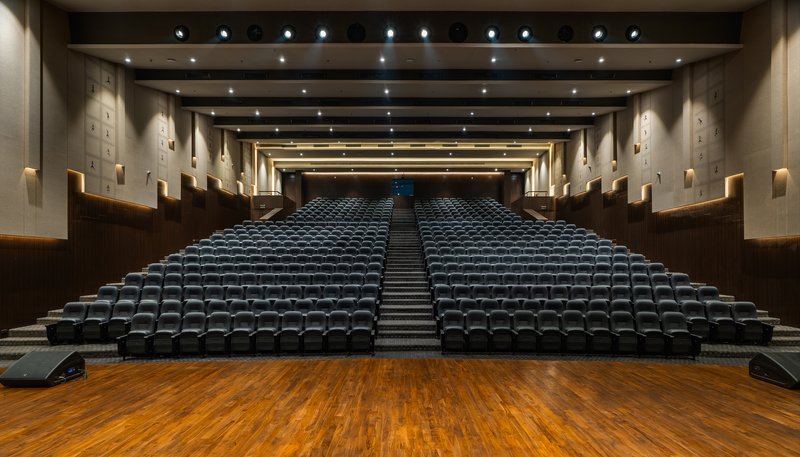
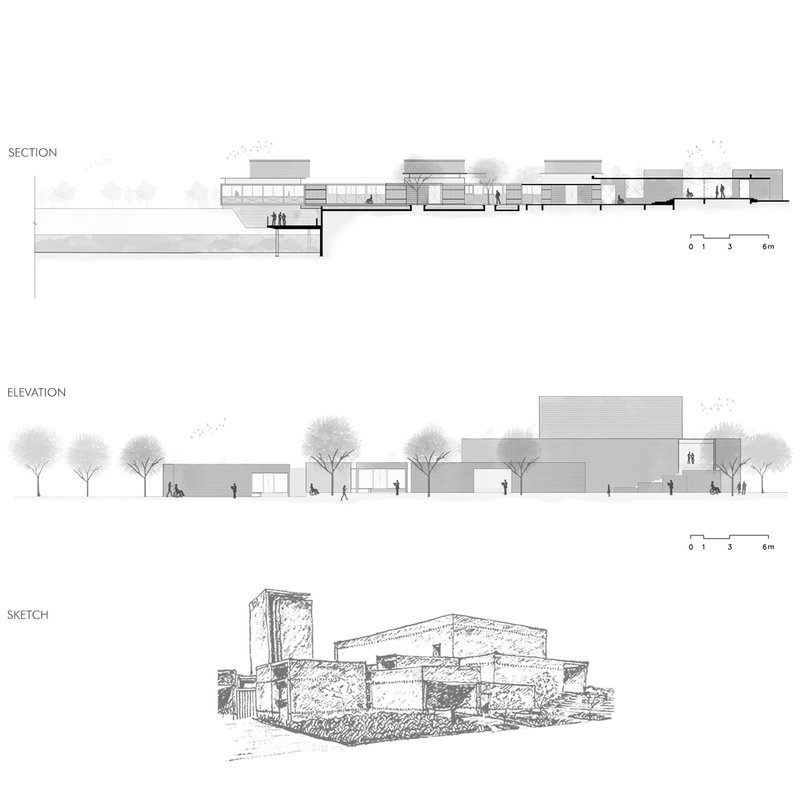
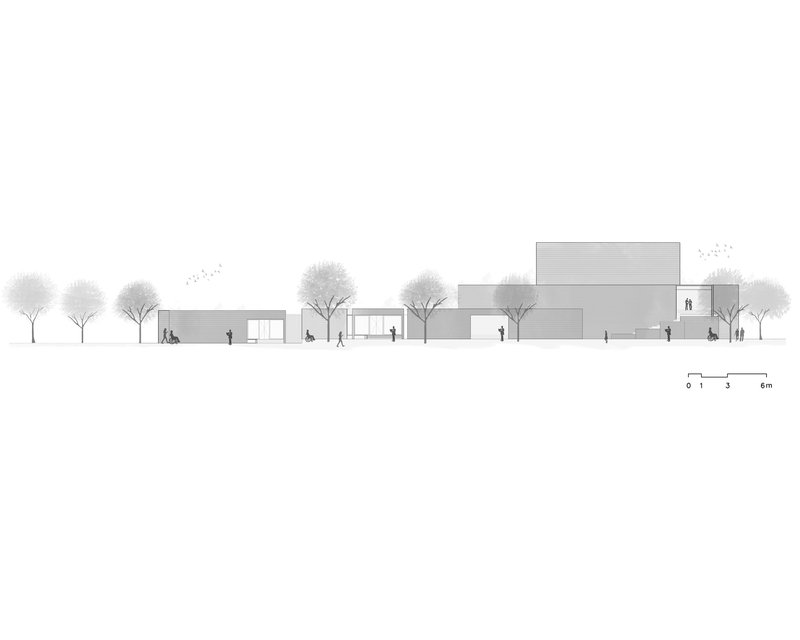
One end of the campus holds a large auditorium used for community events, lectures, and support gatherings. The interior is a calm dark room with tiered seating, a wood floor, and a coffered ceiling. The building wraps the auditorium in thick laterite walls, so from outside it reads as the largest solid mass in the complex. This is one of the project's clearer functional gestures: the public events happen in a contained, defensible volume, while the ward buildings stay quiet and open.
Landscape as Architecture
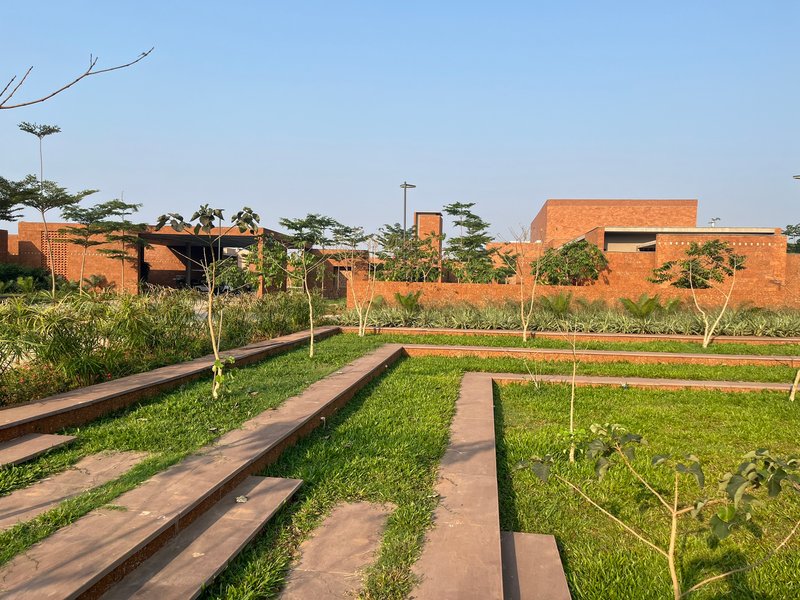
Landscape design by Design Milieu treats the site as a piece of restored land rather than a finished garden. The ground is shaped into gentle terraces, the planting is largely native, and the overall atmosphere is of a wild field slowly being domesticated. For a hospice, this is the right register. Patients and families walking the grounds are not looking at horticulture. They are looking at a piece of earth that feels alive.
The Design Thinking Behind It
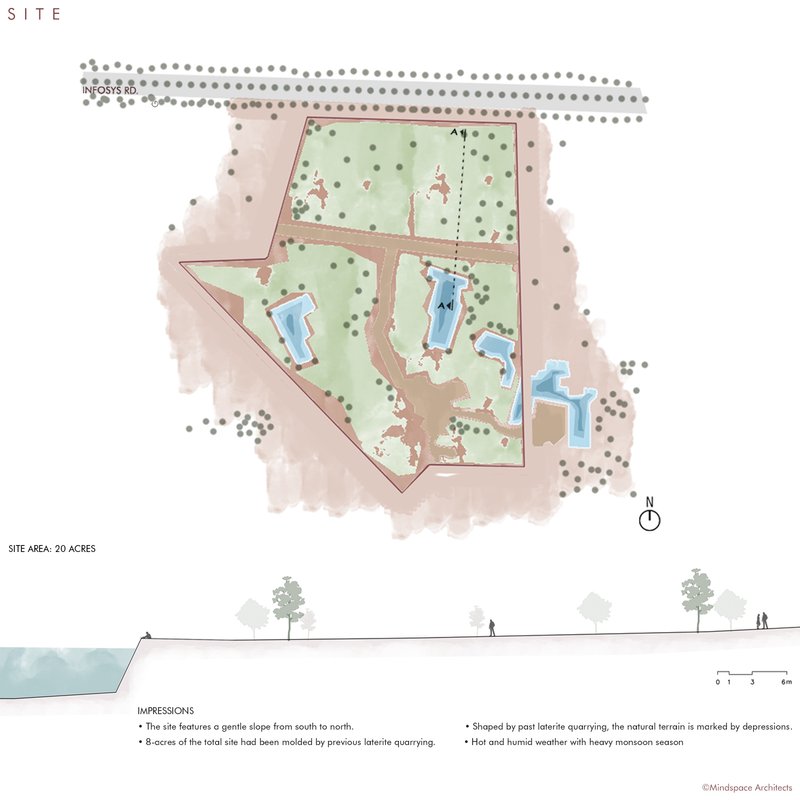
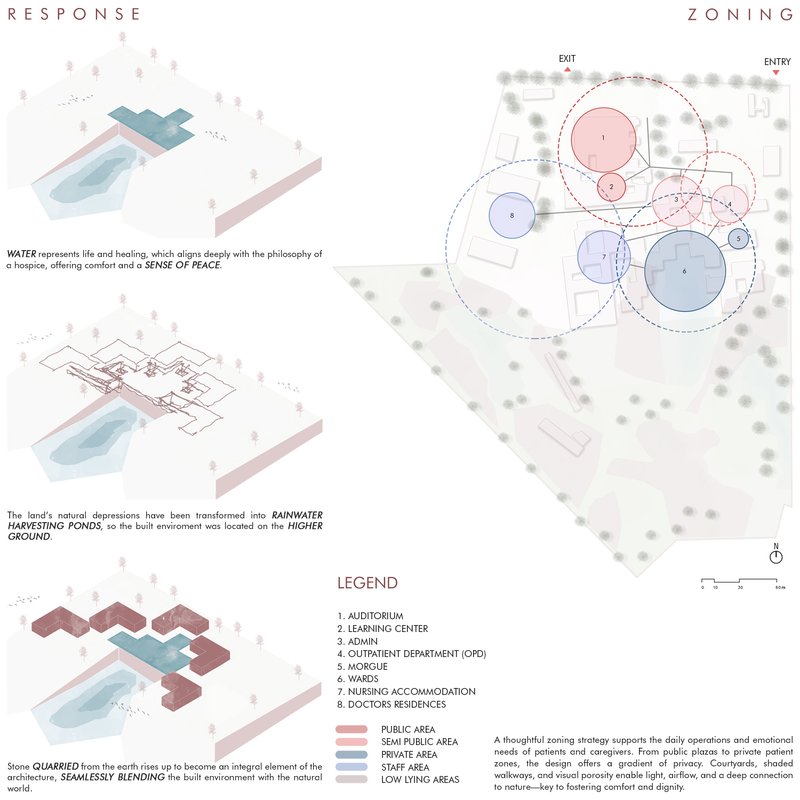
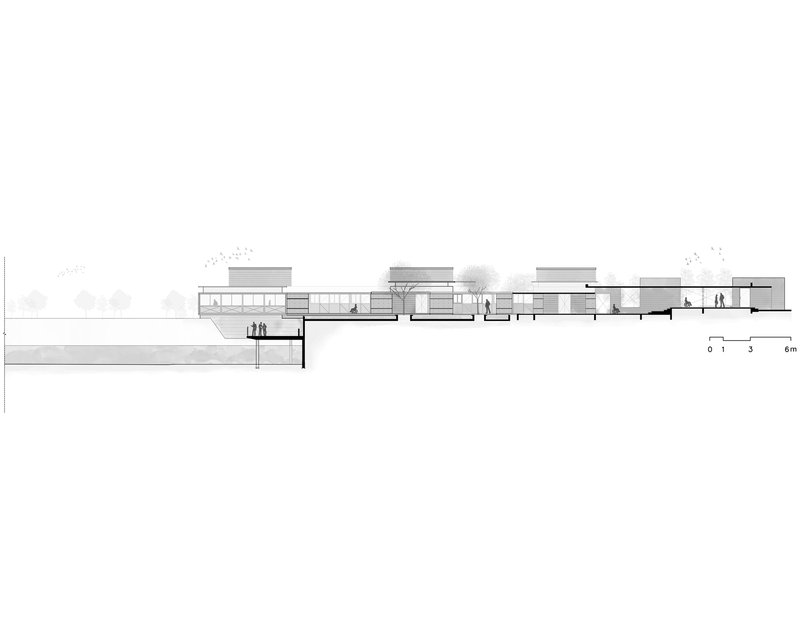
The project's design boards are unusually clear. The studio explains that the site had been shaped by historic laterite quarrying, leaving depressions that could be reused as rainwater harvesting ponds. Instead of flattening the ground, the architects set the building on the higher points and let the lower ones fill with water. The reflecting pools in the finished photographs are not decorative. They are the old quarry pits, turned into a landscape feature.
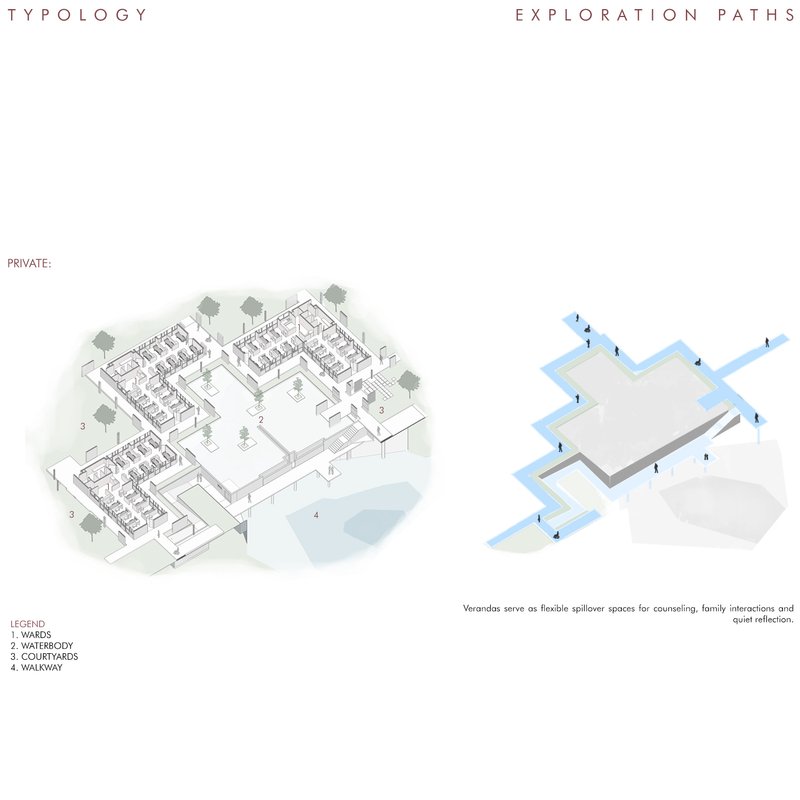
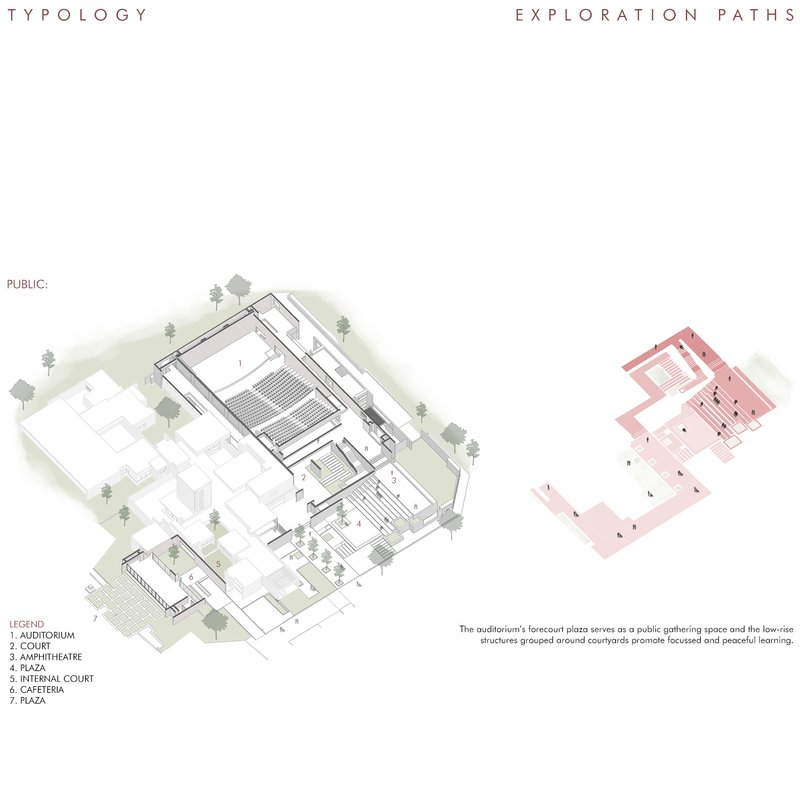
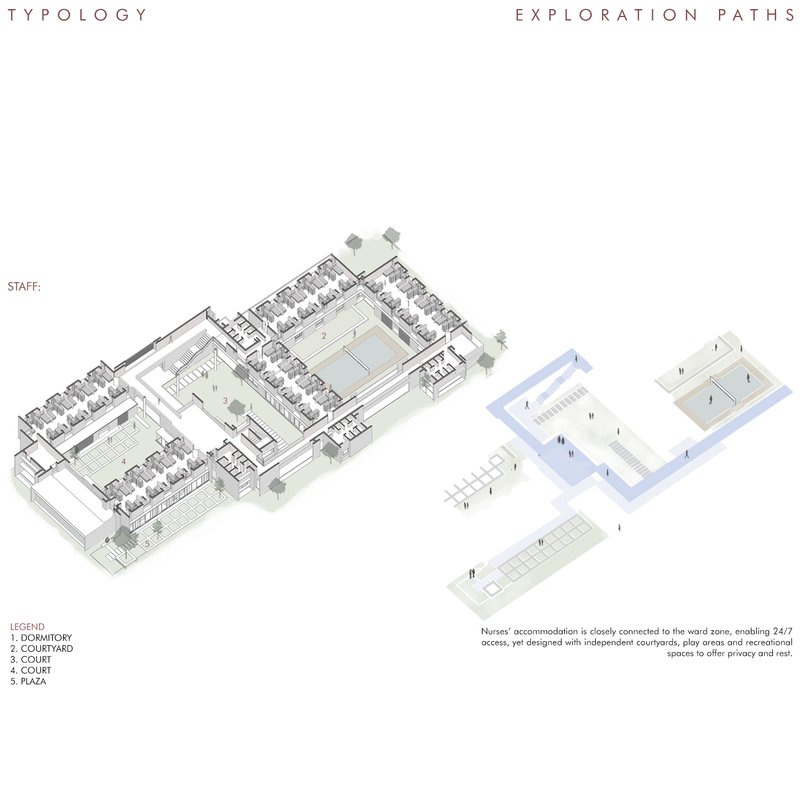
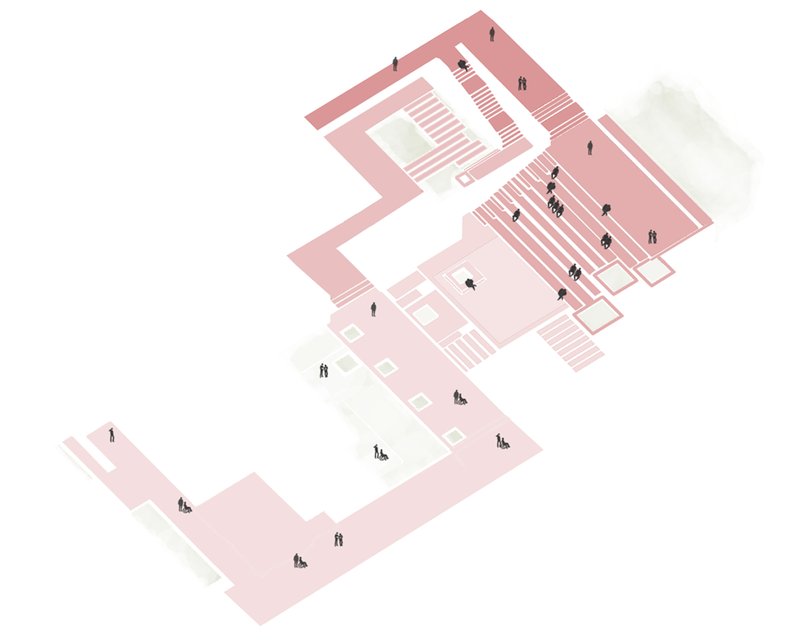
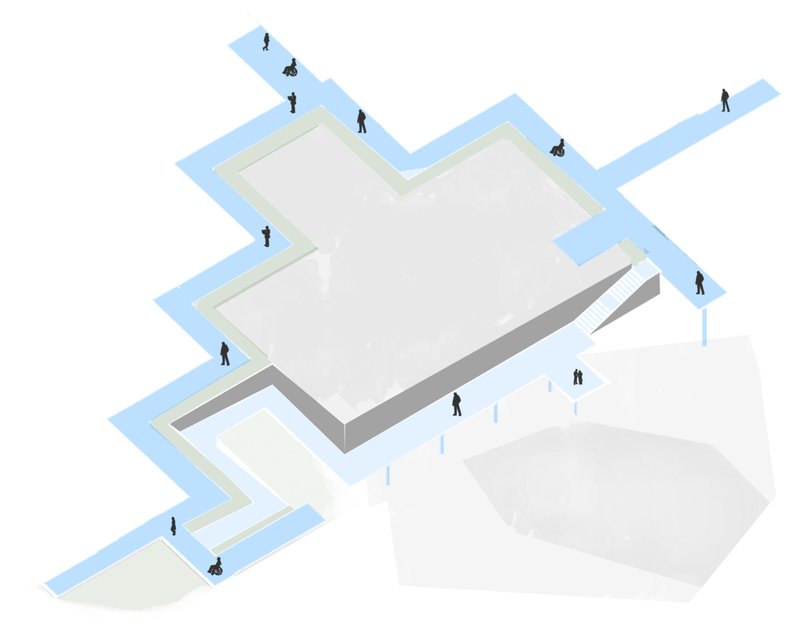
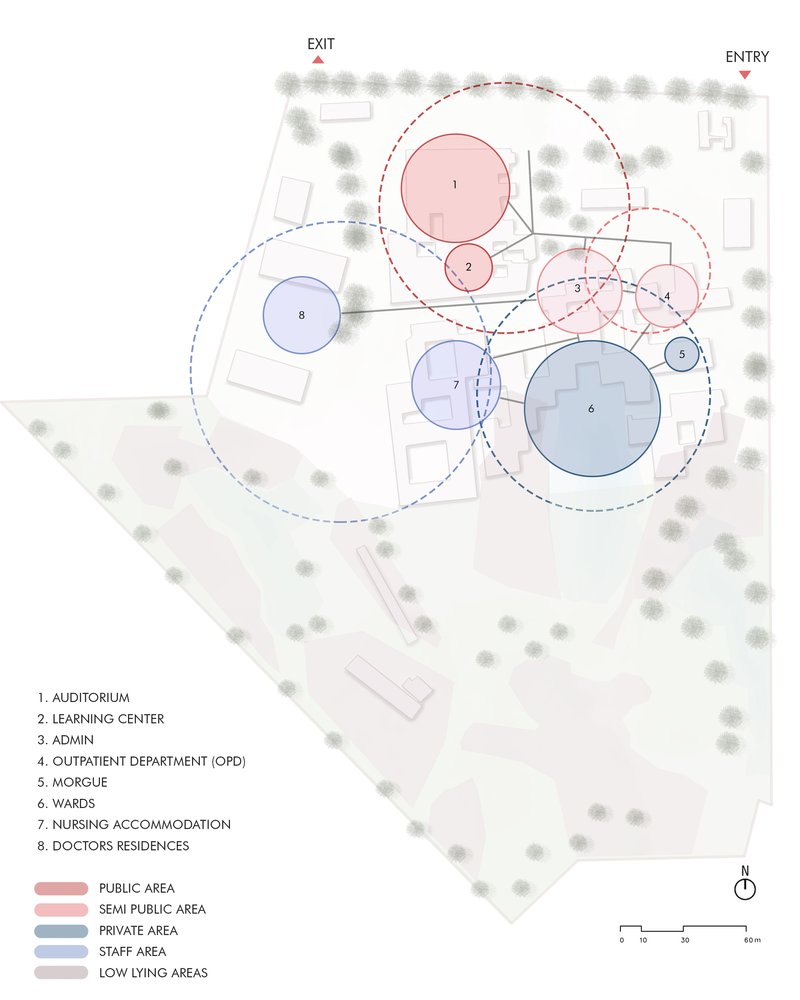
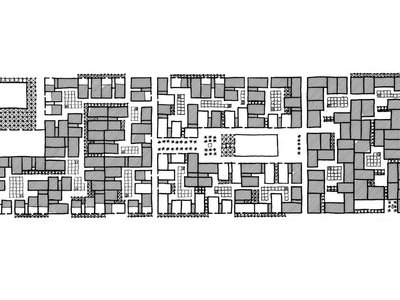
The zoning drawings separate the site into public (auditorium, learning centre, OPD), semi-public (admin), private (wards, nursing), and staff areas. Each zone has its own orientation, courtyard logic, and circulation. This is the clearest way to read the project: as three or four different architectural typologies stitched together by courtyards and water.
Individual Wards and Patient Rooms
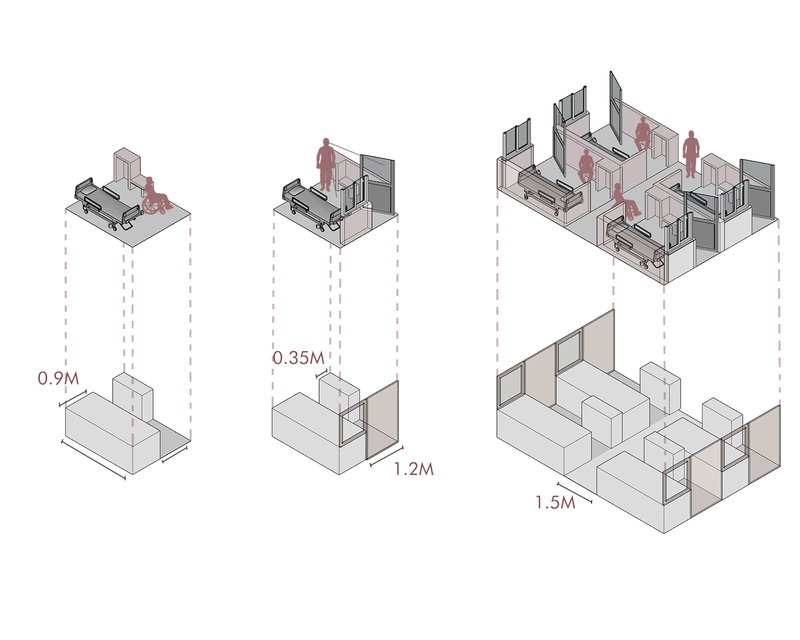
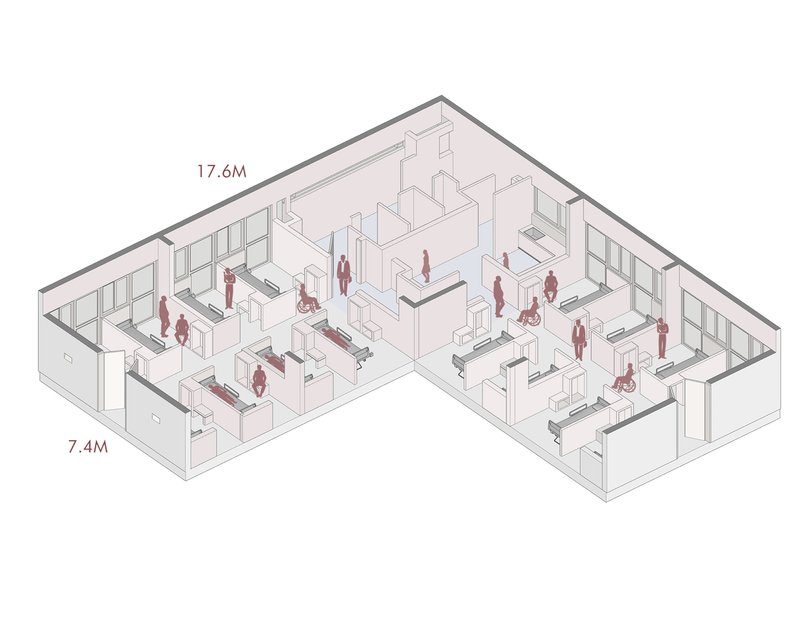
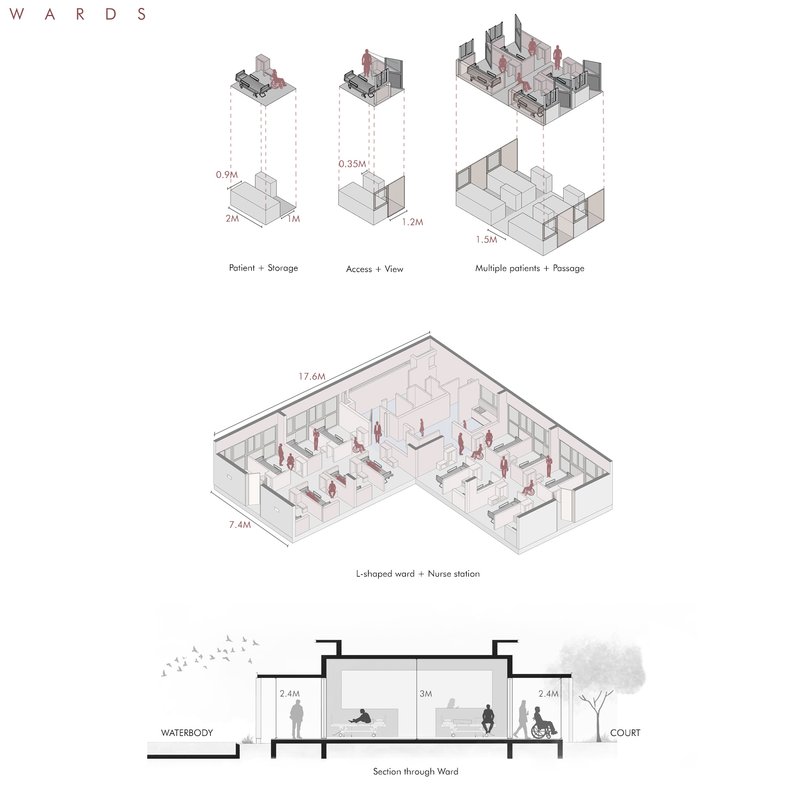
The patient room studies reveal the level of care in the brief. Each bed gets a storage zone, a window with a view of water or planting, and enough space for a family member to sit alongside. The L-shaped ward groups these rooms around a central nurse station, so staff can reach every bed quickly without walking past unrelated rooms. These are small moves, but they change how a patient experiences the day.
Isometric Views and Technical Drawings
Why This Project Matters
Healthcare architecture is where most of the industry's worst instincts come out. The pressure to meet regulatory compliance, the safety margins on every surface, the cost engineering on every finish, all combine to produce buildings that are indistinguishable from each other and uncomfortable for everyone inside them. Hospice architecture is even harder, because the brief is not about cure but about comfort, and comfort is not something most hospital codes know how to measure.
Bagchi Karunashraya is worth studying because it refuses the usual compromises. It is built from a local stone at a scale that matches the site. It organises the programme around water and courtyards rather than corridors. It uses shade and ventilation instead of glass and mechanical cooling. It provides free care. And it is designed with the assumption that a patient's last months should be spent in a place with a view, not a place with a nurses' call button on every wall.
The lessons are transferable to any healthcare project: build with local materials at local scale, put daylight and greenery in every patient room, let landscape do work that mechanical systems would otherwise do, and treat the outdoor spaces as important as the indoor ones. Mindspace has put together one of the clearer demonstrations of this approach, and the photographs by Shamanth Patil show why it is worth looking at carefully.
About the Studio
Share Your Own Work on uni.xyz
If you are working on healthcare architecture, adaptive landscape design, or public buildings, uni.xyz is a place to publish your work, find collaborators, and enter design competitions.
Project credits: Bagchi Karunashraya Palliative Care Center by Mindspace. Bhubaneswar, Odisha, India. 130,000 ft². Completed 2024. Lead architect: P. N. Medappa. Lead team: Febin Frederick. Design team: Sahana M, Shweta Chandran. Landscape: Design Milieu. Structural: Rays Consulting Engineers. MEP: Sampathkumar Associates. Photographs: Shamanth Patil.




Popular Articles
Popular articles from the community

gru.a Builds a 70 m² Timber Shelter That Opens Like a Farm Door in Brazil's Valley of the Vines
In the mountainous region near Rio de Janeiro, a compact retreat uses plywood panels and deep eaves to blur the line between inside and out.
BLDUS Turns a 250-Square-Foot Screened Porch into a Pine Forest Temple in East Hampton
A gabled cedar pavilion mimics the rhythm of surrounding pines, anchoring a 1990s wooded home to its hollow in Long Island.
Constanti Architects Builds a Fortress of Privacy in Nicosia with House 345
A concrete and timber residence in Cyprus reinterprets the traditional introverted courtyard house for a new urban landscape.
BAUEN Builds Two Rammed Earth Volumes in Paraguay Inspired by the Ovenbird's Nest
In San Bernardino, a house of compacted earth channels the instinct of a constructive bird to shelter life from the Paraguayan summer.


Similar Reads
You might also enjoy these articles

127af Flips a Tiny Bagnolet Rowhouse Upside Down with a Handcrafted Roof Extension
A 55-square-meter terraced house on the edge of Paris gains a luminous upper living floor through lightweight timber and steel.
1.61 Design Workshop Wraps a 600-Square-Meter Café in Vietnam in Sculptural Burgundy Drama
Reden Café & Bistro pairs a helical staircase, mosaic floors, and deep red interiors to rethink Vietnamese hospitality space.

The Unbound Brain: A School Shaped by Cognitive Architecture
Cylindrical learning pods radiate like neurons from a central cortex, turning the floor plan into a spatial model of human thought.
Revival Vernacular Architecture: Rammed Earth Settlements for the Sahara
A modular desert community in Mauritania that fuses passive cooling techniques with earthen construction and local craftsmanship.


Explore Public Building Competitions
Discover active competitions in this discipline




The Global Benchmark for Architecture Dissertation Awards


Challenge to design locus for the upliftment of human rights


Challenge to design a learning and healing center


Challenge to design public laboratory
Comments (0)
Please login or sign up to add comments
No comments yet. Be the first to comment!