

Balancing Dichotomy: Modular Prison Architecture Rethought for Cybercriminals
A shortlisted competition entry reimagines correctional facilities as modular ecosystems that rehabilitate cyber offenders through education and spatial op


What does a prison look like when the crime has no physical scene, no weapon, and no face? When the offender is non-violent, technically gifted, and defined more by isolation than aggression, the architecture of incarceration needs to abandon its inherited hostility. "Balancing Dichotomy" starts from this premise and arrives at something genuinely provocative: a correctional facility that treats cybercriminals not as bodies to contain but as intellects to redirect.
Designed by Suchet Dutta and Shivangi Chauhan, the project was shortlisted in the Switching Prisons competition. The brief challenged participants to rethink prison typologies for the present day, and this entry responds with a modular, porous architectural framework designed specifically for digital-age offenses. The result is a compound that replaces isolation with integration, punishment with empowerment, and the label of "criminal" with that of "expert."
From Incognito to Cognito: Mapping the Crime and Its Cure

The project opens with a sharp diagnostic. Cybercriminals exploit digital anonymity to counterfeit identities, operating in a space where traditional justice systems lag behind emerging technologies. The infographic diagram lays this out clearly, tracing the identity counterfeit process while also proposing victim empowerment strategies that fold into the facility's programme. Victims are not sidelined here; they are invited to cooperate with government and private firms within the compound's ecosystem, making the architecture a mediating ground between offender and offended.
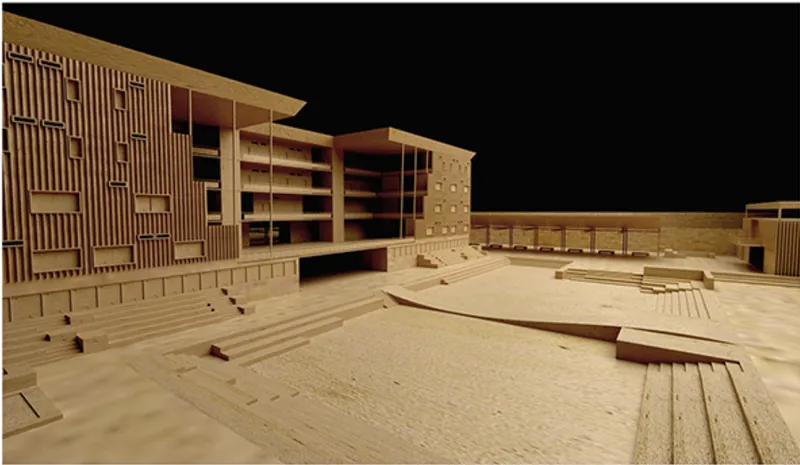
The physical model reveals the spatial language that emerges from this thinking. Stepped seating wraps around a courtyard, creating an amphitheatre condition that privileges visibility and social encounter over surveillance. Multi-story buildings with vertical screen facades allow light and air to penetrate while maintaining a degree of visual filtering. The intent is legible: openness without exposure, structure without confinement.
Activity Networks That Replace Corridors with Connections
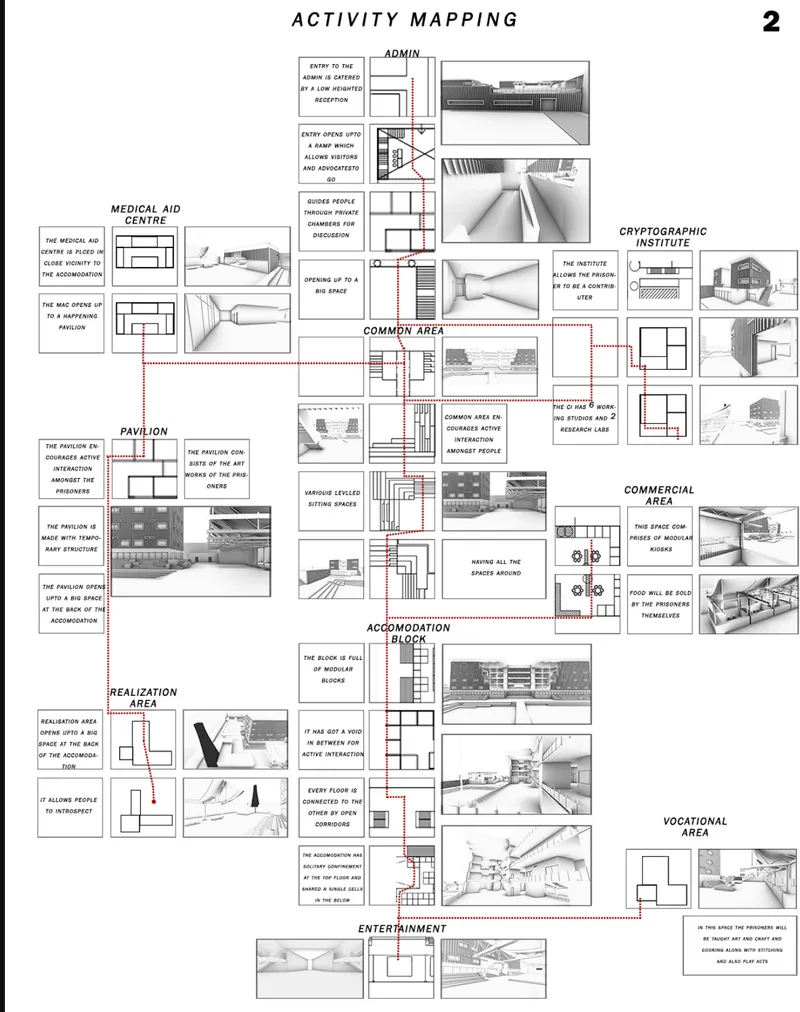
The activity mapping diagram is one of the project's strongest analytical tools. It charts spatial connections between programme areas, pairing plan drawings with perspective sketches to show how circulation is conceived as overlap rather than separation. The cryptography institute, accommodation blocks, community space, vocational centre, and realization area are all linked through a network that prioritizes engagement over containment. Research labs sit alongside working studios and education zones within the cryptography institute, where prisoners learn to identify vulnerabilities in secured systems under the guidance of cybersecurity experts.
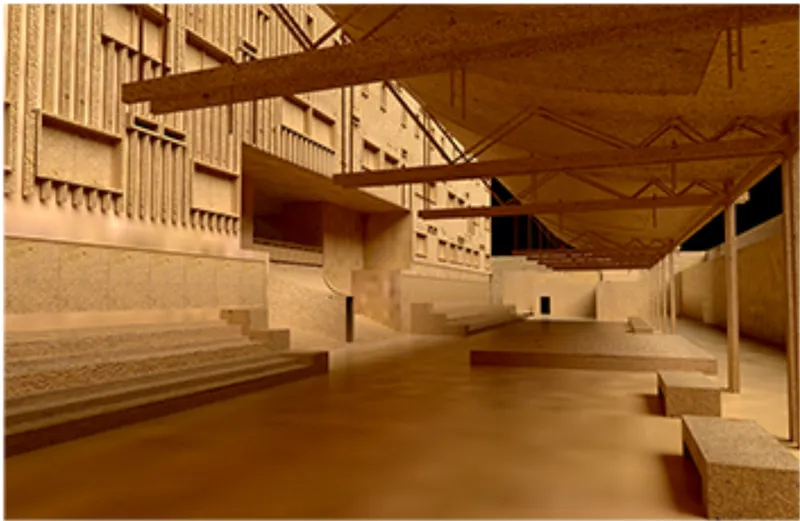
The model interior reinforces this reading. A multi-level gathering space opens up vertically beneath an exposed truss ceiling, with patterned facade walls introducing texture and rhythm without enclosure. Shared corridors and voids between accommodation floors encourage cross-floor interaction, directly countering the isolation that typically characterizes both the crime and the conventional prison response to it.
Courtyards, Colonnades, and the Porosity of Reform

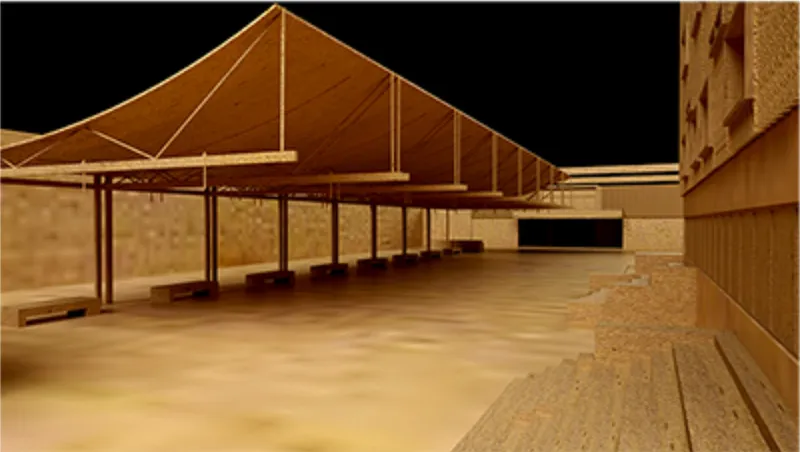
Two model views reveal the tectonic character of the compound. A courtyard organized around a cylindrical chimney element and covered walkway under a tensile canopy creates a threshold between indoor programme and outdoor communal life. The chimney acts as a vertical anchor, pulling the eye upward and marking a point of orientation within the otherwise horizontally distributed plan. Nearby, a covered colonnade with tensile fabric roof meets a stepped concrete retaining wall, grounding the lighter canopy structure against a heavier mass that manages the terrain.
The material palette across these elements is restrained but deliberate: concrete for permanence and legibility, tensile fabric for lightness and adaptability. The modular blocks that compose the residential and institutional programme are designed to be replicable and scalable, meaning the facility can grow or reconfigure over time without demolition. Porosity is not just a visual quality here; it is an operational strategy, ensuring that the perimeter remains secure while the interior remains non-restrictive.
A Compound That Cycles from Entry to Reintegration
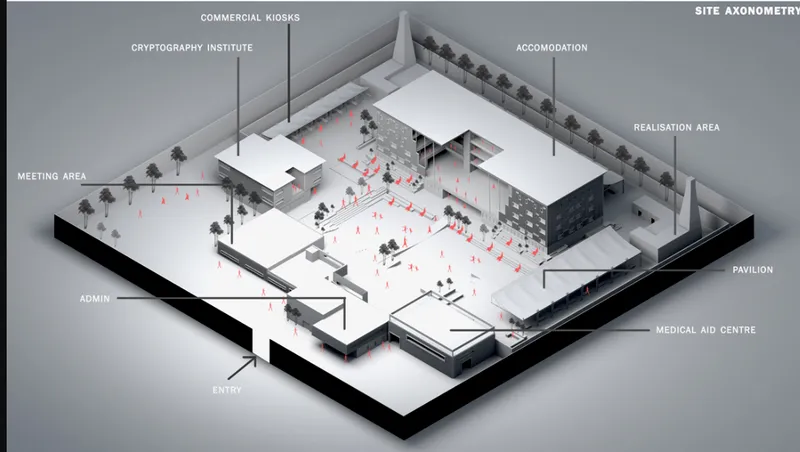
The axonometric drawing pulls the full programme into a single legible view. Labeled zones including commercial kiosks, accommodation blocks, a pavilion, and a medical aid centre are distributed across the compound in a sequence that supports a complete rehabilitation cycle: entry, education, interaction, and reintegration. The realization area and pavilion serve creative expression and community exchange, while the medical aid centre addresses well-being within the secure perimeter. The inclusion of commercial kiosks is a notable detail, suggesting that the facility anticipates economic participation as part of the reform process, not just an outcome of it.
Four architectural strategies hold the compound together: the Cryptography Institute for education and national security contributions, active interaction zones for social engagement, modular and porous residing spaces for adaptable living, and optimised punitive measures that replace punitive labeling with professional identity. The word "expert" replaces "culprit." That linguistic shift is mirrored in every spatial decision.
Why This Project Matters
"Balancing Dichotomy" makes a simple but powerful argument: the architecture of incarceration should be shaped by the nature of the crime it addresses. Cybercrime is non-violent, intellectually driven, and rooted in digital anonymity. The prison designed for it, therefore, should be open rather than closed, educational rather than isolating, and modular rather than monolithic. Dutta and Chauhan demonstrate that this is not idealism but pragmatism, because redirecting technical skill toward cybersecurity and community contribution produces more public value than warehousing it behind walls.
As correctional architecture continues to grapple with its own legacy of dehumanization, projects like this point toward a more literate and responsive future. The modular framework is scalable. The programme is specific. And the spatial language, built on porosity, visibility, and shared ground, offers a credible counter-model to the punitive environments that dominate the field. In a competition asking designers to switch the logic of prisons, this entry does exactly that.
View the Full Project
About the Designers
Designers: Suchet Dutta, Shivangi Chauhan
Enter a Design Competition on uni.xyz
uni.xyz runs architecture and design competitions year-round that reward proposals with spatial conviction and real site intelligence.
Project credits: Balancing Dichotomy by Suchet Dutta, Shivangi Chauhan Switching Prisons (uni.xyz).


Popular Articles
Popular articles from the community


Manzana Morphosis: Stretching Barcelona's Grid into a Living Landscape for 2050
A radical reworking of the Eixample manzana turns density into a tool for generous public space, vertical ecology, and environmental performance.

Singing Woman: An Opera House That Performs Before the Curtain Rises
Ovidiu Cristian Pavel's conceptual opera house translates Estonia's choral identity into a sculpted waterfront landmark facing the Baltic Sea.
Faces of the Soviet Avant-Garde: Turning Moscow's Street Names into an Open-Air Museum
A network of sculptural installations across a Moscow residential district transforms forgotten architect names into spatial encounters with cultural memor

Extended Shell: Retrofitting Kolkata's Balconies as Living Urban Thresholds
A modular retrofit system recovers the social and environmental intelligence of Kolkata's historic verandas for contemporary Park Street residents.

Similar Reads
You might also enjoy these articles

Shakur's House: Exposed Brick as an Interior Organiser in a 168 m² Mashhad Residence
Brick moves indoors in this Mashhad residence, where masonry walls, glass partitions and teal planes sequence a compact home without closing it off.

Day and Night Park: A Time-Based Urban Newsstand in Beijing
A temporary urban newsstand in Beijing blending travel, light, and reading through poetic colors, compact form, and community-focused design.

Modernist Patio Renovation in El Masnou, Barcelona by Oliver Segura Arquitectura + Cebrià Arquitectura
Modernist patio renovation blending tradition and innovation with a movable pool, leveled floors, and Catalan materials in El Masnou.

Alto Residencial Coop: Cooperative Housing Development in Santiago de Compostela by Carbajo Barrios Arquitectos
A linear cooperative housing complex blending white volumes and perforated metal façades, enhancing community living, natural light, privacy, and urban integration.


Comments (0)
Please login or sign up to add comments
No comments yet. Be the first to comment!