

Ballistic Architecture Machine Disguises a Shanghai Waste-to-Energy Plant as a Public Park
The Baoshan Waste-to-Energy Center buries 128,000 square meters of industrial infrastructure beneath landscaped rooftops and museum galleries in Shanghai.


Waste incineration plants rank among the most unwanted neighbors in any city. They smell, they loom, and they carry the symbolic weight of everything a society throws away. In Shanghai's Baoshan district, Ballistic Architecture Machine (BAM) has spent years developing an alternative proposition: a 128,000 square meter waste-to-energy facility that doubles as a public park, an environmental education center, and, in its most striking move, a landscape you might actually choose to visit. Led by Daniel Gass and Jake Walker, the design buries the heavy operational machinery under a topography of terraced green roofs while pushing a cluster of faceted, pyramidal towers skyward as landmarks rather than liabilities.
What makes the project genuinely interesting is not just the camouflage. Plenty of infrastructure projects dress up in green cladding and call it a day. BAM's scheme is more structurally committed. The building's section is organized so that the public literally occupies the roof of the industrial process below, walking through gardens and galleries while waste is being processed underneath. The architecture doesn't hide the function; it choreographs your encounter with it, revealing cranes and furnaces through glass partitions and turning the entire energy cycle into a museum narrative. Completed in 2025, this is one of the most ambitious attempts anywhere to reconcile heavy industry with civic life.
Industrial Scale, Civic Ambition


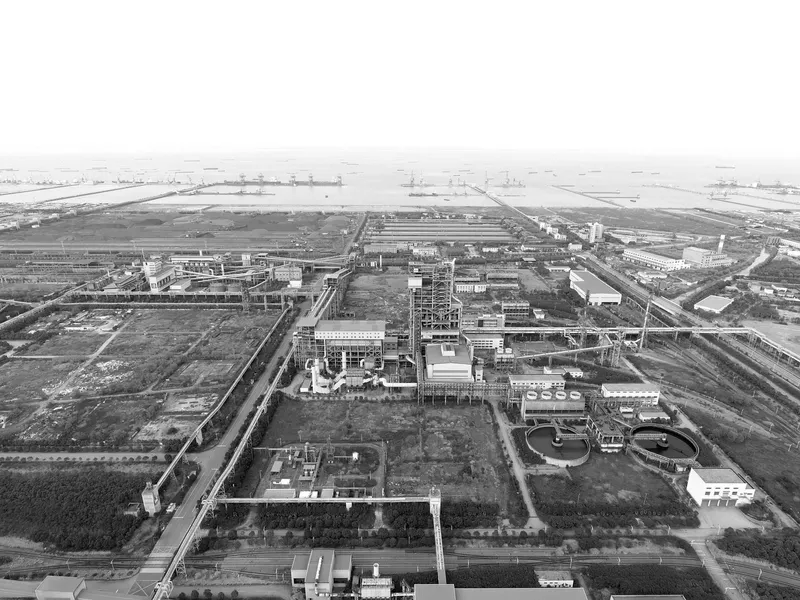
From the air, the scale of the complex is immediately legible. The horizontal base stretches across the site like a vast plinth, its perforated white metal facades creating a unified surface that reads more as a cultural campus than an energy facility. Against the backdrop of Baoshan's container port infrastructure, the building holds its own, neither mimicking industrial neighbors nor pretending they don't exist.
The faceted towers cluster at varying heights, their tapered profiles breaking the roofline into a silhouette that shifts depending on your vantage point. From a distance, the undulating roof and white cladding give the complex a geological quality, as if someone had pushed the ground upward and let it crystallize. It is a deliberate inversion: the dirtiest program in the municipal portfolio gets the most sculptural envelope.
A Facade That Breathes and Pixelates
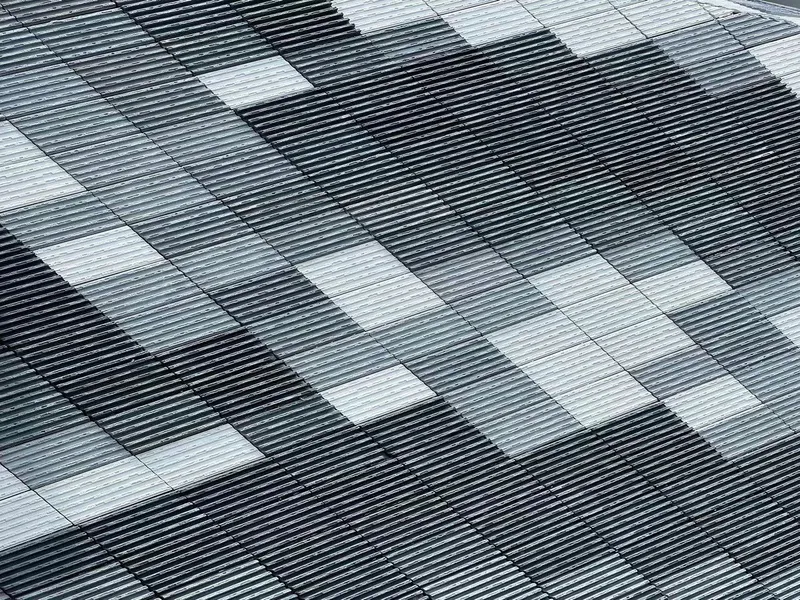
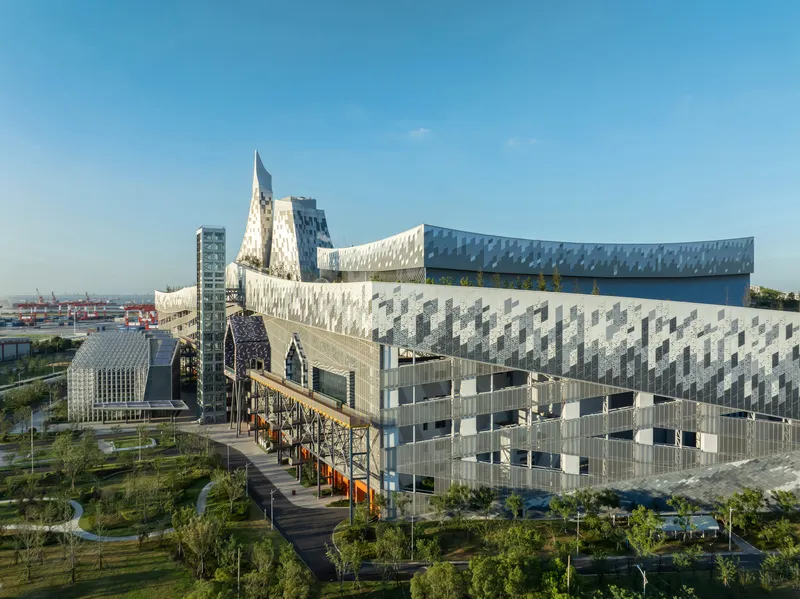

BAM's facade strategy deserves close attention. The cladding system uses horizontal metal louvers interspersed with scattered white panels in a pixelated pattern that serves both ventilation and visual effect. The louvered zones allow air to move through the building's enormous mechanical volumes, while the solid panels create a dappled, shifting surface that resists the monotony typical of industrial enclosures.
At ground level, the design introduces a more human register. Preserved brick arches appear at the base of the glass and steel structure, anchoring the new construction to traces of the site's previous industrial life. Young trees push up around the foundations, and the overall impression is one of careful layering rather than total erasure. The architecture acknowledges that industrial sites carry memory, and it puts that memory to work.
Roofscape as Public Ground
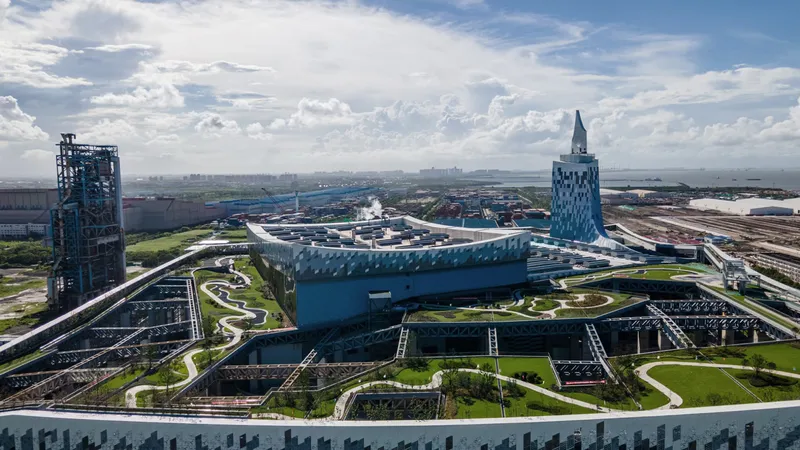


The project's defining section move is the creation of an inhabited roofscape. Landscaped gardens and pathways wind between the tapered towers, offering elevated views of the surrounding district. A pedestrian bridge connects the park-level circulation to the surrounding neighborhood, so that the building functions as a piece of urban infrastructure, not just a destination.
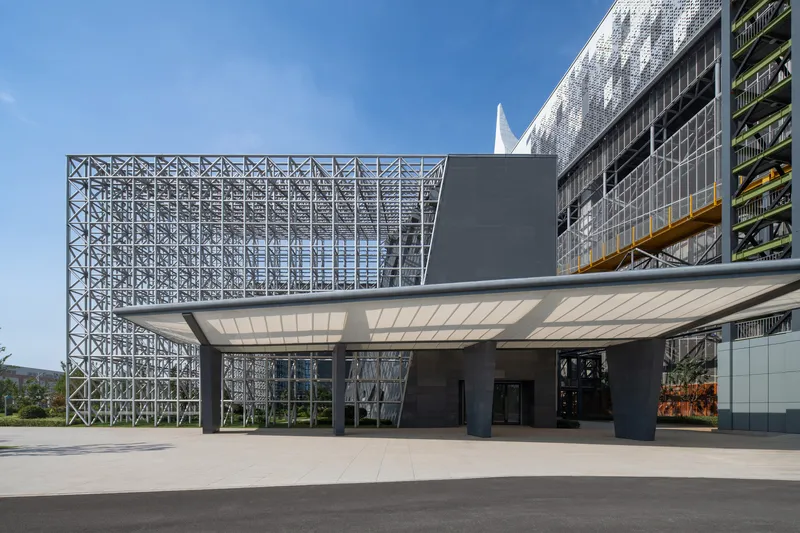
At the entry, a cantilevered canopy with a chevron-patterned soffit provides shelter while announcing the transition from lawn to interior. The generous use of glass at the podium level keeps the boundary between inside and outside ambiguous. You're walking through a park, then suddenly you're inside an atrium, looking up through steel trusses to the pyramidal volumes above. That spatial continuity is the project's strongest argument for why waste infrastructure and public life don't have to be mutually exclusive.
The Museum Inside the Machine

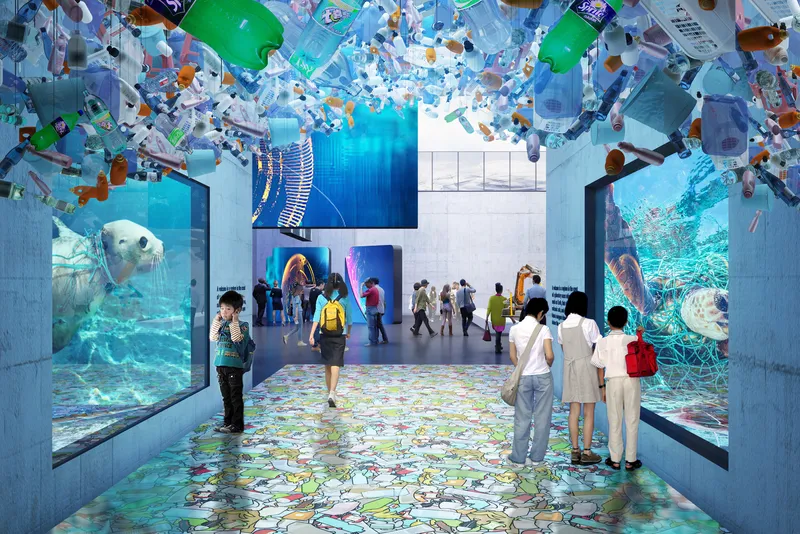
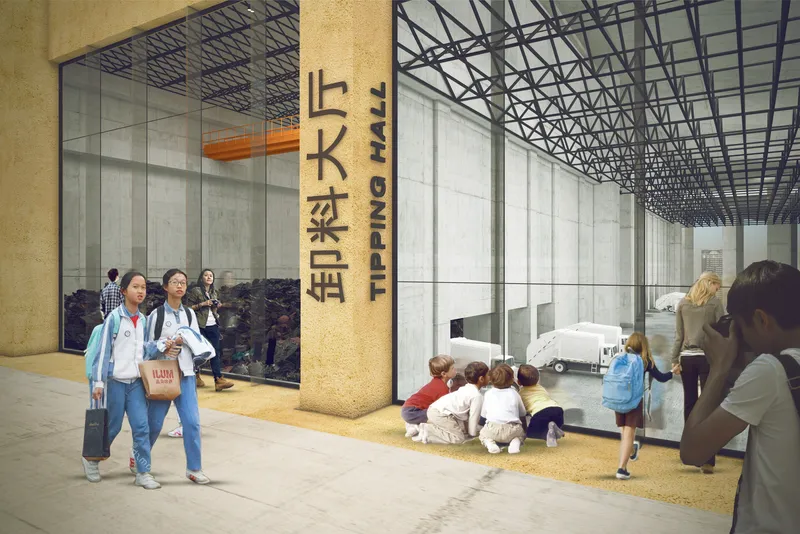
BAM has embedded a full-scale environmental museum within the facility, and this is where the design gets genuinely provocative. One gallery suspends a whale skeleton beside a vertical green wall, turning marine ecology into a spatial experience rather than a placard. Another corridor features aquarium windows alongside a suspended installation of plastic debris, confronting visitors with the material consequences of consumption in a setting that is equal parts beauty and accusation.
The exhibition spaces benefit from the building's industrial DNA. Exposed truss ceilings and glass display walls give the interiors a rawness that would feel forced in a conventional museum but here simply reflects the structural reality overhead. Visitors gather near the exhibits in spaces that feel honest about what they are: rooms carved out of a working power plant.
Confronting the Process

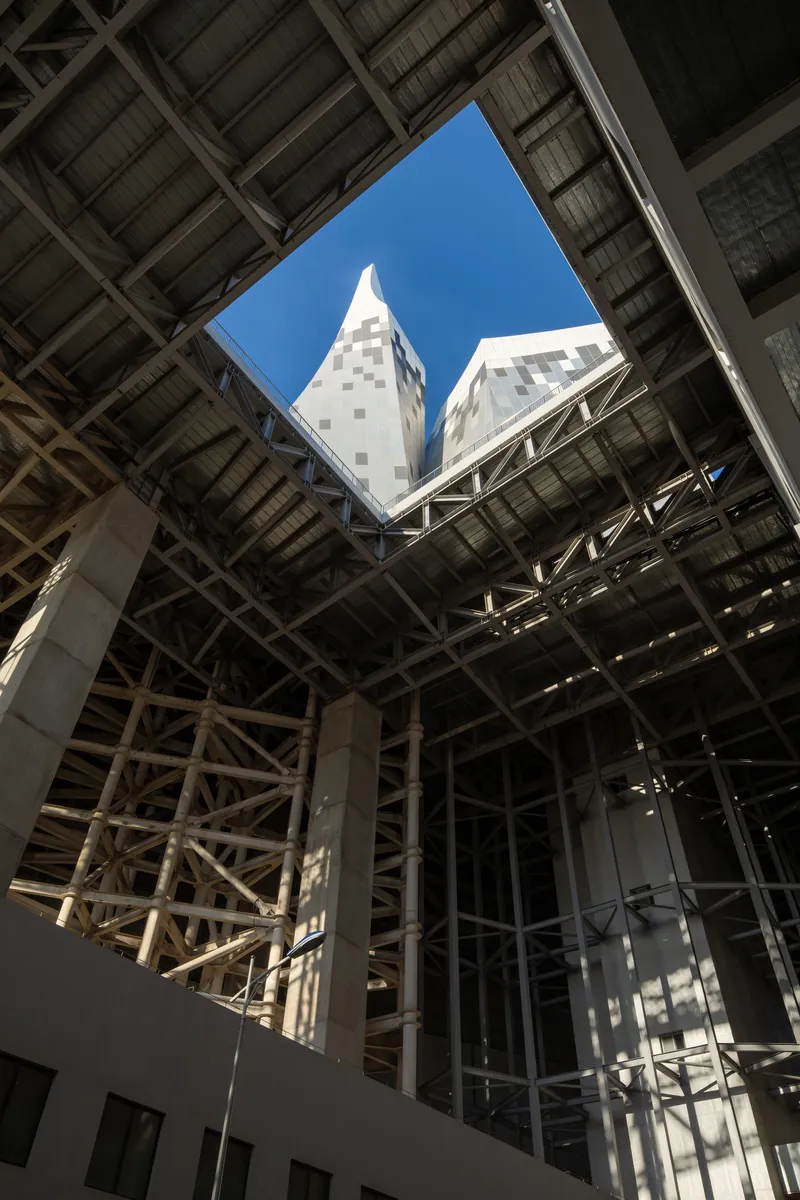
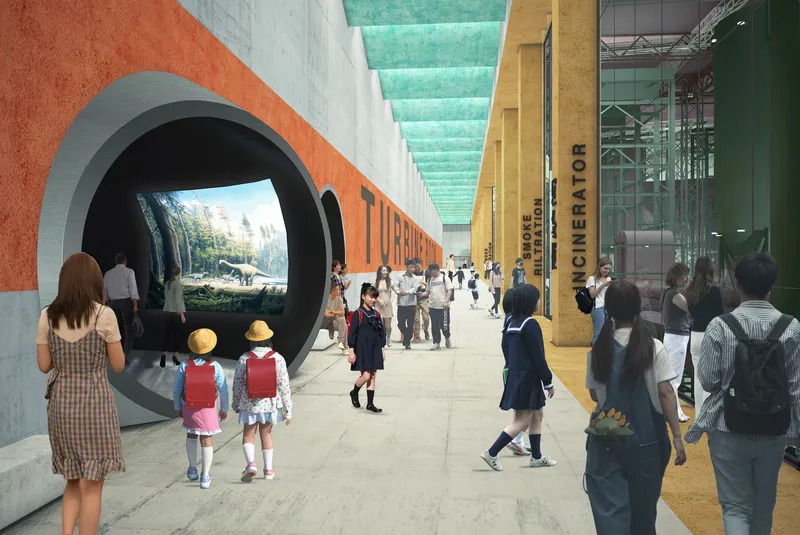
The most compelling interior moment comes when the architecture peels back its civic skin and lets you see the machine. A concrete interior with exposed structural trusses opens through a glass partition to reveal crane operations beyond. You are standing in a museum corridor, watching a mechanical claw sort waste in real time. It is a confrontation that most waste facilities would never permit and most architects would never propose.
Elsewhere, the building uses color and material to modulate the experience. An orange-textured wall lines a pedestrian corridor that terminates in a circular portal opening onto a garden. The journey from industrial observation to green refuge happens within a few steps. BAM treats the building's programmatic contradictions not as problems to solve but as sequences to orchestrate, and the interior circulation is richer for it.
Night Identity
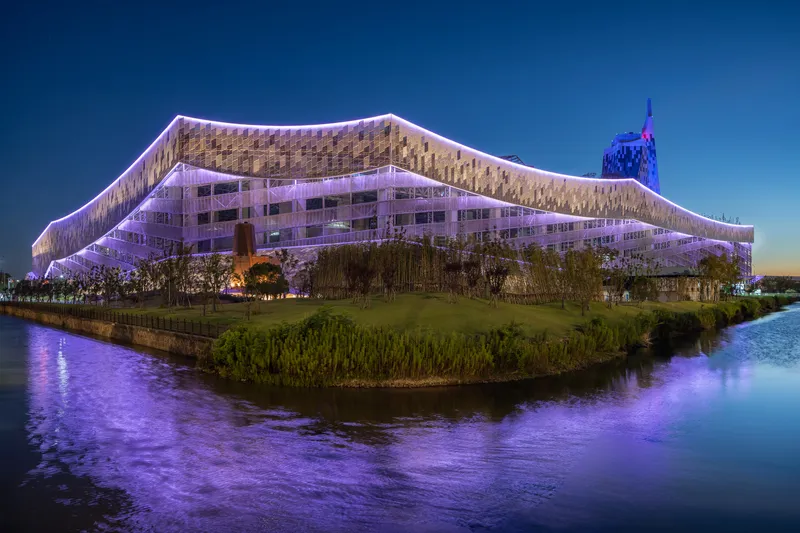
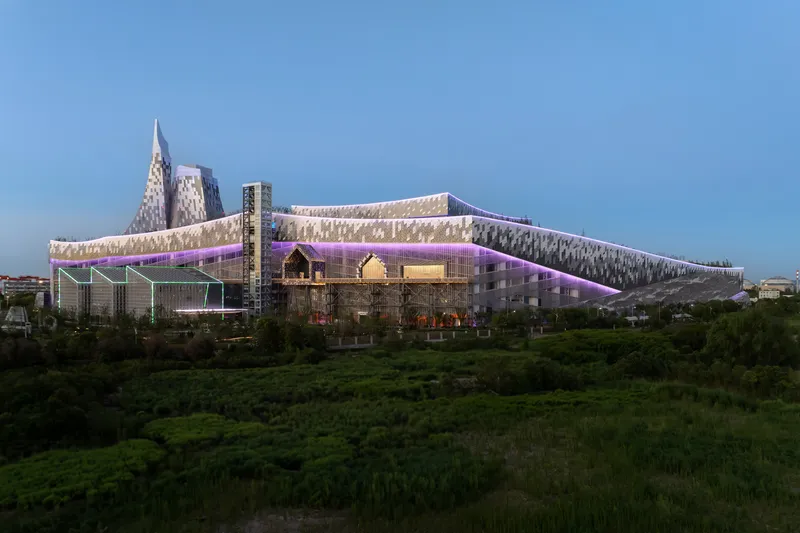

After dark, the building acquires a second life. Purple accent lighting transforms the perforated facade into a glowing lantern, its undulating surface reflected in the adjacent waterway. The pixelated tower shifts to blue, rising above the terraced volumes like a signal beacon. The lighting scheme is theatrical without being garish, and it solves a real problem: making an industrial facility feel safe and inviting after hours, when the park above might otherwise feel desolate.
The dusk views also reveal how the facade perforations work in reverse. During the day, the louvered panels modulate daylight and airflow. At night, internal illumination bleeds through the openings, turning the functional ventilation pattern into an ornamental surface. It's a double reading that the architects clearly anticipated and executed with precision.
Plans and Drawings


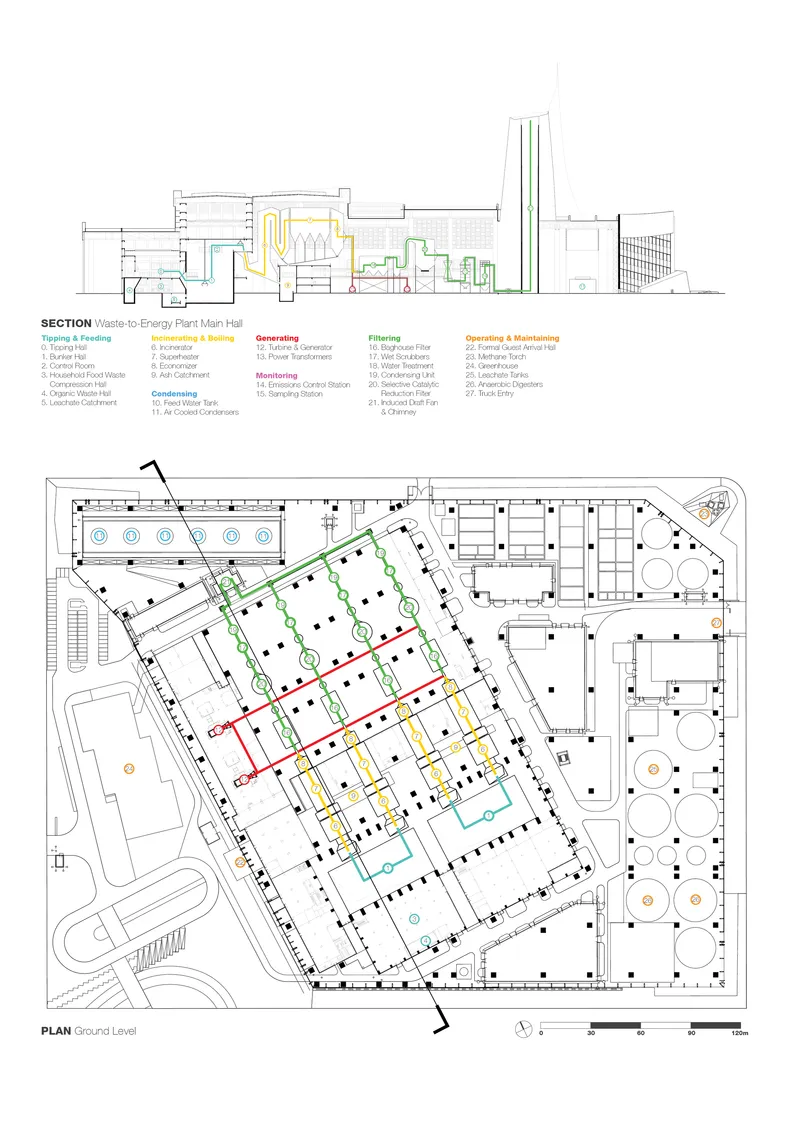

The section and plan drawings confirm what the photographs suggest: the building's functional zones are organized in a strict vertical hierarchy, with waste processing at the base, energy generation in the middle, and public program on top. Color-coded diagrams make legible the stacking of incineration halls, turbine rooms, flue gas treatment systems, and the museum galleries that sit above all of it. The conceptual diagram showing the site's transformation from flat industrial ground to an elevated corner with integrated programs is perhaps the clearest distillation of BAM's thesis.
An infographic comparing carbon emissions before and after waste-to-energy conversion underscores the quantitative argument behind the architectural ambition. The architectural model, with its boldly patterned facades rendered in zigzags, stripes, dots, and geometric motifs, reveals the playful origins of the cladding system. What reads as restrained pixelation on the finished building began as a more exuberant graphic exercise, tempered through development but never fully tamed.
Why This Project Matters

Cities around the world are running out of landfill space, and waste-to-energy technology is scaling up rapidly. The architecture of these facilities, to date, has been almost uniformly awful: corrugated sheds behind chain-link fences, deliberately located as far from population centers as possible. BAM's Baoshan project argues that this isolation is a design failure, not an operational necessity. By folding public program into the same envelope as the incinerators, the building forces a community to engage with its own waste stream rather than exporting it to someone else's backyard.
The risk of a project like this is that it becomes green theater, a pretty wrapper on an ugly process. BAM avoids that trap by making the process visible. The glass partitions onto the crane hall, the museum galleries about marine pollution, the carbon diagrams in the lobby: these are not decorative gestures. They are architectural arguments for transparency. If the future of urban energy is incineration, and for many cities it is, then Baoshan sets the standard for what that future should look and feel like. Not hidden, not apologized for, but designed with the same ambition and civic seriousness we bring to concert halls and libraries.
Baoshan Waste-to-Energy Center by Ballistic Architecture Machine (BAM), led by Daniel Gass and Jake Walker. Shanghai, China. Completed 2025. 128,000 m². Energy Plant. Photography by Derryck Menere.
About the Studio
Share Your Own Work on uni.xyz
If projects like this are the kind of work you want to make, uni.xyz is a place to publish your own, find collaborators, and enter design competitions.


Popular Articles
Popular articles from the community


longwave studio Reorganizes a 112 m² Tainan Apartment Around the Daily Routines of a Family and Two Cats
In Tainan, Taiwan, birch plywood, rust-red furniture and a freestanding plaster wall link arrival, storage, work and family life in one apartment.

LT2A and OPEN Architectes Thread a Brick and Glass High School Through a Wooded Belgian Campus
In Braine-l'Alleud, a 3,000 m² wing for Collège Cardinal Mercier pairs pale brick with a glazed colonnade, deferring to a small chapel and a dense wood.

U.GA Architects Wraps an Oval Rooftop Pool in Curved Board-Formed Concrete on Busan's Jeollidan-gil
In Busan's Jeonpo-dong, a 454 m² mixed-use block stacks a neighborhood facility, guest rooms and an oval rooftop pool inside spiraling concrete walls.

David Ortega Stacks a Two-Story Mexico City Penthouse Around a Steel Stair and a Pergola-Shaded Roof Terrace
In Colonia Roma, a 300 m² penthouse uses oak joinery, a planted steel stair and a slatted roof pergola to make a new-build apartment feel like a house.

Similar Reads
You might also enjoy these articles


LAVA Architecten Gives Vocational Education a Sawtooth-Roofed Face on a Mechelen School Campus
In Mechelen, Belgium, a 2,053 m² STEM school on a 6×6 m grid turns workshops and classrooms into rooms that can be rearranged as teaching changes.

KEMA Studio Turns a Derelict Marvila Attic into a 60 m² Lighthouse Apartment Above Lisbon
In Lisbon's Marvila district, a rebuilt roof, four skylights and two plywood volumes turn an unlivable attic into a bright home facing the Tagus.

Pixel Gardens: One Repeated Module Stacked Into a Terraced Social Housing Tower for Famagusta
Salem Bader's shortlisted housing tower builds a vertical neighbourhood from one repeated module, offsetting units to carve terraces, light and air.

Bao Huynh Watercolor Atelier: A Serene Art Retreat in Hội An
Bao Huynh Watercolor Atelier in Hội An blends multifunctional art spaces, sustainable design, local materials, and family-friendly living in a serene environment.

Explore Power Generation Competitions
Discover active competitions in this discipline

Challenge to visualize future spaces of waste

Challenge to design public laboratory

Bring back Drive In's
Comments (0)
Please login or sign up to add comments
No comments yet. Be the first to comment!