
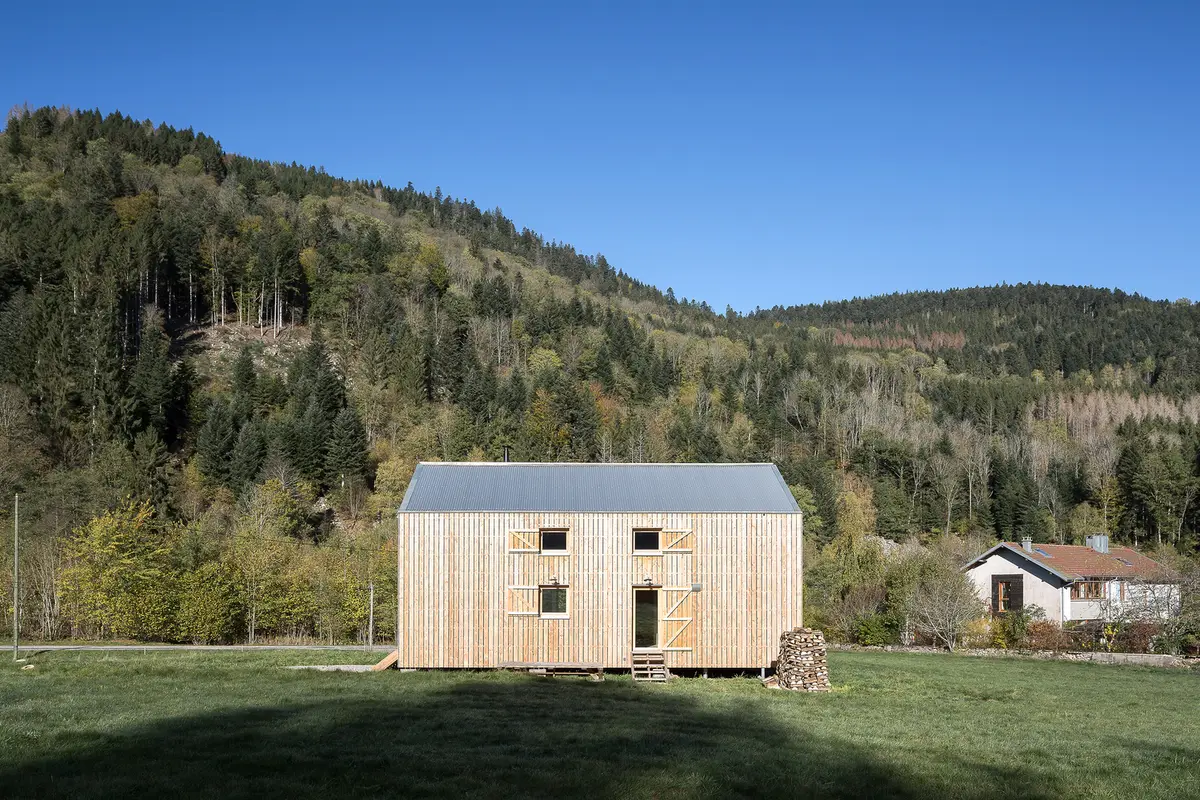
Studiolada Raises a Straw-Insulated Timber House on Granite Blocks in the Vosges Mountains
A 126-square-meter dwelling in France's Straiture Valley built entirely from regional wood, straw, and clay with zero industrial composites.


Most architects who claim to build sustainably still truck in glulam beams from Austria and OSB panels from industrial plants hundreds of kilometers away. Studiolada, led by Christophe Aubertin, took a different position for this 126-square-meter house in Ban-sur-Meurthe-Clefcy: every stick of timber comes from the Vosges region, the structural grid is dimensioned to fit a straw bale, and the whole thing sits on twelve granite blocks quarried in nearby Bresse. The result is not a rustic cabin playing dress-up but a serious piece of climate-responsive architecture that happens to look like an old barn.
What makes the project genuinely interesting is the discipline of its material constraints. No glulam, no OSB, no recomposed wood products. The framework uses solid Vosges spruce reinforced by diagonally placed boards rather than engineered panels. Douglas fir clads the exterior. Oak lines the interior walls. Ash forms the staircase, spruce the kitchen. Clay provides the ground floor's thermal mass. The house is proof that a hyper-local supply chain does not require sacrificing spatial ambition or detailing quality. It just requires knowing your forest.
A Barn That Floats on Stone
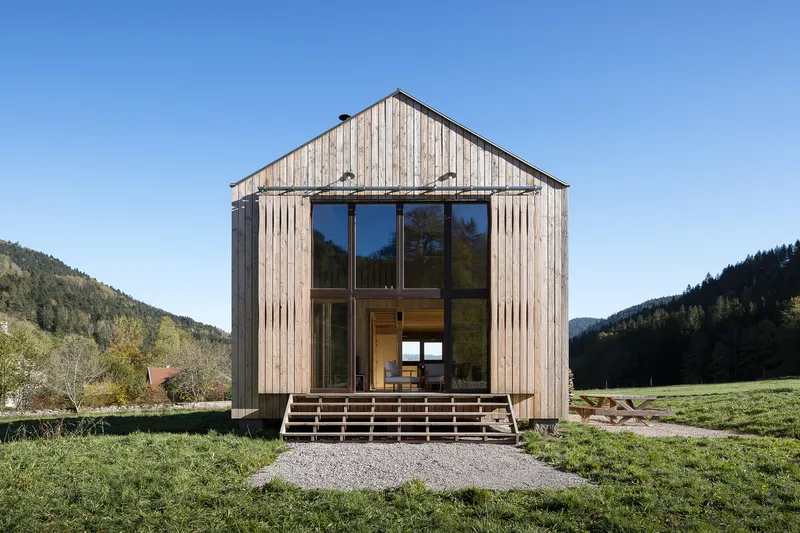
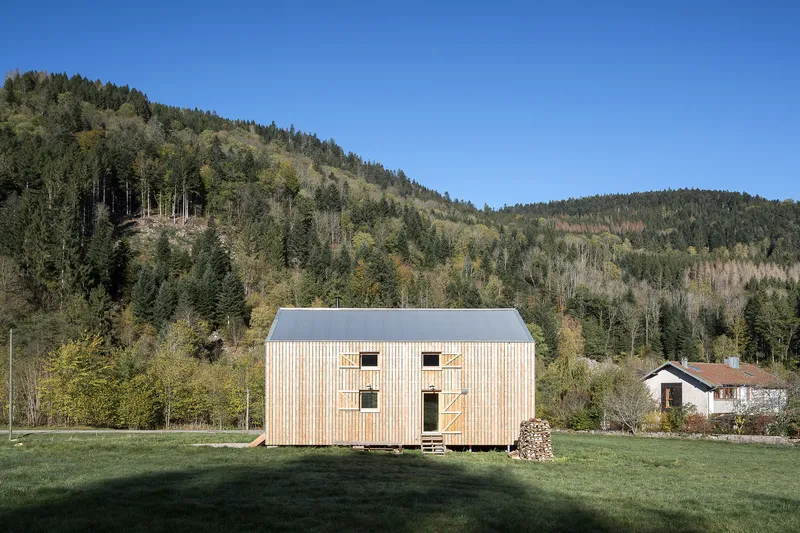
Sited in the Straiture Valley within the Parc Naturel Régional des Ballons des Vosges, the house occupies as little ground as possible. Twelve granite blocks lift it off the earth, creating a visible gap between structure and terrain that reads as both a practical strategy and an ethical statement: the land beneath is not consumed. There is no terrace, no fence, no paved apron. The meadow simply continues under the building.
The volume itself is an archetype: a simple gable oriented downstream toward the valley landscape. Vertical Douglas fir cladding and wooden shutters recall the old farms that once populated these slopes, but the proportions are tighter and the glazing is generous. Full-height windows on the main facade pull the forested hillside into the interior, while the side elevations punctuate the cladding with smaller, more protected openings. The approach is deliberate. Each facade responds to its orientation rather than repeating a single motif.
Straw, Clay, and the Logic of Thermal Mass
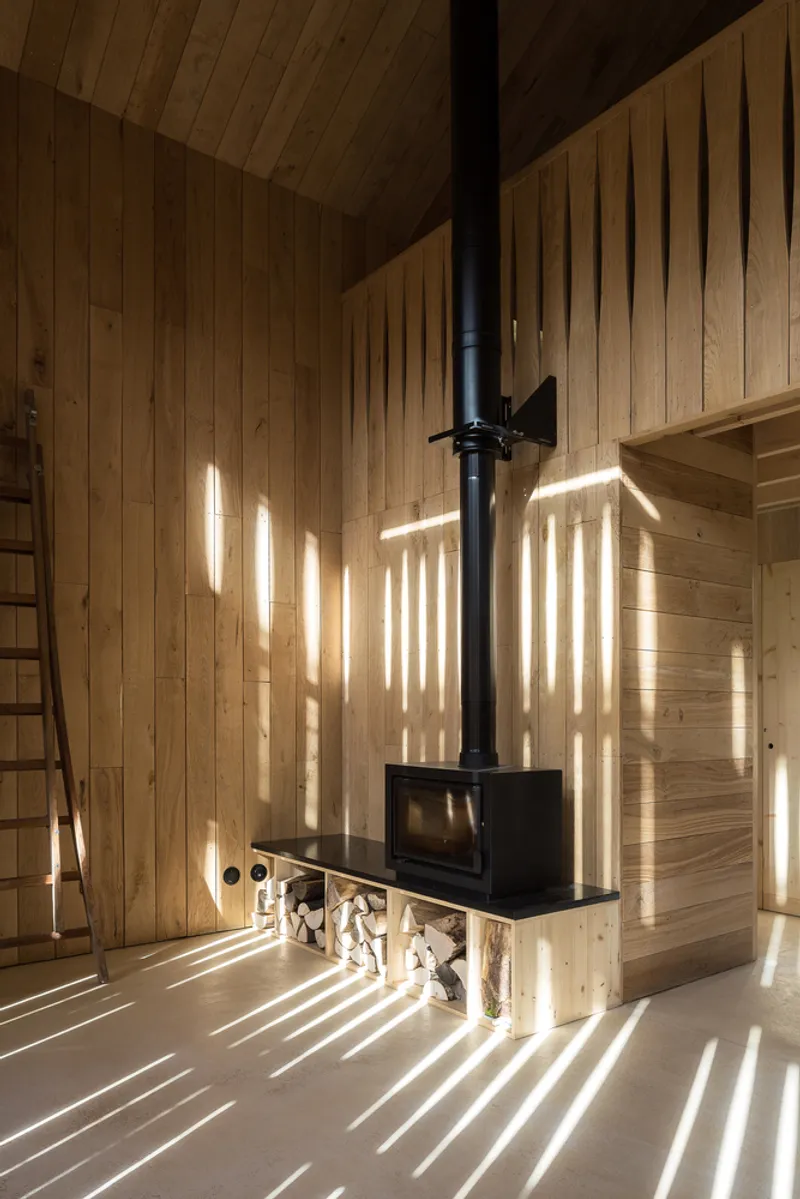
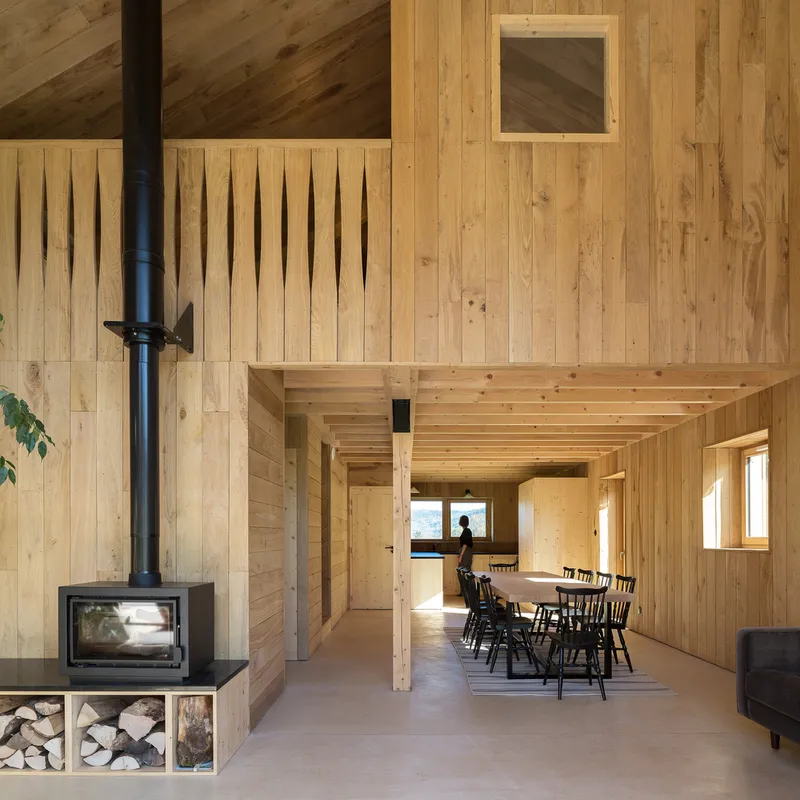
Straw bale insulation is not new, but designing an entire structural grid around straw bale dimensions is a commitment most practices avoid because it complicates every subsequent decision. Here it becomes the organizing principle. Walls are thick, thermal performance is high, and the triple-glazed pine windows from the Faymont sawmill complete the envelope. The clay floor on the ground level, composed with Argilus products and installed by Terraterre, acts as a passive thermal battery: absorbing heat in winter from the wood-burning stove and radiating coolness in summer.
The heating strategy is blunt and effective. A central wood stove does most of the work, with supplemental heaters deployed room by room only when needed. In a house this well insulated and this compact, that is enough. The stacked firewood visible beneath the stove and along the exterior walls is not decorative staging. It is the fuel supply, honestly displayed.
Interior Craft Without Industrial Shortcuts
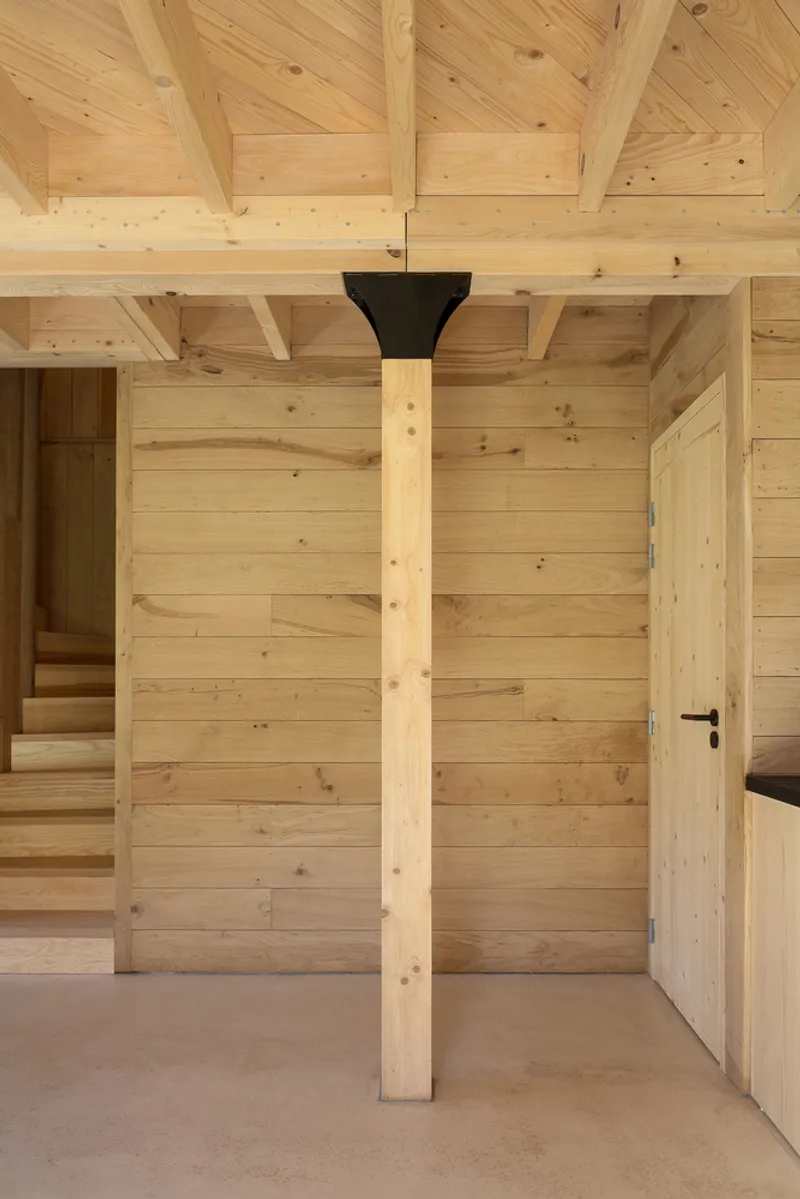
Inside, the material palette shifts but stays regional. Oak boards line the walls, their grain visible and varied. The ash staircase meets exposed spruce ceiling beams through carefully detailed black steel junctions, a small industrial gesture that sharpens the otherwise warm palette. These connections are not hidden behind plasterboard or trim. They are legible, and they communicate how the house is actually put together.
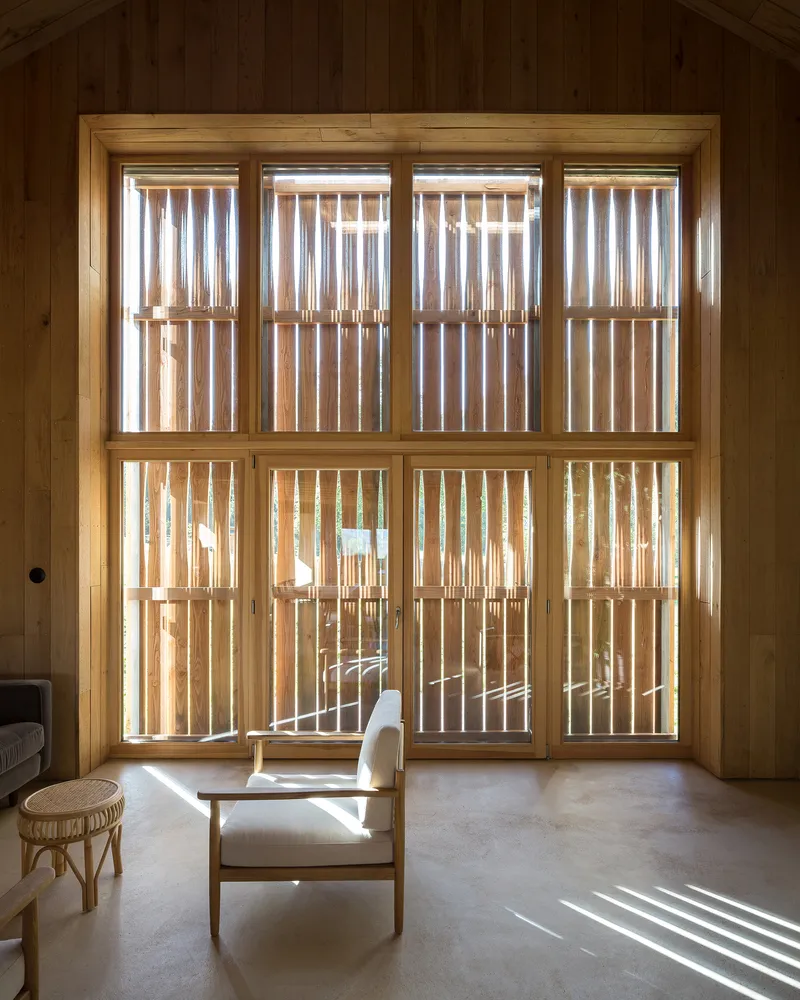
The gridded timber window wall on one facade uses vertical exterior slats as a daylight filter, casting patterned light into the seating area throughout the afternoon. It is a simple move with a significant atmospheric payoff, turning a flat plane of glazing into something more nuanced. The double-height volume at the center of the house, visible from the dining area, gives the compact plan a sense of spatial generosity that the 126-square-meter footprint might not otherwise allow.
Studiolada's refusal to use glulam or OSB is worth underscoring. These products exist to make timber construction faster and more dimensionally stable, but they are manufactured in centralized facilities and often shipped long distances. By substituting diagonal solid-wood bracing for engineered panels, the practice accepted more complexity in the carpentry in exchange for a genuinely local, genuinely traceable supply chain. Construction was carried out by Il Était Un Arbre, a builder whose name, "There Once Was a Tree," signals alignment with that philosophy.
Why This Project Matters
The Ban-sur-Meurthe House matters because it draws a clear line between sustainability as marketing and sustainability as method. Every material decision here can be traced to a specific sawmill, quarry, or workshop within the Vosges region. The structural logic follows from the insulation material, not the other way around. The seismic requirements of the site are met with granite blocks and solid carpentry rather than imported engineered solutions. None of this is invisible: the house communicates its construction logic honestly through its surfaces and details.
At a moment when timber architecture is booming globally but often relies on mass-produced engineered products shipped across continents, Studiolada's project is a quiet counter-argument. It suggests that the most sustainable timber building is one that knows exactly which forest its wood came from, and that the architect's job is not merely to specify materials but to understand the regional economy that produces them. The Straiture Valley gained a good house. The discipline gained a useful precedent.
Ban-sur-Meurthe House by Studiolada. Location: Ban-sur-Meurthe-Clefcy, Straiture Valley, Vosges, France. Area: 126 m². Year: 2022. Photography by Olivier Mathiotte and Christophe Aubertin.
About the Studio
Share Your Own Work on uni.xyz
If projects like this are the kind of work you want to make, uni.xyz is a place to publish your own, find collaborators, and enter design competitions.


Popular Articles
Popular articles from the community


Play: Fragments of Their World
Familiar architecture becomes modular playground design, creating safe spaces where displaced children can learn, connect, imagine and play.

The Ocean Hive: Sustainable Architecture for a Self-Sufficient Civilization at Sea
The Ocean Hive imagines sustainable architecture at sea, where modular habitats, algae, wave power and ocean waste sustain a growing colony.

Co-life: Sustainable Architecture for Age-Friendly Community Living
Co-life reimagines sustainable architecture for seniors through courtyards, rammed earth, shared gardens, and spaces designed for belonging.

Little Red Riding Hood: Architectural Design as a Journey Through Fear, Light, and Storytelling
Little Red Riding Hood reimagines the fairy tale through architectural design shaped by fear, light, scale, memory, uncertainty, and choice.

Similar Reads
You might also enjoy these articles


Hodi-Mandai Geram
Project Function: Preservation and revitalization of the Intangible heritage and socio-spatial identity of the Hodi by Housing, Cultural Memory Center, Sacred Grove, landscape, local tourism economy


Olio Towers: A Mid-Rise for Performers That Fuses Housing, Rehearsal, and Stage
Located blocks from Houston's Theater District, this modular tower stacks living units around a central performance atrium.

Oasis: Modular Green Housing Carved into Dhaka's Urban Fabric
A shortlisted Plugin Housing entry reclaims unauthorized settlements in Dhaka with stepped concrete volumes, green roofs, and ventilation-driven design.

Black Hole: A Floating Megastructure for the Post-Physical Era
Emiliano Mazzarotto envisions a spherical, self-scaling arena where e-sports, digital hotels, and holographic stadiums replace traditional public space.

Explore Architecture Competitions
Discover active competitions in this discipline

Challenge to reimagine the Iron Throne

Photograph architecture without architects

Illustrate the lost glory of Angkor Wat - Render Challenge

Design challenge to reuse E-waste
Comments (0)
Please login or sign up to add comments
No comments yet. Be the first to comment!