

Beneath, Beyond and Unbound: A Cultural Third Space Rooted in Fort Kochi's Rhythms
A reimagined Bharat Bhavan dissolves institutional walls to become an inclusive civic landscape of art, gathering, and fluid spatial experience.


What happens when a cultural institution stops behaving like one? When galleries shed their walls, courtyards become exhibition spaces, and the building itself recedes into the terrain to let public life take center stage? Beneath, Beyond and Unbound poses these questions through a radical reimagining of Bharat Bhavan, not as a monument to culture but as an accessible, non-hierarchical landscape where art and social life are indistinguishable.
Designed by Chandana Rao for the Bharat Bhavan 2020 competition, the project is sited in Fort Kochi, Kerala, a city already globally recognized for the Kochi-Muziris Biennale and its embrace of art as a participatory, public phenomenon. Drawing from sociologist Ray Oldenburg's concept of the "third space," Rao proposes an architecture that exists beyond home and work: a civic gathering ground where people come simply for the joy of being together. The result is a multi-arts complex that refuses monumentality, embedding itself into the city's everyday rhythms and tropical climate with equal conviction.
Sinking Into the Site: Architecture as Terrain
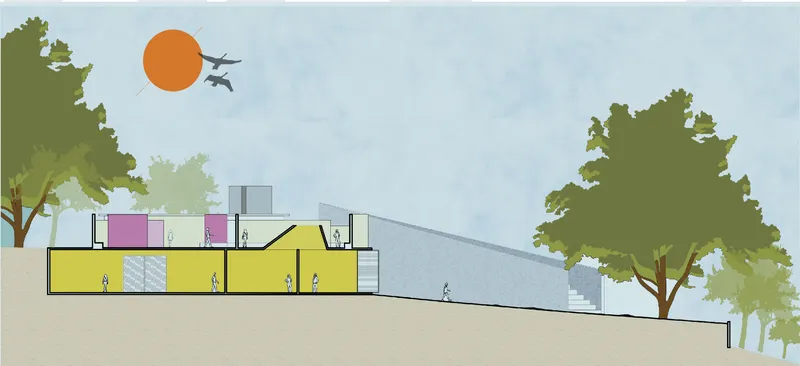
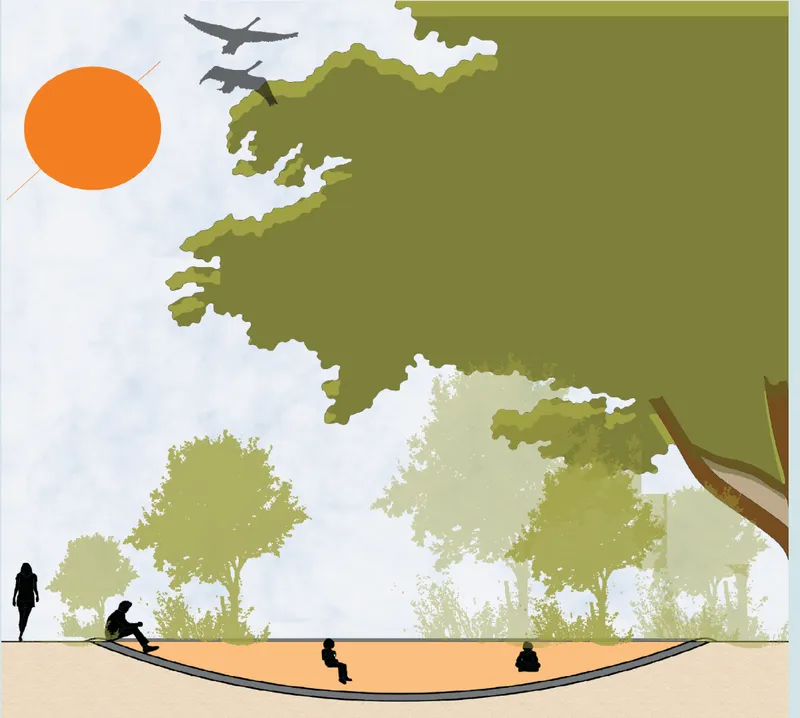
The sectional drawings reveal the project's most striking spatial move: the building doesn't sit on the landscape so much as it submerges into it. A yellow volume nestles within sloped terrain, partially sunken beneath grade, while mature trees rise above to establish the canopy as the dominant visual layer. The architecture deliberately plays second fiddle to the ground plane, an inversion of the typical institutional gesture. Adjacent to it, a curved open-air amphitheater slopes naturally with the site's contours, seating figures beneath tree canopies in a space that reads more as a sculpted clearing than a built auditorium.
These sections communicate a core principle of the project: landscape is not leftover space but an active architectural layer. The underground and partially sunken galleries reduce thermal loads in Kochi's warm and humid climate while creating intimate, earth-cooled environments for art. The open-air theatre, positioned as a communal focal point, reinforces the project's identity as a performative landscape rather than a static building.
Brick Corridors and Circular Light: Atmosphere Through Material Restraint
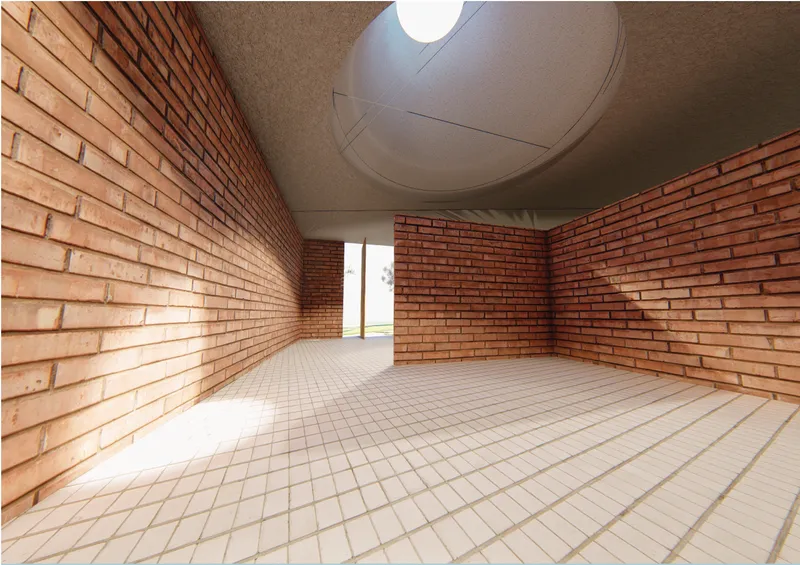
Step inside, and the material palette takes command of the experience. An interior corridor lined in red brick, with a clean white tile floor and a single circular skylight punching light from above, demonstrates how Rao achieves atmospheric richness through restraint. The brick provides thermal mass appropriate to the region while visually grounding the project in its Kerala context. Textured plaster and earth-toned surfaces appear throughout, lending warmth without decoration.
The controlled circular opening overhead is not merely decorative; it is part of a deliberate strategy of architectural punctures, courtyards, and light wells that allow natural ventilation and daylight to shape interior atmospheres. The corridor itself embodies the project's fluid spatial language: there is no single prescribed route, no gallery threshold you must cross. Instead, movement and pause coexist along passages that transition from open, naturally ventilated zones to more enclosed environments, accommodating diverse forms of art and exhibition.
A Waterfront Cluster: Reading the Complex From Above
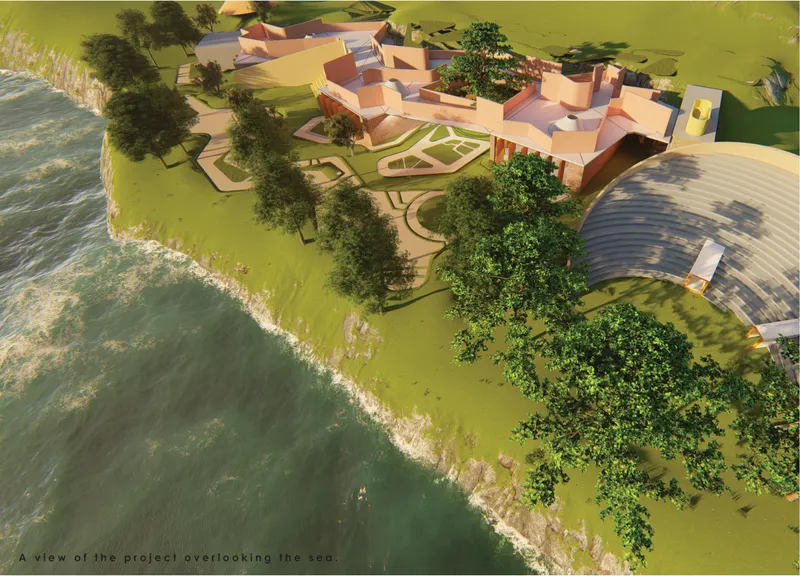
From the aerial perspective, the project reveals its organizational logic as a constellation of clustered volumes along the water's edge, wrapped by trees and connected through a network of planted courtyards. The pink-roofed masses read as a village rather than a single institution, an urban insert that respects the grain and scale of Fort Kochi's existing fabric. There is no grand entrance axis, no symmetrical facade demanding attention. The architecture disperses authority across many smaller moments of gathering, viewing, and resting.
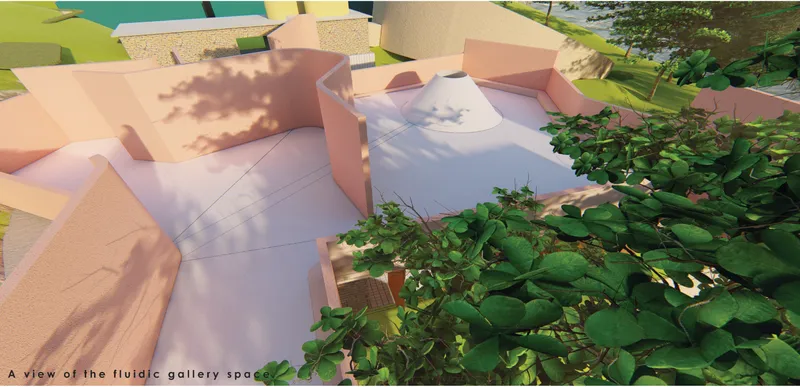
The rooftop view reinforces this reading. Curved white volumes punctuated by circular openings create a topography of their own, dappled with tree shadows that blur the line between built form and canopy. These rooftops are not afterthoughts; they participate in the climate response strategy, with their sculptural forms channeling breezes and their openings drawing light deep into the spaces below. The effect is of a building that breathes, both literally through its ventilation strategy and figuratively through its refusal to seal itself off from the environment.
Courtyards as Connective Tissue
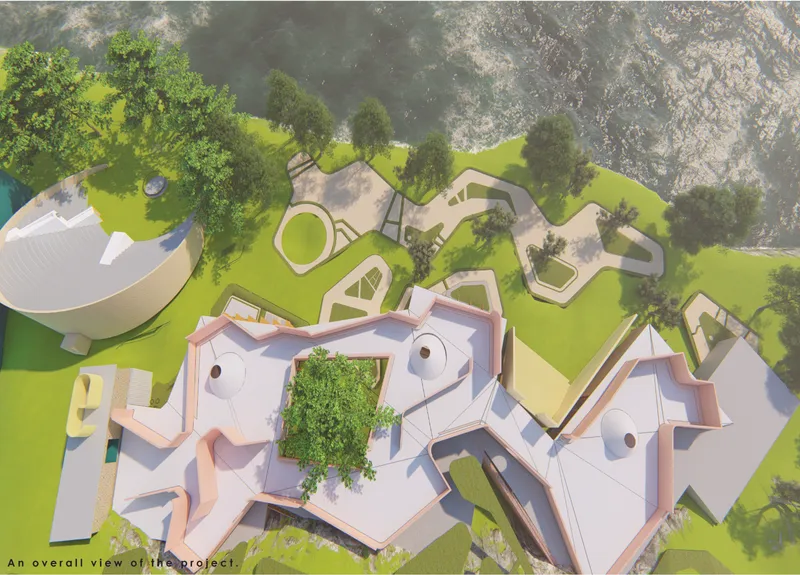
The plan view confirms what the sections and aerials suggest: the planted courtyard is the fundamental unit of spatial organization here. Interconnected white-roofed pavilions frame a series of green courts and lawns that serve as outdoor galleries, gathering zones, and climate buffers simultaneously. Pathways weave between these courts, dissolving the hard boundary between gallery and garden. The design challenges conventional gallery typologies by making the landscape itself a space of cultural encounter.
Rao labels certain gathering zones as "funnicle spaces," sculptural social condensers designed to frame views, modulate light, and encourage informal interaction and impromptu performances. The term is idiosyncratic, but the intention is precise: these are spaces calibrated to produce chance encounters and collective pause, the kind of unplanned social moments that institutional architecture typically suppresses. In a city where the biennale has already trained residents to encounter art in warehouses, streets, and open fields, this approach feels not just appropriate but inevitable.
Why This Project Matters
The competition brief for Bharat Bhavan 2020 asked designers to reconsider what a national multi-arts complex could become in contemporary India. Rao's answer is notable for what it refuses: the grand gesture, the singular icon, the sealed gallery box. Instead, Beneath, Beyond and Unbound proposes a civic landscape that earns its public life through porosity, climate intelligence, and spatial generosity. By sinking galleries into the earth, scattering volumes across a waterfront site, and treating courtyards as primary architectural spaces, the project aligns itself with a growing discourse around accessible, non-elitist cultural infrastructure.
Fort Kochi is a city that already understands art as something that belongs in the street, in the warehouse, in the everyday. Rao's proposal takes that understanding and gives it architectural form: a place where the boundary between gallery and garden, performance and passage, institution and neighborhood dissolves into something looser, more welcoming, and ultimately more useful. It is a vision of cultural architecture that trusts its visitors to find their own path through it.
View the Full Project
About the Designers
Designer: Chandana Rao
Enter a Design Competition on uni.xyz
uni.xyz runs architecture and design competitions year-round that reward proposals with spatial conviction and real site intelligence.
Project credits: Beneath, Beyond and Unbound by Chandana Rao Bharat Bhavan 2020 (uni.xyz).


Popular Articles
Popular articles from the community


Manzana Morphosis: Stretching Barcelona's Grid into a Living Landscape for 2050
A radical reworking of the Eixample manzana turns density into a tool for generous public space, vertical ecology, and environmental performance.

Cloaked Colonization: A Mobile Underwater Habitat That Moves Like a Fish
Micah Abaya's shortlisted EHC Pacific entry reimagines ocean settlement as a dispersed network of self-sustaining architectural organisms.

Extended Shell: Retrofitting Kolkata's Balconies as Living Urban Thresholds
A modular retrofit system recovers the social and environmental intelligence of Kolkata's historic verandas for contemporary Park Street residents.

Temporary Home for Dogs: A Reversed Zoo Rethinks Animal Shelter Architecture
In Bucharest, a sinuous corridor and freed landscape flip the logic of containment, designing a shelter that works to make itself unnecessary.

Similar Reads
You might also enjoy these articles

The Amber Palace Opera: A Geological Fiction Surfaces on Tallinn's Baltic Waterfront
Pierre Brillard reimagines a Baltic legend as a public landscape, opera house, and waterfront promenade rooted in Tallinn's coastal identity.
Dynamic Modules Shelter: A Telescopic Ring for Mountain Pilgrimage
A circular modular framework of steel, bamboo, and fabric grows vertically with demand, wrapping communal ground in adaptable shelter.

Singing Woman: Contemporary Architecture Inspired by Estonia’s Voice and the Sea
Singing Woman turns Estonia’s song culture into flowing opera house architecture, blending public life, landscape, sea, and national memory.
HYPERBLOCK: Flexible Urban Design for Barcelona’s Future City
HYPERBLOCK reimagines Barcelona as flexible urban design, layering density, daylight, public space and adaptable housing above Cerdà’s grid.

Comments (0)
Please login or sign up to add comments
No comments yet. Be the first to comment!