
BETWEEN: Modular Housing as an Ecological Corridor at the City's Edge
A threshold architecture of orange modular volumes, sunken courtyards, and green terraces dissolves the line between urban density and natural landscape.


What if the edge of a city wasn't a wall but a membrane? BETWEEN takes the blunt boundary between urban density and open landscape and replows it into a gradient: a series of modular housing volumes, service cores, and sunken courtyards that allow people and nature to filter through one another. The result is not a building so much as an ecological corridor, a place where architecture operates as connective tissue rather than barrier.
Designed by Altunay Ejdar and Sude Özselçuk, BETWEEN was shortlisted in the Live Green competition. The project's site sits at a transition zone between dense urbanization on one side and open natural landscape on the other. Rather than treating this edge as a line of division, the designers read it as a living threshold, a space capable of facilitating exchange and balance between two opposing conditions.
Orange Volumes Stacked Along a Porous Street
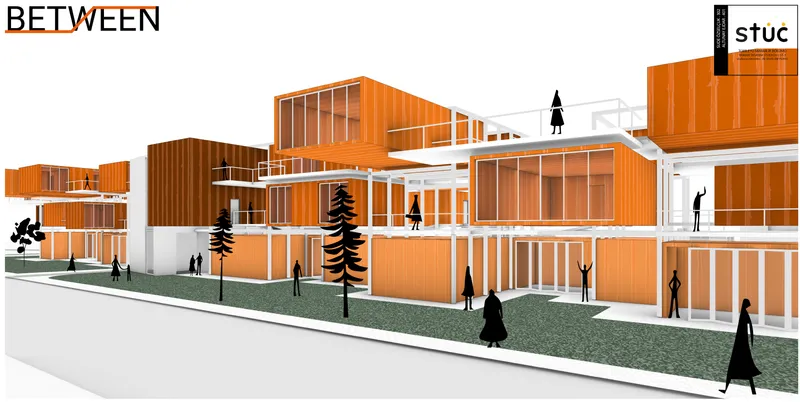
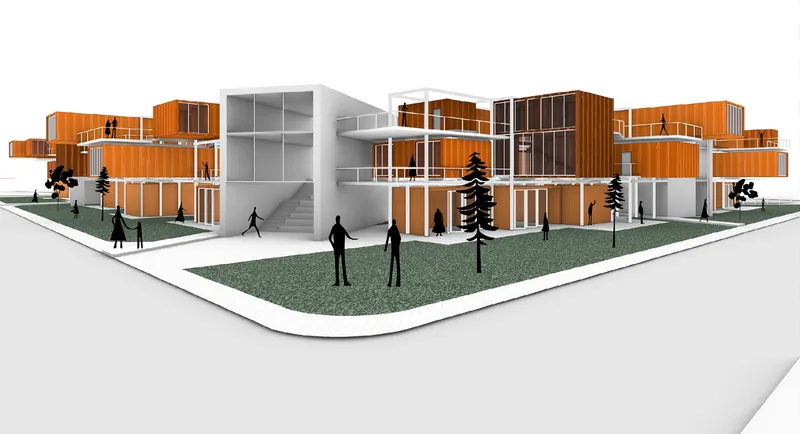
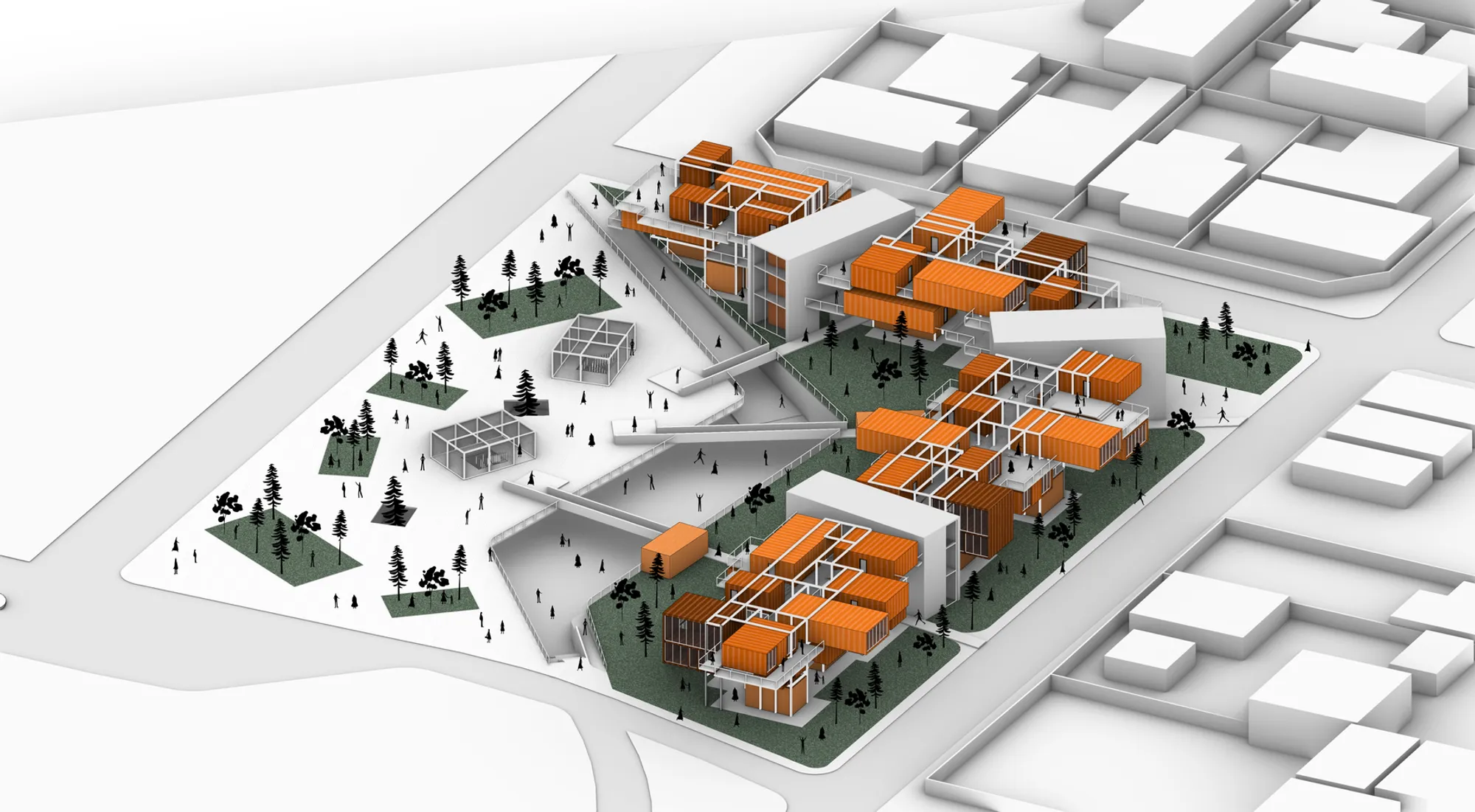
The axonometric view reveals the project's spatial logic immediately: warm orange modular volumes stack and step along a pedestrian street, framed by evergreen trees that carry the surrounding landscape directly into the architectural fabric. These modules are not uniform blocks. They shift, rotate, and cluster around open courtyards, creating pockets of green space at ground level that pull nature through the section of the building. The corner perspective reinforces this reading: white and orange volumes gather around a central courtyard where figures move freely between interior and exterior, suggesting a social life that refuses to be contained by walls.
The modular system is designed with adaptability at its core. Individual units can accommodate varying needs, from solo living to group configurations, ensuring both flexibility and inclusivity. Service cores containing stairs, elevators, and utilities form the structural backbone, linking vertical and horizontal movement and organizing the overall composition into legible clusters rather than a monolithic mass.
Sunken Courtyards and Tiered Circulation
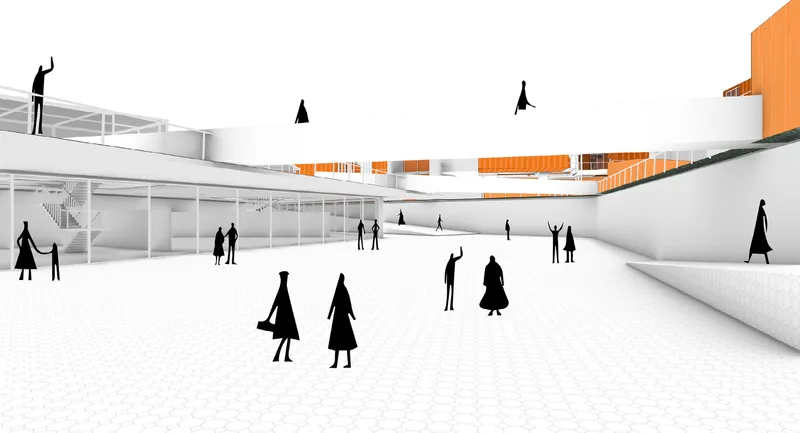
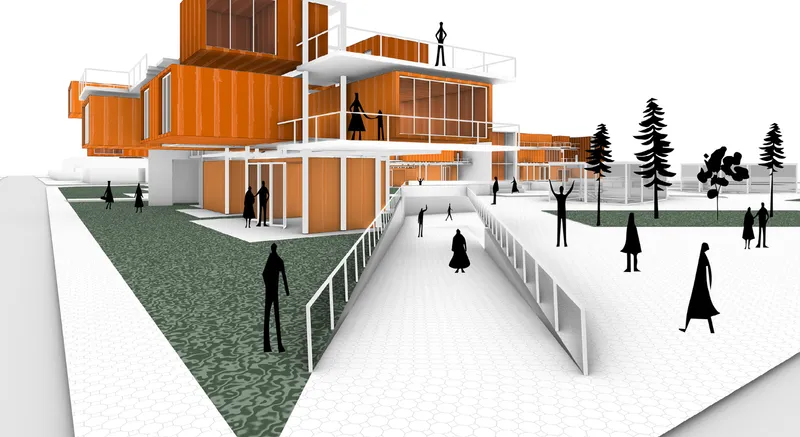
The interior courtyard rendering shows a quieter register of the project. White paved surfaces drop below grade, and silhouetted figures navigate between tiered levels connected by gentle ramps and walkways. The spatial sequence here is deliberate: users move through gradients of openness and enclosure, shifting between communal gathering areas and more private zones. Each turn in the path reveals new interactions between built form and planted void.
The sectional perspective makes the structural strategy legible. Orange stacked volumes anchor the composition at intervals, while white walkways bridge between them, creating a linear pedestrian spine that stitches the entire scheme together. Semi-transparent glass units sit at key junctions, mediating light and visually connecting underground spaces to ground level. At the primary entrance, an amphitheater functions as both access point and community hub, positioning social gathering at the very moment a visitor crosses from city to threshold. This is circulation designed as narrative, not mere logistics.
Green Rooftops Extending the Landscape Upward
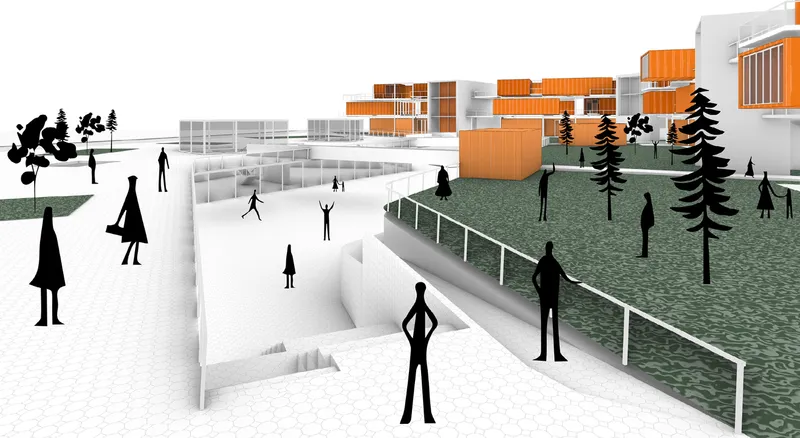
From across the sunken courtyards, the view toward the orange volumes reveals a final, critical layer: green rooftop terraces planted with evergreen trees that extend the surrounding natural landscape onto the building itself. These planted surfaces are not decorative afterthoughts. They contribute to microclimatic comfort, support biodiversity, and visually dissolve the top edge of the architecture into the treeline beyond. The project's structural logic allows for reconfiguration over time, making the scheme inherently resilient to urban growth and environmental change.
Open courtyards, pedestrian pathways, and recreational landscapes work together at grade to reinforce this ecological intent. The project treats its ground plane as a shared commons, blurring the ownership line between building residents and the broader public. Architecture here is not a destination to arrive at but a territory to pass through.
Why This Project Matters
Most urban edge projects choose a side: they either defend the city against nature with hard infrastructure, or they retreat into pastoral fantasy. BETWEEN refuses that binary. Its five-step design process, moving from site mapping through threshold identification to spatial blending, produces an architecture that is genuinely porous. The modular housing system, the sunken courtyards, the glass connectors, and the planted rooftops each play a distinct role in constructing a continuum rather than a boundary.
Ejdar and Özselçuk have proposed something quietly radical: that the most sustainable response to urban expansion might not be a green wall or a solar panel array, but a rethinking of where city ends and landscape begins. By designing that transition as a habitable space in its own right, BETWEEN turns edge condition into primary architecture.
View the Full Project
About the Designers
Designers: Altunay Ejdar, Sude Özselçuk
Enter a Design Competition on uni.xyz
uni.xyz runs architecture and design competitions year-round that reward proposals with spatial conviction and real site intelligence.
Project credits: BETWEEN by Altunay Ejdar, Sude Özselçuk Live Green (uni.xyz).



Popular Articles
Popular articles from the community


Conexión: Biophilic Design Reimagines High-Rise Living in Hong Kong
Conexión reimagines high-rise living in Hong Kong through biophilic design, green facades, shared spaces, daylight, water and nature within.

Riyadh For All: Intergenerational Urban Design for Active Aging in Rabat
Riyadh For All reimagines urban design in Rabat with intergenerational co-living, adaptive courtyards, and Moroccan cultural exchange today.

Co-life: Sustainable Architecture for Age-Friendly Community Living
Co-life reimagines sustainable architecture for seniors through courtyards, rammed earth, shared gardens, and spaces designed for belonging.

The Musturak Paradise: Senior Living Architecture for a Connected Future in Temara, Morocco
The Musturak Paradise reimagines senior living architecture in Temara via private homes, social spaces, culture, community, and shared care.


Similar Reads
You might also enjoy these articles

Lunar Spiral: Space Architecture Shaped by the Mathematics of the Universe
Lunar Spiral reimagines space architecture through Fibonacci geometry, lunar regolith, levitating habitats, and self-sustaining Moon living.
The Main Dream: Modular Architecture for Play, Learning, and Community
A modular playground turns recycled plastic into adaptable spaces where refugee children can play, build, learn, and reconnect.

Play: Fragments of Their World
Familiar architecture becomes modular playground design, creating safe spaces where displaced children can learn, connect, imagine and play.

Wadi Rum Observatory: Desert Architecture Designed for the Night Sky
Wadi Rum Observatory turns desert architecture into a quiet instrument for astronomy, hiding research spaces under Jordan's starlit terrain.




Comments (0)
Please login or sign up to add comments
No comments yet. Be the first to comment!