

BHA Organizes a Three-Generation Da Nang House Around a Central Courtyard Garden
Phai House stacks white volumes around planted voids to bring tropical light and air deep into a dense Vietnamese neighborhood.


In Da Nang's Euro Village, where residential plots sit shoulder to shoulder and privacy is earned rather than given, BHA carved out a 458 square meter house that treats landscape not as decoration but as infrastructure. Phai House, designed by lead architects Nguyen Xuan Minh and Nguyen Cong Tuan, is built for a three-generation family that wanted daily contact with greenery, water, and sky without retreating to the countryside. The solution was not to push the house to the edges and landscape the leftovers, but to pull the building apart at its center and let nature occupy the gap.
What makes Phai House worth studying is the discipline of its section. Three levels of living space are stacked and shifted so that every room, from the ground-floor living area to the upper bedrooms, draws light and ventilation from an internal courtyard that runs the full height of the house. The courtyard is not a luxury; it is the engine of the plan, driving cross-ventilation through central Vietnam's humid climate and creating sightlines that make a compact urban lot feel far larger than its footprint.
A Street Face That Gives Nothing Away


From the street, Phai House presents a composed white stucco facade screened by a vertical slatted fence. The upper volume cantilevers forward, sheltering a recessed carport below and establishing the only real gesture toward the public realm. At twilight the house glows through its slats like a lantern, but by day it reads as restrained, almost reticent. The architects clearly prioritized the interior experience over street-level spectacle, and the facade is better for it: no gratuitous openings, no performative planting. Just a clean boundary between neighborhood and domestic life.
The Courtyard as the Heart of the Plan


Step past the threshold and the house opens up dramatically. A central courtyard, landscaped with young trees, a koi pond, and a patch of lawn, drops into the center of the plan. Concrete terraces extend from the living spaces out toward this green void, and floor-to-ceiling glazing wraps the courtyard edges so that every adjacent room feels as though it is sitting in a garden rather than beside one.
The narrow garden courtyard with its stepped white planters acts as a secondary light well, pulling daylight between the glass walls and white stucco surfaces. This layering of voids is what keeps the plan from becoming a single courtyard trick. BHA understood that one opening would not be enough to ventilate and illuminate three levels of program, so they threaded multiple voids through the mass of the house, each scaled to its neighbors.
Living Spaces That Dissolve Into Green
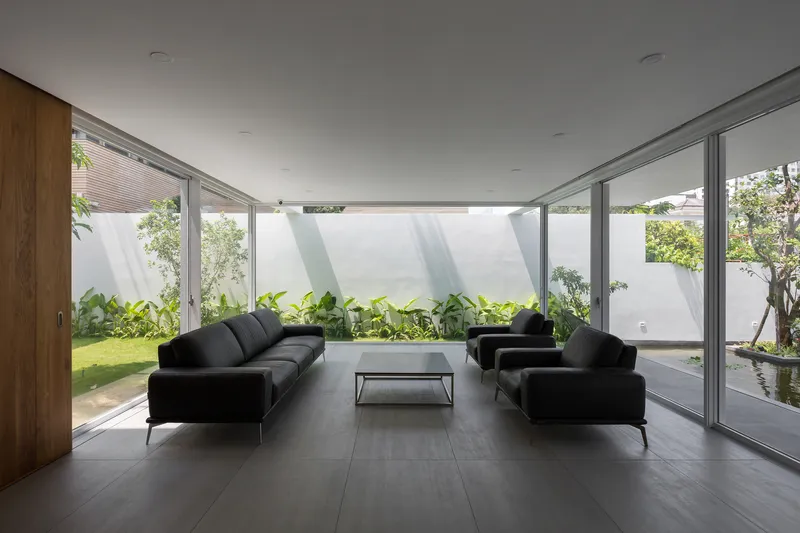


The ground-floor living room is the most generous space in the house. Floor-to-ceiling glazing on two sides opens onto the planted courtyard, and the double-height volume above the dining area lets air and light cascade down from the mezzanine level. The effect is a room that feels porous: you are always aware of the garden, the sky, and the upper levels of the house.
What saves these rooms from feeling like a greenhouse is the material restraint. Large-format grey floor tiles ground the space, white walls and ceilings keep the palette neutral, and the timber staircase provides the only warm accent. There is no competition between interior finishes and the courtyard planting. The greenery wins every visual contest because the architects gave it nothing to fight against.
Timber Staircase as Sculptural Spine


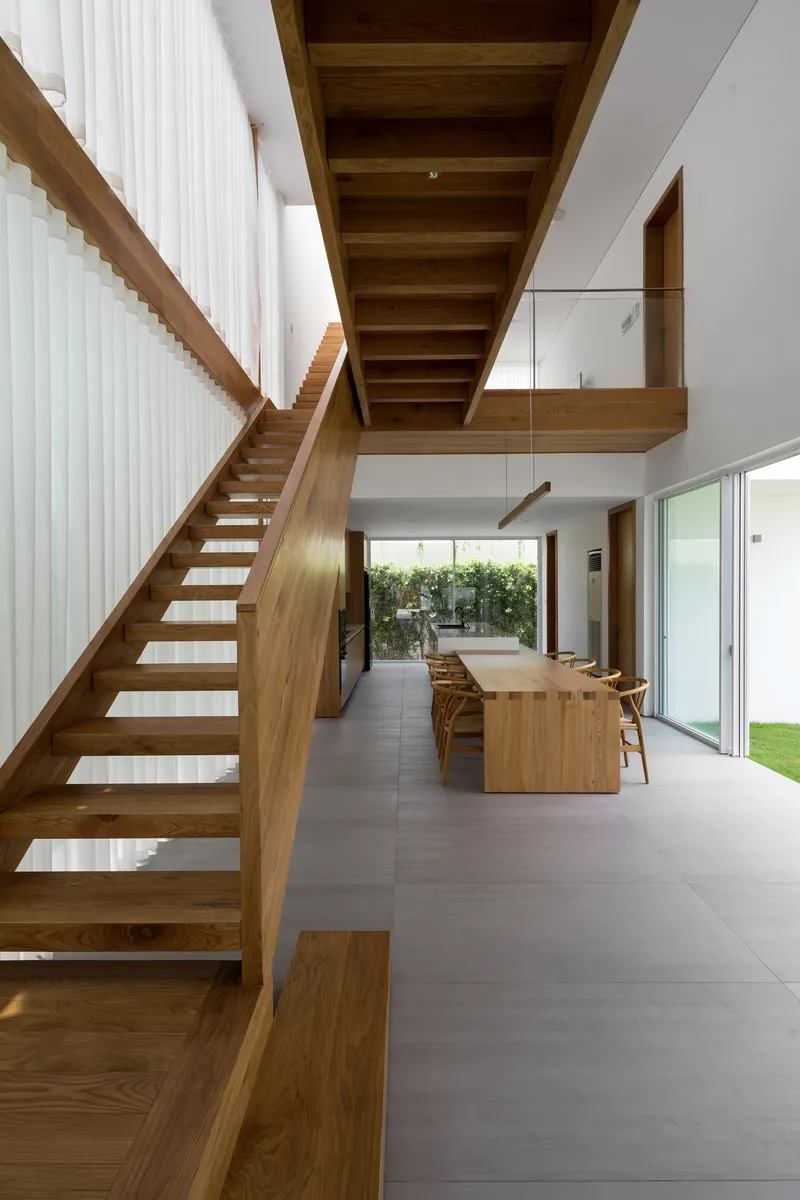
The staircase does heavy lifting here, both structurally and spatially. Built from timber with open treads and a glass balustrade, it threads through the double-height void like a piece of furniture scaled up to architecture. The exposed joists beneath the upper landing give it a slightly raw, workshop quality that pushes back against the otherwise polished interiors.
More importantly, the stair is positioned to work as a visual connector. Standing at the dining table, you can look up through the open treads to the mezzanine. From the upper hallway, you look down through the stairwell past the kitchen to the garden courtyard beyond. BHA used the staircase to stitch the three levels together into a single continuous volume, and its transparency is the mechanism that makes that possible.
Upper Levels: Light, Privacy, and Outdoor Rooms
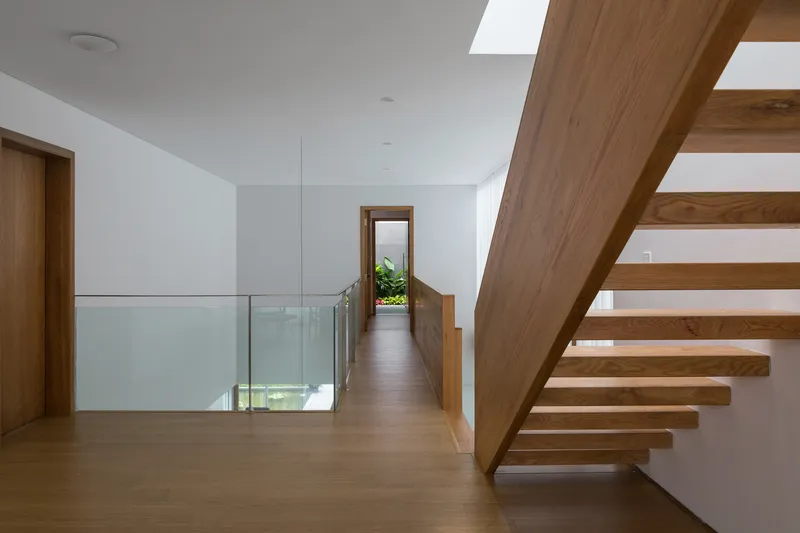
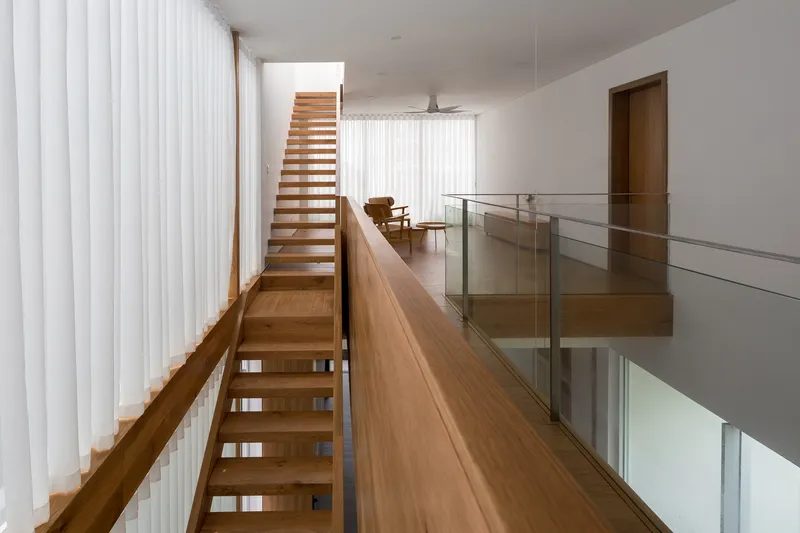

The upper corridors benefit from skylights that wash the cantilevered staircase in overhead light. White vertical blinds filter the glare without blocking it, and the glass guardrails maintain the visual continuity that the architects clearly fought to protect at every turn. These are not afterthought hallways. They are tuned to perform as transitional spaces, connecting the private bedrooms to the communal core of the house while offering glimpses down into the courtyard.
Bedrooms That Open Onto Interior Landscapes
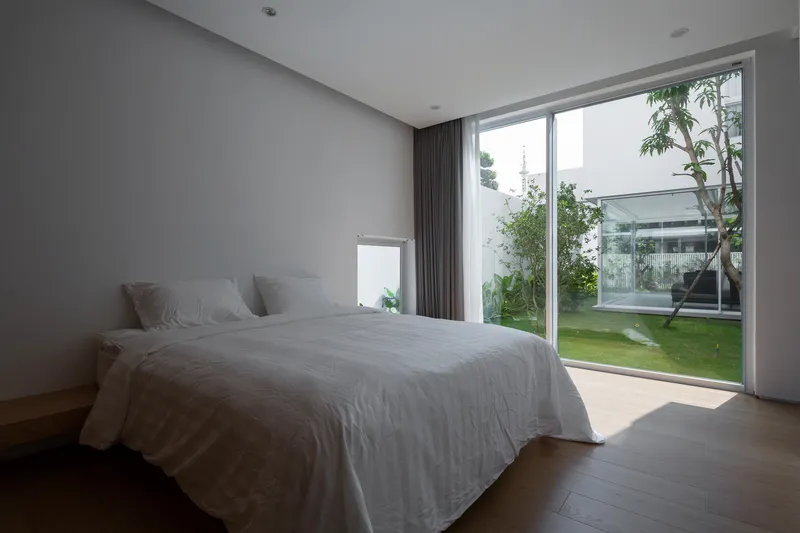

The bedrooms are where the courtyard strategy pays its highest dividend. Sliding glass walls open directly onto the interior garden, so the boundary between sleeping and landscape is a single pane of glass that can be rolled away entirely. For a multigenerational family, this is a significant move: each generation gets its own private room, but none of them is cut off from the shared landscape at the center of the house.
Built-in shelving units combine wood and white surfaces, echoing the timber-and-stucco palette of the rest of the house. The upper bedrooms open onto balconies with potted plants, creating small outdoor rooms that extend the courtyard logic vertically. Nothing here feels borrowed from a hotel catalog. The rooms are specific to this house, this climate, this family.
Plans and Drawings
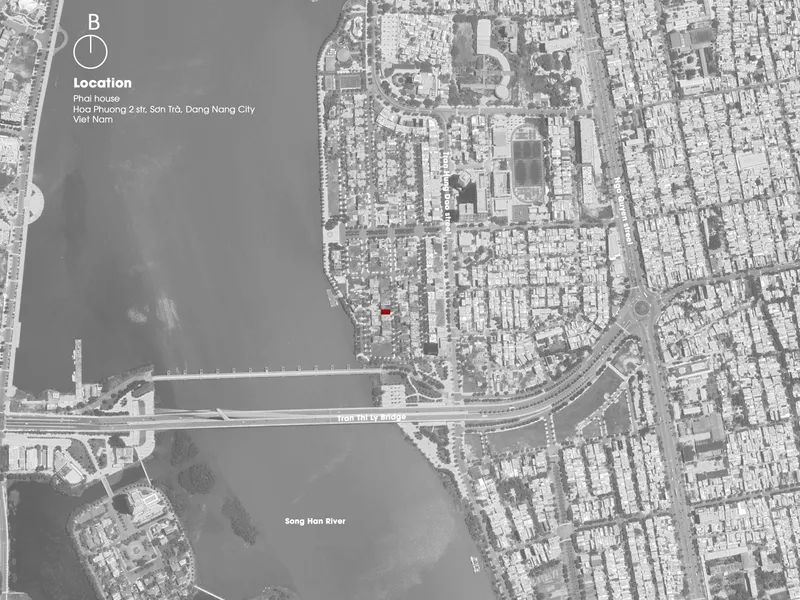
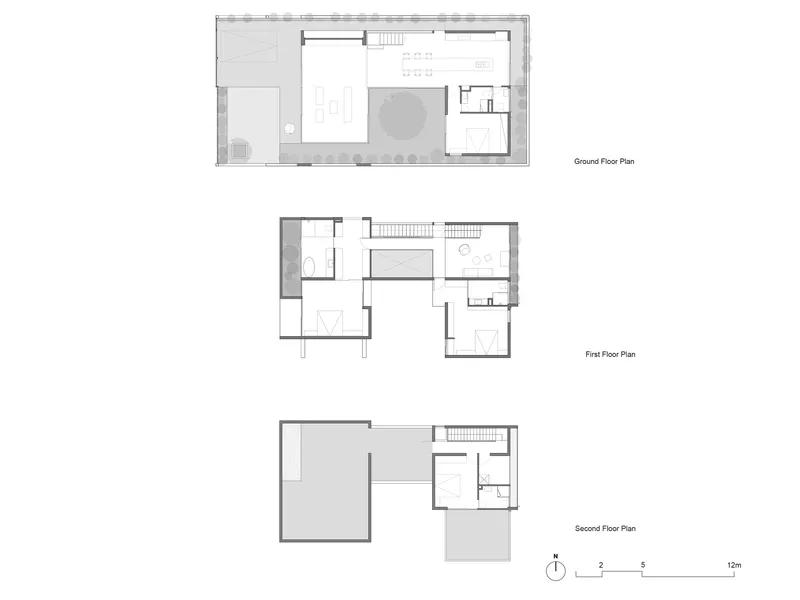

The site plan reveals the house's proximity to a river and bridge infrastructure, situating it within Da Nang's expanding suburban fabric. The floor plans, showing ground, first, and second levels, confirm the central courtyard as the organizing element: circulation wraps around it, the staircase anchors one edge, and all major rooms face into it.
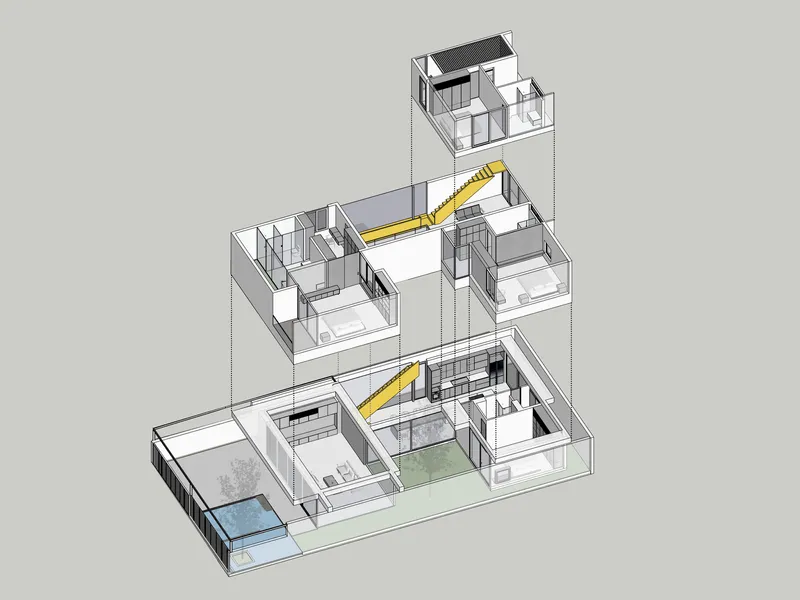

The section drawing lays bare the strategy in profile. Three levels step back from the courtyard edge, and the double-height living space reads clearly as the spatial centerpiece. The axonometric drawing, with its yellow-highlighted staircases, makes the vertical circulation legible as the connective tissue that holds the stacked volumes together. These drawings are honest representations of a house that is, at its core, a straightforward idea executed with precision.
Why This Project Matters
Phai House belongs to a growing body of Vietnamese residential architecture that takes the courtyard typology seriously as a climate strategy rather than a stylistic reference. In a dense urban neighborhood where exterior space is limited and the subtropical climate demands ventilation, BHA's decision to sacrifice floor area to create planted voids is both pragmatic and generous. The house breathes because the architects let it, and the family lives in contact with trees, water, and sky because the plan was organized around those elements from the start.
What elevates the project beyond competent planning is its material and spatial consistency. The timber staircase, the white stucco volumes, the glass boundaries, and the planted courtyards all belong to the same argument. Nothing is decorative; everything earns its place. For a 458 square meter house serving three generations, that kind of coherence is hard to achieve and harder to sustain across three floors. BHA managed it, and the result is a house that feels both calm and alive.
Phai House by BHA, lead architects Nguyen Xuan Minh and Nguyen Cong Tuan. Located in Euro Village, Da Nang, Vietnam. 458 m², completed 2021. Photography by Hoang Le.
About the Studio
Share Your Own Work on uni.xyz
If projects like this are the kind of work you want to make, uni.xyz is a place to publish your own, find collaborators, and enter design competitions.


Popular Articles
Popular articles from the community


Faces of the Soviet Avant-Garde: Turning Moscow's Street Names into an Open-Air Museum
A network of sculptural installations across a Moscow residential district transforms forgotten architect names into spatial encounters with cultural memor

Manzana Morphosis: Stretching Barcelona's Grid into a Living Landscape for 2050
A radical reworking of the Eixample manzana turns density into a tool for generous public space, vertical ecology, and environmental performance.

Opera by the Sea Estonia: Three Shells Dissolving Architecture into Tallinn's Coastline
A winning opera house proposal replaces monumental form with interconnected shells that blur the boundary between building, park and Baltic Sea.

Opera on the Sea: Driftwood Logic Shapes a Timber Opera House on Estonia's Coast
Trevor Orgill's opera house translates the entangled drift of floating timber into a civic building where wood, water, and music converge.

Similar Reads
You might also enjoy these articles

Bao Huynh Watercolor Atelier: A Serene Art Retreat in Hội An
Bao Huynh Watercolor Atelier in Hội An blends multifunctional art spaces, sustainable design, local materials, and family-friendly living in a serene environment.

Atelier Macri Concept Store Interior Design by CASE-REAL
Atelier Macri store features a "ko" counter, walnut wood details, cork displays, blending retail, gallery, and seamless customer experiences.

Manuel Vargas Izquierdo Stadium and High-Performance Sports Center: Architectural Excellence in Jalpa de Méndez
The Manuel Vargas Izquierdo Stadium blends sustainable design, inclusive sports facilities, and cultural-inspired architecture, revitalizing Jalpa de Méndez’s public spaces.

KAKR Buluh Awar Hall: Revitalizing Community and Ecology Through Bamboo Architecture
Community built bamboo hall revitalizes Buluh Awar village, empowering youth, restoring ecology, celebrating vernacular craftsmanship through sustainable architecture and culture.


Comments (0)
Please login or sign up to add comments
No comments yet. Be the first to comment!