

Kanchi Koodu: Reinterpreting Temple Architecture as Civic Cultural Infrastructure
A nine-volume cultural campus in Kancheepuram translates sacred temple typologies into porous public space for artisans and visitors alike.


What happens when you take the spatial logic of a South Indian temple and strip away the singular devotional program, replacing it with silk looms, painting galleries, open-air theatres, and artisan workshops? You get Kanchi Koodu, a cultural campus that treats the ancient city of Kancheepuram not as a backdrop for a new institution but as the very source code for its architecture. The garbhagriha becomes a symbolic cultural heart rather than a sacred chamber. The circumambulatory path becomes the primary circulation spine. The temple pond becomes an ecological anchor. Every move in this project is a translation, not a transplant, of a living architectural tradition into contemporary civic life.
Designed by Saru Kumar and Jegan Muralidharan, Kanchi Koodu was a runner-up entry in the Bharat Bhavan 2020 competition. The proposal sits on a five-acre site in Kancheepuram, Tamil Nadu, a city known as the City of Thousand Temples and Weavers. Adjacent to the site lies Okkaiparinthan Kulam, one of the city's historic water bodies, which the designers absorb into the project as both landscape feature and social gathering space. The site's proximity to major temples, weaving communities, and transit nodes like the bus stand and railway station ensures the building plugs directly into the daily rhythms of the city rather than standing apart from them.
A Nine-Volume Grid Rooted in Temple Geometry

The axonometric site plan reveals the project's fundamental organizational move: nine primary volumes arranged in a grid, each functioning as a flexible cultural container. The massing sits beside the large water body of Okkaiparinthan Kulam, and the drawing makes clear how porous the boundary between building and landscape truly is. There is no monolithic facade facing the city. Instead, the volumes break down to maintain human scale and visual intimacy, with gaps between them functioning as courtyards, corridors, and transition spaces.
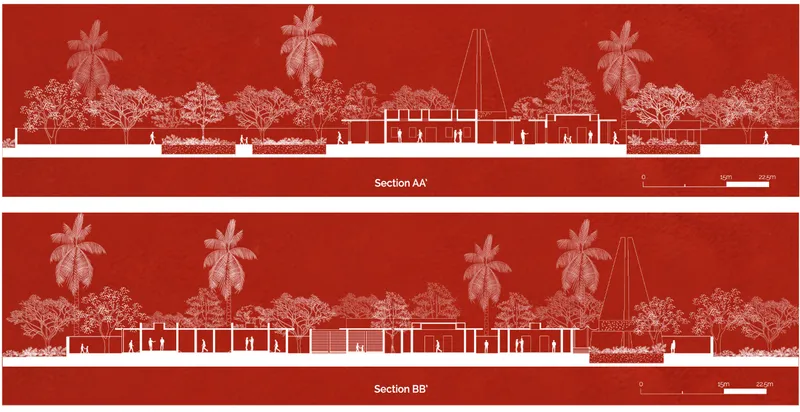
The section drawings reinforce this reading. Low pavilion structures nestle beneath palm trees and tropical vegetation, their rooflines deliberately deferring to the canopy. The architecture stays close to the ground, horizontal and breathable, a posture that reads as both contextually respectful and climatically intelligent. By keeping built volumes modest in height, the designers ensure that the temple spires of Kancheepuram remain the dominant vertical markers on the skyline.
The Garbhagriha Reimagined as a Skylit Cultural Core

The most striking interior moment in the project is this pyramidal skylight, captured from below. Light pours down through the apex and catches patterned floor panels, producing an atmosphere that is unmistakably temple-like in its verticality and focus, yet entirely secular in its program. This is the central core of the nine-volume grid, the reinterpreted garbhagriha around which all other activities revolve. In a traditional temple, this would be the innermost sanctum, dim and compressed. Here, the designers invert the condition: the core is flooded with light, open to the sky, and accessible to everyone.
The patterning on the floor panels is not decorative filler. It references the geometric language of Kancheepuram's textile traditions, creating a moment where the craft being celebrated in the galleries becomes embedded in the architecture itself. Light and pattern work together to mark this space as the symbolic heart of Kanchi Koodu without relying on monumentality or ornamental excess.
Red Canopies and Pyramidal Towers: The Art Gopuram as Threshold
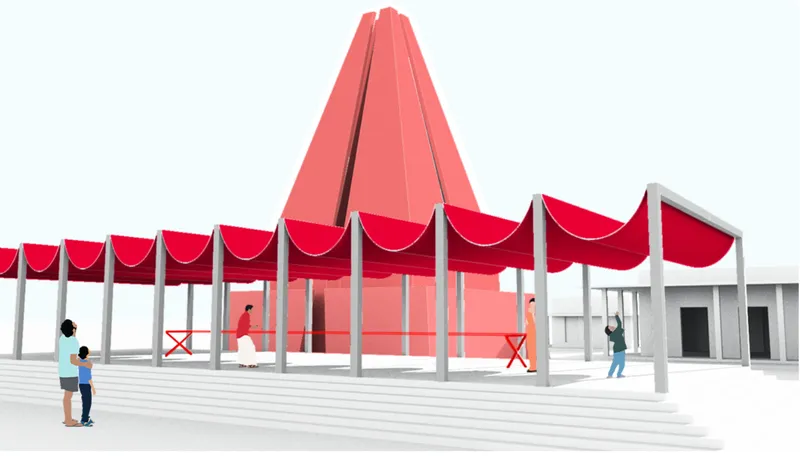
The rendering of the covered plaza captures the project's approach to public gathering. Red fabric canopies stretch across an open ground plane, shading clusters of visitors beneath a pyramidal tower that the designers call the Art Gopuram. In temple architecture, the gopuram is the monumental gateway that announces entry into sacred territory. Here, it signals entry into a cultural precinct: a space for street weaving demonstrations, craft exhibition zones, and informal social exchange. The tower form is instantly legible to anyone familiar with South Indian temple typology, but its materiality and openness declare a different intent.
The ground level beneath the canopies is deliberately unprogrammed, a quality that distinguishes Kanchi Koodu from more conventional cultural centers. Trading, workshop activities, and spontaneous performance can occupy this space without requiring fixed infrastructure. The red fabric introduces color and softness against the hard geometry of the tower, a move that also nods to the vibrant textile culture the project celebrates.
Colonnaded Paths That Stitch Craft to Movement
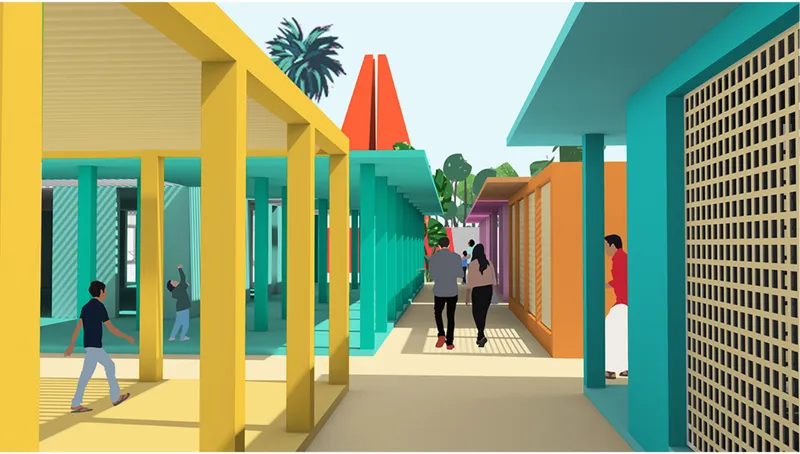

Two interior views reveal the connective tissue of the project: shaded walkways and corridors that link the nine volumes into a continuous spatial experience. The pedestrian walkway flanked by yellow and turquoise columns produces dappled sunlight conditions that recall the colonnades of temple mandapams, while the bold color draws from the palette of Kancheepuram's silk saris. Visitors move through these paths not as passive consumers of gallery content but as participants in a continuous ambulatory sequence that references the circumambulatory routes of temple architecture.
The interior corridor with alternating patterned screens operates on a similar principle. Screens filter light and frame views into adjacent workshop and exhibition spaces, creating a layered visual field where the boundary between circulation and program dissolves. Artisans weaving at their looms or shaping clay deities become part of the spatial experience for anyone walking through. The design refuses the conventional museum model of sealed galleries connected by neutral corridors. Instead, the corridor is the gallery, and the act of walking is the act of encountering culture.
Why This Project Matters
Kanchi Koodu demonstrates that cultural institutions in India need not choose between historical reference and contemporary ambition. By decomposing the temple typology into its spatial operations (threshold, core, circumambulation, colonnade, water body) and reassembling them around civic and artisanal programs, Saru Kumar and Jegan Muralidharan produce an architecture that feels both deeply local and genuinely new. The project does not aestheticize tradition; it operationalizes it.
The real achievement here is porosity. Too many cultural buildings in Indian cities function as enclosed containers that cut visitors off from the urban fabric they claim to celebrate. Kanchi Koodu does the opposite: its grid of volumes, its open ground planes, its ambulatory paths, and its integration with Okkaiparinthan Kulam all ensure that the building remains continuous with the city. Art, craft, and architecture are not separated into departments. They coexist in the same corridors, under the same canopies, around the same water. For a city whose identity has always been woven from temple, textile, and daily ritual, that spatial continuity is not a design gesture. It is a cultural argument.
View the Full Project
About the Designers
Designers: Saru Kumar, Jegan Muralidharan
Enter a Design Competition on uni.xyz
uni.xyz runs architecture and design competitions year-round that reward proposals with spatial conviction and real site intelligence.
Project credits: Bharat Bhavan 2020 -kanchi koodu by Saru Kumar, Jegan Muralidharan Bharat Bhavan 2020 (uni.xyz).



Popular Articles
Popular articles from the community


Conexión: Biophilic Design Reimagines High-Rise Living in Hong Kong
Conexión reimagines high-rise living in Hong Kong through biophilic design, green facades, shared spaces, daylight, water and nature within.

The Musturak Paradise: Senior Living Architecture for a Connected Future in Temara, Morocco
The Musturak Paradise reimagines senior living architecture in Temara via private homes, social spaces, culture, community, and shared care.

Hill & Cross Opera: Sculptural Opera House Architecture Shaped by Tallinn’s Landscape and Identity
Hill & Cross Opera reimagines opera house architecture in Tallinn through its sculptural hill, civic plaza, glass wave and a luminous cross.

Riyadh For All: Intergenerational Urban Design for Active Aging in Rabat
Riyadh For All reimagines urban design in Rabat with intergenerational co-living, adaptive courtyards, and Moroccan cultural exchange today.

Similar Reads
You might also enjoy these articles
The Musturak Paradise: Senior Living Architecture for a Connected Future in Temara, Morocco
The Musturak Paradise reimagines senior living architecture in Temara via private homes, social spaces, culture, community, and shared care.

The Leaf Center: Cultural Center Architecture for Social Integration in Amsterdam
Cultural center architecture becomes a bridge at The Leaf Center, connecting international students with Amsterdam through art and exchange.
Conexión: Biophilic Design Reimagines High-Rise Living in Hong Kong
Conexión reimagines high-rise living in Hong Kong through biophilic design, green facades, shared spaces, daylight, water and nature within.

Wander to Wonder: Modular Playground Design for Children in Kutupalong Refugee Camp
Wander to Wonder uses modular playground design to create flexible, imaginative play spaces for children in Kutupalong refugee camp.

Explore Uttarakhand Architecture Competitions
Discover active competitions in this discipline


Design a brochure to showcase the effects of the technosphere

Challenge to illustrate ‘A tale of Two Cities’

Deconstructivism - Illustration Design Challenge
Comments (0)
Please login or sign up to add comments
No comments yet. Be the first to comment!