
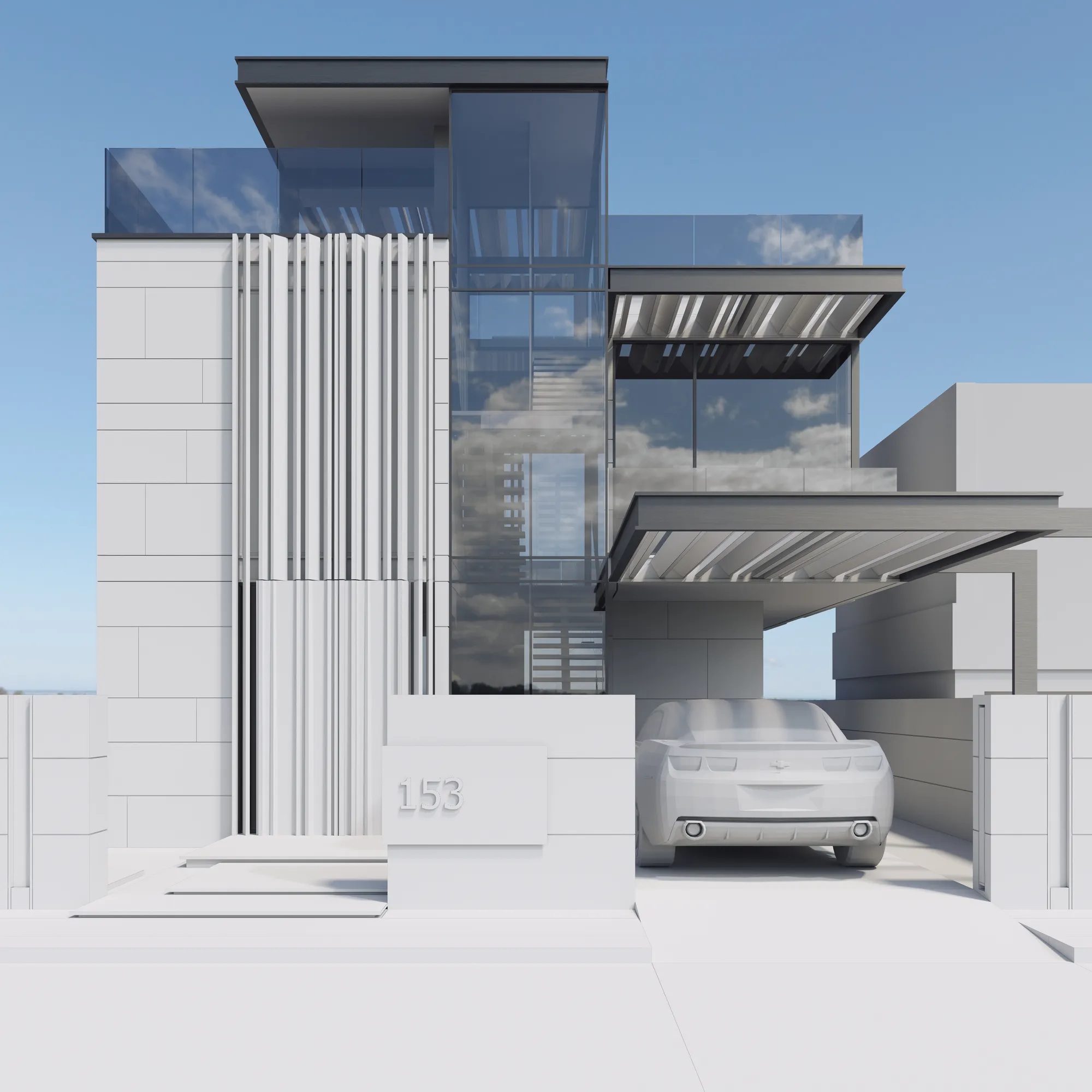
BIO-HOME project
single family home project

Indonesia is a country with lush tropical vegetation. Despite the dense urban development, greenery here tries to occupy every free square meter.
The goal of this project is to help it do this.
Basic principles of house design:
1. Maximum use of the roof for landscaping.
2. Place the house on the site as harmoniously as possible in relation to nature
3. Integrate nature from outdoor to the house inner space as much as possible
4. Create a comfortable environment for family life. Organize areas for joint leisure time and recreation, as well as organize personal spaces for each inhabitant
5. Be guided by the principles of environmental friendliness and smart house energy efficiency
A typical task for an architect is to strike a balance between nature and residential development. To endow the house with everything necessary for a comfortable family life, to make a bias in favor of nature.
Working on the project, first of all, I wanted to blur the line between interior and exterior.
The kitchen-living room space is separated from the terrace by a glass partition. So the space seems wider and as if it unites with the street. The kitchen flows smoothly into the outdoor barbecue area. I make the most of the floor-to-ceiling windows. More glazing means more light. All bedrooms and bathrooms have floor-to-ceiling windows.
Baths by the window - comfort and benefits for the state of mind

In finishing the facade I use natural stone of matte texture (travertine), which gives a natural feeling of tactility and naturalness.
An integral part of the design of a bio-house is to use roofs at maximum. In this project, two-tier flower beds are organized on the roof. Low bushes are planted on the first tier, tropical trees are on the higher tier.
Interior Design
The design traces a combination of a small amount of natural textures: travertine, brown metal and wood.
Also used in the design are vertical and horizontal slats.
Slats are a distinctive design element of the house. There are both horizontal (used in hinged structures) and vertical (front door area on the facade). The slats are grouped and have a different angle of rotation relative to each other. These slats are used in the fence, facade decoration and also in the interior: staircase area and double-height space. This is the unifying element. It gives the house a single style and, as it seems to me, is remembered.


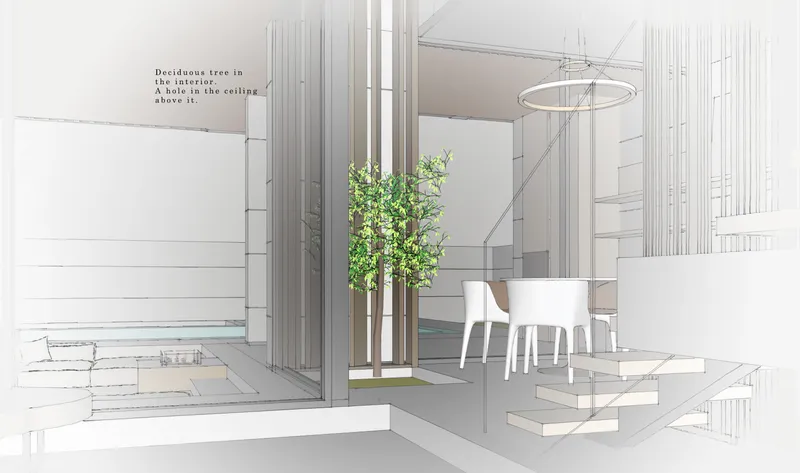
How is nature integrated into the interior?
Deciduous tree in the interior of the kitchen-living room is the central object. Above the tree is a double-height space so that it has the opportunity to grow, develop and receive vital sunlight.
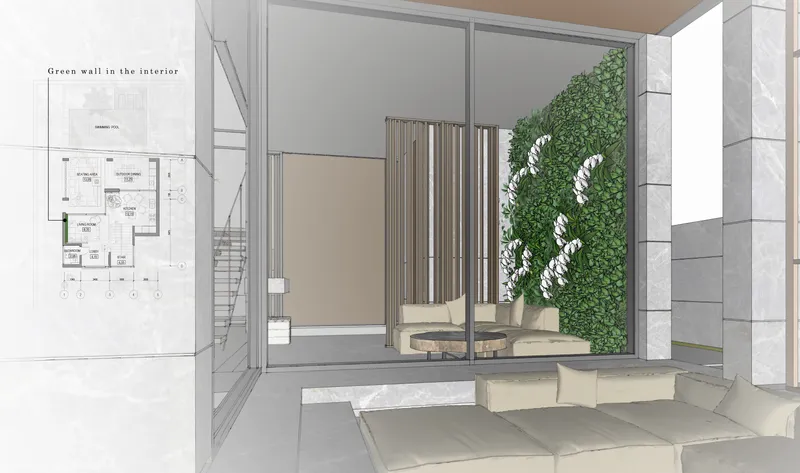
There is also a green wall behind the sofa in the living area.
Arrangement on Master Plan
When starting to place a building spot on the site, I was guided by the principles of harmony and balance. I wanted to make the courtyard as large, functional, and green as possible. But at the same time, I did not want to adjoin the facade tightly to the road. I wanted to leave the space in front of the entrance, play out the composition of the entrance and place the flower beds, despite the fact that while analyzing the surrounding buildings and plots, I noticed that most of the buildings are close to the road.
You may also notice that I have added a sidewalk. In reality, there is no sidewalk on this street, but, theoretically, within the framework of the development of the city, it could appear.
I also made paths along the side facades of the house so that you can walk around the house around the perimeter.
House composition
I immediately decided that the house should have a large percentage of glazing. After all, this is a bio-house. There must be unity between the house and the street. Thus, large floor-to-ceiling windows are present in every bedroom. There are also windows in every bathroom. And the living room is separated from the terrace on the ground floor by a large glass partition.
I wanted to make the staircase light and expressive. So that it looks good from the main facade. And also as open as possible, since the area of the ground floor is rather small and I didn't want to put extra walls.
Companioning the premises of the first floor, I realized that the floor would protrude as a cantilever towards the courtyard. Thus, we have a canopy for the terrace: a barbecue area and a sofa lounge area.
Everything matters. Sun loungers are located in the pool itself. Thus, the pool spot turned out to be larger, and its shape is more complex, more pleasing to the eye.
As I was creating this project, I realized more and more that this project is something very close to me, and I can imagine with ease and pleasure how I could live in this house with my loved one.




Popular Articles
Popular articles from the community


The Musturak Paradise: Senior Living Architecture for a Connected Future in Temara, Morocco
The Musturak Paradise reimagines senior living architecture in Temara via private homes, social spaces, culture, community, and shared care.

Hill & Cross Opera: Sculptural Opera House Architecture Shaped by Tallinn’s Landscape and Identity
Hill & Cross Opera reimagines opera house architecture in Tallinn through its sculptural hill, civic plaza, glass wave and a luminous cross.

Conexión: Biophilic Design Reimagines High-Rise Living in Hong Kong
Conexión reimagines high-rise living in Hong Kong through biophilic design, green facades, shared spaces, daylight, water and nature within.

Co-Life: Senior Housing Design That Reconnects Older Adults With the City
Co-Life reimagines senior housing design through healing gardens, shared streets, workshops, and a sustainable community across generations.


Similar Reads
You might also enjoy these articles

Day and Night Park: A Time-Based Urban Newsstand in Beijing
A temporary urban newsstand in Beijing blending travel, light, and reading through poetic colors, compact form, and community-focused design.

Modernist Patio Renovation in El Masnou, Barcelona by Oliver Segura Arquitectura + Cebrià Arquitectura
Modernist patio renovation blending tradition and innovation with a movable pool, leveled floors, and Catalan materials in El Masnou.

Alto Residencial Coop: Cooperative Housing Development in Santiago de Compostela by Carbajo Barrios Arquitectos
A linear cooperative housing complex blending white volumes and perforated metal façades, enhancing community living, natural light, privacy, and urban integration.
Vil Genis School by BPA ARCHITECTURE – Massy, France
Vil Genis School in Massy, France, features sustainable design, south-facing classrooms, community integration, accessible spaces, and modern educational architecture.

Explore Villa Competitions
Discover active competitions in this discipline




Challenge to reimagine the Iron Throne


Photograph architecture without architects


Illustrate the lost glory of Angkor Wat - Render Challenge


Design challenge to reuse E-waste
Comments (0)
Please login or sign up to add comments
No comments yet. Be the first to comment!