
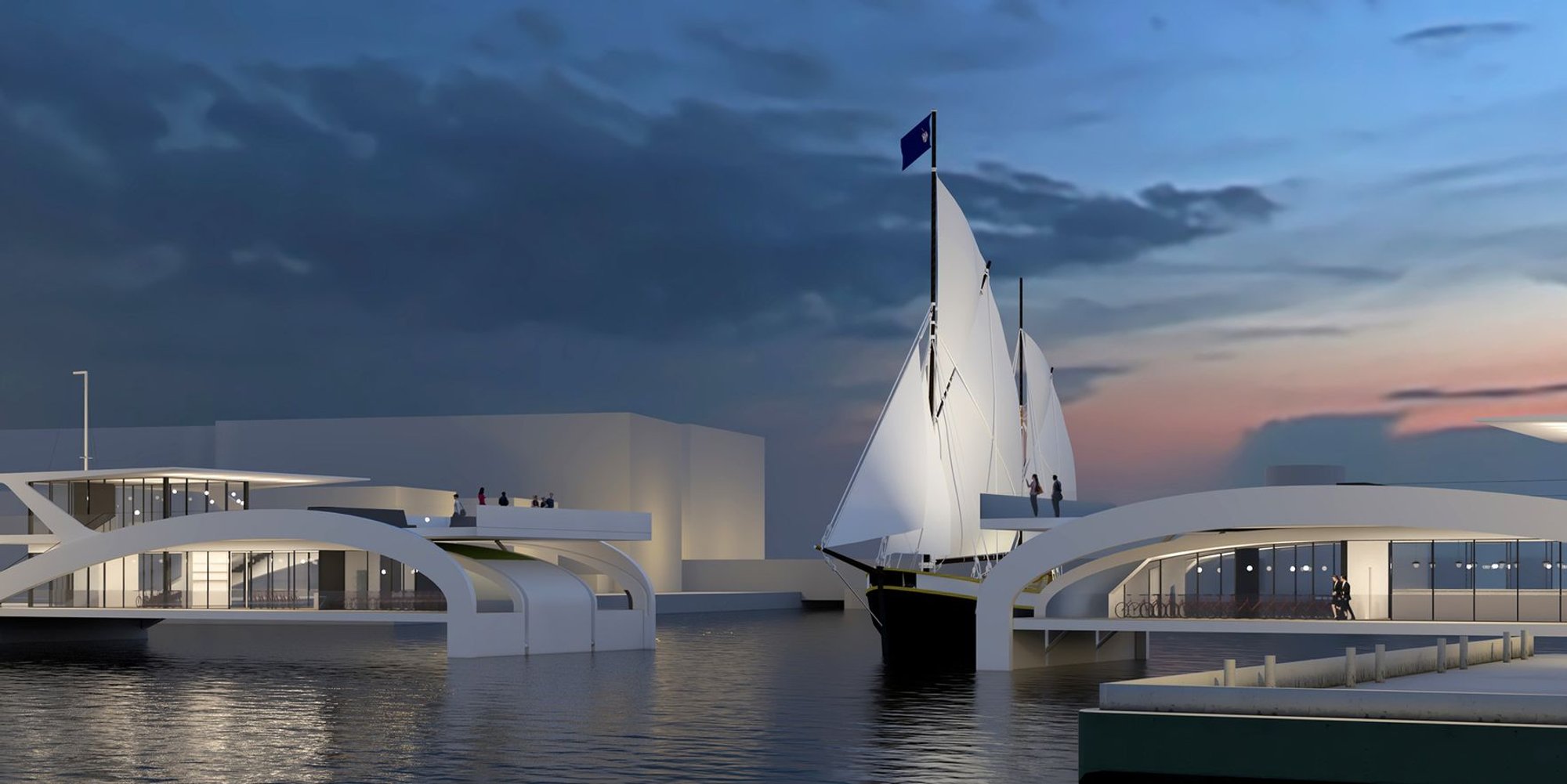
Biplane Bridge: Two Levels of Public Life Over Copenhagen's Harbor
A movable cycle-pedestrian bridge that stays open to people even while lifting, layering cafes and workshops above the waterline.

What happens when a bridge refuses to be just a bridge? The Biplane Bridge in Copenhagen's main harbor answers that question with a two-level movable structure that houses cafes, workshops, terraces, a cycling lane, and a pedestrian sidewalk, all while remaining accessible to foot and cycle traffic even as its decks lift to let boats pass. It is infrastructure that performs, socially and mechanically, at the same time.
Designed by Vjačeslav Bezuško, the Biplane Bridge is positioned to connect Copenhagen's historic center with Freetown Christiania, linking existing and proposed cycling networks in a city already committed to sustainable transport. Its silhouette, recalling the wings of a biplane or the hull of a ship, is a deliberate nod to Copenhagen's maritime culture. The project proposes a new typology for bridge architecture: compact, civic, and layered with program.
A Harbor Silhouette Built from Movement Metaphors
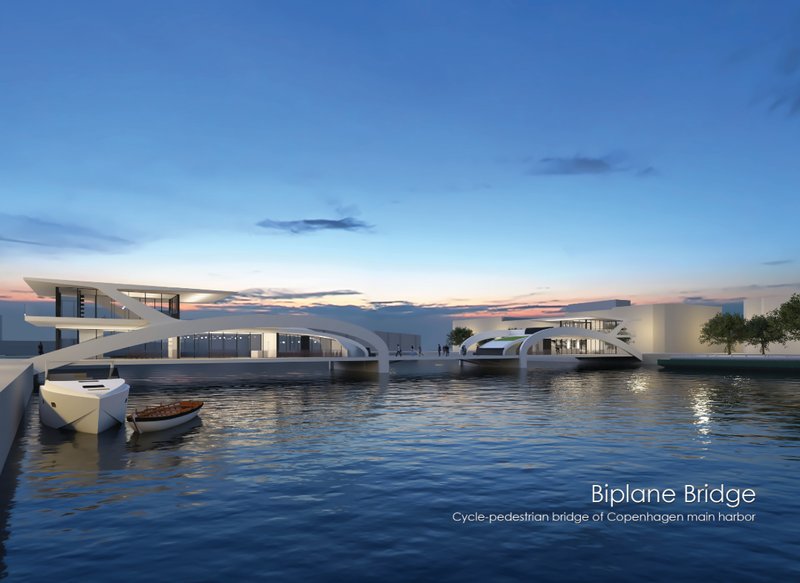
Seen from the waterfront at dusk, the bridge's clean white curves catch light like sails. The elevated geometry arcs over moored boats, creating a profile that people have compared to birds, ships, and airplanes. These are not accidental associations. Bezuško draws on an associative landscape specific to Copenhagen: natural and human-made elements that evoke freedom, connection, and flight. The result is a piece of infrastructure that reads as a landmark from a distance and as a public room up close.
Hydraulic Decks That Lift Without Closing
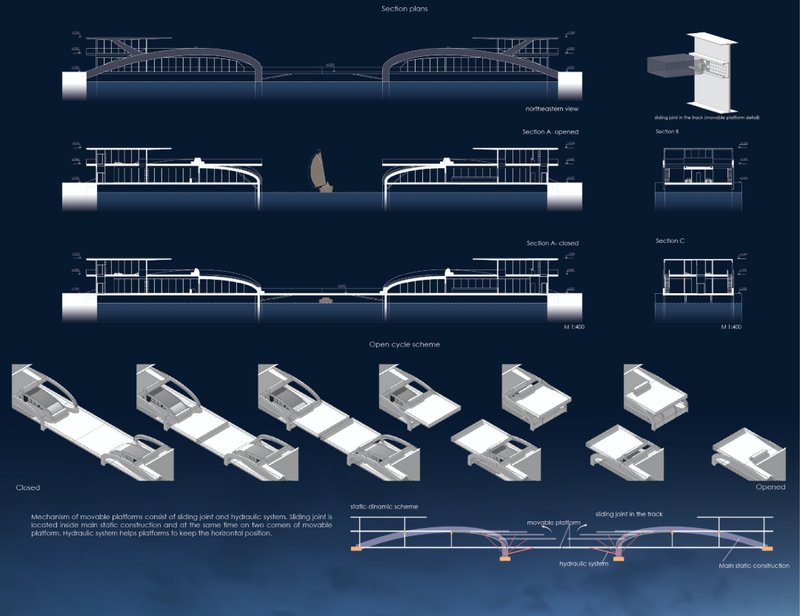
The technical drawings reveal the bridge's defining innovation: a hydraulic system with sliding joints that lifts and expands the deck platforms to allow boats to pass beneath. Crucially, the bridge does not shut down during this operation. Pedestrians and cyclists are elevated to the upper public zone rather than being stopped at a barrier, turning what is typically dead time in urban transit into an unexpected moment of public life. The sections and isometric diagrams show how the two levels stack: the lower level functions as a thoroughfare, while the upper level becomes a place for pause, reflection, and interaction.
Side platforms house the one-way cycle path and pedestrian sidewalk, keeping through-traffic flowing along the edges. The core of the bridge is reserved entirely for public program. It is a spatial inversion of the typical bridge hierarchy, where movement dominates the center and services, if they exist at all, are pushed to the margins.
A Cafe Under Angular Geometry
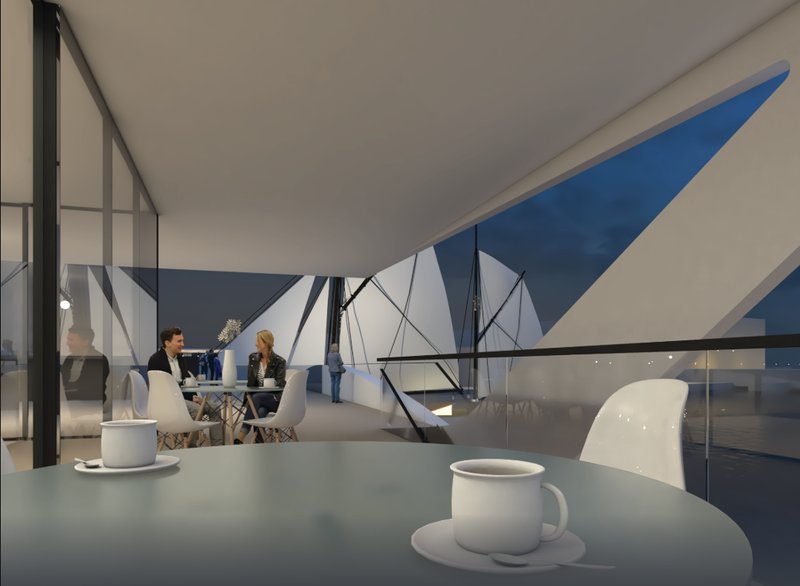
Inside the upper level, the angular ceiling geometry creates a sheltered, intimate space that feels more like a neighborhood cafe than a piece of transport infrastructure. The rendering shows two people seated at a table beneath faceted structural planes, warm light filtering in from the harbor. The deliberate inclusion of hospitality program, a cafe, shaded seating zones, workshops, ensures the bridge generates social activity beyond commuting hours. It is designed for lingering, not just crossing.
Red Lane, Glass Storefronts, Constant Rhythm
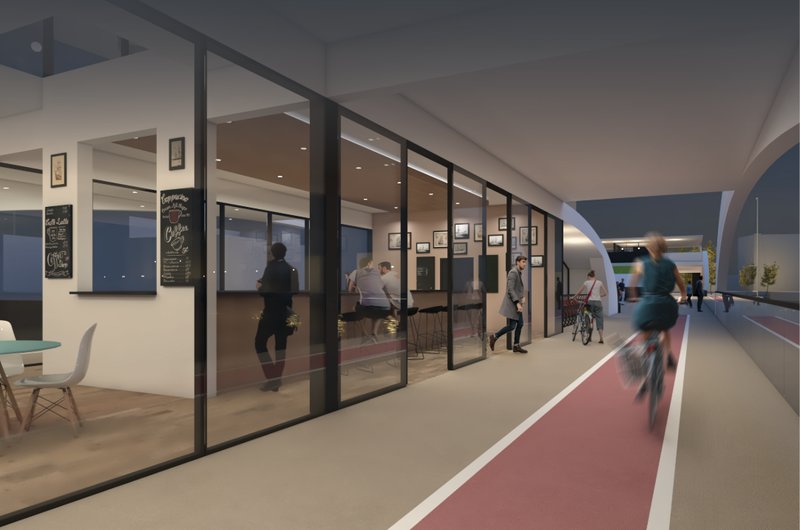
The interior corridor captures the dual-purpose logic of the bridge in a single frame. A red cycling lane cuts through the space with clarity, directing bike traffic along its dedicated path while pedestrians move past glazed storefronts on either side. The motion blur in the rendering is telling: this is a space designed for a constant rhythm of movement and social activity, where speed and stillness coexist. Workshop and community program spaces sit behind the glass, visible to passersby and activated by them.
Why This Project Matters
The Biplane Bridge challenges a stubborn assumption in urban design: that bridges are mono-functional connectors, tolerated as necessities but rarely celebrated as places. Bezuško layers civic program onto infrastructure without compromising the primary task of getting people across water. The hydraulic mechanism that keeps the bridge accessible during boat passage is not just an engineering detail; it is a statement about how cities should treat their residents' time and experience.
Positioned between Copenhagen's historic center and Freetown Christiania, the bridge occupies a charged threshold. Its design responds to that condition by being more than a line drawn between two points. It is a public room suspended over the harbor, a place of memory, encounter, and daily ritual. As cities increasingly ask infrastructure to do more, the Biplane Bridge offers a convincing model for how contemporary bridge architecture can redefine the way we inhabit movement.
View the Full Project
About the Designers
Designer: Vjačeslav Bezuško
Enter a Design Competition on uni.xyz
uni.xyz runs architecture and design competitions year-round that reward proposals with spatial conviction and real site intelligence.
Project credits: Biplane Bridge by Vjačeslav Bezuško.




Popular Articles
Popular articles from the community

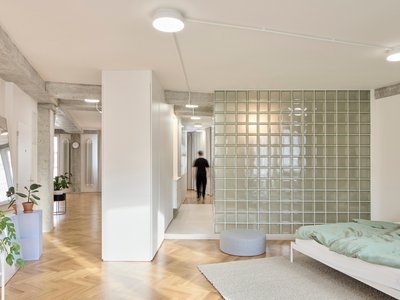
RDTH architekti Rips Out Nearly Every Wall in a Prague Apartment and Replaces Them with Furniture
A 101-square-meter post-war flat in Prague trades rigid partitions for a single rotated furniture block, curtains, and glass concrete.
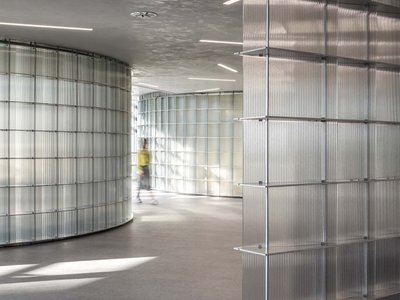
HCCH Studio Wraps a Shanghai High-Rise Office in Curved Walls of Translucent Glass
A 1,000 square meter fit-out in Lujiazui replaces the typical tech-office palette with layered glass, micro-cement, and quiet rigor.
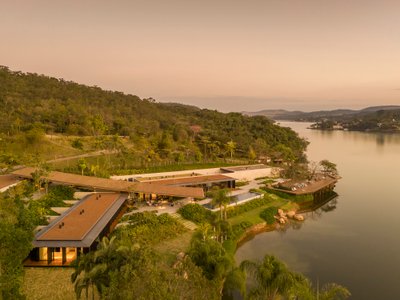
Bernardes Arquitetura Stretches a Timber Roof Along a Reservoir's Edge in Minas Gerais
Dam House in Itaúna lets a sweeping wooden canopy dissolve the boundary between hillside terrain and open water.
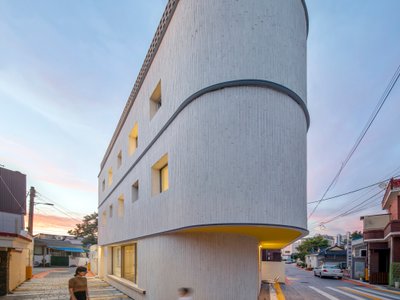
YOAP Architects Round a Corner in Yeongcheon with a Cylindrical Community Hub
A 197-square-meter brick and ribbed-clad tower turns a forgotten alley corner in South Korea into a public garden with a low threshold.


Similar Reads
You might also enjoy these articles

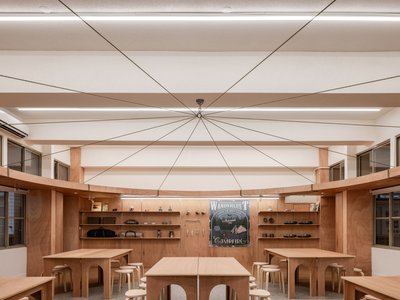
317studio Turns an 87 m² Classroom into a Forest Clearing for Scouts in New Taipei City
A rope canopy, student-made specimens, and campfire geometry replace rows of desks in this Scouting classroom in Xizhi District.
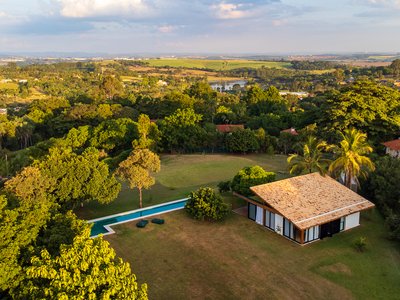
24 7 Arquitetura Builds a Timber Pavilion as a Family's First Act on a 5,000 m² Brazilian Plot
In Jaguariúna, a prefabricated glulam house nestles among mature trees as the opening move of a larger residential masterplan.
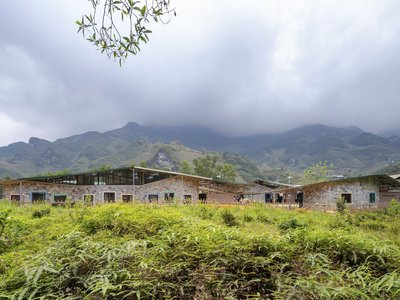
1+1>2 Architects Build a School from 900 Blocks of Hmong Stone on Vietnam's Rocky Plateau
On a barren valley in Ha Giang province, a community quarried its own stone to raise a kindergarten and primary school rooted in Hmong identity.
100A Associates Builds a Volcanic Stone Retreat on Jeju Island Rooted in Ritual and Restraint
Watarstay [Wa:Tar] in Bongseong-ri channels Jeju's basalt, reed, and hemp into a 150 m² hospitality space shaped by contemplation.


Explore Public Building Competitions
Discover active competitions in this discipline




The International Standard for Design Portfolios


The Global Benchmark for Architecture Dissertation Awards


The Global Benchmark for Graduation Excellence


Challenge to re-imagine a department store in present times
Comments (0)
Please login or sign up to add comments
No comments yet. Be the first to comment!