
BlahBlah: A School Where Circulation Becomes Curriculum
Winner of School of Thought, this modular learning framework replaces rigid corridors with slides, ramps, and planted terraces that let students define the


What if the walk between classrooms mattered more than the classroom itself? BlahBlah takes that provocation seriously, proposing a school where the circulation system is intentionally convoluted and exploratory: slides, ramps, and elevated walkways replace corridors, turning movement through the building into an act of discovery. There are no singular routes, no enforced directionality. The architecture refuses to tell students where to go, offering instead a spatial web that rewards curiosity with unexpected encounters, planted pockets, and moments of spontaneous exchange.
Designed by Cevsen Kocaman, BlahBlah won the School of Thought competition with a proposal that treats the school not as an institution of discipline but as a living organism responsive to its users. The project decentralizes programming across workshop units, farming zones, food courts, showcase terraces, and quiet retreat spaces, all held together by a modular carrier structure designed for long-term spatial reconfiguration. The result reads less like a school and more like a small city organized around the principle that learning happens through doing, through movement, and through social exchange.
A Structural Grid That Invites Reinterpretation
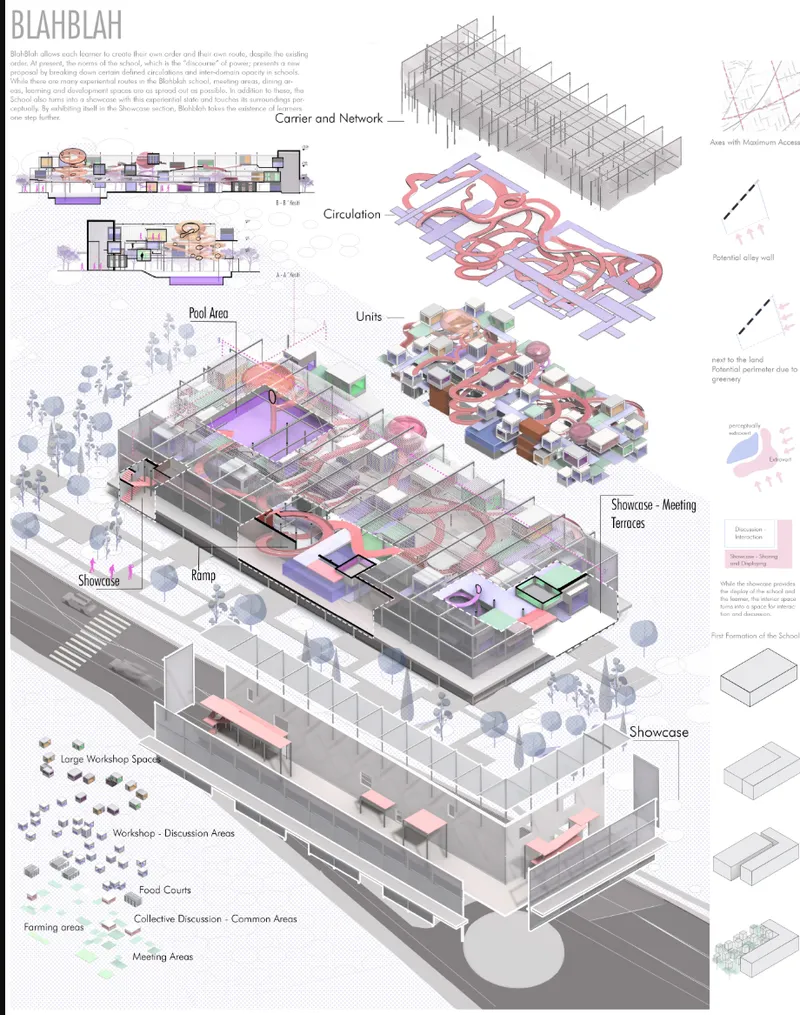
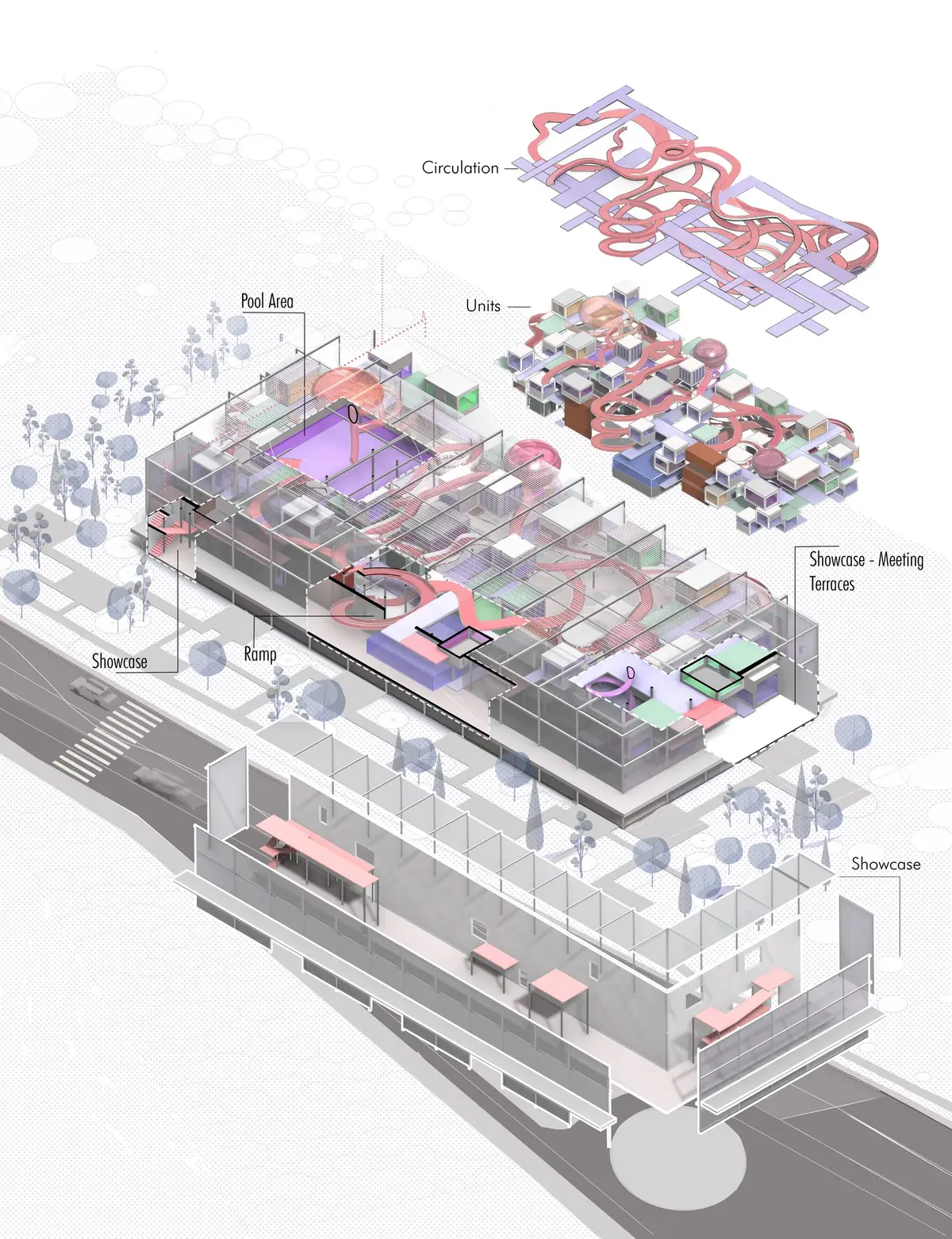
The exploded axonometric drawing reveals the logic behind BlahBlah's apparent informality. A structural grid provides the underlying order, but the program zones layer onto it with deliberate looseness: workshop pods, discussion areas, green pockets, and social platforms occupy different strata, connected by curving circulation ribbons that weave through and around the volumes. The drawing makes clear that no single floor plate dominates. Instead, each layer is porous, allowing visual and physical connections between levels. This is a carrier structure conceived for adaptability, where units can be reconfigured as the school's needs evolve.
Threshold as Welcome: The Ground Level Entry
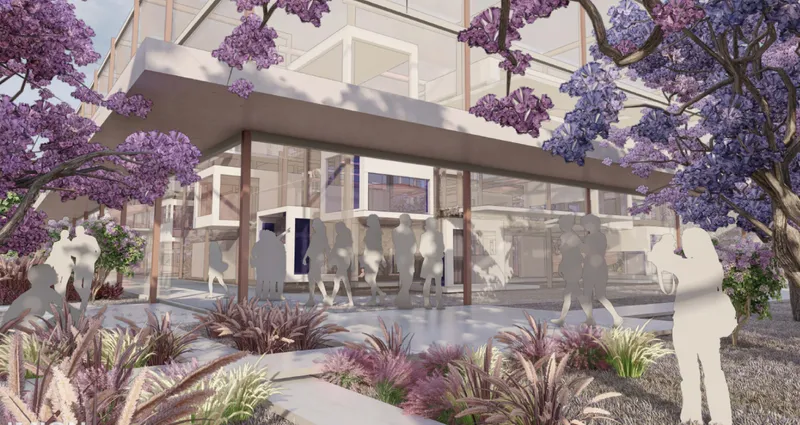
At ground level, a canopy supported by slender columns frames a glazed lobby set among blooming jacaranda trees. The entry condition is porous and generous: there is no monumental gate, no bottleneck that funnels students into a controlled sequence. The landscape bleeds into the building, setting the tone for an architecture that dissolves the boundary between inside and out. This threshold signals from the first step that BlahBlah operates on different terms than a conventional school.
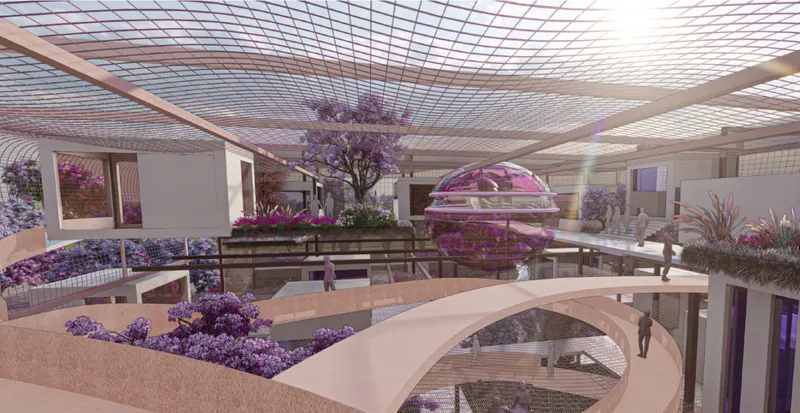
Step inside, and the interior atrium confirms that promise. Curved bridges span across planted terraces beneath a cable net skylight, creating a vertical landscape where students can look up, down, and across to see activity happening at every level. The atrium functions as the school's social engine: a space of passive surveillance that is communal rather than authoritarian, where seeing and being seen fosters connection rather than control. The planted terraces embedded within the section ensure that nature is not relegated to the perimeter but threaded through the core of the building.
Stacked Volumes and Curving Ribbons in Section
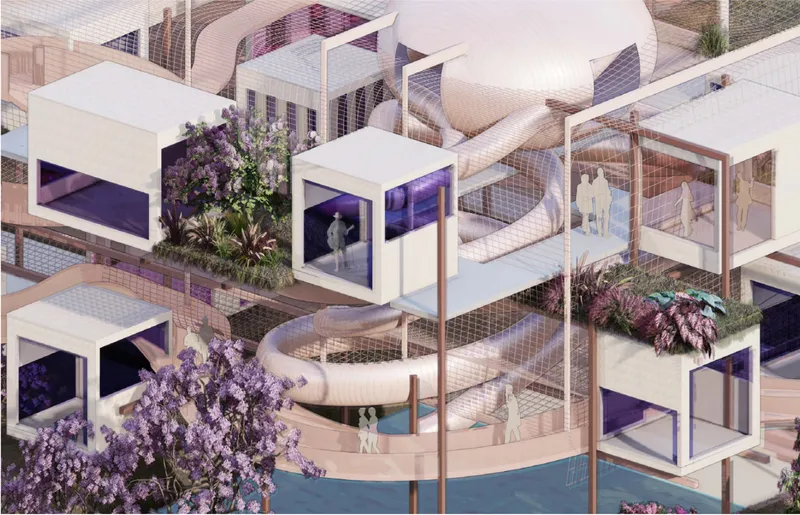
The sectional drawing through BlahBlah is where Kocaman's spatial argument becomes most legible. White volume units stack and offset, interwoven with planted terraces and looping circulation paths that curve between floors. The section reveals that no two routes through the building are identical. Ramps wrap around program clusters, slides offer rapid descent, and elevated walkways bridge gaps between units. This is circulation as pedagogy: the act of navigating the building becomes an exercise in choice, orientation, and spatial awareness. Quiet retreat zones and spaces for mental reset are also visible in the section, tucked into moments of calm within the kinetic whole, accommodating diverse neurodivergent needs alongside the more socially charged program.
Filtered Light and the Interior Courtyard
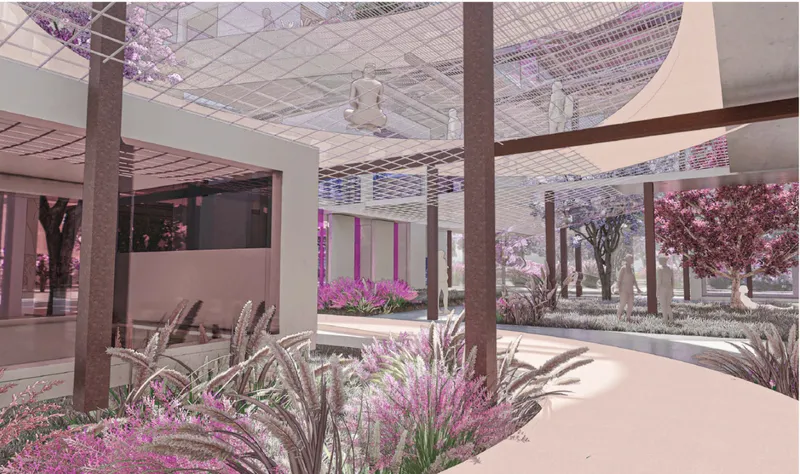
One of the project's quieter but most effective moves is the interior courtyard, where a mesh ceiling grid filters light over planted beds and seating areas beneath columns. The quality of light here is diffuse and gentle, a deliberate contrast to the energetic circulation zones. This is where the farming and green pocket strategy becomes tangible: students engage with soil, growth, and seasonal rhythms in a space that feels protected yet open to the sky. It is simultaneously a place for sustainability education and for simply sitting still, a reminder that BlahBlah's vision of experiential learning includes contemplation alongside action.
Why This Project Matters
BlahBlah's strength lies in its refusal to separate the vessel from the pedagogy. Most school designs treat architecture as a container for a predetermined curriculum; Kocaman treats it as the curriculum itself. The building's modular carrier structure and decentralized program mean that it can absorb change without losing coherence. Showcase terraces for peer feedback sit alongside pool slides, farming zones abut discussion pods, and food courts become sites of informal learning. The hierarchy between formal and informal space is deliberately collapsed.
As a winning entry in School of Thought, BlahBlah earns its position not through formal spectacle but through a rigorous spatial argument: that schools shaped by centralized authority and opaque walls reproduce power structures rather than nurture independent thinkers. By making every path visible, every destination negotiable, and every surface available for reinterpretation, Kocaman proposes an architecture that adapts to its users rather than disciplining them. It is a school that trusts students to define what learning means on their own terms, and builds the spatial framework to let them do exactly that.
View the Full Project
About the Designers
Designer: Cevsen Kocaman
Enter a Design Competition on uni.xyz
uni.xyz runs architecture and design competitions year-round that reward proposals with spatial conviction and real site intelligence.
Project credits: BlahBlah by Cevsen Kocaman School of Thought (uni.xyz).


Popular Articles
Popular articles from the community

Extended Shell: Retrofitting Kolkata's Balconies as Living Urban Thresholds
A modular retrofit system recovers the social and environmental intelligence of Kolkata's historic verandas for contemporary Park Street residents.

Singing Woman: An Opera House That Performs Before the Curtain Rises
Ovidiu Cristian Pavel's conceptual opera house translates Estonia's choral identity into a sculpted waterfront landmark facing the Baltic Sea.

Opera on the Sea: Driftwood Logic Shapes a Timber Opera House on Estonia's Coast
Trevor Orgill's opera house translates the entangled drift of floating timber into a civic building where wood, water, and music converge.
Faces of the Soviet Avant-Garde: Turning Moscow's Street Names into an Open-Air Museum
A network of sculptural installations across a Moscow residential district transforms forgotten architect names into spatial encounters with cultural memor

Similar Reads
You might also enjoy these articles

Shakur's House: Exposed Brick as an Interior Organiser in a 168 m² Mashhad Residence
Brick moves indoors in this Mashhad residence, where masonry walls, glass partitions and teal planes sequence a compact home without closing it off.

Day and Night Park: A Time-Based Urban Newsstand in Beijing
A temporary urban newsstand in Beijing blending travel, light, and reading through poetic colors, compact form, and community-focused design.

Modernist Patio Renovation in El Masnou, Barcelona by Oliver Segura Arquitectura + Cebrià Arquitectura
Modernist patio renovation blending tradition and innovation with a movable pool, leveled floors, and Catalan materials in El Masnou.

Alto Residencial Coop: Cooperative Housing Development in Santiago de Compostela by Carbajo Barrios Arquitectos
A linear cooperative housing complex blending white volumes and perforated metal façades, enhancing community living, natural light, privacy, and urban integration.

Explore Experiential Architecture Competitions
Discover active competitions in this discipline

Challenge to design a shop stop sunk in the city

Challenge to design public laboratory
Comments (0)
Please login or sign up to add comments
No comments yet. Be the first to comment!