
blaq arquitectos Threads a Black Pine Cabin Through the Trees on Chile's Ranco Lake
A 140 m² lakeside retreat in southern Chile lifts off the hillside on stilts, wrapping its deck around existing trees to leave the landscape intact.


Nine hundred and fifty kilometers south of Santiago, on the forested shores of Ranco Lake, blaq arquitectos planted a house that barely touches the ground. Designed by Benjamin Litvak and Felipe Pommerenke as a second home for a young family, the Lake House is a 140 m² single-story volume raised on stilts, clad entirely in black-stained pine, and tucked so carefully among the existing trees that several trunks punch straight through its wraparound deck. The project treats remoteness not as a limitation but as the core design premise: everything here, from the material palette to the construction method, follows the logic of building simply, far from the city, with the resources and labor traditions available locally.
What makes the house worth studying is not the gesture of the dark box in the green landscape, which has become familiar enough. It is the way blaq arquitectos reduced the project to two horizontal planes, the terrace plate and the pitched roof, and let those planes do almost all the architectural work. Between them, glass and pine boards define rooms, frame views, and negotiate climate. The result is austere but not cold, specific to its site but replicable in its thinking.
Touching the Ground Lightly
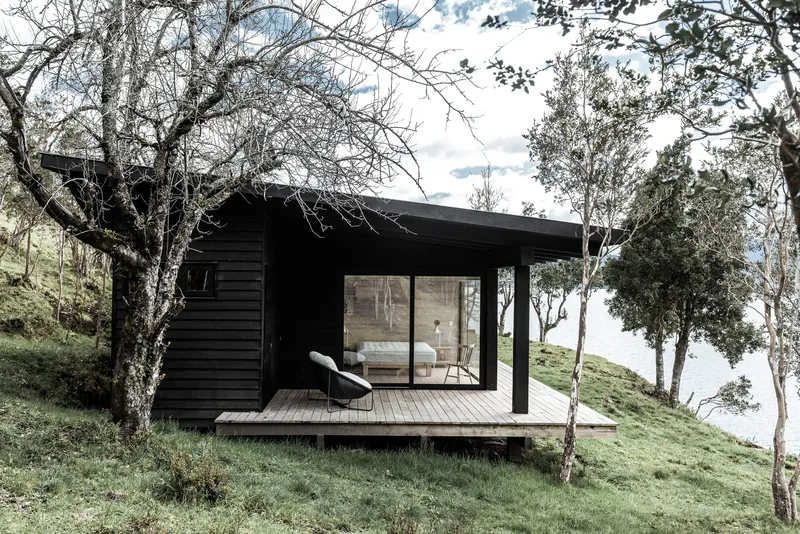

The sloping hillside drops toward the lake at a grade that would have demanded significant earthwork for a conventional foundation. Instead, the house sits on a field of piles that lift it above the terrain, following the slope without cutting into it. This strategy does two things at once: it eliminates the need for large excavation on a remote site where machinery is expensive to mobilize, and it preserves the root systems and drainage patterns of the trees that make the site worth building on in the first place.
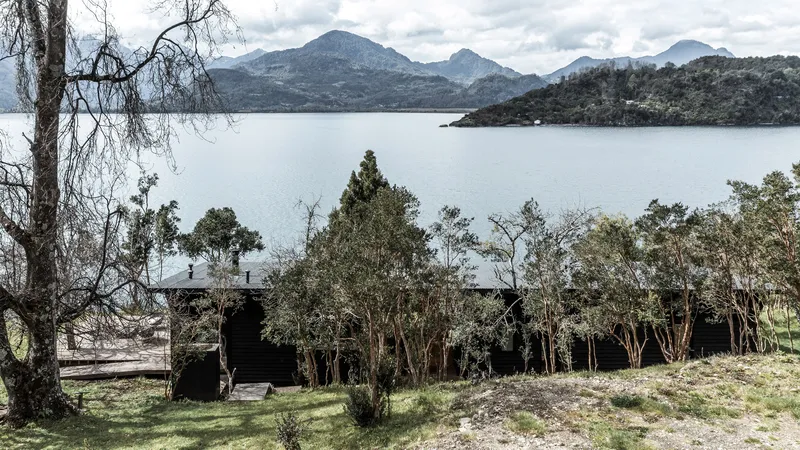
From a distance, the dark volume reads as a shadow among the trunks. The black pine cladding, laid in horizontal boards, absorbs light rather than reflecting it, and the low pitch of the roof keeps the silhouette compact. It is a deliberate act of visual restraint in a landscape where the lake and the Andes across the water are the subjects.
The Deck as Threshold
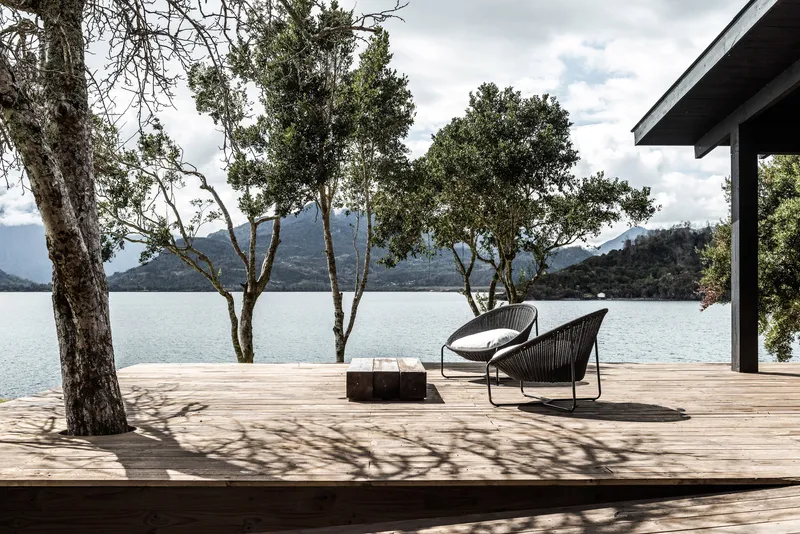
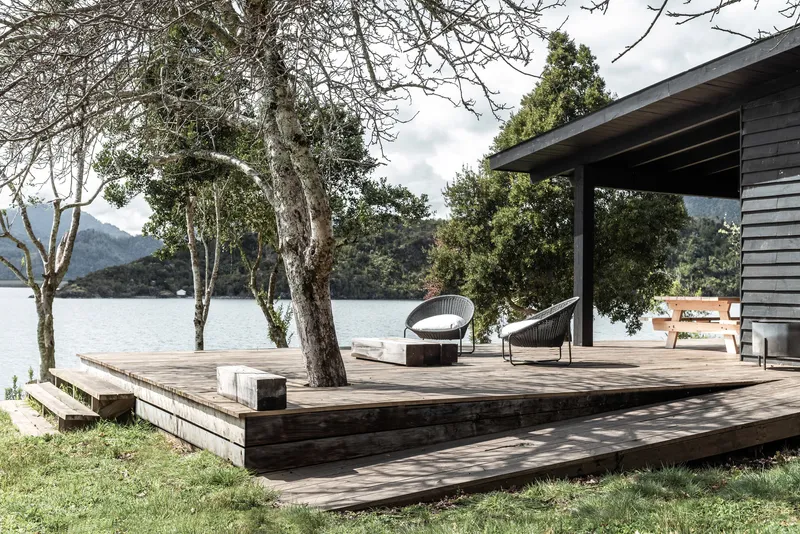
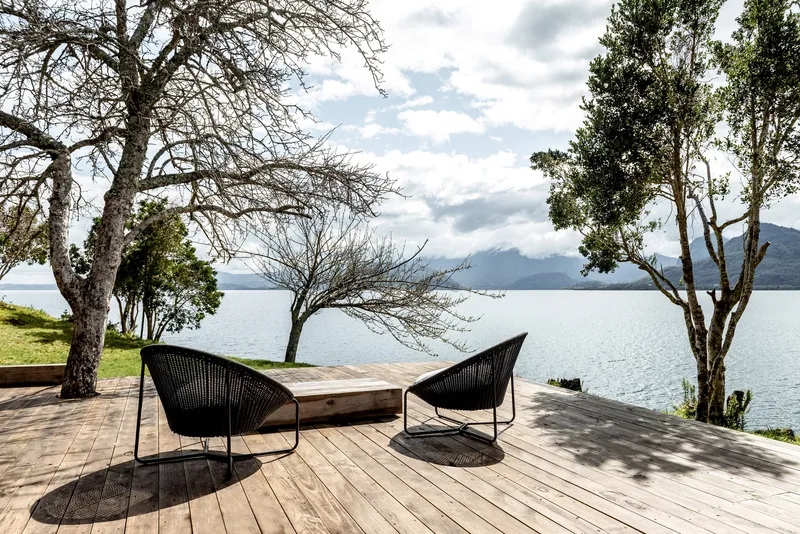
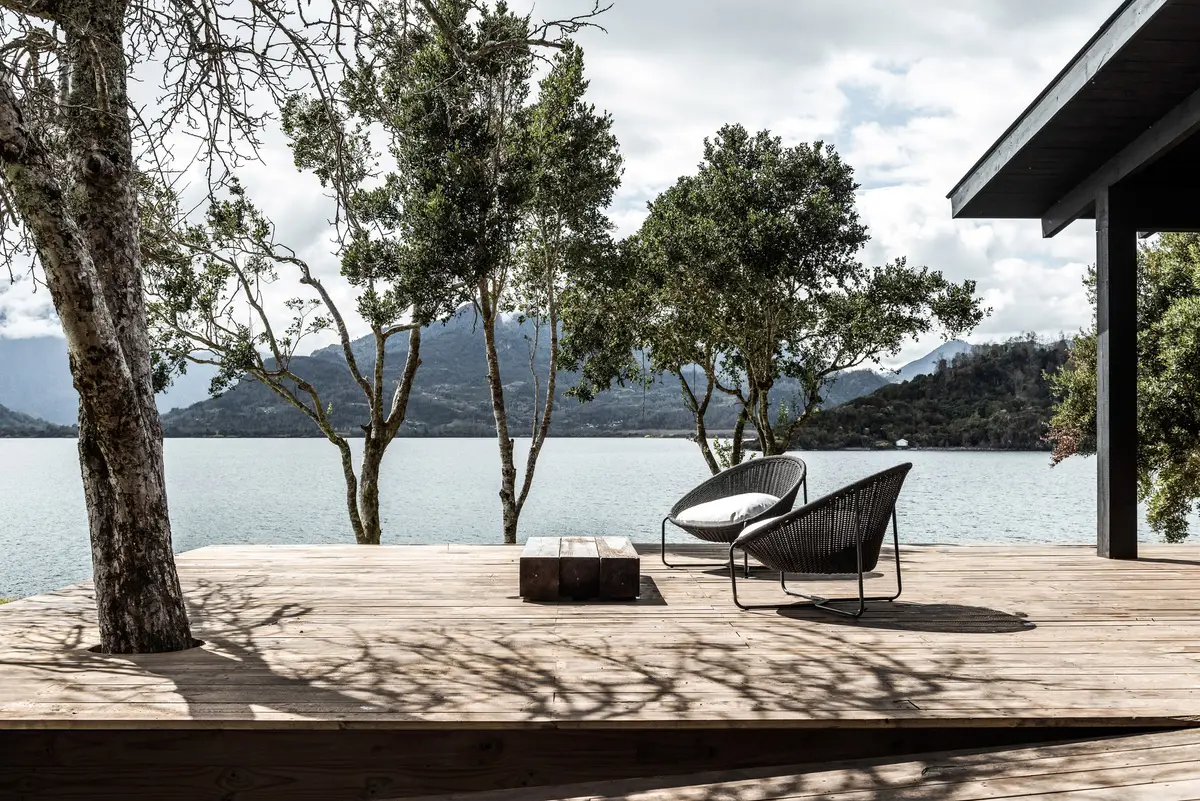
The most generous architectural move is the continuous timber deck that wraps the enclosed volume and extends it into the canopy. Where an existing tree stands in the way, the deck boards simply part around the trunk and continue on the other side. These moments are not incidental; they are the clearest statement of the project's ethic. Rather than clearing the site to build and then replanting later, the architects surveyed every tree position and designed the platform to accommodate them.
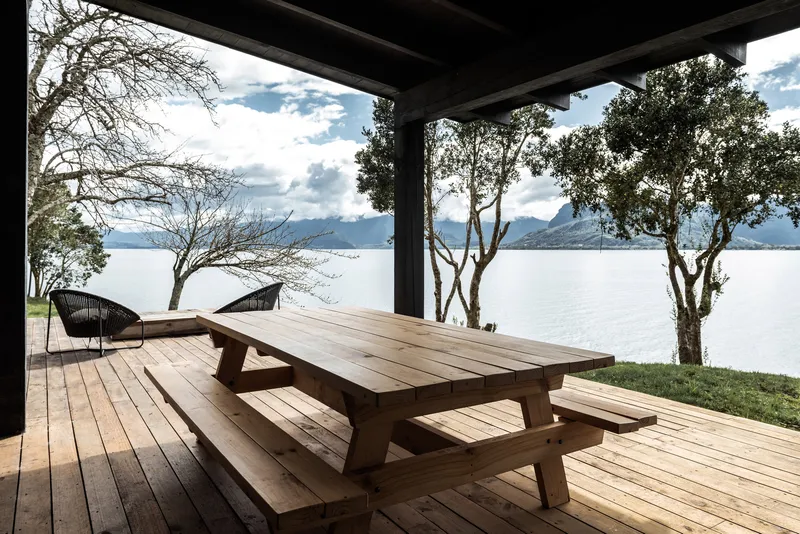
The deck also serves as the primary social space. With lounge chairs oriented toward the lake and the snow-capped peaks beyond, it becomes the room you use most during the hot southern Chilean summer. Deep eaves overhead protect it from both rain and direct sun, creating a covered intermediate zone that is neither fully inside nor fully outside. In a climate that swings from warm dry summers to wet winters near 4°C, this in-between condition is essential.
Black Columns, Long Views
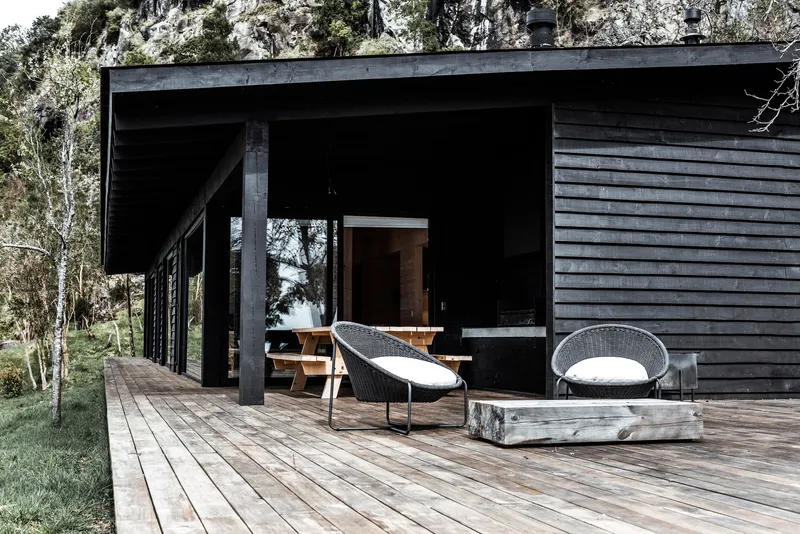
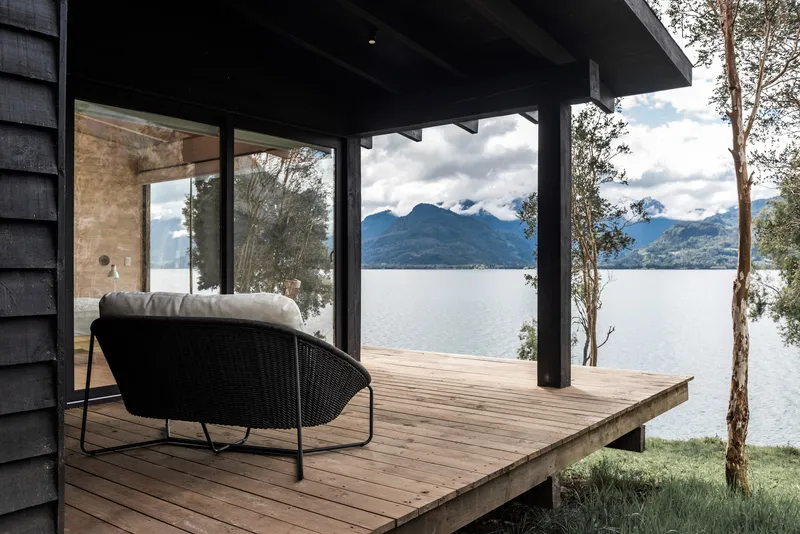
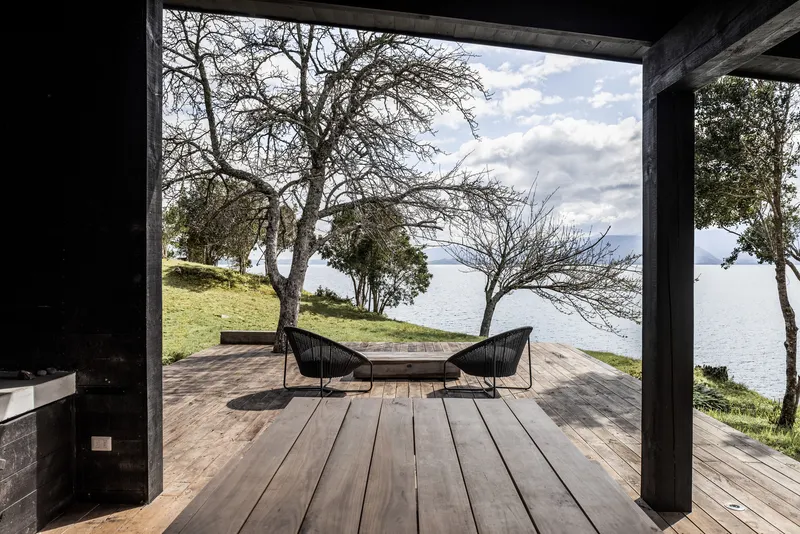
Beneath the eave, slim black steel columns carry the roof load and frame the view into a series of tall, narrow panels. The effect is cinematic: the lake and mountains appear as a sequence of vertical slices as you move along the covered porch, each step recomposing the panorama. Timber furniture, including a long picnic table and paired lounge chairs, sits quietly under the roof projection, scaled to the column rhythm.
The columns also solve a practical problem. By separating the structural role from the wall plane, they allow the glazing to run nearly uninterrupted along the lake-facing elevation. The wall becomes a membrane of glass and pine, not a load-bearing element, and the interior gains the wide openings that connect every room to the water.
Pine Inside and Out

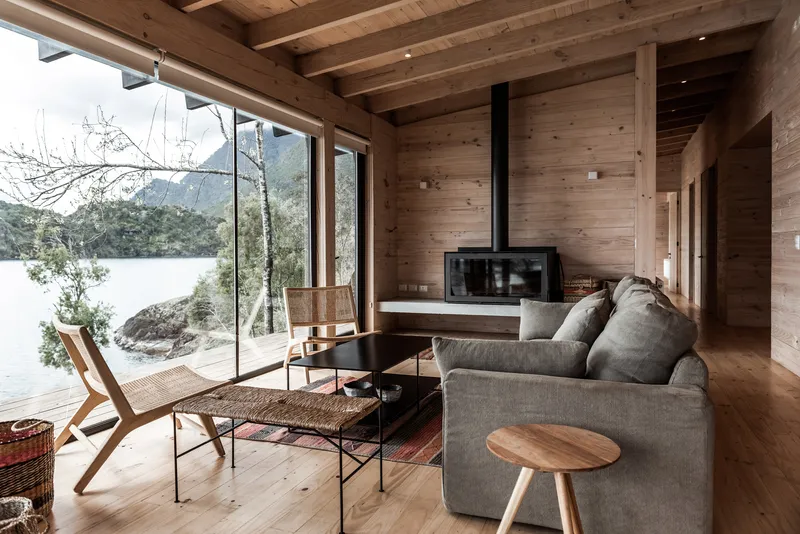

Step inside and the material language continues without interruption. Floors, walls, and ceilings are finished in the same local pine that clads the exterior, though here the wood is left in its warm natural tone rather than stained black. Exposed ceiling beams run the length of the rectangular plan, reinforcing the linearity and drawing your eye toward the floor-to-ceiling glazing at the end of each room. The consistency of material is total: there is no drywall, no plaster, no tile. Everything you touch is wood.
The open-plan living area, which combines sitting, dining, and cooking, occupies the northeast end of the volume. This orientation is deliberate. In the southern hemisphere, northeast-facing rooms receive winter sun during the low-angle months, keeping the common spaces bright and warm precisely when the family needs it most. A glazed corner opening in the living room frames a single tree trunk against the lake and the peaks beyond, a composition so precise it functions like a picture window engineered for one specific view.
The Kitchen as Counterpoint
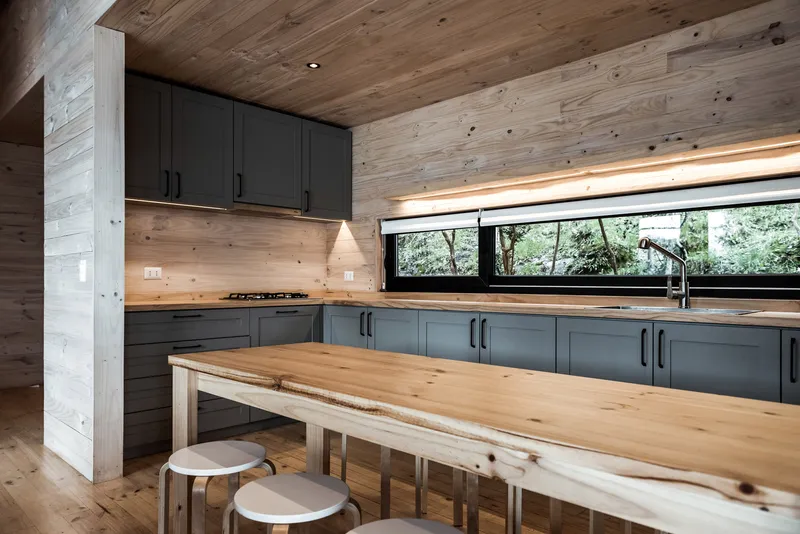

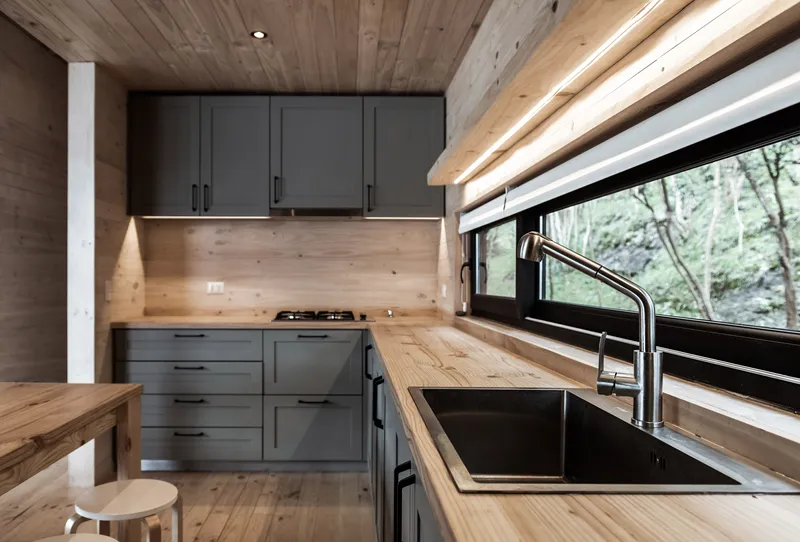
Against the warm envelope of pine, the kitchen introduces the only chromatic shift: charcoal-grey cabinetry with clean slab fronts. The contrast is disciplined rather than dramatic, grounding the workspace against the timber surfaces without breaking the material logic. Timber countertops and a long horizontal window above the sink keep the kitchen connected to the forest and the lake, ensuring that even the most utilitarian room in the house participates in the view.
The kitchen also reveals the architects' attention to proportion. The horizontal window sits at precisely the height where it frames treetops and sky but screens the ground plane, giving the cook a sense of floating among the canopy. It is a small calibration, but it shows how carefully the section was tuned to the experience of standing and working in the space.
Aerial Readings
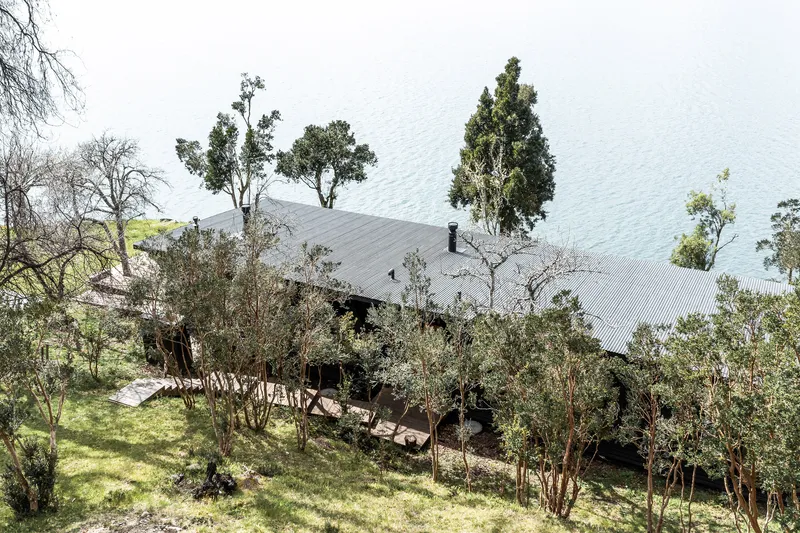
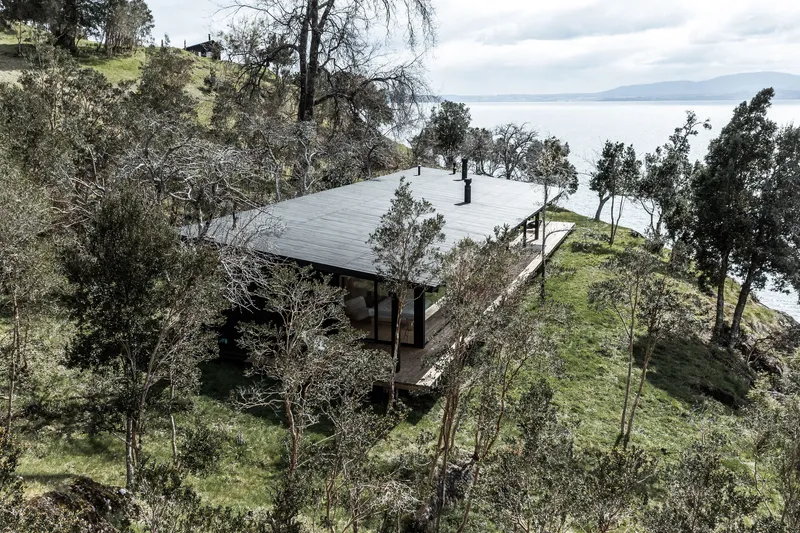
From above, the corrugated metal roof is almost invisible among the tree crowns. The low pitch and the muted surface finish mean the house registers as a gap in the canopy rather than an object on the hillside. This is the payoff of every decision the architects made: stilts instead of foundations, black cladding instead of light, trees kept instead of cleared. The ecological argument and the aesthetic argument converge in a single image.
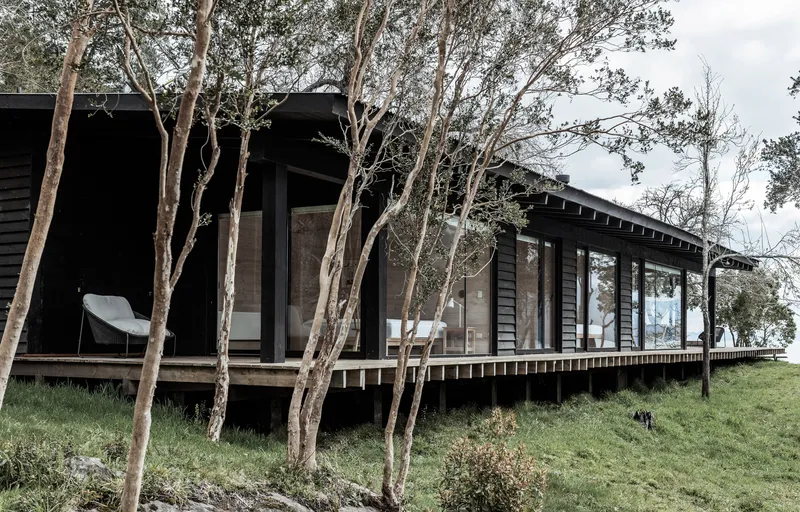
At ground level, the lakeside elevation reads differently. Seen through the screen of slender eucalyptus trunks, the continuous glazing and pale timber deck glow against the dark frame, announcing the presence of inhabitation without shouting. The house is legible as a domestic object only at the scale of the pedestrian; from the lake or from the air, it nearly disappears.
Plans and Drawings

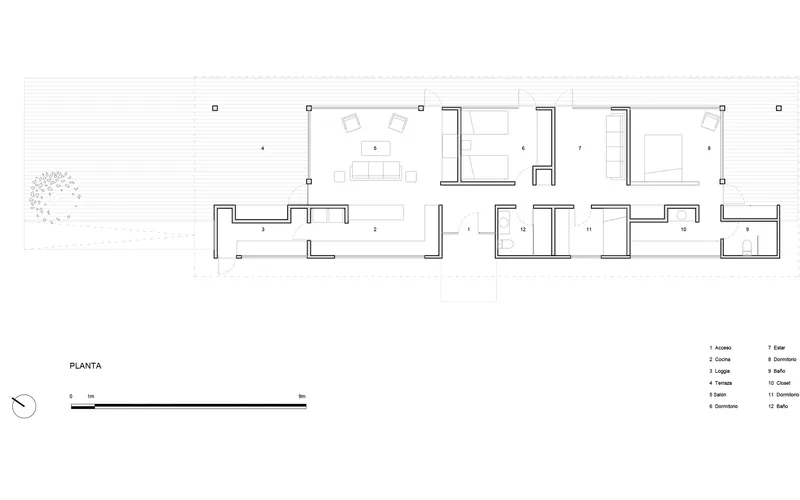
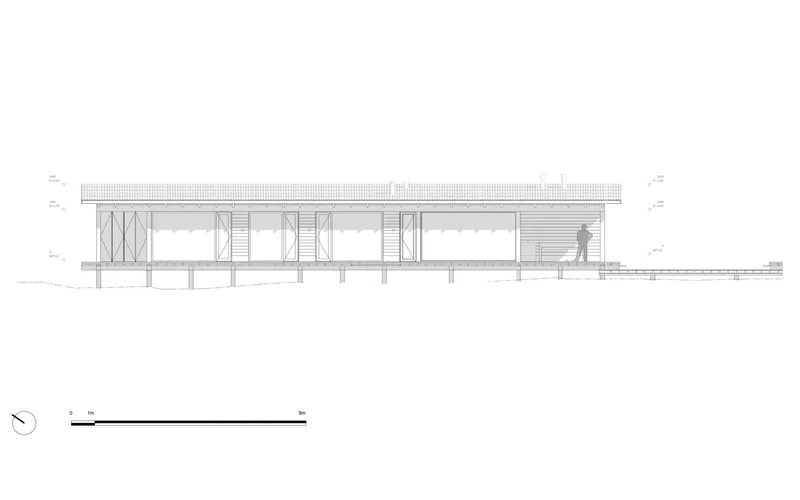
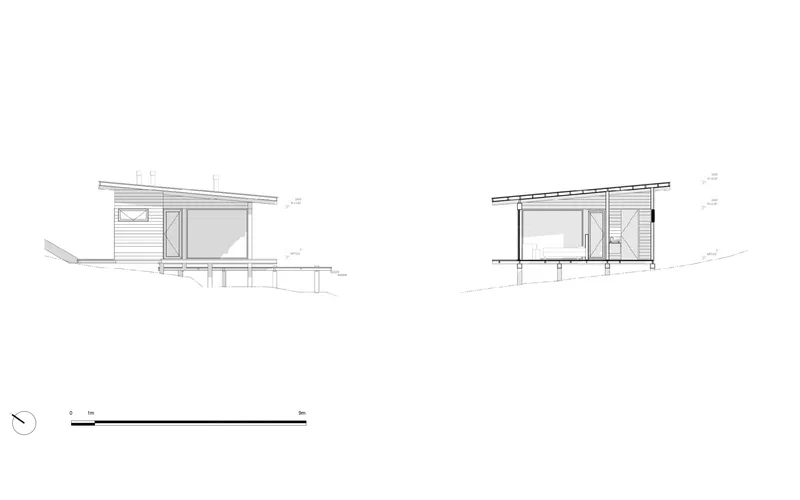
The site plan confirms the minimal footprint: a single linear bar placed along the contour lines, rotated to maximize lake views from every room while sitting parallel to the slope. The floor plan shows the organizational clarity. A central corridor runs the length of the rectangle, separating the bedrooms on the east (lake-facing) side from service spaces. Living, dining, and kitchen cluster at the northeast end, where they receive the most winter sun and the widest panorama.
The elevation and section drawings reveal how the stilts adapt to the terrain. The floor plate remains level while the column heights vary, absorbing the grade change without a single retaining wall. The roof overhang is generous enough to shelter the deck on all sides, and the section shows the pitched profile that sheds heavy winter rain while keeping summer sun off the glass. It is vernacular thinking executed with architectural precision.
Why This Project Matters
The Lake House is a reminder that restraint is not the absence of ambition. Every choice here, from the pile foundations to the deck openings around existing trees, is a decision not to do something: not to excavate, not to clear, not to import materials from the capital. That discipline produces a house that belongs to its site in a way that more assertive designs rarely achieve. The project also demonstrates that vernacular construction methods, local pine, simple framing, horizontal cladding, are not obstacles to spatial sophistication. The section is carefully tuned, the views are precisely composed, and the threshold between inside and outside is managed with real subtlety.
For architects working on remote residential projects, the Lake House offers a useful model. It proves that logistical constraints, limited access, distance from suppliers, unfamiliar labor pools, can be turned into generative parameters rather than compromises. blaq arquitectos did not build a simple house because they had to. They built a simple house because simplicity was the most intelligent response to the site, the climate, and the distance. That is a distinction worth paying attention to.
Lake House by blaq arquitectos (Benjamin Litvak, Felipe Pommerenke). Lago Ranco, Chile. 140 m². 2021. Photography by Teresa Fischer.
About the Studio
blaq arquitectos
Official website of blaq arquitectos, one of the studios behind this project.
blaq.clShare Your Own Work on uni.xyz
If projects like this are the kind of work you want to make, uni.xyz is a place to publish your own, find collaborators, and enter design competitions.


Popular Articles
Popular articles from the community


Manzana Morphosis: Stretching Barcelona's Grid into a Living Landscape for 2050
A radical reworking of the Eixample manzana turns density into a tool for generous public space, vertical ecology, and environmental performance.


graciastudio Turns a Viewless Tijuana Lot Inward Around a Courtyard of Concrete, Timber and Trees
In Tijuana, Jorge Gracia's GA2 House stacks a timber-clad private floor over exposed concrete and replaces a missing view with a planted interior patio.

ETEH Reworks the Shared Spaces of São Domingos School in Brazil Around Timber, Color and Hanging Plants
At São Domingos School in Brazil, 436 m² of hall, refectory and library are recast with timber joinery, a yellow and blue code and trailing greenery.

Opera on the Sea: Driftwood Logic Shapes a Timber Opera House on Estonia's Coast
Trevor Orgill's opera house translates the entangled drift of floating timber into a civic building where wood, water, and music converge.

Similar Reads
You might also enjoy these articles

LAVA Architecten Gives Vocational Education a Sawtooth-Roofed Face on a Mechelen School Campus
In Mechelen, Belgium, a 2,053 m² STEM school on a 6×6 m grid turns workshops and classrooms into rooms that can be rearranged as teaching changes.

KEMA Studio Turns a Derelict Marvila Attic into a 60 m² Lighthouse Apartment Above Lisbon
In Lisbon's Marvila district, a rebuilt roof, four skylights and two plywood volumes turn an unlivable attic into a bright home facing the Tagus.

Pixel Gardens: One Repeated Module Stacked Into a Terraced Social Housing Tower for Famagusta
Salem Bader's shortlisted housing tower builds a vertical neighbourhood from one repeated module, offsetting units to carve terraces, light and air.

Bao Huynh Watercolor Atelier: A Serene Art Retreat in Hội An
Bao Huynh Watercolor Atelier in Hội An blends multifunctional art spaces, sustainable design, local materials, and family-friendly living in a serene environment.
Explore Plug-In House Competitions
Discover active competitions in this discipline

Challenge to design mud housing for contemporary communities

Challenge to reimagine the Iron Throne

Photograph architecture without architects

Illustrate the lost glory of Angkor Wat - Render Challenge
Comments (0)
Please login or sign up to add comments
No comments yet. Be the first to comment!