

Bollywood Heights: A Vertical Film City Rising from an Artificial Island in Mahim Bay
An undergraduate thesis stacks sound stages, studios, a museum and a hotel into a twin-core diagrid tower on an island that filters Mumbai's polluted bay.


Mumbai makes more films than almost anywhere on earth, yet the industry's physical home has always been horizontal: sprawling studio campuses, back lots and sets spread across scarce urban land. Bollywood Heights...A Film City Tower asks a blunt question. What happens if you take the entire film city and stand it on its end? The answer is a single twisting tower where production, post-production, exhibition and public spectacle share one vertical ecosystem, set on a new island in one of the city's most damaged stretches of coast.
Developed as an undergraduate thesis by Vaishaly Archi, the project sits in Mahim Bay along the Arabian Sea. It responds to three pressures at once: Mumbai's shortage of land, the environmental stress on its waterfront, and Bollywood's standing as a global cultural industry. The ambition is large, and the most interesting thing about the thesis is that it treats that ambition as an infrastructure problem as much as an image problem.
A Film City Compressed into One Twisting Silhouette
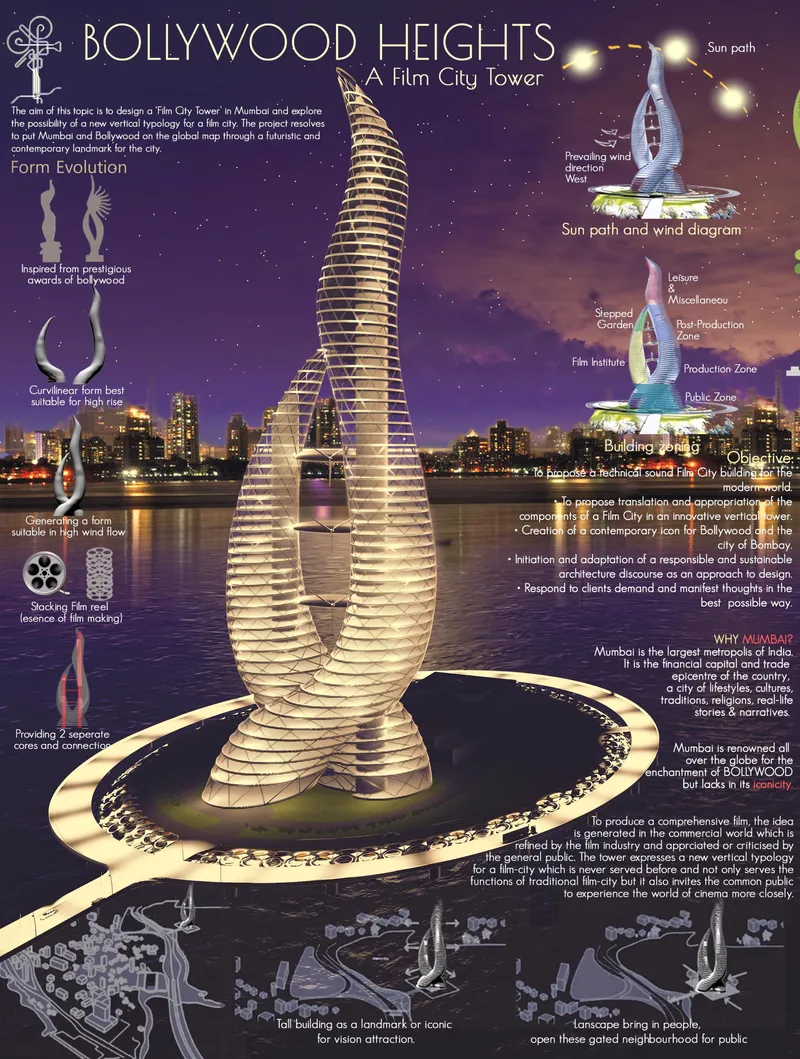
The dusk rendering shows the tower's twin lobes lit against dark water, with the city skyline held at a distance behind its circular island. The curvilinear, twisting form is meant to translate the motion of film reels and Bollywood dance into architecture. That reference could easily become decoration, but the designer ties it to performance, arguing that the sculpted geometry improves wind flow and structural behaviour while giving the tower a clear presence on the skyline.
The programme is where the idea earns its name. Sound stages, acting studios, chroma studios, animation and editing suites, screening theatres, a Bollywood museum, hotel spaces and public observatory decks are all stacked into the same building. The tower can therefore run around the clock, serving crews, visitors and tourists in one system. It is a bold move: it turns a closed industrial process into something the city can watch and visit.
An Island Built to Clean the Bay Around It
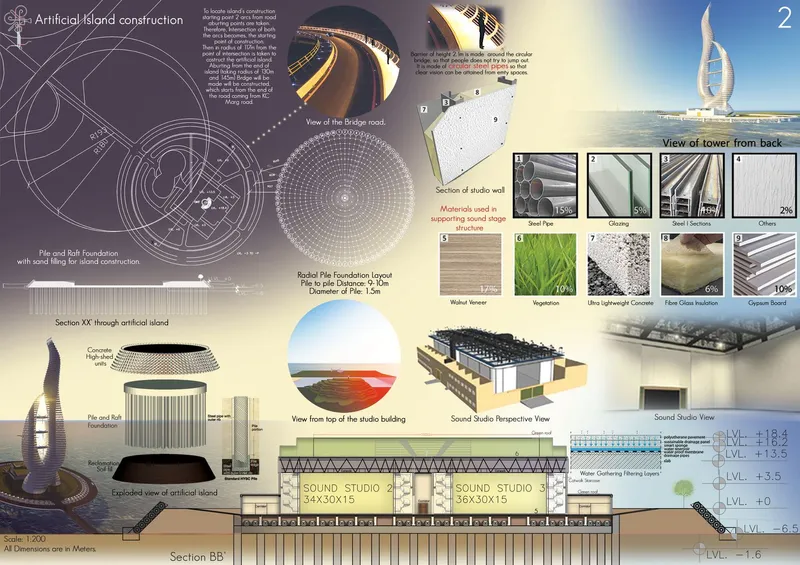
Mahim Bay suffers badly from untreated sewage and industrial runoff, and the thesis does not pretend otherwise. The artificial island is built on pile and raft foundations with controlled sand filling, and the first board lays out the pile grid next to a section through a sound studio and a set of material swatches. The island's outline comes from road intersections and access points on the mainland, and circular road networks with landscaped zones keep public, service and production movement apart. For a building full of trucks, sets and crowds, that separation is a practical decision, not a stylistic one.
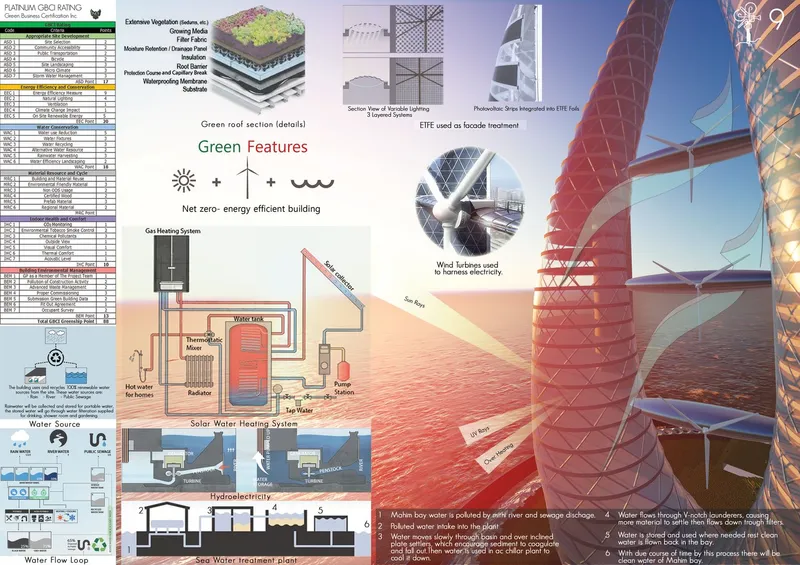
The stronger claim is that the island works as an environmental machine. Seawater passes through sedimentation basins, inclined plate settlers and filtration layers before it returns to the bay, slowly improving the water quality. The second board extends this thinking to the tower, with a green roof layer diagram, a solar water heating schematic and wind turbines set into the facade. The site is no longer treated as a backdrop. The project becomes a partial repair of its own setting, which is a more convincing justification for building in the bay than spectacle alone.
Twin Cores, a Diagrid Skin and the Bridges Between Them
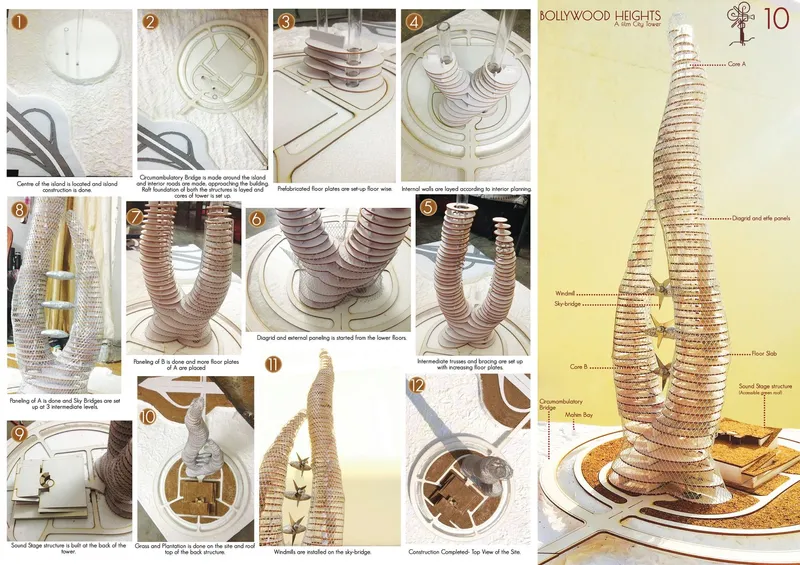
The twelve-step sequence in white card models is the clearest drawing in the set. It builds the scheme from the island base up to the finished twin-core tower and its sky-bridges, so the structural logic reads step by step. Two reinforced concrete cores carry services, vertical circulation and stability. Sky bridges link them at intermediate levels, adding lateral resistance and creating places where the two halves of the building meet.
Wrapped around this is a diagrid exoskeleton of high-tensile, weather-resistant steel tubes. The diagrid carries load efficiently and makes the free-form geometry possible, but its key role is programmatic: by moving structure to the perimeter, it frees large column-free interiors for sound stages and studios. This is where the thesis is most persuasive. The structure answers the specific demands of filmmaking instead of simply supporting an expressive shape.
Floor Plates That Shrink as the Programme Climbs
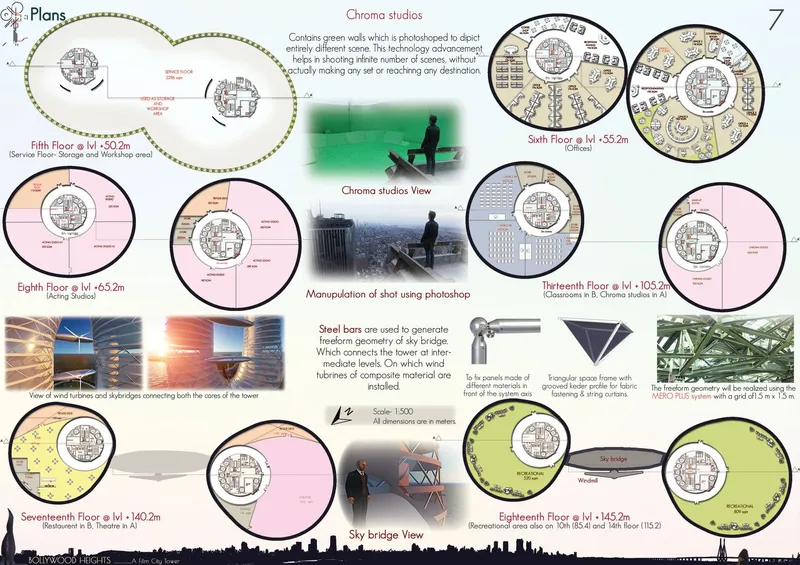
The plan drawings follow the tower's circular levels upward, from the service floor to the recreational floor, alongside reference photos of chroma studios and details of the steel sky-bridge connections. Lower down, the large plates take the heavy, space-hungry functions: studios and theatres that need depth and open spans. It is the industrial base of the tower, and placing it near the ground keeps the heaviest uses closest to the island's access routes.
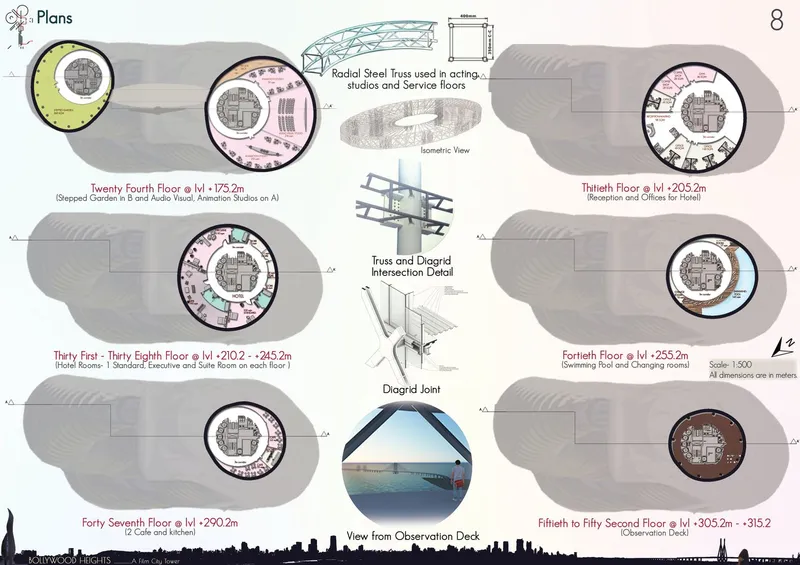
Higher up, the plates tighten to hold hotel rooms, offices, a pool and the observation deck, and the final board pairs these plans with an isometric of the steel truss and diagrid joint. The gradual taper does structural work and keeps the vertical profile clean. It also sets up a sensible social gradient: production at the base, hospitality and public views at the crown, so the tower moves from workplace to destination as you rise.
Why This Project Matters
Bollywood Heights tests whether a cultural industry with a huge land footprint can be condensed without losing its working logic. The thesis does not settle every question. Stacking sound stages under hotel floors would raise serious acoustic and vibration problems in a real building, and an artificial island always carries ecological costs of its own. Still, the project takes on the right problems: column-free production space, separated service routes and a structure shaped by the programme it holds.
Its most valuable move is the island itself. By making the foundation of a landmark tower also clean the water, Vaishaly Archi links cultural infrastructure to environmental repair, and that is a model worth pushing further in coastal cities under pressure. For an undergraduate thesis, the integration of structure, programme and site is impressive. The project reads less like a stunt and more like an early argument for how Mumbai might build when it runs out of ground.
View the Full Project
About the Designers
Designer: Vaishaly Archi
Enter a Design Competition on uni.xyz
uni.xyz runs architecture and design competitions year-round that reward proposals with spatial conviction and real site intelligence.
Project credits: Bollywood Heights...A Film City Tower by Vaishaly Archi.


Popular Articles
Popular articles from the community


David Ortega Stacks a Two-Story Mexico City Penthouse Around a Steel Stair and a Pergola-Shaded Roof Terrace
In Colonia Roma, a 300 m² penthouse uses oak joinery, a planted steel stair and a slatted roof pergola to make a new-build apartment feel like a house.

Cube Design Draws an Ecological Corridor Between Two Shenzhen Hills with the Nankai Building
Beside Shenzhen's container docks, the Nankai Building pairs stacked balconies with a climbing green screen to connect two hillsides across its height.


Manzana Morphosis: Stretching Barcelona's Grid into a Living Landscape for 2050
A radical reworking of the Eixample manzana turns density into a tool for generous public space, vertical ecology, and environmental performance.

Singing Woman: An Opera House That Performs Before the Curtain Rises
Ovidiu Cristian Pavel's conceptual opera house translates Estonia's choral identity into a sculpted waterfront landmark facing the Baltic Sea.

Similar Reads
You might also enjoy these articles
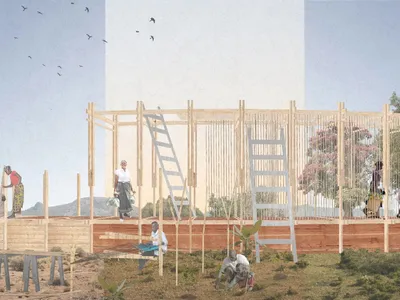
Healing Façade: A Modular Chapel System That Restores Ethiopia's Sacred Forests
Winner of the Eco-Chapel competition, this circular timber façade collects water from air to rebuild soil and reforest degraded Ethiopian landscapes.
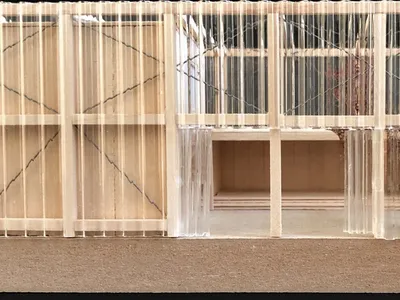
Kaffeebühnen: Where Coffee Shop Architecture Becomes a Civic Stage in Vienna
A linear sequence of timber boxes, transparent shells, and open yards turns the Viennese café tradition into a public performance space.
Eco Chapel: A Modular Forest Pavilion That Grows Like the Landscape It Protects
Hexagonal timber modules weave through existing trees, turning a chapel into a living system for prayer, education, and reforestation.


Urban Forest: A Vertical Ecosystem for 5,000 Workers in Singapore's Changi Business Park
Radially stacked pods and layered green decks turn a 7-acre plot into 47 acres of ecological workspace projected for 2040.

Explore Mumbai Competitions
Discover active competitions in this discipline

Challenge to reimagine the Iron Throne

Photograph architecture without architects

Illustrate the lost glory of Angkor Wat - Render Challenge

Design challenge to reuse E-waste
Comments (0)
Please login or sign up to add comments
No comments yet. Be the first to comment!